
Skip to content
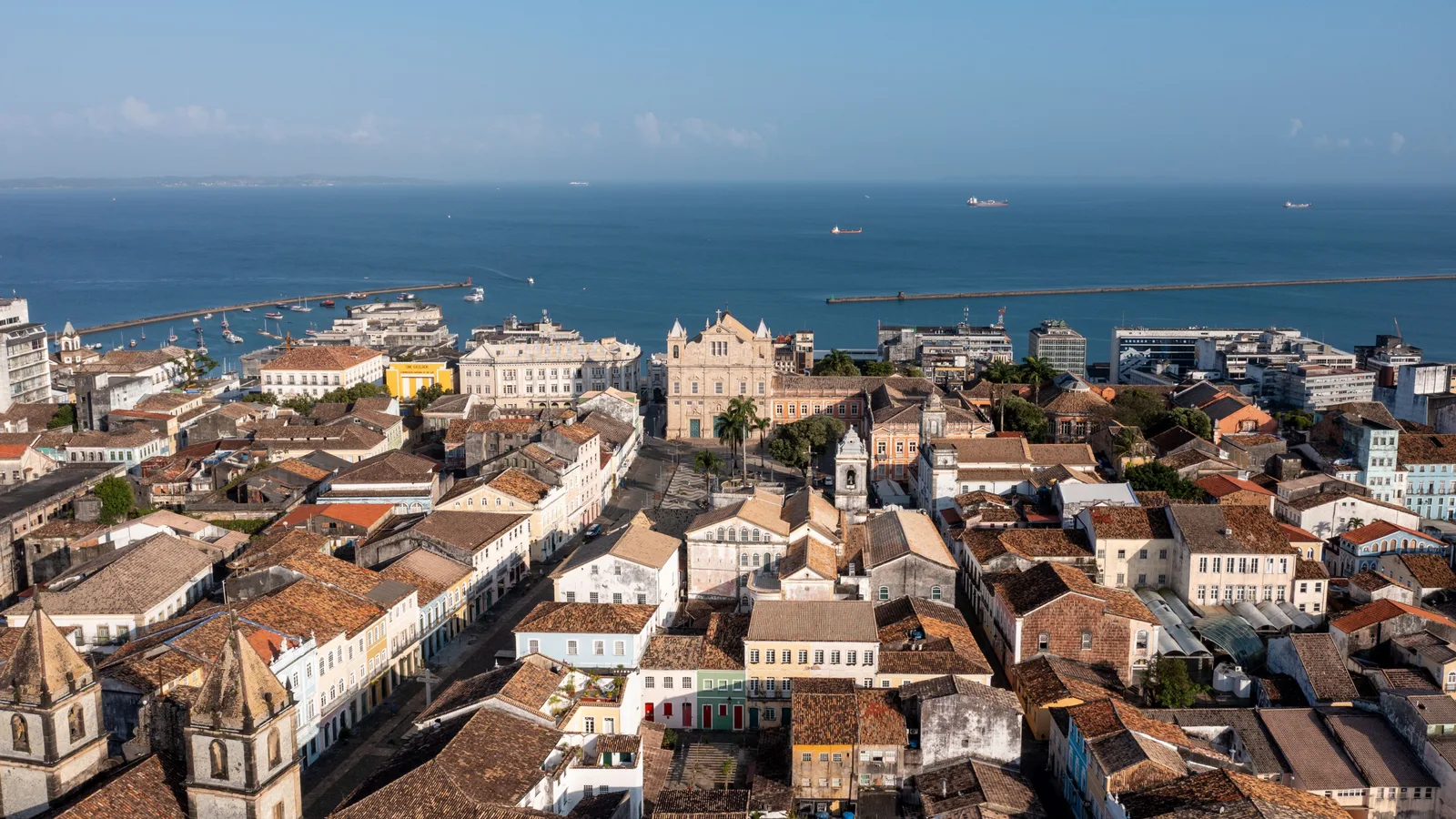
Salvador’s historic center from the air: red-tiled colonial rooftops and church towers packed along the clifftop, the pale facade of the Catedral Basílica on the Terreiro de Jesus in the middle of them, and the Bay of All Saints with the port and anchored ships stretching out behind

Bahia

Salvador

Brazil’s first capital, and its African heart.

Last checked September 2026

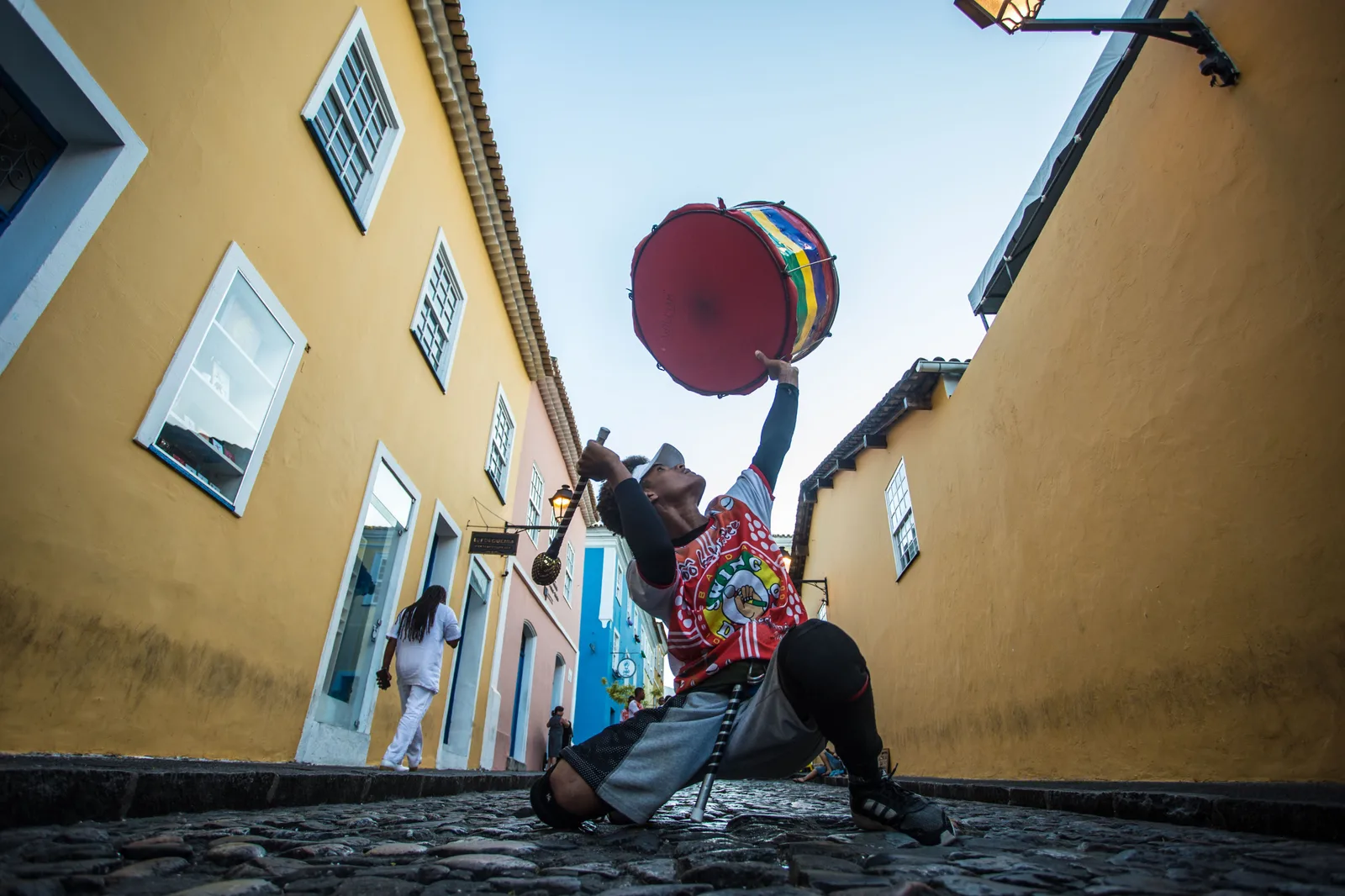
  • A drummer leaping in mid-air with his drum in a narrow Pelourinho street of yellow colonial houses
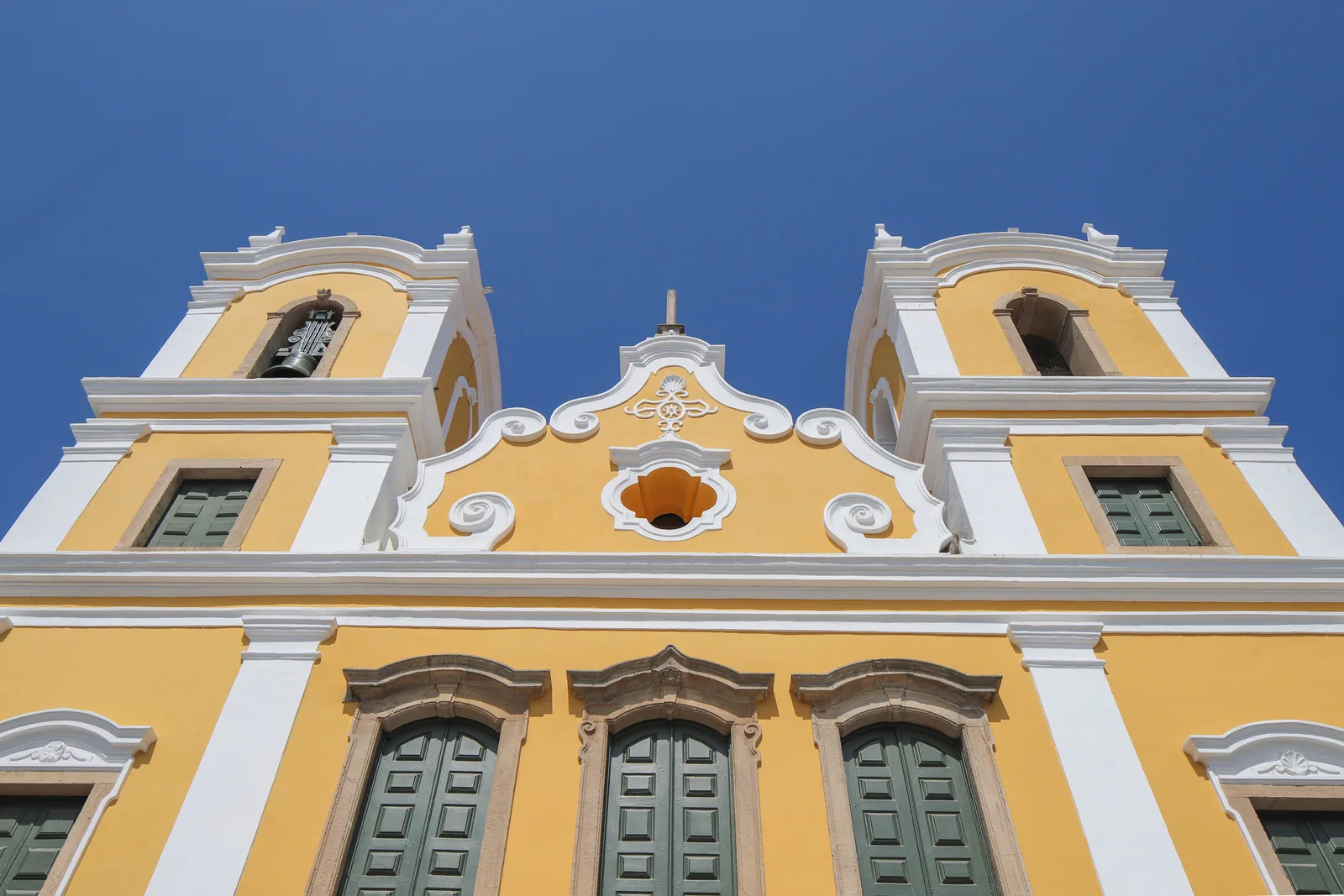
  • The yellow and white baroque façade of the Igreja da Saúde e Glória against a deep blue sky
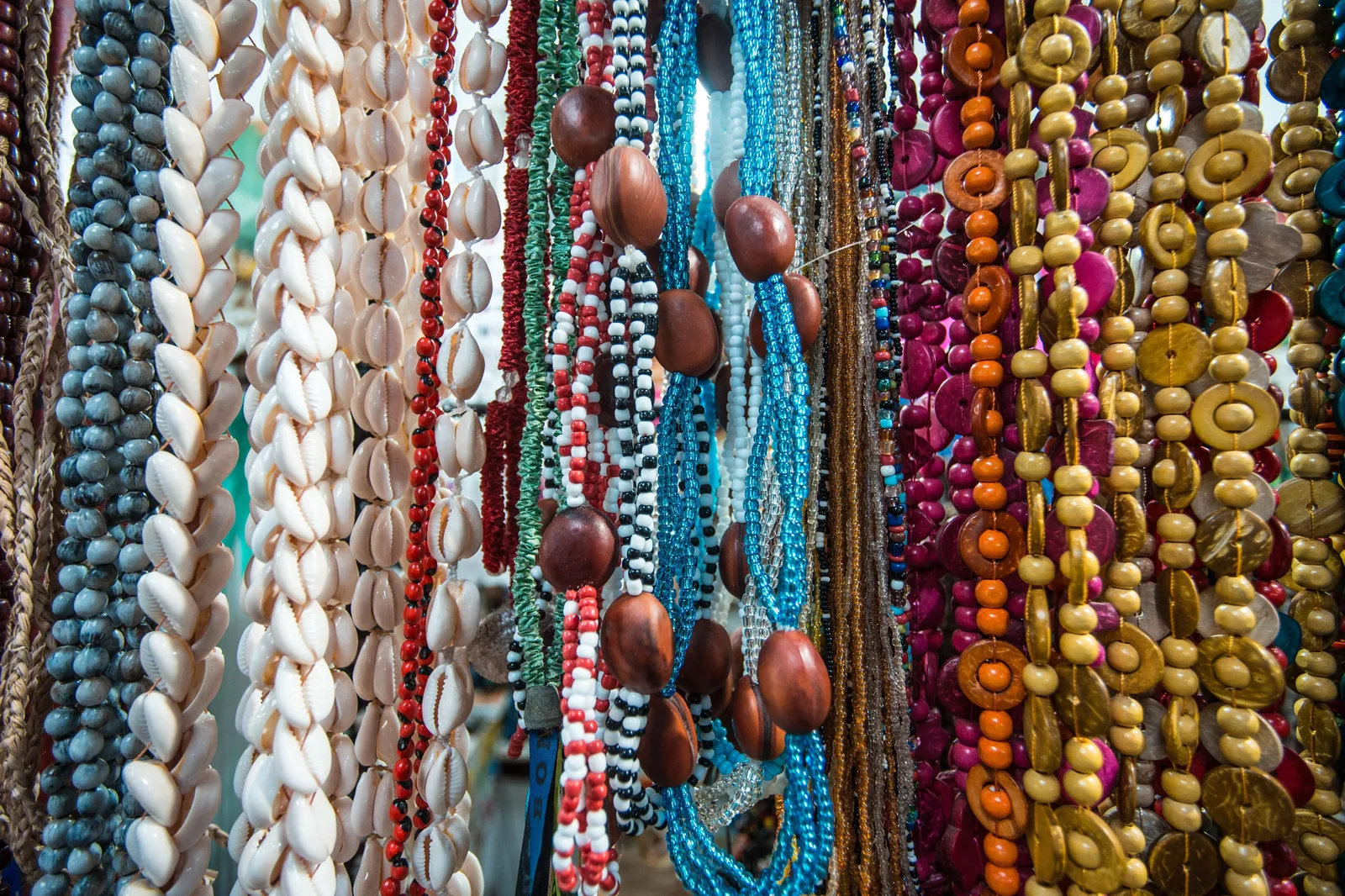
  • Strands of colorful beaded necklaces hanging in rows at a stall in the Mercado Modelo
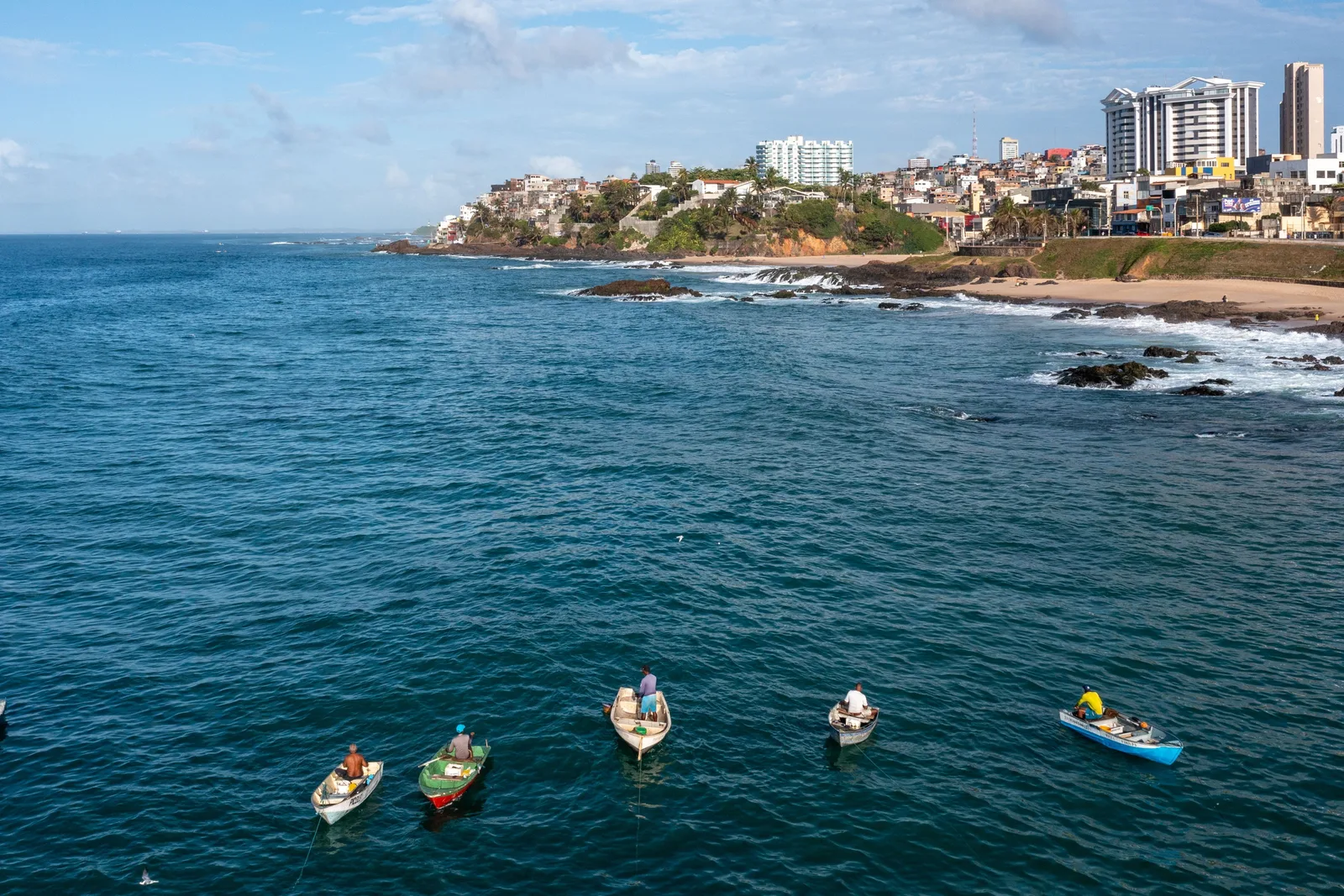
  • Fishing canoes on deep blue water off Rio Vermelho, seen from above, the neighborhood’s rocky shore and houses behind
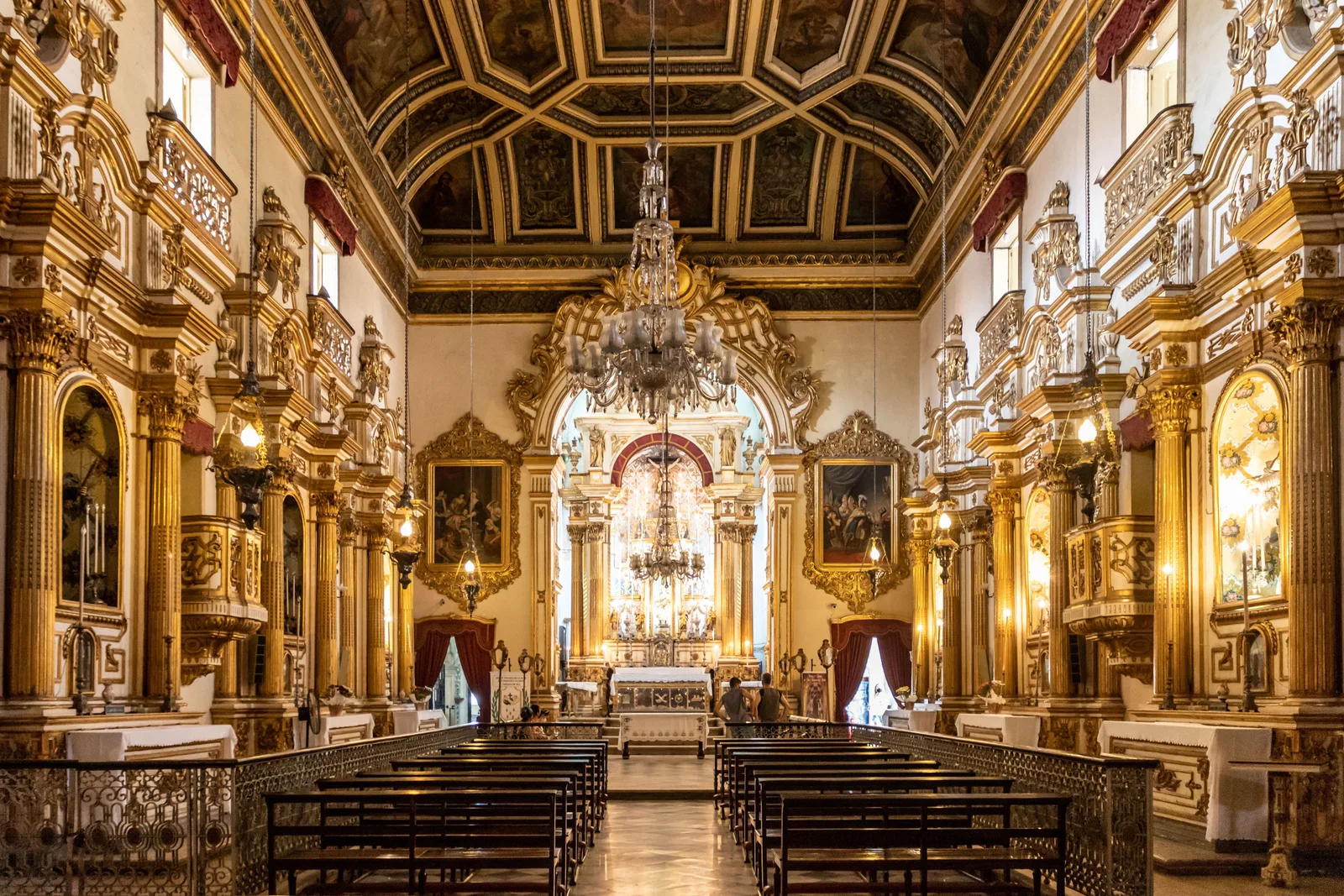
  • The gilded nave of the Igreja da Ordem Terceira de São Francisco, carved gold on every wall and chandeliers down the middle
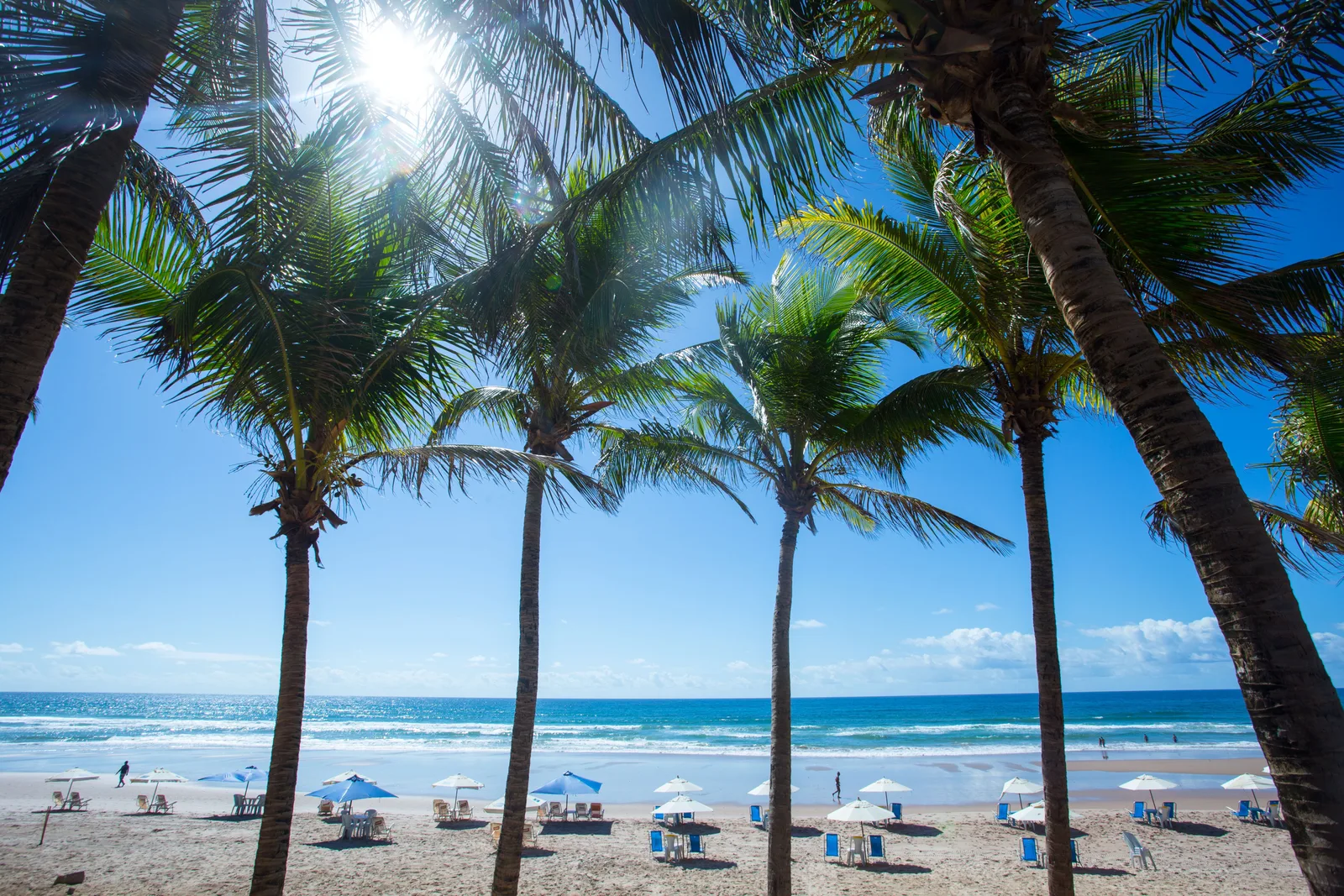
  • Tall coconut palms over Praia do Flamengo, umbrellas and swimmers on the sand below
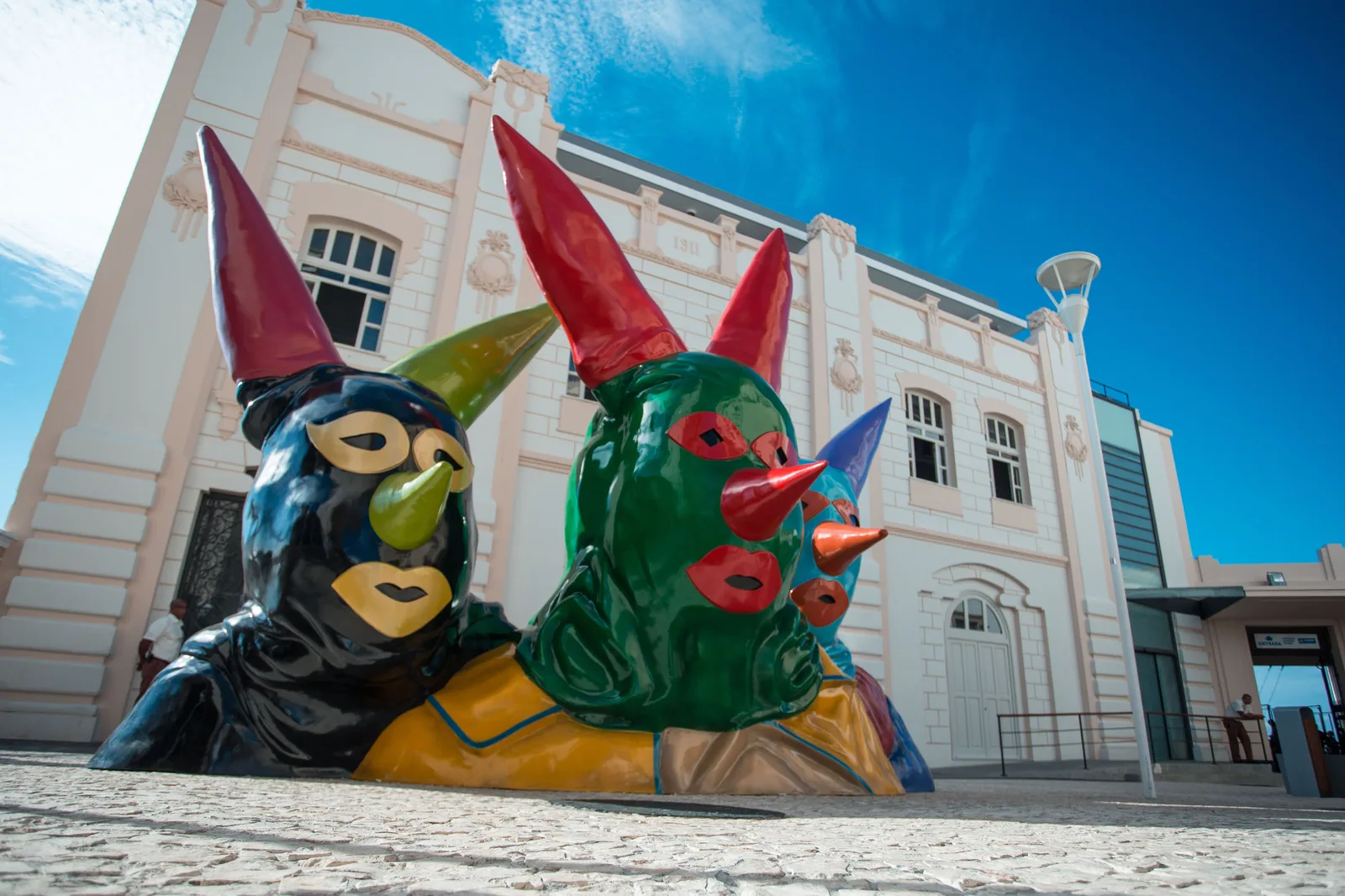
  • Giant carnival masks with horns and bright paint set out in front of a white building in the Pelourinho
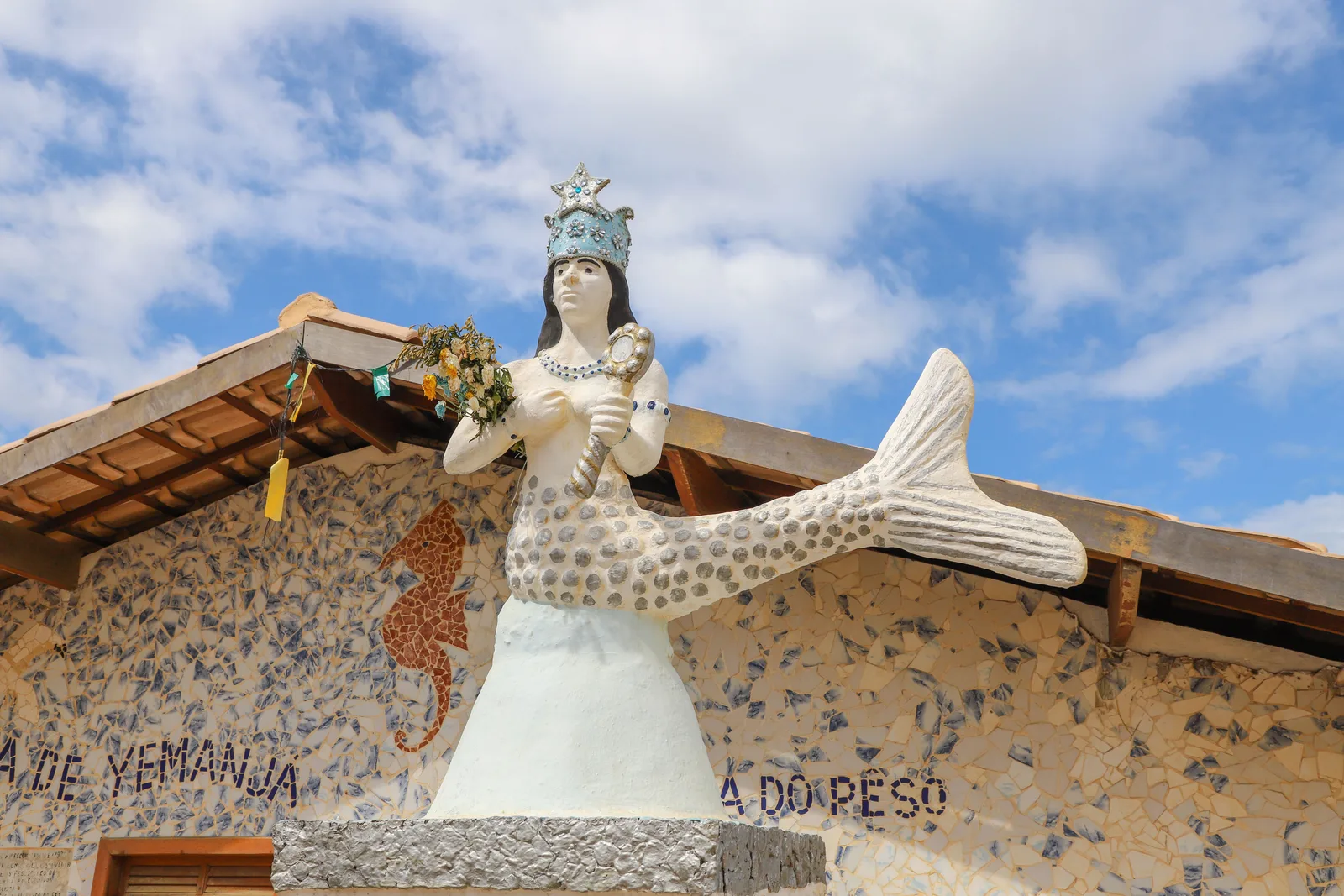
  • A white mermaid sculpture of Yemanjá, crowned and holding a mirror, on the roof of her house in Rio Vermelho
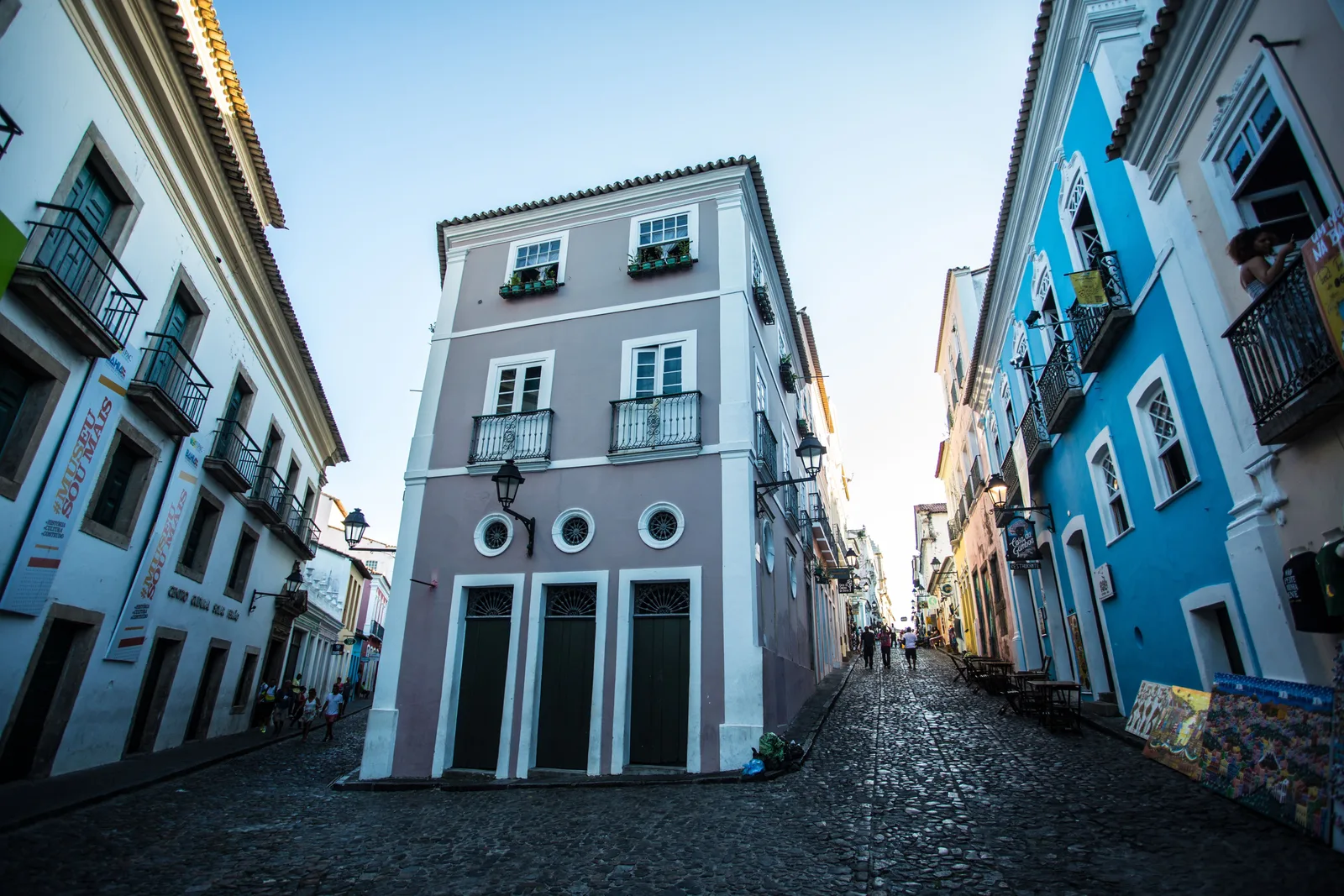
  • A pale blue colonial building at the end of a cobbled Pelourinho street, painted houses on both sides
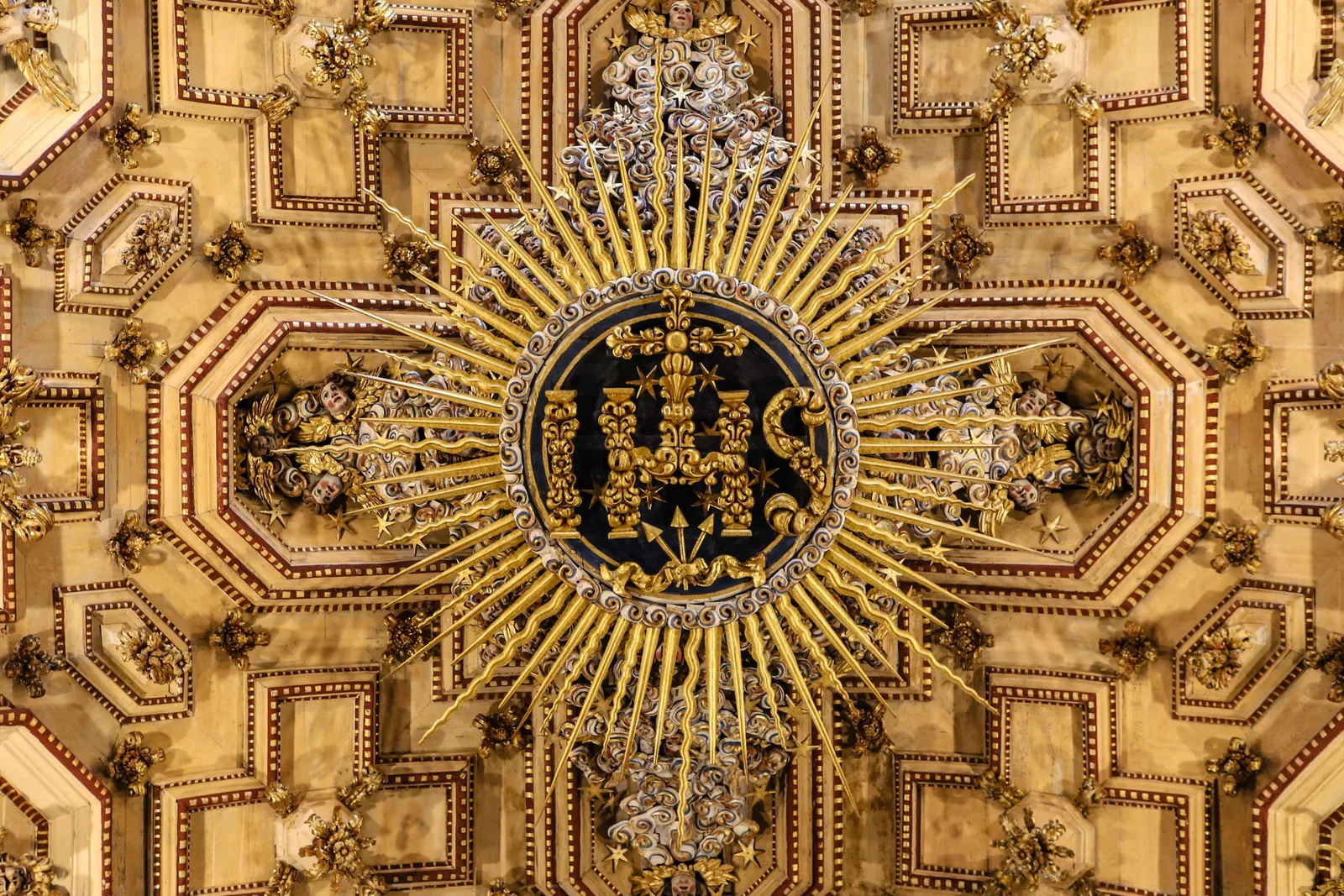
  • Looking straight up at the gilded, coffered ceiling of Salvador’s Catedral Basílica
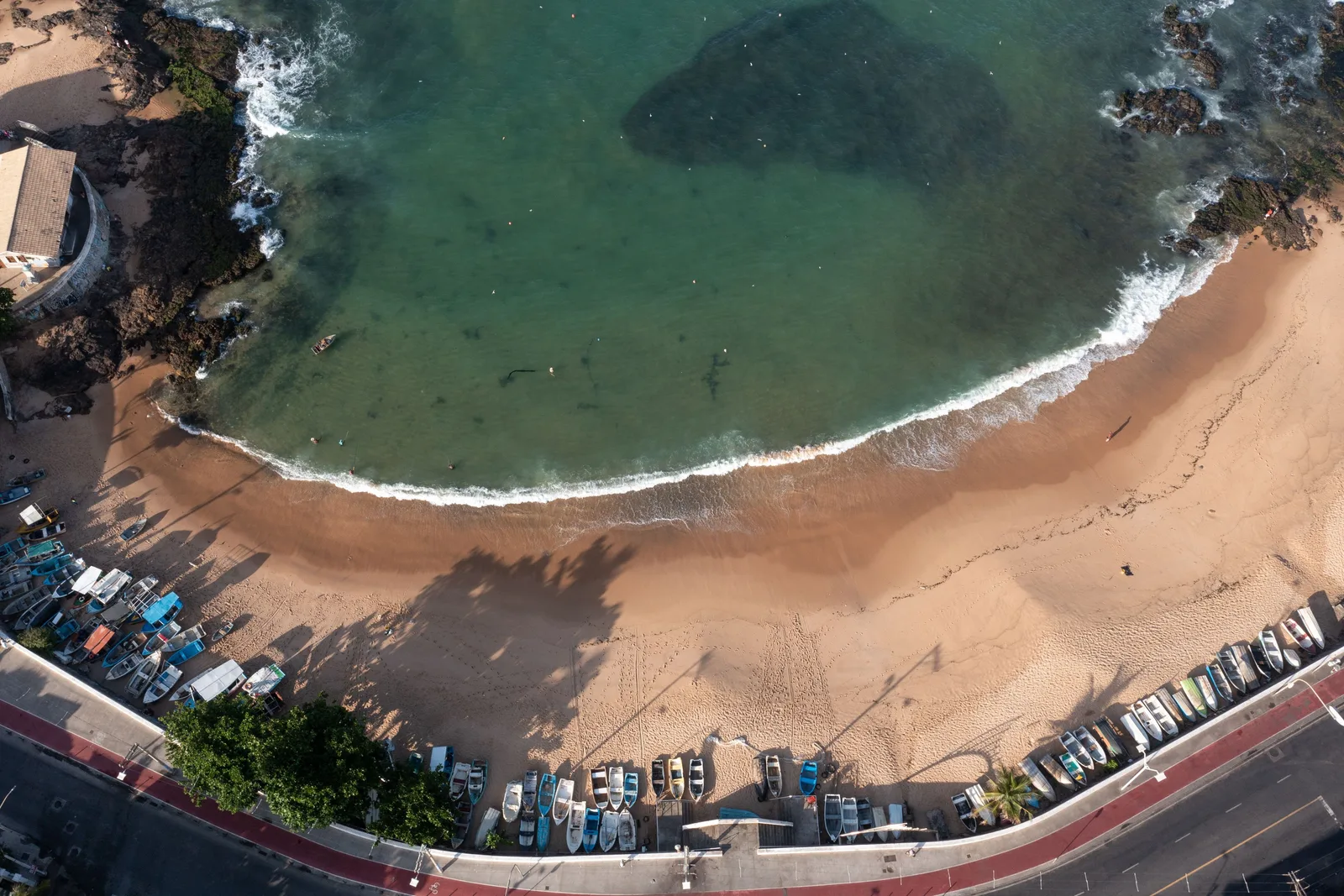
  • A small crescent beach in Rio Vermelho from above, green water, boats pulled up along the seawall

Orientation

The city in one screen.

Everything logistical, before the pretty pictures start.

General Info

What makes Salvador, Salvador

Salvador was Brazil’s first capital, founded in 1549 and the seat of colonial government for the next 214 years. It was also the busiest slave port in the Americas, and those two facts are the same fact: the sugar wealth that built the churches came from the labor of people landed at the bottom of this cliff. Nothing about the city makes sense without that, and nothing about the city hides it. Of Salvador’s 2.4 million people, more than eight in ten identified as Black or mixed-race in the 2022 census — the highest proportion of any Brazilian capital.

What that produced is a city whose culture is African before it is European, and confidently so. Candomblé is practiced openly. Capoeira was invented here. The drum is the lead instrument. The national dish of Bahia is a black-eyed pea fritter fried in palm oil and sold on street corners by women in white, and the recipe came across the Atlantic. Travelers who arrive expecting a smaller Rio find something else entirely, and the ones who enjoy Salvador most are the ones who came for that rather than for the beach.

Geographically it is two cities stacked on top of each other. The Cidade Alta sits on an escarpment about 85 meters up, and holds the Pelourinho — the largest surviving colonial quarter in the Americas, a UNESCO World Heritage Site since 1985. The Cidade Baixa runs along the water below, with the port, the market and the ferry terminals. An 1873 public elevator connects them in thirty seconds. Everything else — the ocean beaches, the nightlife, the airport — strings out east and north along a coastline that runs for fifty kilometers inside the city limits.

Where It Is

Northeast Brazil, on the Bay of All Saints

Salvador sits on a peninsula at the mouth of the Baía de Todos os Santos, the largest bay in Brazil, about 1,600 km northeast of Rio de Janeiro. It is roughly two hours away by air from Rio and São Paulo, and it is the gateway to the whole Bahian coast.

Salvador Salvador

12.97° S, 38.51° W

See the Northeast on the interactive map

Cost

What a day here actually costs

Salvador is noticeably cheaper than Rio or São Paulo, and the gap shows up most in restaurants and rooms. The one thing that upends a Salvador budget is Carnival: for six days in February the accommodation market becomes a different market, with prices several times the rest of the year and minimum stays attached.

Estimated daily budget, regular season

Budget

$55 / day

A hostel bed or a simple pousada in Barra or Santo Antônio, acarajé and market lunches, the metro and buses, and the beaches, churches and viewpoints that cost nothing or almost nothing.

Mid-range

$110 / day

A mid-range double split two ways in Barra or Rio Vermelho, restaurant dinners, ride apps everywhere, and a museum, a show or a boat most days.

Comfortable

$230 / day

A well-reviewed hotel on the water, dinners at the good moqueca places, private transfers and a guide for the historic center, and a schooner day booked without thinking about it.

Estimates, per person per day, at ordinary prices once you are in the city — flights not included. Carnival week is not ordinary prices and is handled separately below.

What things cost, outside Carnival

  • Mid-range double room, Barra or Rio Vermelho $100 R$510
  • Hostel bed, same neighborhoods $15 R$75
  • A room during Carnival week $300 R$1,530
  • Metro, single ride $0.80 R$4.10
  • City bus or BRT, single ride $1.15 R$5.90
  • Elevador Lacerda, one way $0.20 R$1
  • Uber, airport to Barra $12 R$60
  • Acarajé from a street baiana $3 R$15
  • Lunch for two, comida baiana $24 R$120
  • Moqueca for two at a well-known restaurant $55 R$280
  • Chopp (draft beer), 300 ml $1.80 R$9
  • Catedral Basílica or the Museu Afro-Brasileiro $2 R$10
  • Balé Folclórico da Bahia ticket $18 R$90
  • Catamaran to Morro de São Paulo, each way $31 R$160

Carnival is a separate market. Rooms run three to four times the rest of the year, minimum stays of five to seven nights are normal, and the well-placed places along the Barra–Ondina circuit sell out months out. Abadás — the bloco shirts that get you inside the rope behind a trio — and camarote tickets are bought separately again.

Restaurants add a 10 percent service charge to the bill. It is customary rather than compulsory, and it is almost always already on the total rather than expected on top of it.

Cards work nearly everywhere and contactless is normal — bring one with no foreign-transaction fee. Withdraw inside a bank branch, a shopping mall or the airport rather than at a street ATM, and skip the exchange booths.

The one place cash still matters is the street: acarajé stands, the Balé Folclórico box office, market stalls and the smaller kiosks. Carry small notes and not many of them.

Checked September 2026 and converted at R$5.10 to the dollar. Estimates, not quotes — the shape of a budget rather than a price you can hold anyone to.

Safety

Real risks, and real precautions

5 /10

Our rating, and the lowest on this site. Not a reason to skip Salvador — a reason to be deliberate about where you are and what time it is.

Salvador records the highest homicide rate of any Brazilian state capital, several times Florianópolis’s. Almost none of that violence happens where visitors go: it is concentrated in the peripheral neighborhoods on the far side of the city, driven by disputes between drug factions, and it is not aimed at tourists. What is aimed at tourists is robbery, and that is common enough here that the precautions below are not decoration. Take them and Salvador is one of the great cities of the Americas. Ignore them and you will lose a phone, and possibly a bad ten minutes with it.

  • The historic center is a daytime place with one exception. The Pelourinho is busy and patrolled through the day, and it is also busy and patrolled on nights when there is programming in the squares — the summer Olodum rehearsals, a concert, Carnival. On an ordinary Wednesday at 10:00pm it empties out, and its edges — the lanes running down toward Baixa dos Sapateiros, the dark end of the Ladeira do Carmo — are not somewhere to be wandering. Arrive by car and leave by car.
  • The Cidade Baixa closes when the shops do. Comércio and the streets behind the Mercado Modelo work perfectly well in business hours and empty by early evening. Do not be walking there after dark, and do not use the low station of the Elevador late.
  • Phones are the routine target. Snatching from the hand — on foot, and from moving motorbikes — is the crime that actually happens to visitors here. Keep it in your pocket on the street and step into a shop, a café or a restaurant when you need it. Busy daytime seafront in Barra and Rio Vermelho is the reasonable exception.
  • Wear nothing worth taking. No watch, no gold chain, no camera around the neck, no visible bag. Chains are snatched more often than anything except phones.
  • The beach is for the beach. Barra and Porto da Barra are crowded and policed through the day, and none of Salvador’s beaches is a place to be after sunset. Take a little cash and nothing you would mind losing, and never leave a bag on the sand while you swim.
  • Use Uber or 99 between neighborhoods and always at night. It is cheap by US standards, it is what residents do, and it removes the whole question. Order it from inside a bar or a lobby rather than standing on the sidewalk with the phone out.
  • Carnival is a crowd risk rather than a violence risk. Pickpocketing in a packed circuit is near-universal; go with people, carry a card and a phone in a zipped pocket and nothing else, agree a meeting point before you lose each other, and expect to.
  • If you are robbed, hand it over without arguing. Nothing you are carrying is worth the alternative, and compliance is what thieves here expect.

Getting There

One airport, and no nonstop from the US

Salvador Bahia Airport (SSA) sits about 28 km northeast of the center, at the far end of the beach strip. It is a modern, comfortable airport and it is well connected to the rest of Brazil — what it does not have is a direct flight from the United States.

  • There is no nonstop service from the US. The shortest routing is through Panama City: Copa restarted Salvador–Panamá in January 2026, four flights a week, which connects to most of North America through its hub.
  • The alternative is a domestic connection. LATAM, Gol and Azul all fly Salvador–São Paulo (GRU) and Salvador–Rio (GIG) many times a day; the leg is about two hours, and it is how the overwhelming majority of American visitors arrive.
  • From Europe, TAP flies daily from Lisbon, Air Europa three times a week from Madrid and Air France three times a week from Paris — worth knowing if you are combining Brazil with a European stop.
  • The metro’s Line 2 runs from a station beside the airport, with a free shuttle to the terminal, into Lapa in the center in about 35 minutes for R$4.10. It is a genuinely good option in daylight with light luggage, and a poor one at night.
  • Otherwise it is 30 to 50 minutes by road to Barra or the historic center. An Uber runs around R$60 and a metered taxi R$80 to R$120.

Getting Around

Ride apps, plus a metro that solves one problem

Salvador is long, hilly and spread out, and the parts visitors want are not adjacent. Ride apps do almost all the work. A rental car is worth having only if you are heading up the coast.

  • Uber and 99 are everywhere, cheap, and the default way to move between the historic center, Barra, Rio Vermelho and the northern beaches. Most rides inside the city are R$15 to R$40.
  • The metro is clean and fast and goes to exactly two places a visitor cares about: the airport and Lapa, the interchange in the center. It does not serve Barra, Rio Vermelho or the beaches, so treat it as an airport link rather than a network.
  • The Elevador Lacerda drops you from the historic center to the Mercado Modelo and the ferry terminals in about thirty seconds for R$1. It reopened in February 2025 after a ten-month, R$14 million overhaul, and runs from early morning until around 9:30pm.
  • Buses and the BRT cover everything for R$5.90 a ride, but the routes are hard to read from outside and the buses are where pickpocketing concentrates. Most visitors skip them.
  • Walking works within a neighborhood and not between them. The historic center is walkable end to end, so is the Barra seafront, so is Rio Vermelho — the gaps in between are not.
  • Rent a car only for the coast. The Linha Verde north toward Praia do Forte is easy driving; the city itself is not, and parking in Barra and the Pelourinho is genuinely painful.

The big four

The landmarks worth building days around.

Not a top-ten list. These are the four places that, if you left Salvador without seeing them, you would not really have seen Salvador.

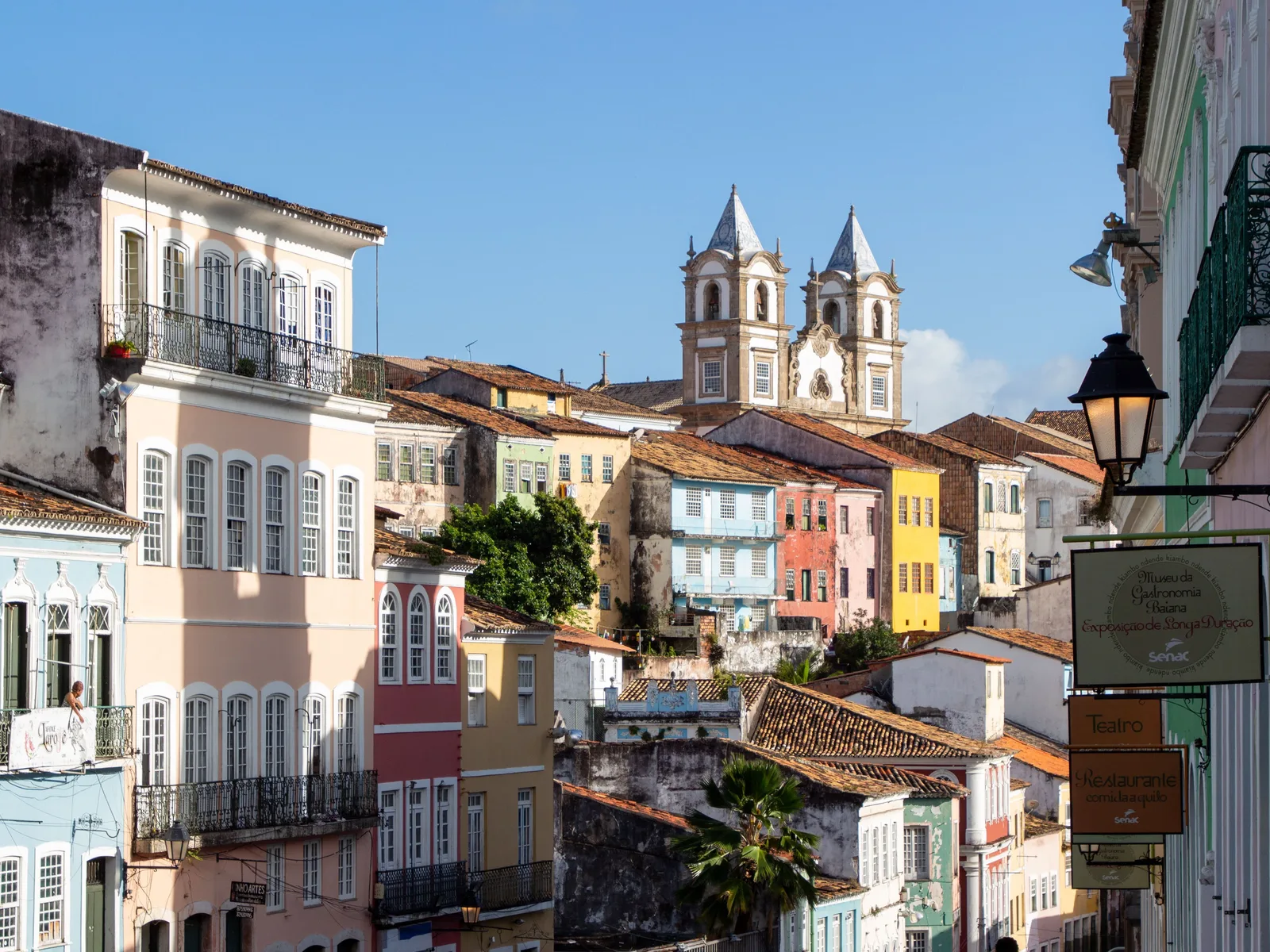
The Largo do Pelourinho from the top of the slope: rows of tall pink, blue and yellow colonial townhouses with iron balconies falling away downhill, and the twin white towers of the Rosário dos Pretos church rising over the rooftops at the bottom 01

The largest colonial quarter in the Americas

Pelourinho & the Centro Histórico

Listed
UNESCO World Heritage, 1985
Built
17th to early 20th century
Best at
Morning, and music nights

Thirty-odd blocks of Portuguese colonial architecture on the clifftop, painted in the blues, ochres and pinks that have become the city’s shorthand, and steep enough that the cobbles have handrails. The name is not decorative: the pelourinho was the whipping post, and this square is where enslaved people were punished in public. UNESCO listed the quarter in 1985 as the largest surviving ensemble of its kind in the Americas, and the restoration that followed brought back the facades of a district that had been left to fall down for most of the twentieth century.

It works best as a morning and a music night rather than a single visit. In daylight it is museums, churches, craft workshops and the Terreiro de Jesus square with its clutch of baroque interiors; after dark it belongs to whatever is programmed in the squares, and there is usually something. One caveat worth knowing before you go: the Igreja e Convento de São Francisco — the gold-drowned Baroque interior that appears on every list of Salvador’s must-sees — has been closed since a ceiling collapse in February 2025, and the restoration is not expected to finish before 2029.
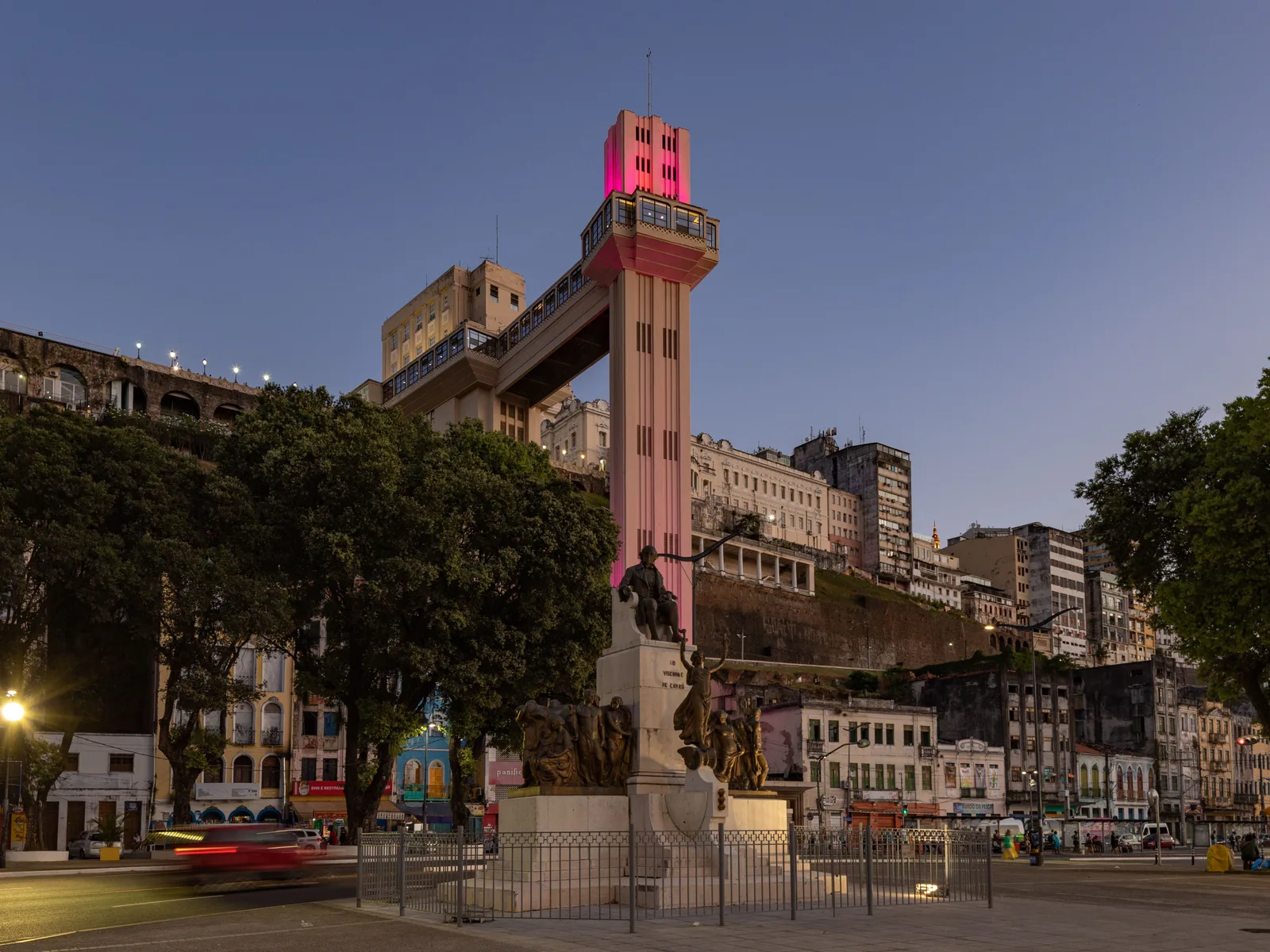
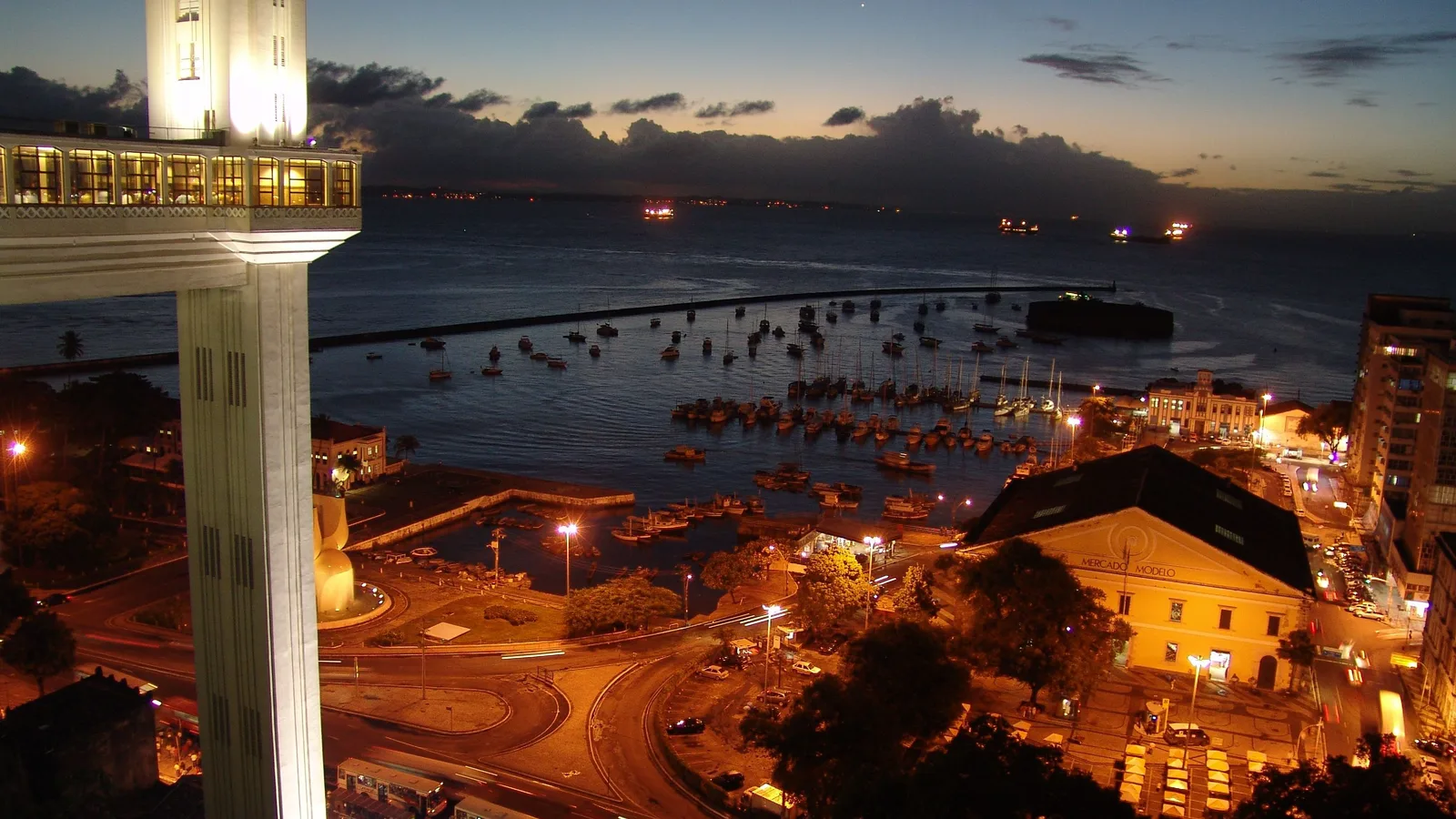
The Elevador Lacerda at dusk from the Cidade Baixa below, its shafts rising the full height of the cliff to the walkway and the upper city, the tower floodlit pink for a public health campaign and traffic passing the monument at its foot 02

The 30-second link between two cities

Elevador Lacerda & the Cidade Baixa

Opened
1873
Rise
72 m, four cabins
Fare
R$1, about 30 seconds

Salvador is built on an escarpment, and for three hundred years getting between the government city on top and the working port below meant a rope hoist or a long climb. The Elevador Lacerda, opened in 1873 and rebuilt into its art-deco tower in 1930, solved that: four cabins running 72 meters up the cliff face in about half a minute, for a single real. It is a piece of everyday public transport that happens to be the city’s most photographed structure, and the view from the upper platform — the whole Bay of All Saints, the ferries, the far shore — is the reason to ride it even if you have no reason to go down.

What is at the bottom is the Cidade Baixa: the Mercado Modelo in the old customs house, the ferry terminals, and the Comércio district of nineteenth-century commercial buildings that empty out at 6:00pm. Ride down for the market, the bay-level view back up at the cliff, and the boats. Do not linger past dusk — this is the clearest example in Salvador of an area that is entirely fine by day and not somewhere to be at night.

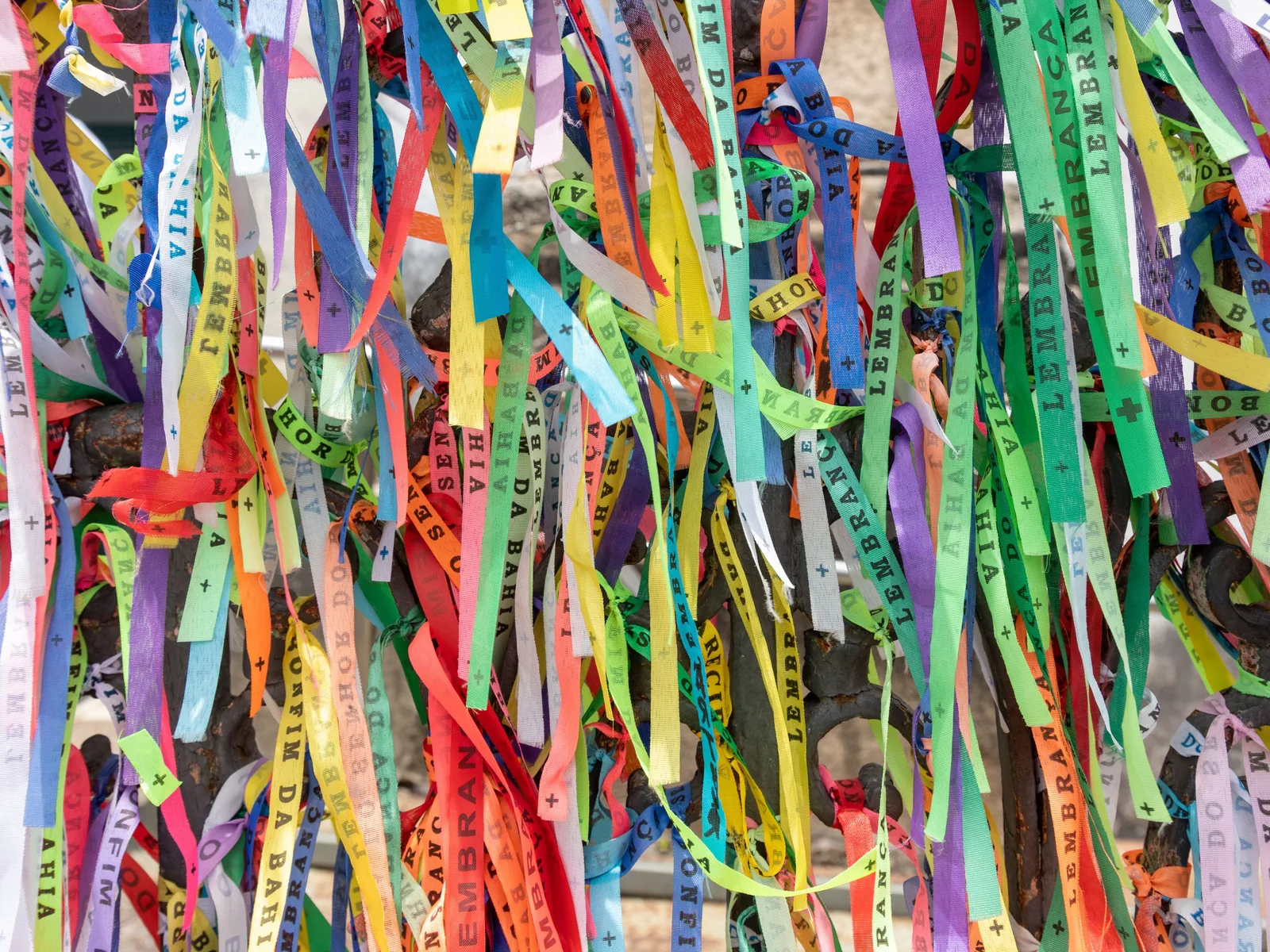
Close on the ironwork outside the Igreja do Senhor do Bonfim, packed with hundreds of knotted cotton ribbons in every color, each one printed “Lembrança do Senhor do Bonfim da Bahia” 03

Two faiths, one church, and a million ribbons

Igreja do Senhor do Bonfim

Built
1746–1754
Where
Itapagipe peninsula, Cidade Baixa
Big day
Second Thursday of January

A white rococo church on a hill above the bay, and the most visited religious site in Bahia. Its railings are covered in tens of thousands of colored cotton ribbons — the fitas do Bonfim — tied on with three knots for three wishes and worn until they fall off on their own. They are the single most reproduced souvenir in Brazil, and the reason the church is on this list rather than the dozens of grander ones in the historic center.

Bonfim is also the clearest thing in Salvador to point at when explaining religious syncretism. In Catholic terms the church honors Christ; in Candomblé, the same figure is Oxalá, the oldest and most senior of the orixás, whose color is white. Both congregations come. The Lavagem do Bonfim on the second Thursday of January makes the overlap explicit: a procession of eight kilometers from the Conceição da Praia church down in the Cidade Baixa, led by baianas in white who wash the church steps with scented water while several hundred thousand people follow.

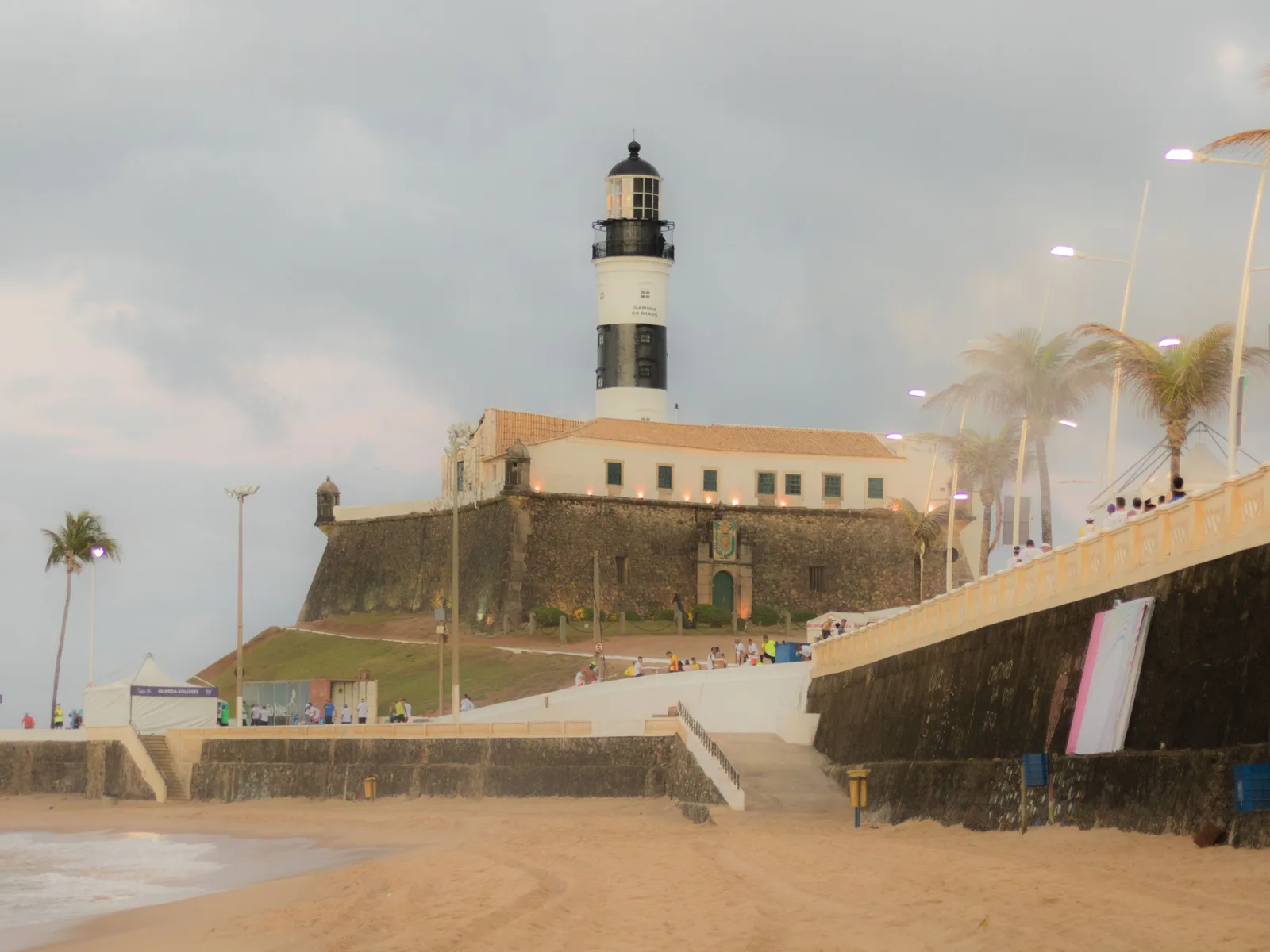
The black-and-white striped Farol da Barra lighthouse standing above the stone walls of its fort at the point, seen from the sand on an overcast evening with palms and the sea wall in the foreground 04

Where the bay meets the Atlantic

Farol da Barra & Porto da Barra

Fort
Santo Antônio da Barra, rebuilt 1696
Lighthouse
Current tower, 1839
Best at
The last hour of daylight

The black-and-white striped lighthouse on the point at Barra is the other image of Salvador, and it stands on the fort that guarded the mouth of the bay from the seventeenth century. A light has burned here since 1698, which makes it one of the oldest light stations in the Americas; the tower you see went up in 1839, shipped in from England. Inside the fort is the Museu Náutico da Bahia, a small, genuinely good collection of navigation instruments and material recovered from wrecks in the bay.

Immediately around the corner is Porto da Barra, and it is a geographic oddity worth understanding: it faces west, into the bay, which on Brazil’s Atlantic coast almost nothing does. The water is flat, shallow and warm, there is no surf to speak of, and the sun sets over the sea rather than behind the city. That combination is why this short crescent of sand is the most crowded beach in Salvador every clear evening, and why the applause at sunset is a local habit rather than a tourist one.

What to actually do

One city, six ways to spend a day.

Pick a category, then scroll sideways through it. Every one of these is a realistic half-day or evening, not a bucket-list fantasy.

Historic Center

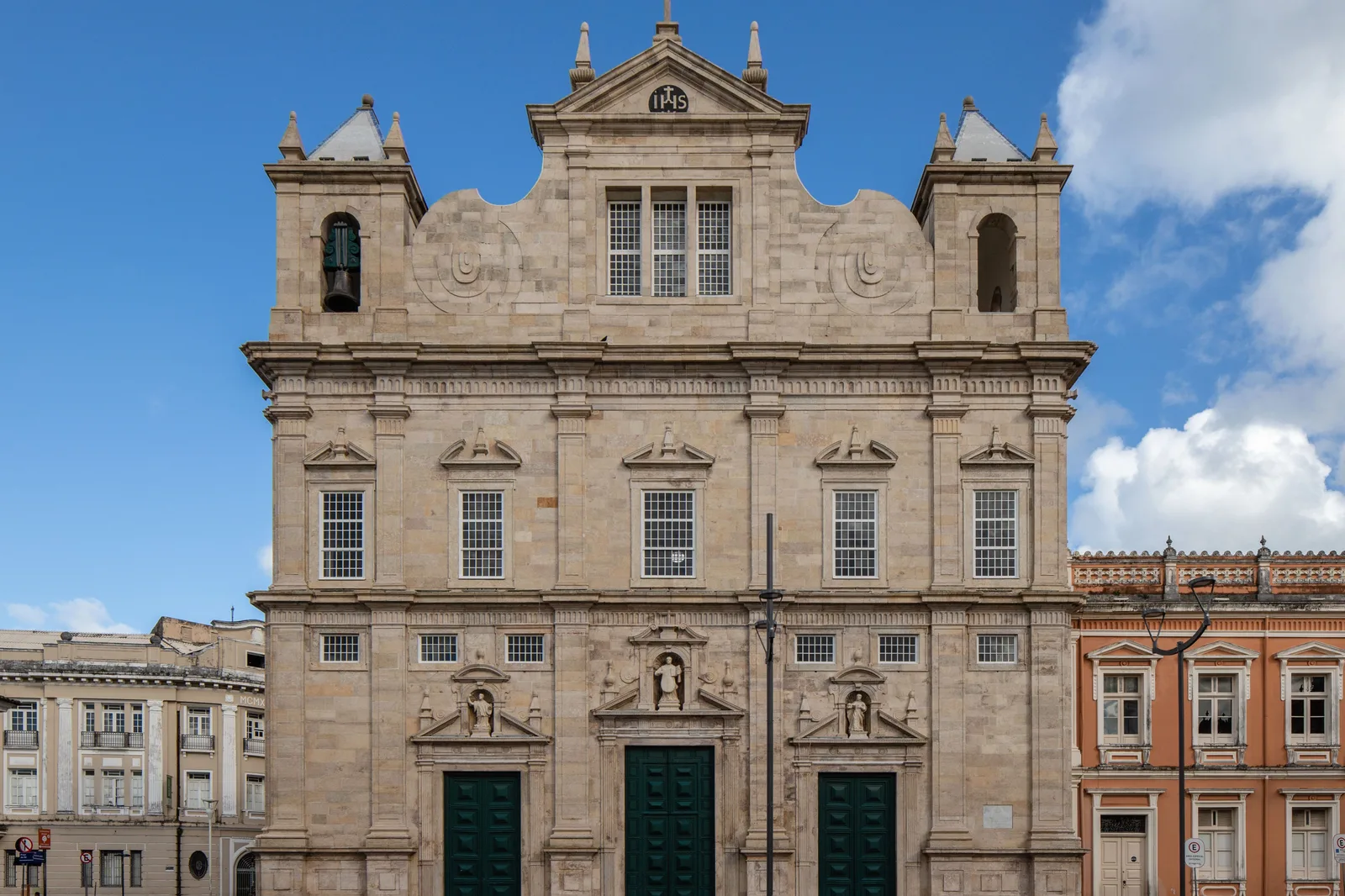
  • The pale limestone facade of the Catedral Basílica filling the frame from across the Terreiro de Jesus, three green doors below tiers of pilasters and grilled windows, with the colonial houses of the square either side of it

    Pelourinho · half day

    Church-hopping on the Terreiro de Jesus

    Four churches face or nearly face one square, and each charges a few reais to go in. The Catedral Basílica is the big one — a 1650s Jesuit church with a Lisbon limestone facade shipped over as ballast, R$10. Around it are São Pedro dos Clérigos and São Domingos at R$3 each, and the Igreja do Carmo a short walk up the hill at R$5. Note that the most famous interior of all, the gold-covered Igreja de São Francisco, is closed for restoration until roughly 2029 after a ceiling collapse in 2025.

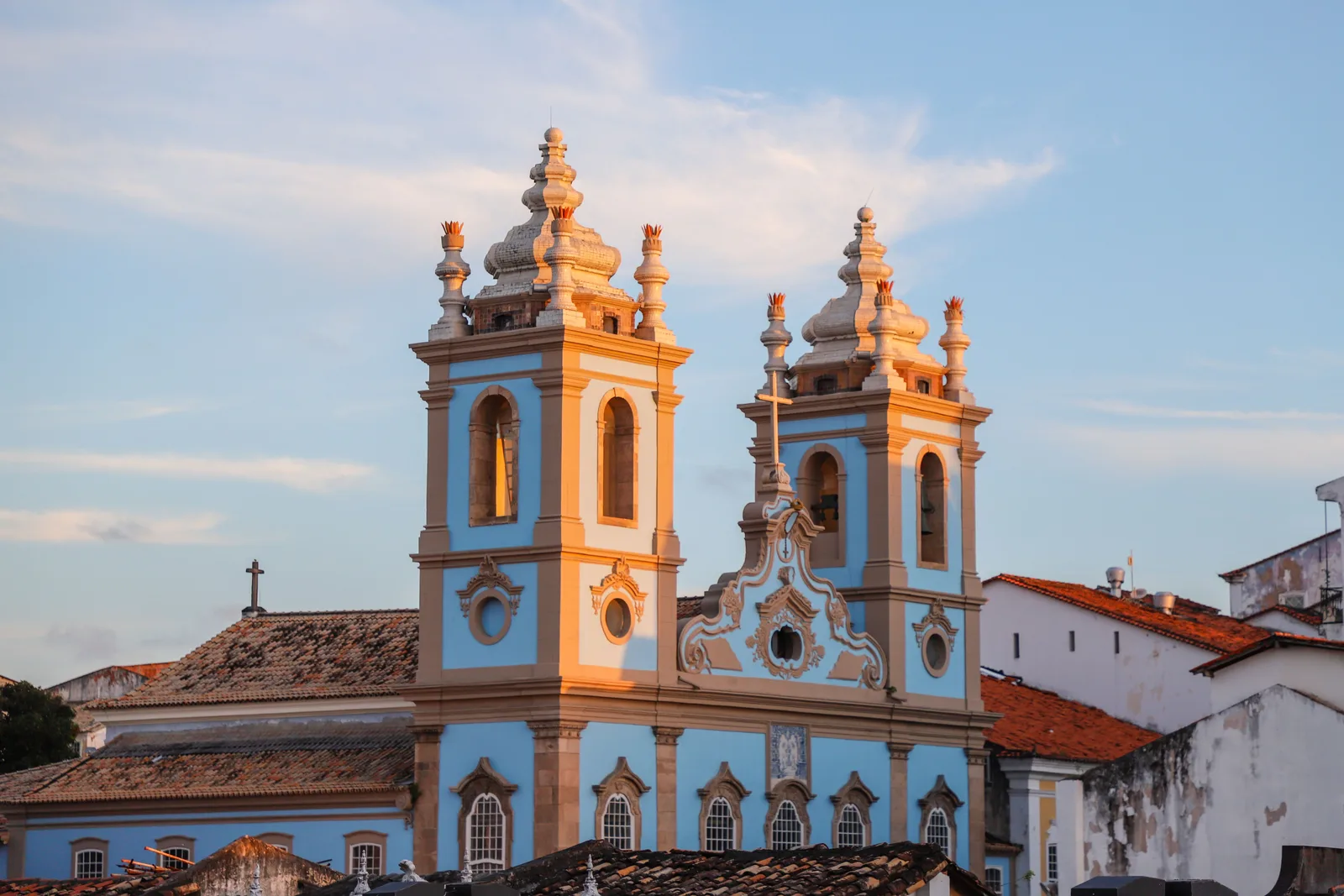
  • The pale blue and white baroque bell towers of the Igreja do Rosário dos Pretos catching the last of the sun, seen over the tiled rooftops of the Pelourinho below

    Largo do Pelourinho · 1 hour

    Igreja do Rosário dos Pretos

    The blue-and-white church at the bottom of the Pelourinho slope was built by a brotherhood of enslaved and freed Africans across most of the eighteenth century, largely at night and on their own time, because they were not permitted to worship in the city’s other churches. It is still an active parish and still the most explicitly Afro-Brazilian Catholic church in Brazil — the Tuesday 6:00pm mass for Santo Antônio de Categeró runs to atabaque drums and ijexá rhythm, ends with baskets of bread handed out to everyone present, and is open to anyone who turns up quietly. It fills early, so come well before 6:00pm if you want a seat.

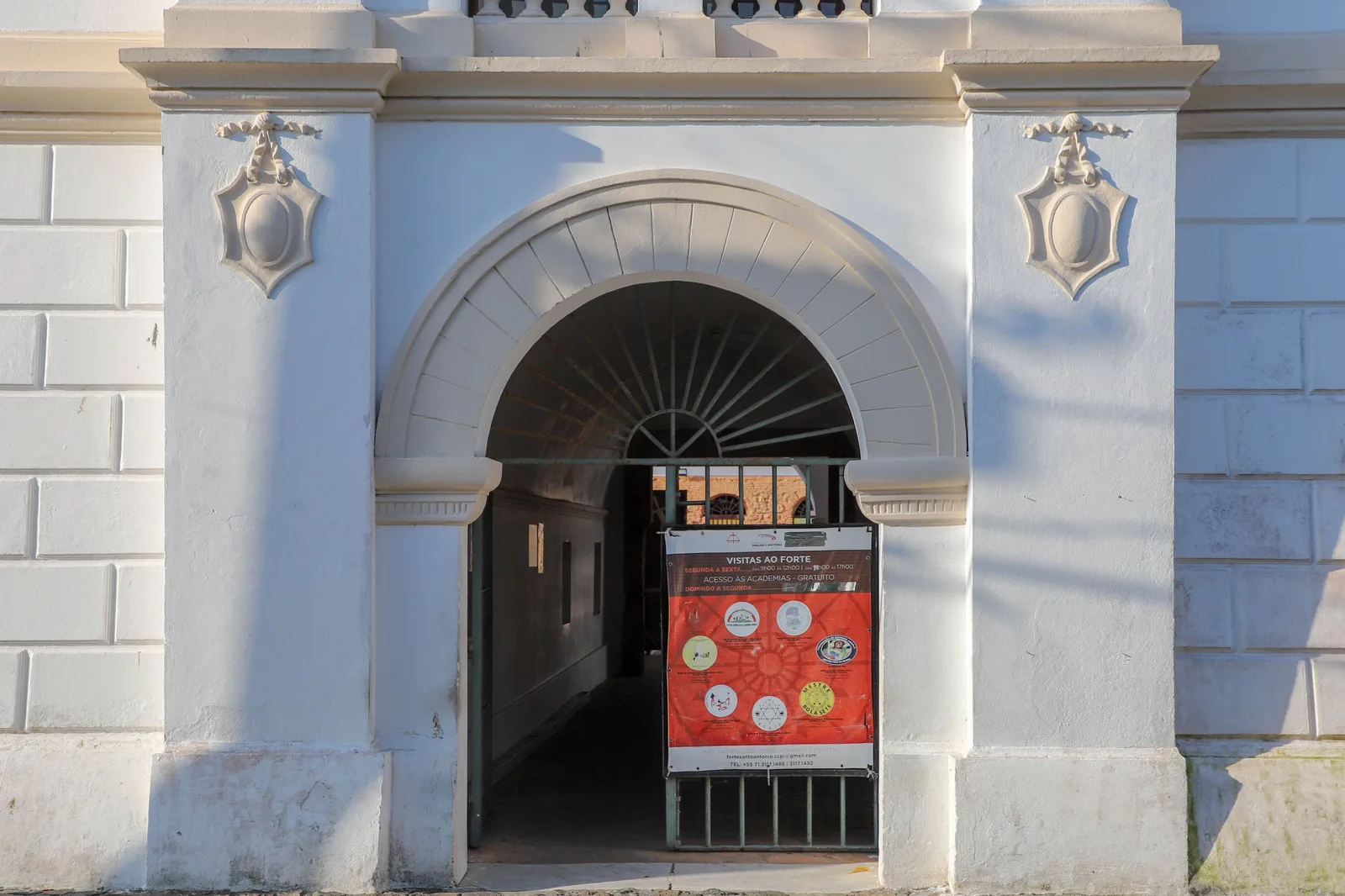
  • The whitewashed arched gateway of the Forte de Santo Antônio Além do Carmo in low sun, with a red board standing inside the arch that lists the capoeira academies working in the fort and free access to them

    Santo Antônio Além do Carmo · 2 hours

    Capoeira at the Forte de Santo Antônio

    An eighteenth-century fort at the far end of the historic center, now given over almost entirely to capoeira: seven mestres teach here, six of them in the Angola style formalized by Mestre Pastinha and one in the Regional style of Mestre Bimba. There is a memorial to the old masters, a workshop making berimbaus and caxixis, and open rodas most weeks. It is the real thing, as distinct from the tip-seeking performances staged for tourists in the Pelourinho squares.

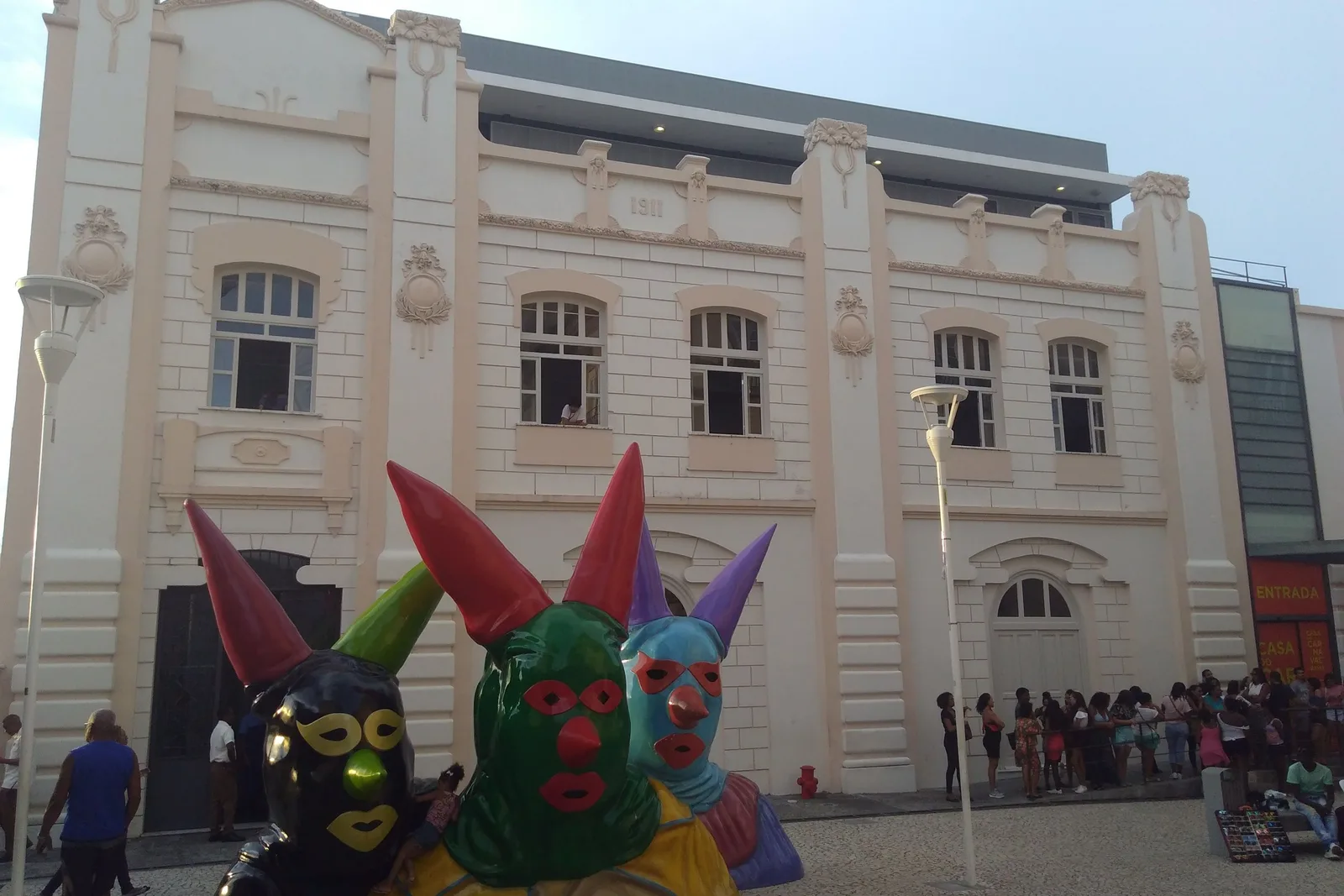
  • The Casa do Carnaval from the square outside: three giant painted Carnival-mask sculptures in green, black and blue set out in front of the museum’s pale 1911 facade, with a line of visitors along the pavement by the entrance

    Pelourinho · 1–2 hours

    Casa do Carnaval da Bahia

    A small, well-made museum on how Salvador’s Carnival became what it is: the invention of the trio elétrico by Dodô and Osmar on a modified 1929 Ford in 1950, the rise of the blocos afro in the 1970s, the axé years, and the costumes and instruments that go with each. The rooftop terrace has one of the best free views over the bay in the historic center. Worth doing before Carnival if you are coming for it, and worth doing instead if you are not.

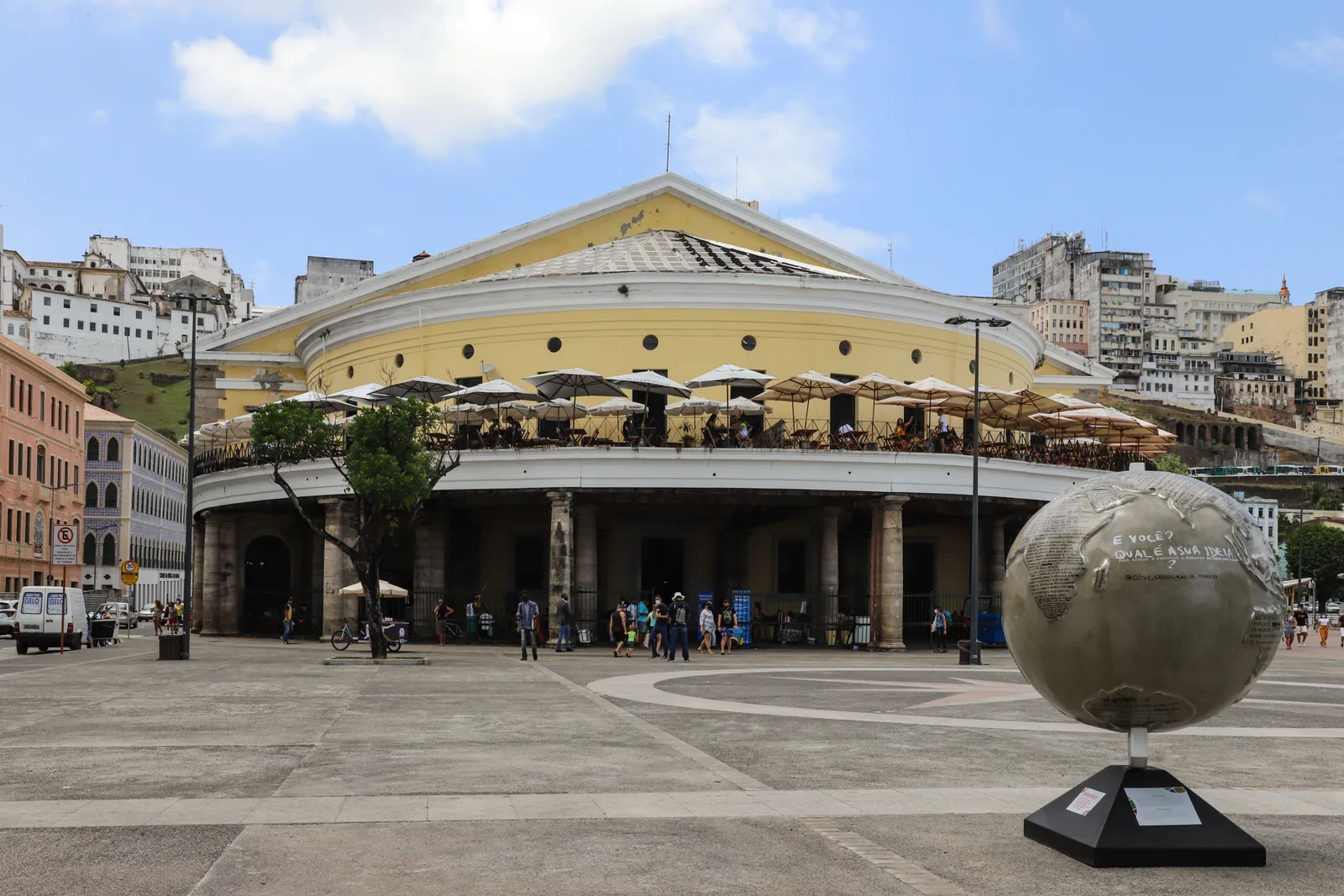
  • The Mercado Modelo from the plaza in front of it: the old yellow customs house with white umbrellas shading the restaurant terrace on its upper floor, shoppers going in and out under the stone arcade below, and the cliff of the upper city rising behind

    Cidade Baixa · 1–2 hours

    Shopping at the Mercado Modelo

    Two floors of craft stalls in the old customs house at the foot of the Elevador, 258 traders selling berimbaus, lace, cachaça, wood carvings and enough fitas do Bonfim to tie the whole bay. It reopened after an R$17 million restoration that replaced the roof and the wiring, and it is unashamedly the tourist market — prices open high and are meant to be negotiated. The restaurants on the upper terrace have the best bay view of any cheap lunch in the city.

  • Terreiro de Jesus · 1–2 hours

    The Carybé panels at the Museu Afro-Brasileiro

    The university’s Afro-Brazilian museum occupies the old medical faculty on the Terreiro de Jesus, and one room in it is worth the trip on its own: twenty-seven cedar panels carved by Carybé in 1968, each three meters tall, one for each orixá, inlaid with gold, silver, iron and shell according to what belongs to that deity. It is the single best explanation in Salvador of who the orixás are and what they carry. Entry is R$10, and free on Tuesdays.

Afro-Brazilian Bahia

  • The pale blue and white baroque bell towers of the Igreja do Rosário dos Pretos catching the last of the sun, seen over the tiled rooftops of the Pelourinho below

    Largo do Pelourinho · 1 hour

    Igreja do Rosário dos Pretos

    The blue-and-white church at the bottom of the Pelourinho slope was built by a brotherhood of enslaved and freed Africans across most of the eighteenth century, largely at night and on their own time, because they were not permitted to worship in the city’s other churches. It is still an active parish and still the most explicitly Afro-Brazilian Catholic church in Brazil — the Tuesday 6:00pm mass for Santo Antônio de Categeró runs to atabaque drums and ijexá rhythm, ends with baskets of bread handed out to everyone present, and is open to anyone who turns up quietly. It fills early, so come well before 6:00pm if you want a seat.

  • The whitewashed arched gateway of the Forte de Santo Antônio Além do Carmo in low sun, with a red board standing inside the arch that lists the capoeira academies working in the fort and free access to them

    Santo Antônio Além do Carmo · 2 hours

    Capoeira at the Forte de Santo Antônio

    An eighteenth-century fort at the far end of the historic center, now given over almost entirely to capoeira: seven mestres teach here, six of them in the Angola style formalized by Mestre Pastinha and one in the Regional style of Mestre Bimba. There is a memorial to the old masters, a workshop making berimbaus and caxixis, and open rodas most weeks. It is the real thing, as distinct from the tip-seeking performances staged for tourists in the Pelourinho squares.

  • The Casa do Carnaval from the square outside: three giant painted Carnival-mask sculptures in green, black and blue set out in front of the museum’s pale 1911 facade, with a line of visitors along the pavement by the entrance

    Pelourinho · 1–2 hours

    Casa do Carnaval da Bahia

    A small, well-made museum on how Salvador’s Carnival became what it is: the invention of the trio elétrico by Dodô and Osmar on a modified 1929 Ford in 1950, the rise of the blocos afro in the 1970s, the axé years, and the costumes and instruments that go with each. The rooftop terrace has one of the best free views over the bay in the historic center. Worth doing before Carnival if you are coming for it, and worth doing instead if you are not.

  • Terreiro de Jesus · 1–2 hours

    The Carybé panels at the Museu Afro-Brasileiro

    The university’s Afro-Brazilian museum occupies the old medical faculty on the Terreiro de Jesus, and one room in it is worth the trip on its own: twenty-seven cedar panels carved by Carybé in 1968, each three meters tall, one for each orixá, inlaid with gold, silver, iron and shell according to what belongs to that deity. It is the single best explanation in Salvador of who the orixás are and what they carry. Entry is R$10, and free on Tuesdays.

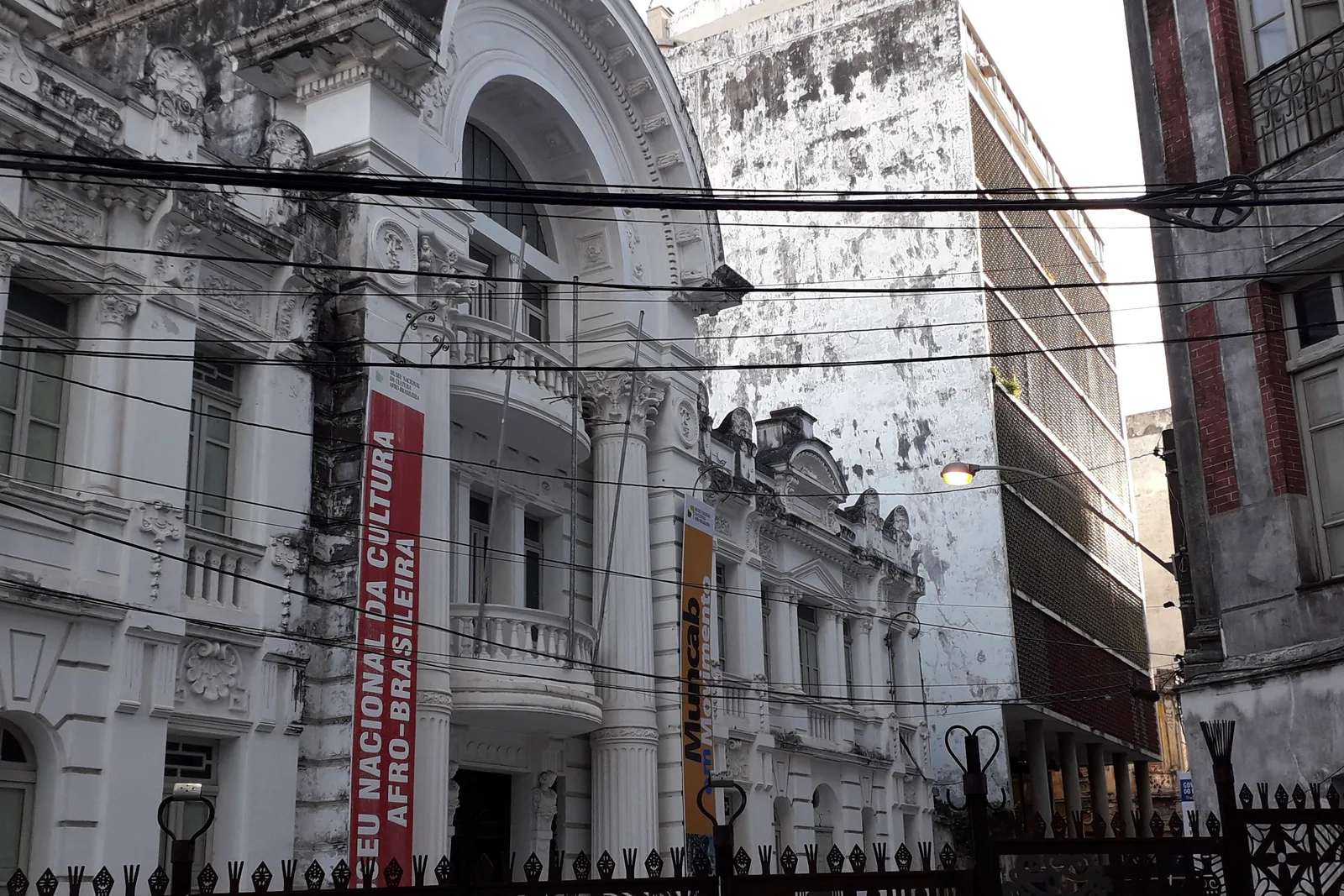
  • The Museu Nacional da Cultura Afro-Brasileira seen from the street below the Pelourinho: a tall red banner carrying the museum’s name hung down the columned white facade of the restored mansion, a second banner beside it and iron railings along the front

    Centro · 2 hours

    MUNCAB, the national Afro-Brazilian museum

    The Museu Nacional da Cultura Afro-Brasileira sits in a restored nineteenth-century mansion below the Pelourinho and takes the wider view: not only Bahia but the whole Black Brazilian story, from the Atlantic crossing through Candomblé, capoeira, food, music and contemporary art. Better curated and much quieter than the Pelourinho museums. R$20, and free on Wednesdays and Sundays.

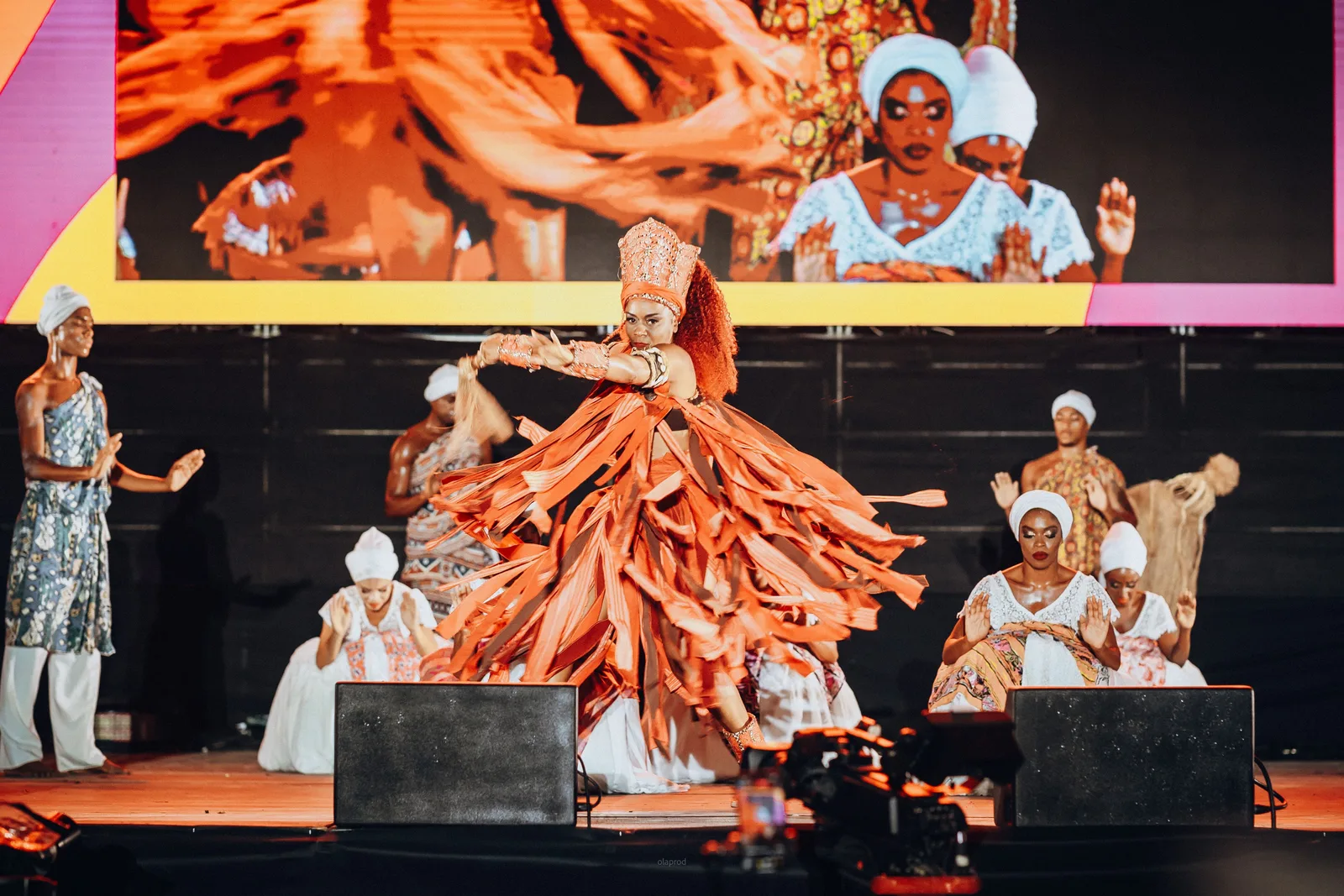
  • A dancer of the Balé Folclórico da Bahia mid-spin in a full orange raffia orixá costume and beaded crown, the rest of the company kneeling in white on the darkened stage behind her

    Teatro Miguel Santana, Pelourinho · evening

    Balé Folclórico da Bahia

    Brazil’s only professional folk dance company, working out of a small theater in the Pelourinho with live musicians and no recorded sound. The 55-minute program runs through the movement vocabulary of Candomblé, the maculelê stick dance, capoeira and samba de roda, and it is performed at a level that has taken the company to opera houses worldwide. Around R$90, cash at the box office, and it sells out — check the schedule and go early.

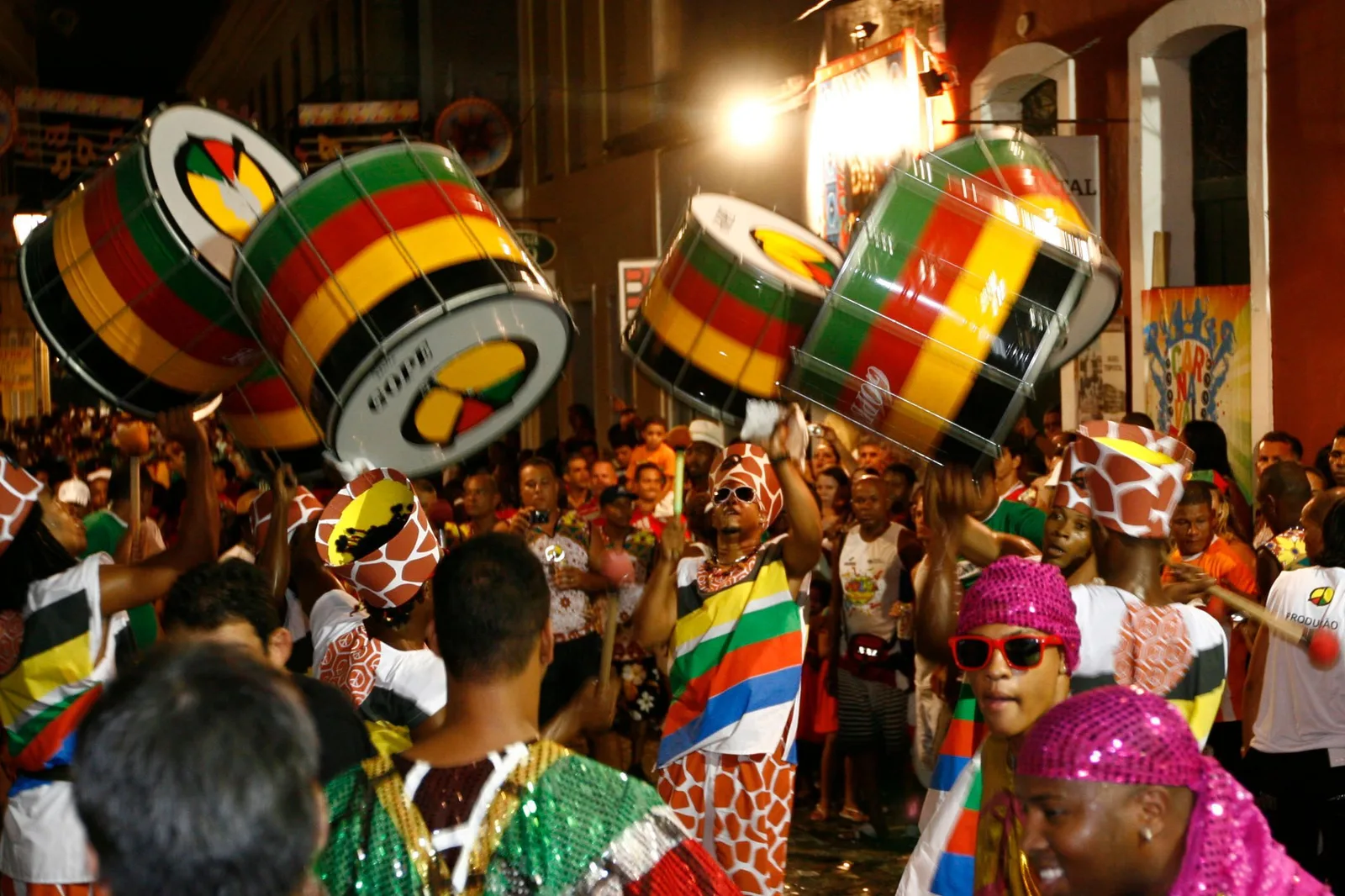
  • Olodum drummers moving off through a Salvador street at night, big surdos painted in green, yellow and red held up over their shoulders, players in printed headwraps and a crowd filling the road behind them

    Largo do Pelourinho · 2 hours

    Olodum in the Pelourinho

    The bloco afro that put Salvador’s drumming on the world’s radar — the sound on Paul Simon’s “The Obvious Child”, and the band in the Pelourinho half of Michael Jackson’s “They Don’t Care About Us”. The public rehearsals are a summer thing, roughly December through Carnival: free Sunday afternoons in the Largo do Pelourinho from about 3:00pm, and a ticketed Tuesday-night show. Both are open-air, loud and entirely worth arranging a day around — but come in September and there is neither, so check the group’s own schedule before you build a day on it.

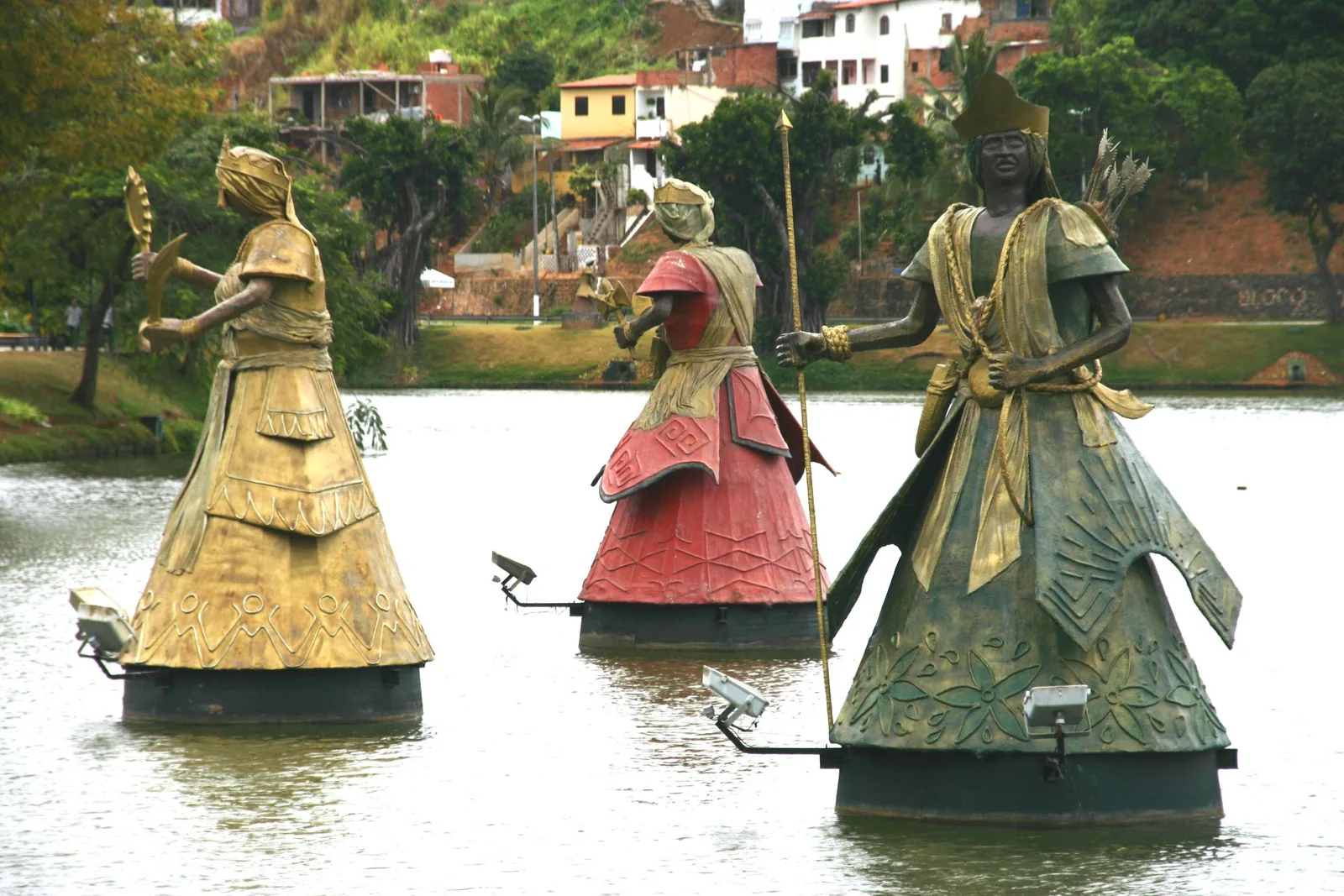
  • Three of the orixá sculptures standing out on the water of the Dique do Tororó, robed figures in gold, red and green holding their emblems, with the houses of the hillside neighborhood rising behind the lake

    Tororó · 1 hour

    The orixás at the Dique do Tororó

    Eight sculptures of orixás, each around seven meters tall, standing on the water of a lake in the middle of the city with the Arena Fonte Nova behind them. They were made by the Bahian artist Tatti Moreno and they are the most direct public statement of Candomblé in Salvador — Iemanjá, Oxum, Xangô and the rest, out in the open, in a country that criminalized the religion within living memory. A walkway rings the lake; go late in the day when the light is on the figures.

  • Outer neighborhoods · an evening

    A Candomblé ceremony

    Candomblé is a living religion, not a show, and the version staged in the Pelourinho for tourists has nothing to do with it. Real terreiros — Casa Branca and Ilê Axé Opô Afonjá among them — do receive visitors at public ceremonies, on their terms: white or modest clothing, no photography, no participation, and a donation to the house rather than an admission price. Go with a guide who has an actual relationship with the terreiro, and treat the evening as being someone’s guest at their church.

Beaches

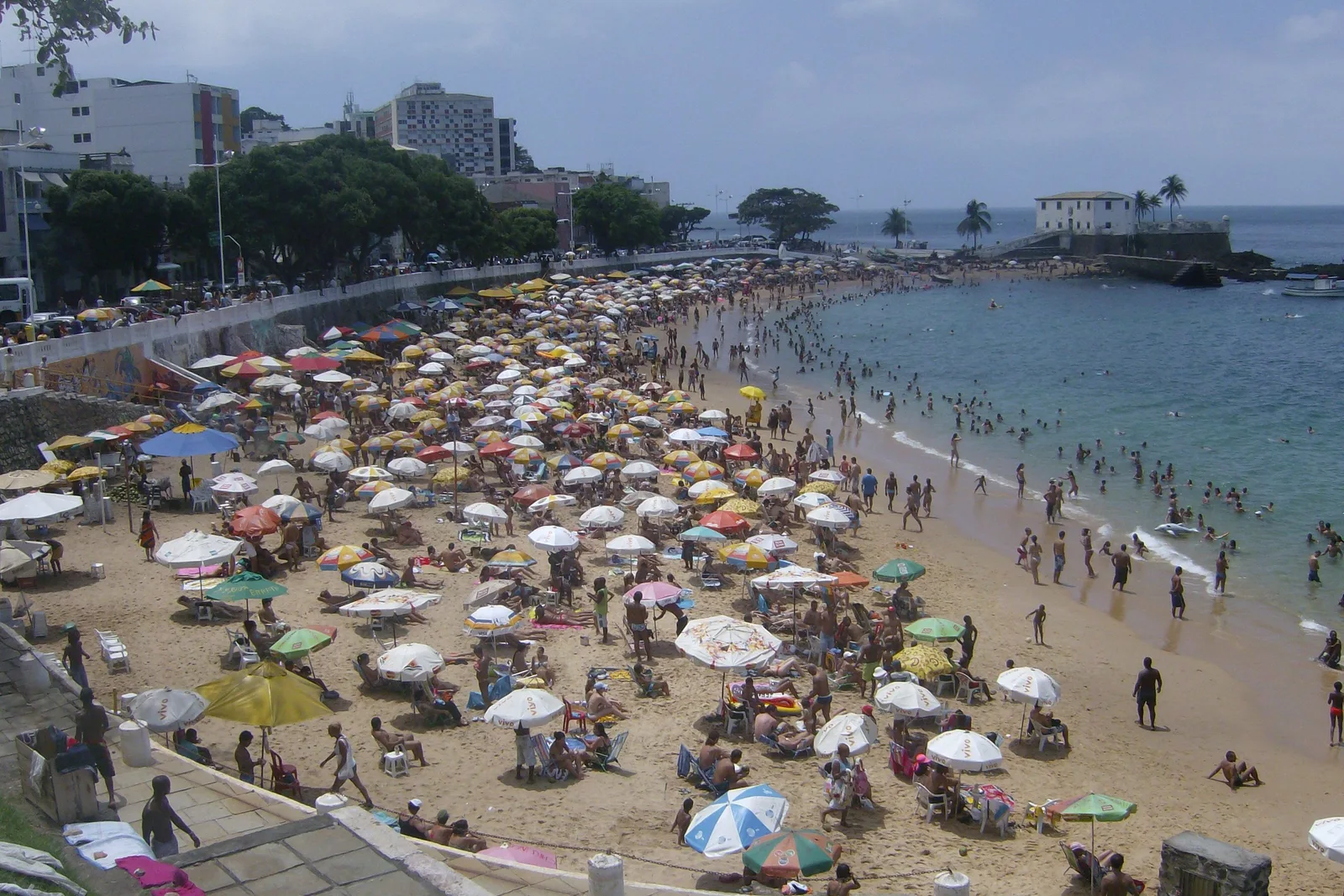
  • Porto da Barra on a busy afternoon: a curve of sand packed with colored umbrellas, swimmers standing in flat bay water, and the low stone fort closing the far end of the beach

    Barra · half day

    Swimming at Porto da Barra

    A short crescent of sand facing west into the bay, which makes it the calmest swimming water in the city and the only beach in Salvador where the sun sets over the sea. Flat, shallow, no surf, vendors working the sand with beer, oysters and grilled cheese, and a crowd that goes from families in the morning to everybody by 6:00pm. It is small for the number of people who love it, so go early or accept the crush.

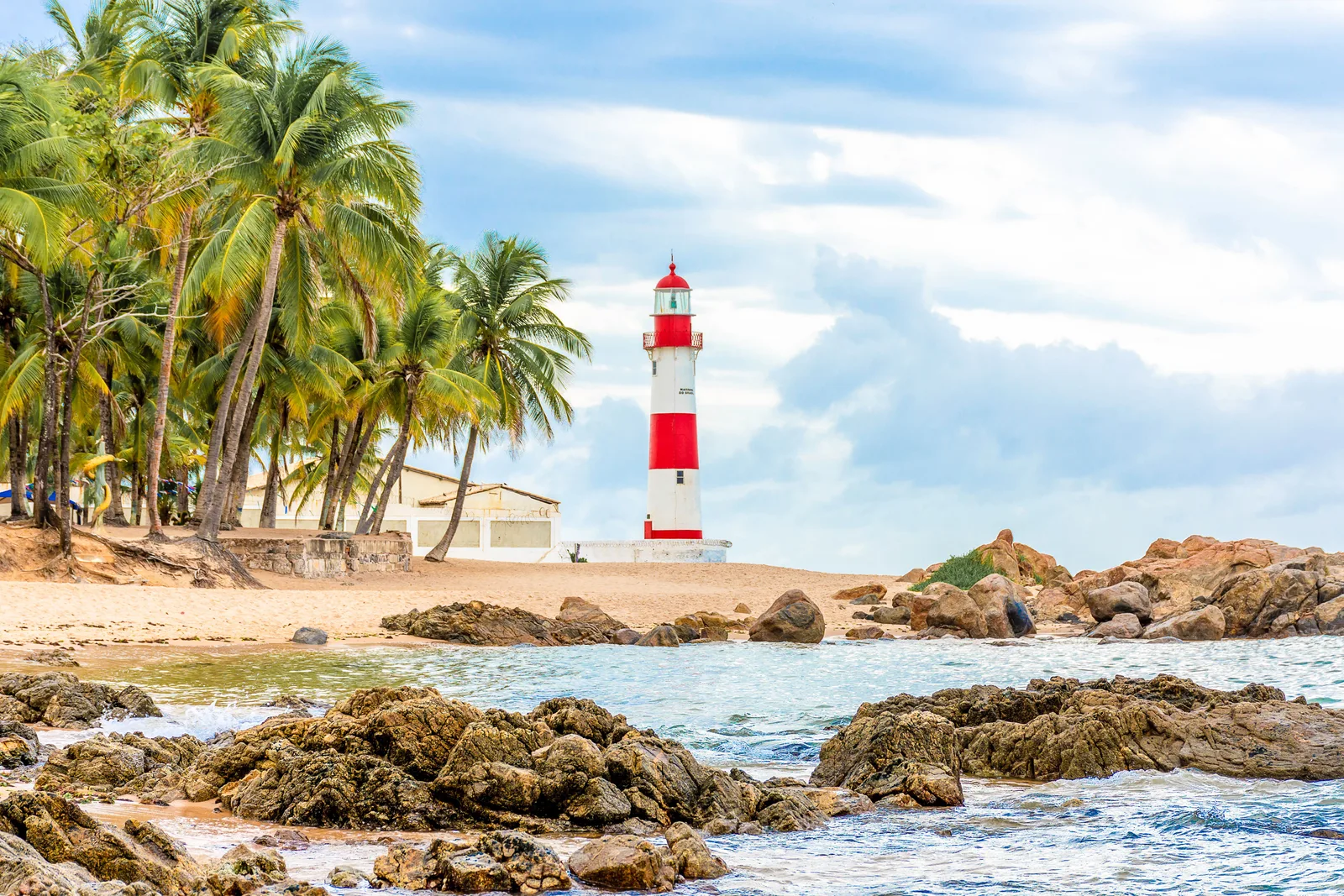
  • The red-and-white Itapuã lighthouse standing behind a line of coconut palms on the sand, with dark reef rock breaking the surface of the shallow water in the foreground

    Itapuã · half day

    Natural pools at Itapuã

    Twenty kilometers out along the coast, past the point where the city stops feeling like a city. Reefs a little way offshore break the Atlantic swell and leave warm, clear pools at low tide, and there is a squat red-and-white lighthouse at the end of the sand. Itapuã has a place in Brazilian popular music that Americans will not know and every Brazilian does — Vinicius de Moraes and Toquinho wrote it into a song that is still what the name means to the country.

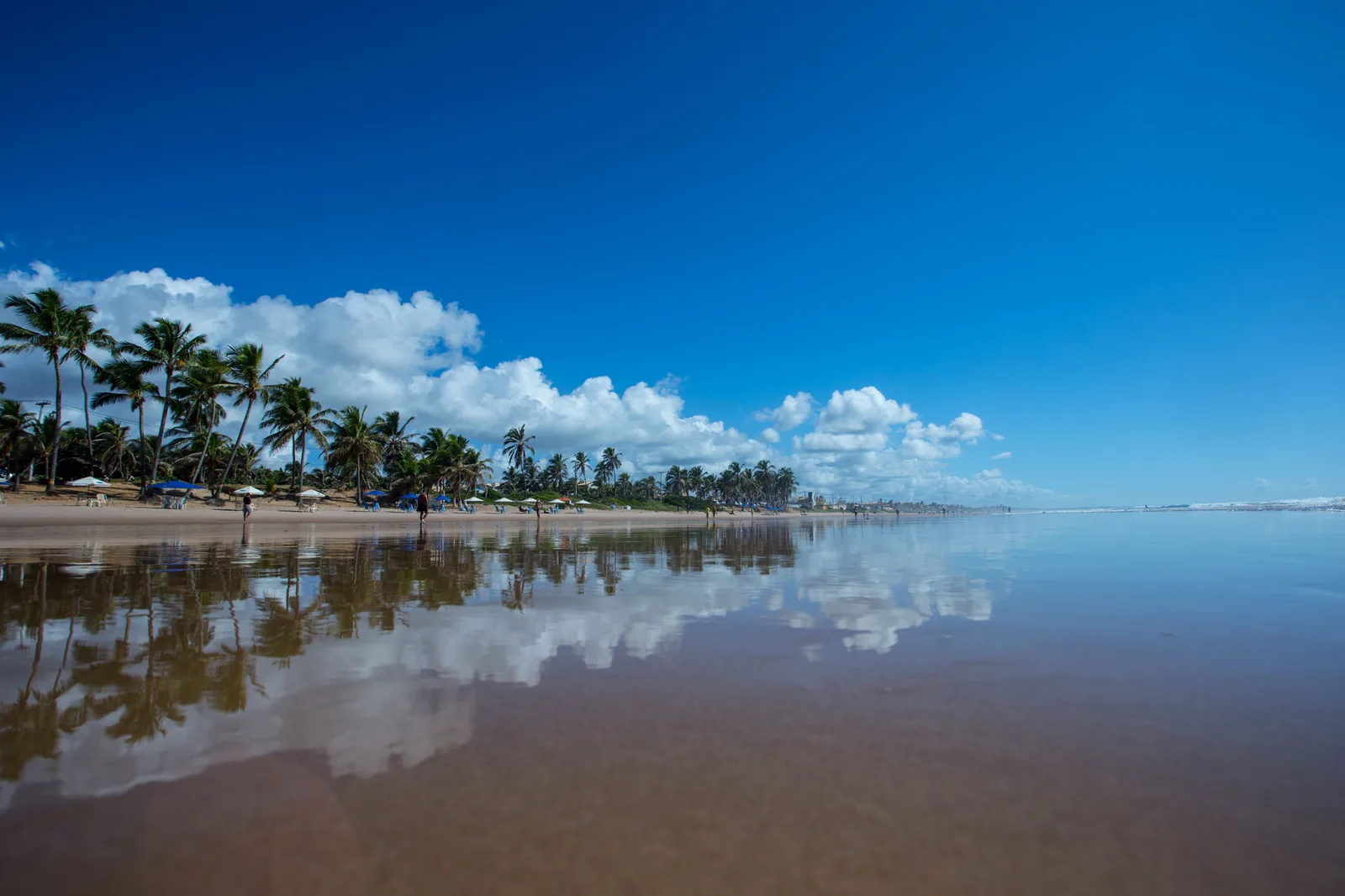
  • The open Atlantic beach at Praia do Flamengo on Salvador’s northern coast, a wide sheet of wet sand mirroring the sky, coconut palms and a scatter of parasols along the back of it and almost nobody on the shore

    Northern beaches · half day

    Surf and space at Stella Maris and Flamengo

    The last stretch of coast before the airport, and the closest thing Salvador has to an open Atlantic beach: real waves, coconut palms behind the sand, dunes in places, and enough room that a weekday morning can be close to empty. This is where the resorts and the beach houses are, and where the city’s surfers go. Check where the flags and the other swimmers are before you get in — the shore break here is not the bay.

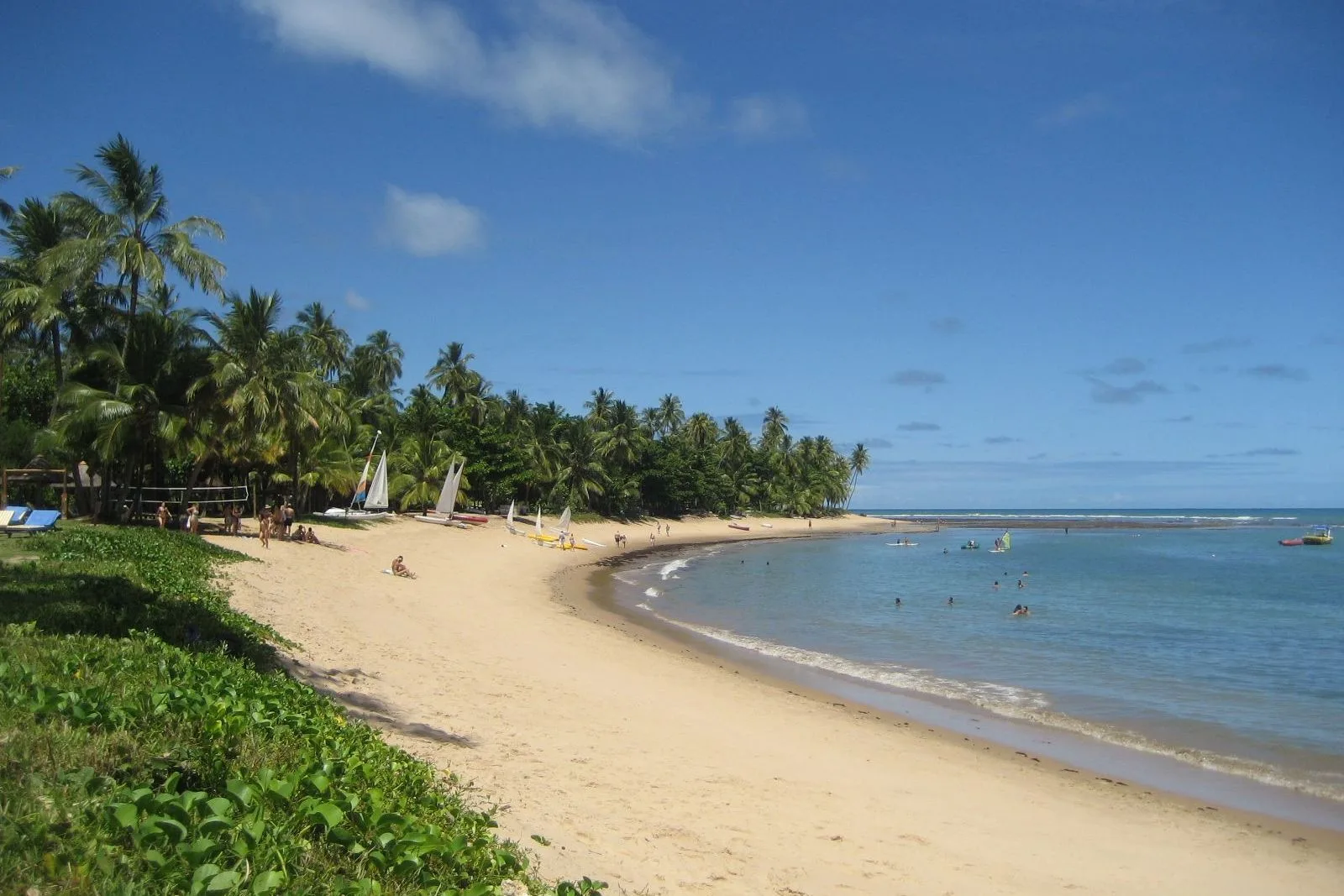
  • The beach at Praia do Forte: a curve of pale sand backed by dense coconut palms, calm shallow water with a few swimmers standing in it, and a low reef line breaking the swell offshore

    75 km north · full day

    Turtles and calm water at Praia do Forte

    An hour and a bit up the Linha Verde, and the standard beach day out of Salvador: a single pedestrianized street of restaurants leading to reef-protected pools, the ruined sixteenth-century Castelo Garcia d’Ávila on the hill above, and the main visitor station of Projeto Tamar, Brazil’s sea-turtle conservation program, right on the sand. It is the easiest good beach within reach of the city and it works as a day trip or as a two-night decompression at the end of a trip.

Food & Music

  • Olodum drummers moving off through a Salvador street at night, big surdos painted in green, yellow and red held up over their shoulders, players in printed headwraps and a crowd filling the road behind them

    Largo do Pelourinho · 2 hours

    Olodum in the Pelourinho

    The bloco afro that put Salvador’s drumming on the world’s radar — the sound on Paul Simon’s “The Obvious Child”, and the band in the Pelourinho half of Michael Jackson’s “They Don’t Care About Us”. The public rehearsals are a summer thing, roughly December through Carnival: free Sunday afternoons in the Largo do Pelourinho from about 3:00pm, and a ticketed Tuesday-night show. Both are open-air, loud and entirely worth arranging a day around — but come in September and there is neither, so check the group’s own schedule before you build a day on it.

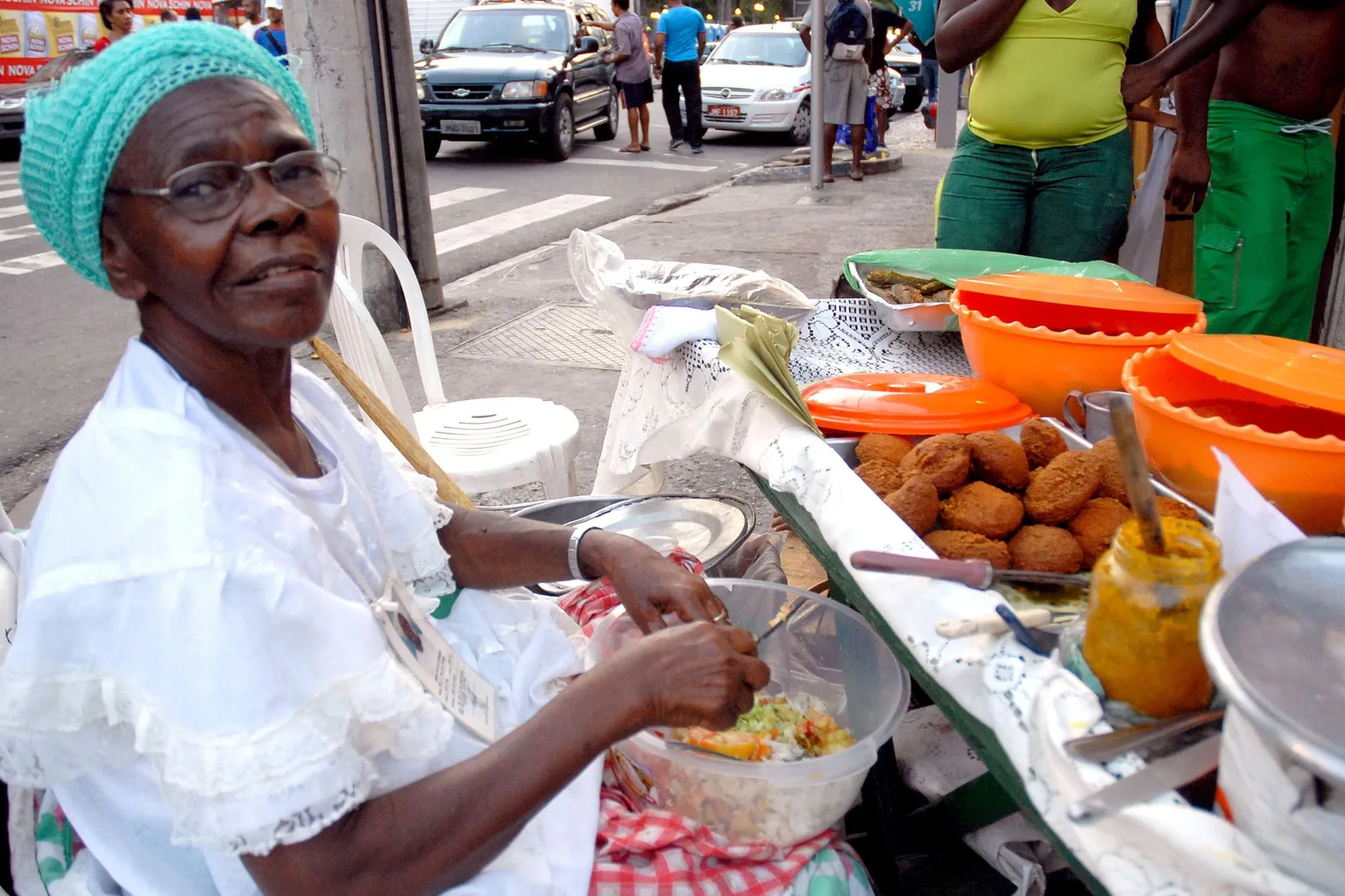
  • A baiana in white lace and a knitted headwrap working at her street acarajé stand, a tray of fried fritters and covered orange bowls of fillings laid out along the table beside her

    Rio Vermelho and citywide · 30 minutes

    Acarajé from a street baiana

    Black-eyed pea dough, hand-shaped, deep-fried in dendê palm oil, split open and packed with vatapá, caruru, dried shrimp, tomato salad and as much pepper as you say yes to. It was an offering to the orixá Iansã before it was street food, and the trade of the baianas who sell it — in white lace, at a fixed corner, often for decades — is registered as national intangible heritage. The famous stands are in Rio Vermelho at the Largo de Santana. Around R$15, and say “pouca pimenta” unless you mean it.

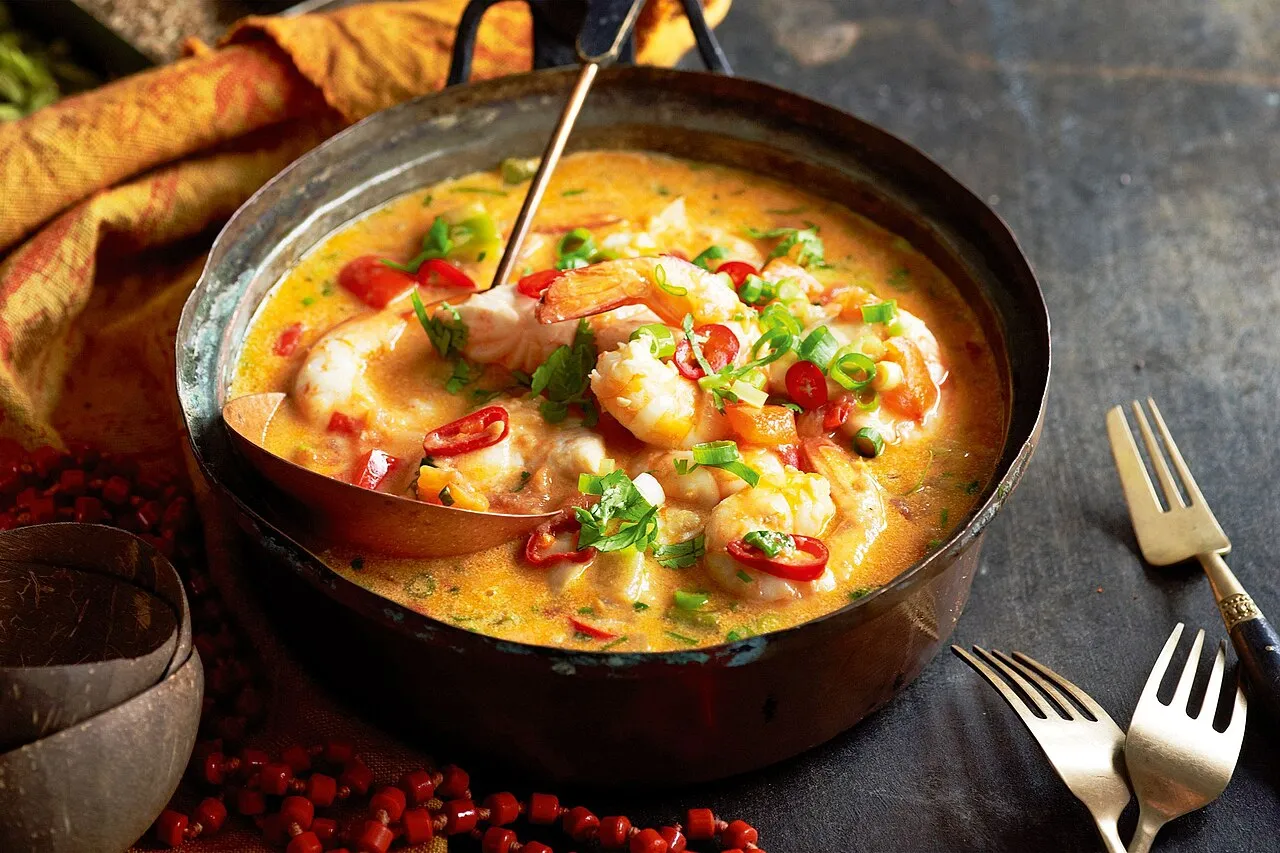
  • A shrimp moqueca in a heavy round pan, the broth orange with dendê and coconut milk and scattered with sliced chili, scallion and cilantro, a ladle standing in it and forks laid out beside

    Rio Vermelho and Ondina · long lunch

    Moqueca in Rio Vermelho

    Bahian moqueca is fish or shrimp simmered in a clay pot with coconut milk, dendê, peppers, tomato, onion and coriander — no roux, no cream, and orange rather than red. It arrives bubbling with rice, farofa and pirão, it is built for two, and it is the dish Bahia would put forward if it were allowed one. Casa de Tereza and Dona Mariquita are the reliable names; expect around R$280 for two and plan nothing energetic afterwards.

  • Rio Vermelho · an evening

    A night in Rio Vermelho

    The neighborhood residents go out in, and the one part of Salvador where the evening happens on the street rather than behind a door. Two squares do most of the work — Largo de Santana and Largo da Mariquita — with bars spilling across them from about 6:00pm, live music most nights, and the Mercado do Peixe grilling fish and pouring beer until close to dawn at the bottom of the hill. It is also where the Festa de Iemanjá lands every February 2.

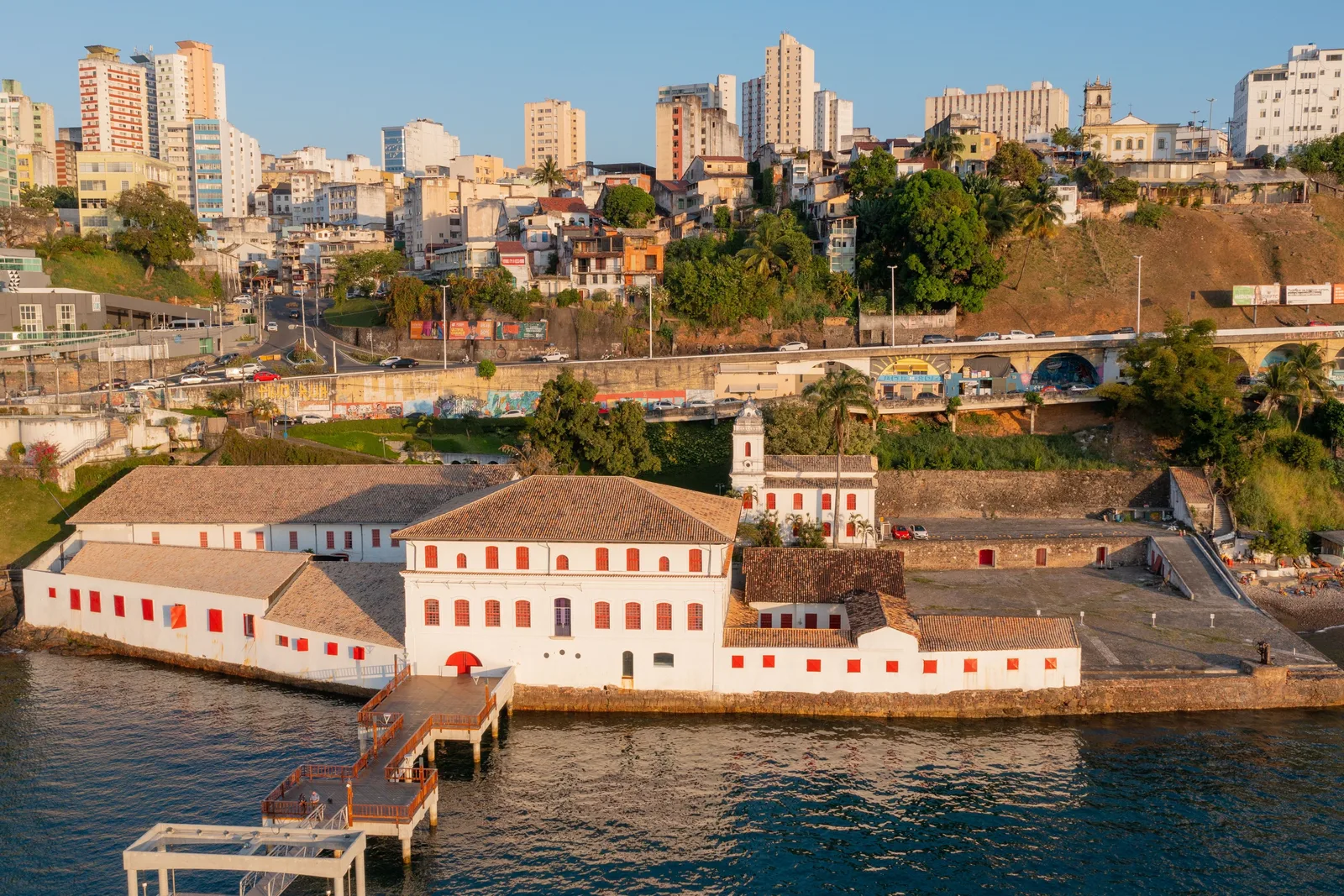
  • The Solar do Unhão late in the day, seen from over the water: the whitewashed colonial warehouse, chapel and yard of the modern art museum on their own promontory, with the apartment blocks and hillside of the city rising behind

    Solar do Unhão · Saturday evening

    Jam no MAM at the Solar do Unhão

    A seventeenth-century sugar estate on a spit of land in the bay, now the Museu de Arte Moderna da Bahia, with a sculpture garden running down to the water. Every Saturday from about 6:00pm the courtyard becomes an open-air jazz session that has been running for more than two decades and is one of the genuinely great things to do in this city — sunset over the bay included, and a crowd that is local rather than touristic. Check the lineup before you go: most weeks are open, but special editions are ticketed.

Out on the Bay

  • The Solar do Unhão late in the day, seen from over the water: the whitewashed colonial warehouse, chapel and yard of the modern art museum on their own promontory, with the apartment blocks and hillside of the city rising behind

    Solar do Unhão · Saturday evening

    Jam no MAM at the Solar do Unhão

    A seventeenth-century sugar estate on a spit of land in the bay, now the Museu de Arte Moderna da Bahia, with a sculpture garden running down to the water. Every Saturday from about 6:00pm the courtyard becomes an open-air jazz session that has been running for more than two decades and is one of the genuinely great things to do in this city — sunset over the bay included, and a crowd that is local rather than touristic. Check the lineup before you go: most weeks are open, but special editions are ticketed.

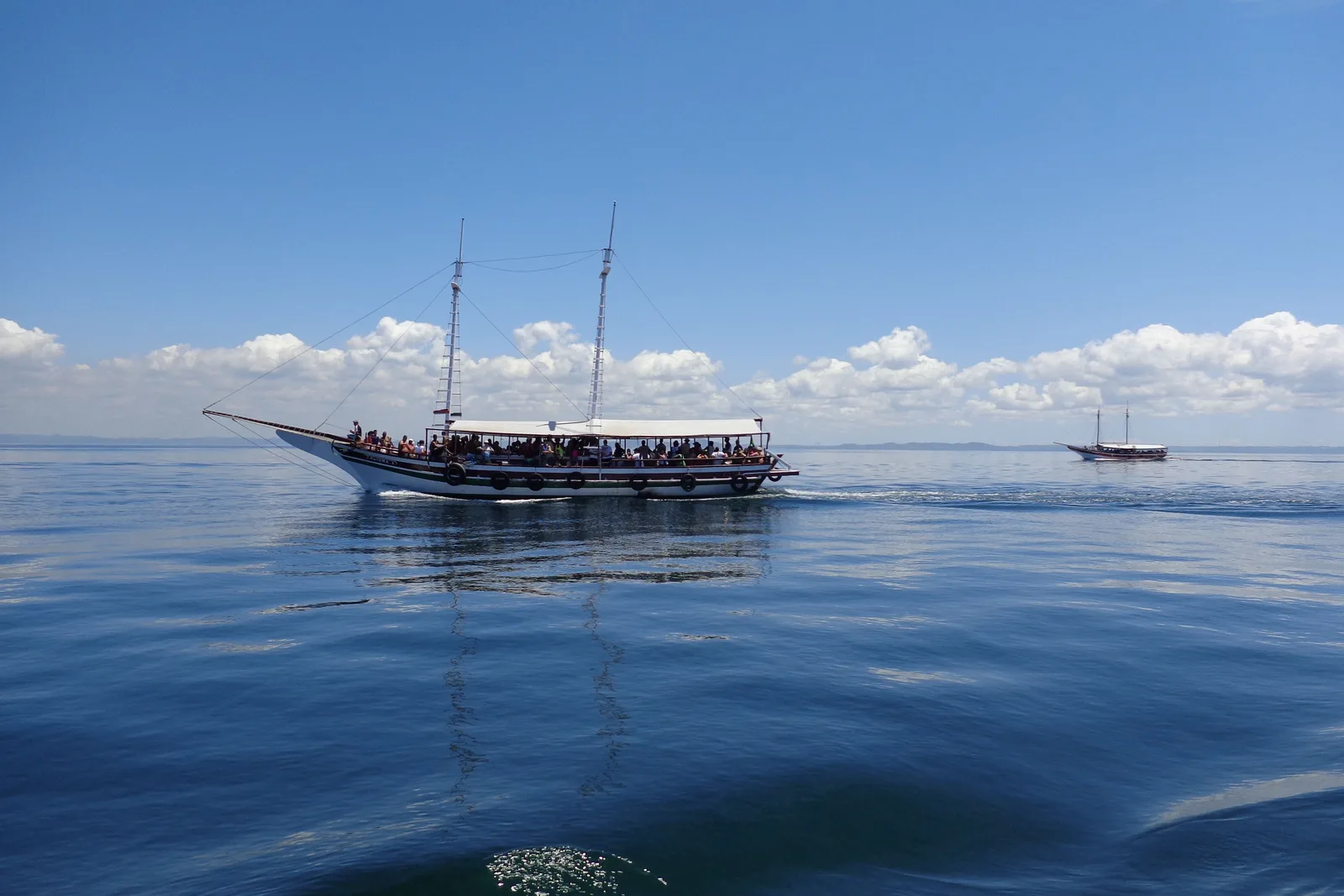
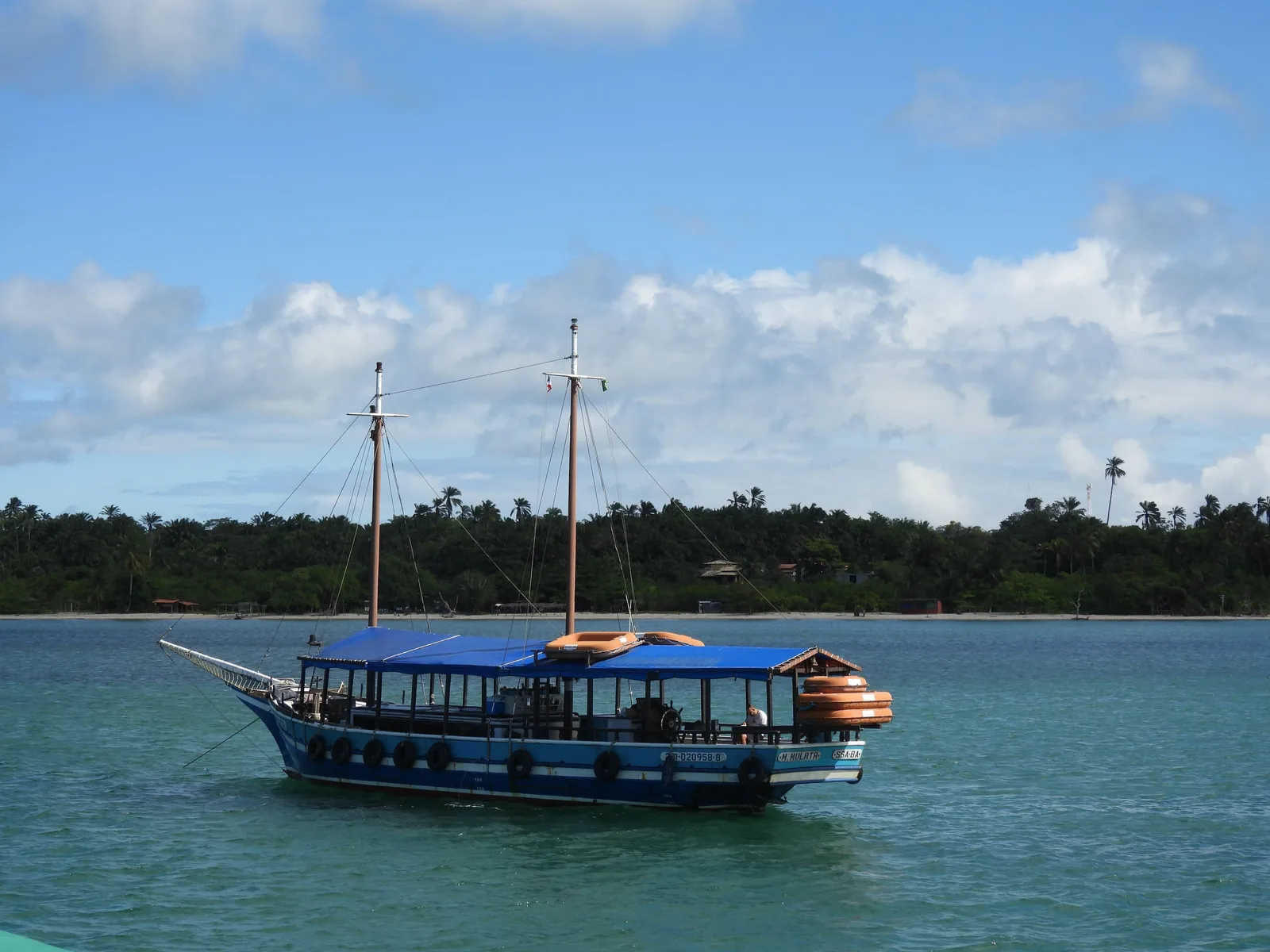
  • A wooden two-masted schooner under way on the flat blue water of the Bay of All Saints, passengers packed along its awning deck, with a second schooner small on the horizon behind

    From Terminal Náutico · full day

    Schooner across the Baía de Todos os Santos

    The Bay of All Saints is the largest bay in Brazil — around 1,100 square kilometers, with 56 islands in it — and it is the reason the city is where it is. The standard day out is a wooden schooner from the terminal beside the Mercado Modelo, calling at Ilha dos Frades for a swim and Itaparica for lunch, with the city skyline receding behind you on the way out. Around R$120 to R$180 depending on the operator and whether lunch is included.

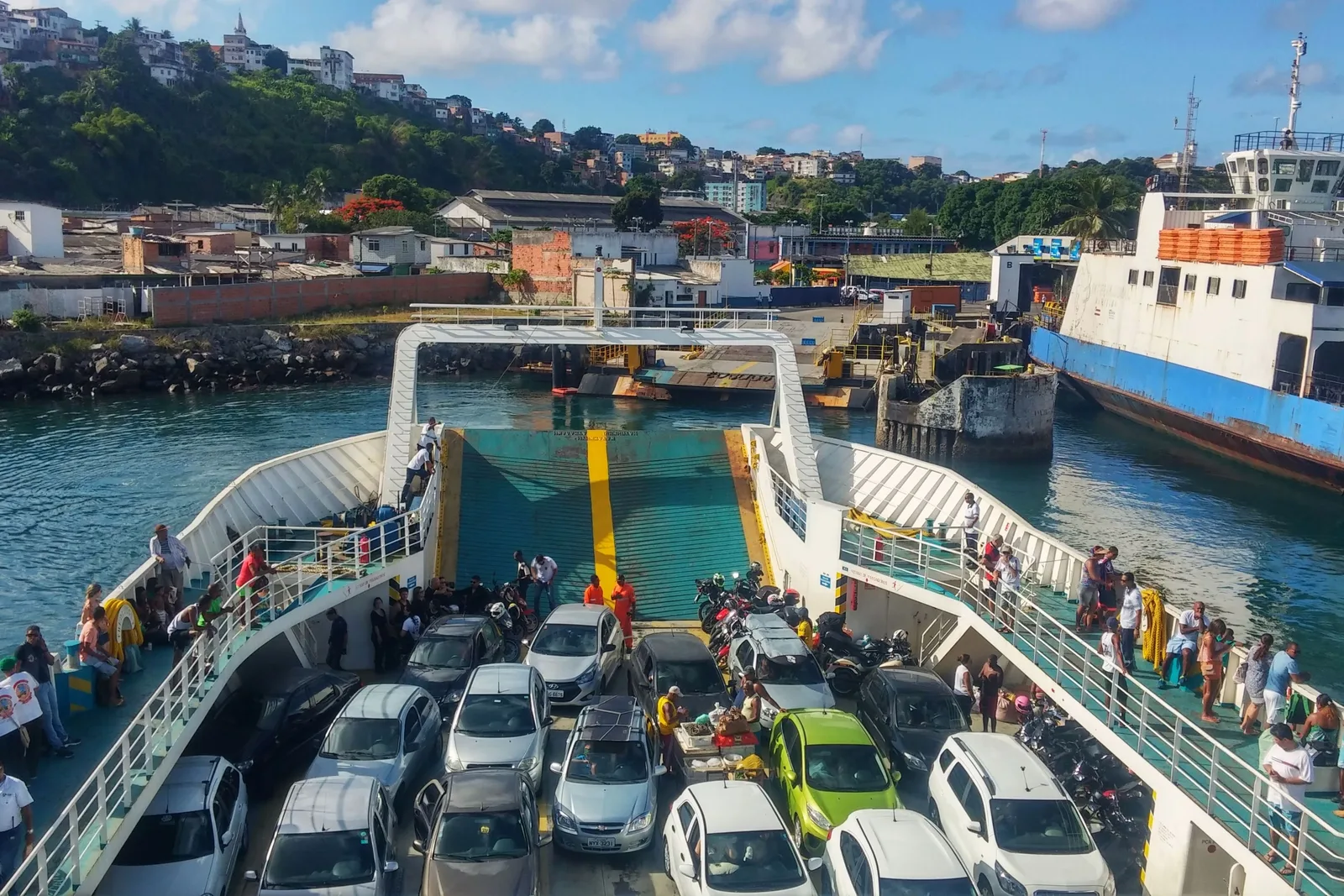
  • The car deck of a ferry at the São Joaquim terminal in Salvador, cars and motorbikes packed in bumper to bumper, passengers standing along the rails and another ferry tied up alongside with the hillside of the city behind

    São Joaquim to Bom Despacho · half day

    The ferry to Itaparica

    The workaday alternative to a schooner, and better value than any of them: the car ferry from São Joaquim crosses to Itaparica island in about fifty minutes for a few reais on foot, with the same view and none of the commentary. On the far side there are quiet beaches, a small colonial town at Vera Cruz, and a very different pace within an hour of the Pelourinho. Go on a weekday; the weekend queues are long.

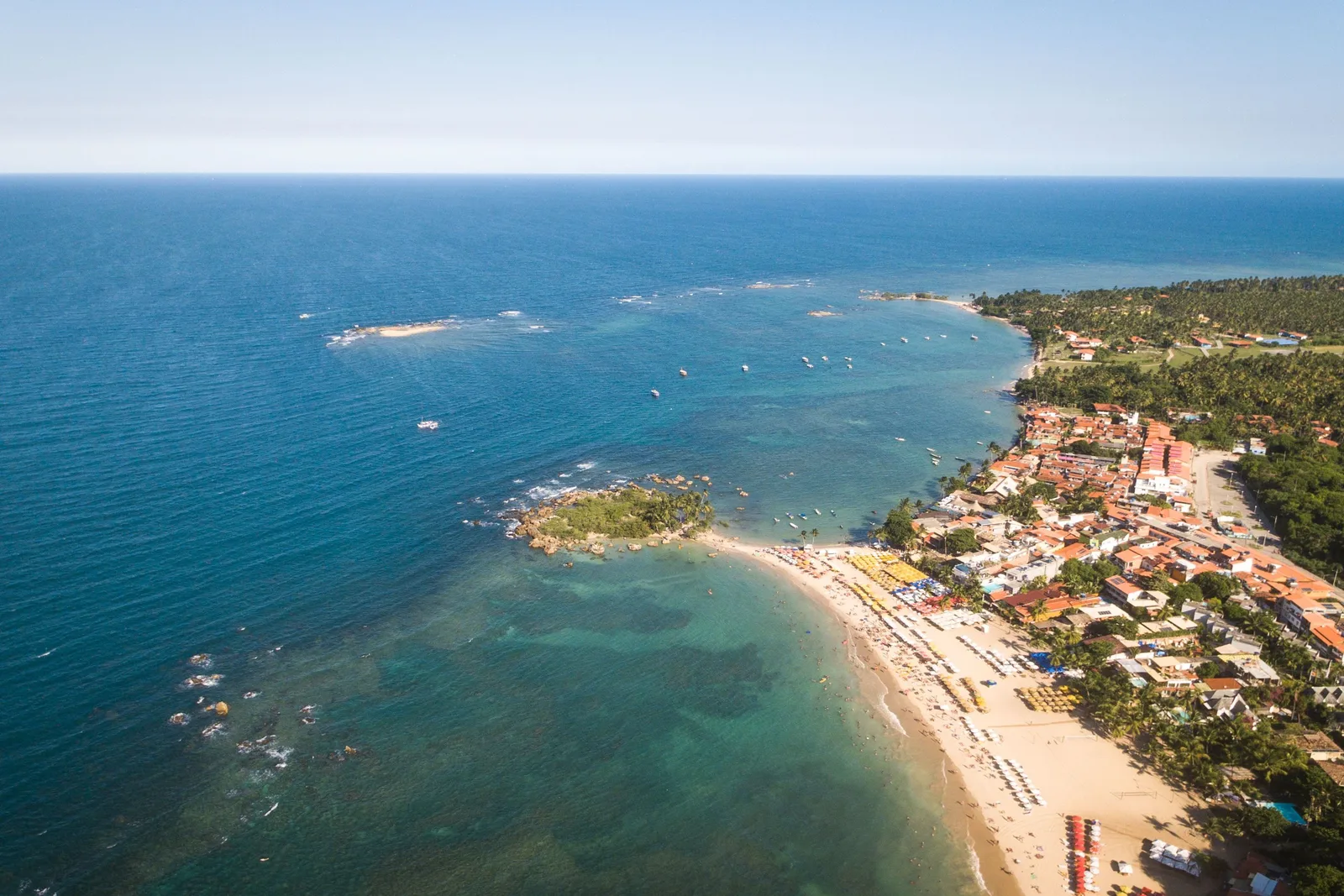
  • Morro de São Paulo from the air: a long arc of pale sand lined with beach umbrellas, low red-roofed pousadas and palms packed in right behind it, and reef showing dark through turquoise water offshore

    Two and a half hours south · full day or overnight

    Morro de São Paulo by catamaran

    A car-free village on the island of Tinharé, with four numbered beaches getting progressively emptier as you walk south and a landing pier that is still the only way in. The catamaran from the Terminal Náutico takes two to two and a half hours and costs around R$160 each way. It is doable in a very long day and much better as two nights — and the sea is genuinely rough between May and August, when the crossing is often switched to the semi-terrestrial route through Itaparica and Valença instead, which adds about an hour. Small independent boats do get canceled outright in that stretch; the ticketed catamaran is usually rerouted rather than lost.

Day Trips

  • The beach at Praia do Forte: a curve of pale sand backed by dense coconut palms, calm shallow water with a few swimmers standing in it, and a low reef line breaking the swell offshore

    75 km north · full day

    Turtles and calm water at Praia do Forte

    An hour and a bit up the Linha Verde, and the standard beach day out of Salvador: a single pedestrianized street of restaurants leading to reef-protected pools, the ruined sixteenth-century Castelo Garcia d’Ávila on the hill above, and the main visitor station of Projeto Tamar, Brazil’s sea-turtle conservation program, right on the sand. It is the easiest good beach within reach of the city and it works as a day trip or as a two-night decompression at the end of a trip.

  • Morro de São Paulo from the air: a long arc of pale sand lined with beach umbrellas, low red-roofed pousadas and palms packed in right behind it, and reef showing dark through turquoise water offshore

    Two and a half hours south · full day or overnight

    Morro de São Paulo by catamaran

    A car-free village on the island of Tinharé, with four numbered beaches getting progressively emptier as you walk south and a landing pier that is still the only way in. The catamaran from the Terminal Náutico takes two to two and a half hours and costs around R$160 each way. It is doable in a very long day and much better as two nights — and the sea is genuinely rough between May and August, when the crossing is often switched to the semi-terrestrial route through Itaparica and Valença instead, which adds about an hour. Small independent boats do get canceled outright in that stretch; the ticketed catamaran is usually rerouted rather than lost.

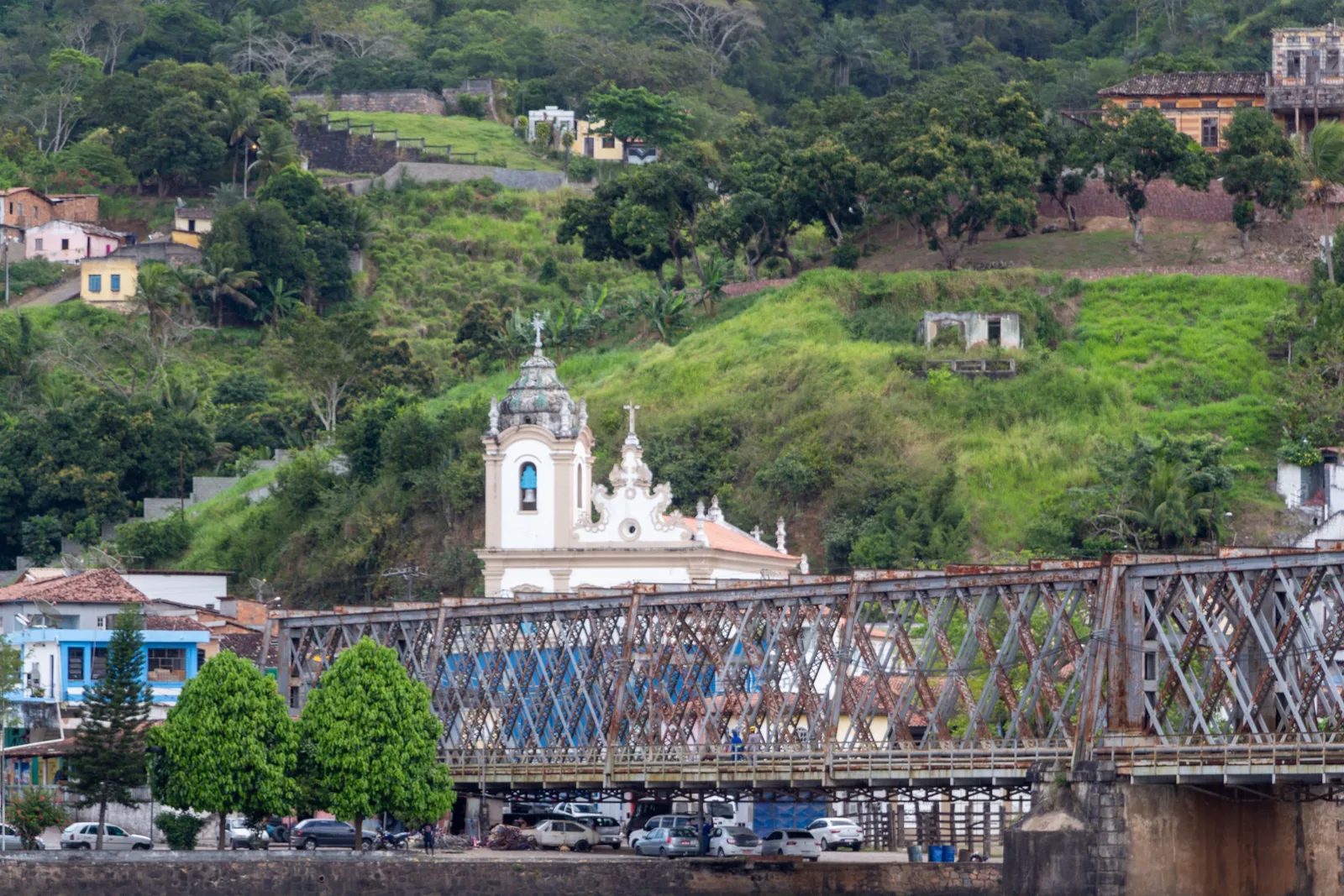
  • The iron Dom Pedro II bridge between Cachoeira and São Félix, its rusting lattice spans crossing the frame in front of a white baroque church tower and the pastel houses climbing the green hillside behind

    120 km inland · full day

    The Recôncavo at Cachoeira and São Félix

    Two small towns facing each other across the Paraguaçu river, joined by a nineteenth-century iron bridge, in the sugar and tobacco country that funded colonial Salvador. Cachoeira has one of the best-preserved colonial streetscapes in Brazil and almost none of the Pelourinho’s crowds, along with a deep Candomblé tradition and the Irmandade da Boa Morte, a sisterhood descended from enslaved women who have run their own August festival for two centuries. It is the trip for people who liked the historic center and want the version without the souvenir stalls.

Where to stay

The neighborhood decides the trip.

Salvador is long and its good parts are not adjacent, so where you sleep sets what your evenings look like more than it does in most cities. These four are the real choice, and any of them is twenty to forty minutes from the others in a ride app.

Drag and zoom to explore.

Tap an area to open it and see it on the map

  • Our pick

    Best for: The best balance for a first visit

    The point where the bay meets the ocean, and the most straightforward base in the city: two swimmable beaches, a lit and patrolled seafront promenade, hotels at every price, and a fifteen-minute ride to the historic center. It is touristy and it is short on colonial charm — most of what you see is 1970s apartment blocks — and in exchange it is the one place in Salvador where walking out for dinner is uncomplicated.

    • Barra
    • Ondina
    • Porto da Barra
    • Farol da Barra
  • Best for: Waking up inside the history

    Guesthouses in restored eighteenth-century townhouses, the museums and churches at the end of the street, and drumming somewhere most nights. Santo Antônio Além do Carmo, the quieter end, has the best small pousadas and views straight over the bay. The trade-offs are real: no beach, few everyday shops, and streets that need a ride app rather than a walk after dark. Best as two or three nights inside a longer stay rather than the whole trip.

    • Pelourinho
    • Santo Antônio
    • Carmo
    • Centro Histórico
  • Best for: Eating and drinking like a local

    The bohemian neighborhood east along the coast: leafy, residential, upper-middle-class, and built around two squares that fill with bar tables every evening. It has the best restaurants and the best live music in Salvador and a genuine mix of residents and visitors rather than a tourist monoculture. The catch is the water — the shoreline here is rocky and not for swimming, so a beach day means a ride.

    • Rio Vermelho
    • Largo de Santana
    • Largo da Mariquita
  • Best for: A resort week, not a city week

    The last twenty kilometers of coast before the airport, where the city thins out into beach houses, condominiums and the resorts: reef pools at Itapuã, surf at Stella Maris and Flamengo, and far more space than anywhere closer in. Choose it if the trip is mostly about the sea and the city is a day or two of it — the historic center is forty minutes and a fair fare away, and doing that every evening gets old.

    • Itapuã
    • Stella Maris
    • Praia do Flamengo
    • Jaguaribe

A working plan

Four days, one part of the city a day.

Built around Salvador’s geography rather than a checklist — the upper city, the bay, the ocean coast, and one day out of town. The last day is the flexible one if the rain sets in.

  1. 01
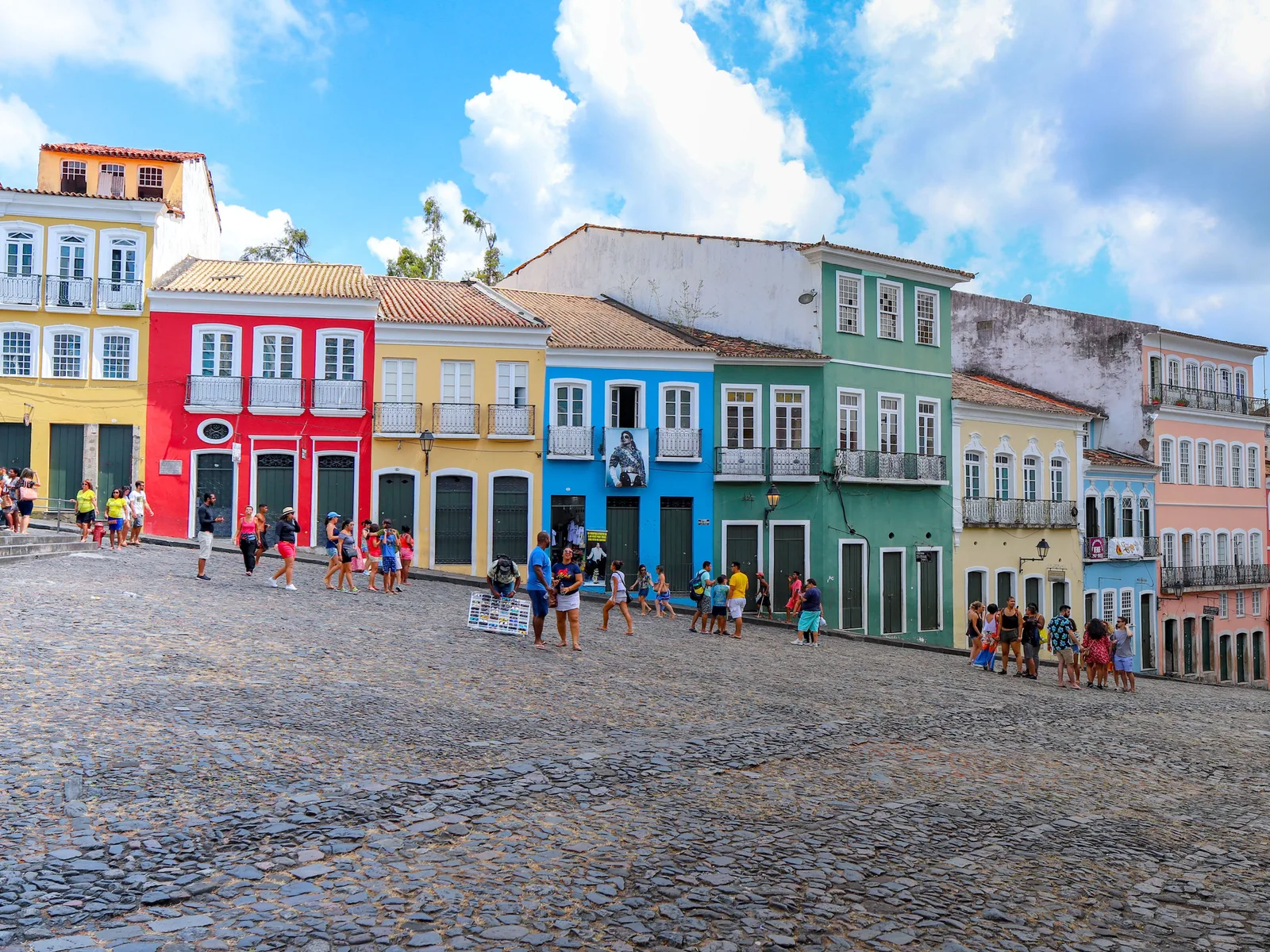
    The wide cobbled expanse of the Largo do Pelourinho under a bright sky, one side lined with red, yellow, blue and green colonial townhouses, visitors crossing the stones in front of them

    Pelourinho & Centro Histórico

    The upper city, on foot

    Start at the Terreiro de Jesus, work down the slope through the churches and the Carybé panels, and stay into the evening for whatever is playing in the squares. Ride back rather than walk.

  2. 02
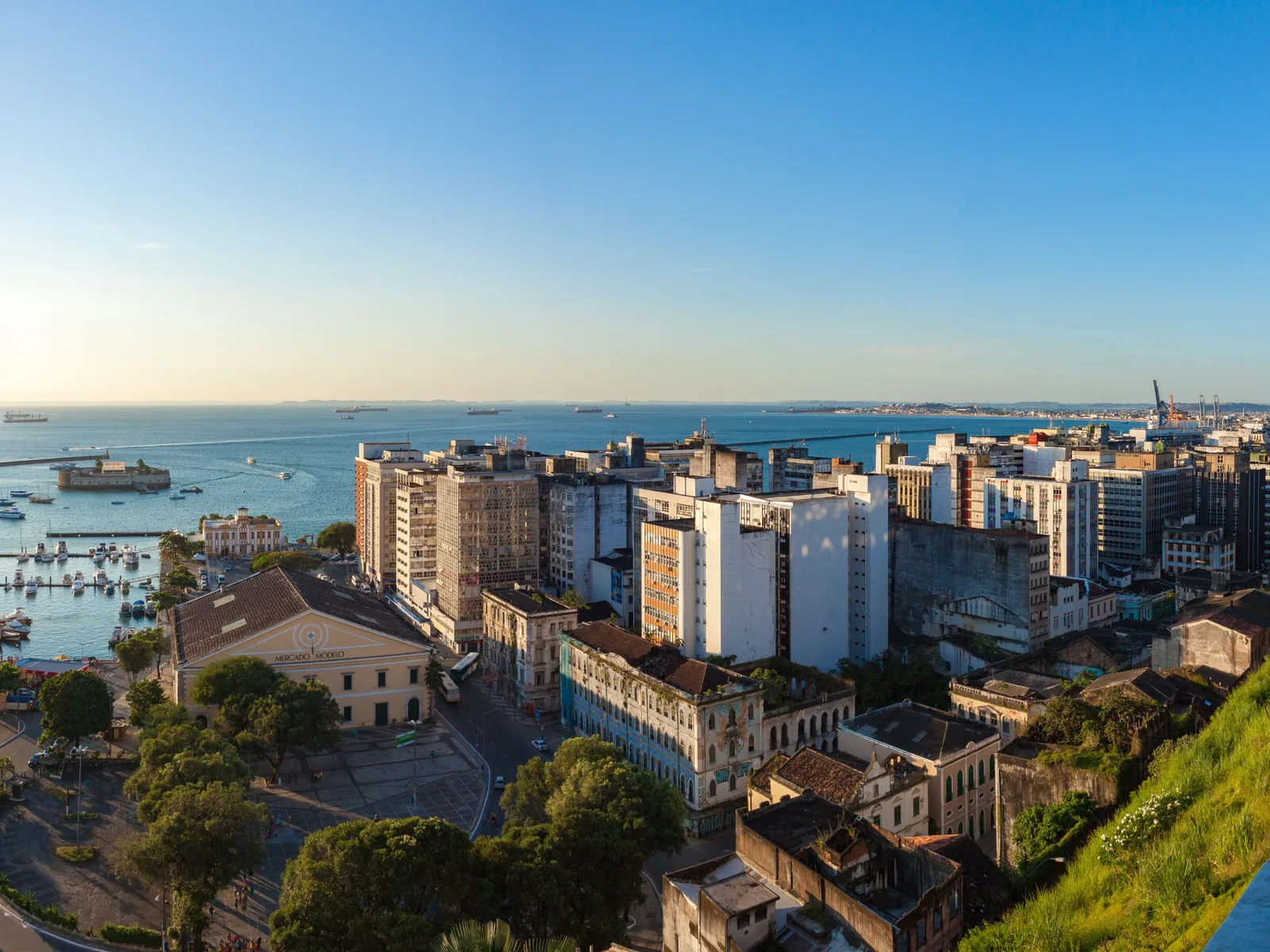
    The Bay of All Saints in the late afternoon from the top of the cliff: the marina below packed with moored boats, the yellow Mercado Modelo and the office blocks of the lower city along the shore, and cargo ships out on the open water

    Cidade Baixa & Bonfim

    Down the cliff, and around the bay

    The Elevador down to the Mercado Modelo, out along the Itapagipe peninsula to the Bonfim and its ribbons, and back for the Saturday jazz and the sunset at the Solar do Unhão.

  3. 03
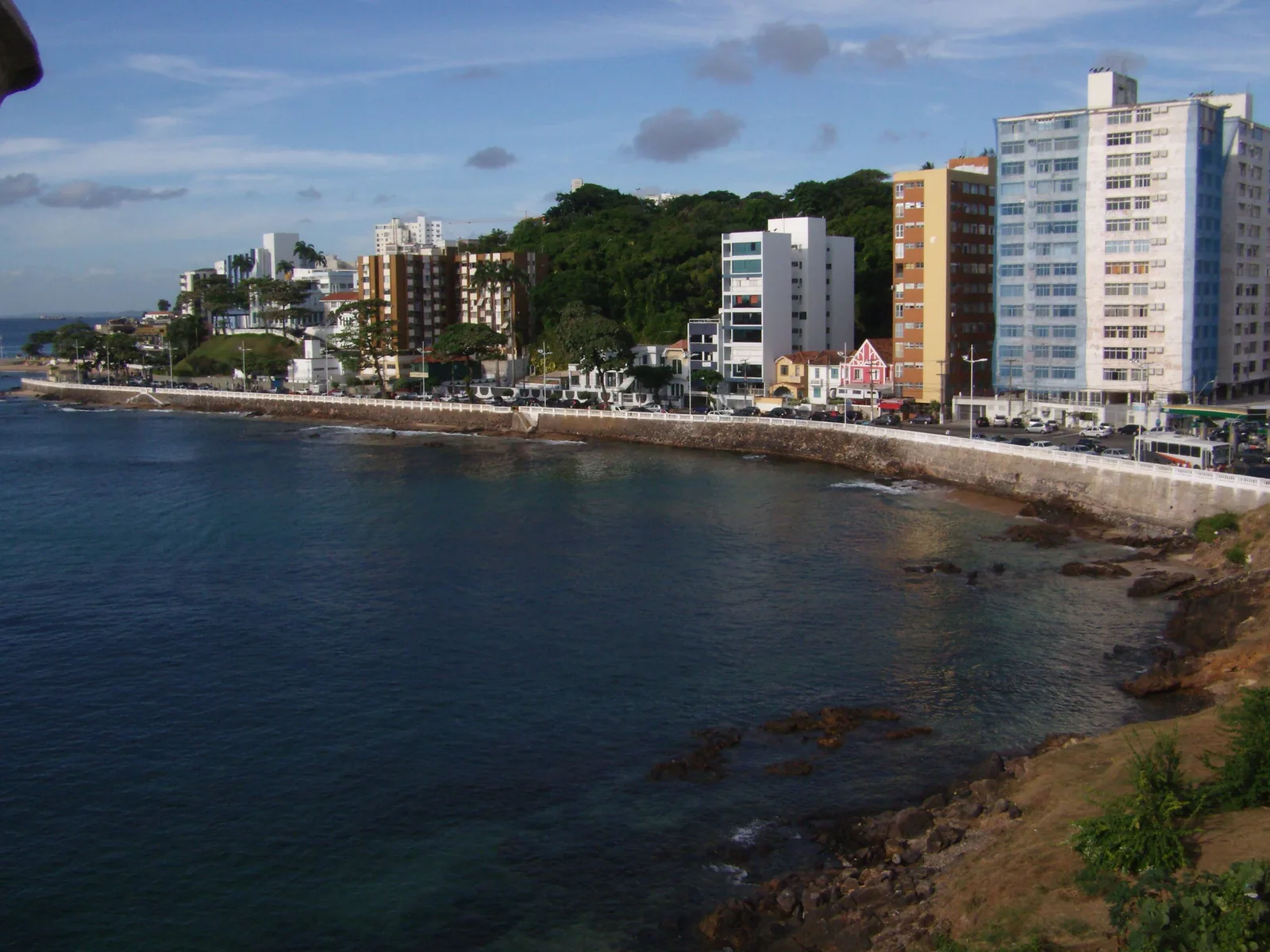
    The seafront north of Barra seen from the fort at the point: the Avenida Oceânica curving along a rocky shore below a line of apartment blocks, with flat blue water in the foreground

    Barra to Rio Vermelho

    The ocean end, and a night out

    A slow morning at Porto da Barra, the fort and the nautical museum at the lighthouse, then east along the coast to Rio Vermelho for acarajé at the Largo de Santana and an evening in the squares.

  4. 04
    A wooden two-masted schooner with a blue awning lying at anchor in clear green water off Itaparica, a low unbroken line of coconut palms along the shore behind it

    The bay, or the coast road

    Out of the city

    The flexible day. A schooner across the Bay of All Saints, the ferry to Itaparica, or the Linha Verde north to the turtles and the reef pools at Praia do Forte.

This is a starting shape, not a fixed departure — we rearrange it around your dates. Have it built for you

Timing

Warm all year. The variable is rain.

Salvador is 13 degrees south of the equator and the temperature barely moves: every month of the year runs to a high somewhere between 26 and 31 degrees, and the sea never drops below 25. What changes is the sky. The rain here falls in autumn and early winter — April, May and June are the wet months, not January — which is the reverse of Rio and catches out almost everyone.

How good each month is in Salvador. Choose a month for its average air and sea temperatures, rainfall and what the city is like then.

January

Good
Air
24–31°C 75–88°F
Sea
27°C 81°F
UV
10 Very high
Rain
9 days 77 mm / 3.0 in

Hot, bright and among the driest months. Peak beach season, and the run-up to Carnival.

February

Best
Air
24–31°C 75–88°F
Sea
28°C 82°F
UV
10 Very high
Rain
9 days 99 mm / 3.9 in

Hot, still mostly dry, and usually Carnival — six days that redefine the whole month.

March

Good
Air
24–31°C 75–88°F
Sea
28°C 82°F
UV
10 Very high
Rain
11 days 147 mm / 5.8 in

The warmest sea of the year, and the rain starting to build toward the wet season.

April

Trade-offs
Air
24–30°C 75–86°F
Sea
28°C 82°F
UV
8 Very high
Rain
16 days 285 mm / 11.2 in

One of the two wettest months. Real downpours rather than passing showers, and sixteen wet days.

May

Trade-offs
Air
23–28°C 73–82°F
Sea
27°C 81°F
UV
7 High
Rain
18 days 302 mm / 11.9 in

The wettest month of the year. Warm and green, and no month for a beach-first trip.

June

Trade-offs
Air
22–27°C 72–81°F
Sea
26°C 79°F
UV
6 High
Rain
19 days 238 mm / 9.4 in

Still wet, and the coolest stretch of the year. Festa Junina fills Bahia with bonfires and forró.

July

Trade-offs
Air
21–27°C 70–81°F
Sea
26°C 79°F
UV
6 High
Rain
18 days 194 mm / 7.6 in

The rain easing, the nights at their coolest around 21 degrees, and Brazilian school holidays.

August

Trade-offs
Air
21–27°C 70–81°F
Sea
25°C 77°F
UV
7 High
Rain
16 days 130 mm / 5.1 in

The tail of the rains: showery, warm, quiet, and the coolest sea of the year at 25 degrees.

September

Good
Air
22–28°C 72–82°F
Sea
25°C 77°F
UV
9 Very high
Rain
11 days 99 mm / 3.9 in

The dry season resumes at 99 mm across eleven wet days. Warm, bright, and a step behind October.

October

Best
Air
23–29°C 73–84°F
Sea
26°C 79°F
UV
10 Very high
Rain
8 days 91 mm / 3.6 in

Dry, warming, and only eight wet days.

November

Good
Air
23–30°C 73–86°F
Sea
26°C 79°F
UV
9 Very high
Rain
8 days 108 mm / 4.3 in

Hot and comfortable with slightly more rain, and the last month before holiday prices.

December

Good
Air
24–31°C 75–88°F
Sea
27°C 81°F
UV
10 Very high
Rain
7 days 63 mm / 2.5 in

The driest month of the year. Quiet and hot until about the 20th, then the holidays arrive.

  • Best The one or two peak months
  • Good A real recommendation
  • Trade-offs Workable, with a catch
See Salvador on the Brazil calendar

UV is the monthly average of the daily peak, 2022 to 2025, calculated from Copernicus Atmosphere Monitoring Service data. Weather data by Open-Meteo.com, CC BY 4.0.

For sun and space

September–December

The dry season with none of the crowd. Warm, bright, low rainfall, a sea at 25 to 27 degrees, and rooms at ordinary prices. October is the pick on the figures: 91 mm across eight wet days and 227 hours of sun, second only to January.

For Carnival

February

The biggest street party in the world takes over the whole city for six days. Hot and mostly dry — and a completely different trip, at completely different prices.

The wet months

April–July

Salvador’s rain lands here, not in summer. April to June average 240 to 300 mm across sixteen to nineteen wet days. Still warm, still worth going — but plan indoor days.

About the rain

The single most useful thing to know about Salvador’s weather is that it inverts the pattern most visitors bring with them. Rio is wettest in January and driest in July; Salvador is the other way round. December averages 63 mm across seven wet days and May averages 302 mm across eighteen — nearly five times as much, in what a North American calendar would call late spring. The wet season runs roughly April to July, and it rains in long gray stretches rather than the violent hour-long thunderstorms of the southeast.

None of that makes the wet months unusable. It is still 27 degrees, the sea is still 26, and the city’s best things — the museums, the churches, the drumming, the food, the Festa Junina in June — are indoors or happen anyway. But if the trip is built around beaches and boats, the crossing to Morro de São Paulo gets rerouted the long way round in rough weather between May and August, and September to December is the window that reliably delivers what people picture.

The dates worth planning around

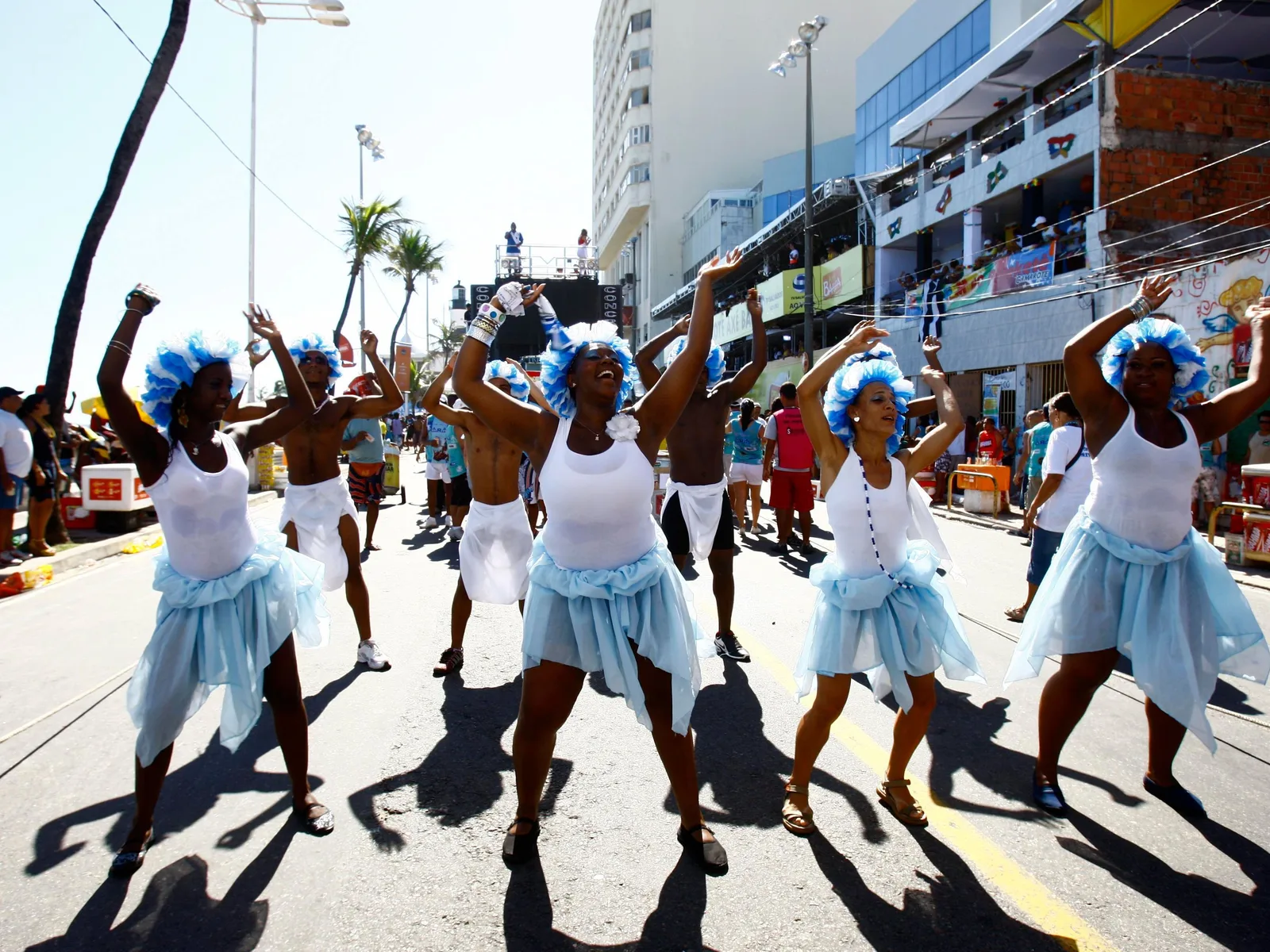
Dancers in white vests and pale blue skirts leading a bloco up the middle of Salvador’s Barra–Ondina Carnival circuit in hard daylight, a sound truck and the tiered spectator boxes lining the avenue behind them

Carnaval

Six days in February, moving with Easter — February 4–10 in 2027

Structurally nothing like Rio’s. There is no sambadrome, no parade to buy a seat at and no competition to judge. Instead there are trios elétricos — articulated trucks carrying a band on the roof and a wall of speakers down the sides, an idea invented here in 1950 — moving at walking pace along three street circuits with the crowd around them. The Circuito Dodô runs 4.5 km of seafront from the Farol da Barra to Ondina and is the loudest and most commercial; the Circuito Osmar, from Campo Grande to the Praça Castro Alves, is the older and more traditional one; the Circuito Batatinha in the Pelourinho has no trios at all, just afro blocos, marchinhas and drums. You experience it in one of three ways: pipoca, free, in the street with everyone; in a bloco, having bought an abadá shirt that gets you inside the rope escorting one trio; or in a camarote, a ticketed grandstand with a bar and a bathroom. Guinness has it as the largest street party on earth, and around two million people a day is the usual estimate.

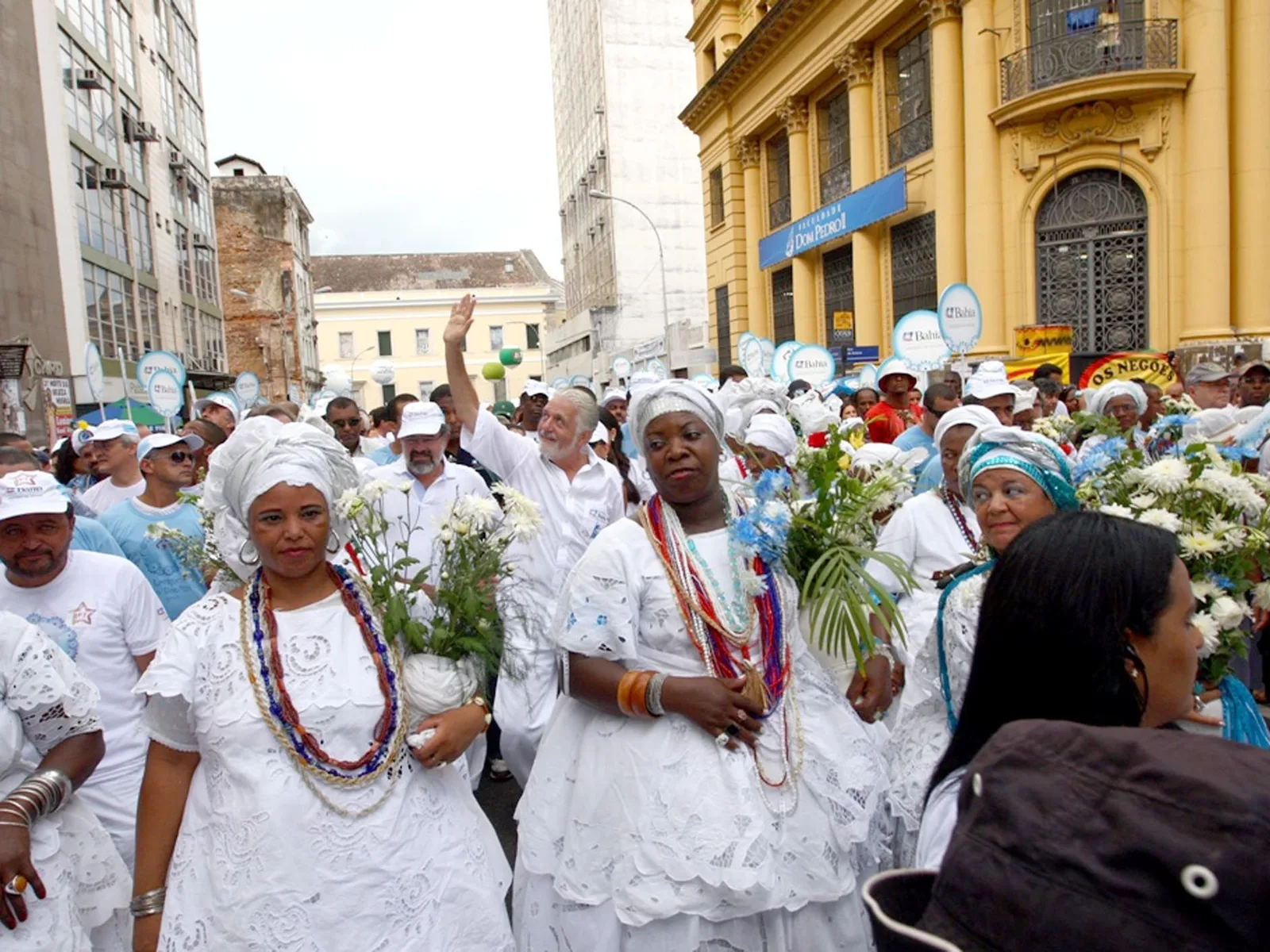
Baianas in white lace dresses, headwraps and layered beads carrying armfuls of white flowers through the Lavagem do Bonfim procession, the crowd dressed in white filling the street behind them

Lavagem do Bonfim

The second Thursday of January

A procession of eight kilometers from the Conceição da Praia church in the Cidade Baixa up to the Igreja do Senhor do Bonfim, led by baianas in white lace carrying clay jars of scented water, who wash the church steps on arrival in a rite that is Catholic and Candomblé at the same time. Several hundred thousand people walk it, most of them dressed in white, with trios and drums along the route and a party on the hill that runs for the rest of the day. It is the second-largest event in Salvador’s calendar after Carnival and far less known outside Brazil.

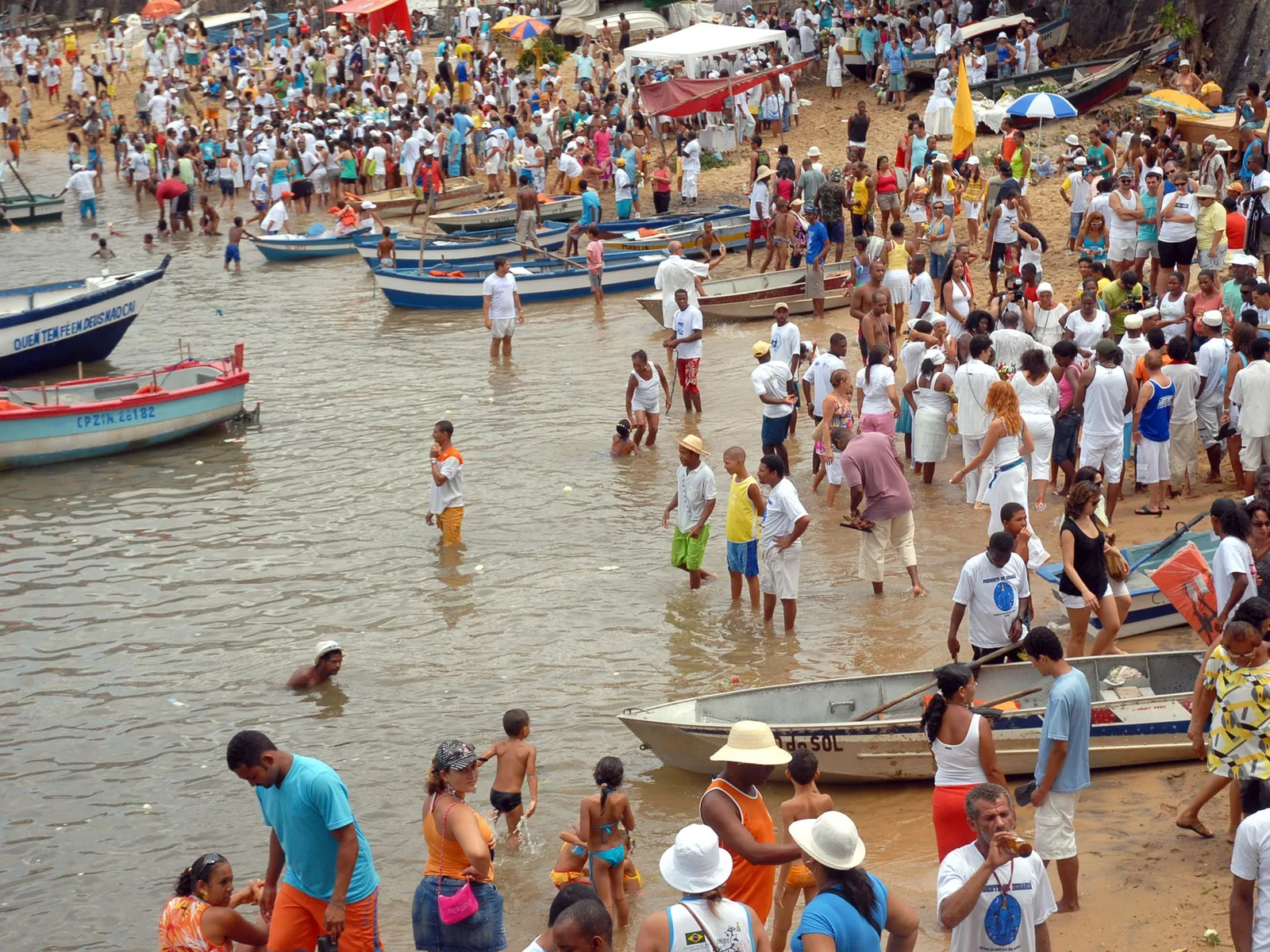
The beach at Rio Vermelho on the day of the Festa de Iemanjá: wooden fishing boats drawn up at the water’s edge, people wading out to them, and the sand behind packed with a crowd mostly dressed in white

Festa de Iemanjá

February 2

The largest public Candomblé celebration in Bahia, and it happens on one beach: Rio Vermelho, at the Casa de Iemanjá by the fishermen’s colony. Through the day people bring gifts for the queen of the sea — flowers, perfume, mirrors, combs, letters — which are loaded into baskets and taken out beyond the surf by fishing boats to be given to the water. Around it the neighborhood turns into a street party that runs until the small hours. Wear white, do not photograph people mid-offering without asking, and expect to be moved by it more than you planned.

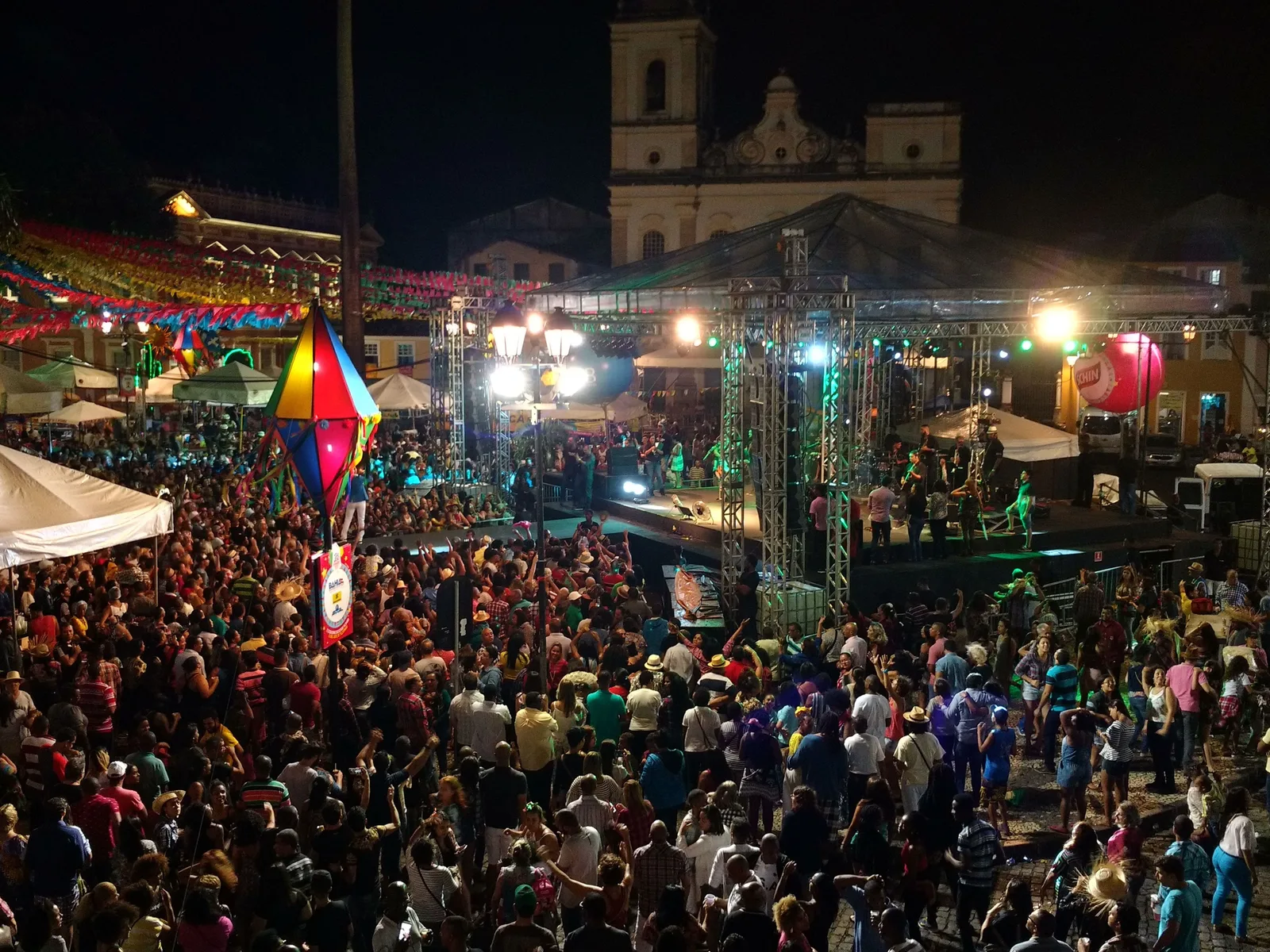
São João night on the Terreiro de Jesus: strings of paper bunting and a big striped balloon lantern over the square, a lit stage at the far side, and a crowd filling the cobbles in front of the cathedral

São João and the Festas Juninas

Through June, peaking June 23–24

Bahia takes the June festivals more seriously than almost anywhere in Brazil, and the state government funds programming in nearly 300 municipalities. The soundtrack is forró rather than axé, the food is corn in every form, there are bonfires and quadrilha dancing, and the best of it is inland rather than in Salvador — Amargosa, Cruz das Almas and Cachoeira all run several days of it. It falls in the wettest stretch of the year, which is the trade, and it is the most purely Brazilian party on this calendar.

Good to know

Before you come

Is Salvador safe for tourists? +

It asks more of you than anywhere else on this site, and it is manageable. The statistic is real: Salvador has the highest homicide rate of any Brazilian state capital. Almost all of that is concentrated in peripheral neighborhoods a visitor has no reason to enter, and it is not directed at outsiders. The risk you actually face is robbery, and it is common enough that the standard advice here is not optional. In practice that means: keep the phone in your pocket on the street, wear no watch and no chain, carry a card and a little cash and nothing else, use Uber or 99 between neighborhoods and always at night, treat the Pelourinho and the Cidade Baixa as daytime places unless there is a crowd and programming, and stay off every beach after dark. Barra and Rio Vermelho are the two areas where walking around in the evening is normal. Do those things and the overwhelming likelihood is a trip with no incident at all.

How many days do I need in Salvador? +

Four is the honest number, which is why the itinerary above is built that way. The historic center is a full day on its own, the Cidade Baixa and the Bonfim are another, the ocean coast and Rio Vermelho are a third, and the fourth gets you out of the city — the bay, Itaparica or Praia do Forte. Three days covers the city and leaves out the coast, which is a real loss in a place with fifty kilometers of it. Five or six lets you slow down, add a second day out, and see the historic center twice, which it rewards — daytime and a music night are not the same place.

Where should I stay in Salvador? +

Barra for a first visit: it has the two swimmable beaches, a lit and patrolled seafront, hotels at every price, and a short ride to everything else. Rio Vermelho is the alternative if eating and drinking well matters more to you than swimming — the best restaurants and the best live music in the city, and a rocky shoreline. The Pelourinho is the most atmospheric place to sleep and the least practical, and works best as two or three nights inside a longer stay rather than the whole trip. The northern beaches at Itapuã and Stella Maris are for a resort week with a day or two of city attached, not the reverse. What almost nobody should do is book in the Cidade Baixa, which empties out completely at night.

How does Carnival in Salvador work — do I need a ticket? +

No, and that is the main difference from Rio. There is no sambadrome and no parade to buy a seat at. Salvador’s Carnival is trios elétricos — trucks carrying a band and a wall of speakers — moving slowly along three street circuits over six days, with the crowd around them. You can simply turn up and stand in the street: that is called pipoca, it is free, and it is how most of the two million people a day do it. If you want to be inside the roped-off area escorting one trio you buy an abadá, a shirt sold per bloco per day that functions as the ticket. If you want a bathroom, a bar and a place to sit you buy a camarote, a grandstand ticket, which is the expensive option. What you do need to book far ahead is a room: Carnival accommodation goes for three to four times normal rates with minimum stays of five to seven nights, and the places on the Barra–Ondina circuit sell out months out.

When is the best time to visit Salvador? +

September to December, if the weather is what you are optimizing for, and October is the pick of it. That stretch is warm, dry, uncrowded and cheap by the standards of the rest of the calendar — around 90 mm of rain a month over seven or eight wet days, air in the high twenties and a sea at 25 to 27 degrees. January and February are the other good window, hot and mostly dry, with Carnival inside February and prices to match. The months to think twice about are April to July, which is Salvador’s wet season and the opposite of the pattern in Rio: May averages 302 mm across eighteen wet days. It is still warm and the city still works, but a beach-and-boat trip is the wrong trip to book then.

Keep going

Where Salvador fits in a bigger trip.

Salvador is the anchor of the Northeast and it pairs in three directions: north up the coast for the easiest beach base, south by boat to a car-free island, or on to Rio. These three are the ones that make sense with it.

Free · 29 pages

Free guide

Beginner's Guide to Brazil

A free 29-page guide to everything a first-time visitor should know before landing: visas, safety, money, getting around, where to go, and what to eat.

We'll email you a link to confirm your address. Click it and the guide opens right away.

See what's inside
Salvador at dusk from the top of the cliff: the floodlit Elevador Lacerda standing in the foreground, the Mercado Modelo and a marina full of moored boats below it, and the Bay of All Saints running out dark to the horizon

Skip the planning

See Salvador properly, without guessing at the hard parts.

Tell us your dates, your pace, and whether you are coming for Carnival, for the culture or for the coast. We will shape a private Bahia itinerary around exactly that — the right neighborhood to base in, a guide who can actually get you into a terreiro, the days out placed where the weather allows them, and the tickets bought before they sell out.

  • One person, living in Brazil, replying to you directly
  • A reply within one business day — no call center, no bots
  • No cost to plan, and no obligation to book
  • Built around your dates, not a fixed departure