
Skip to content
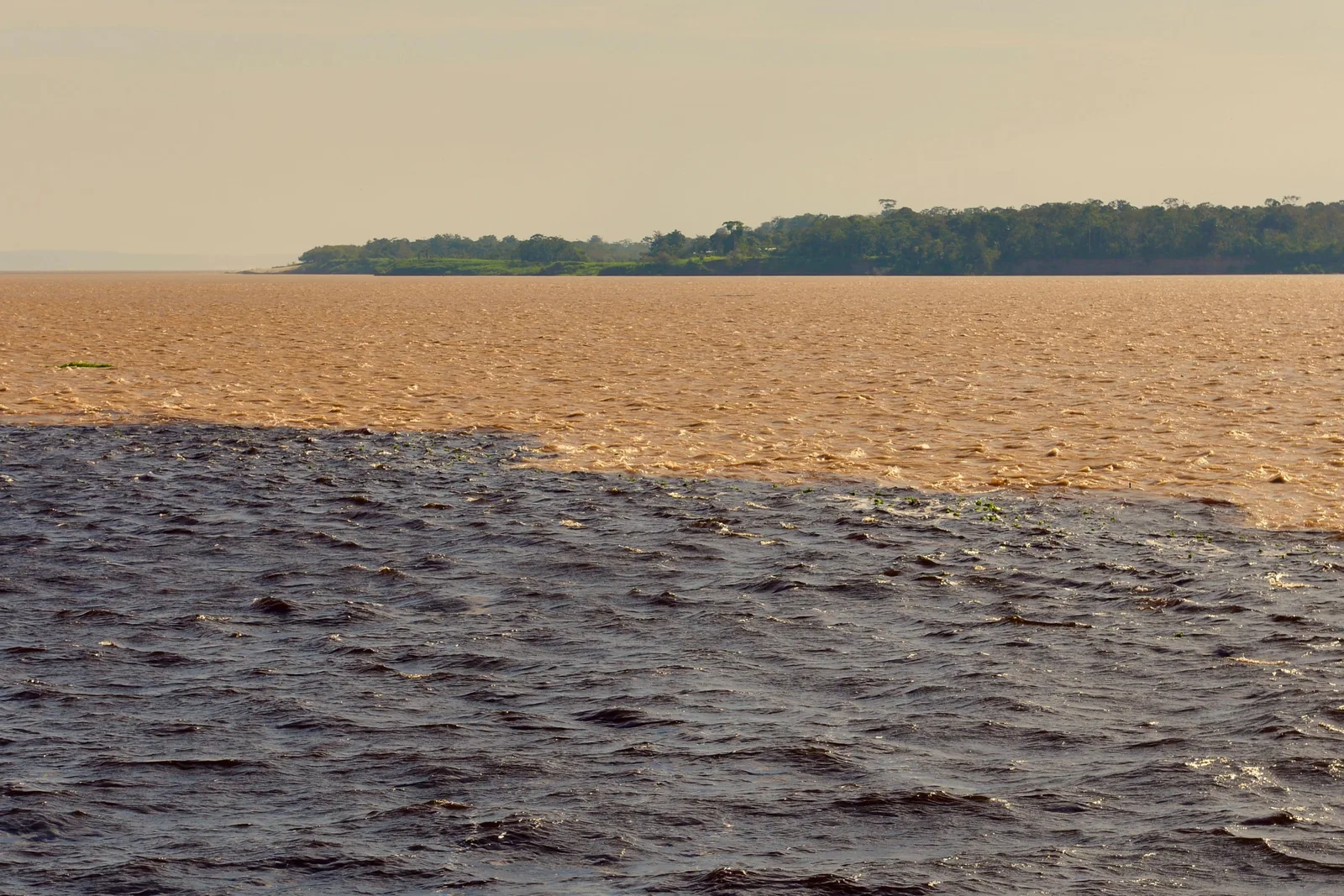
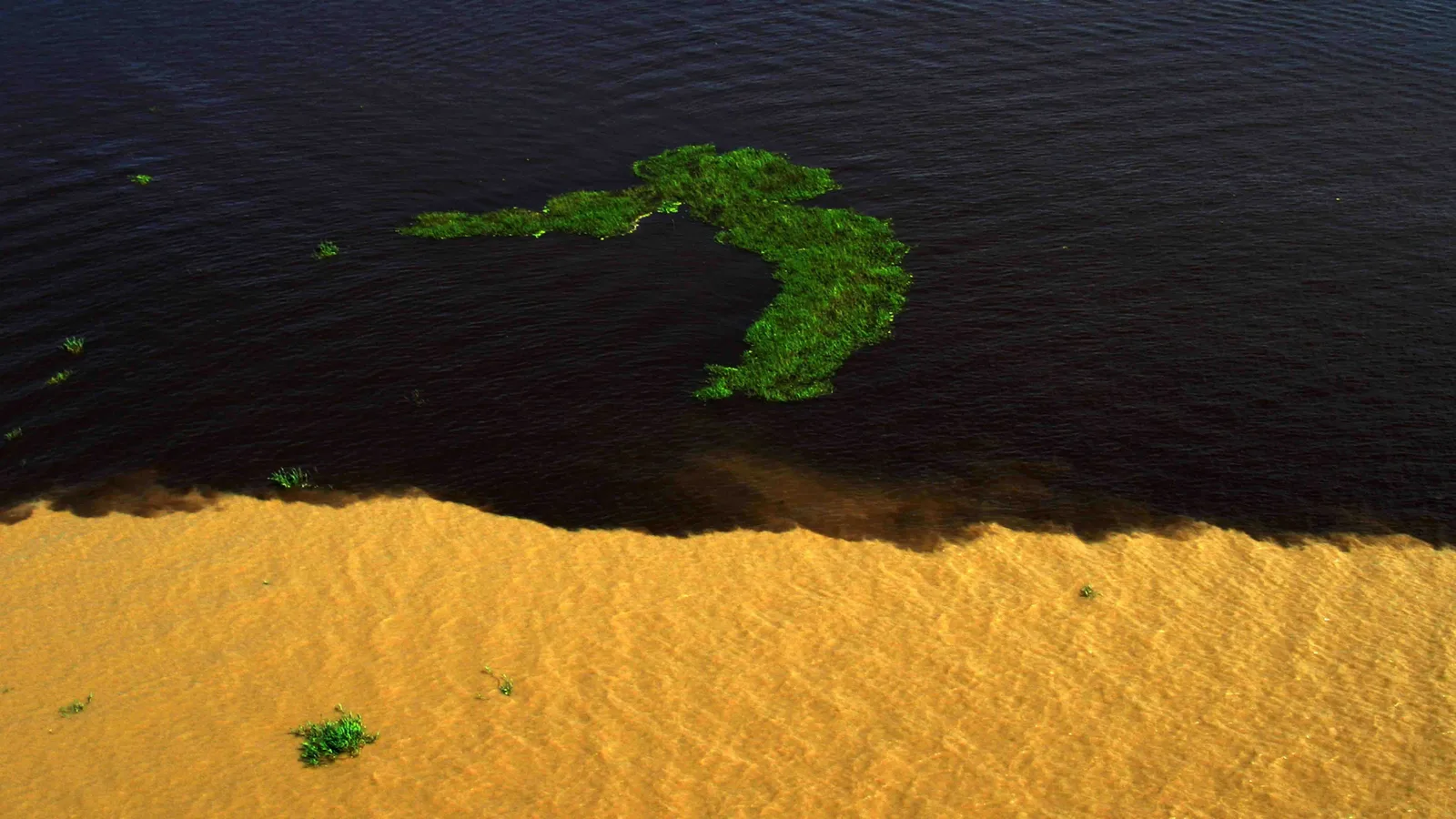
The Meeting of the Waters from directly above: near-black water across the top of the frame, opaque orange-brown water across the bottom, and a wandering line between them, with a large curl of floating green vegetation drifting on the dark side

Amazonas

The Amazon

One strange city on the river, and the forest behind it.

Last checked October 2026

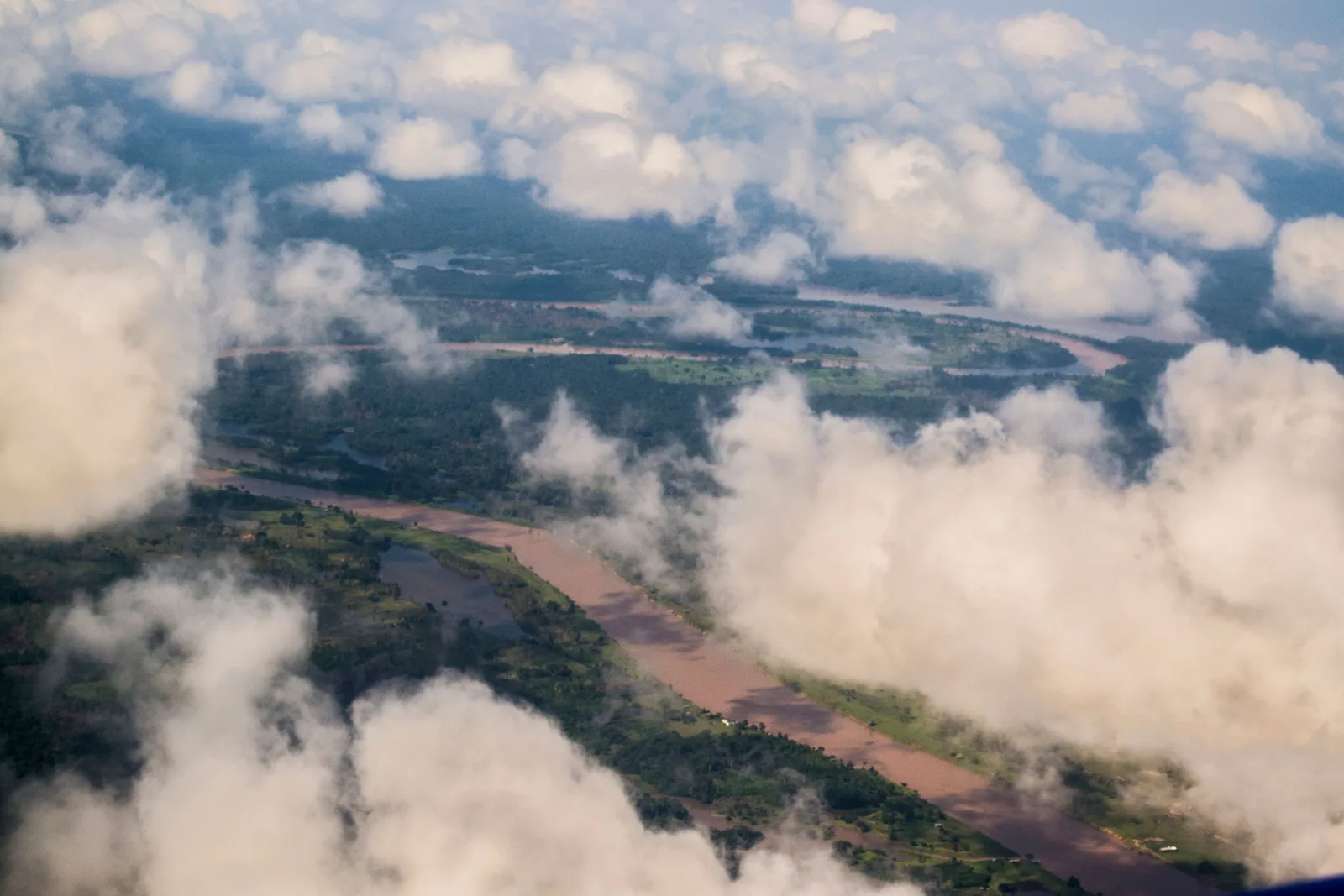
  • Low white clouds drifting over unbroken dark rainforest, a river showing through a gap in them
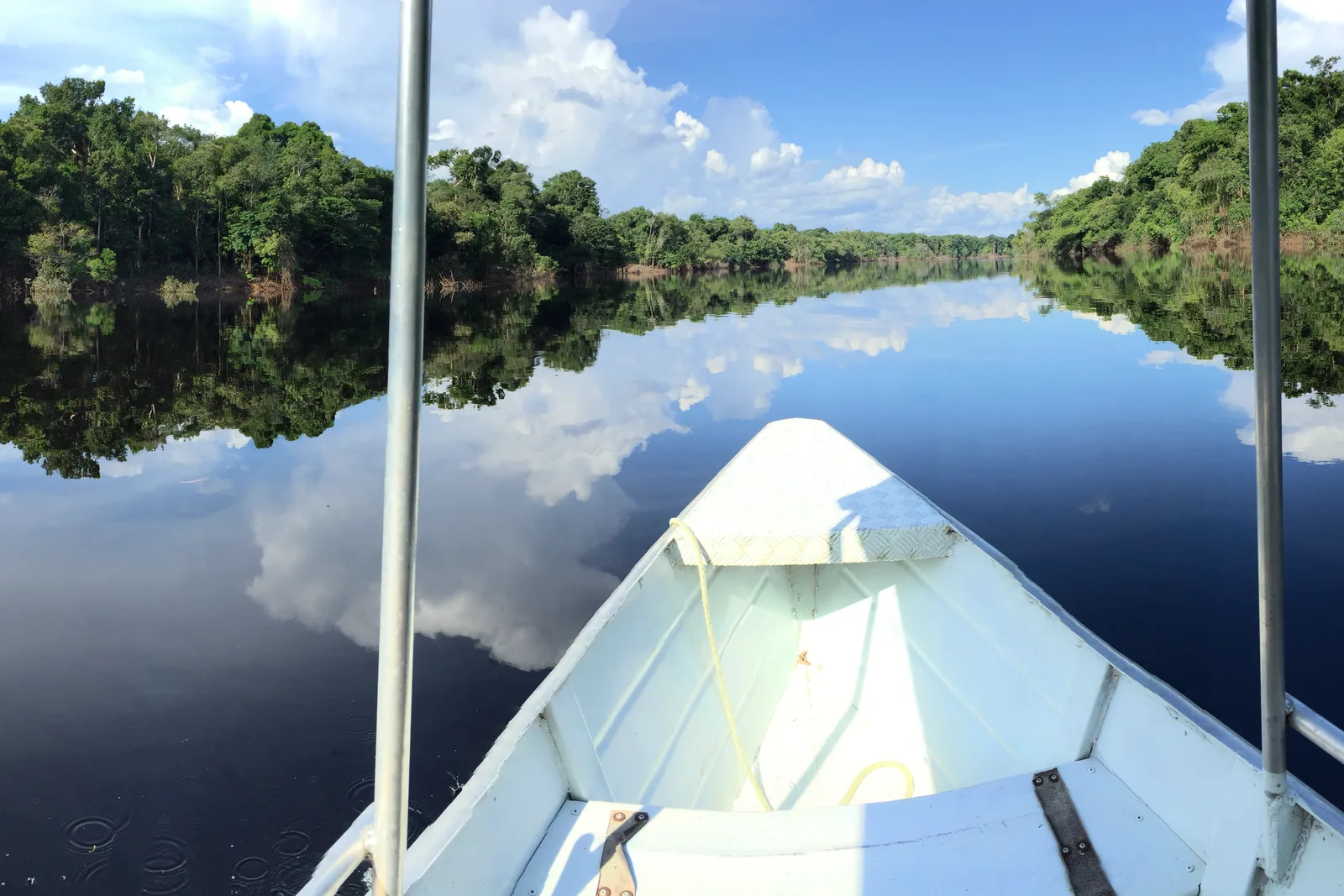
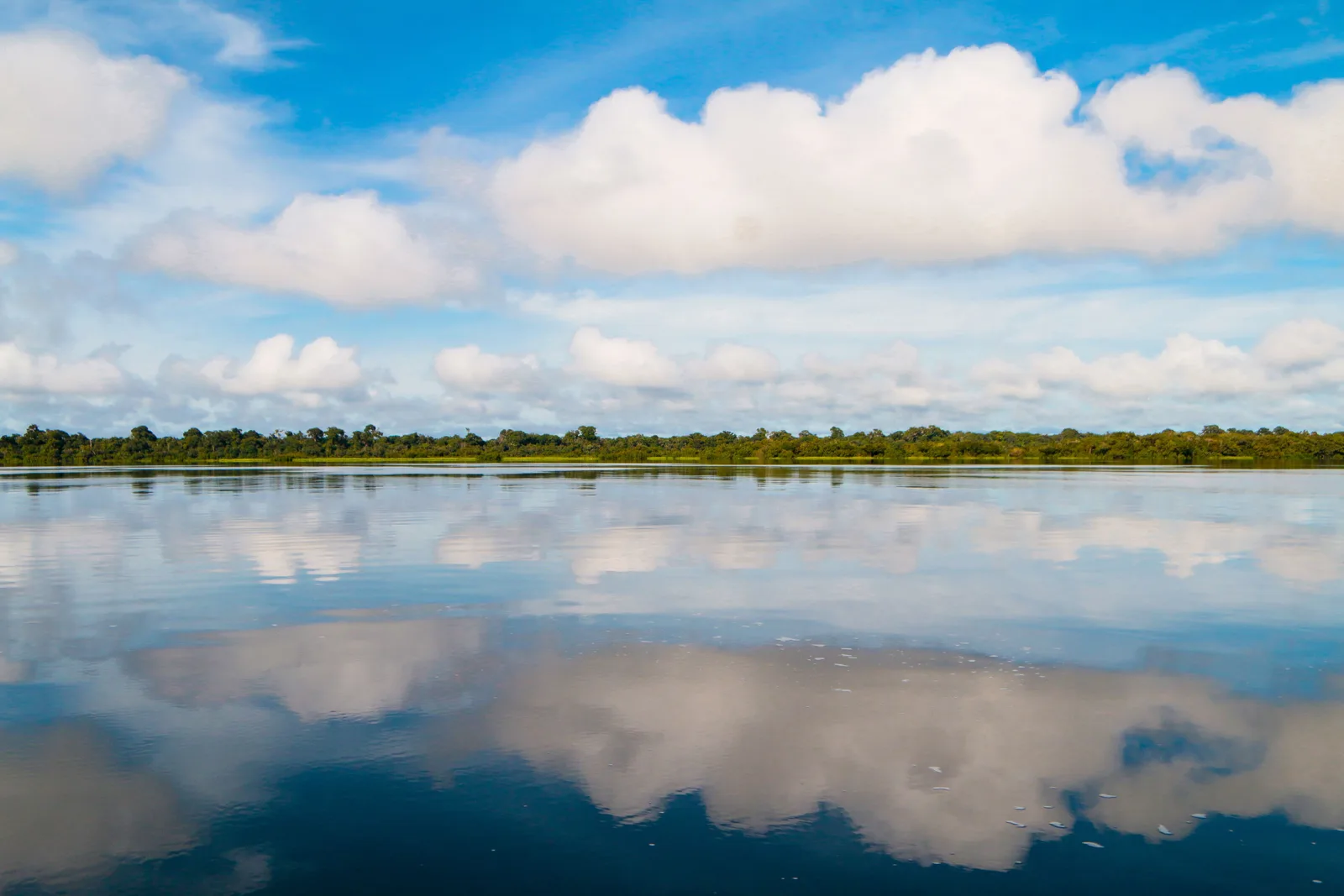
  • White cumulus scattered across a blue sky and mirrored in perfectly flat dark water, a thin green line of forest between the sky and its reflection
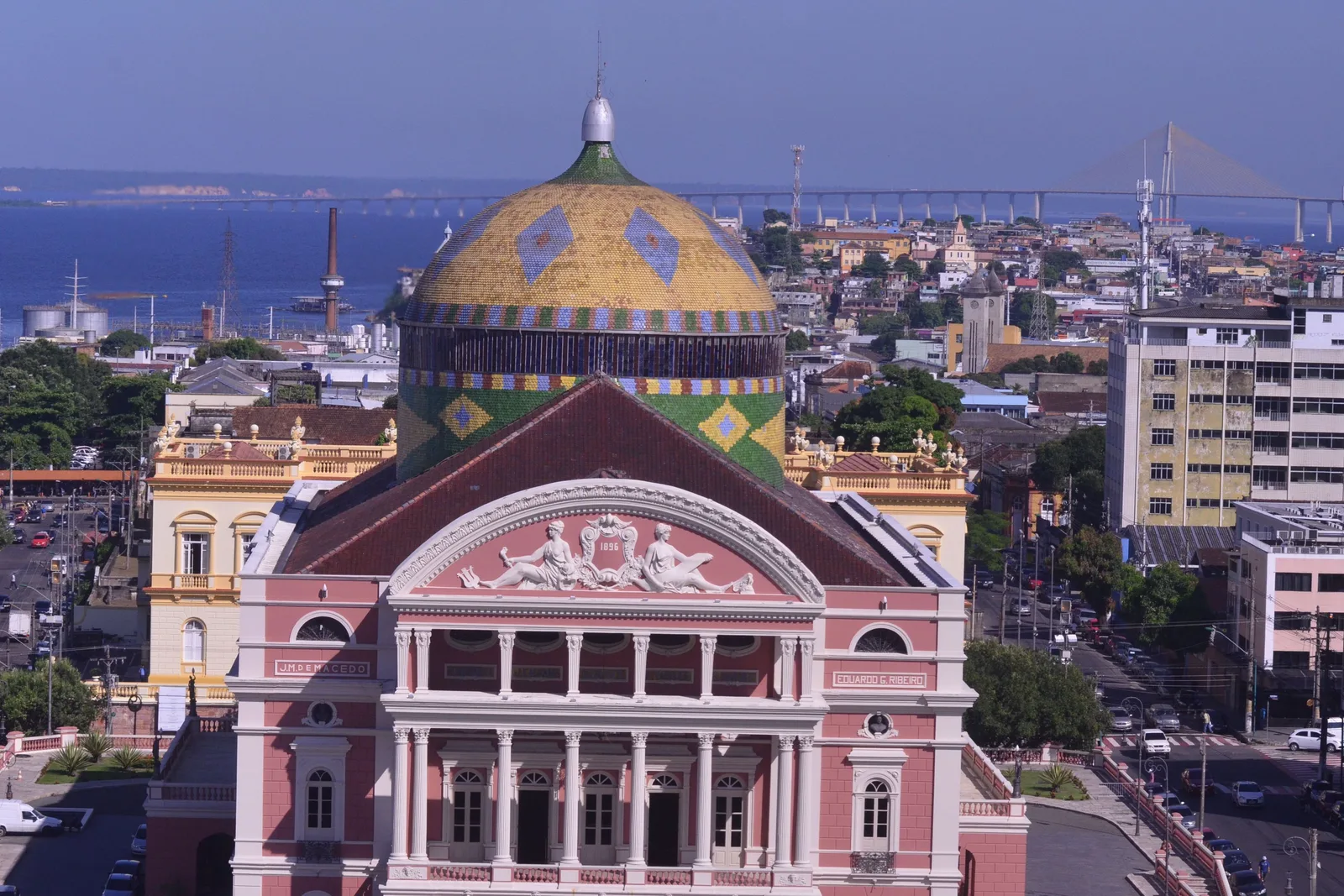
  • The Teatro Amazonas from above: its pink and cream facade and tiled dome standing among the low buildings of central Manaus, with the river beyond
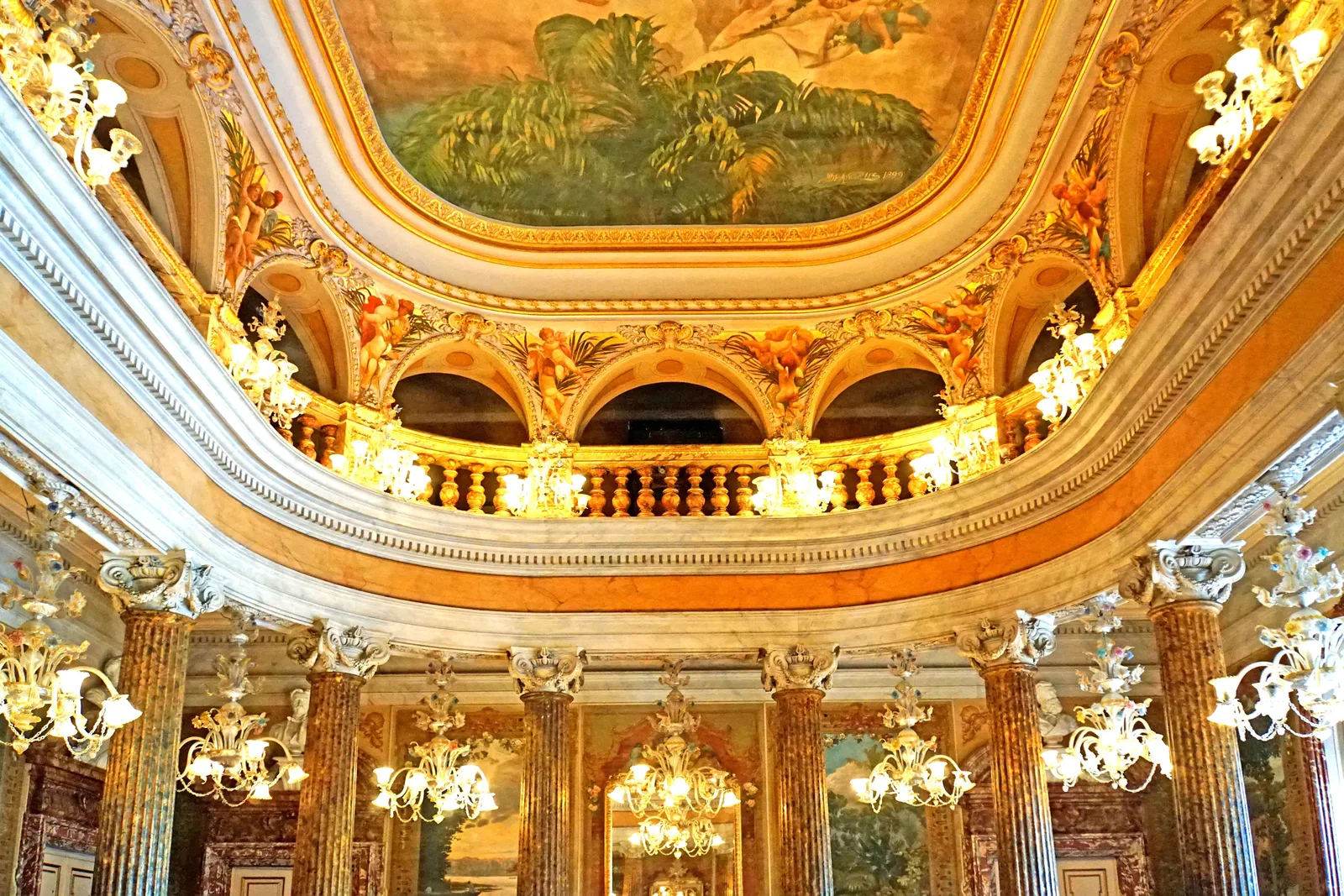
  • The gilded ceiling of the Teatro Amazonas ballroom, painted panels between columns with chandeliers hanging below
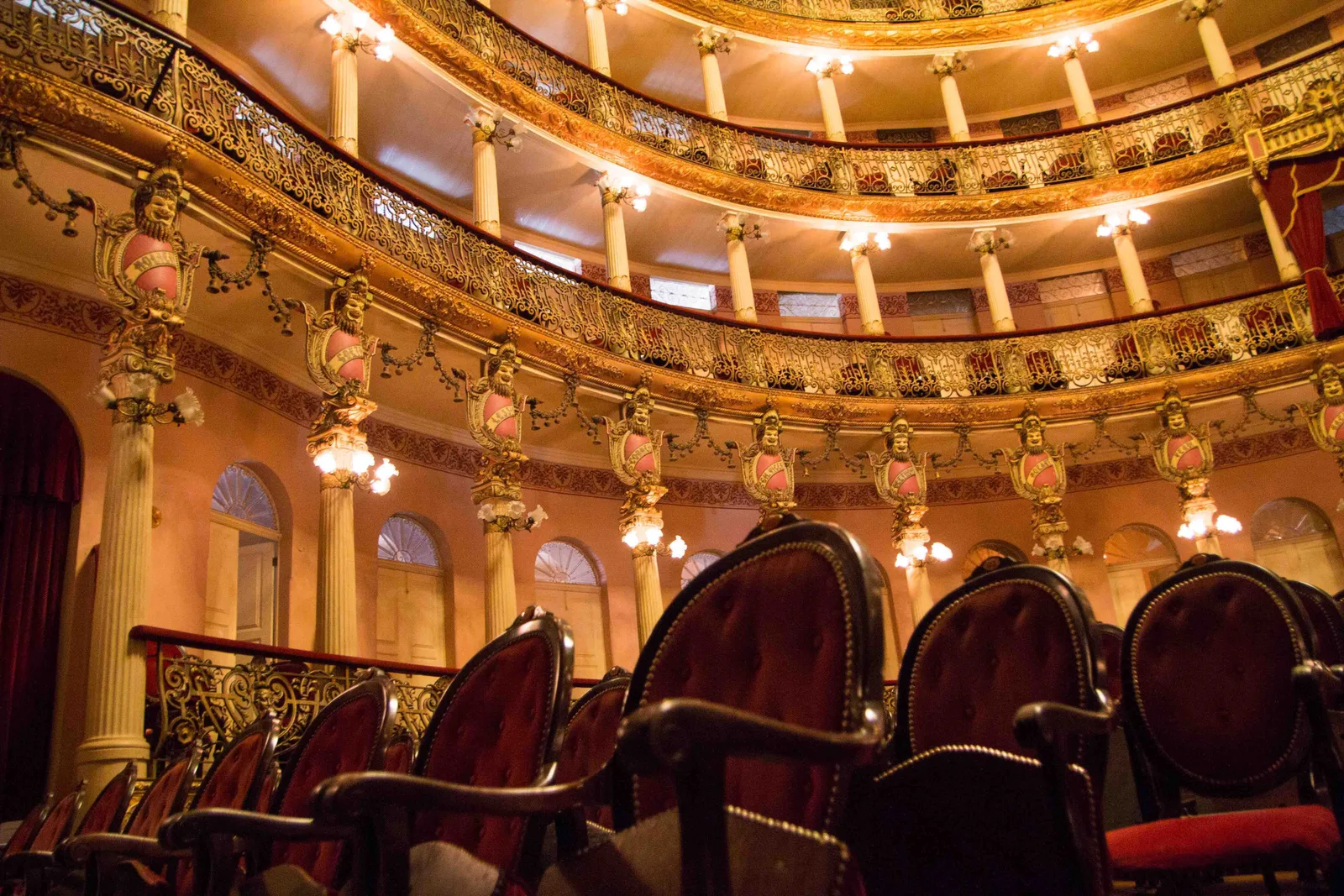
  • Tiers of boxes inside the Teatro Amazonas, red velvet chairs behind gilded balconies
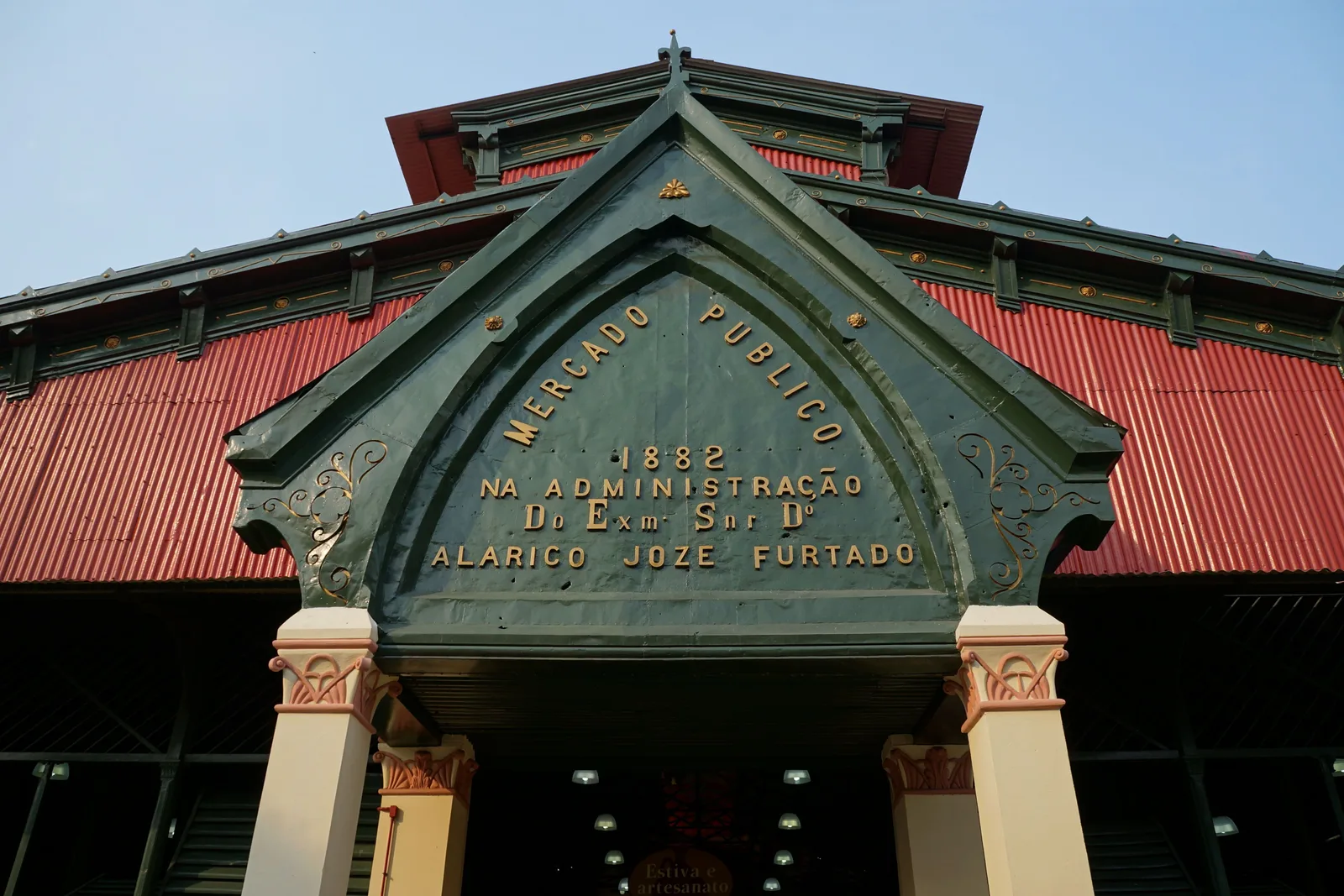
  • The green painted iron gable over the entrance of the Manaus municipal market, lettered MERCADO PUBLICO and dated 1882 in gold
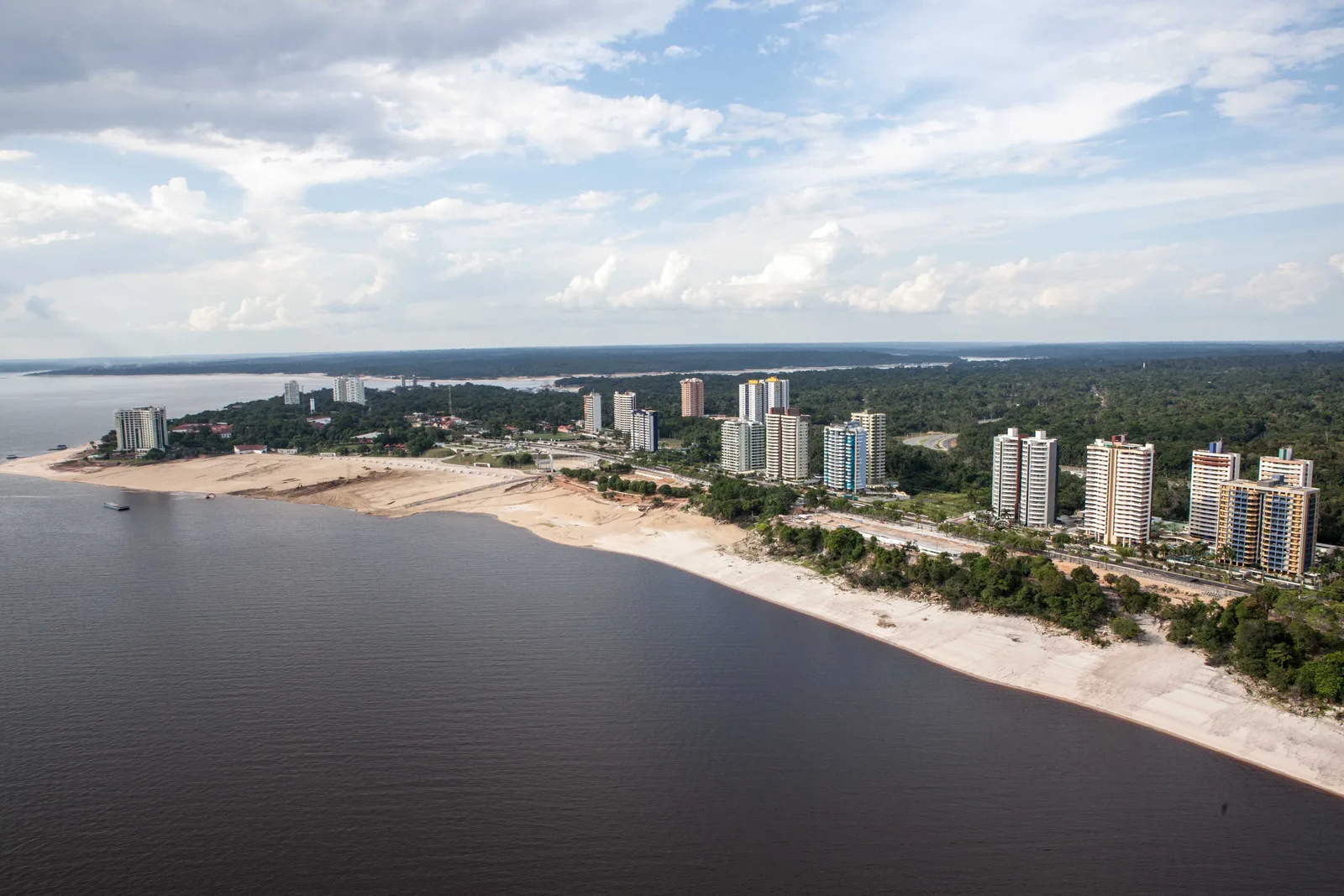
  • Ponta Negra from the air: a pale river beach curving along the shore with a line of apartment towers behind it
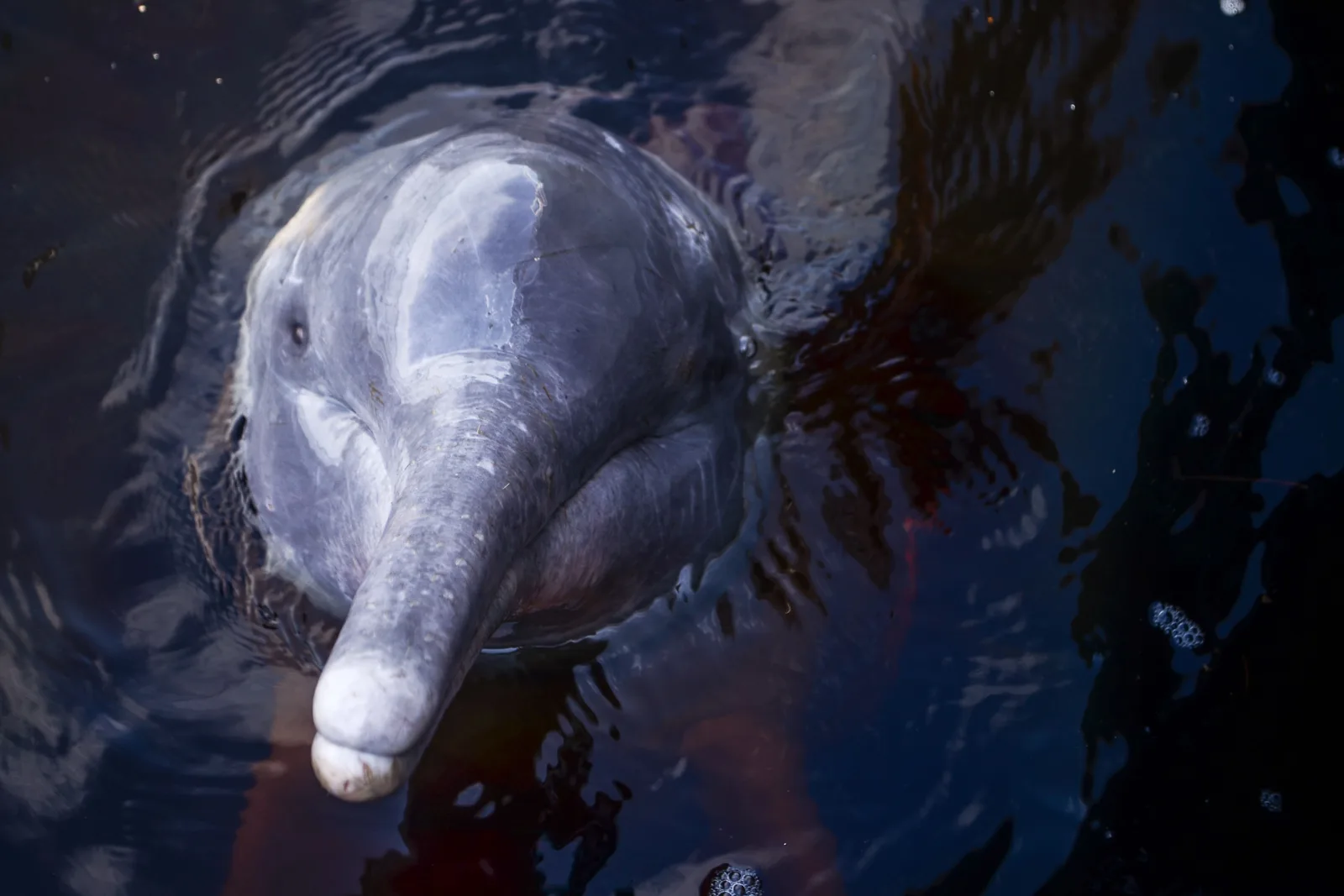
  • The head and long narrow beak of a pink river dolphin breaking the surface of dark water
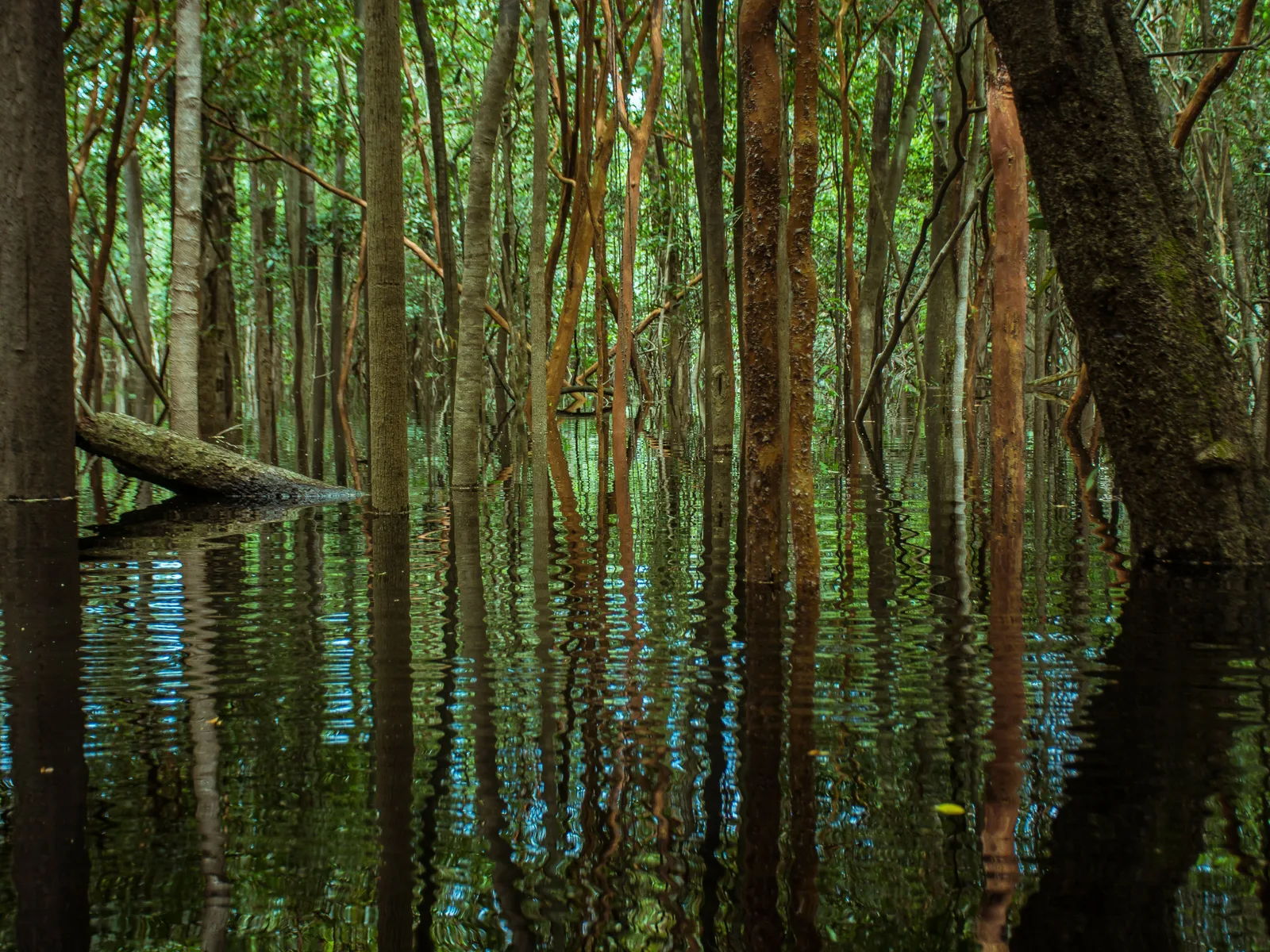
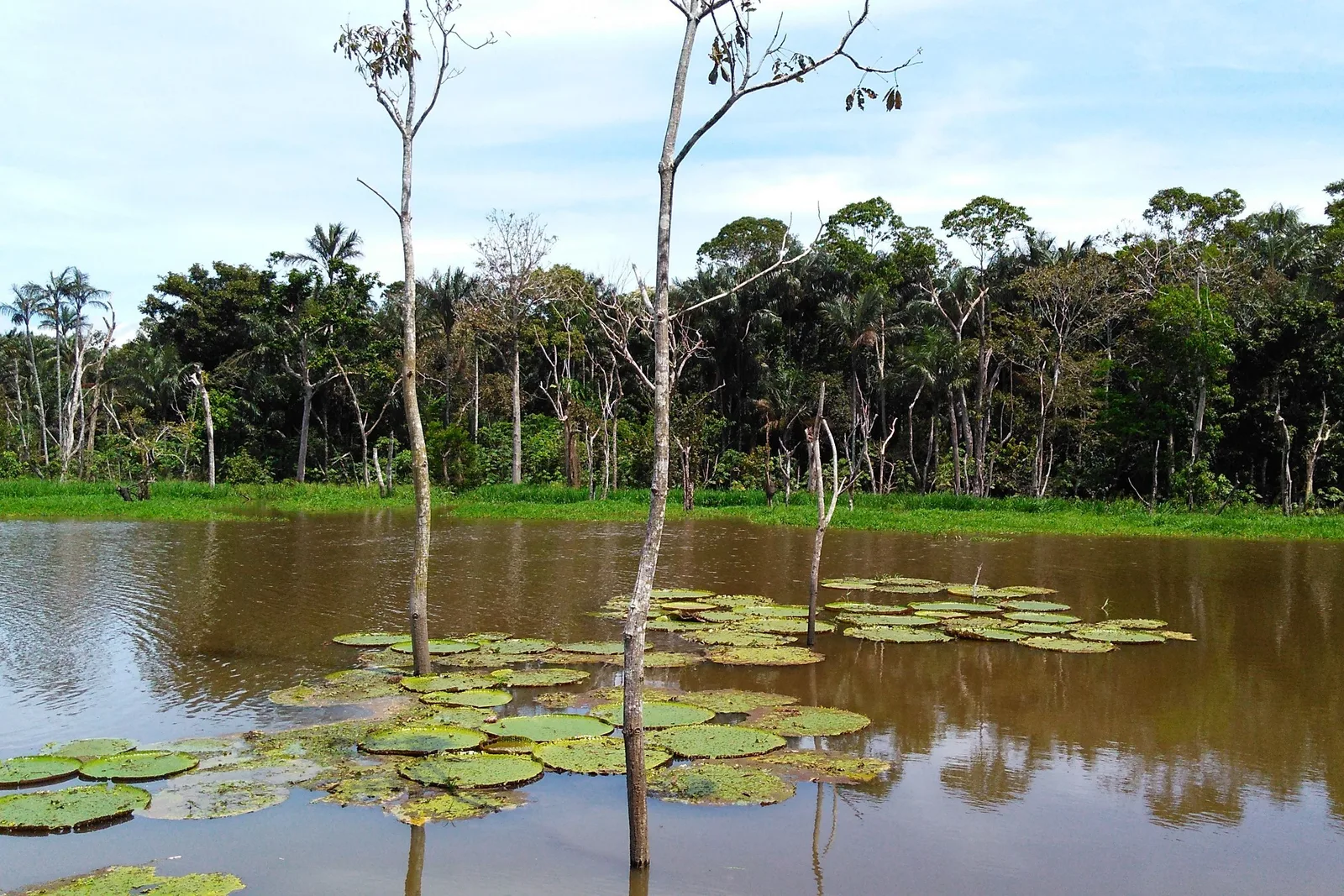
  • Flooded forest at the edge of the river: bare gray trunks standing in brown water with round lily pads spread across the surface between them
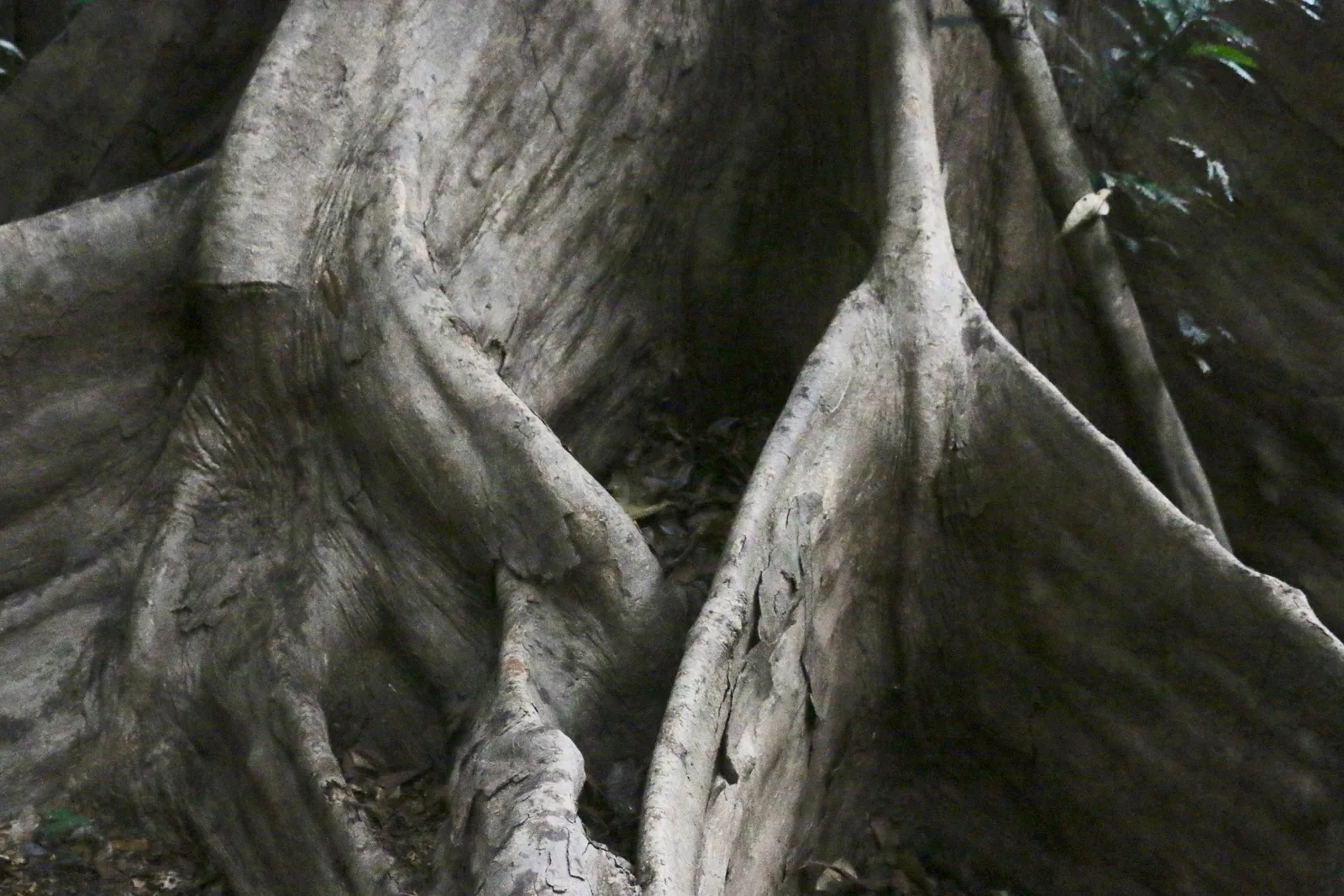
  • A black-and-white close view of the buttress roots of a rainforest tree, thin fins of wood fanning out from the trunk
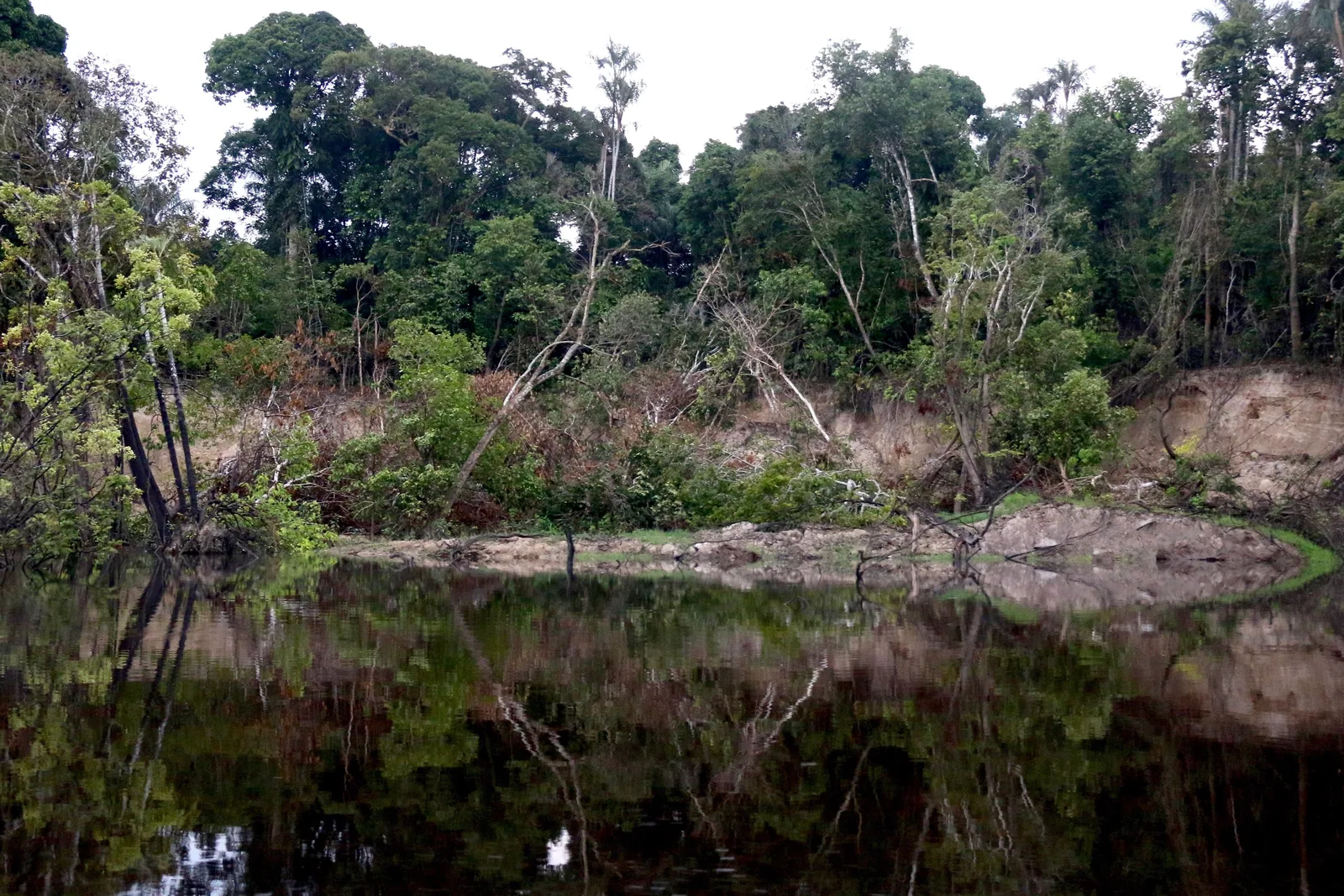
  • A bare river bank at low water, dead branches and pale sand above the waterline, the whole thing reflected in still dark water
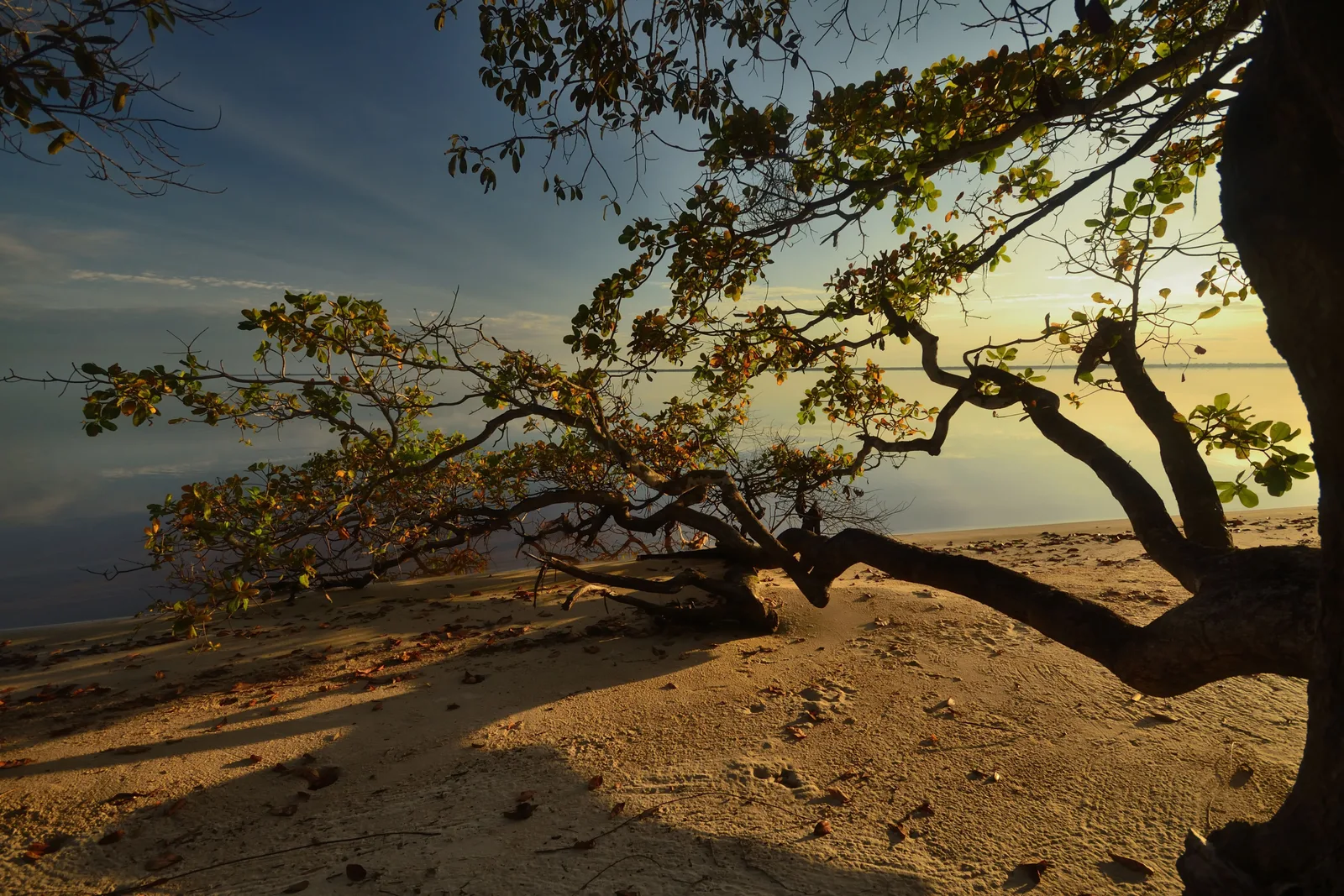
  • A tree leaning far out over a river beach at dusk, its branches spread across a pale sky above bare sand
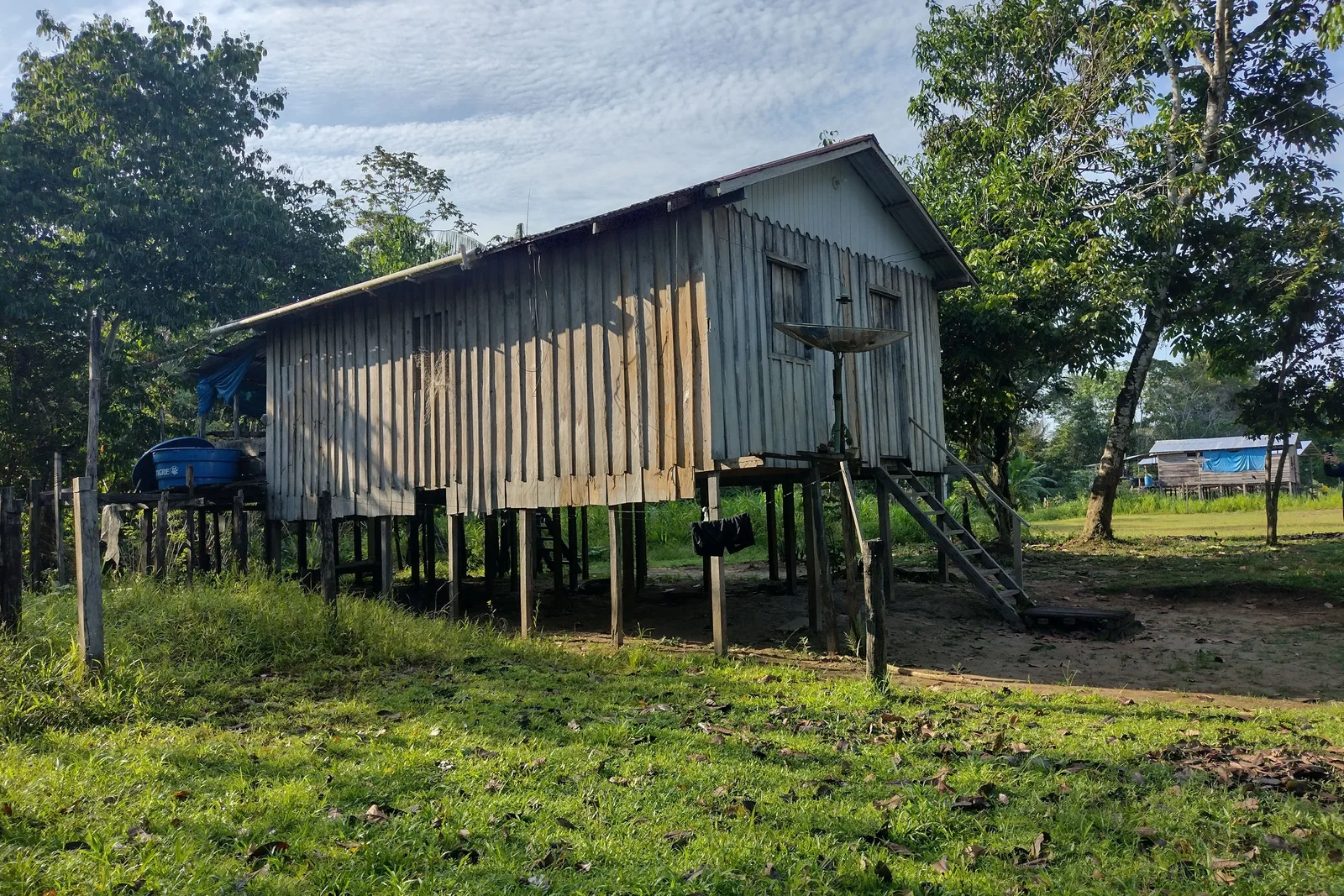
  • A wooden house raised on tall stilts in a grassy clearing, built high enough to stay dry when the water comes up
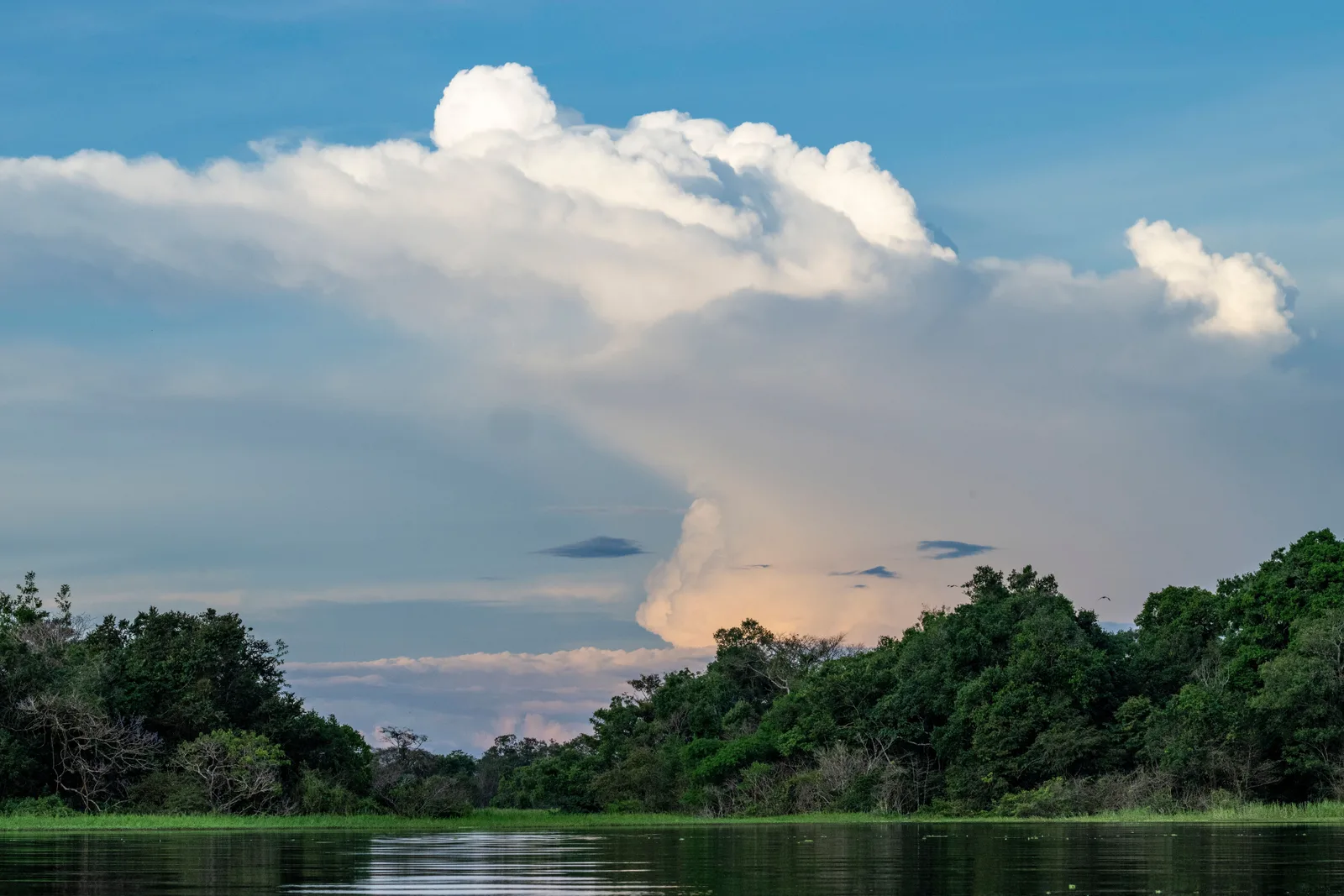
  • A towering cumulus cloud building over the forest at the end of the day, its base lit orange above a dark river
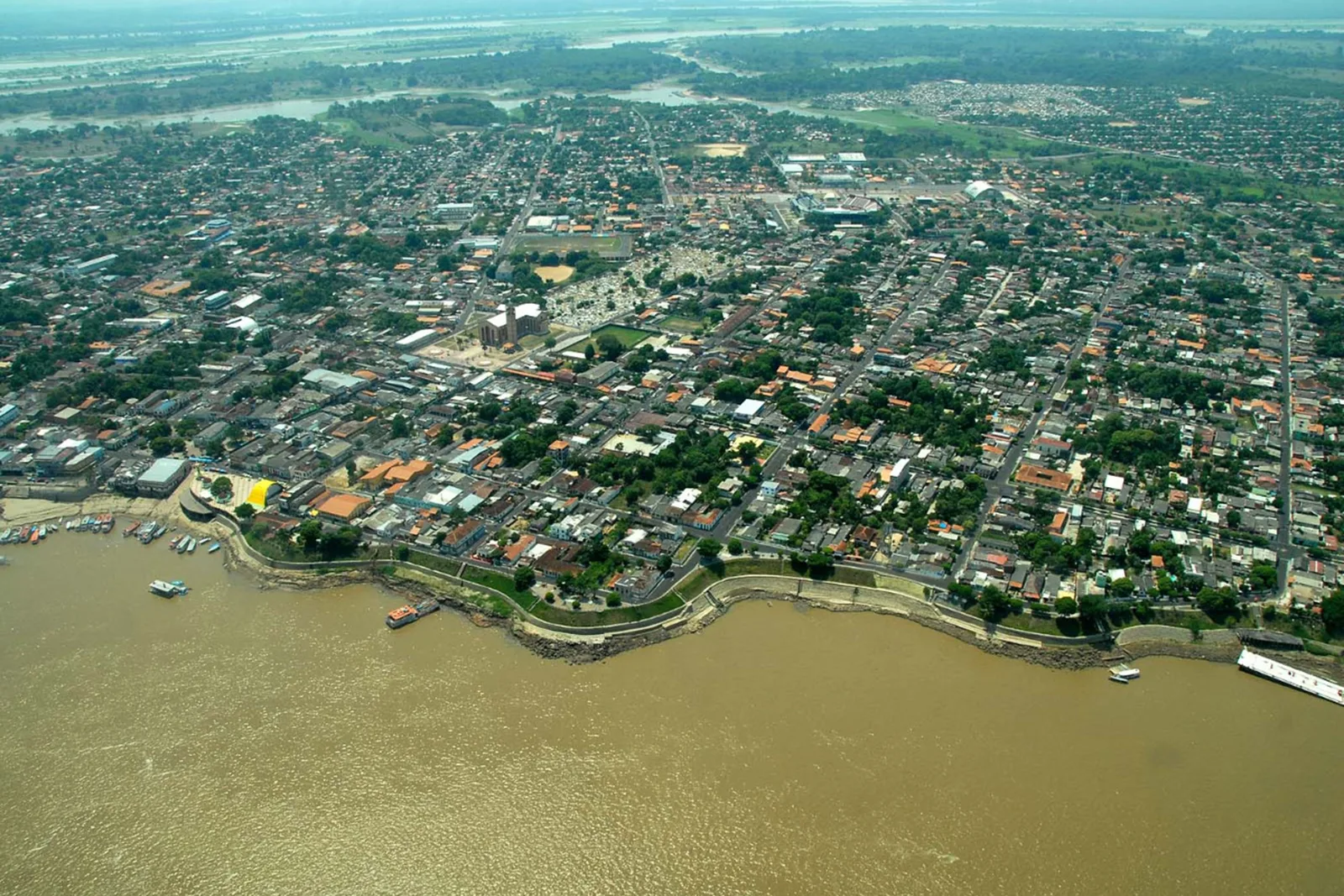
  • The town of Parintins from the air, laid out along a bend of the river with the forest closing in behind it
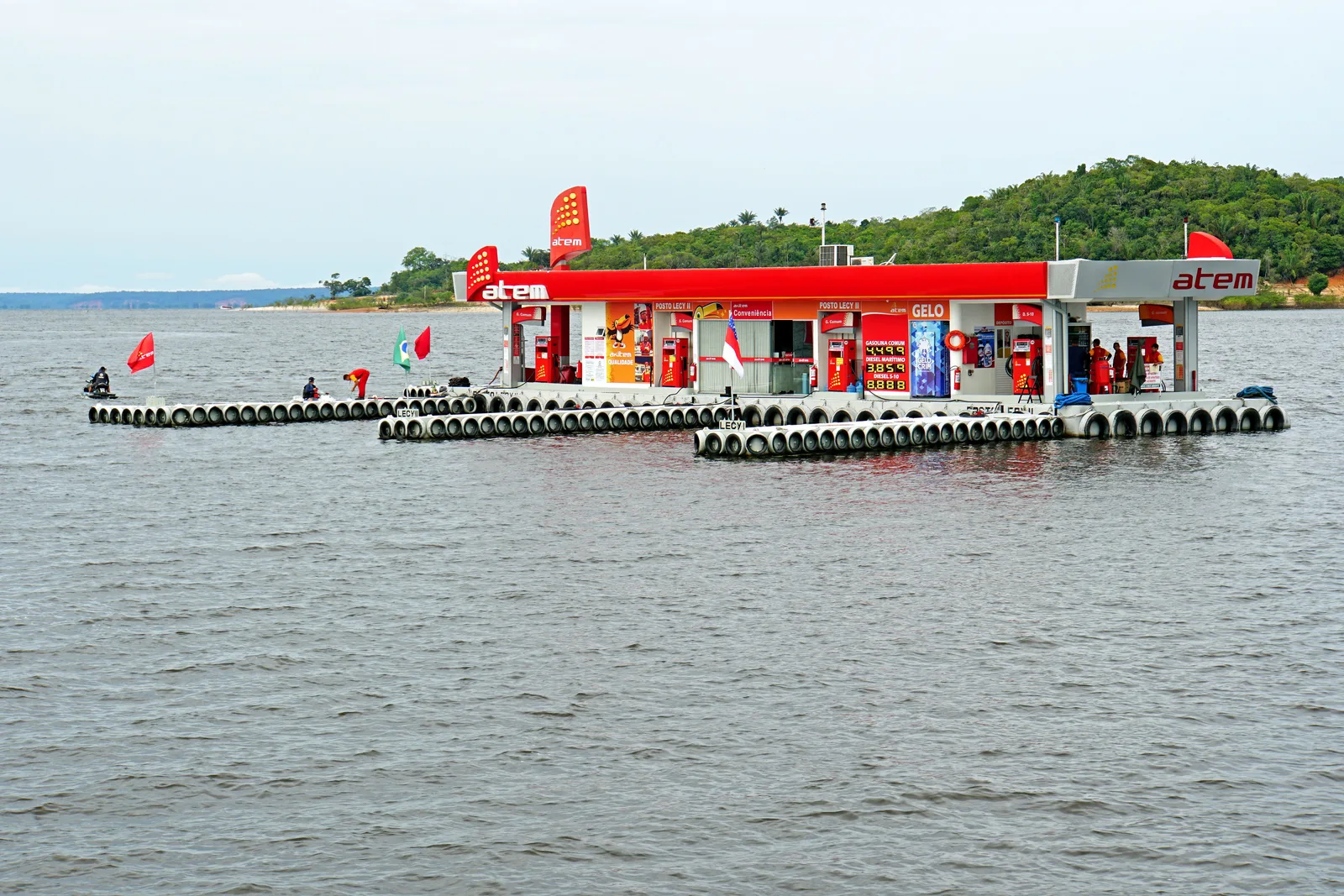
  • A floating filling station moored out on the river, its red canopies and pumps sitting on a pontoon with forest behind
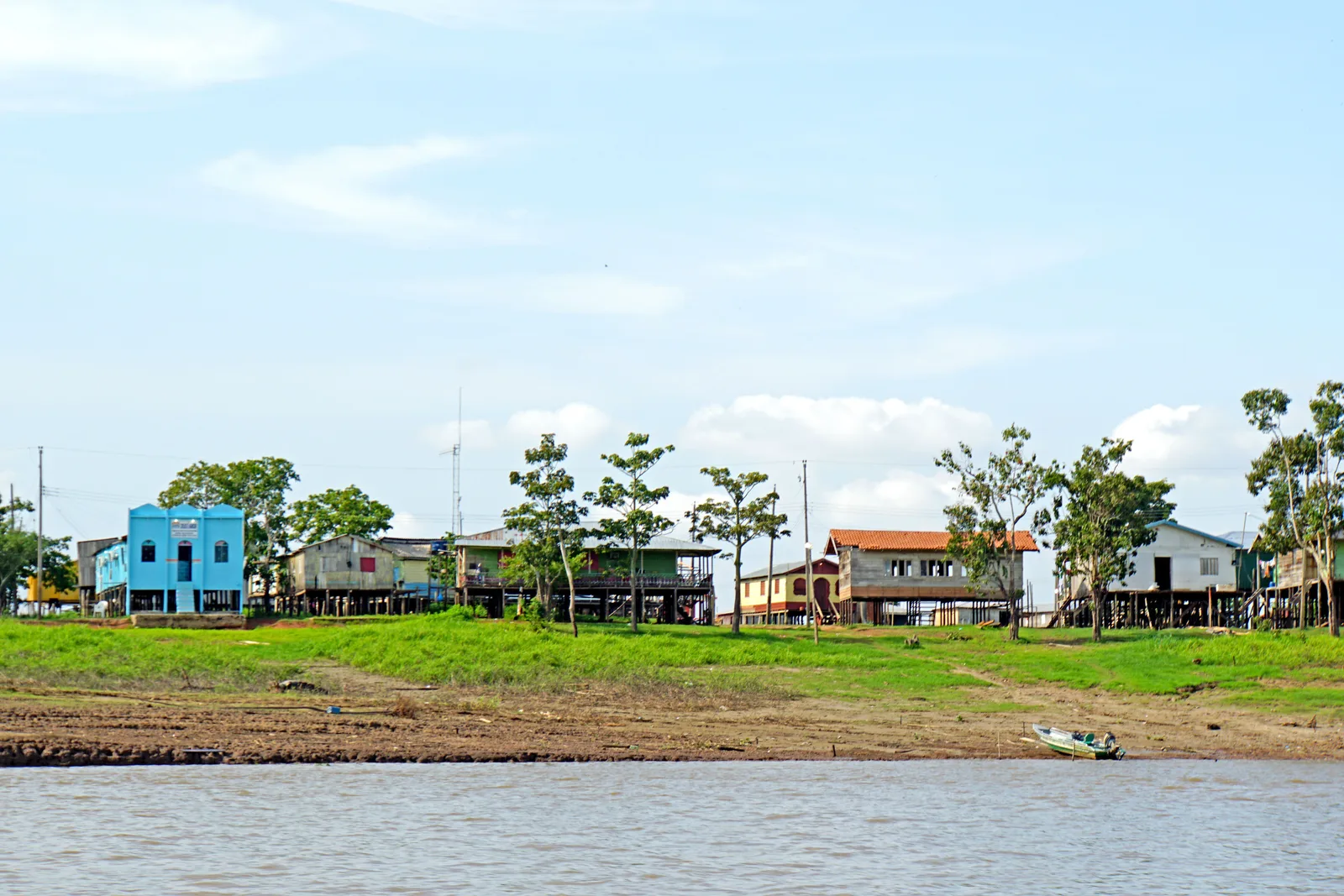
  • A riverside settlement seen from the water, painted wooden houses spaced along a grass bank above the river
  • The Meeting of the Waters from the air, black water and sandy water running side by side without mixing

Orientation

The trip, before the pictures.

What this page covers, what it costs, and how you get to it.

General Info

One city, and the river behind it

The Amazon is not a destination, it is a landmass. What people actually book is a version of it, and this page is the version most travelers from the US end up taking: Manaus, the Meeting of the Waters just downstream, and a lodge somewhere up the Rio Negro. The river towns and beaches downstream in Pará are a different trip and a different flight.

Manaus is stranger than its reputation. It is a city of 2.3 million people 1,500 km up the river from the Atlantic, deep enough that ocean-going ships tie up downtown, and it got there on rubber. For about thirty years either side of 1900 the world’s rubber came almost entirely out of this basin, and the money built an opera house, a tiled market shipped in pieces from Europe, and a floating harbor engineered by the British to ride a river that moves ten meters or more a year. Then seedlings smuggled to Southeast Asia broke the monopoly and the boom ended almost overnight. What kept the city alive afterward was a free-trade zone, which is why a rainforest capital has a motorcycle industry.

The rest of it is water. There are essentially no roads: you cannot drive from Manaus to São Paulo or Rio, and the rivers do the work roads do elsewhere. That is not an inconvenience to plan around — it is the whole texture of the trip. You arrive by plane, and after that you go everywhere in a boat.

Where It Is

Deep in the north, on the Rio Negro

Manaus sits on the north bank of the Rio Negro, about 10 km upstream of the point where it joins the Solimões and the two become the Amazon proper. It is roughly 2,700 km northwest of São Paulo — four hours in the air — and around 1,500 km from the Atlantic by river.

The Amazon The Amazon

3.10° S, 60.02° W

See the North on the interactive map

Cost

The flight and the lodge are the budget

Almost nothing else moves the number. Lodges are sold as all-inclusive packages — room, every meal, two guided outings a day, and the boat from Manaus — so once you are out there, there is nothing to spend money on. Which lodge you pick, and how many nights, is the decision that sets the cost of the week.

Estimated daily budget, per person

Budget

$110 / day

A simple room in Manaus, a basic lodge with shared bathrooms and group outings, market food on the city days.

Mid-range

$220 / day

A private cabin at a mid-range lodge with all meals and two guided trips a day, and a comfortable Manaus hotel either side of it.

Comfortable

$400 / day

A cabin at Mamirauá, small-group or private guiding, speedboat transfers. The design lodges on the Rio Negro run from about $720 a night per person on their own.

Per person per day once you are in Amazonas — international flights not included. Lodge rates are quoted per person for a package of nights rather than per room per night, and a two-night minimum is standard.

What things cost

  • Basic jungle lodge, per night, all in $130 R$650
  • Mid-range lodge, per night, all in $245 R$1,250
  • Top-end lodge, per person per night, all in $720 R$3,660
  • Mid-range hotel room, Manaus $52 R$265
  • Meeting of the Waters, group day trip with lunch $49 R$250
  • Teatro Amazonas, guided visit $4 R$20
  • Museu da Amazônia (MUSA), entry $10 R$50
  • Uber, airport to Ponta Negra $7 R$34
  • Lunch for two at the market $12 R$60
  • Dinner for two, mid-range in Manaus $40 R$200
  • São Paulo–Manaus, round trip $255 R$1,300

What a lodge package includes: the room, every meal, the guided outings on the program, an English-speaking guide, and the transfer from Manaus in both directions. What it does not: drinks, tips, laundry, and anything private.

July and the Brazilian school holidays are the expensive weeks — Brazilians fill the lodges then, and rates and minimum stays both go up.

Cards work everywhere in Manaus. They mostly do not work at lodges. Take cash in reais for tips and the bar tab, and get it before you leave the city.

Almost every lodge runs two fixed transfer times a day. Book flights that land in time for one of them, or you buy a night in Manaus you did not plan on.

Checked October 2026 and converted at R$5.10 to the dollar. Estimates, not quotes — the shape of a budget rather than a price anyone can be held to.

Safety

Two places under one heading

7 /10

Our rating — the forest is the easy half. Manaus is the half that asks something of you, and everybody has to pass through it.

Once you are on the river, this is one of the safer trips in Brazil: you are with a guide, in a small group, a long way from anyone with an interest in your phone. What can hurt you out there is the sun, the heat, the water and the insects. Manaus is a different proposition — a large, hot, hard-working port city where street theft is ordinary, and where the areas visitors want (the old center, the waterfront) are the ones that empty out after dark.

  • Treat central Manaus as a daytime place. The opera house, the market and the port are all fine in daylight and busy with people; the same streets after the shops close are not where you want to be wandering. Ponta Negra is the district that stays lively in the evening.
  • Keep the phone in your pocket on the street in Centro and around the port. Use Uber or 99 rather than walking between neighborhoods at night — it is cheap and it removes the question.
  • Get the yellow fever shot. The CDC recommends it for travelers to Amazonas, and it needs about ten days to take effect, so this is a decision you make weeks out rather than at the airport.
  • Ask a travel clinic about malaria. The CDC recommends preventive medication for travel in Amazonas state, including the rural areas the lodges sit in. Four to six weeks before you fly is the right time to have that conversation.
  • Mosquitoes vary enormously by river. The Rio Negro is black water — acidic, tannin-stained, and genuinely poor mosquito habitat. The Solimões side is white water and there are far more. Repellent and long sleeves at dusk regardless.
  • The heat is the underrated risk. Highs sit between 31 and 34°C all year with humidity in the eighties and a UV index that is very high in every month. Drink more water than feels necessary, and take the hat seriously.
  • Book the lodge and the boat before you arrive, through the lodge or an operator you have checked. Manaus has plenty of people selling trips at the port, and no way for you to tell the good ones from the rest.

Getting There

One stop, almost always

Eduardo Gomes International (MAO) sits 14 km north of downtown Manaus and handled about 3.3 million passengers in 2025. There is no dependable year-round nonstop from the United States, so plan on a connection and stop looking for one.

  • Copa flies Panama City to Manaus daily, which is the cleanest one-stop routing from most US cities and the one to price first.
  • Everything else goes through São Paulo (GRU), Brasília or Rio. São Paulo to Manaus is about four hours in the air and there are flights all day.
  • Gol has run a seasonal nonstop between Manaus and Miami in the Brazilian winter-holiday window — twice a week from 18 June to 9 August in 2026. Take it if the dates happen to line up; do not build a trip around it.
  • Avianca flies Bogotá to Manaus, which is worth checking if you are already routing through Colombia.
  • For Mamirauá, you fly on again: Manaus to Tefé is about an hour and a half on Azul, which does not fly the route every day, and then roughly an hour and a half by speedboat to the lodge.
  • There is no useful way to drive here. The only paved highway out of Manaus runs north to Boa Vista and the Venezuelan border; the BR-319 south toward Porto Velho is unpaved through its middle stretch and impassable for much of the year.

Getting Around

Uber in the city, boats after that

You never need a car. In Manaus a ride app covers everything, and beyond Manaus the roads simply stop — the lodge’s boat is the transport, and it is included.

  • Uber and 99 both work across Manaus. The airport to Ponta Negra runs around R$34 and about twenty minutes.
  • The historic center is compact enough to walk: the Teatro Amazonas, the Mercado Adolpho Lisboa and the floating port are all within about fifteen minutes of one another.
  • Lodge transfers are usually a van to a jetty and then a speedboat, or a straight run down the Rio Negro. One to four hours, depending entirely on how far out you have chosen to go.
  • Public riverboats leave the Manaus port for everywhere in Amazonas. Hammock space on deck is cheap and sociable; a cabin costs several times more and earns it on anything over two nights.
  • Fast boats to the Meeting of the Waters leave from the Ceasa terminal in Mauazinho, east of the center, rather than from the main passenger port. It is the closest departure point to the confluence and the quickest way out to it.

The big four

What this trip is actually built on.

Two things you go and look at, and two conditions you spend the week inside. Miss any of them and you have not really been here.

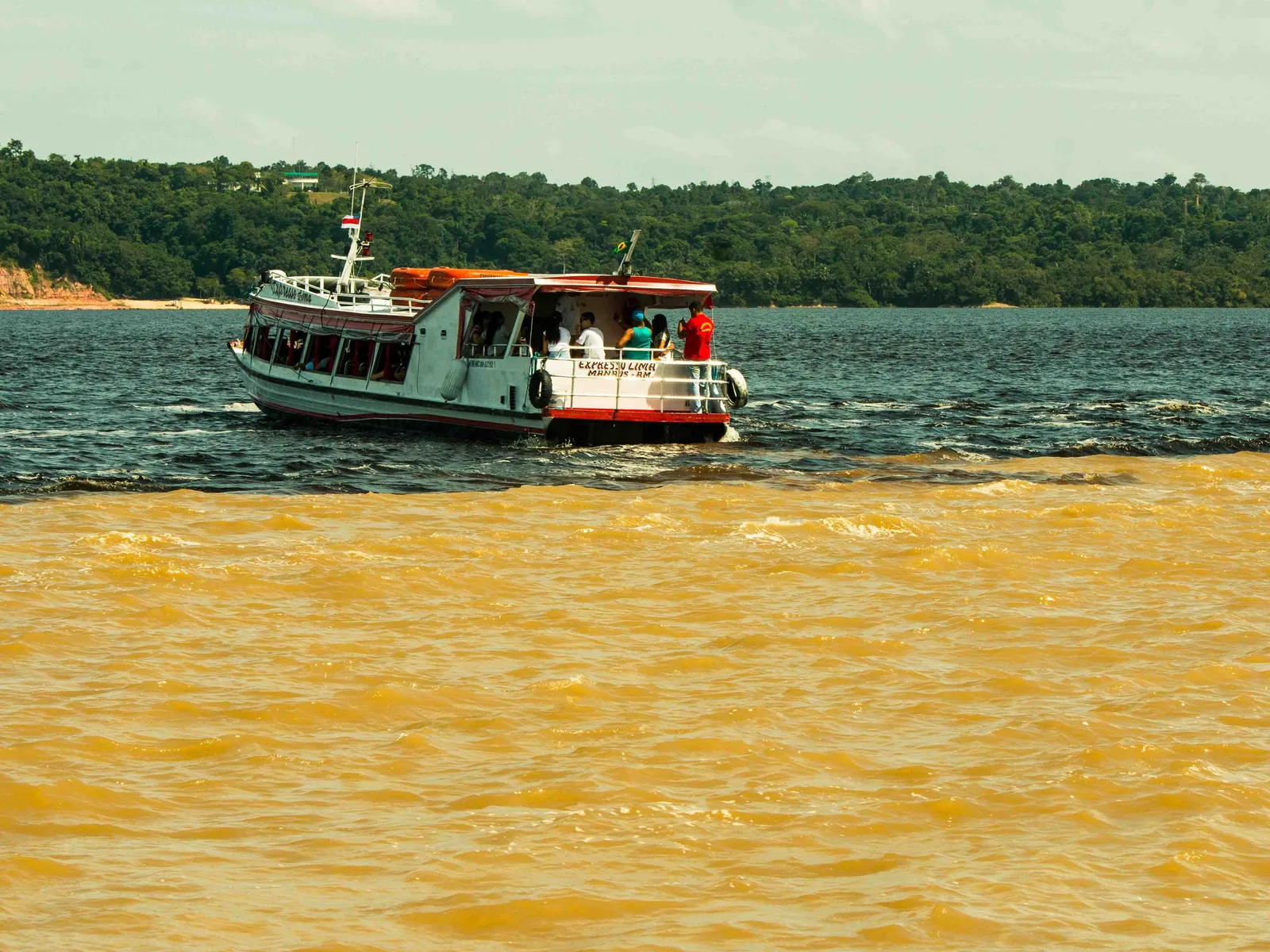
A small white and red tour boat sitting directly on the line where dark water meets sandy brown water, with a low forested shore behind it 01

Two rivers that refuse to mix

The Meeting of the Waters

Where
About 10 km downstream of Manaus
How far
They run side by side roughly 6 km
When
Year-round; nothing published ranks it by month

The Rio Negro arrives at Manaus warm, slow and stained almost black by dissolved plant tannin. The Solimões arrives from the Andes several degrees colder, moving considerably faster, and so loaded with silt that it is the color of milky coffee. Where they meet, the difference in temperature, speed and density is enough that they refuse to blend, and the two run beside each other for about six kilometers under one hard, wandering line before the Amazon finally takes over.

It is a boat trip and it is worth doing properly. Skippers cut the engine on the boundary and let you put a hand in each river, which is the moment the whole thing stops being a photograph and starts being physics. Most operators pair it with the flooded forest and the giant lily pads at Lago do Janauari, and often lunch on a floating restaurant, which turns it into a comfortable half or full day out of Manaus.
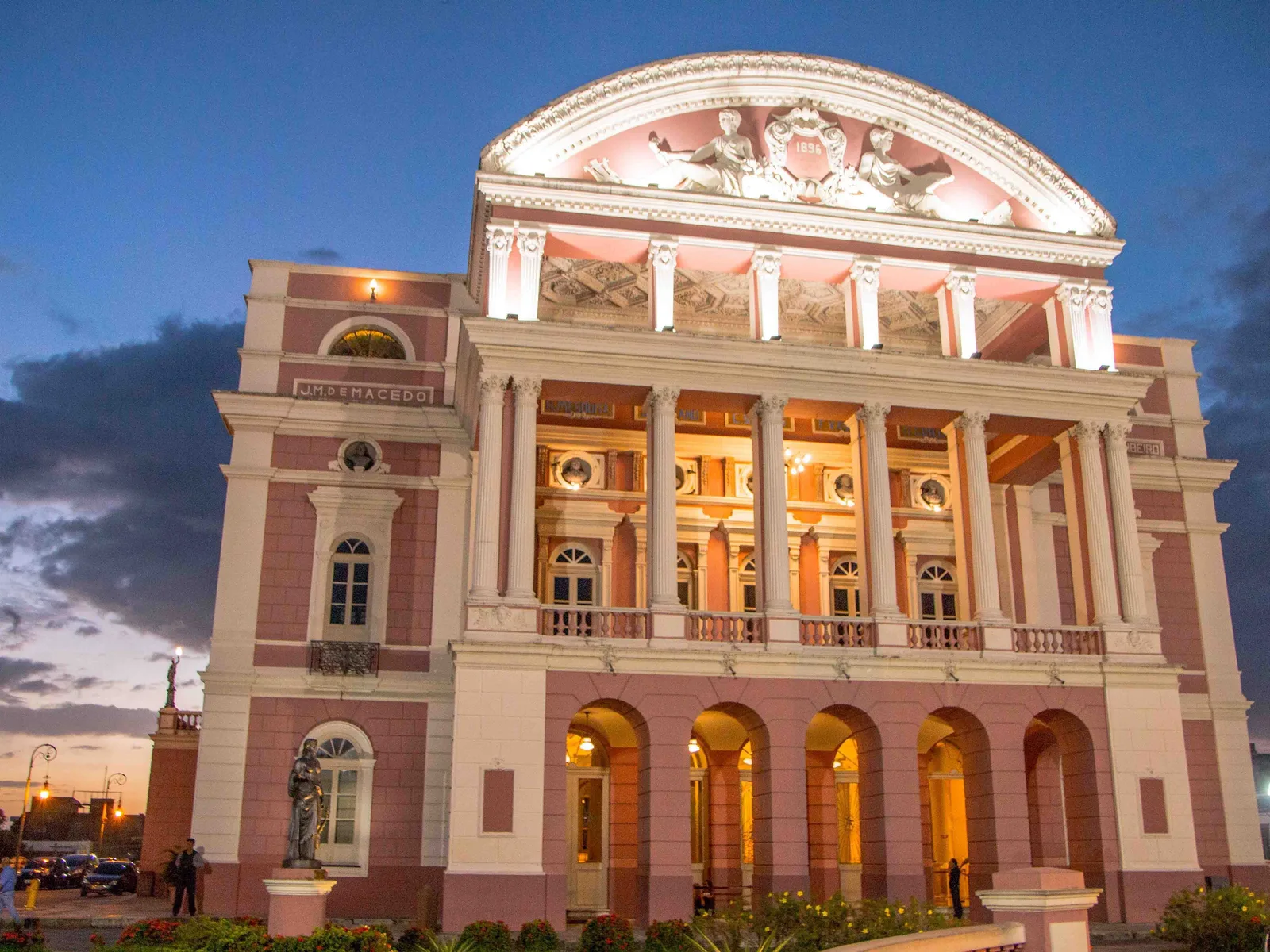
The floodlit front of the Teatro Amazonas at dusk against a deep blue sky, pink and cream stone, a colonnade of tall columns and a sculpted pediment above it 02

Rubber money, in the middle of a rainforest

Teatro Amazonas

Opened
December 31, 1896
Visits
Guided, about 30 minutes, R$20
Closed
Mondays

An Italianate opera house, finished in 1896, a thousand miles up the Amazon. The rubber barons imported nearly all of it: marble from Italy, ironwork and furnishings from Europe, and 36,000 glazed tiles from France for the dome, laid in the green, blue and yellow of the Brazilian flag. UNESCO added it to the World Heritage List in July 2026. It is genuinely peculiar to stand in front of — a Belle Époque theater with the forest starting a few miles behind it.

The boom that paid for it lasted about a generation. Seedlings taken out of the basin and planted in Southeast Asia broke Brazil’s monopoly, prices collapsed, and Manaus went quiet for decades. The theater did not: it still works, with a resident philharmonic and a full season, and the guided visit takes about half an hour and costs R$20. Tuesday to Saturday nine to five, Sundays and holidays nine to one.

A forested island in the Rio Negro under a blank white sky, a strip of bare red earth and fallen branches exposed along its bank above dark tea-colored water that carries the reflection 03

Four hundred islands in one river

Anavilhanas & the Rio Negro

Islands
Around 400
Length
About 130 km of the Rio Negro
Nearest town
Novo Airão, 180 km by road

Upstream of Manaus the Rio Negro splits into a maze — roughly 400 islands, sixty lakes and a tangle of channels running about 130 kilometers along the river. It has been protected since 1981 and a national park since 2008, and it forms part of the Central Amazon Conservation Complex, a UNESCO World Heritage Site. Novo Airão, on the west bank, is the road-accessible base; several of the better lodges sit on this stretch.

The water is what makes it. Black water is acidic and tannin-stained, which is why it looks like strong tea over pale sand, why it holds far fewer mosquitoes than the muddy rivers, and why the reflections on a still morning are absurd. The islands themselves flood and reappear on a ten-meter cycle, so the channel you paddle through in April is a forest floor you can walk across in September.

Flooded forest at high water: dozens of slender pale trunks rising straight out of still water, each one doubled by its own reflection 04

The forest with the river inside it

The igapó, and the ten-meter year

Annual range
Usually 10–14 m at Manaus
Record high
30.02 m, June 2021
Record low
12.66 m, October 2024

The single thing to understand before you book. The river at Manaus does not have a bank in any sense a visitor from a temperate country would recognize — it has an annual range of ten meters and more, and the forest along it spends part of every year underwater. That flooded forest is called igapó on black-water rivers, and it is where most of what you came to see happens.

The numbers are not gentle ones. The port’s gauge has been read since 1902; it recorded 30.02 m in June 2021 and 12.66 m on 4 October 2024, the highest and the lowest in its 122 years, three years apart. That is why Manaus has a floating harbor, why houses stand on stilts, and why the same lodge sells two completely different weeks depending on when you turn up.

What to actually do

Five ways to spend a day out here.

Almost all of this comes bundled into a lodge package rather than bought separately. Pick a category and scroll sideways through it.

Wildlife

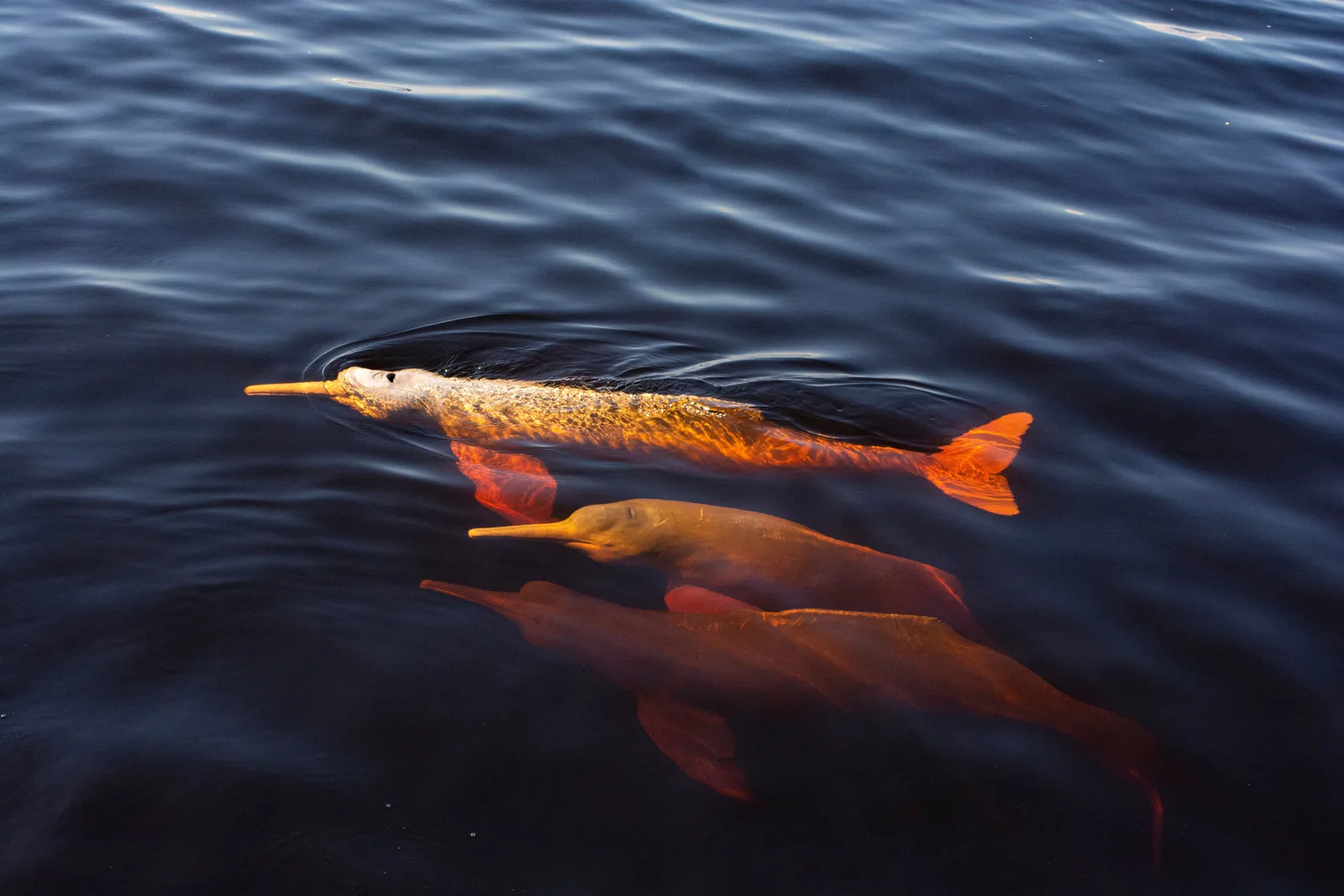
  • Two pink river dolphins at the surface of dark water, their orange-pink backs and dorsal ridges showing above the ripples

    Anywhere on the black water · a morning

    Looking for river dolphins on the Rio Negro

    Two species share these rivers: the pink boto, which is big, slow and unmistakable when it surfaces, and the smaller gray tucuxi. On the Rio Negro they are common enough that most people see them from the boat without trying. There are places near Novo Airão that feed them so tourists can swim with them; the practice has been criticized for years on animal-welfare grounds, and watching them wild from a boat is the better trade.

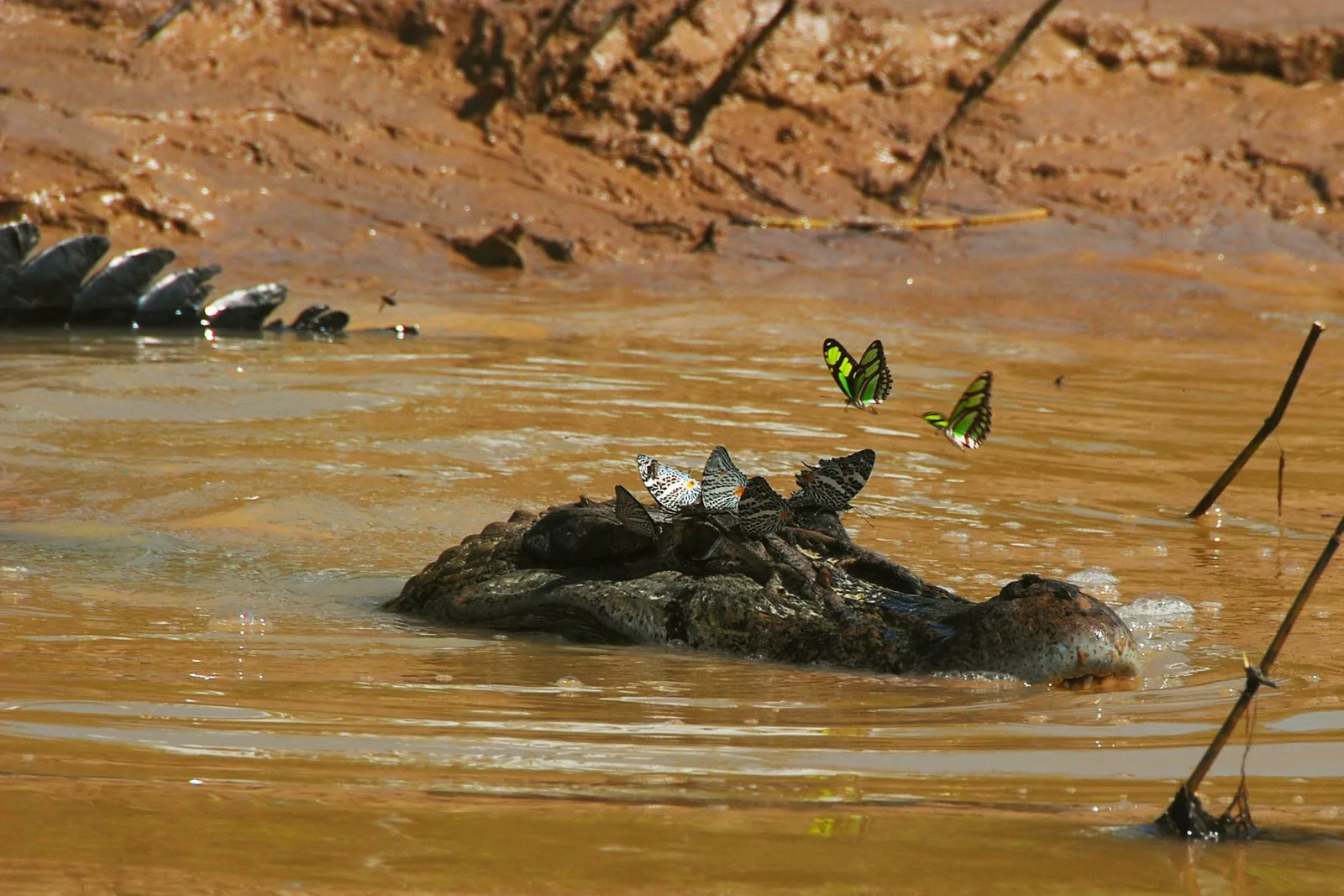
  • A caiman lying half-submerged in shallow muddy water, half a dozen cream and black spotted butterflies settled along the ridged skin of its head with their wings raised, and two more, green and black, hovering just above them

    From the lodge · about 2 hours

    Caiman spotting after dark

    The standard night outing, and it works. A guide takes a small boat into the side channels with a spotlight, and caiman eyes come back at you like road studs. Most lodges will catch a small one to show the group and put it straight back. Go on a moonless night if you can choose — the sky over the river with no light for a hundred kilometers is half the reason to be out there.

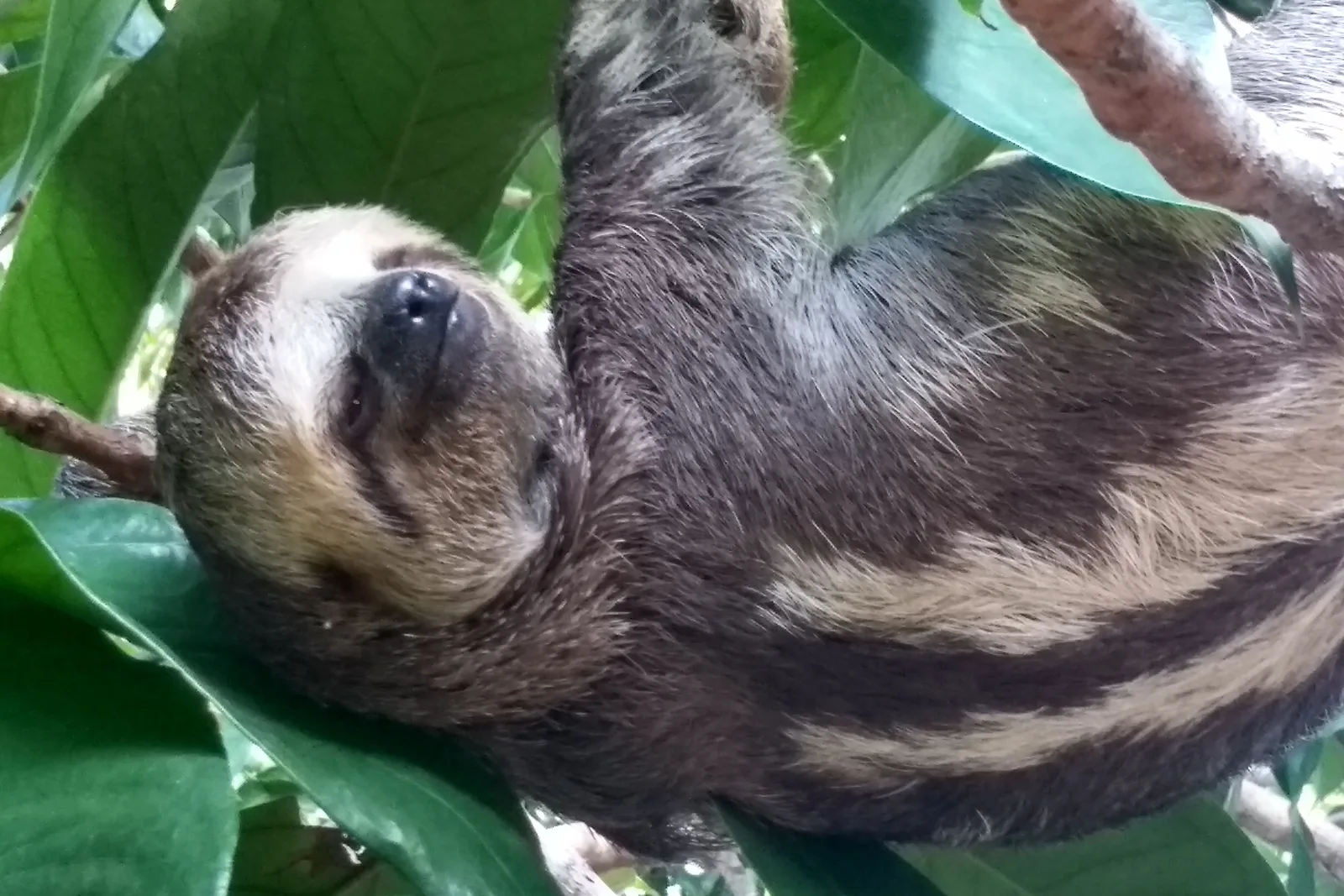
  • A three-toed sloth hanging upside down among broad green leaves, its face turned toward the camera

    Forest walks and canoe trips · ongoing

    Sloth spotting in the canopy

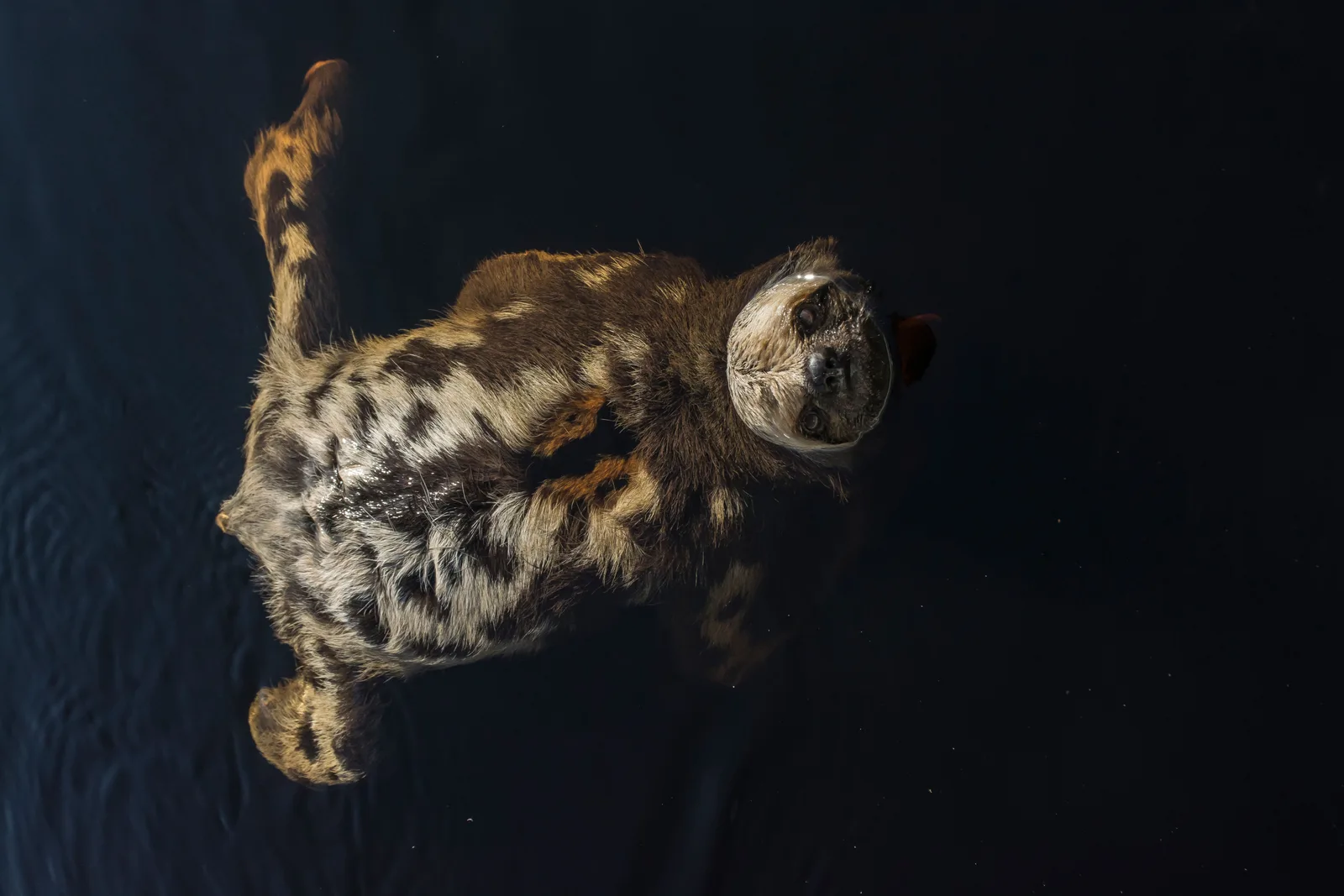
    Sloths are the animal most people actually get close to, because they cannot run away. Guides find them by scanning the crowns for a shape that does not move, most often in cecropia trees. They also swim, surprisingly well, and in the flooded season you sometimes see one crossing open water between islands.

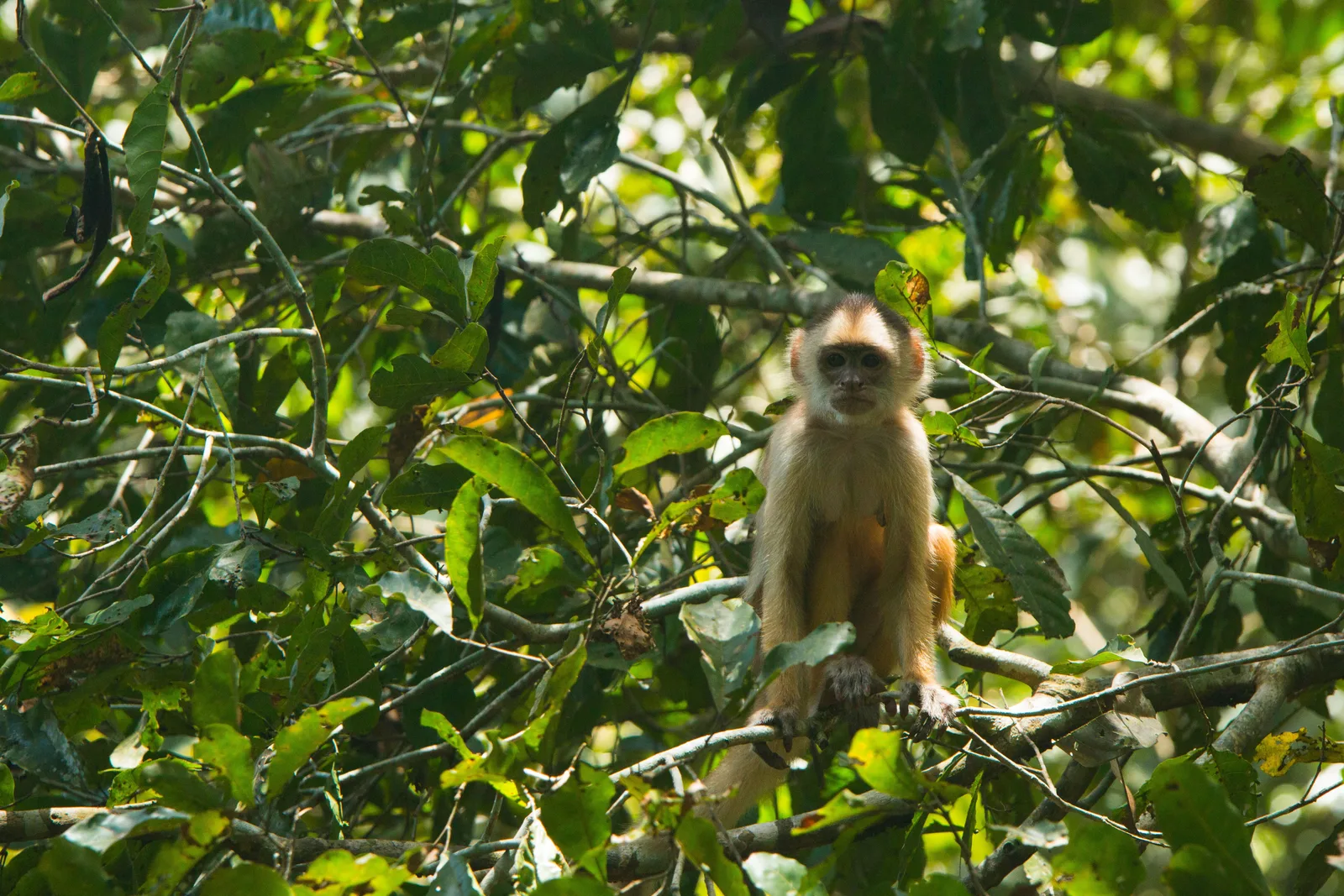
  • A small pale monkey sitting upright on a branch deep inside dense green foliage, watching the camera

    Tefé · a full day

    Monkeys at Mamirauá

    Mamirauá is the reserve people go to when the wildlife is the point rather than a bonus. It is flooded várzea forest at the meeting of the Solimões and the Japurá, and it holds the white uakari — a monkey with a bald scarlet face found almost nowhere else — along with squirrel monkeys, howlers and sakis. Getting there costs you a flight to Tefé and a boat, which is exactly why the animals are still there.

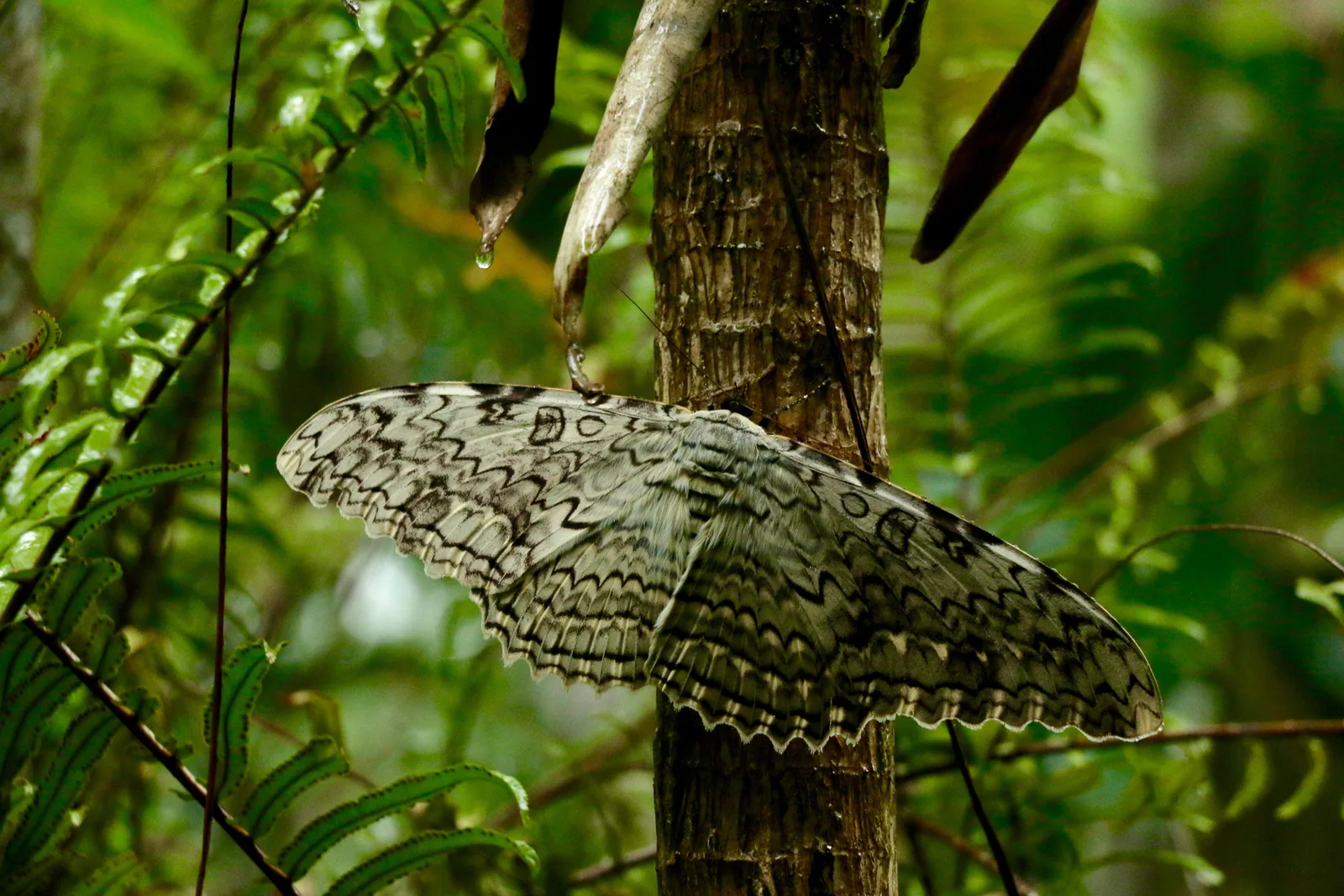
  • A large gray and brown moth with intricately patterned wings spread flat against the bark of a tree trunk

    From the lodge · about 90 minutes

    A night walk in the forest

    The forest changes staff at dusk. A guided walk with headlamps after dinner turns up tarantulas, tree frogs, stick insects, hunting spiders and moths the size of a hand — far more life, and far more of it visible, than the same trail gives you at noon. Closed shoes, long trousers, and stay behind the guide.

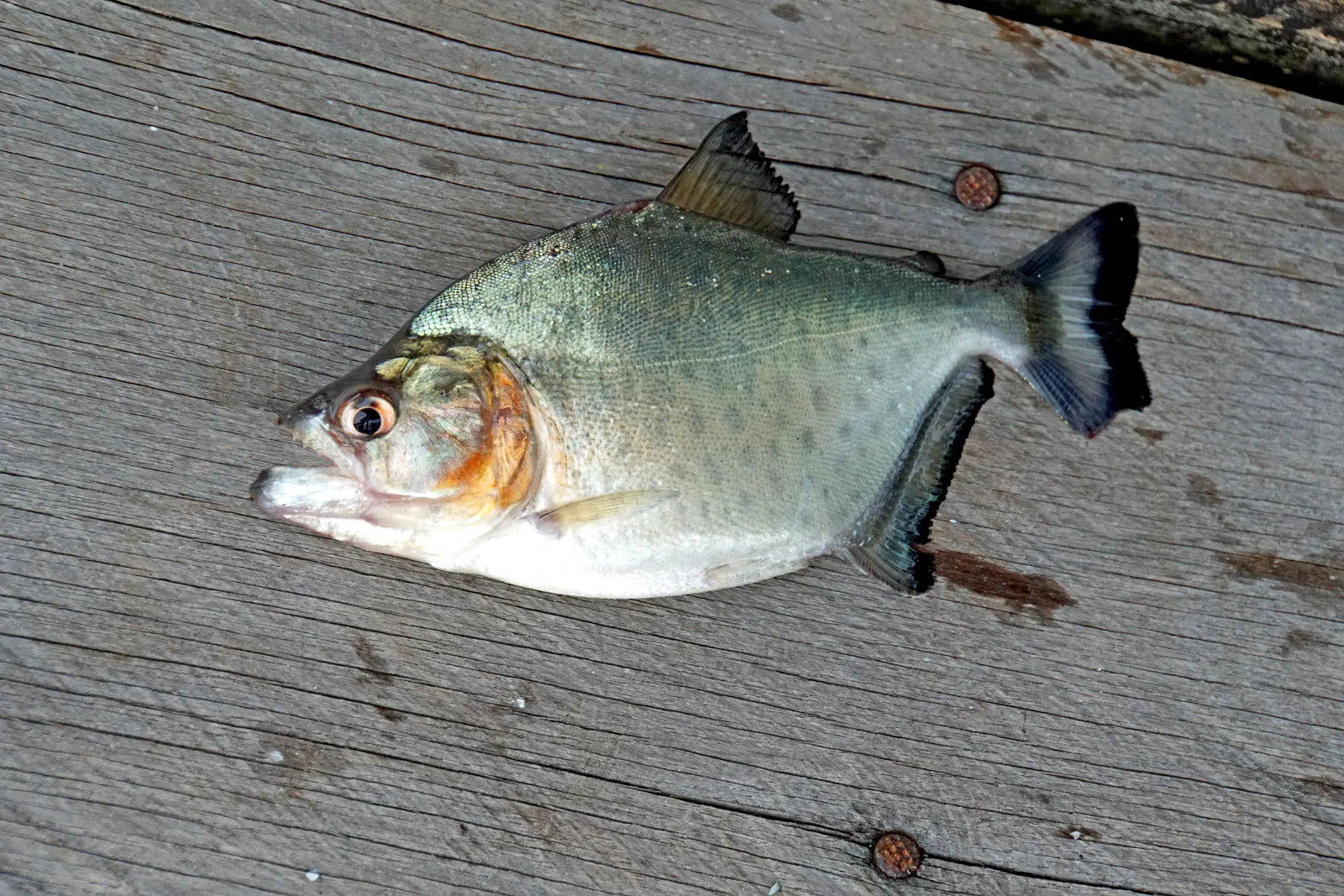
  • A single piranha lying on weathered wooden decking, its silver flank and blunt jaw clearly visible

    Side channels and lakes · about 2 hours

    Piranha fishing

    A stick, a line, a hook and a lump of beef. It is a genuinely good hour, the guide will out-fish everyone in the boat by a factor of ten, and whatever the group catches usually turns up fried at dinner. Better at low water, when the fish are concentrated in the channels rather than spread through a flooded forest the size of a county.

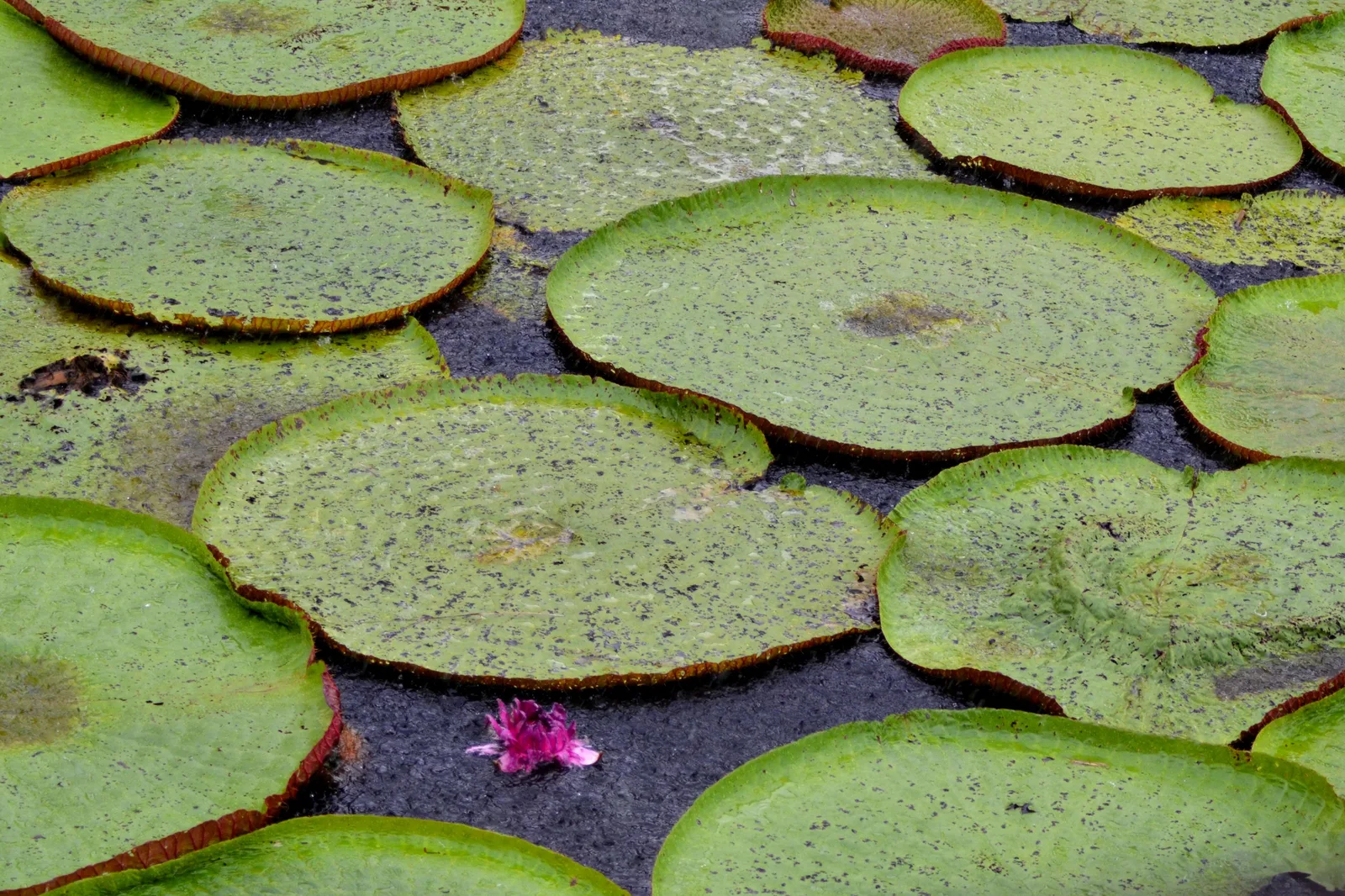
  • Giant round lily pads with raised rims packed across dark water, one pink flower open among them

    Near the confluence · usually bundled in

    Giant lily pads at Lago do Janauari

    Victoria amazonica grows leaves more than two meters across, with an upturned rim and a spined underside, and it flowers white on the first night and pink on the second. The stands in the lakes near the confluence are the easy place to see them, and nearly every Meeting of the Waters trip goes there afterward on a boardwalk through the flooded forest.

On the river

  • Two pink river dolphins at the surface of dark water, their orange-pink backs and dorsal ridges showing above the ripples

    Anywhere on the black water · a morning

    Looking for river dolphins on the Rio Negro

    Two species share these rivers: the pink boto, which is big, slow and unmistakable when it surfaces, and the smaller gray tucuxi. On the Rio Negro they are common enough that most people see them from the boat without trying. There are places near Novo Airão that feed them so tourists can swim with them; the practice has been criticized for years on animal-welfare grounds, and watching them wild from a boat is the better trade.

  • A caiman lying half-submerged in shallow muddy water, half a dozen cream and black spotted butterflies settled along the ridged skin of its head with their wings raised, and two more, green and black, hovering just above them

    From the lodge · about 2 hours

    Caiman spotting after dark

    The standard night outing, and it works. A guide takes a small boat into the side channels with a spotlight, and caiman eyes come back at you like road studs. Most lodges will catch a small one to show the group and put it straight back. Go on a moonless night if you can choose — the sky over the river with no light for a hundred kilometers is half the reason to be out there.

  • A single piranha lying on weathered wooden decking, its silver flank and blunt jaw clearly visible

    Side channels and lakes · about 2 hours

    Piranha fishing

    A stick, a line, a hook and a lump of beef. It is a genuinely good hour, the guide will out-fish everyone in the boat by a factor of ten, and whatever the group catches usually turns up fried at dinner. Better at low water, when the fish are concentrated in the channels rather than spread through a flooded forest the size of a county.

  • The white bow of a small boat pointing up a narrow channel of perfectly still water, forest and cloud reflected so cleanly that the horizon is hard to find

    High water, February to June · a morning

    Canoeing the flooded forest

    The best two hours of a high-water trip. A paddled canoe goes where a motorboat cannot, in among the trunks of a forest standing in six or eight meters of water, and the noise drops to nothing. You end up looking down at ground you could have walked across in September and up into branches that are normally thirty feet over your head.

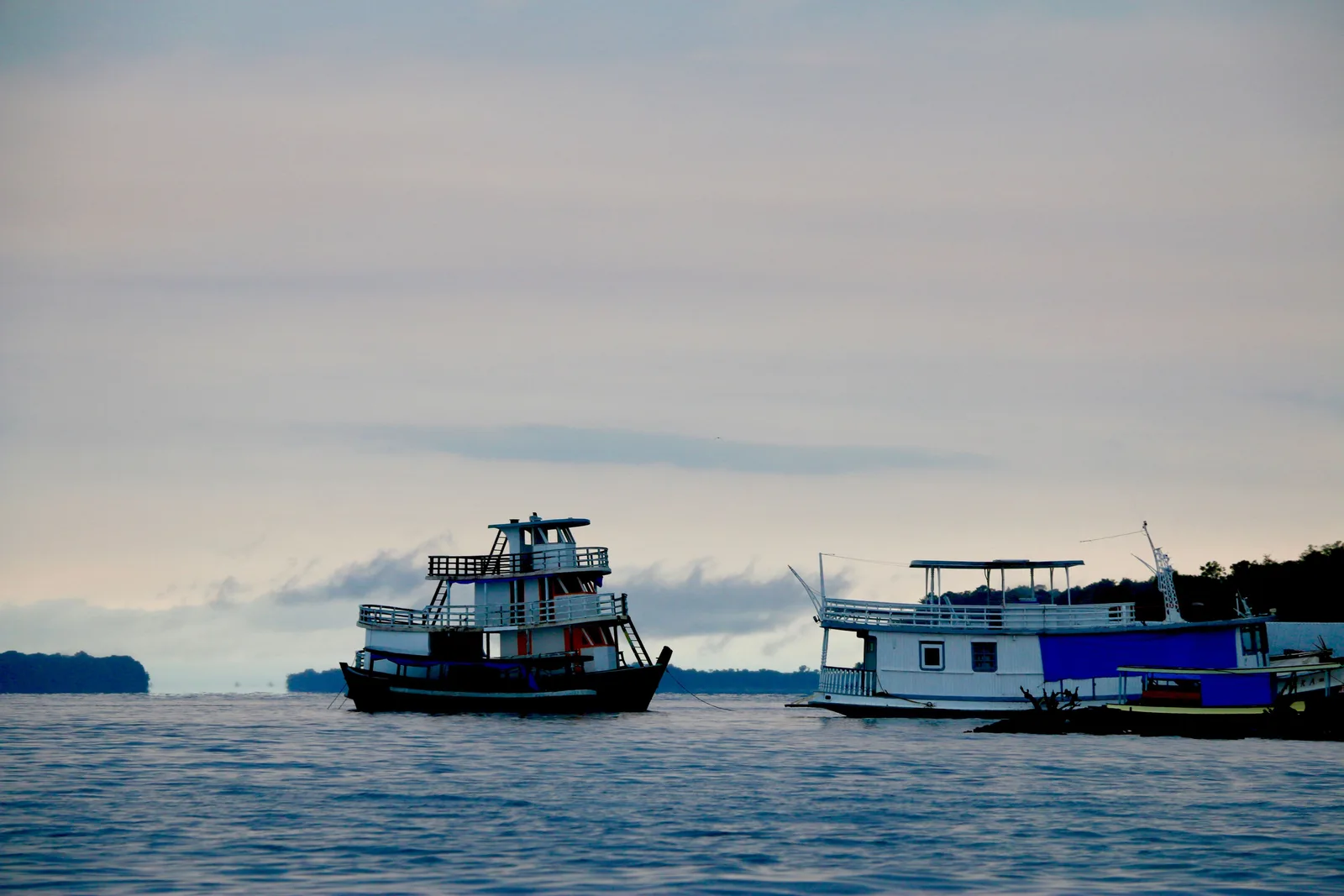
  • Two double-decked wooden riverboats lying on flat pale water at dusk, a low dark line of forest along the shore behind them

    From the Manaus port · overnight and up

    A leg on a public riverboat

    The double-decked wooden boats tied up at the Manaus waterfront are the region’s bus network, and riding one is the cheapest window into how the Amazon actually works. You sling a hammock on deck among fifty other hammocks, and the boat stops at communities all night. Do it as one leg of a trip rather than as the whole trip, and pay for a cabin on anything longer than two nights.

  • Giant round lily pads with raised rims packed across dark water, one pink flower open among them

    Near the confluence · usually bundled in

    Giant lily pads at Lago do Janauari

    Victoria amazonica grows leaves more than two meters across, with an upturned rim and a spined underside, and it flowers white on the first night and pink on the second. The stands in the lakes near the confluence are the easy place to see them, and nearly every Meeting of the Waters trip goes there afterward on a boardwalk through the flooded forest.

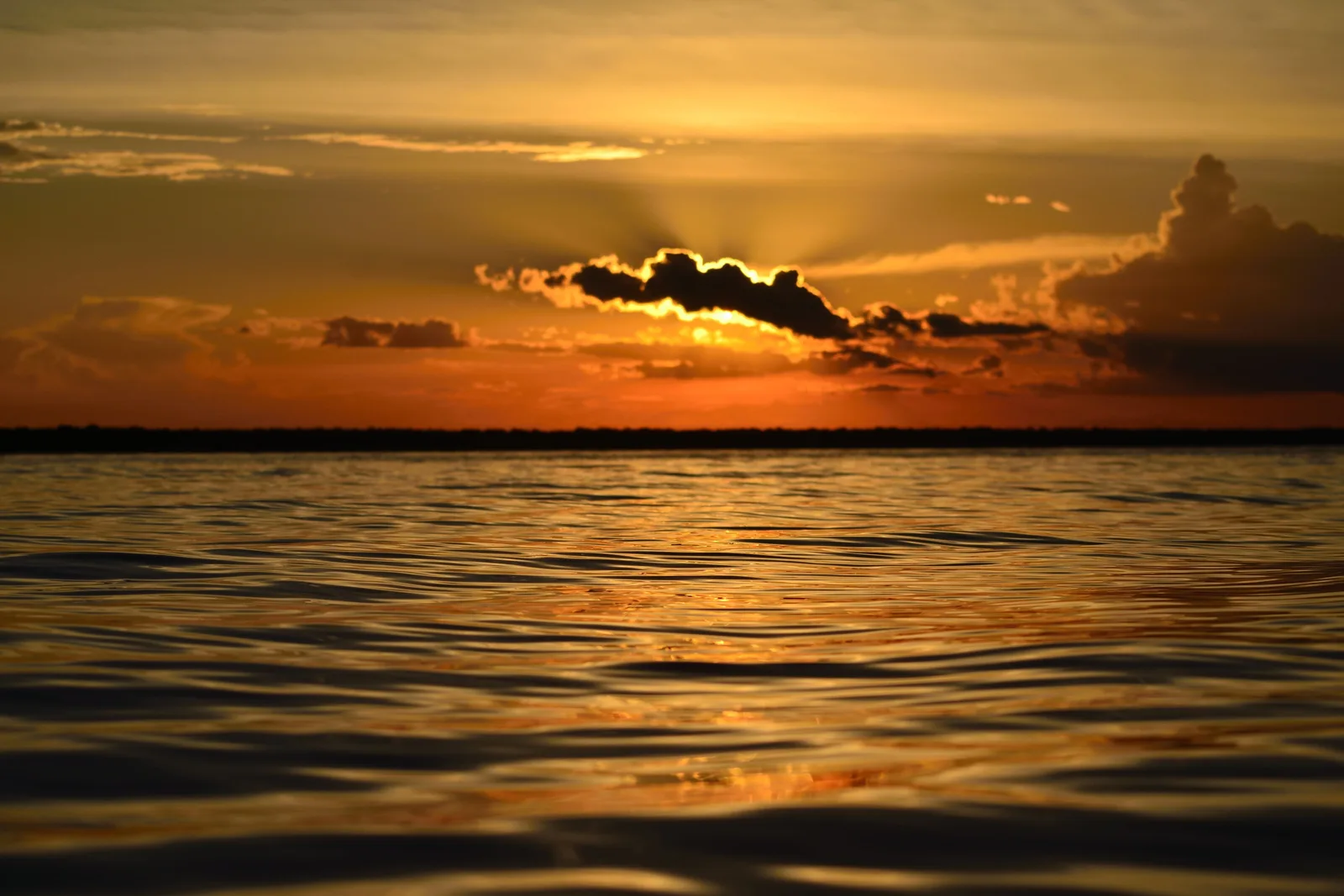
  • A low orange sun over a wide river with a dark bar of cloud across it and a long track of light running toward the camera

    From any lodge · an hour

    Sunset on the Rio Negro

    Every lodge runs one and it is never a filler. The river is wide enough here that the sun goes down over water like an ocean horizon, the afternoon storm clouds pile up on one side, and the black water takes the color better than muddy water does. Bring the camera and the repellent; the mosquitoes arrive at the same time as the light.

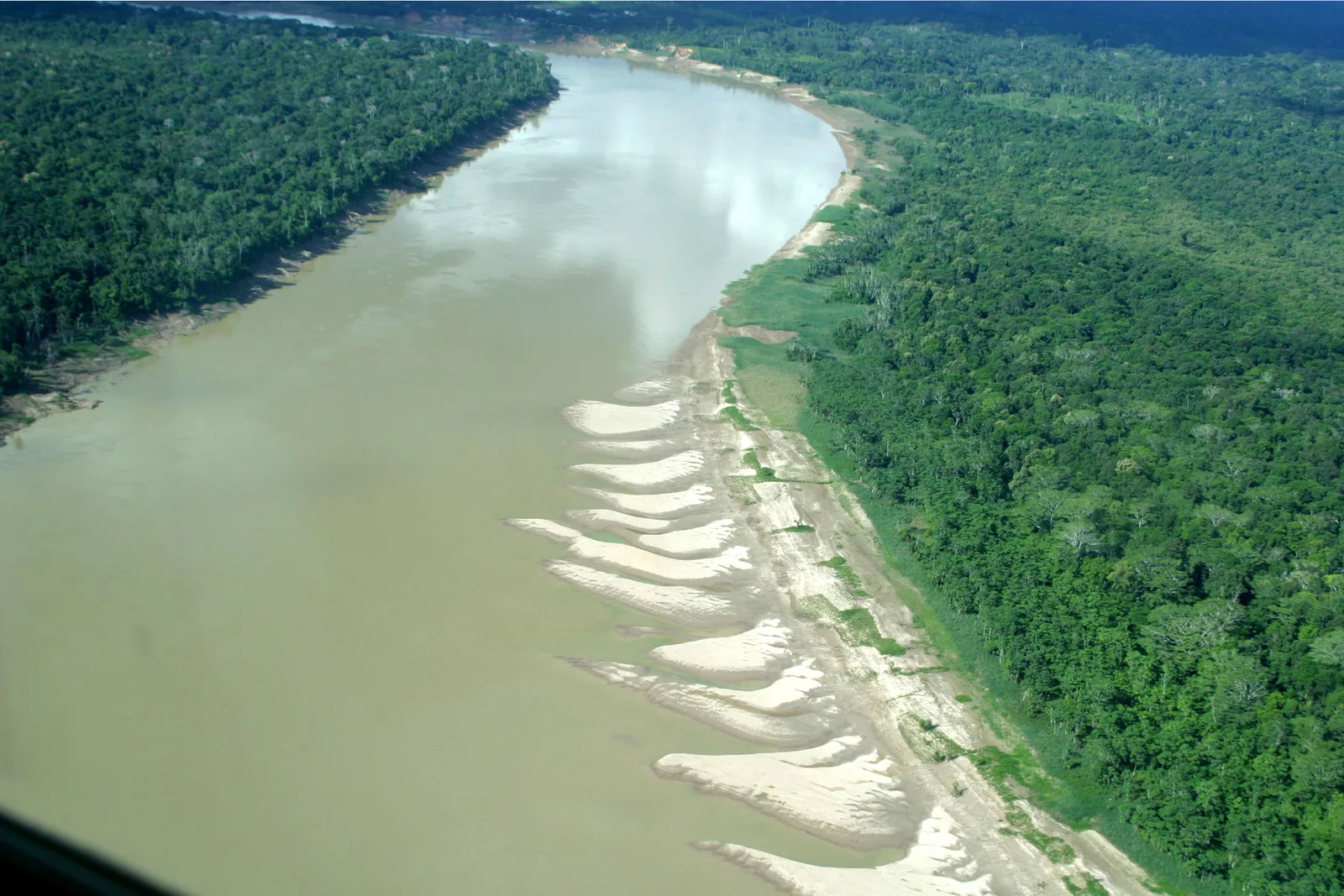
  • A long curving white river beach seen from the air, scalloped along the edge of dense forest with pale water beyond it

    August to November · half a day

    River beaches at low water

    When the Rio Negro drops it leaves behind long crescents of clean white sand along the islands and the mainland shore, warm tea-colored water, and no waves at all. Lodges run picnics out to them and half the point is that they will be underwater again in March. The Atlantic is more than a thousand kilometers away; these are what the Amazon has instead.

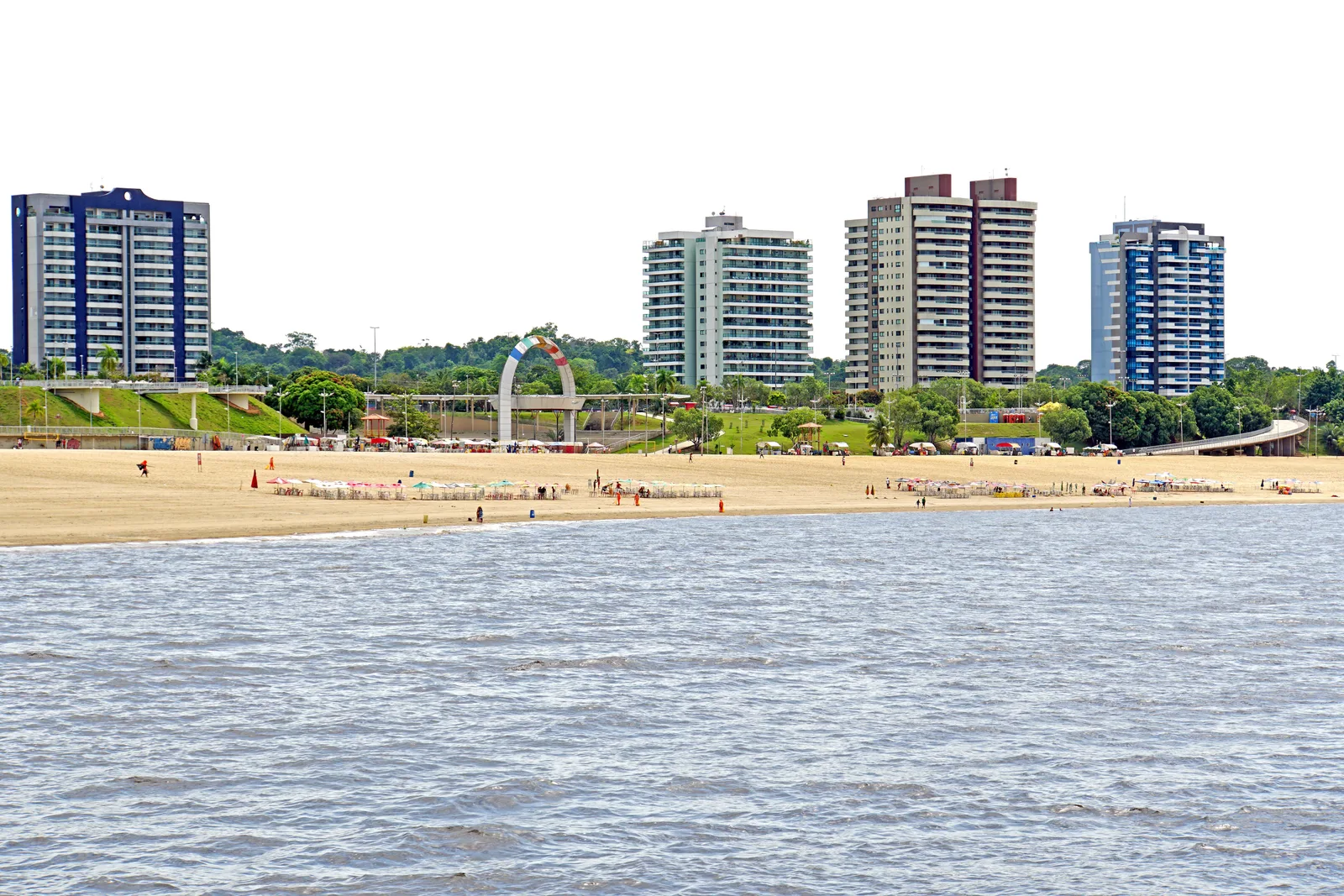
  • The beach at Ponta Negra seen from the water, people and rows of white parasols along the sand, and four apartment towers — navy, pale green, dark red and blue — standing above the trees behind

    Manaus · a few hours

    An afternoon at Ponta Negra

    Manaus has its own river beach, on the Rio Negro at the western edge of the city, with a rebuilt promenade, an amphitheater, food stalls and the bulk of the city’s better hotels behind it. At low water there is real sand; at high water most of it is gone and the promenade is the point. It is the one part of Manaus that is genuinely pleasant in the evening.

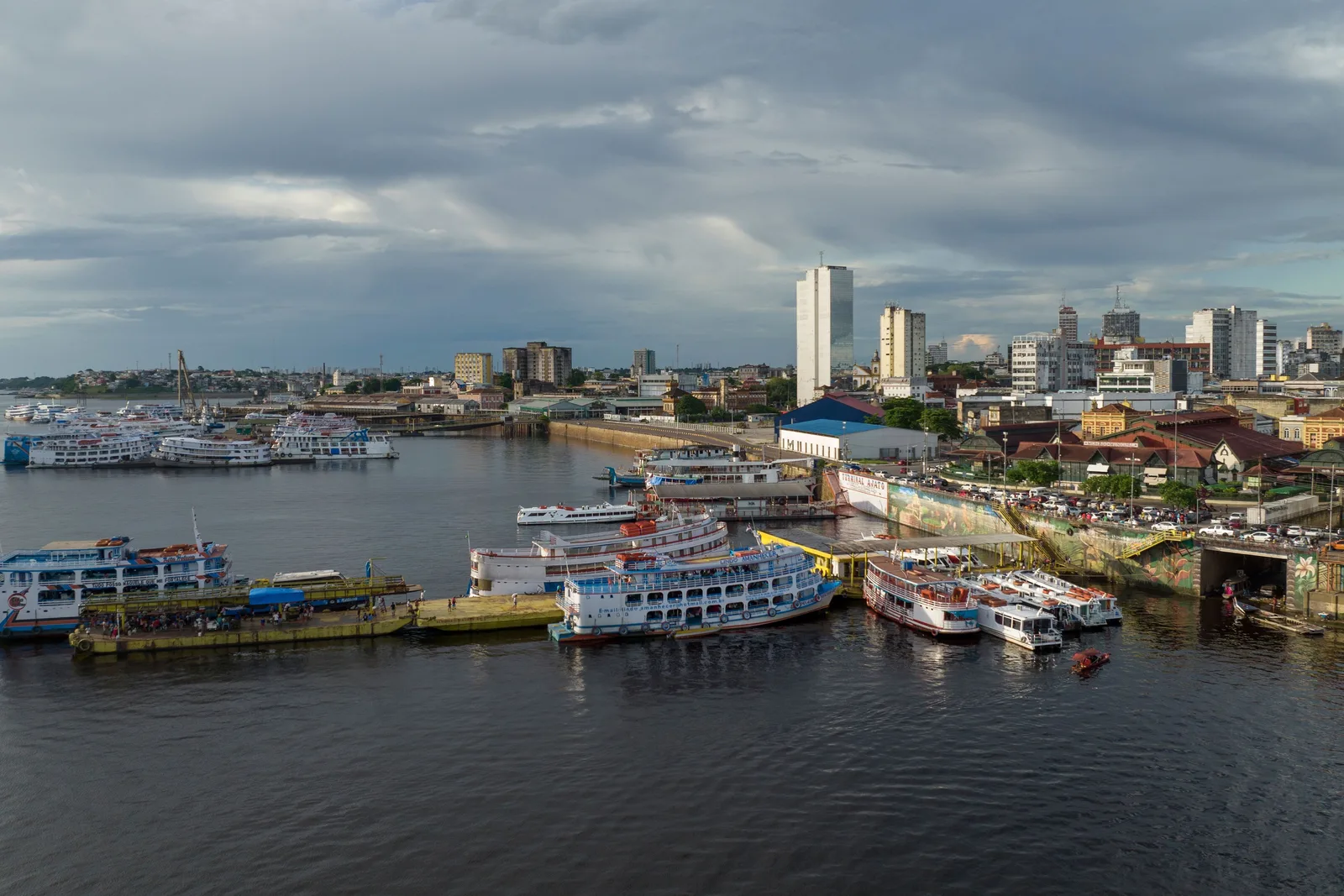
  • Manaus seen from the water: rows of double-decked riverboats moored along the shore with the dense low city and its tower blocks rising behind them

    Manaus Moderna · an hour

    Watching the port work

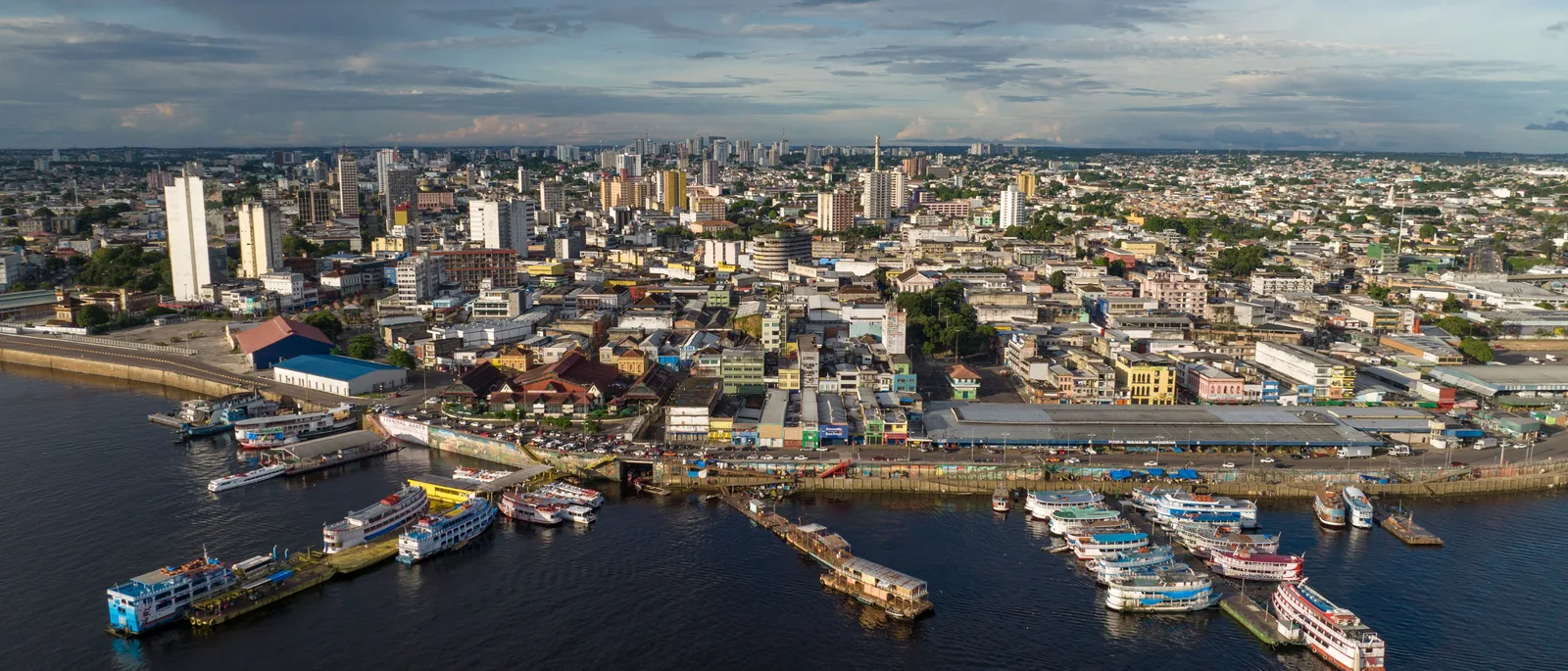
    The waterfront below the market is where the whole region arrives and leaves: ranks of double-decked riverboats loading bananas, fuel, furniture and passengers, with hammocks already strung on the top deck. The harbor itself is the engineering answer to a river that moves ten meters a year — the docks float and rise with it. It is the most interesting hour in Manaus and it costs nothing.

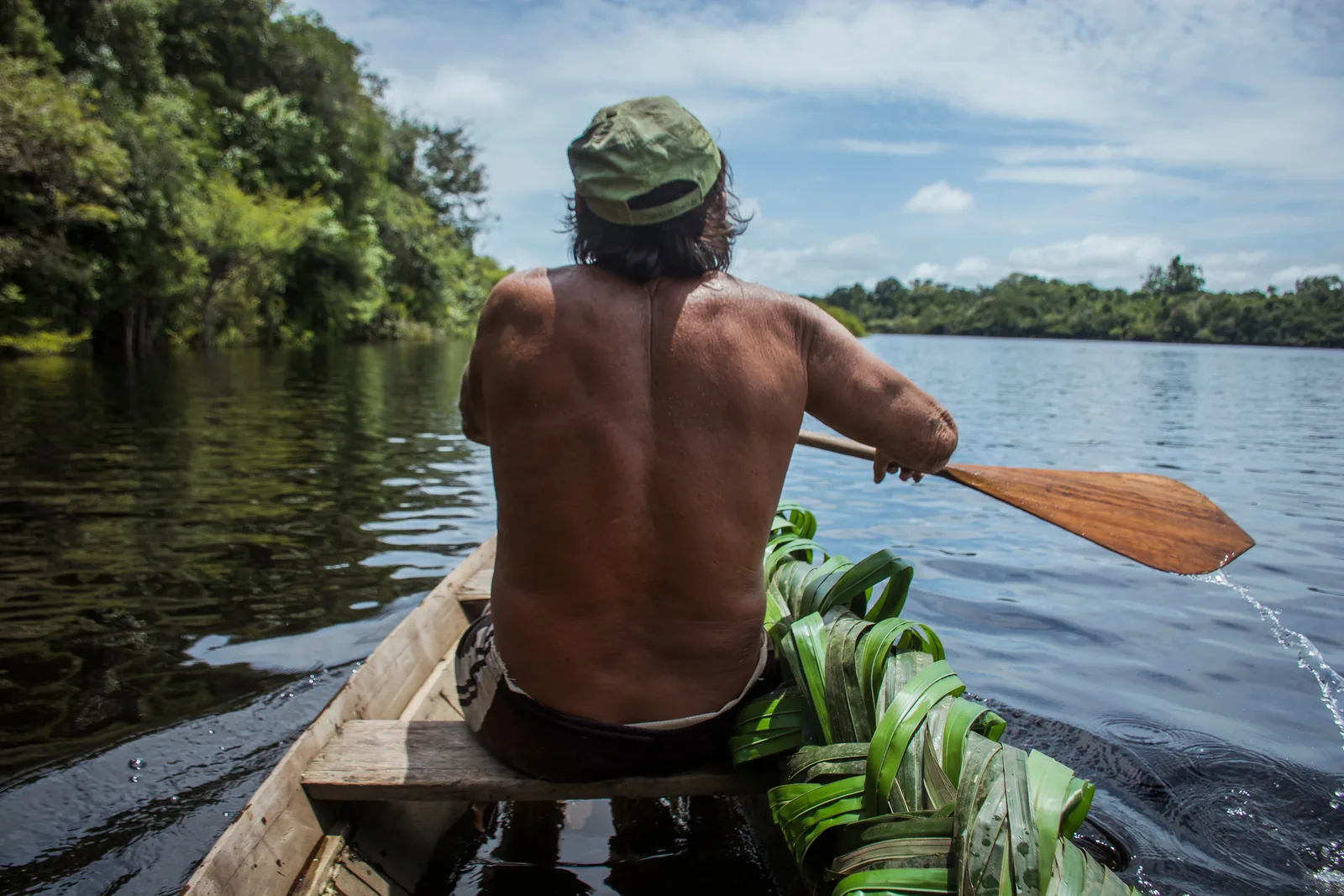
  • A man in a cap paddling a narrow dugout canoe away from the camera, cut green plants piled in the boat beside him and open river ahead

    From the lodge · 2 hours

    A visit to a riverine community

    Most lodges include a stop at a caboclo community — a scattering of stilt houses, a school, a soccer field on whatever ground is above water, and manioc going through a press. Done well it is the most interesting outing of the week; done badly it is a group of strangers photographing somebody’s kitchen. Ask before you book whether the community is a partner in the lodge or just on the route.

In the forest

  • A three-toed sloth hanging upside down among broad green leaves, its face turned toward the camera

    Forest walks and canoe trips · ongoing

    Sloth spotting in the canopy

    Sloths are the animal most people actually get close to, because they cannot run away. Guides find them by scanning the crowns for a shape that does not move, most often in cecropia trees. They also swim, surprisingly well, and in the flooded season you sometimes see one crossing open water between islands.

  • A large gray and brown moth with intricately patterned wings spread flat against the bark of a tree trunk

    From the lodge · about 90 minutes

    A night walk in the forest

    The forest changes staff at dusk. A guided walk with headlamps after dinner turns up tarantulas, tree frogs, stick insects, hunting spiders and moths the size of a hand — far more life, and far more of it visible, than the same trail gives you at noon. Closed shoes, long trousers, and stay behind the guide.

  • The white bow of a small boat pointing up a narrow channel of perfectly still water, forest and cloud reflected so cleanly that the horizon is hard to find

    High water, February to June · a morning

    Canoeing the flooded forest

    The best two hours of a high-water trip. A paddled canoe goes where a motorboat cannot, in among the trunks of a forest standing in six or eight meters of water, and the noise drops to nothing. You end up looking down at ground you could have walked across in September and up into branches that are normally thirty feet over your head.

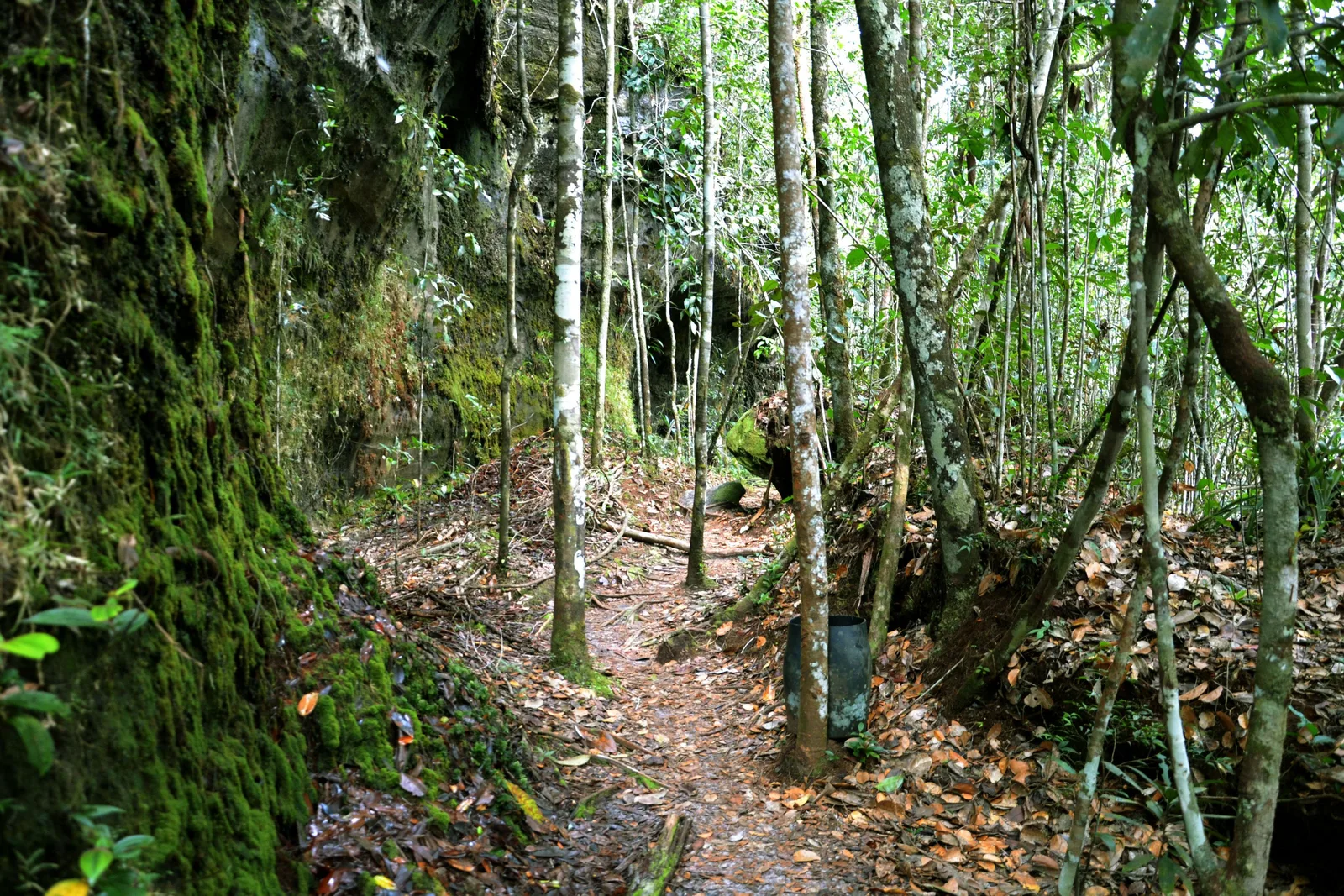
  • A narrow earth trail running through green forest between slender trunks, with light coming down through the canopy ahead

    From the lodge · 2 to 3 hours

    A walk in the terra firme forest

    The forest that never floods, and the one where you actually walk. A good guide turns it into a lesson rather than a hike: which tree the latex comes out of, which one the ants defend, which vine you cut for drinking water, which root is a medicine. It is hot, it is close, and the wildlife is mostly heard rather than seen — the value is in the guide, so ask what language yours speaks before you book.

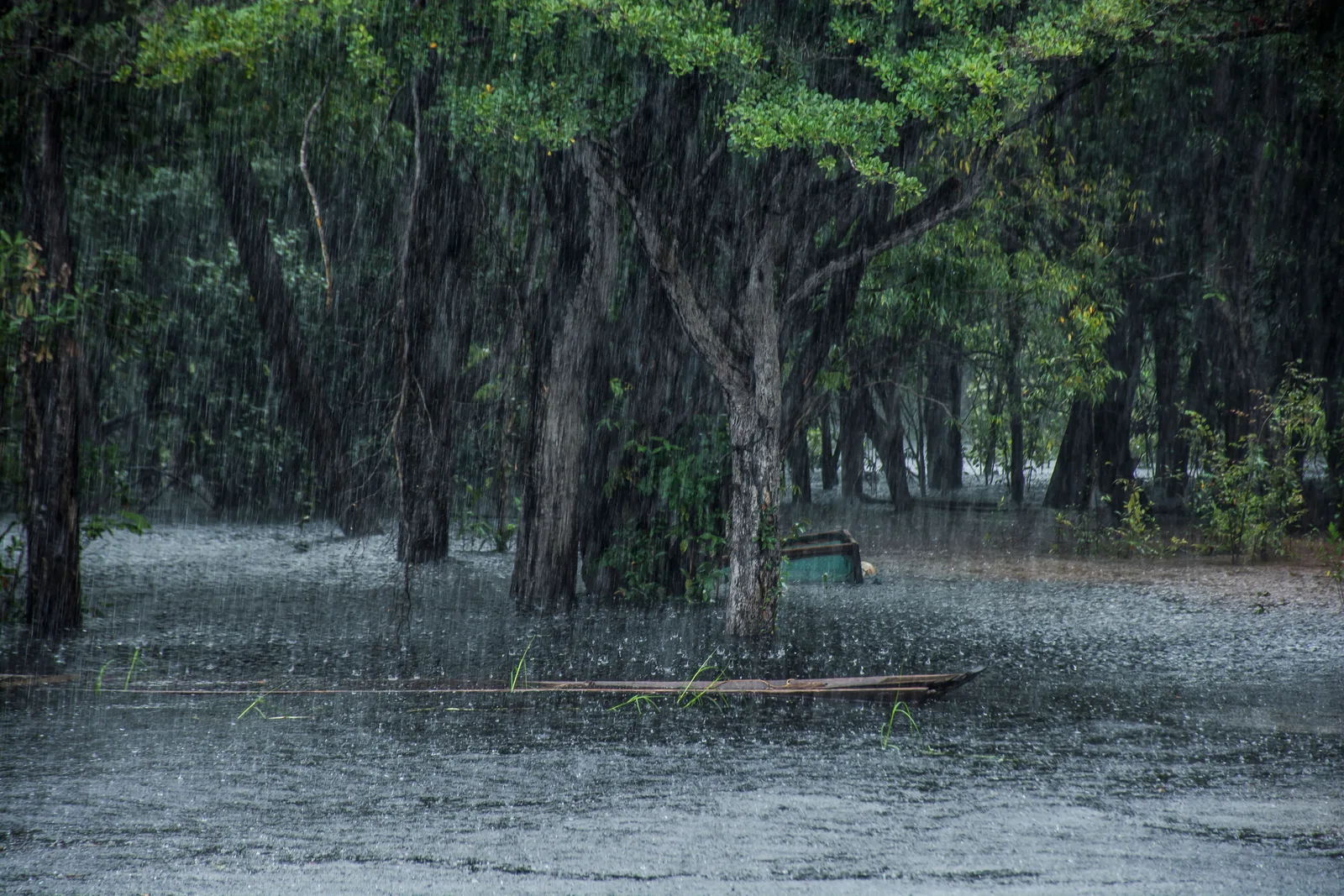
  • Heavy rain falling on flooded forest, the surface of the water broken all over by drops, with a small boat moored at the edge of the trees

    From most lodges · one night

    Sleeping out in the forest

    Most lodges offer a night in the forest as an add-on: hammocks and mosquito nets under a tarp, a fire, food cooked on it, and a walk in and out with the guide. It is the honest version of the "survival" trips the region has always sold — no theatrics, just a night with the sound turned all the way up. Take it in the dry months; sleeping out in an April downpour is a different experience.

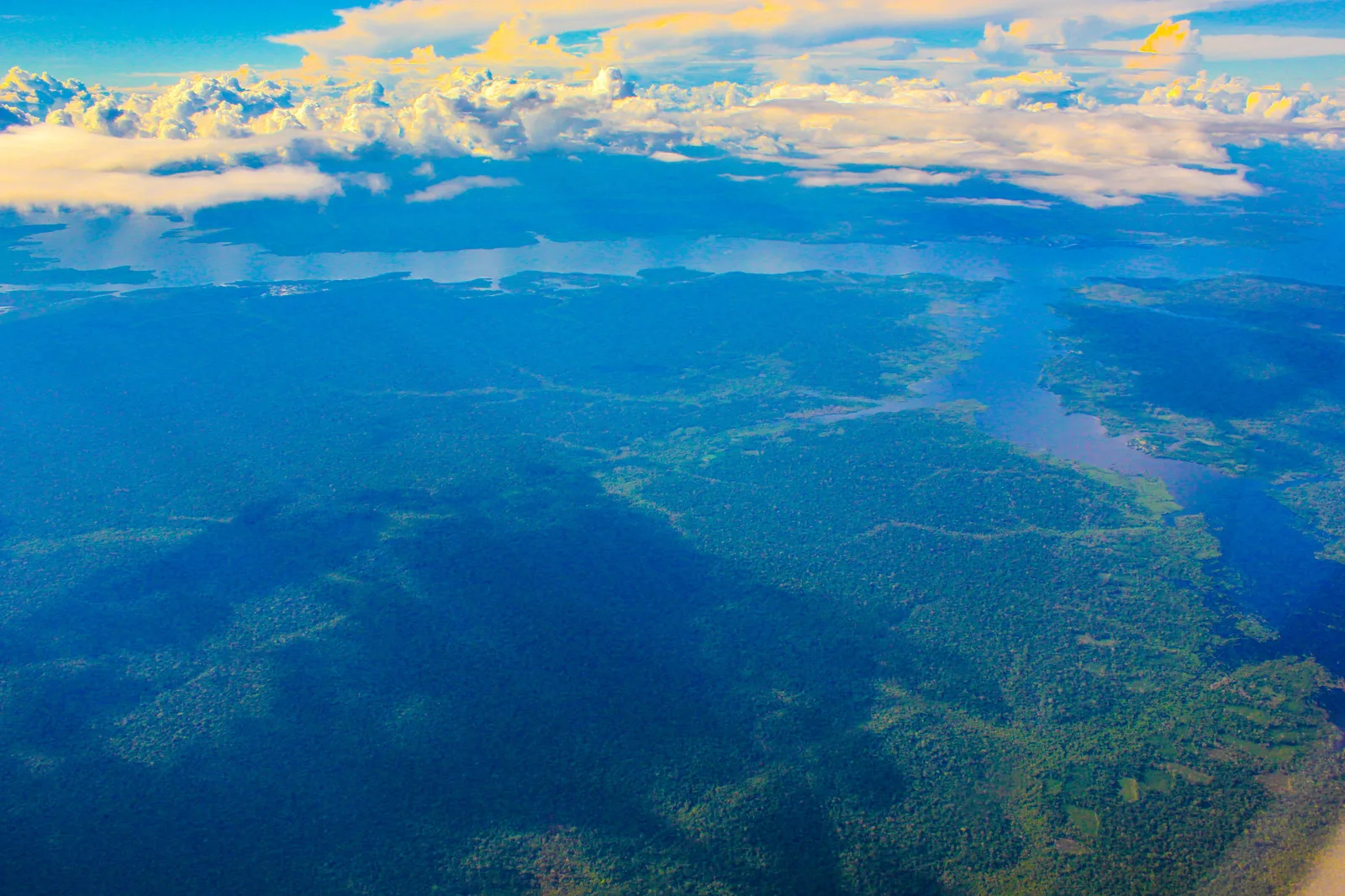
  • Rainforest photographed from high altitude, dark green under broad cloud shadows and cut through by a blue river and its lakes, with the tops of a cloud deck across the distance

    Manaus · half a day

    The canopy tower at MUSA

    The Museu da Amazônia sits inside a forest reserve on the edge of Manaus, and its 42-meter steel tower has platforms at 14, 28 and 42 meters — 242 steps to the top, and a view straight out across the canopy. There are trails, an orchid house, aquariums and a butterfly vivarium on the same site. Entry is R$50, it is closed on Wednesdays, and sunrise and sunset climbs are booked separately.

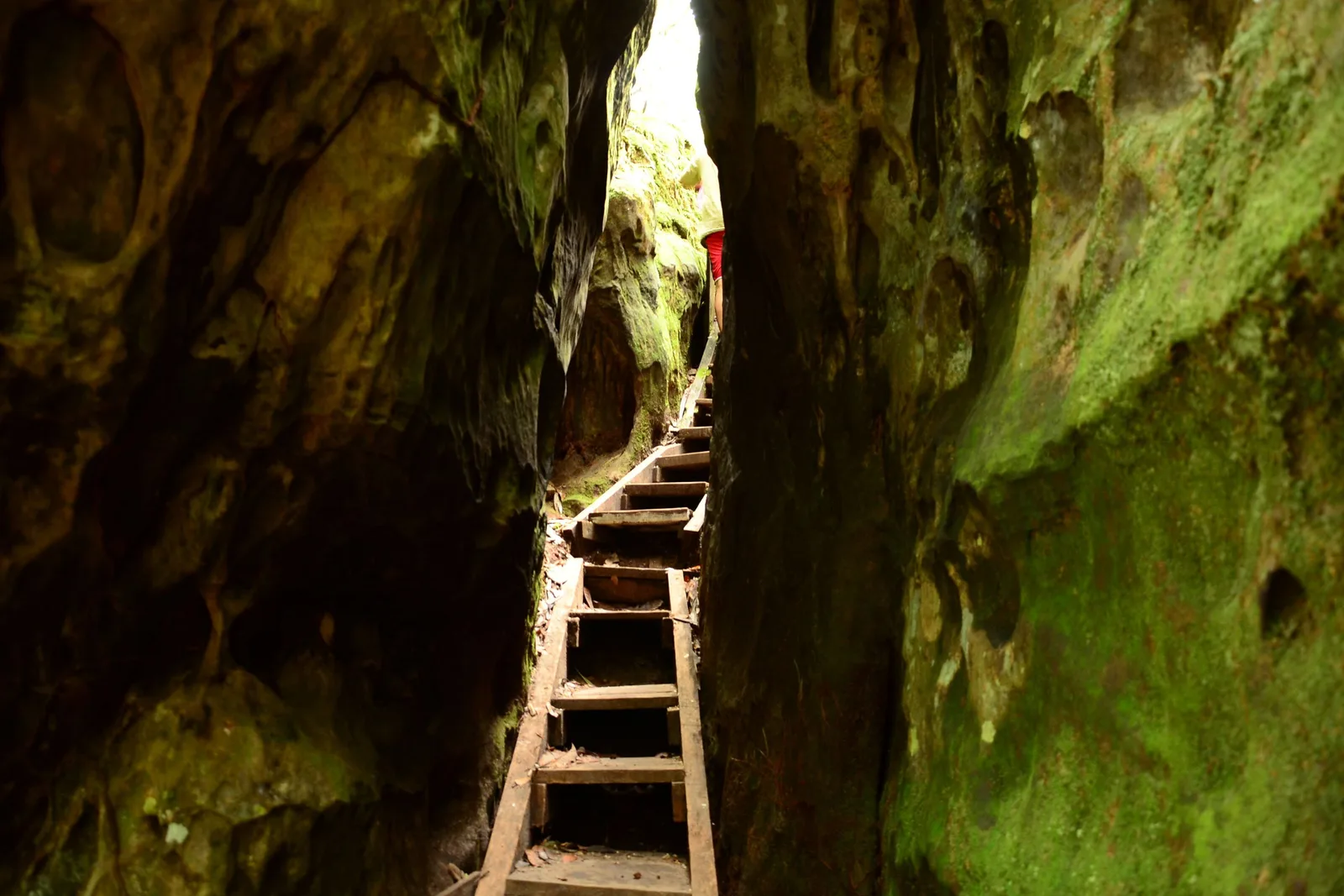
  • A wooden ladder and steps climbing a narrow cleft between damp mossy sandstone walls, with daylight coming down from above

    107 km north of Manaus · a long day

    Waterfalls and caves at Presidente Figueiredo

    The one worthwhile trip out of Manaus that is not on a river. Presidente Figueiredo sits about 107 km north up the BR-174, in sandstone country with well over a hundred waterfalls and a set of caves, including the Maroaga system. It is clear water rather than black or brown, you can swim in most of it, and it is a thirteen-hour day door to door.

In Manaus

  • The beach at Ponta Negra seen from the water, people and rows of white parasols along the sand, and four apartment towers — navy, pale green, dark red and blue — standing above the trees behind

    Manaus · a few hours

    An afternoon at Ponta Negra

    Manaus has its own river beach, on the Rio Negro at the western edge of the city, with a rebuilt promenade, an amphitheater, food stalls and the bulk of the city’s better hotels behind it. At low water there is real sand; at high water most of it is gone and the promenade is the point. It is the one part of Manaus that is genuinely pleasant in the evening.

  • Rainforest photographed from high altitude, dark green under broad cloud shadows and cut through by a blue river and its lakes, with the tops of a cloud deck across the distance

    Manaus · half a day

    The canopy tower at MUSA

    The Museu da Amazônia sits inside a forest reserve on the edge of Manaus, and its 42-meter steel tower has platforms at 14, 28 and 42 meters — 242 steps to the top, and a view straight out across the canopy. There are trails, an orchid house, aquariums and a butterfly vivarium on the same site. Entry is R$50, it is closed on Wednesdays, and sunrise and sunset climbs are booked separately.

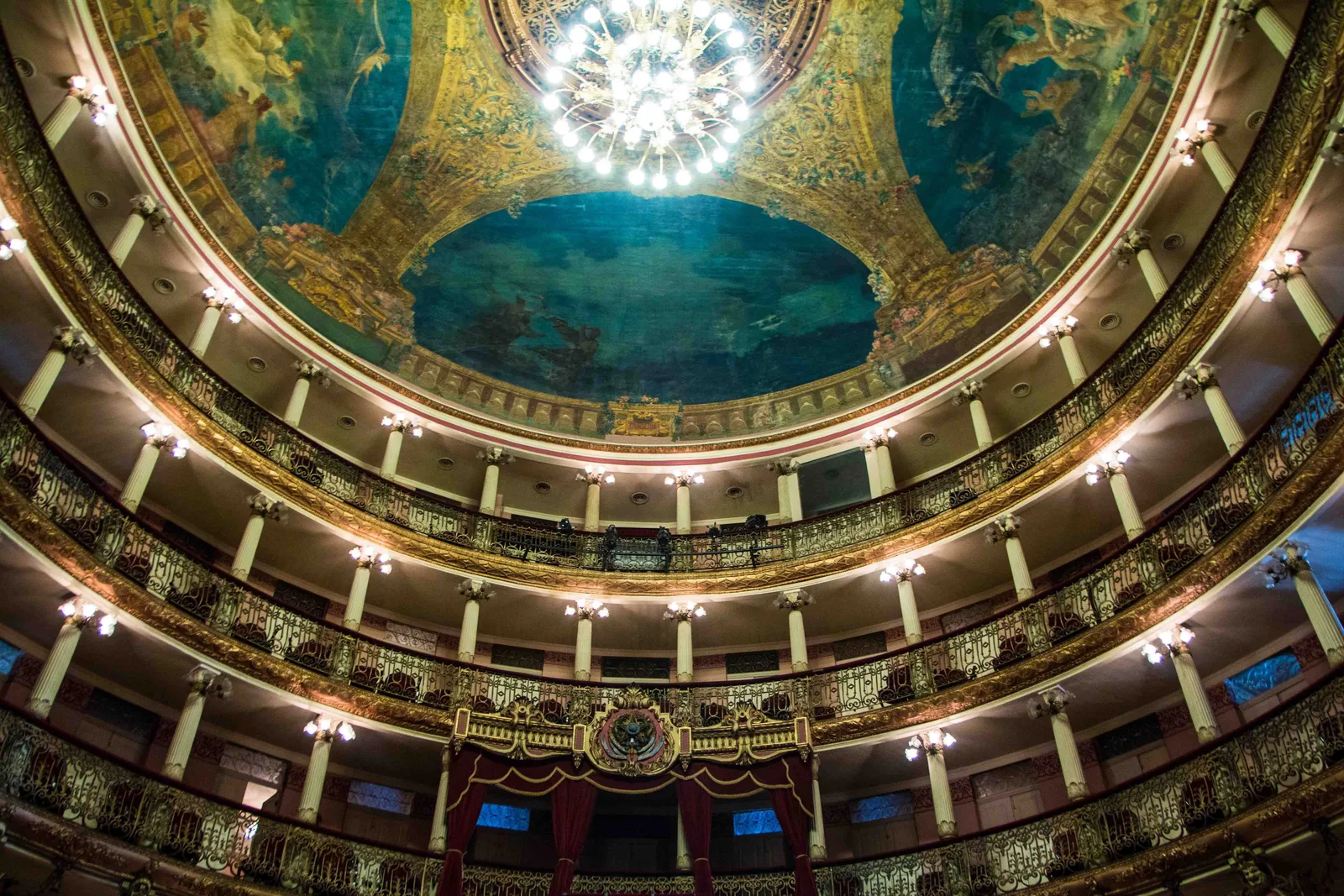
  • The painted dome of the Teatro Amazonas seen from the floor below, a chandelier hanging at its center above tiers of gilded boxes

    Centro · about 30 minutes

    A guided visit to the Teatro Amazonas

    Half an hour, R$20, and no booking. The tour takes in the auditorium, the tiers of boxes, the ballroom with its painted ceiling, and the dome from underneath. Tuesday to Saturday nine to five and Sunday and holidays nine to one, so Monday is the day not to plan it. If a concert falls in your window, buy a ticket instead.

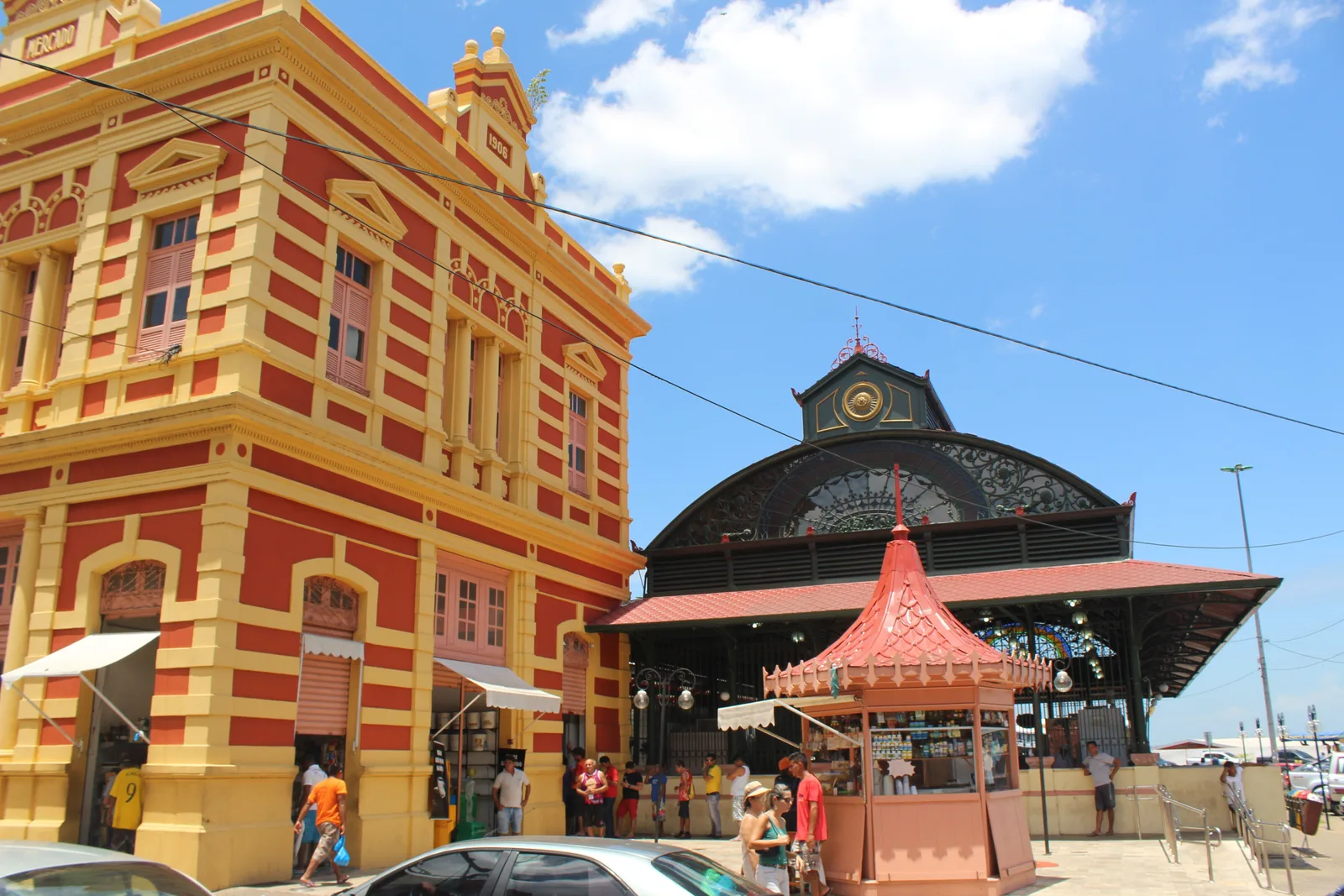
  • The red and yellow painted facade of the Manaus municipal market, with a dark iron pavilion under an arched roof standing beside it and a small pink kiosk and shoppers in the street in front

    Waterfront · 1 to 2 hours

    The Mercado Adolpho Lisboa

    A cast-iron market hall on the waterfront, built in the early 1880s in deliberate imitation of Les Halles in Paris, with its metal structure shipped in from Europe and put together on the riverbank. It has been a listed monument since 1987 and it is still a working market. Go in the morning, when the fish side is busy and the river boats are unloading.

  • Manaus seen from the water: rows of double-decked riverboats moored along the shore with the dense low city and its tower blocks rising behind them

    Manaus Moderna · an hour

    Watching the port work

    The waterfront below the market is where the whole region arrives and leaves: ranks of double-decked riverboats loading bananas, fuel, furniture and passengers, with hammocks already strung on the top deck. The harbor itself is the engineering answer to a river that moves ten meters a year — the docks float and rise with it. It is the most interesting hour in Manaus and it costs nothing.

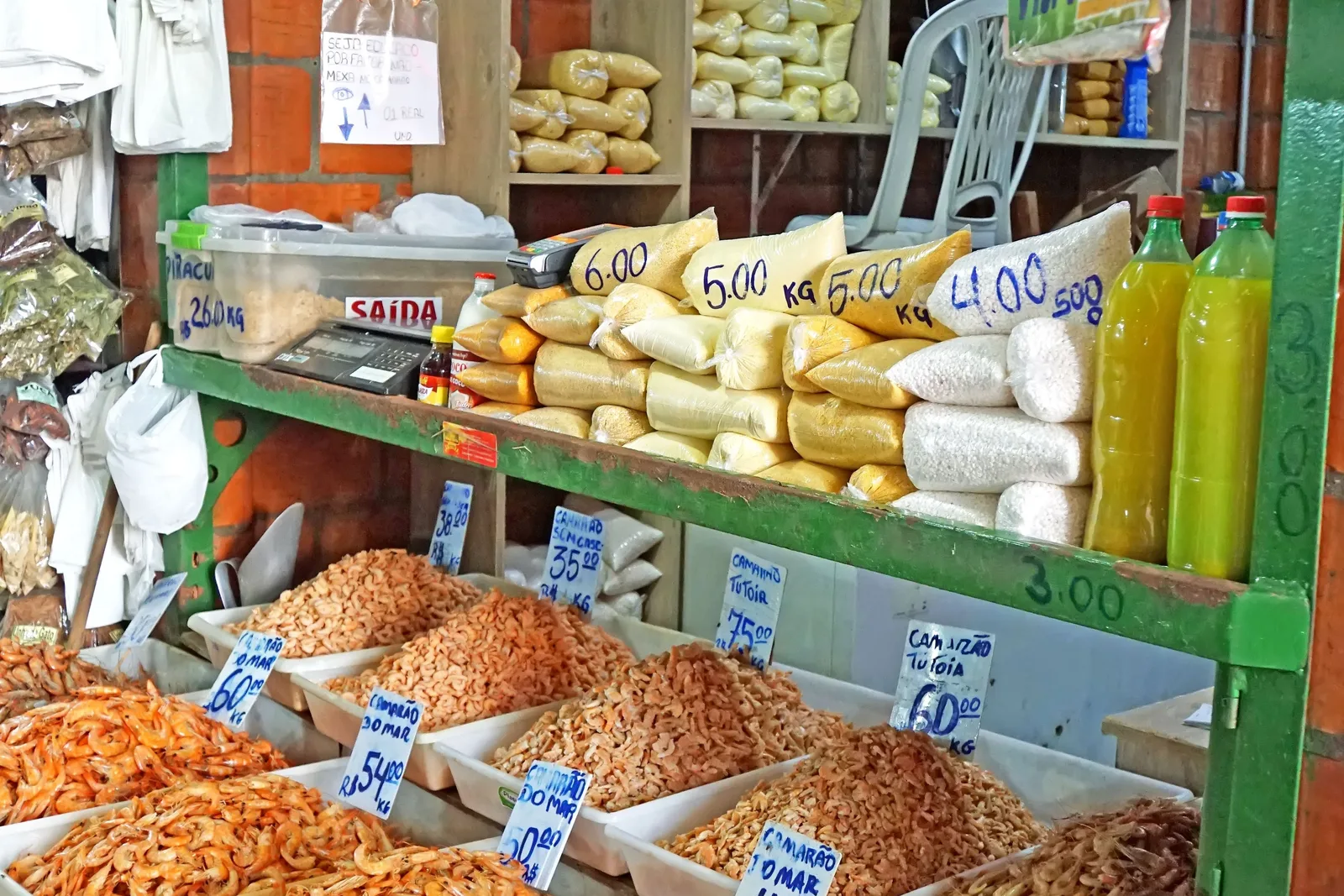
  • A market stall stacked with bins of dried shrimp and manioc flour and bags of grains, handwritten price cards propped in each one

    Markets and restaurants · any meal

    Eating the river fish

    Tambaqui grilled on the rib is the dish Manaus is proudest of. Pirarucu, one of the largest freshwater fish anywhere, turns up salted and dried like cod. Jaraqui is the everyday one, fried whole. On the sweet side there is cupuaçu and real açaí, which is savory and thick and eaten with fish and manioc flour rather than with granola.

Food & culture

  • The red and yellow painted facade of the Manaus municipal market, with a dark iron pavilion under an arched roof standing beside it and a small pink kiosk and shoppers in the street in front

    Waterfront · 1 to 2 hours

    The Mercado Adolpho Lisboa

    A cast-iron market hall on the waterfront, built in the early 1880s in deliberate imitation of Les Halles in Paris, with its metal structure shipped in from Europe and put together on the riverbank. It has been a listed monument since 1987 and it is still a working market. Go in the morning, when the fish side is busy and the river boats are unloading.

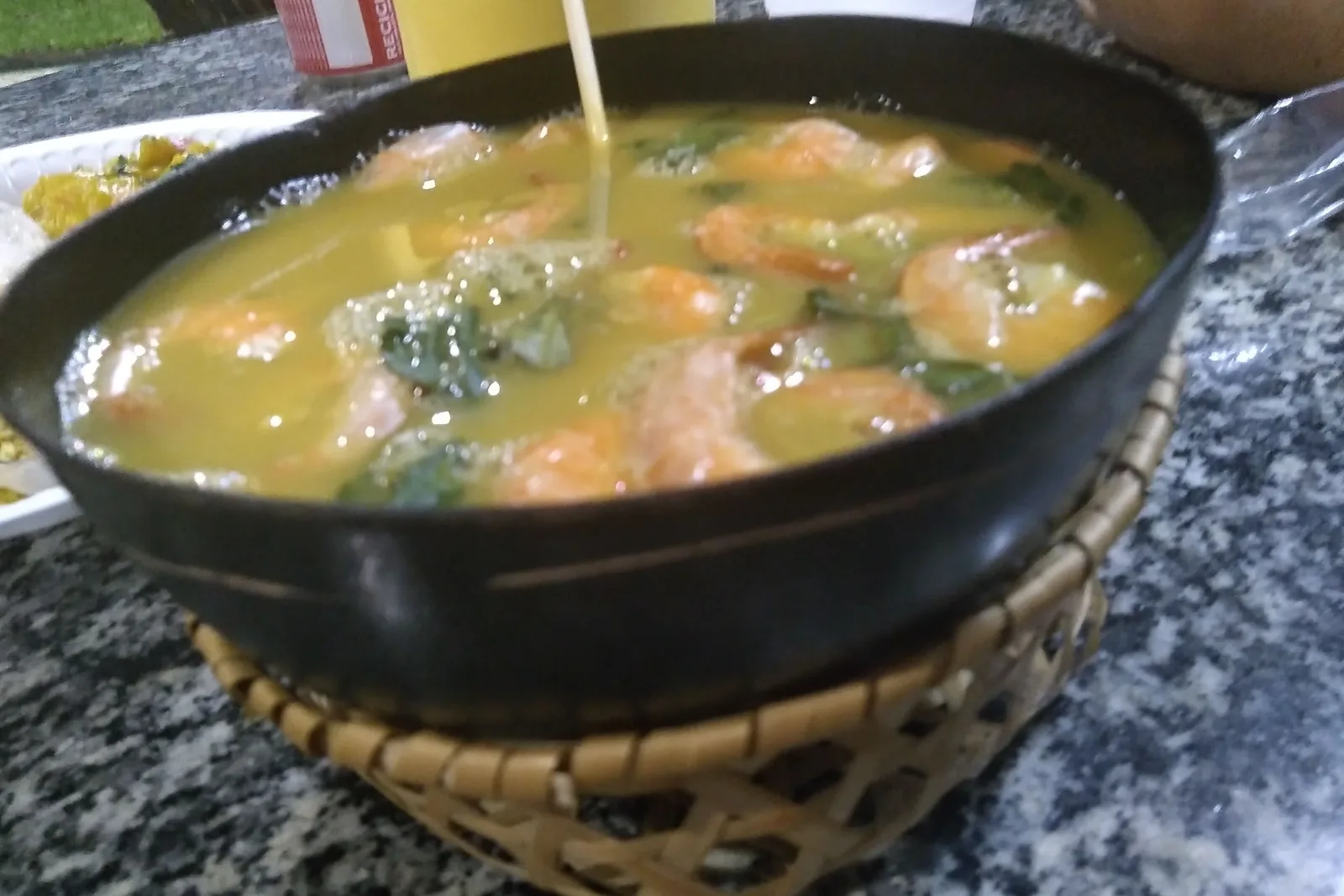
  • A dark bowl of tacacá in a woven stand, filled with pale yellow broth, pink shrimp and green jambu leaves

    Citywide · late afternoon

    Tacacá at a street counter

    A hot yellow broth of tucupi — the fermented juice pressed out of wild manioc — served in a gourd with dried shrimp, tapioca gum and jambu, a leaf that makes your mouth go numb. It is sour, salty and completely unlike anything else in Brazilian food, it is sold from little stands in the late afternoon, and it is the single dish to try before you leave.

  • A market stall stacked with bins of dried shrimp and manioc flour and bags of grains, handwritten price cards propped in each one

    Markets and restaurants · any meal

    Eating the river fish

    Tambaqui grilled on the rib is the dish Manaus is proudest of. Pirarucu, one of the largest freshwater fish anywhere, turns up salted and dried like cod. Jaraqui is the everyday one, fried whole. On the sweet side there is cupuaçu and real açaí, which is savory and thick and eaten with fish and manioc flour rather than with granola.

  • A man in a cap paddling a narrow dugout canoe away from the camera, cut green plants piled in the boat beside him and open river ahead

    From the lodge · 2 hours

    A visit to a riverine community

    Most lodges include a stop at a caboclo community — a scattering of stilt houses, a school, a soccer field on whatever ground is above water, and manioc going through a press. Done well it is the most interesting outing of the week; done badly it is a group of strangers photographing somebody’s kitchen. Ask before you book whether the community is a partner in the lodge or just on the route.

Where to stay

The only real question is how far out.

This is not a choice between neighborhoods. It is a choice about distance: every hour further from Manaus buys quieter water, more animals and fewer other boats, and costs you time and money to get there. Nearly everyone also spends a night or two in the city itself, because that is where the plane lands.

Drag and zoom to explore.

Tap an area to open it and see it on the map

  • Best for: The nights either side of the forest

    Manaus from across the river: riverboats moored in ranks along the shore below a dense city of low buildings and scattered tower blocks

    Not a base for the Amazon — a base for the flights. Almost every trip starts and ends with a night here, and the city earns one full day: the opera house, the market, the port and the Meeting of the Waters. Ponta Negra has the better hotels and the only waterfront worth an evening; Centro puts you within walking distance of everything historic but empties out after dark. Book the night before your lodge transfer rather than trusting a same-day connection.

    • Ponta Negra
    • Centro
    • Airport 14 km
    • One full day
  • Our pick

    Best for: The best trade between time and forest

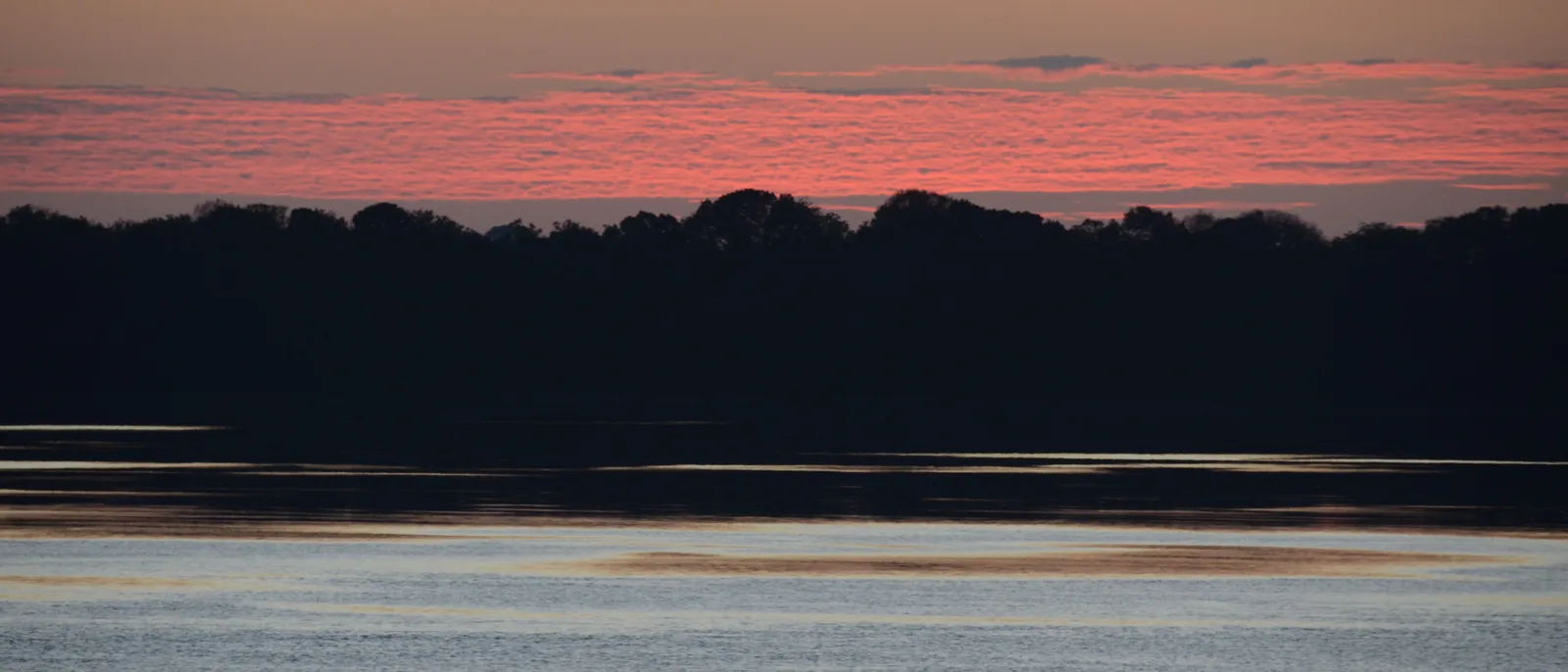
    A pink and gray dawn over the Rio Negro, a low black line of forest along the horizon and the light spreading across flat pale water

    One to three hours out of Manaus, on the Tarumã-Açu, the Rio Cuieiras or the lakes around Acajatuba, and the band most people should book. You get black water, flooded forest, night canoe trips, dolphins and a canopy tower without losing a day at each end, and there are more lodges here at more prices than anywhere else in Amazonas. Two nights works and three is better. The trade is that you are not the only boat on the water.

    • 1–3 hours out
    • Widest choice
    • Black water
    • 2–3 nights
  • Best for: The archipelago, and a road to reach it by

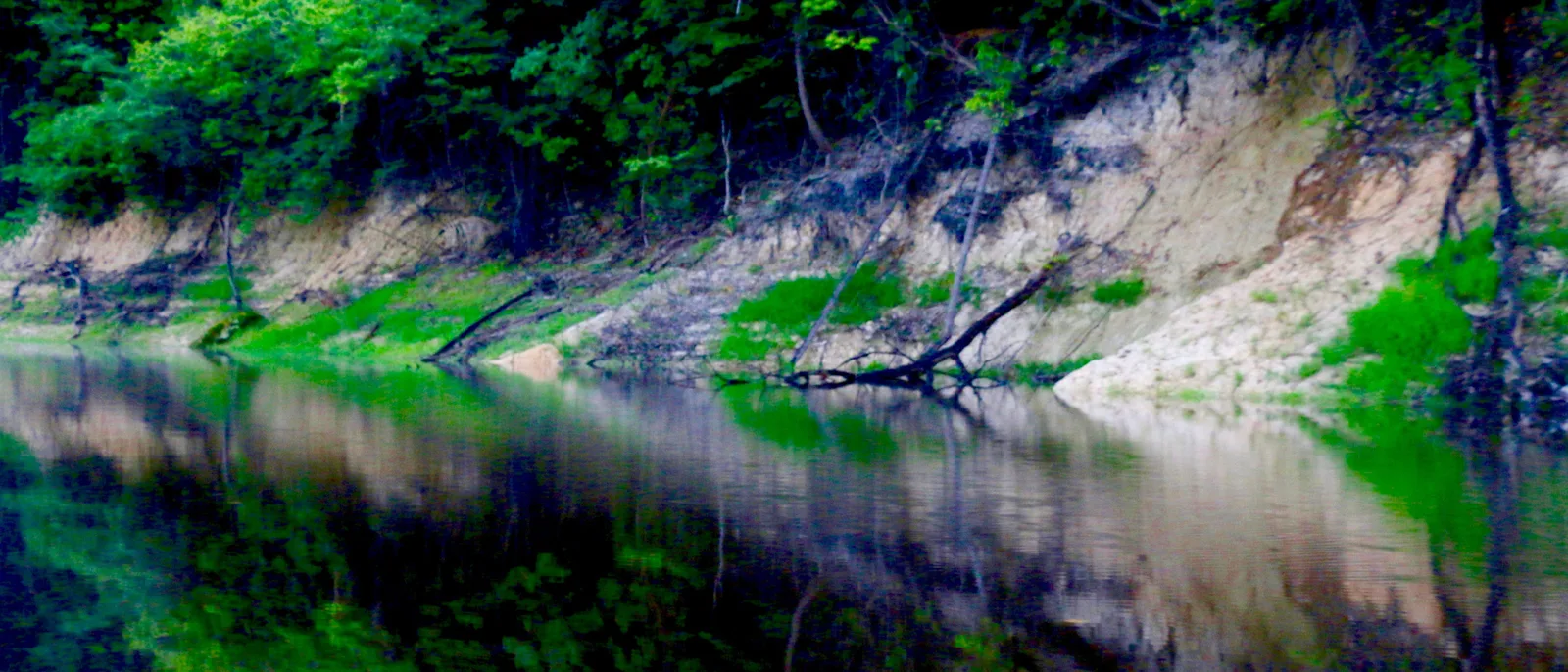
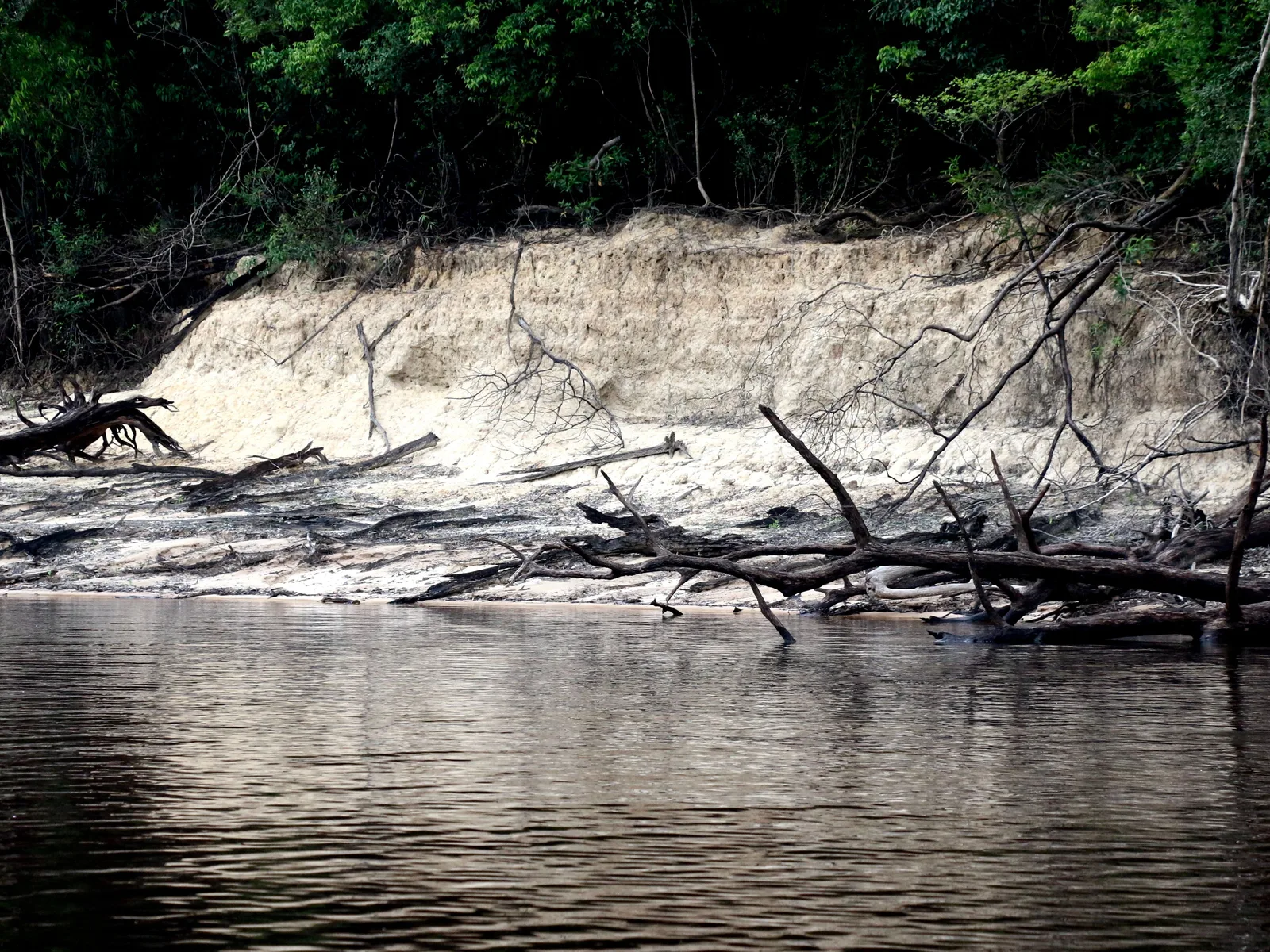
    A pale eroded river bank at low water, bright green growth and dead branches spilling down it from the forest above, the whole thing doubled in the dark still water below

    About 180 km northwest of Manaus by road, which is the unusual part: you can drive here in roughly three hours instead of taking a boat all the way. The reward is the archipelago itself — four hundred islands, sixty lakes and channels that go on for a hundred kilometers — plus a small town with restaurants and a jetty. Several of the region’s best lodges are on this stretch. Give it three nights; you did not come this far for one.

    • 180 km by road
    • National park
    • Novo Airão
    • 3 nights
  • Best for: Serious wildlife, and real distance

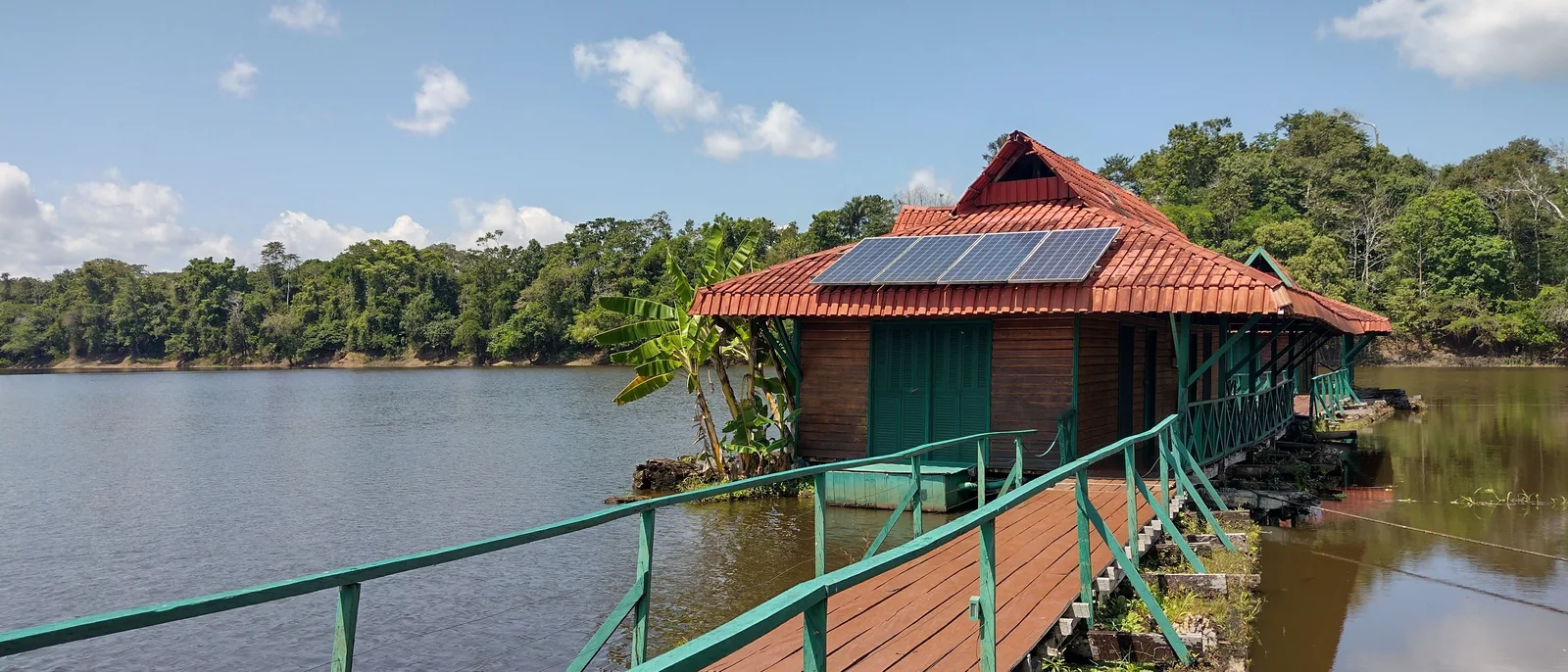
    A floating lodge on the river: a green railed walkway leading out to a cabin with a red roof and solar panels, forest closing in behind

    A separate flight and a different kind of trip. Mamirauá is 600 km west of Manaus — an hour and a half in the air to Tefé, then about ninety minutes by speedboat — and the lodge inside it floats, moving with the river. It is flooded várzea forest rather than black water, which means more mosquitoes and far more animals, including the white uakari monkey. Four nights minimum to justify the getting there, and it is the most expensive way to do this. Worth it if wildlife is the whole reason you came.

    • Flight to Tefé
    • Floating lodge
    • Uakari monkeys
    • 4 nights min

A working plan

Five days, two of them properly out there.

Built around the lodge transfer, which is the fixed point everything else moves for — most lodges run two a day and your flights have to meet one of them. Add nights to the lodge end, not to the city end.

  1. 01
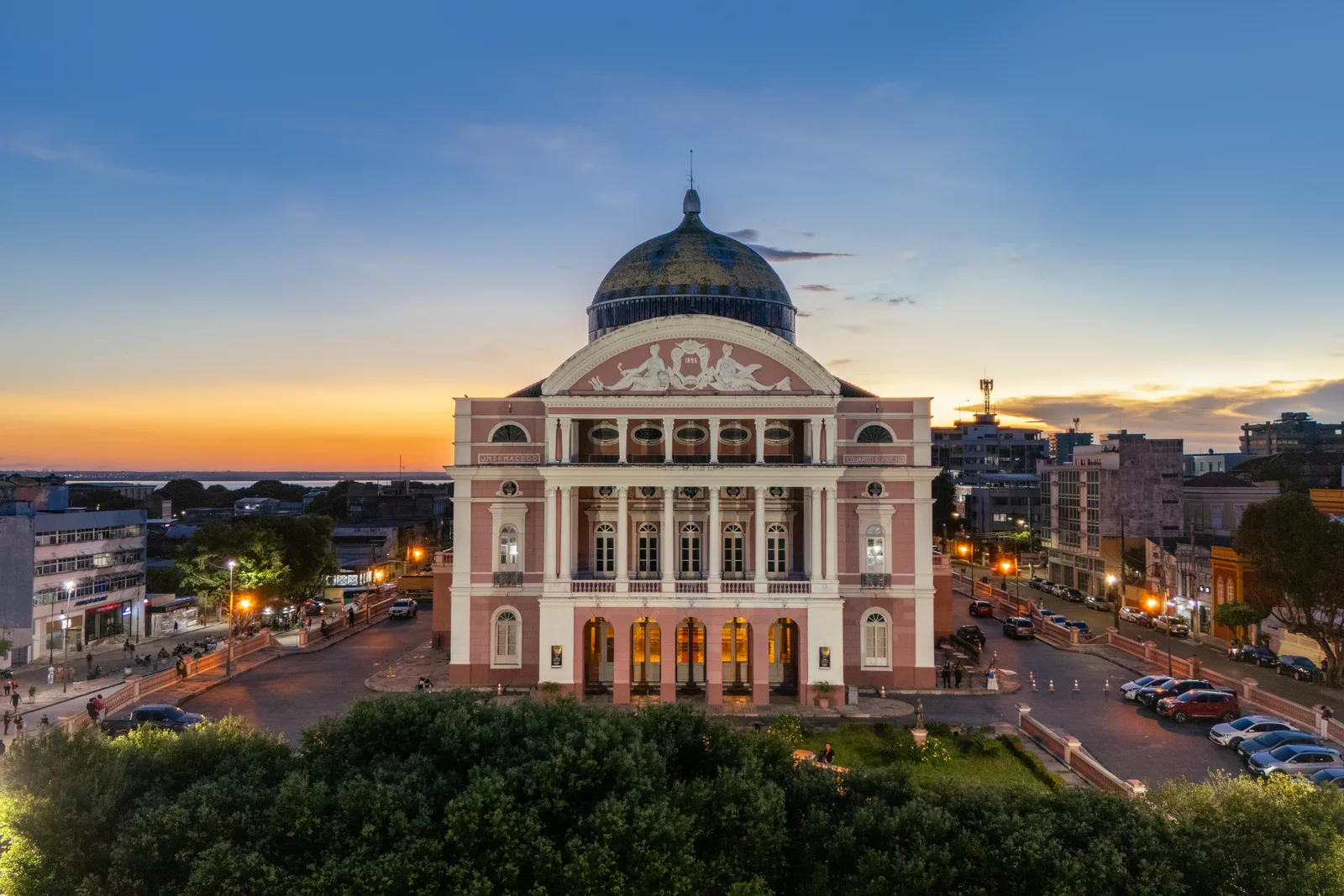
    The Teatro Amazonas from above just after sunset: its pink and cream front lit from below, the tiled dome dark against an orange sky, and the streets and buildings of Manaus around it

    Manaus

    Land, and take the city seriously

    The opera house in the morning, the market and the floating port after it, and the Ponta Negra promenade for the evening. Buy your reais tonight — the lodge will not take a card.

  2. 02
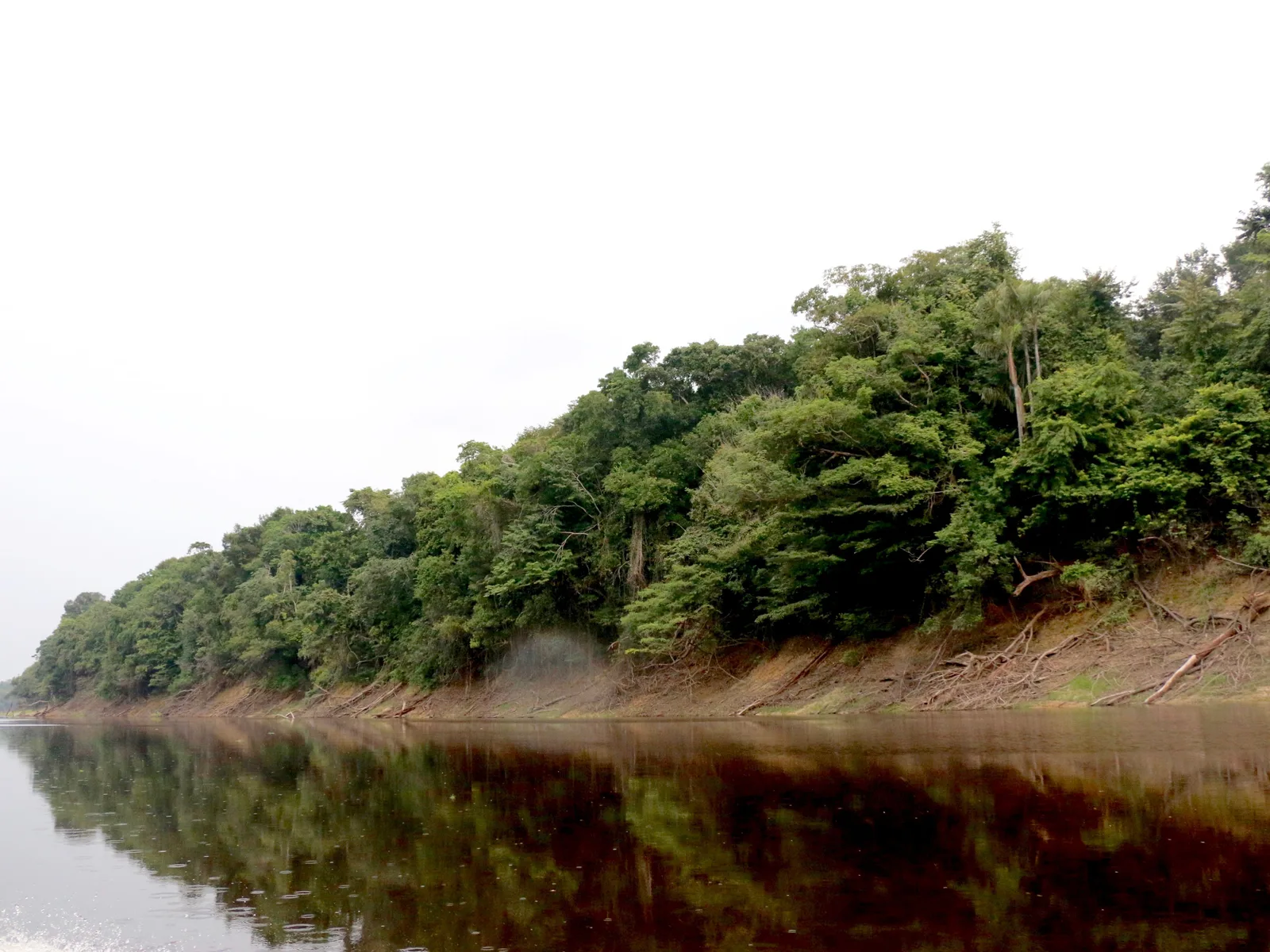
    The meeting of the waters at eye level from a boat: dark rippled water in the foreground, a hard line, then flat sandy water running to a low forest horizon

    Encontro das Águas & Lago do Janauari

    Where the two rivers meet

    Out early to the confluence, a hand in each river, then the boardwalks and giant lily pads at Janauari and lunch on the water. Second night in Manaus.
  3. 03
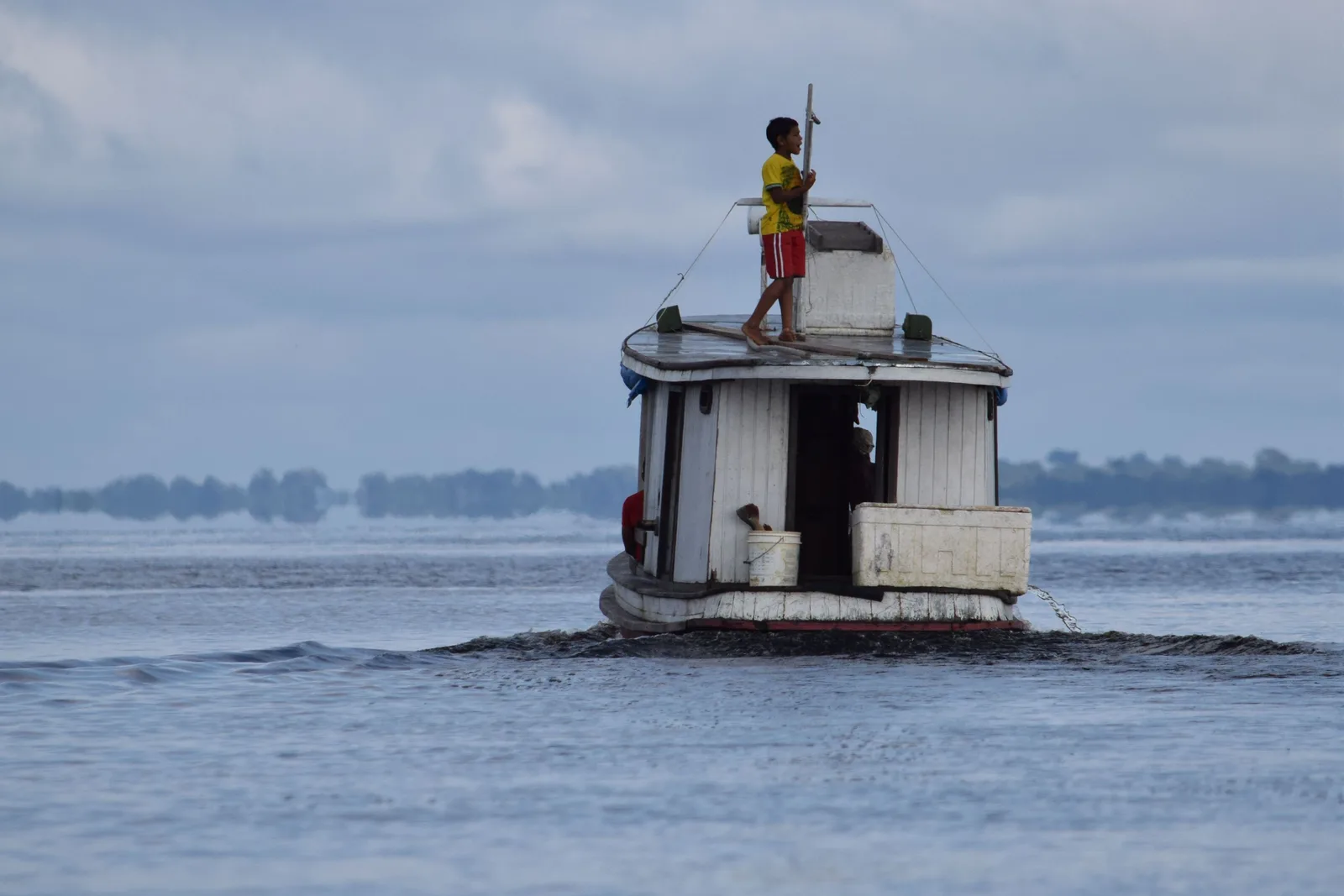
    A boy standing on the roof of a small boat crossing a wide gray river, a low green shore in the distance behind him

    The Rio Negro

    Upriver to the lodge

    The transfer, which is half the pleasure — the city thins out, the water goes black, and the last stretch runs between islands. Afternoon canoe, and caiman after dark.
  4. 04
    A sloth swimming across dark open water seen from above, its head raised clear of the surface and its mottled brown and cream back and outstretched limbs breaking through it

    Flooded forest & side channels

    The day the trip is for

    On the water before it gets hot, looking for dolphins and birds. A forest walk with a local guide in the middle of the day, a community visit, and piranha fishing before dinner.

  5. 05
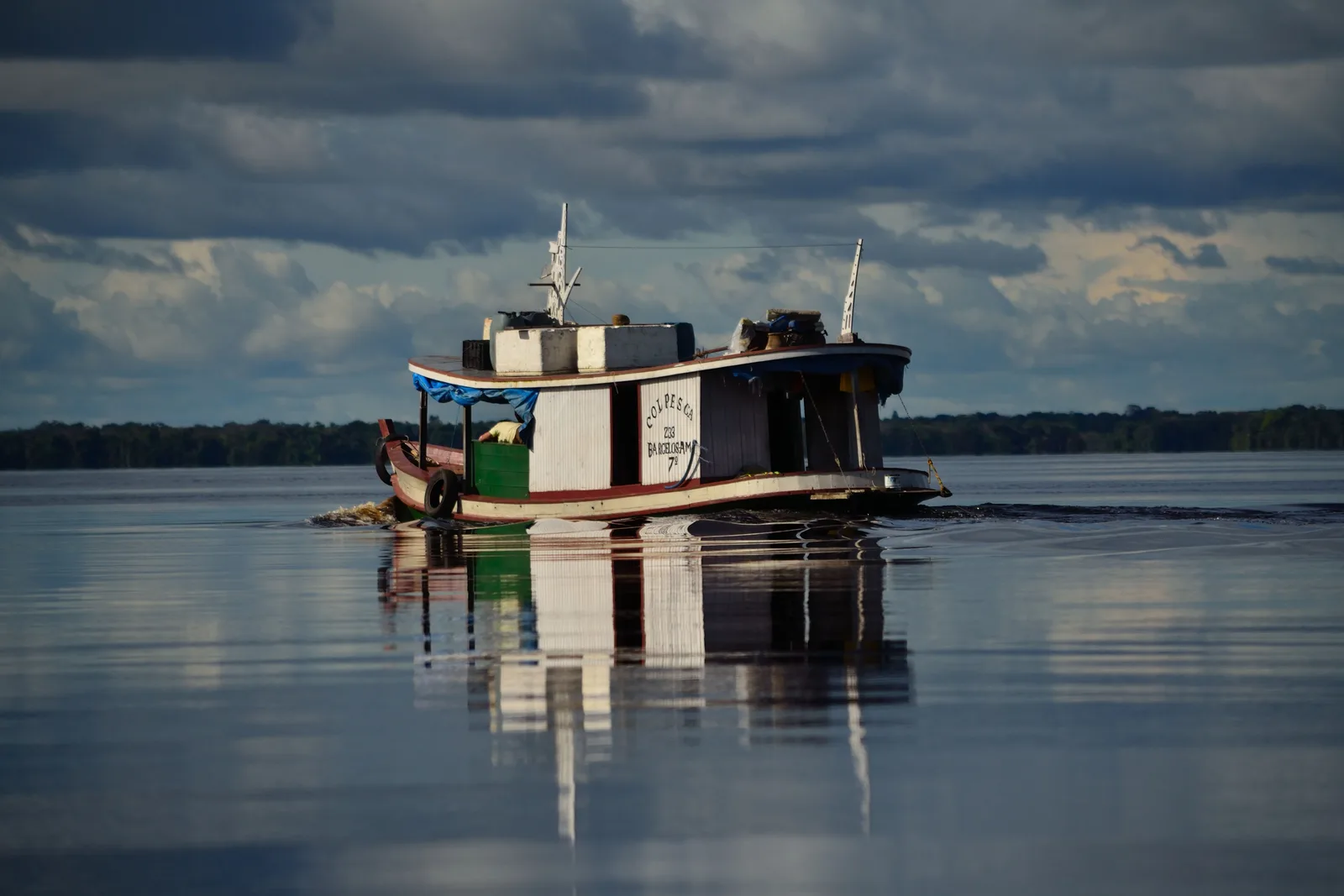
    A wooden riverboat sitting on water so still it doubles the hull perfectly, under a flat gray sky

    Rio Negro to Manaus

    One more sunrise, then out

    The best hour of the day is the one before breakfast, so take the last boat out. Back down the river to Manaus by early afternoon, with time to spare before the flight.

This is a starting shape, not a fixed departure — we rearrange it around your dates. Have it built for you

Timing

No bad season. Two different trips.

The temperature here barely moves all year — highs of 31 to 34, nights around 24, humidity in the eighties, every month. What changes is the river. From roughly February to June it is high, the forest is flooded and you travel by canoe among the trees. From August to November it is low, sand beaches appear, trails open, and the animals come down to the banks. It rains in both, because it is a rainforest.

Rainfall, rain days, temperature and UV for Manaus, month by month. Choose a month to see what the river and the weather are doing then.

January

Trade-offs
Air
24–31°C 75–88°F
UV
8 Very high
Rain
19 days 306 mm / 12.0 in

The wet season at full strength and the river climbing fast. Green, dramatic, very quiet.

February

Good
Air
24–31°C 75–88°F
UV
9 Very high
Rain
18 days 297 mm / 11.7 in

High water begins and the rain is still heavy at 297 mm. Quiet on the river, and green.

March

Good
Air
24–31°C 75–88°F
UV
9 Very high
Rain
19 days 321 mm / 12.6 in

Deep in the flooded season. Canoes run far into forest you could walk through in September.

April

Good
Air
24–31°C 75–88°F
UV
9 Very high
Rain
18 days 331 mm / 13.0 in

The wettest month of the year at 331 mm, with the river still climbing hard. Strong for boat-based birding, a step behind June.

May

Good
Air
24–32°C 75–90°F
UV
8 Very high
Rain
16 days 233 mm / 9.2 in

The river holds high, the rain begins to ease, and the forest is at its greenest.

June

Best
Air
24–32°C 75–90°F
UV
8 Very high
Rain
10 days 117 mm / 4.6 in

The high-water peak: the Negro at Manaus tops out in June in most years, and the rain is already down to 117 mm. Flooded forest by canoe, without the rain.

July

Good
Air
24–33°C 75–91°F
UV
9 Very high
Rain
7 days 67 mm / 2.6 in

Dry, bright and falling water. Brazilian holidays fill the lodges — book well ahead.

August

Good
Air
24–34°C 75–93°F
UV
9 Very high
Rain
6 days 56 mm / 2.2 in

The driest month. Beaches appear along the Rio Negro and wildlife pulls in to the banks.

September

Best
Air
25–34°C 77–93°F
UV
9 Very high
Rain
6 days 79 mm / 3.1 in

Low water at its best. Hot, clear, far fewer mosquitoes, and excellent for walking and fishing.

October

Good
Air
25–34°C 77–93°F
UV
9 Very high
Rain
8 days 114 mm / 4.5 in

Still low and still hot, with the first storms building back in the afternoons.

November

Good
Air
24–33°C 75–91°F
UV
8 Very high
Rain
10 days 188 mm / 7.4 in

Low water ending. The rain returns properly in the second half of the month.

December

Trade-offs
Air
24–32°C 75–90°F
UV
8 Very high
Rain
15 days 254 mm / 10.0 in

The wet season sets in and the river starts to rise. Hot, humid and heavily green.

  • Best The one or two peak months
  • Good A real recommendation
  • Trade-offs Workable, with a catch
See The Amazon on the Brazil calendar

UV is the monthly average of the daily peak, 2022 to 2025, calculated from Copernicus Atmosphere Monitoring Service data. Weather data by Open-Meteo.com, CC BY 4.0.

For wildlife and walking

August–October

Low water. Trails open, river beaches appear, animals concentrate along the shrinking banks, and it is the driest and brightest stretch of the year. September is the pick: 79 mm across six wet days, with the water still low and far fewer mosquitoes.

For the flooded forest

February–June

High water. Canoes go in among the crowns of the trees, and the birding is at its best. June is the pick: the Negro at Manaus tops out in June in most years and the rain is already down to 117 mm, so you get the flooded forest without the wet season on top of it.

Book far ahead for

Late June and July

Brazilian winter holidays fill the lodges, rates rise, and the Parintins festival takes the last weekend of June.

About the rain

The wet half of the year is genuinely wet. March and April average over 300 mm across eighteen or nineteen rain days, which means it rains most days — usually as a heavy afternoon downpour that arrives, empties itself and clears, rather than as a gray drizzle that takes the day away. You plan around it. The compensation is real: the forest is at its greenest, the lodges are at their quietest, and the flooded channels only exist now.

The dry half is dry by rainforest standards, not by anyone else’s. August averages 56 mm over six rain days and September is not far behind, which is about as reliable as tropical weather gets. What actually changes is the water level. The river falls ten meters or more, beaches and sandbars come out of it, trails that were submerged reopen, and animals that were spread through a flooded forest the size of a small country are suddenly concentrated along a shoreline you can follow in a boat. If seeing wildlife is the priority, this is the half of the calendar to book.

The dates worth planning around

A huge black bull costume with white horns and a decorated head raised above a crowd of performers in blue and white feathered costumes

Festival de Parintins

Last weekend of June — 25 to 27 June 2027

Two rival groups, Garantido in red and Caprichoso in blue, stage a competing folk opera about an Amazonian legend in a purpose-built arena on an island in the middle of the river. It is enormous, entirely serious, and unlike anything else in Brazil. Parintins is a long way downstream of Manaus, hotel rooms are scarce, and most visitors sleep on a chartered boat — which means booking months out, not weeks.

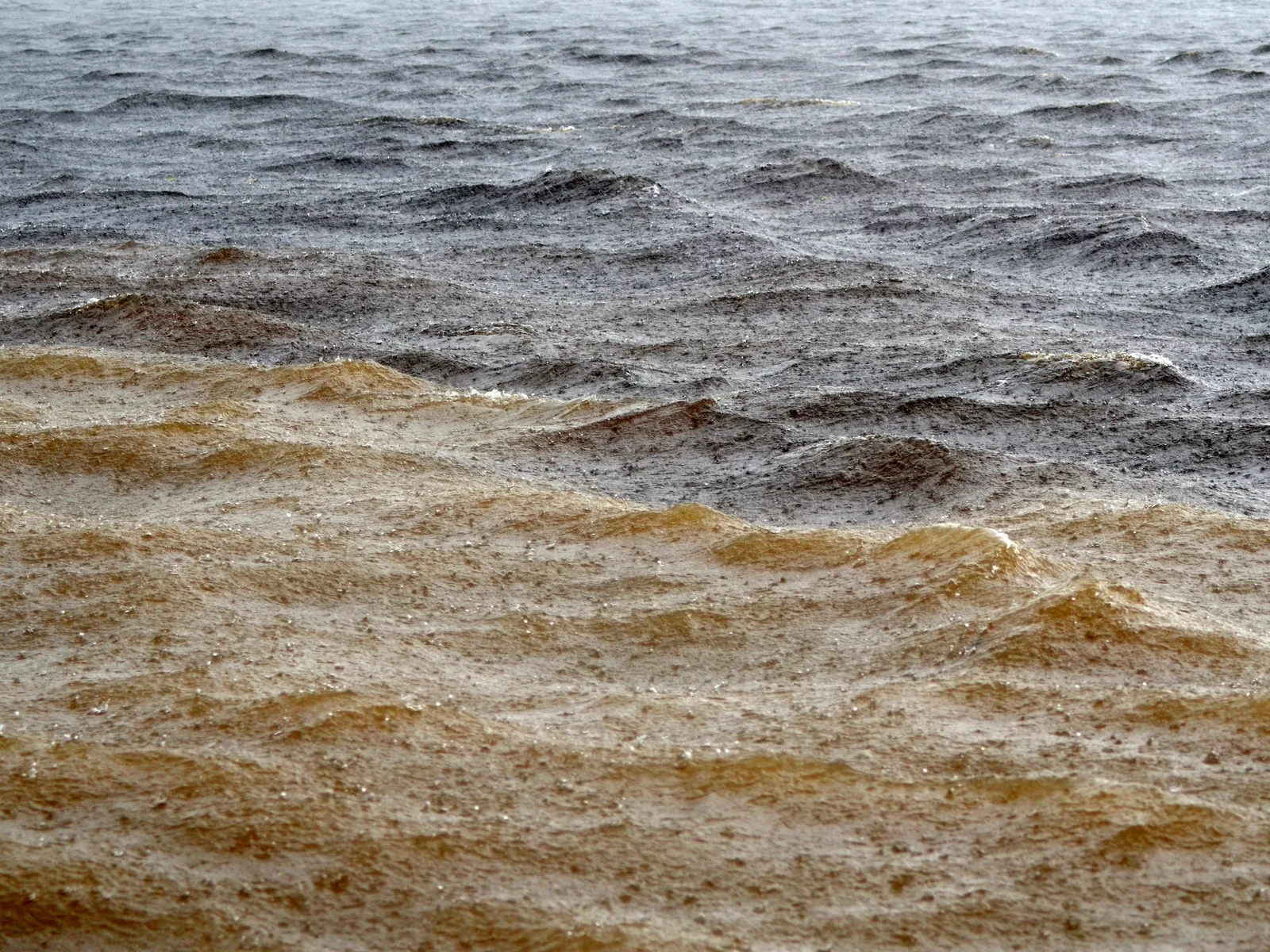
A close view of the water surface where dark tannin-black water and opaque sandy water churn against each other along a ragged boundary

The Meeting of the Waters at high water

Sharpest February to April

The confluence is visible from Manaus all year, but the boundary between the two rivers is crispest when the water is high and the Solimões is carrying its heaviest sediment load. February to April is when the line looks like the photographs. It is also the wettest stretch of the year, so pair the trip with a morning rather than counting on a clear afternoon.

A bank of pale sand exposed at low water, tangled with bleached fallen branches above the edge of dark still water

Low water and the river beaches

August to November

Not an event, but the closest thing this region has to a season with a start and an end. As the Rio Negro drops it uncovers white sand along the islands and the mainland shore, opens forest trails that spend half the year underwater, and pushes the wildlife down to a shoreline that is easy to follow by boat. It undoes itself again from December.

Good to know

Before you come

How many days do I need in the Amazon? +

Five, and that is the itinerary above. The travel in and out is long enough that anything shorter spends most of itself moving: one day for Manaus, one for the Meeting of the Waters, and three that give you two full days and two nights at a lodge. Four works if you cut the confluence day, and a lot of people do it. Three is a transfer with a night in the middle. If you can spend six or seven, put every extra night at the lodge rather than in the city — the second and third mornings out there are better than the first, because you have stopped being startled by everything and started noticing things.

High water or low water — which is the better trip? +

They are different trips and neither is the wrong one. High water, roughly February to June, floods the forest: you travel by canoe among the trunks and crowns of trees, the birding is at its best, and the Meeting of the Waters is at its sharpest. Low water, August to November, drains it: white sand beaches appear along the Rio Negro, trails that spend half the year submerged reopen, mosquitoes drop off sharply, and animals concentrate along the shrinking banks, which makes them much easier to see. If wildlife is why you are coming, go low. If the flooded forest is the image in your head, go high. There is no month here that does not work.

Will I actually see much wildlife? +

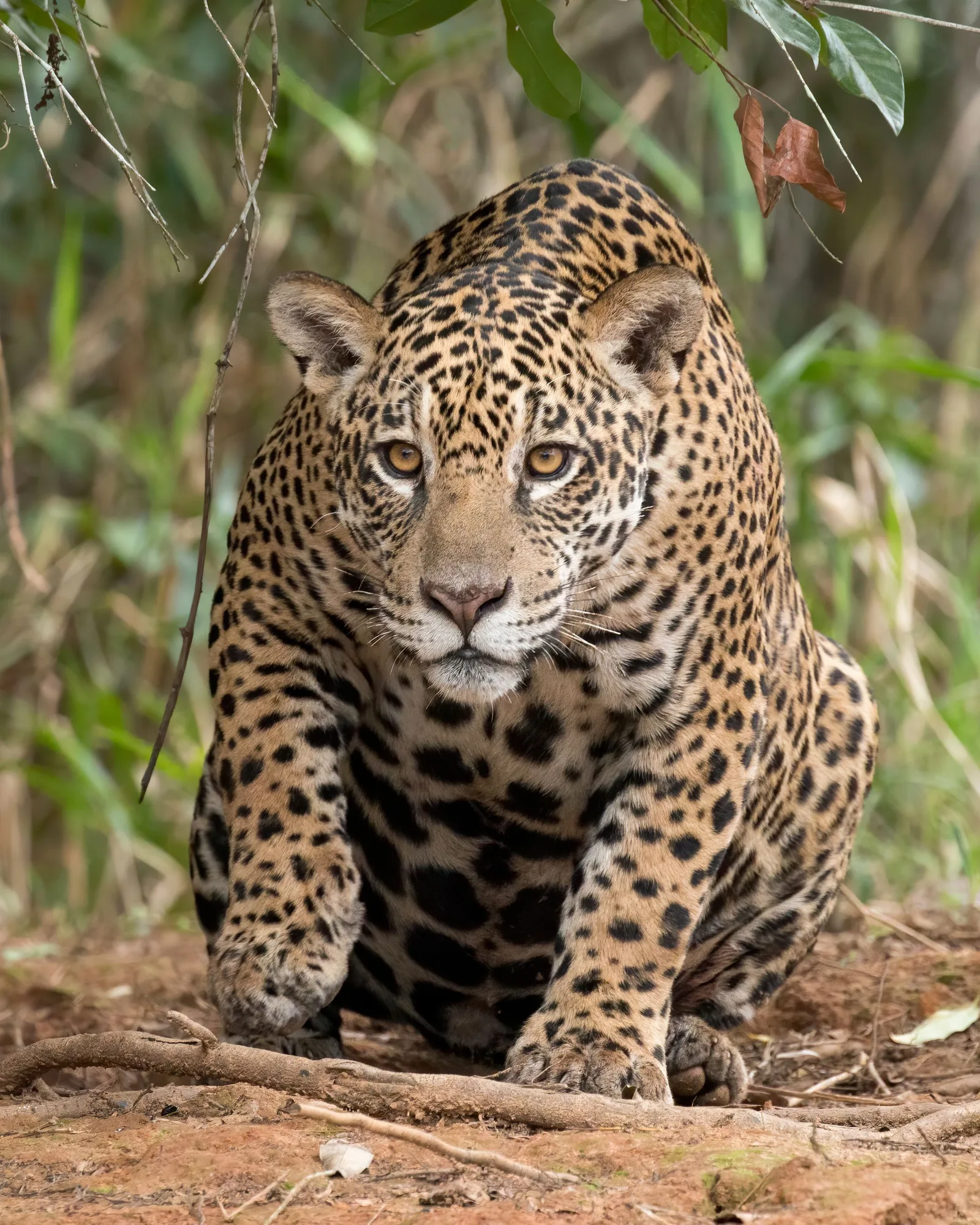
Less than a nature documentary and more than you fear, and how much depends almost entirely on how far from Manaus you go. Within two or three hours of the city you can reasonably expect river dolphins, caiman at night, sloths, several kinds of monkey, macaws, toucans, kingfishers, and a great deal of insect life. What you will not see are jaguars, and anyone promising them is selling something. For a real step up in density, go to Mamirauá — or, honestly, go to the Pantanal, which is open wetland rather than closed forest and is the better place in Brazil to actually watch animals. The Amazon’s subject is the forest itself.

Do I need a yellow fever shot and malaria pills? +

Yellow fever: yes, plan on it. The CDC recommends vaccination for travelers to Amazonas, it is not required to enter Brazil, and it takes about ten days to become effective — so it is a decision to make several weeks out. Malaria: the CDC recommends preventive medication for travel in Amazonas state, including the rural areas where the lodges are, so talk to a travel clinic four to six weeks before you fly and let them weigh it against your actual itinerary. Beyond that it is repellent, long sleeves at dusk and dawn, and the standard advice about water and sun. One piece of local good news: the Rio Negro is black water, which is acidic and a poor breeding ground, so lodges on that river have noticeably fewer mosquitoes than those on the muddy Solimões side.

Is Manaus safe, and do I have to spend time there? +

You do have to pass through it — every flight lands there and every lodge transfer leaves from there — and you should give it a day rather than treating it as an airport with hotels attached, because the opera house, the market and the port are genuinely worth it. It is a working city of 2.3 million with ordinary big-city street crime, and the honest advice is specific rather than alarming: the historic center is fine and busy in daylight and is not where you want to wander after the shops close; keep your phone out of sight on the street around Centro and the port; use Uber or 99 instead of walking between neighborhoods at night; and stay in Ponta Negra if you would rather have somewhere pleasant to eat in the evening. Once you are on the river, none of this applies.

Keep going

Where the Amazon fits in a bigger trip.

Nobody flies to Manaus and straight home again. These three are the trips that most often go either side of it — one for the wildlife the forest hides, one for the city you will connect through, and one for the other end of the Brazilian north.

Free · 29 pages

Free guide

Beginner's Guide to Brazil

A free 29-page guide to everything a first-time visitor should know before landing: visas, safety, money, getting around, where to go, and what to eat.

We'll email you a link to confirm your address. Click it and the guide opens right away.

See what's inside
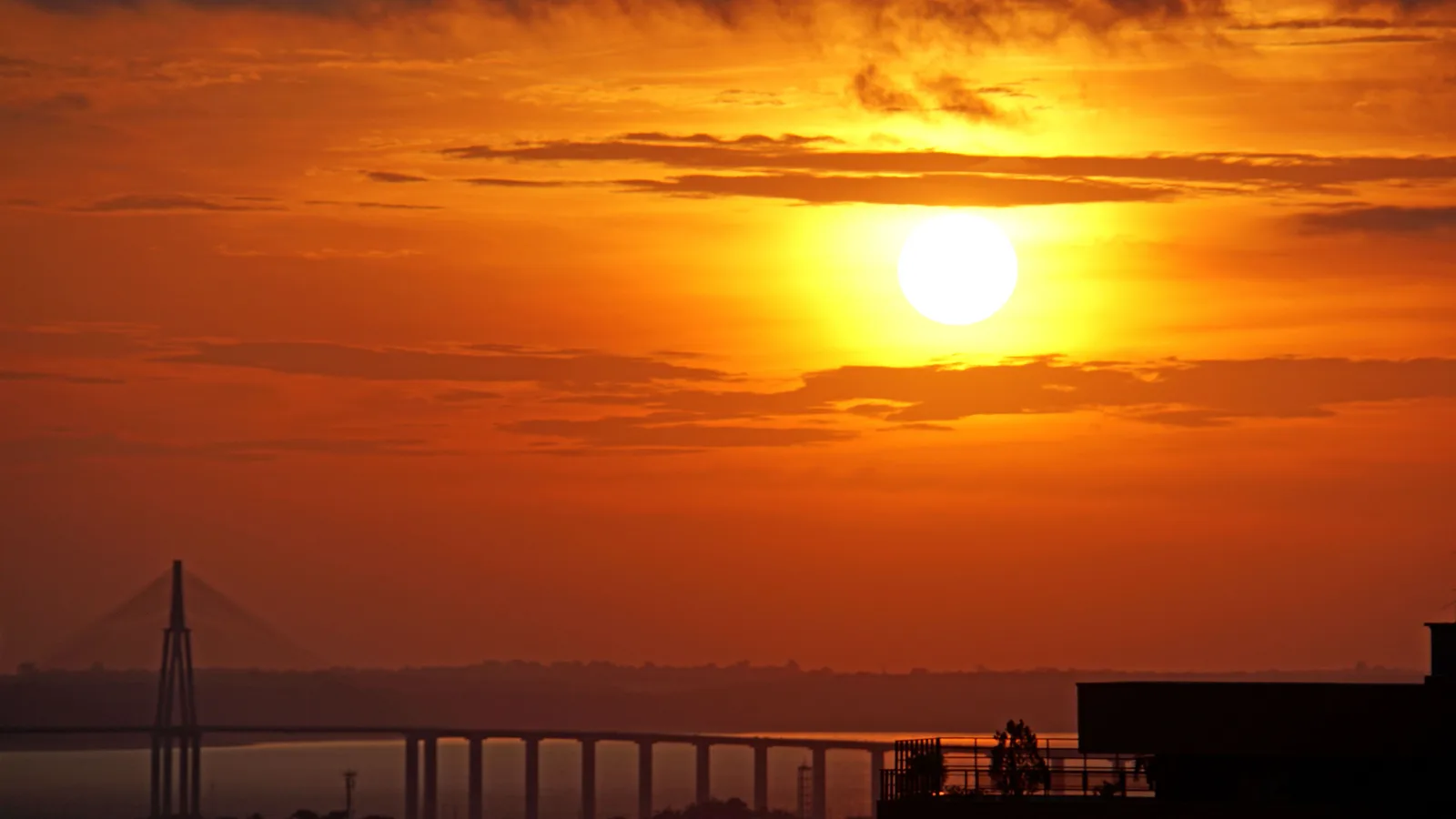
A large orange sun setting over the Rio Negro with the long silhouette of the Manaus bridge crossing the water beneath it

Skip the planning

The Amazon rewards being specific.

Tell us whether you want comfort, dense wildlife or real remoteness, your dates, and how much time you have. We will match you to the right lodge at the right distance out, get the transfer times to line up with your flights, and tell you plainly whether your dates land in the flooded season or the dry one.

  • One person, living in Brazil, replying to you directly
  • A reply within one business day — no call center, no bots
  • No cost to plan, and no obligation to book
  • Built around your dates, not a fixed departure