
Skip to content
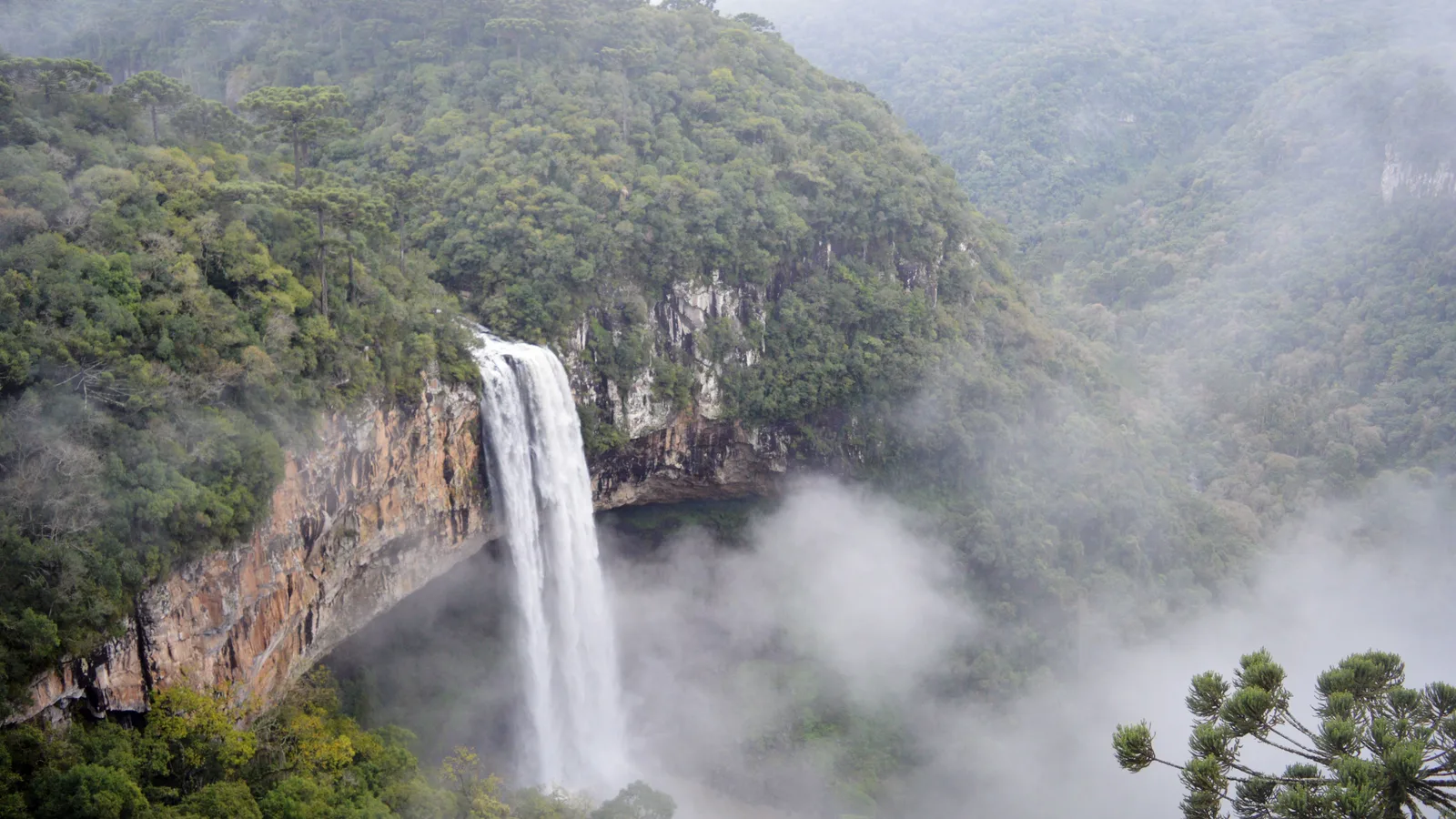
The Caracol waterfall falling in a single white column from a curved rock cliff into a forested gorge, with mist rising out of the gorge and an araucaria branch in the lower right corner

Rio Grande do Sul

Gramado & Canela

Two mountain towns, one big waterfall, and a real winter: fog, frost and fondue.

Last checked October 2026

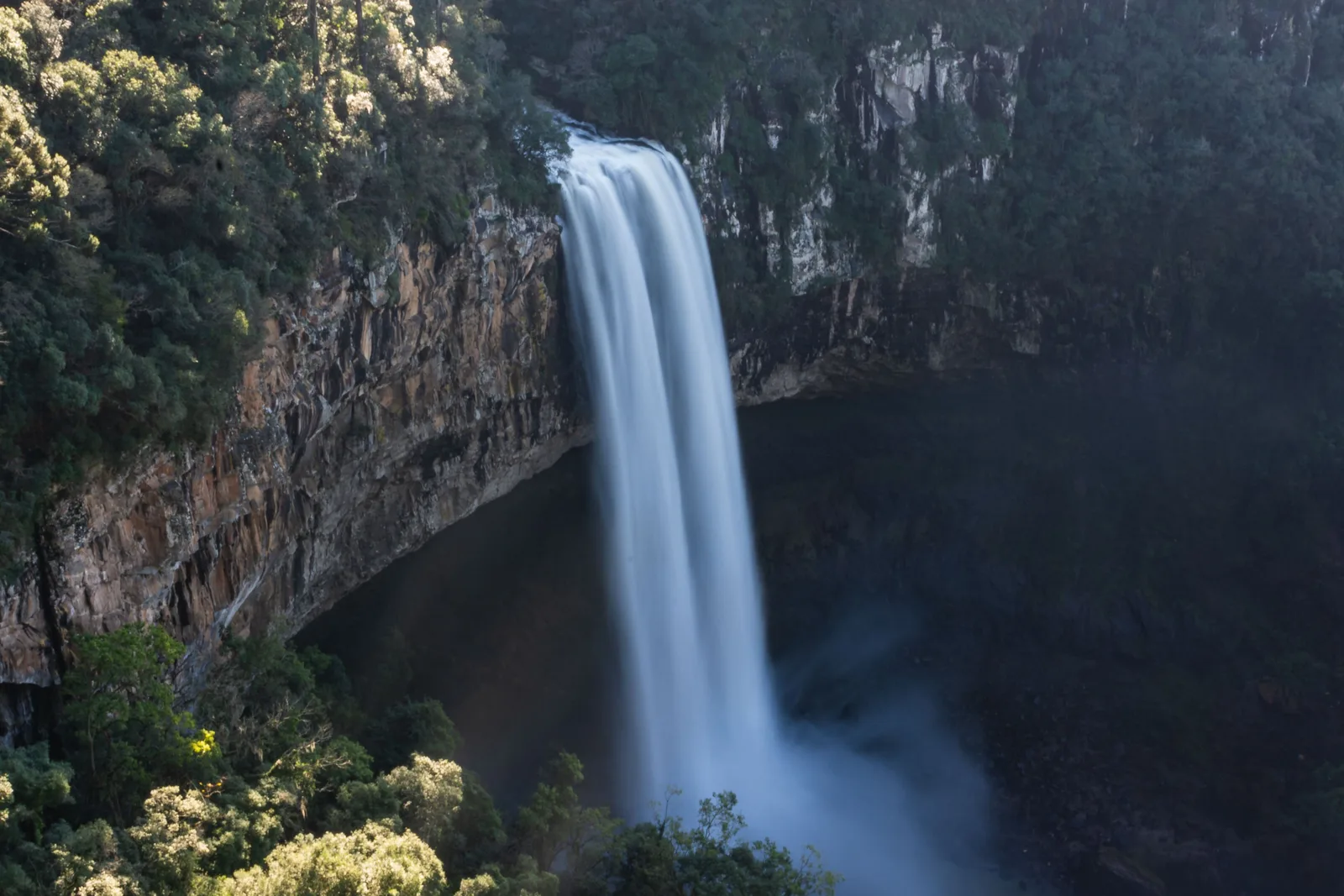
  • The Caracol waterfall in shadow, a bright ribbon of water dropping past a dark cliff into a misty pool, forest lit by sun along the rim
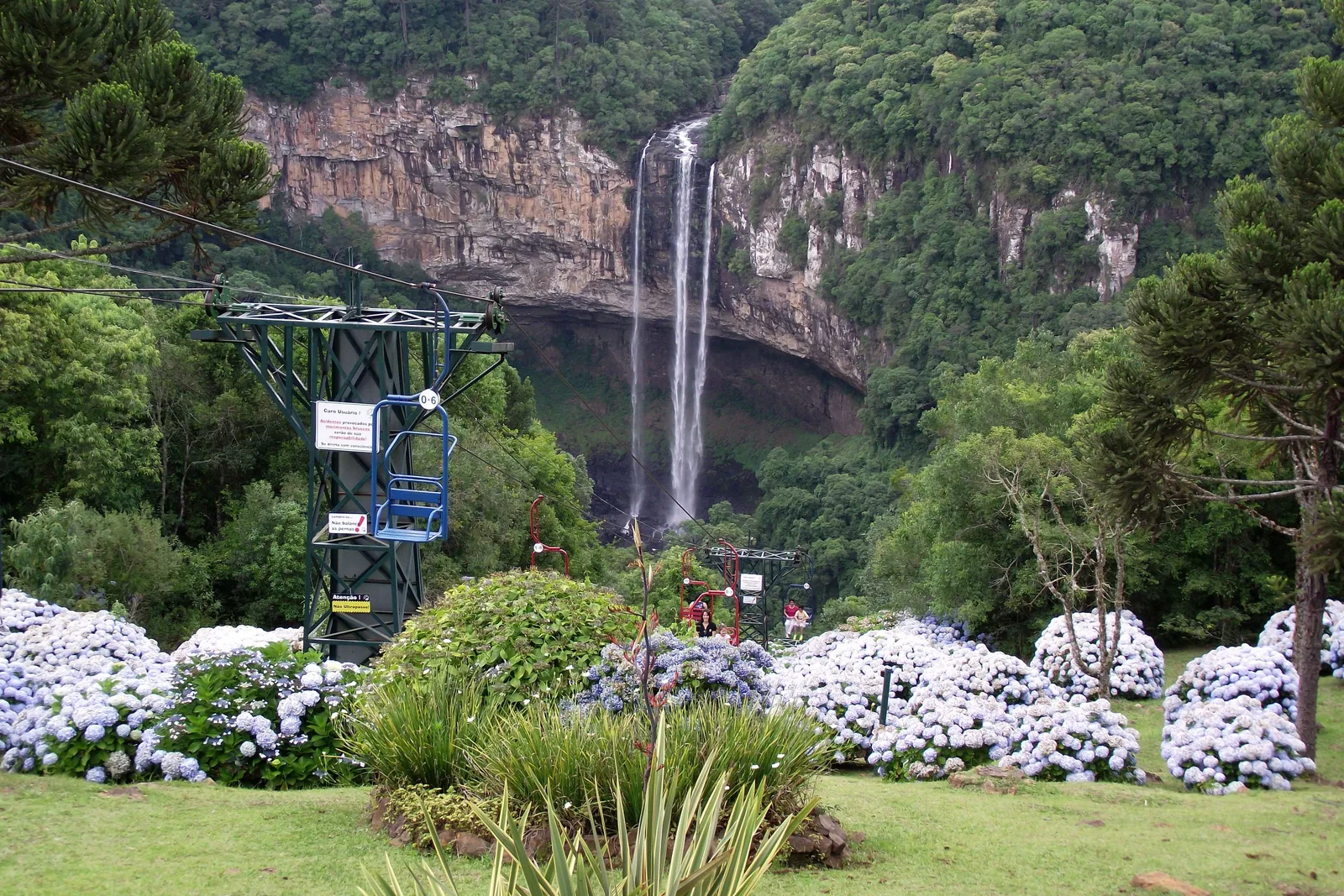
  • A cable-car pylon and an empty chair above beds of pale blue hydrangeas, with the Caracol waterfall falling from a cliff in the background
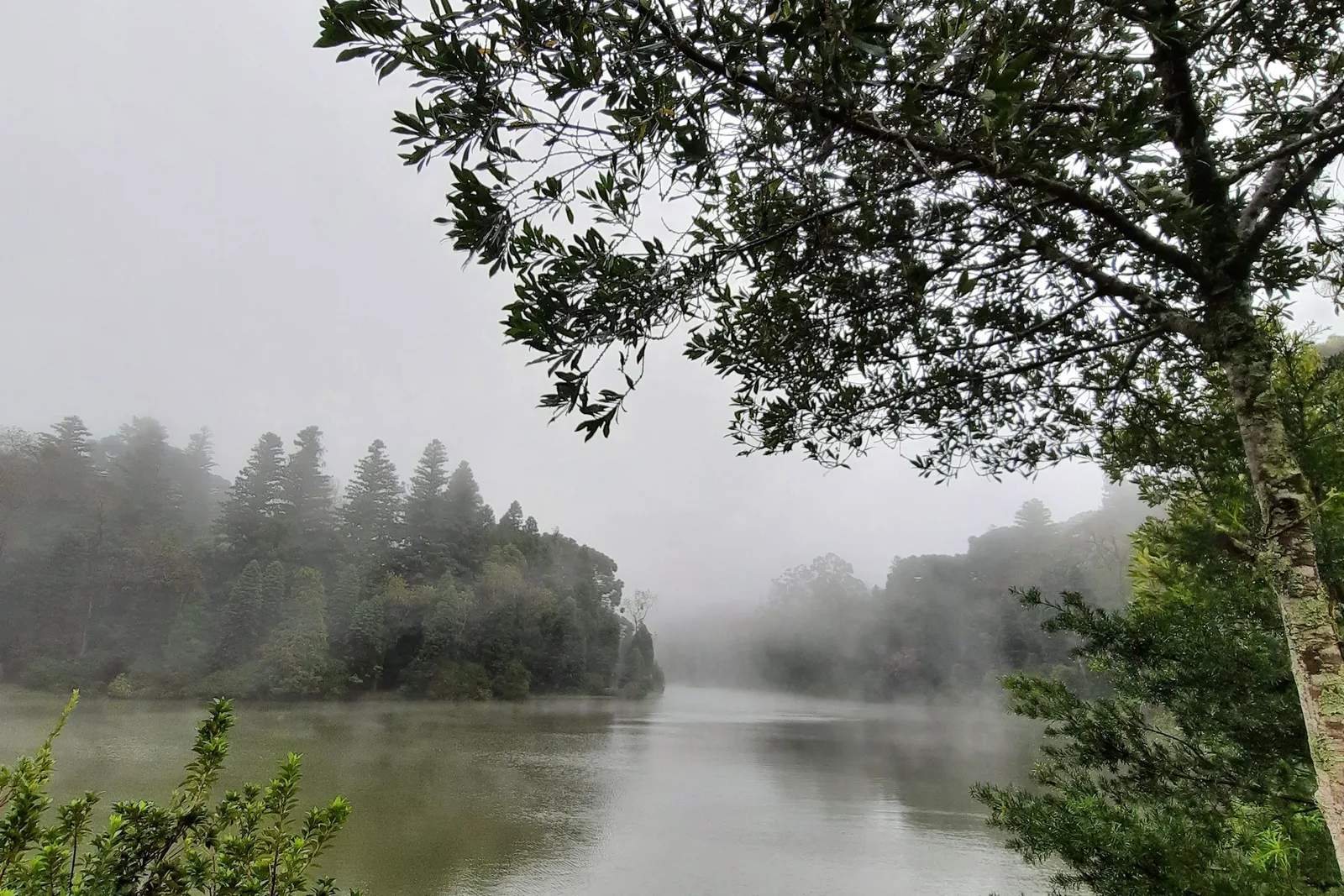
  • Mist lying over a still lake with a dark wooded point running into it and a tree overhanging the right of the frame
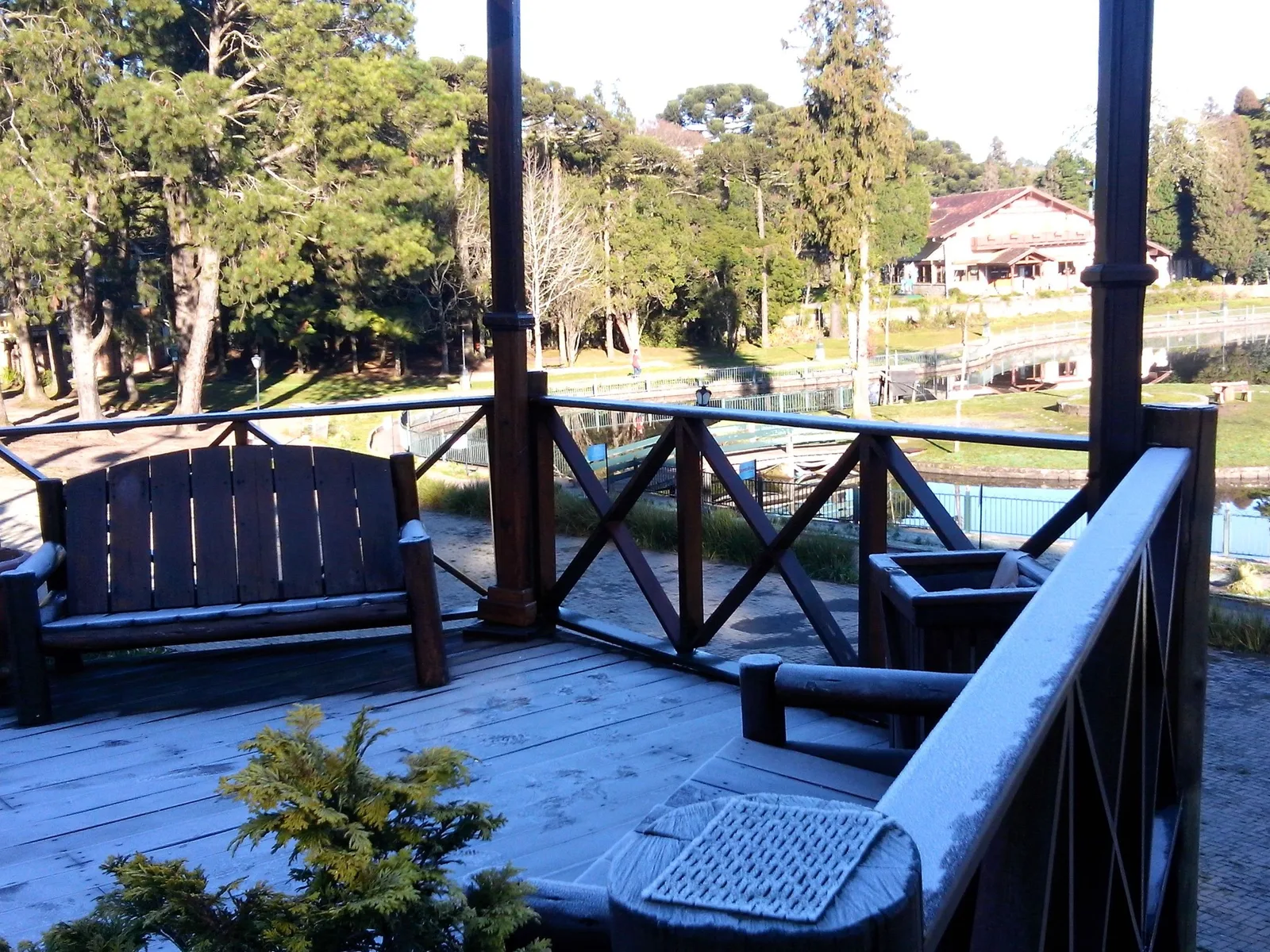
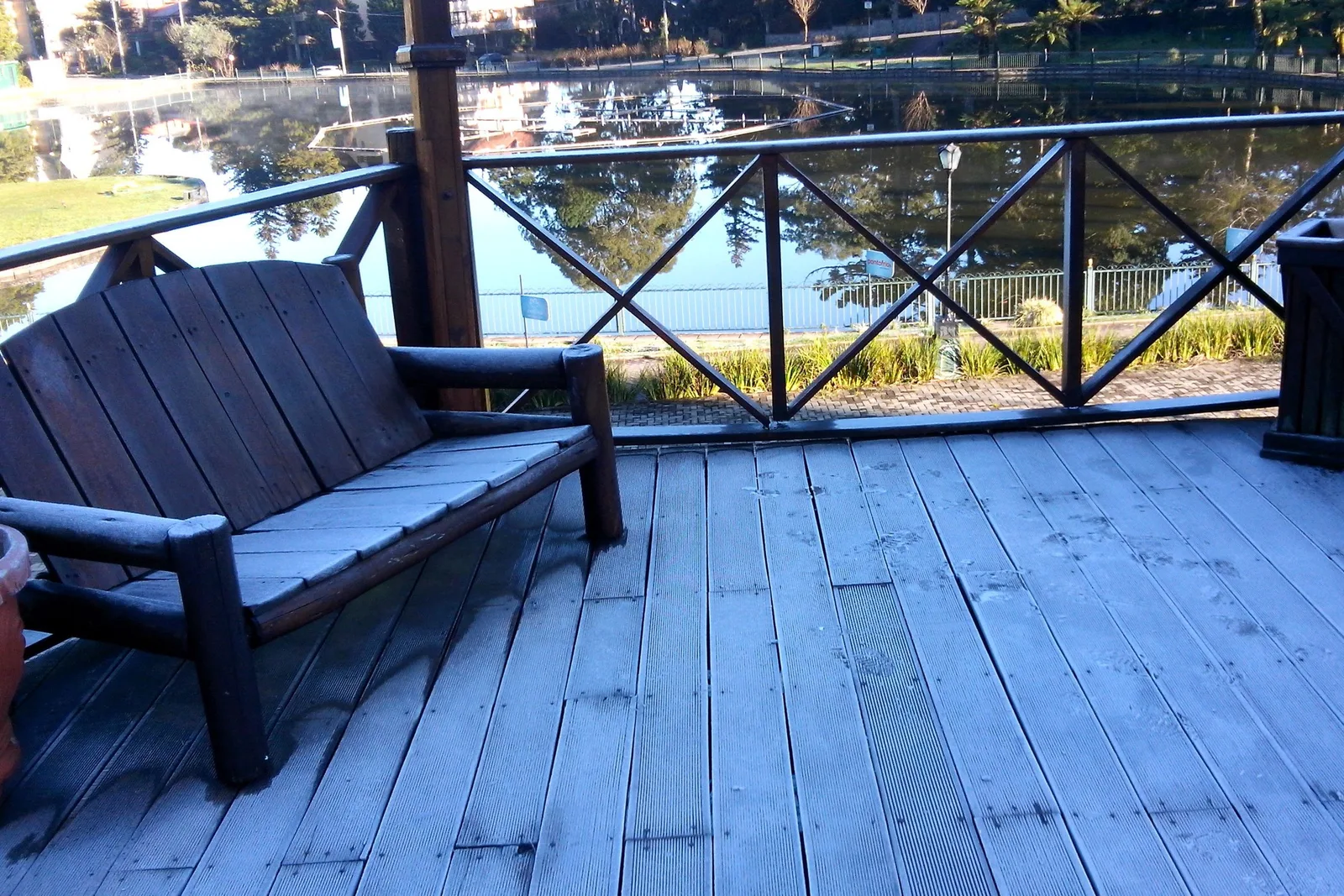
  • White frost on the boards and on a wooden bench of a lakeside deck, the lake and trees reflected beyond a crossed timber railing
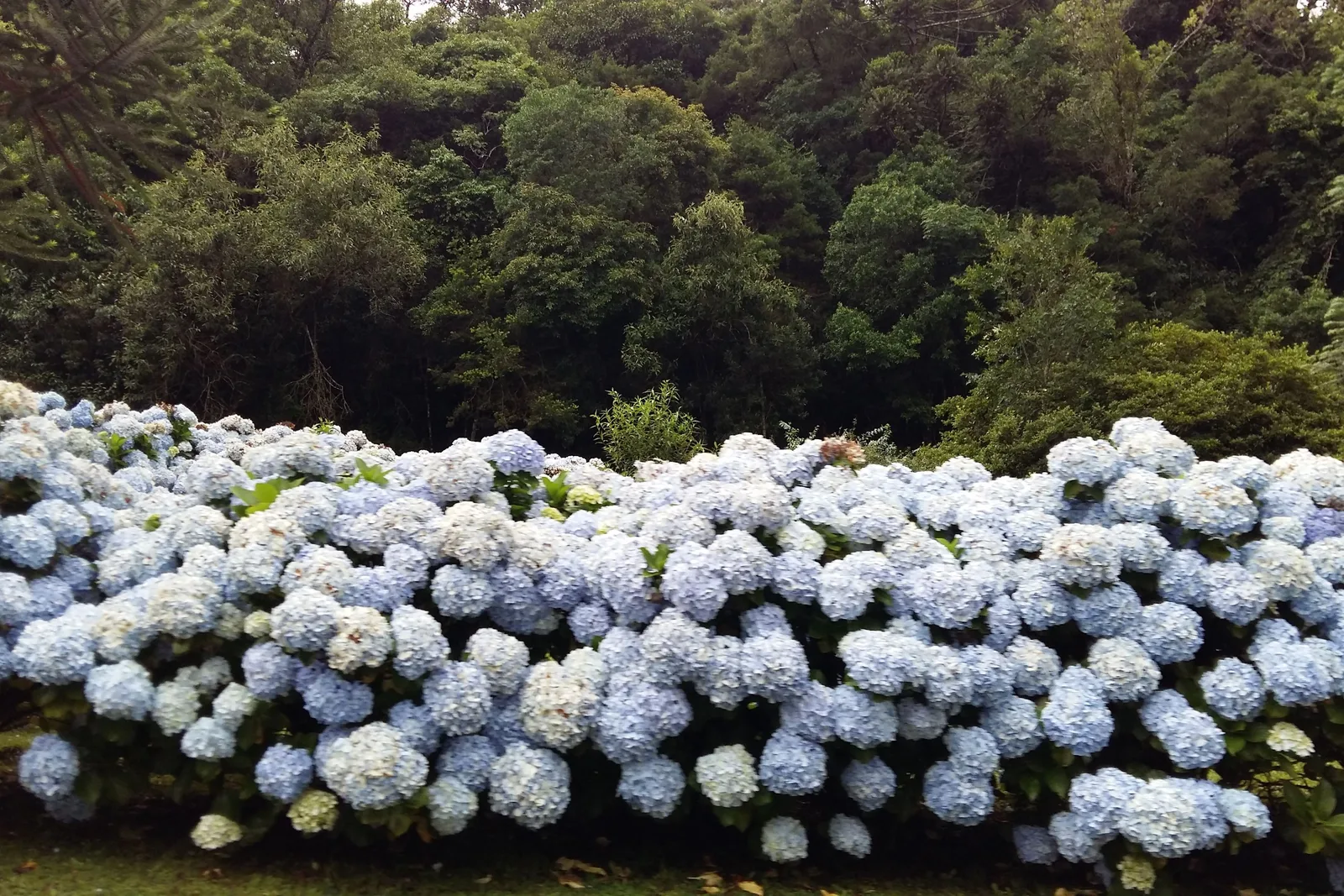
  • A long bank of blue and white hydrangeas in full flower in front of dense green forest
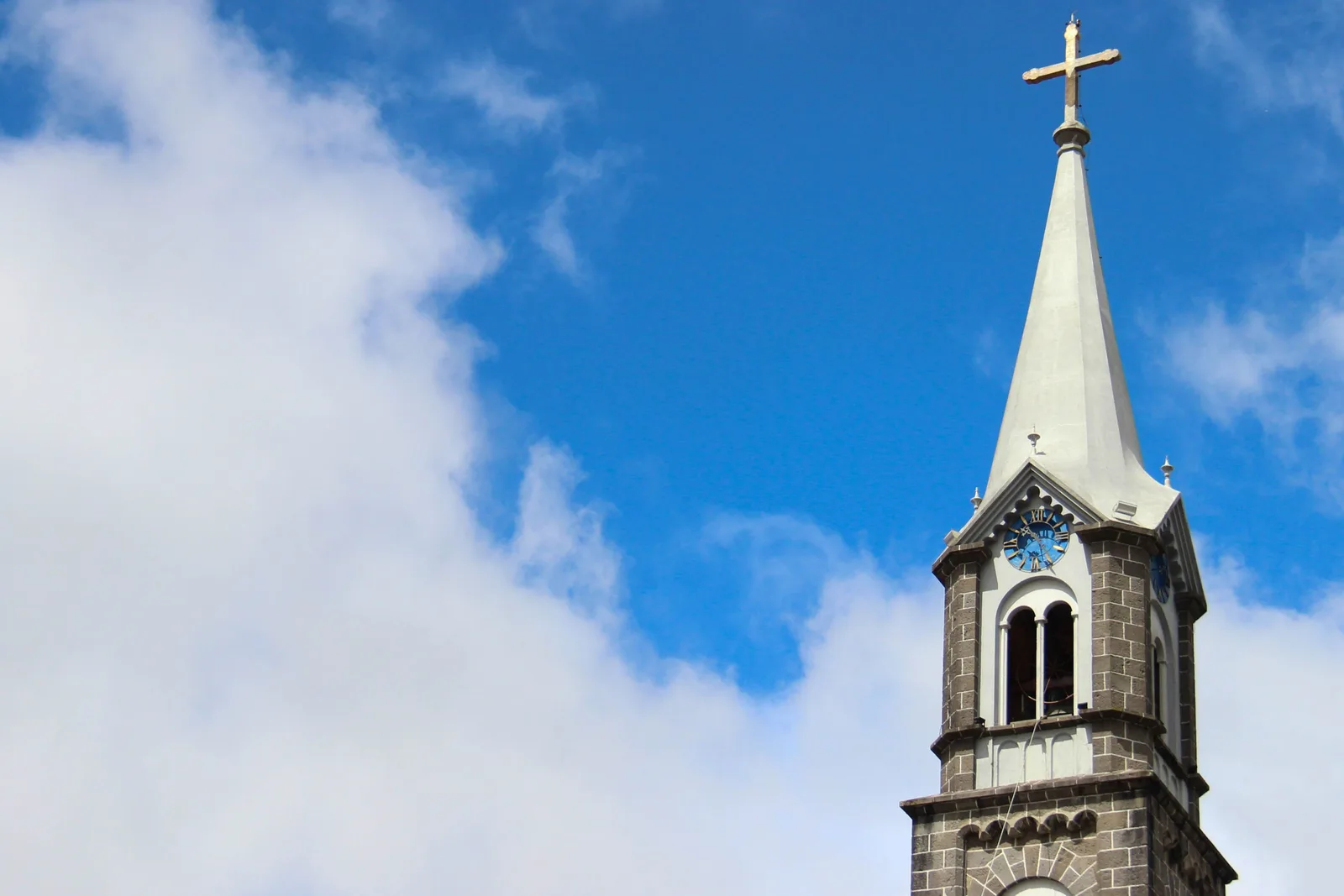
  • The pointed white steeple and clock of a stone church tower in Gramado against blue sky and a bank of white cloud
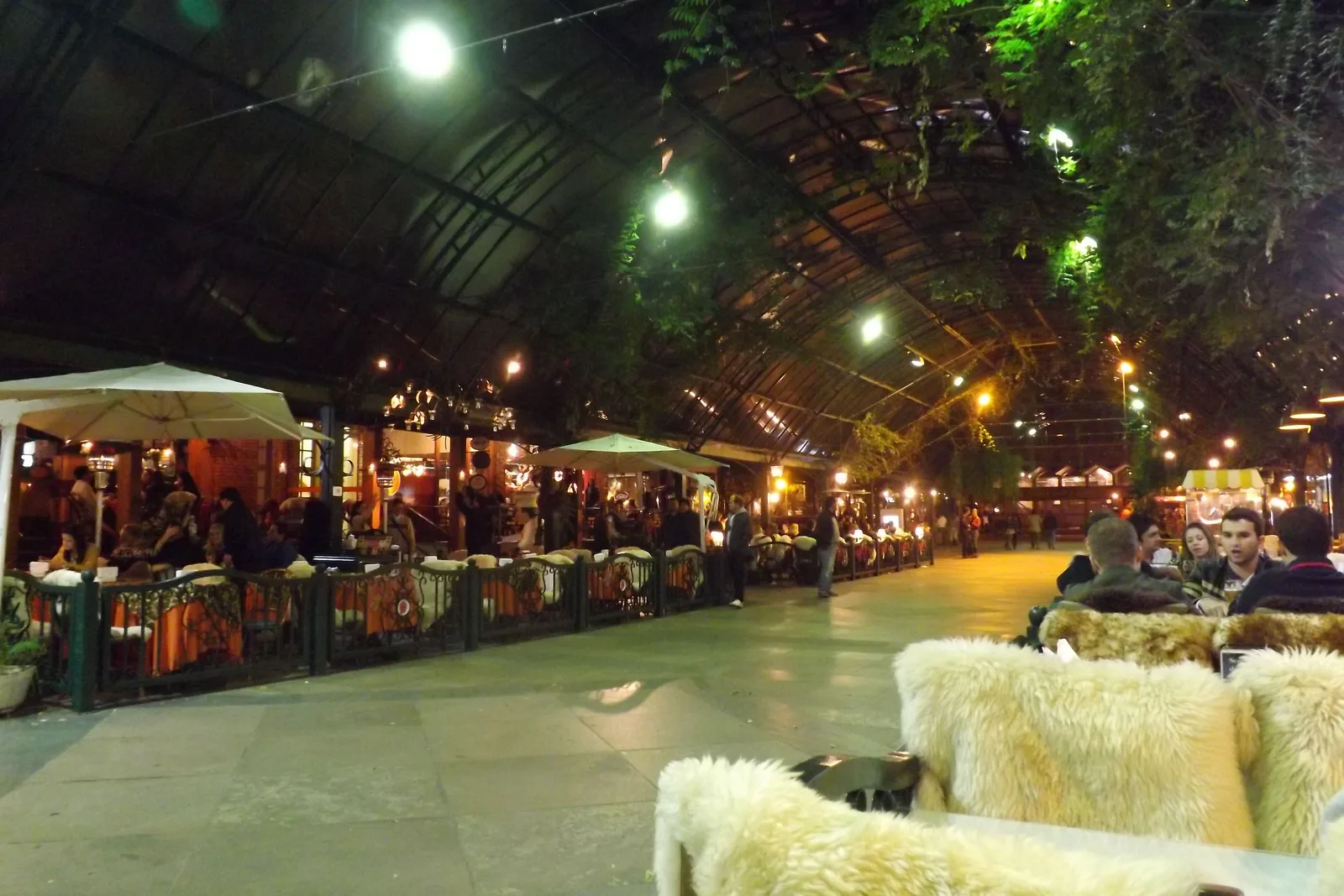
  • Restaurant tables under the glass roof of the Rua Coberta at night, sheepskins thrown over the chairs in the foreground and strings of lights overhead
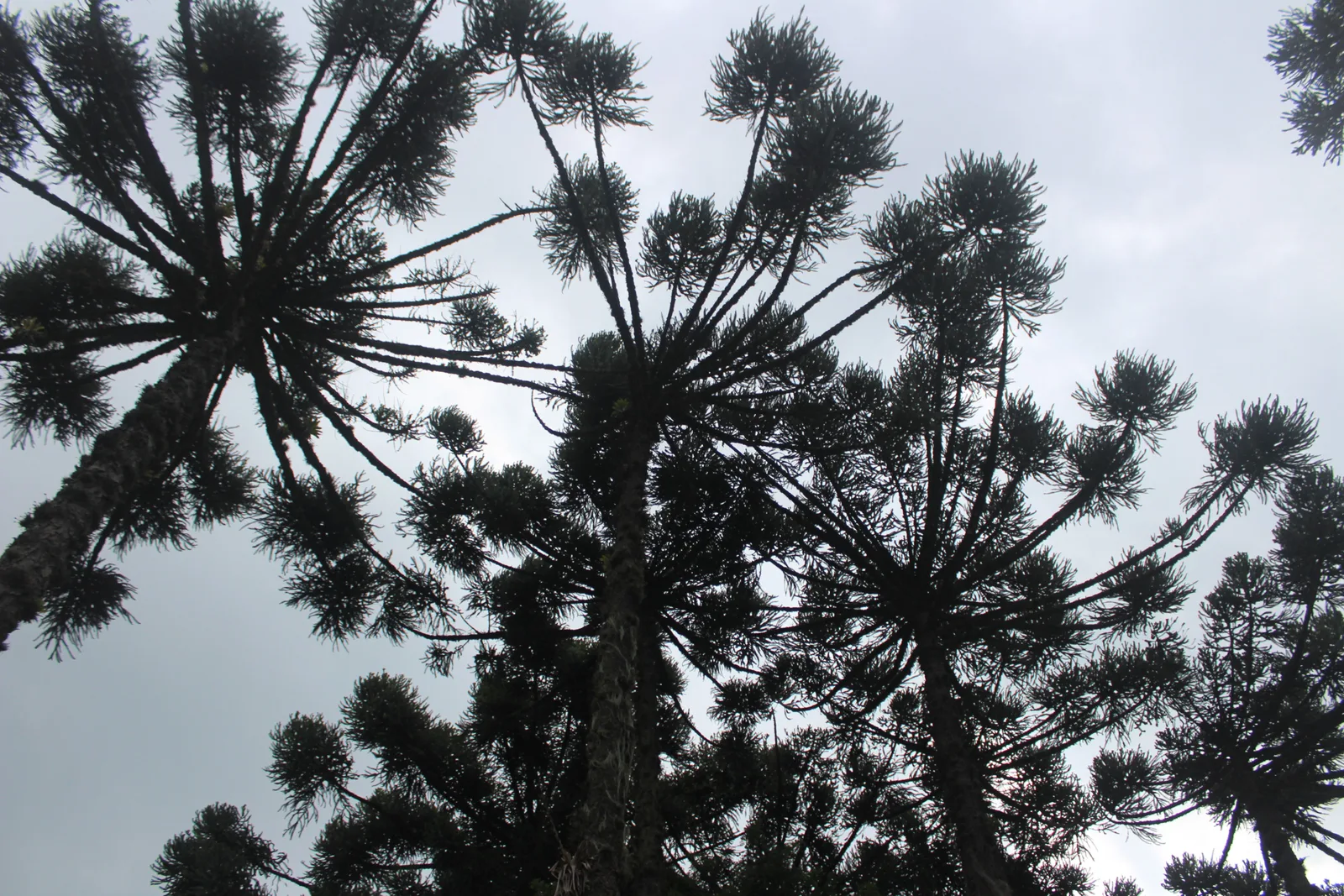
  • Looking straight up at the candelabra-shaped crowns of araucaria pines against a pale overcast sky
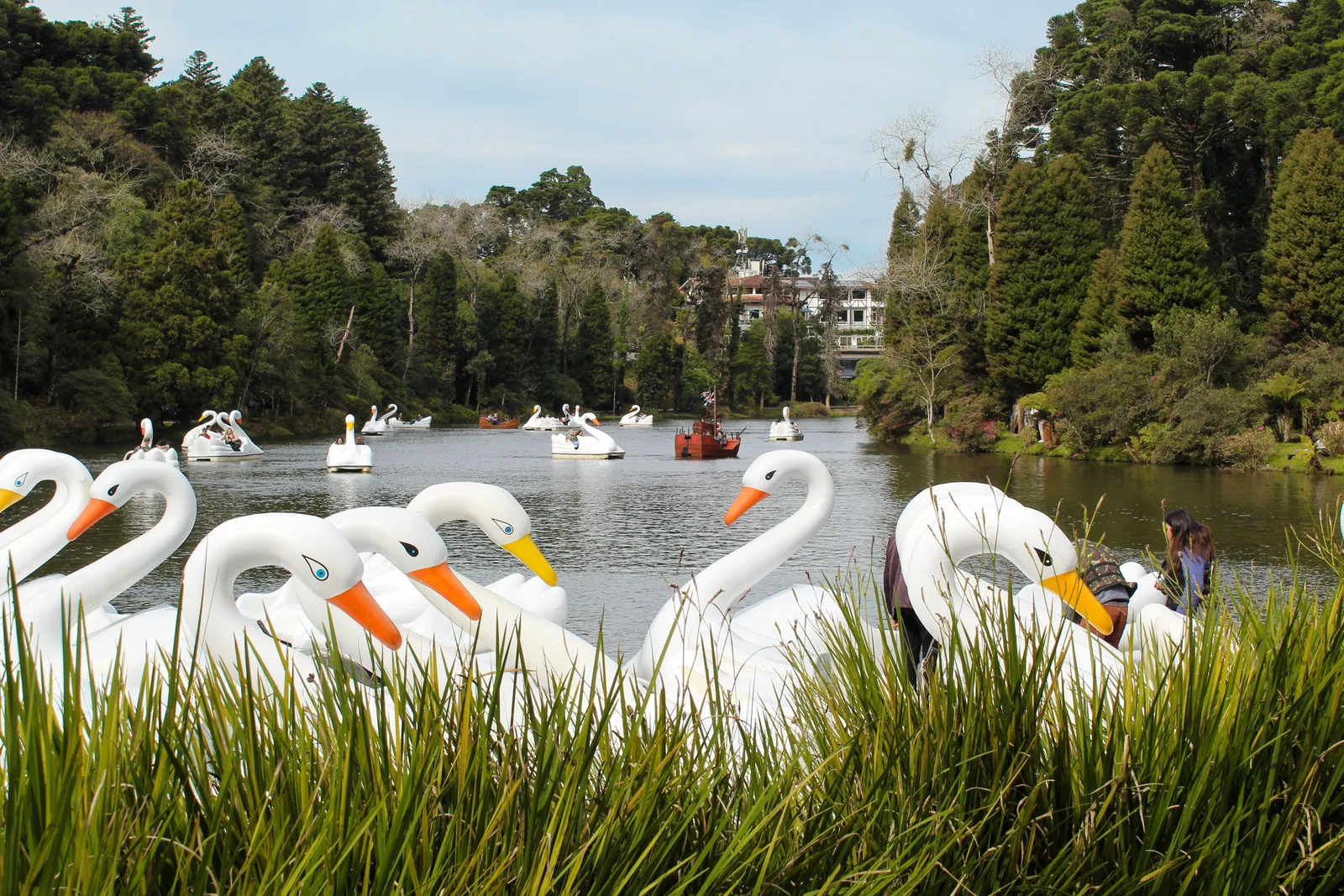
  • A row of white swan-shaped pedal boats moored in the grass at the edge of a lake, more swans out on the water in front of a pine-covered bank
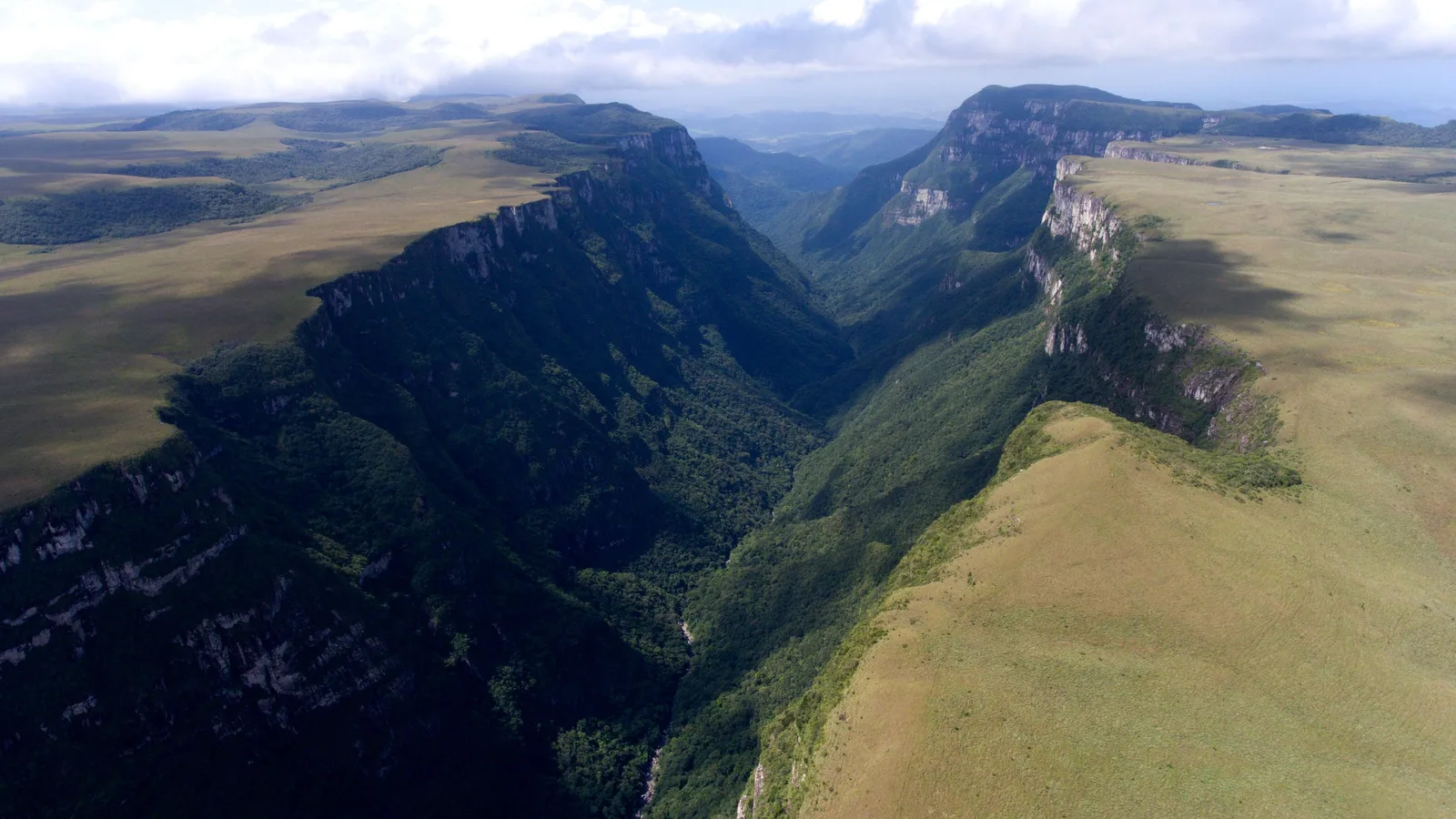
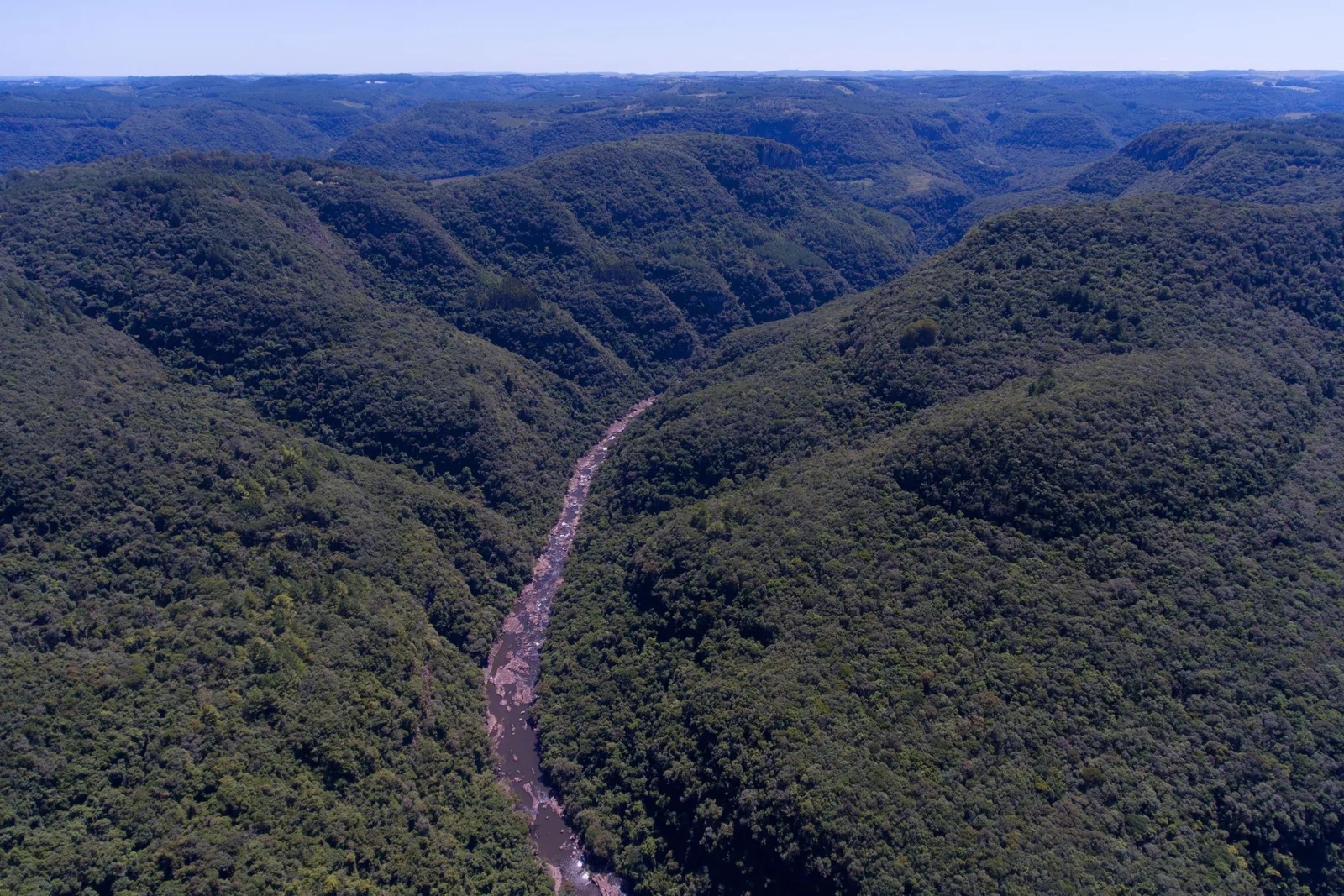
  • A deep forested valley seen from the air, a river glinting along the bottom of it and wooded ridges running to the horizon
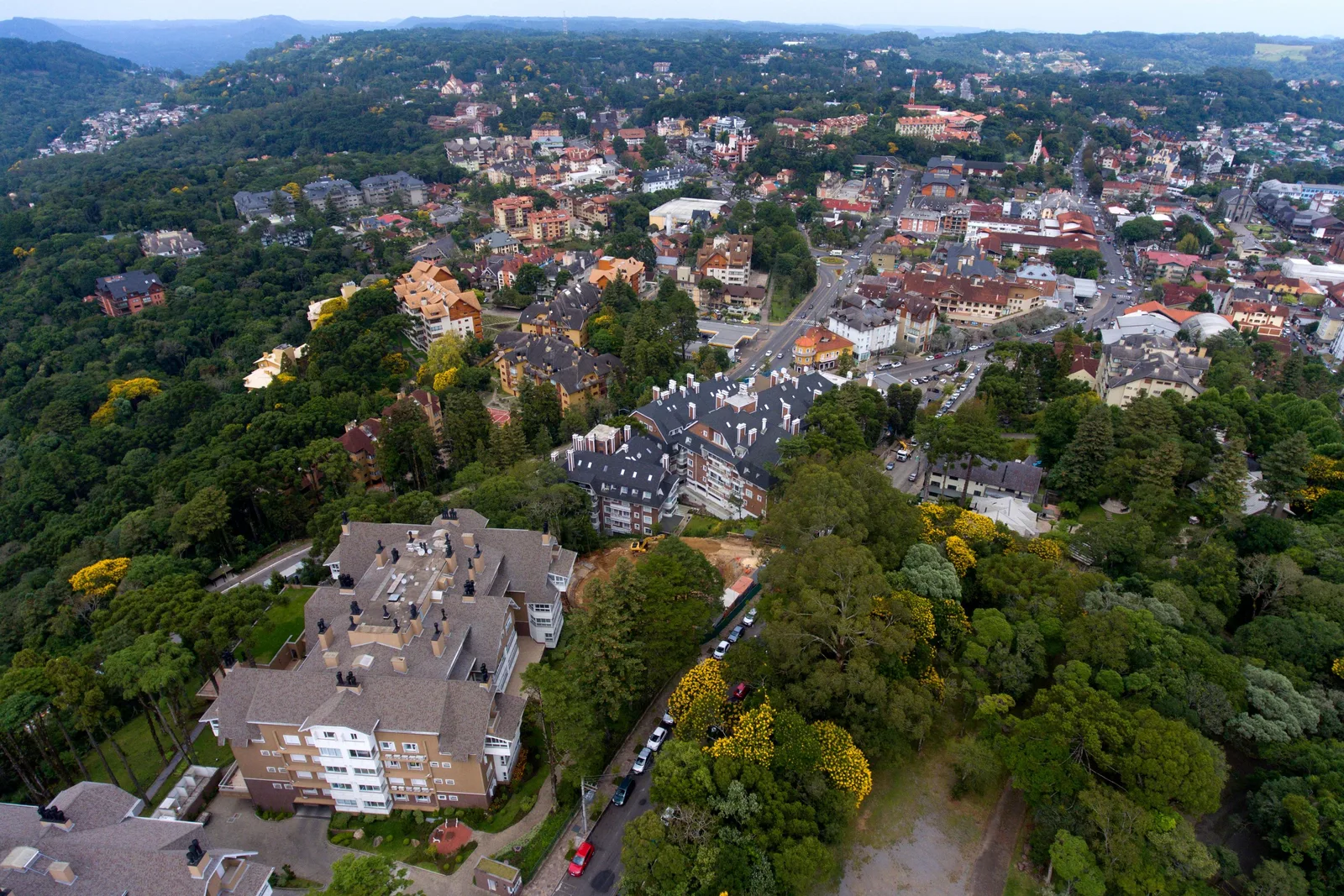
  • Gramado from the air: red roofs, apartment blocks and church spires among trees, with the town running off toward the hills
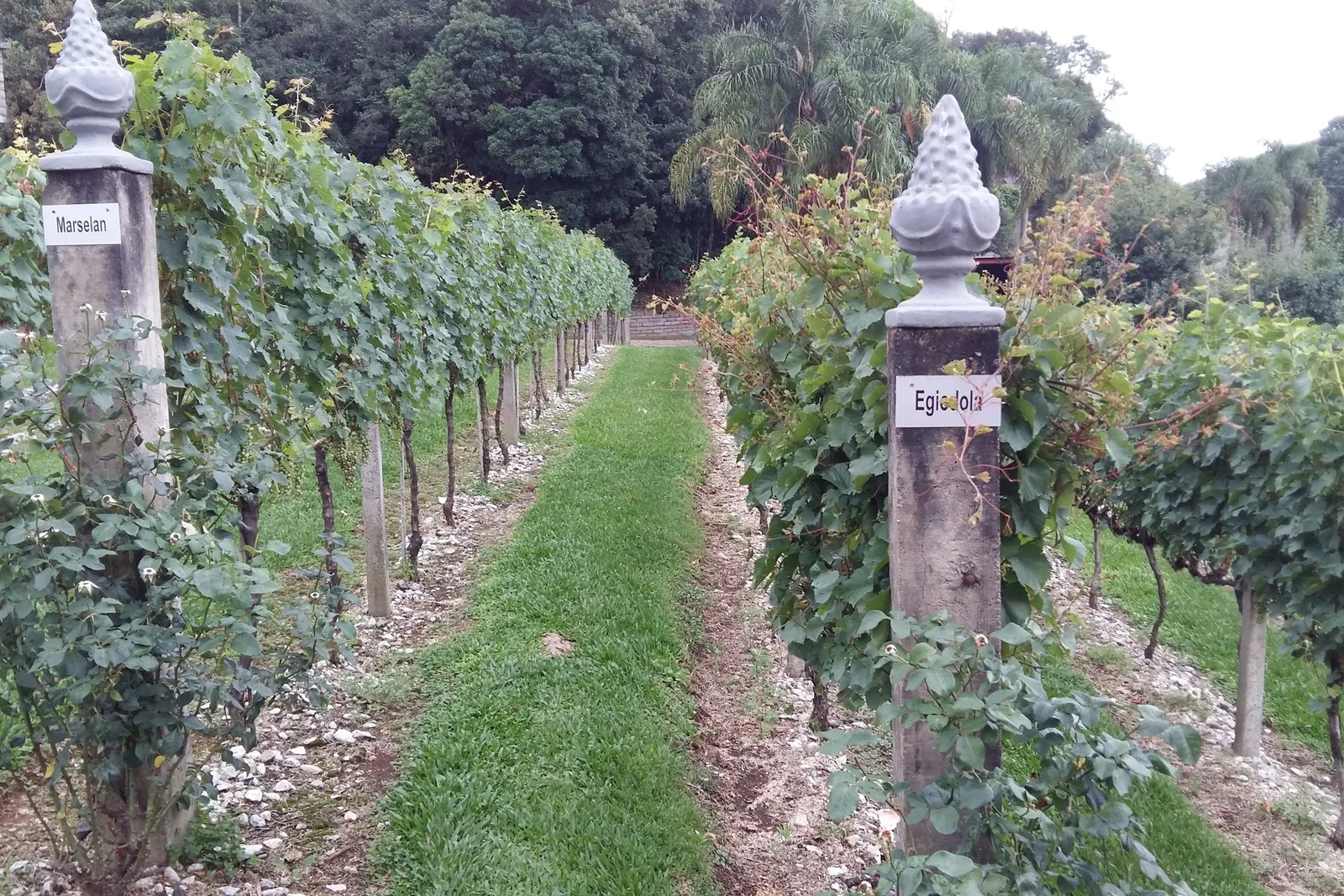
  • Two rows of trellised vines with a strip of grass between them, each row marked by a stone post with a carved finial and a grape-variety name plate
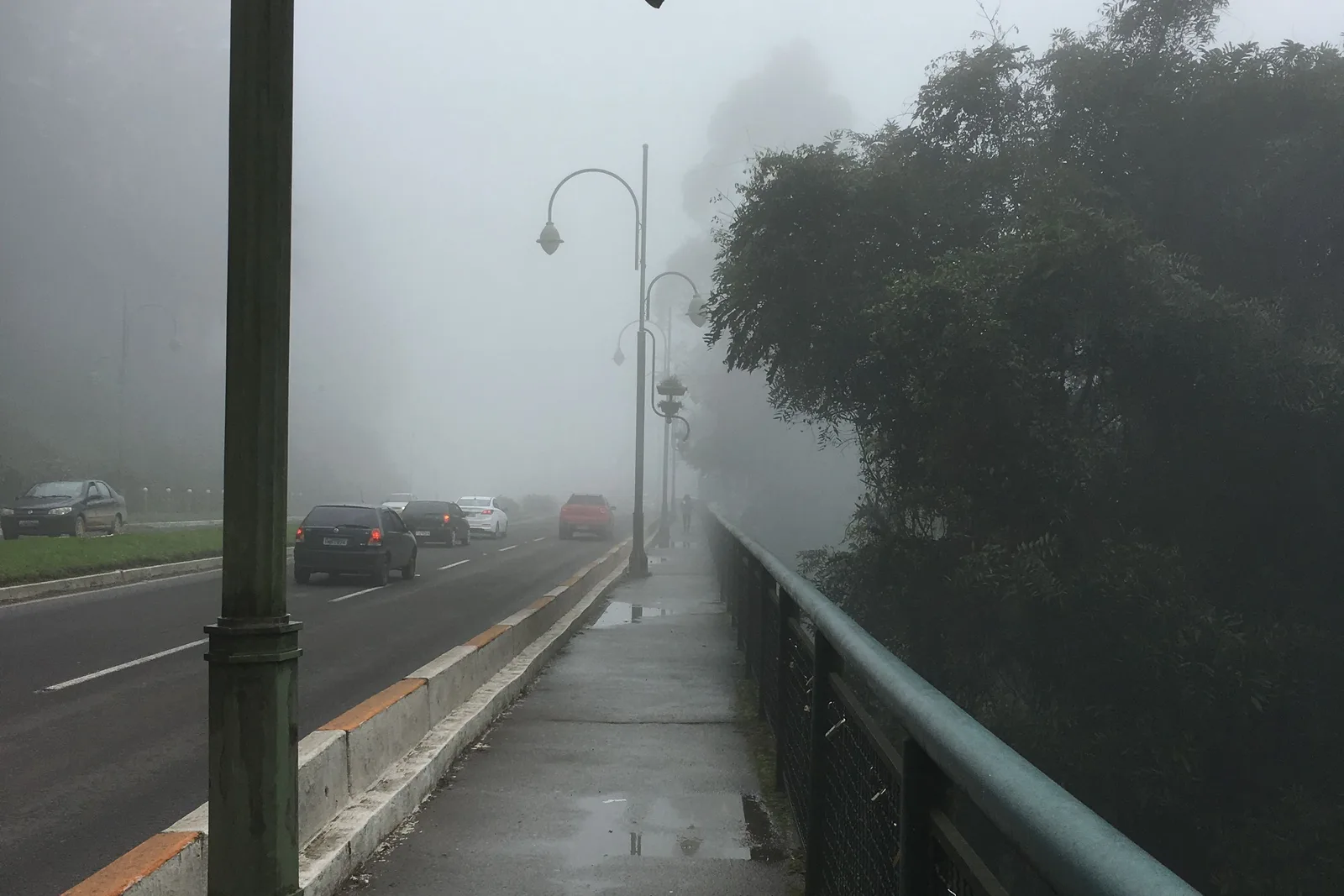
  • A street lamp, a guardrail and a line of cars disappearing into thick fog on a road in central Gramado
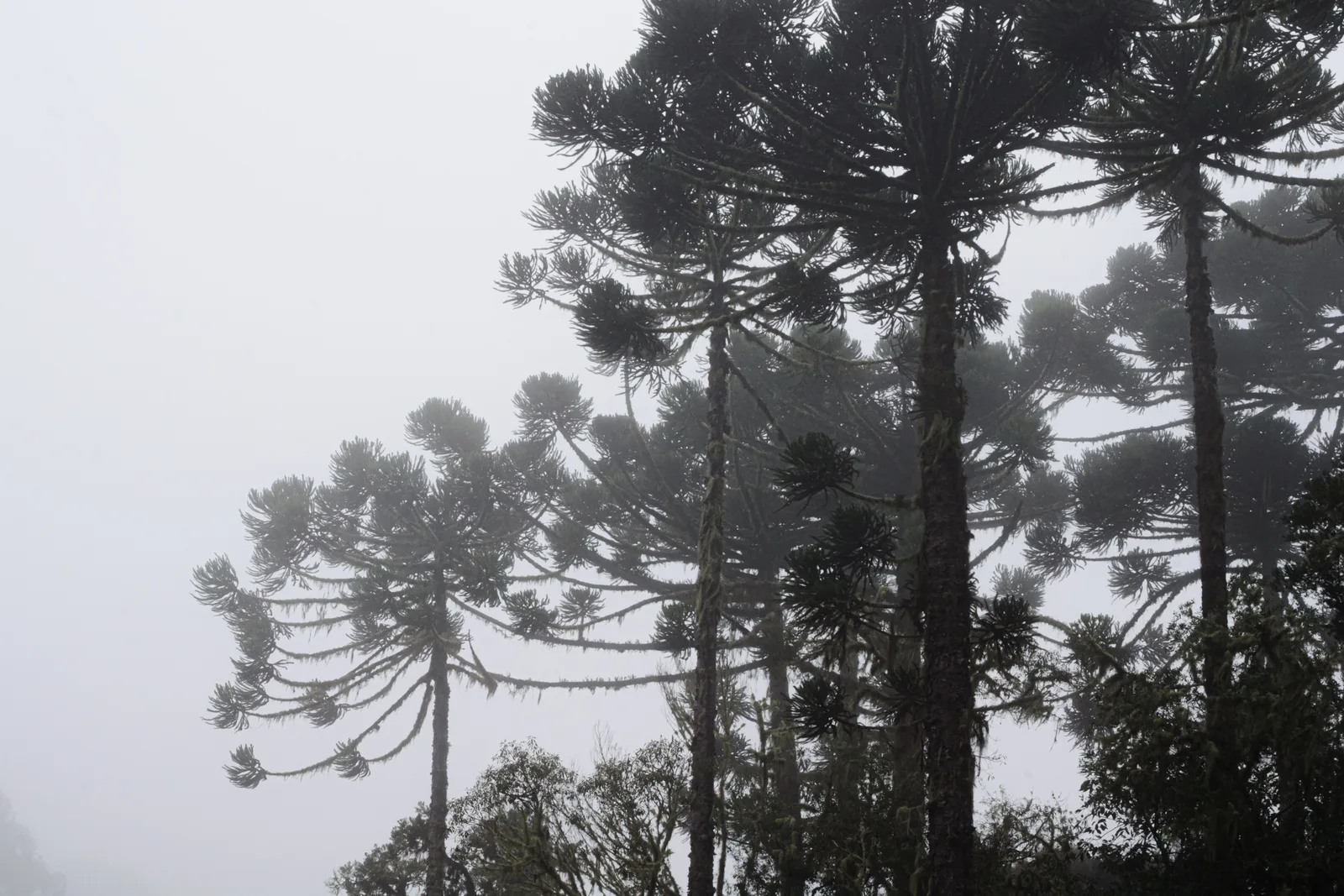
  • Araucaria trees standing in dense gray fog, their flat-topped crowns fading into the sky
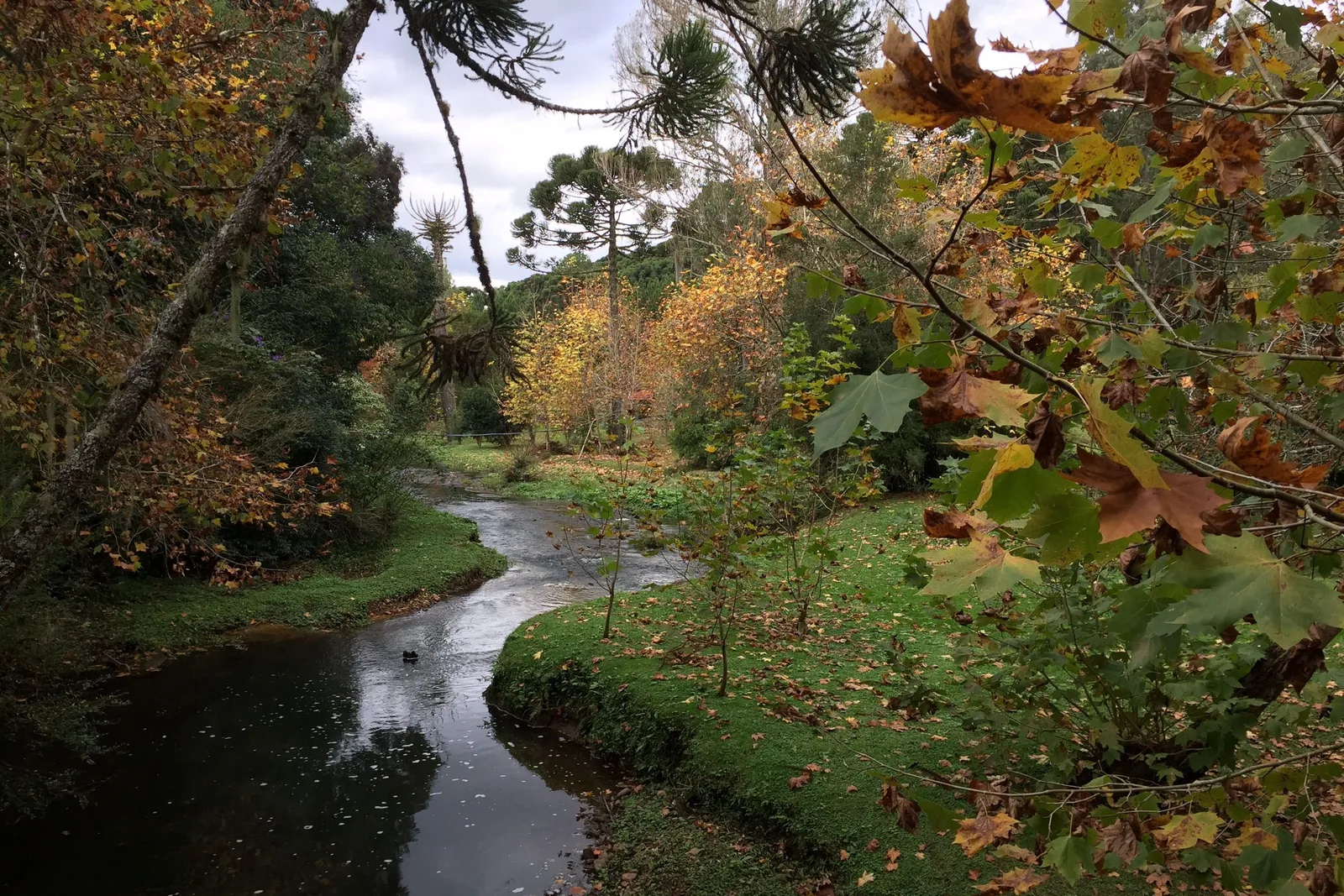
  • A small stream winding between grassy banks under trees turning yellow and brown, autumn leaves in the foreground

Orientation

Two towns, one trip.

What the Serra is, what it costs, and how you reach it from the United States.

General Info

Brazil’s mountain resort

Gramado and Canela sit next to each other on the edge of the plateau in northeastern Rio Grande do Sul, Brazil’s southernmost state, at about 830 meters. They are small: Gramado had 40,134 people at the 2022 census and Canela 48,946, so the quieter-feeling Canela is actually the bigger town. The road between their centers is about 8 kilometers.

The settlers who shaped the region were descendants of German and Italian immigrants, who came up from older colonies in the late 1800s and early 1900s and joined a few Portuguese-Brazilian families already on the land. Gramado was a summer retreat before it became a municipality, and it turned to tourism on purpose with its first Festa das Hortênsias in 1958. The half-timbered, Alpine look of its main avenue is mostly a style adopted for visitors from then on, a nod to that German past rather than the houses the settlers actually built.

What the towns sell today is cold. Winter nights drop to single digits Celsius, fog rolls through the streets, and the whole place runs on fondue, chocolate, fireplaces and a Christmas festival that lasts almost three months. Around that are real forests of araucaria pine, a 130-meter waterfall, and an hour or two away, the wine country of the Vale dos Vinhedos.

Where It Is

The edge of the southern plateau

Gramado and Canela are in the Serra Gaúcha, the hills north of Porto Alegre, in the far south of Brazil. Porto Alegre’s airport is the usual way in, two to two and a half hours by road. Bento Gonçalves and the Vale dos Vinhedos, the wine valley this page treats as a day out, are west of Gramado, about two hours by road.

Gramado & Canela Gramado & Canela

29.38° S, 50.87° W

See the South on the interactive map

Cost

A resort town, priced like one

Gramado is expensive by Brazilian standards. Almost everything worth doing beyond walking costs a ticket, and most tickets cost $23 to $32 (R$115 to R$165). The free things are good, though: the Lago Negro, the Rua Coberta, the churches, the Floresta Nacional and the viewpoints cost nothing at all.

Estimated daily budget, per person

Budget

$70 / day

A simple pousada room shared by two, bakery breakfasts, the free lakes, churches and viewpoints, and the town bus between Gramado and Canela.

Mid-range

$150 / day

A good hotel in central Gramado shared by two, one paid attraction a day, a fondue or café colonial dinner, and a rental car or ride apps.

Comfortable

$300 / day

The best rooms in town, guided wine tasting in the valley, Natal Luz show tickets, and private transfers from Porto Alegre.

Our estimates, per person per day once you are in the Serra, flights not included. The Natal Luz season and July push room rates up.

What things cost

  • Parque do Caracol ticket, adult, online $26 R$134.90
  • Parque do Caracol parking, per car $6 R$30
  • Bondinhos Aéreos cable car, adult, online $25 R$130
  • Skyglass glass platform, adult, online $32 R$165
  • Fondue sequence, per person, menu price $31–35 R$159.90–179
  • Café colonial, per adult $25–29 R$129–150
  • Reino do Chocolate tour, Caracol Chocolates from $4 from R$19.90
  • Prawer chocolate factory tour $12–14 R$59–69
  • Snowland, adult, online from $28 from R$144.50
  • Mini Mundo, adult $31 R$156
  • Wine tasting at Lidio Carraro, five labels $24 R$120
  • Maria Fumaça steam train and show, Bento Gonçalves from $55 from R$280
  • Natal Luz Grande Desfile, unnumbered stands $82 R$420

Every price above was read on the operator’s own site on 5 October 2026. Several of them change with the date you pick, and the gate price is usually higher than the online one.

Half-price tickets (meia-entrada) go to anyone over 60 (a passport showing your age is enough), people with disabilities and, at shows and events, students with a Brazilian student ID. A foreign student card does not count, and the Parque do Caracol gives no student discount at all.

Checked October 2026 and converted at R$5.10 to the dollar. Hotel prices are left off the list on purpose: they swing hard between a November weekday, a July weekend and a Natal Luz Saturday.

Safety

Very little robbery, roads to respect

8 /10

Our rating, on the state police’s own figures for 2025 and the years before. Robbery is rare; violent deaths are few, though in Canela about the state average per resident. The mountain roads in fog and ice need care too.

In all of 2025, Gramado recorded 6 robberies of any kind and Canela 17, on the Rio Grande do Sul police’s own municipal figures: per resident, about a tenth and a fifth of the state rate, against Porto Alegre’s 8,871. Neither town had a vehicle robbery that year. Violent deaths are few (2 in Gramado, 6 in Canela), though in Canela that is about the state average per resident. Theft without violence runs at about the state average, which is the risk to plan for: a bag left on a chair in a busy café.

  • Watch your phone and bag in the crowds on the Rua Coberta and the Avenida Borges de Medeiros in Natal Luz season. That is pickpocket territory anywhere in the world.
  • Fog can cut visibility on the mountain roads to a few dozen meters, in summer as well as winter. If you are driving up from Porto Alegre, do it in daylight.
  • In cold snaps the state civil defense warns of ice on the Serra’s roads in the early morning, and the road operator says bridges, viaducts and shaded curves ice up first. Leave later on a frosty day.
  • Hospital Arcanjo São Miguel, on Rua Madre Verônica in central Gramado, has a 24-hour emergency department and the two towns’ only adult ICU. Canela’s Hospital de Canela has a 24-hour emergency door but no ICU. Dial 192 for an ambulance, 190 for police and 193 for the fire brigade.
  • Dress for the cold. From June to August nights average 8 to 9°C at the Canela weather station and reach freezing about once a month. Bring layers and a real jacket.
  • The CDC recommends the yellow fever vaccine for travelers going anywhere in Rio Grande do Sul. Brazil does not require it for entry. The state is not on the CDC’s list of malaria areas, and the CDC advises against swimming in fresh, unchlorinated water anywhere in Brazil, which includes the lakes and rivers here.
  • Dengue does reach the Serra in hot summers: Gramado had locally caught cases in the 2024 outbreak, mostly from February to April. Use repellent in the warm months.

Getting There

One connection from the US, then the road up

There is no airport with scheduled flights in Gramado or Canela. The usual way in is Porto Alegre (POA), then the road or the bus up into the hills.

  • There is no nonstop from the United States to Porto Alegre. The simplest route is a nonstop to São Paulo Guarulhos (GRU), which has flights from Miami, Orlando, Atlanta, New York, Dallas, Houston, Newark, Washington, Chicago, Boston and Los Angeles, then one of the 16 to 20 daily flights on to Porto Alegre, about 1 hour 45 minutes.
  • Copa flies daily from Panama City to Porto Alegre, but it lands at about 12:25am. TAP flies from Lisbon three times a week, and LATAM from Santiago five times a week and from Lima four times a week.
  • Porto Alegre’s airport was closed by the May 2024 floods. It has been back to full operation, 24 hours a day on its full runway, since 16 December 2024.
  • Caxias do Sul’s airport (CXJ) is closer, but it has three flights a day, one each from São Paulo Guarulhos, Congonhas and Campinas, all landing between about 2:40pm and 6:10pm. It only helps if one of those fits your connection.
  • By car from Porto Alegre’s airport, Gramado is about 110 kilometers and 2 hours via Taquara and the RS-115, or about 120 kilometers and 2 hours 15 minutes via Novo Hamburgo, Nova Petrópolis and the RS-235. Both routes end with a climb on mountain roads, so plan to arrive in daylight.
  • Citral runs buses from the airport straight to Gramado and Canela, from its desk in domestic arrivals. On a weekday in November 2026 there are about a dozen, from 8:15am to 8:15pm; the executive bus takes 2 hours 15 minutes to Gramado and costs $17 (R$84.85). If your flight is late, Citral moves you to a later bus at no charge, seats permitting. Going back, every bus leaves from the Gramado or Canela bus station, and Citral advises leaving five hours before your flight.
  • Brocker Turismo runs a shared transfer from the airport to hotels in Gramado and Canela, from $22 (R$114.50) a person, about 2 hours.

Getting Around

Walk the towns, drive the rest

Central Gramado and central Canela are each small enough to walk. Everything else, from the Caracol waterfall to the wineries, is a drive.

  • Citral’s circular bus links central Gramado and central Canela from early morning to near midnight, every half hour on weekdays from 8:00am to 7:00pm and about hourly in the evening and on Sundays. The ride takes 15 minutes and costs $1.40 (R$6.95).
  • Uber works in both towns. Its own Gramado page gives average UberX fares of about $3 (R$13–14) to the Lago Negro or the Rua Coberta and $5 (R$25) to the Catedral de Pedra in Canela.
  • A car earns its keep for the Parque do Caracol, about 9 kilometers by road from central Canela, the Skyglass, the Floresta Nacional and the wine valley. Street parking in central Gramado is metered from 8:45am to 6:45pm every day, $0.55 (R$2.80) an hour with a three-hour limit, payable by card or Pix.
  • There is no direct bus from Gramado to Bento Gonçalves. Day tours collect you at your hotel: Brocker’s Trem e Vinho day, with the Maria Fumaça, a tasting at Aurora and the Epopeia Italiana show, runs Wednesday, Friday, Saturday and Sunday from $76 (R$388) a person and needs eight people to go.
  • Do not drink and drive on the wine day. Brazil’s traffic code fines any measurable alcohol at all, about $575 (R$2,934.70) and a 12-month suspension of the right to drive, and at 0.3 mg per liter of breath or more it is a crime. Book a tour or a driver.

The big four

What people come up the mountain for.

A waterfall, a lake, a covered street and a stone church. Two are in Gramado, two in Canela, and only one of them charges admission.

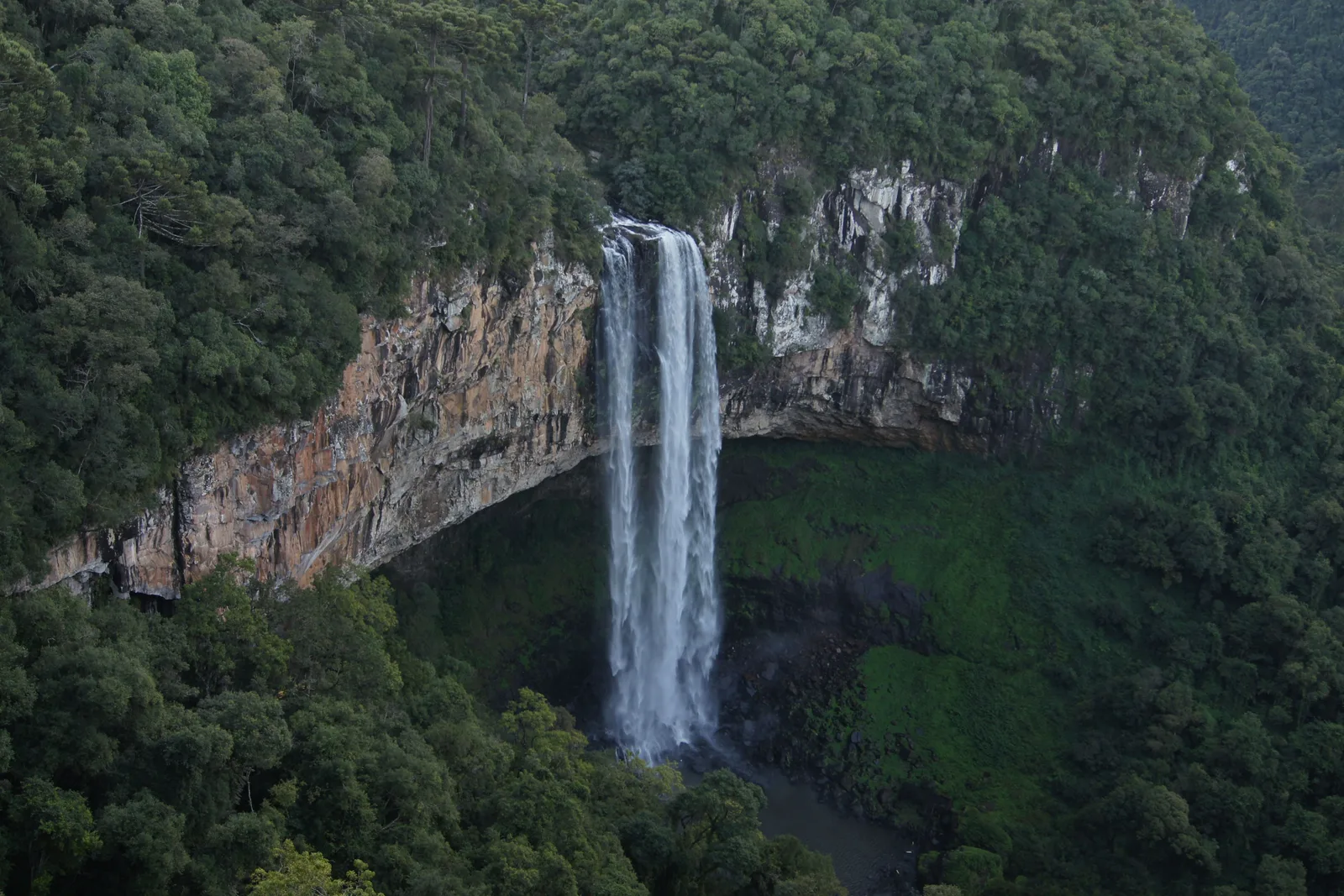
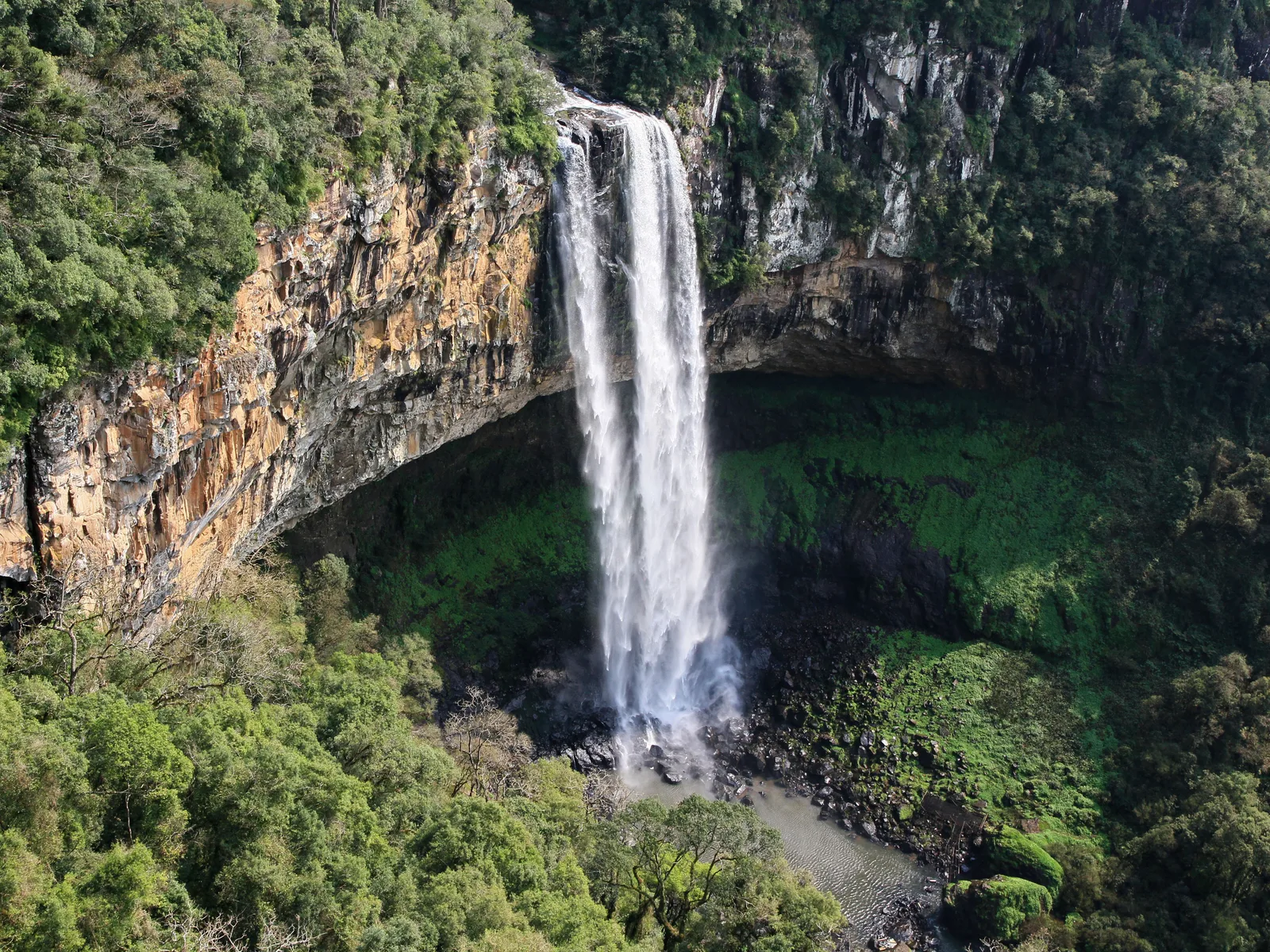
The Caracol waterfall seen from above, dropping from an overhanging orange-streaked cliff into a gorge of bright green forest, spray rising from the pool at its foot 01

A free fall of about 130 meters into a forest gorge

The Caracol waterfall

Where
Parque do Caracol, about 9 km by road from Canela
Open
Daily from 9:00am
Ticket
$26 (R$134.90) online

The Arroio Caracol runs across the plateau, reaches the edge of a cliff and drops in one clean white column into a bowl of forest below. The state puts the fall at 131 meters. It is inside the Parque do Caracol, a state park that has been run by a private concession since December 2022, led by the company behind Rio’s Sugarloaf cable car.

The ticket covers the new viewing deck, which has a glass-floored section, the observation tower, a trail to a deck facing a second, smaller fall, and the visitor center. Give it two to three hours. There is no way down to the foot of the falls inside the park: the park says the base is closed to the public. Two separate companies sell the waterfall from other angles next door, the Bondinhos Aéreos cable car and the Skyglass platform, and neither is part of the park ticket.
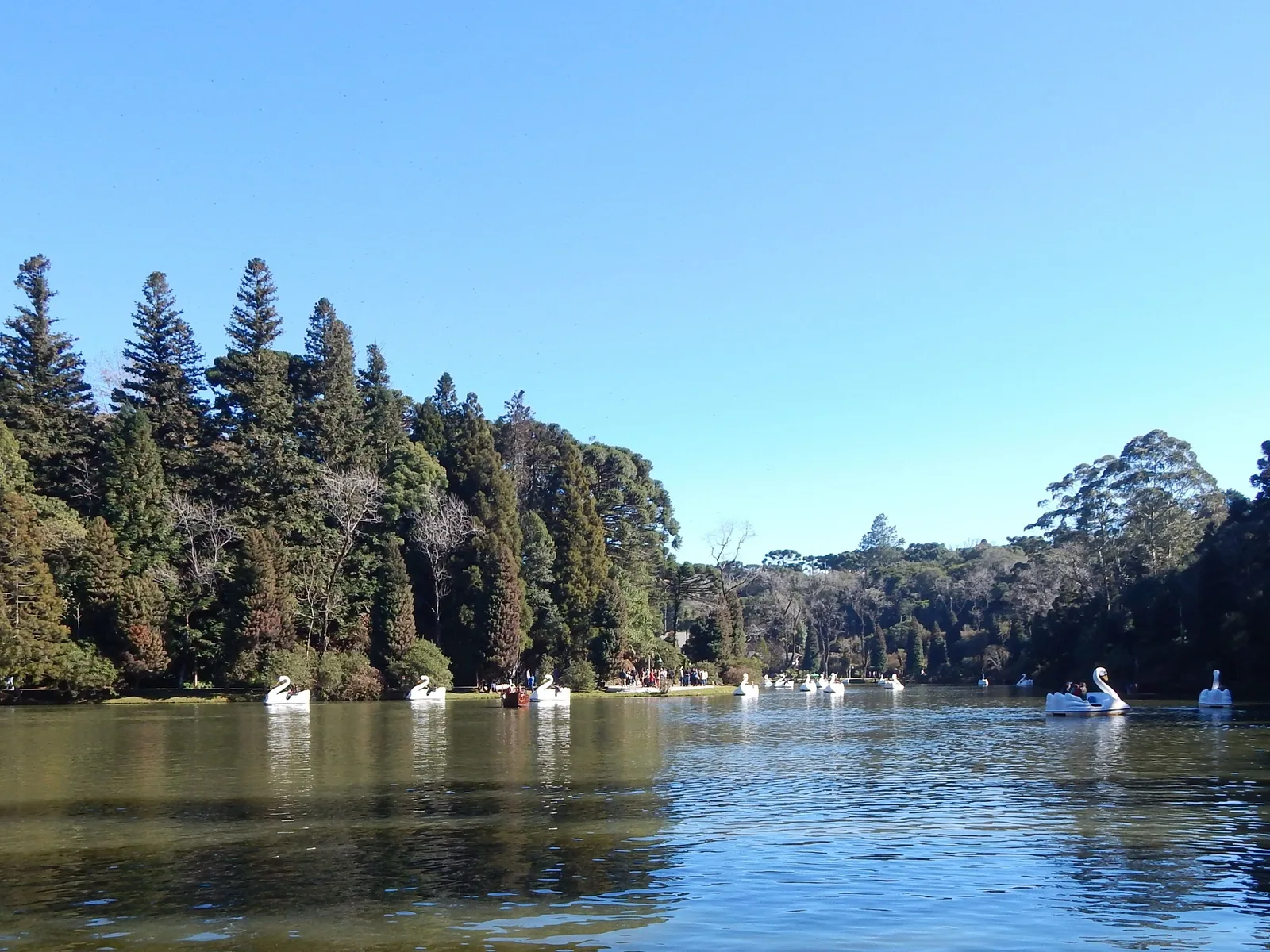
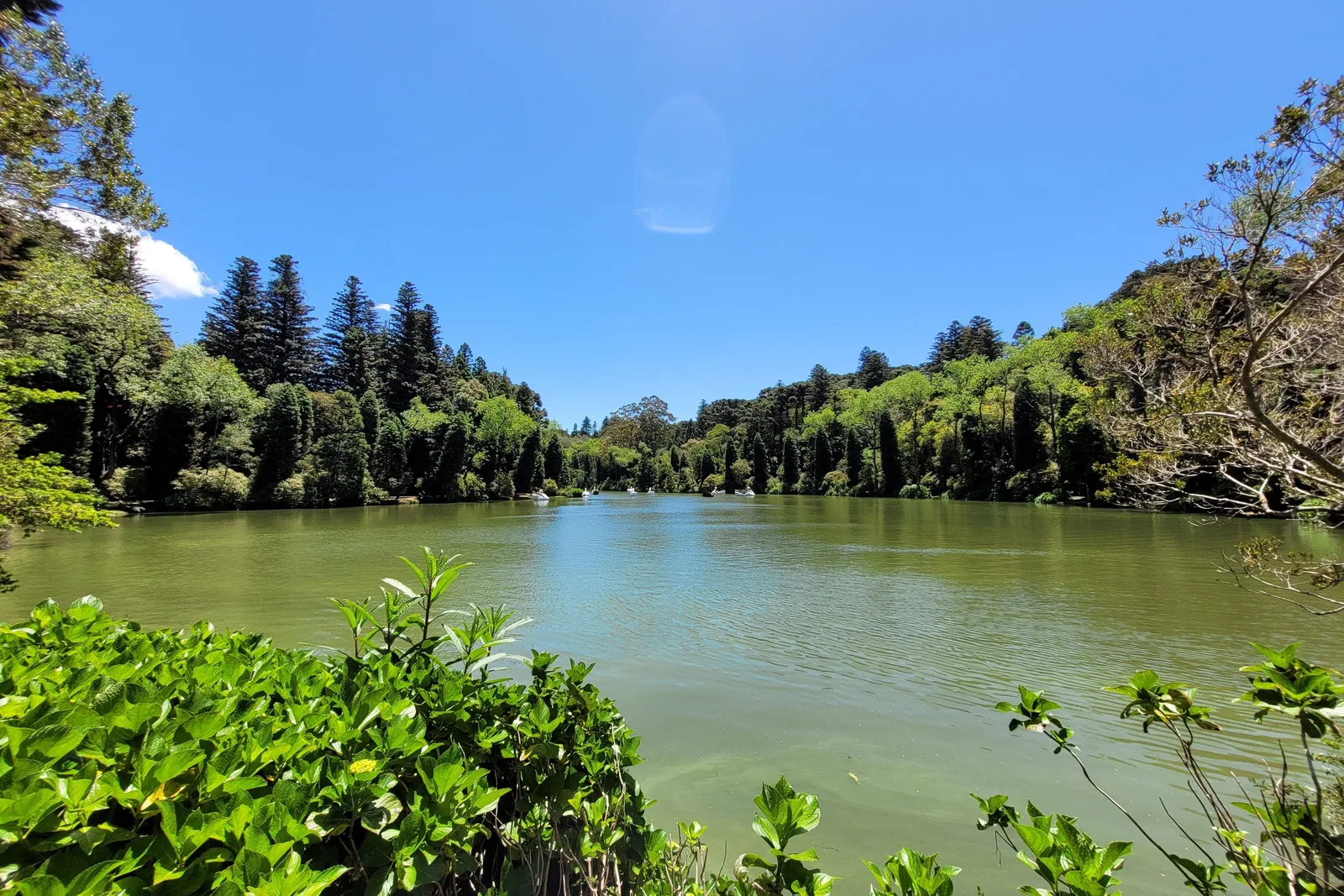
The Lago Negro on a clear blue day, a wall of tall dark conifers along the far bank and a scatter of white swan pedal boats on the water in front of them 02

A lake built after a fire, planted with Black Forest trees

The Lago Negro

Where
Gramado, about 2 km south of the Rua Coberta
Open
24 hours; pedal boats 8:30am–6:00pm
Entry
Free

After a fire cleared the forest in what was then called the Vale do Bom Retiro, a landowner named Leopoldo Rosenfeldt dammed the valley and planted its banks with trees imported from Germany’s Black Forest. That is where the name comes from: the Lago Negro, the black lake. Today it is Gramado’s park, with a path all the way around, dark conifers standing over the water, azaleas in winter and hydrangeas in summer.

It costs nothing to walk in, and it is open around the clock. The swan-shaped pedal boats are the only charge. Go early in the morning or late in the afternoon, when it is quiet and the mist sits on the water in the cold months.

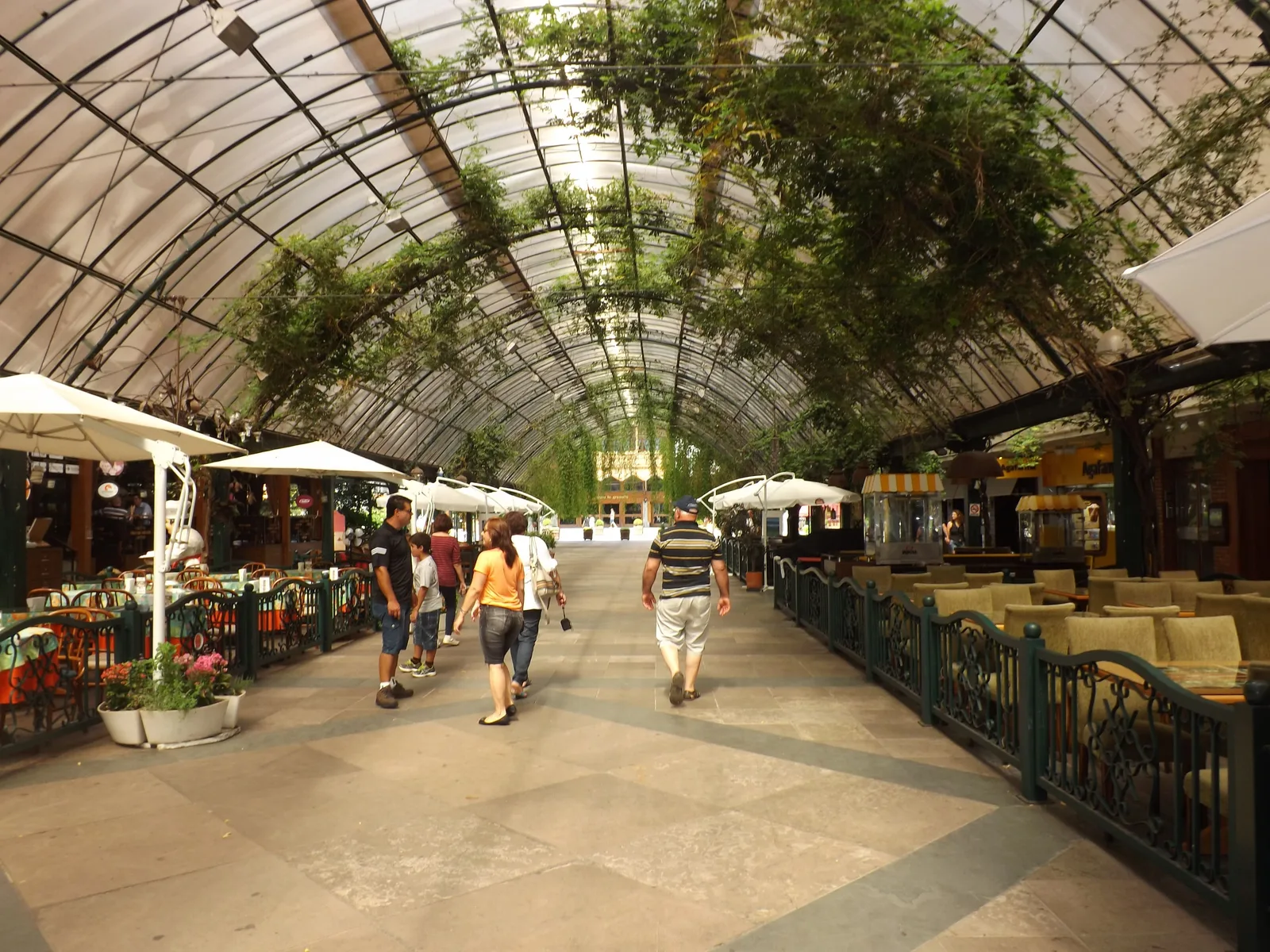
The Rua Coberta in daylight: an arched glass roof hung with greenery over a paved street, café tables and white parasols down both sides, people walking down the middle 03

A glass roof over a street of cafés

The Rua Coberta and the Borges

Where
Central Gramado
What
A covered stretch of Rua Madre Verônica
Entry
Free, open all day

In the middle of Gramado, one block of Rua Madre Verônica, between the Avenida Borges de Medeiros and Rua Garibaldi, has a glass roof over it, with café and restaurant tables down both sides and a stage at one end. It is the town’s living room. On a rainy afternoon it is the one place in Gramado where you can sit outside, and in Natal Luz season it has free shows from Tuesday to Sunday at 6:30pm.

The Avenida Borges de Medeiros runs past the end of it, the main street of chocolate shops, half-timbered façades, the Palácio dos Festivais where the film festival is held, and the Igreja São Pedro. Walk it once by day and once after dark. It is busy, it is commercial, and it is exactly what Gramado set out to build.

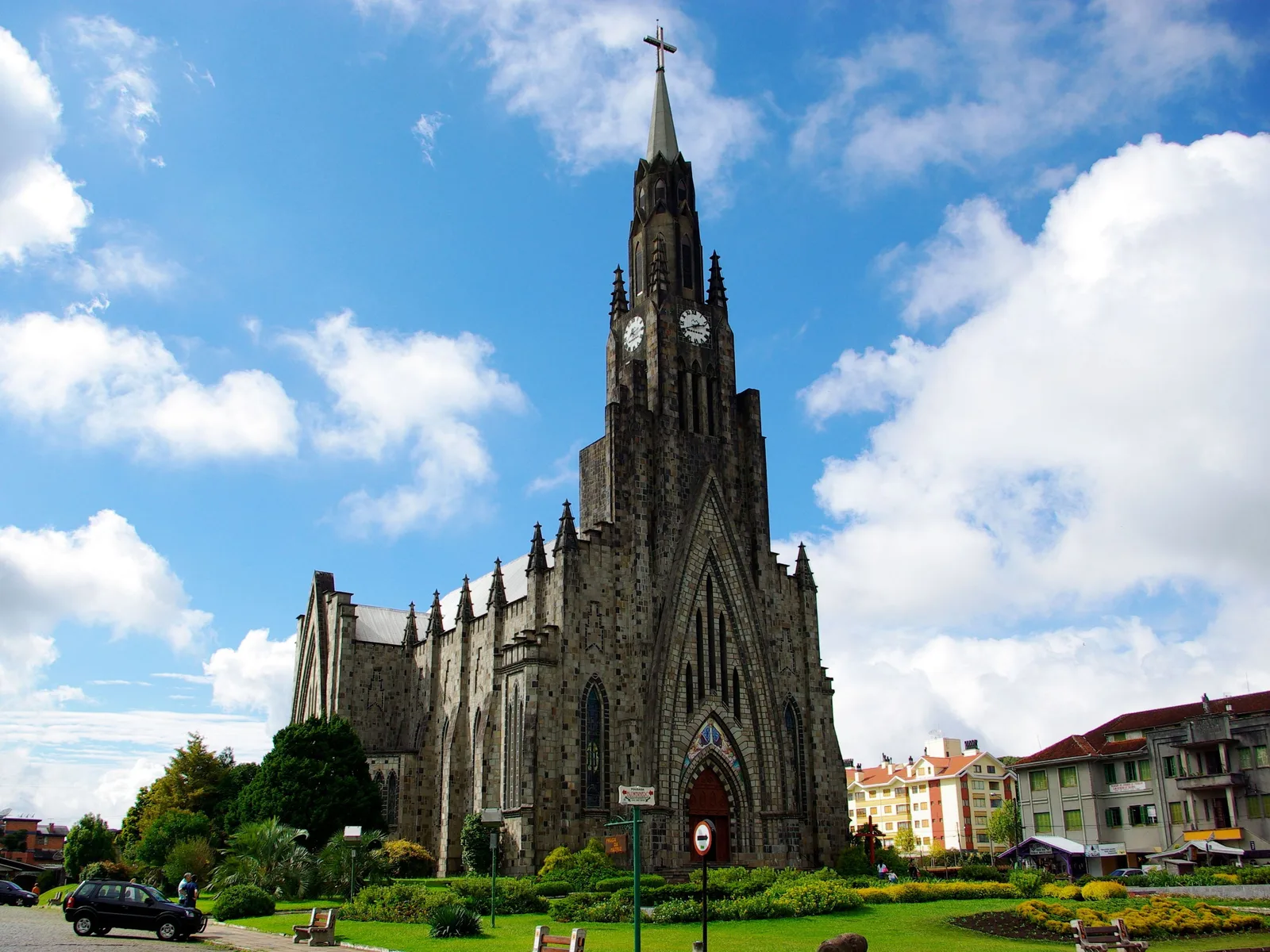
The Catedral de Pedra in Canela under a blue sky with white clouds: a dark stone Gothic church with a tall pointed clock tower, a garden and lawn in front and apartment buildings to the right 04

A 65-meter tower of dark basalt

The Catedral de Pedra

Where
Praça da Matriz, central Canela
Tower
65 meters
Light show
Nightly at 8:00pm, from the square

Canela’s parish church of Nossa Senhora de Lourdes is known as the Catedral de Pedra, the stone cathedral: a Gothic-style church built of basalt, with a single tower that rises 65 meters over the main square. It is a working parish church with daily Mass, and the square in front of it, with its gardens, is the center of town.

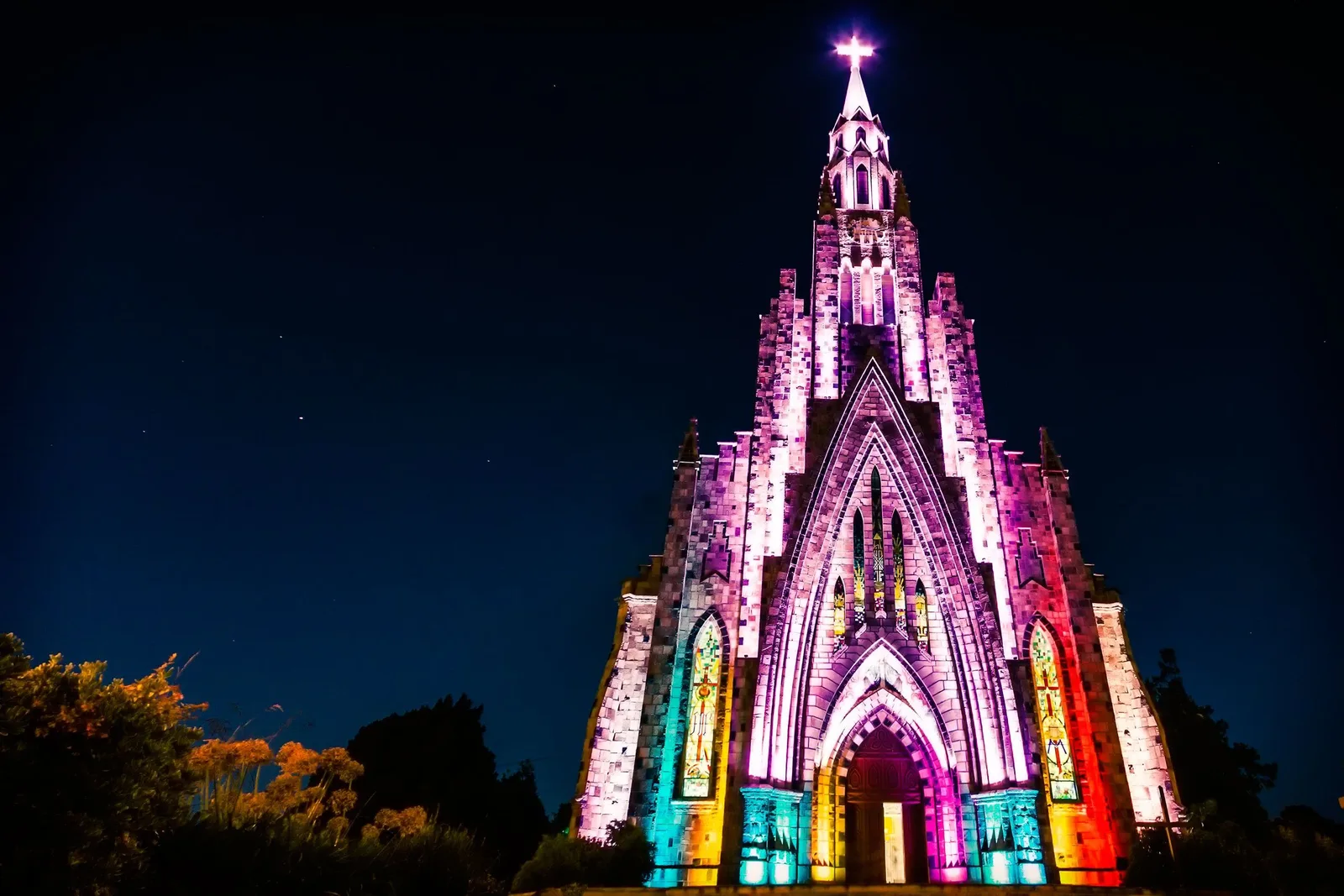
Since late September 2026 a new sound-and-light show of more than a hundred spotlights has lit the façade every night at 8:00pm, watched from the square. It is the best reason to stay in Canela past dark, or to drive over from Gramado for dinner.

What to actually do

Free lakes, paid parks and a wine day.

Pick a tab and scroll sideways. The first two are the towns, the third is what you eat, the fourth is the paid parks, honestly described, and the last is the wine valley.

In Gramado

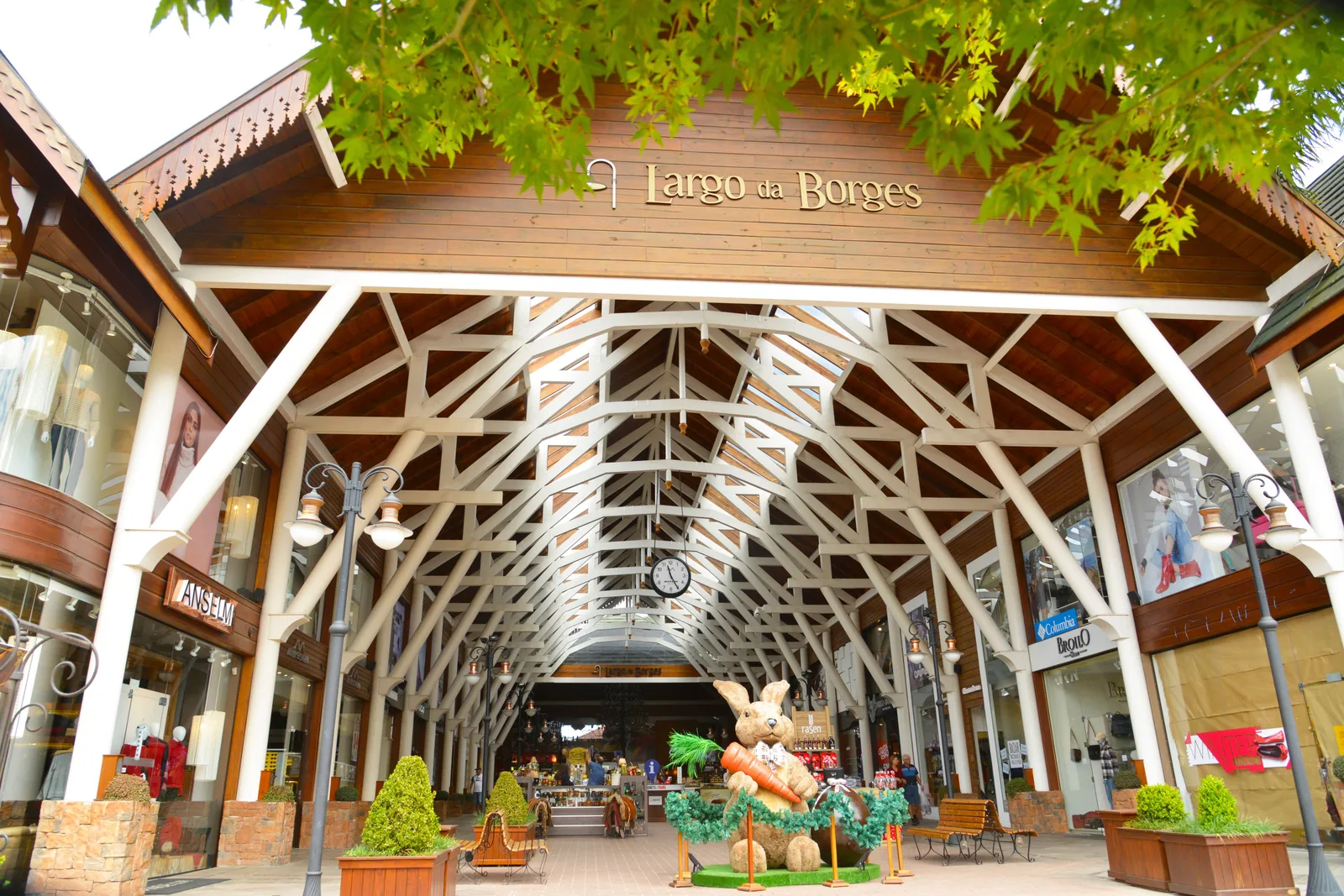
  • The entrance to the Largo da Borges arcade in Gramado: a wooden gable with the name in gold letters over a white timber-framed roof, shops on both sides and an Easter rabbit figure at the far end

    Central Gramado · an hour or two

    A walk on the Avenida Borges de Medeiros

    The main street, and the Gramado on the postcards: chocolate shops, half-timbered fronts, flower beds and the covered Largo da Borges arcade. It is a style borrowed for tourism rather than the town’s original architecture, and it is busy and commercial. It is also good fun to walk, end to end, with a hot chocolate in hand.

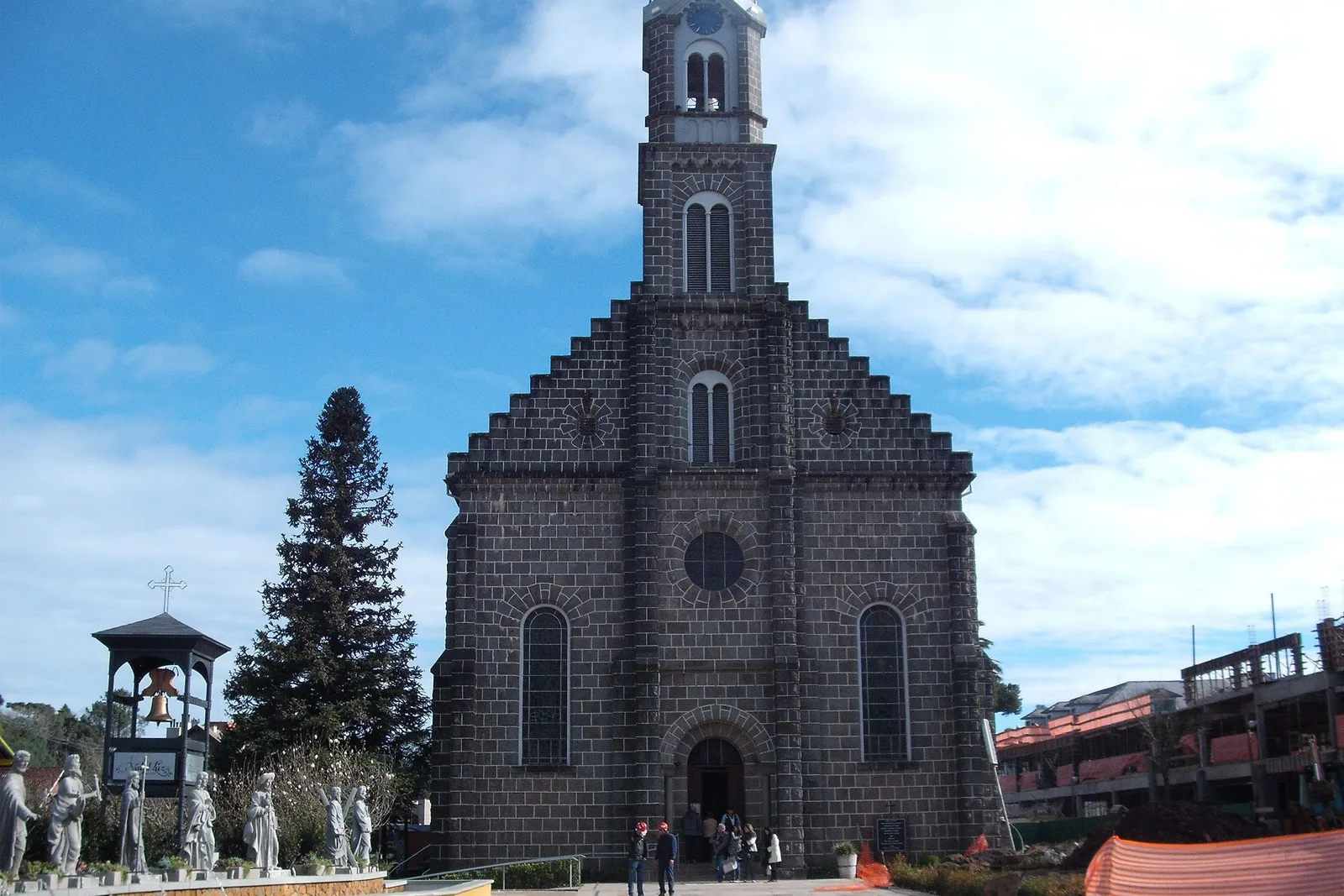
  • The Igreja São Pedro in Gramado: a dark stone church with a tall square tower under a blue sky with cloud, a pine tree and white statues on the left

    Central Gramado · twenty minutes

    The Igreja São Pedro

    Gramado’s main church, opened in 1942 and built of basalt, with a 46-meter tower that you see from most of the center. It is free and open daily from 7:00am to 8:00pm, and it sits right on the Borges, so it takes no detour at all.

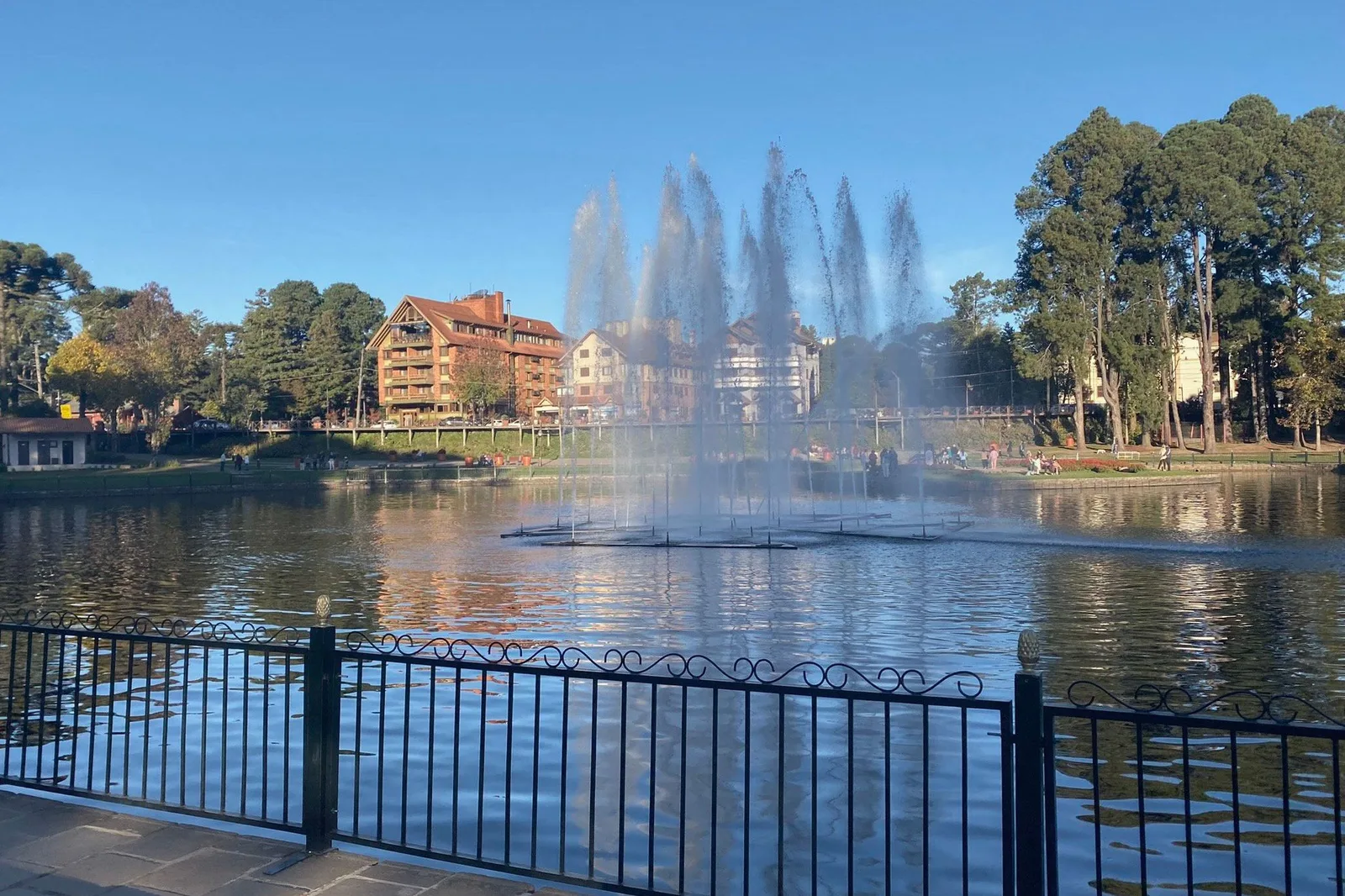
  • The Lago Joaquina Rita Bier on a sunny day: fountains jetting up from the middle of the lake, a black railing in the foreground and hotels among tall trees on the far side

    Gramado · half an hour

    Lakeside at the Lago Joaquina Rita Bier

    Gramado’s second lake, also laid out by Leopoldo Rosenfeldt and dug, the town says, by shovel and pickaxe. It covers about 17,000 square meters, has a small island and araucarias more than 70 years old around it, and it is free. Quieter than the Lago Negro, and good on a frosty morning.

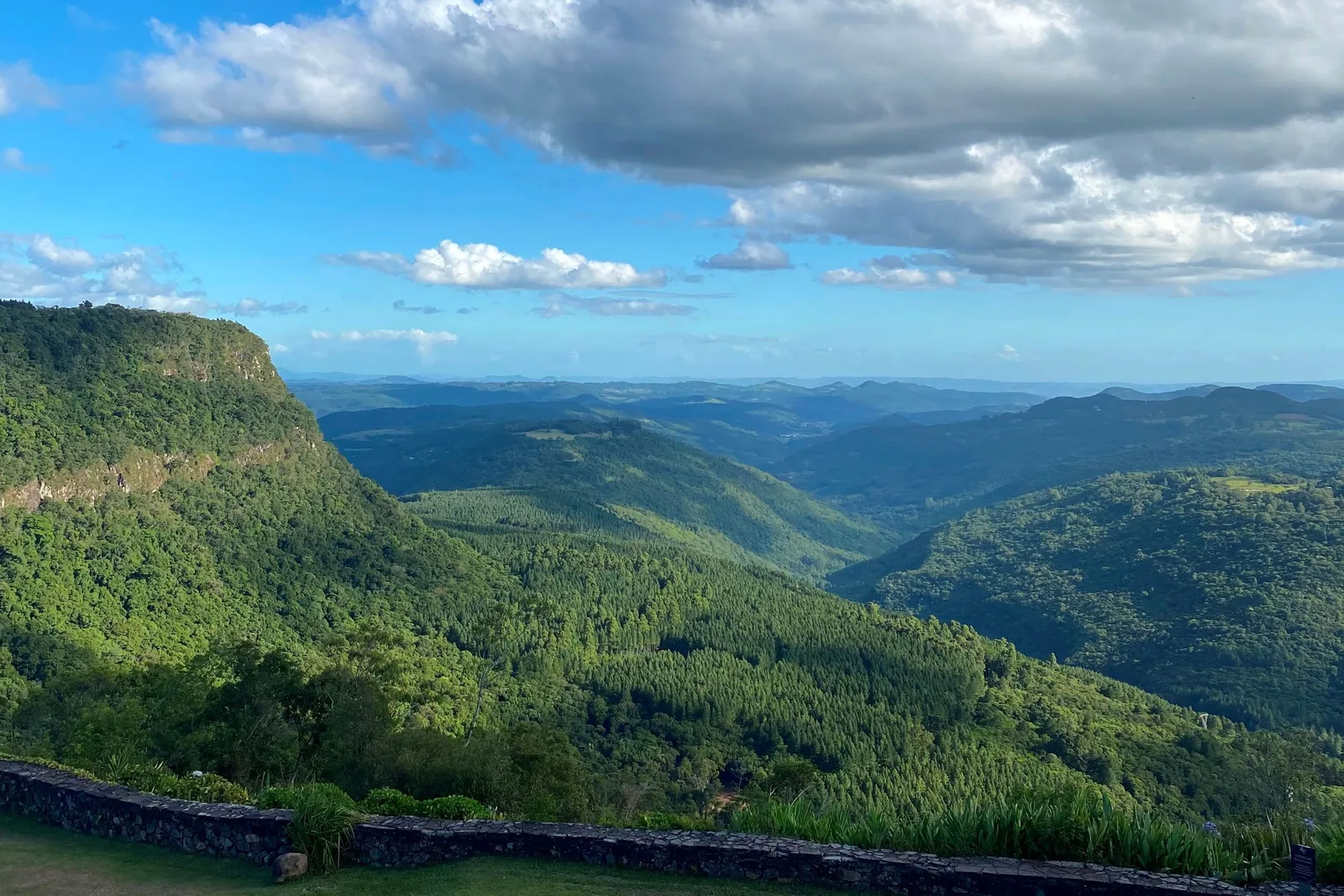
  • The Vale do Quilombo from above: forested slopes falling away into a long green valley with a flat-topped ridge on the left and hills fading into blue haze

    Gramado · fifteen minutes, free

    The view from the Belvedere

    A free lookout on the edge of town over the Vale do Quilombo, the deep green valley that drops away below Gramado and runs toward Canela. It is the quickest way to see that these towns sit on the rim of a plateau. Go late in the afternoon, when the light comes across the valley.

In Canela

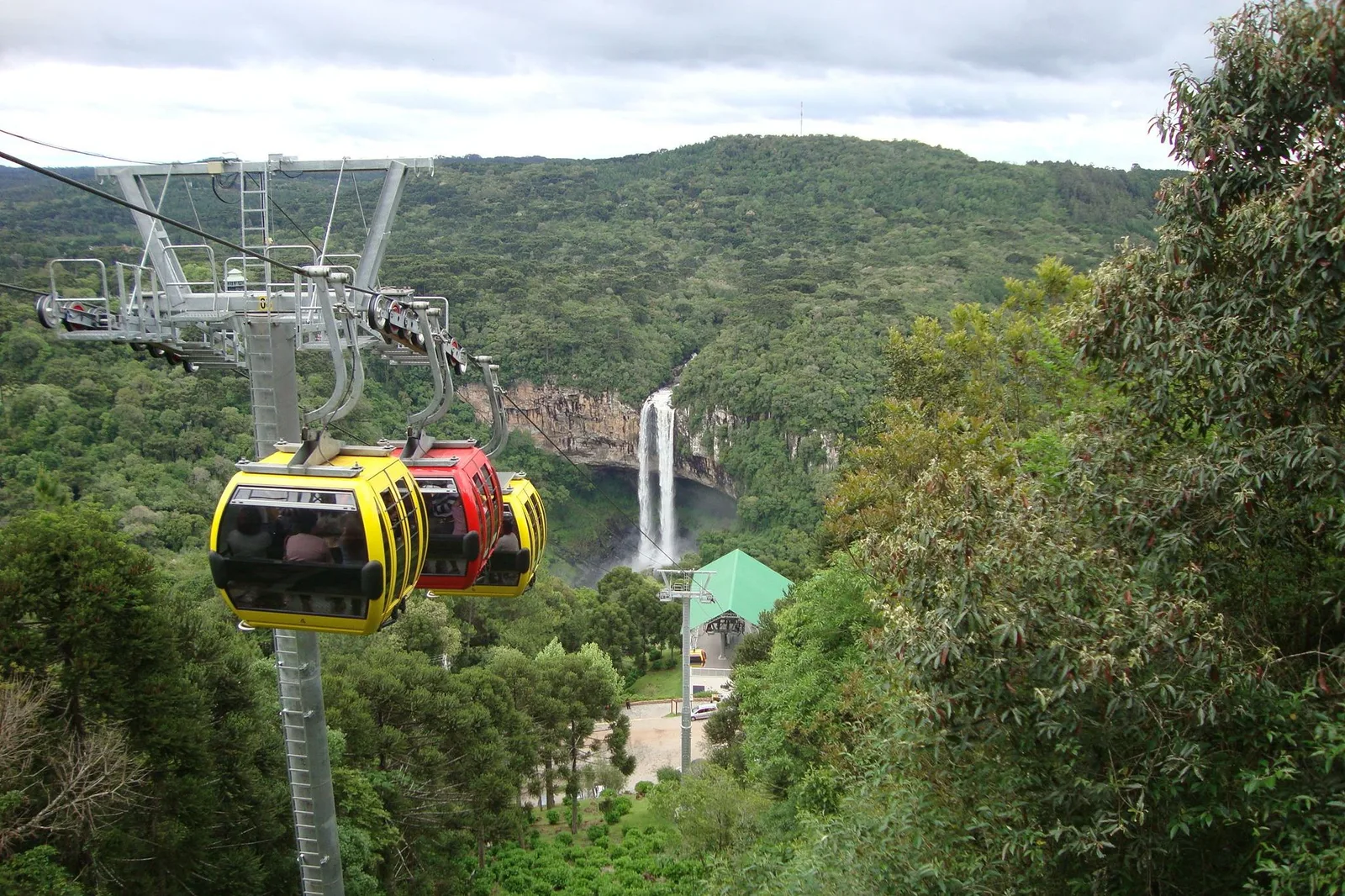
  • Yellow and red cable-car cabins hanging from a cable over the forest, with the Caracol waterfall falling from a cliff in the distance behind them

    Next to the Parque do Caracol · about an hour

    The cable car at the Bondinhos Aéreos

    A separate company from the park. Its cabins run 840 meters out over the forest with three stations, and the last one has what the operator calls the closest, front-on view of the falls. Daily 9:00am to 5:00pm, $25 (R$130) online. The cabins take wheelchairs and strollers.

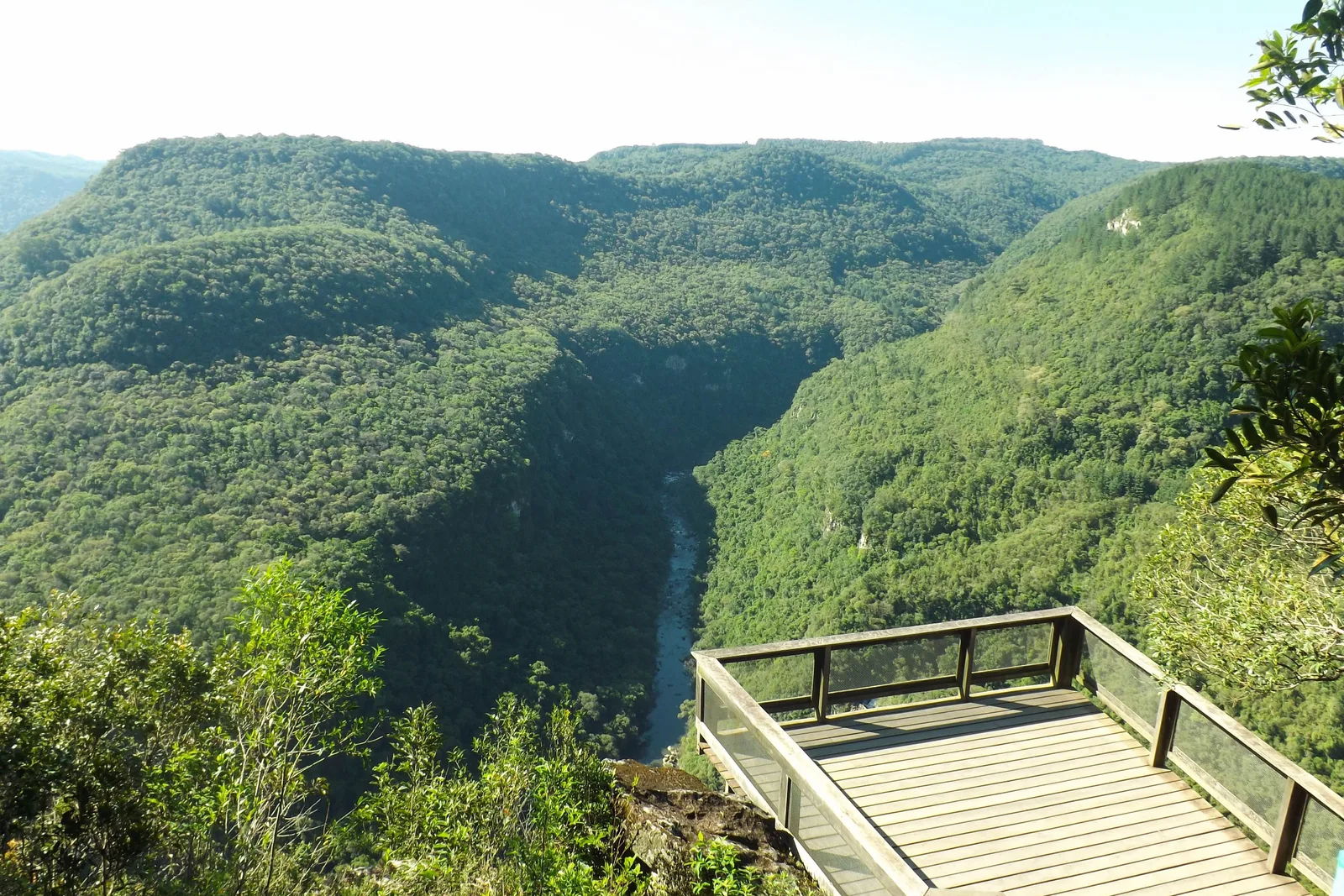
  • A wooden viewing deck on the rim of the Vale da Ferradura, looking out over steep forested slopes that fall into a deep canyon with a glimpse of river at the bottom

    14 km from central Canela · an hour

    The Skyglass over the Vale da Ferradura

    A glass platform that runs 35 meters out over the Vale da Ferradura, a horseshoe bend of canyon with the Rio Caí 360 meters below, according to the operator. Daily 9:30am to 6:00pm, $32 (R$165). Bags, hats and keys go in free lockers before you walk out. Our view: the valley itself is the point, and the deck is a dramatic way to look at it.

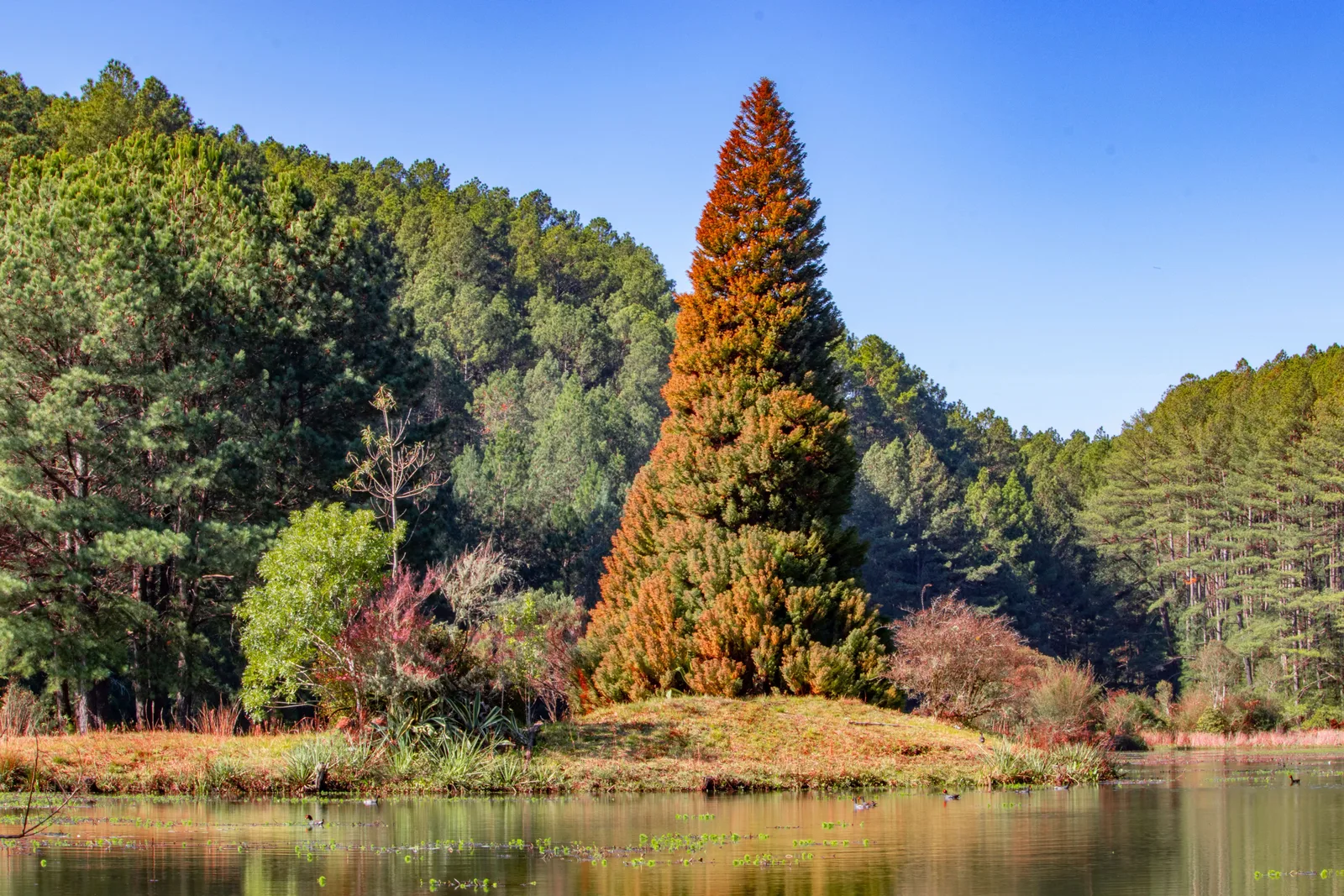
  • A still lake in the Floresta Nacional de Canela with a tall rust-colored conifer standing out against green forested hills under a clear blue sky

    About 6 km north of Canela · half a day

    Trails in the Floresta Nacional de Canela

    A federal forest reserve run by ICMBio, created in 1968, of araucaria and native woodland with three marked trails of 8.6, 6 and 4.5 kilometers. Entry is free, it is open daily from 8:00am to 5:00pm, and groups of up to six need no booking. The last stretch of road in is dirt. It is the antidote to the ticket booths.

  • The Catedral de Pedra at night, its Gothic façade and spire lit in pink, violet and gold against a dark sky

    Central Canela · nightly at 8:00pm

    The light show at the Catedral de Pedra

    Every night at 8:00pm the stone cathedral’s façade is lit by more than a hundred spotlights in a show set to music, supported by Canela’s tourism department. It is watched from the square. The town says the schedule can change without notice, so check before you drive over.

Fondue & chocolate

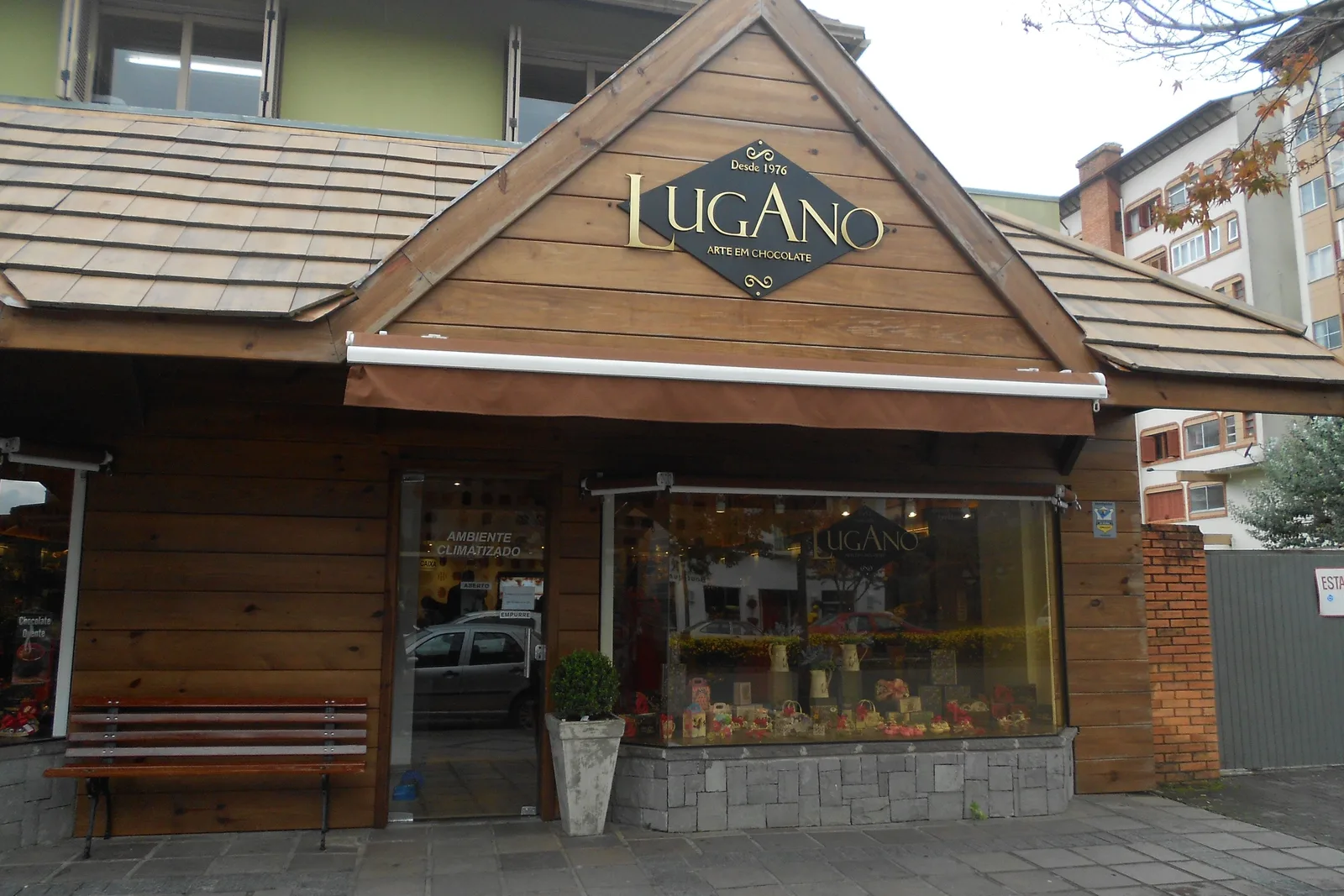
  • The front of a Lugano chocolate shop in Gramado: a wooden chalet-style gable with the Lugano name over a window full of boxed chocolates, a bench beside the door

    Central Gramado · dinner

    Chocolate and fondue in central Gramado

    Chocolate shops line the center: Lugano, a family firm founded in 1976, has six of its own in Gramado. For dinner, the town’s signature is a fondue sequence: cheese, then meat cooked at the table, then chocolate with fruit. At the menu price it runs $31–35 (R$159.90–179) per person at two long-running houses, Maison de la Fondue on the Borges and Chateau de la Fondue, which has been open since 1986. Both sell prepaid vouchers online for less. Book in July and in Natal Luz season.

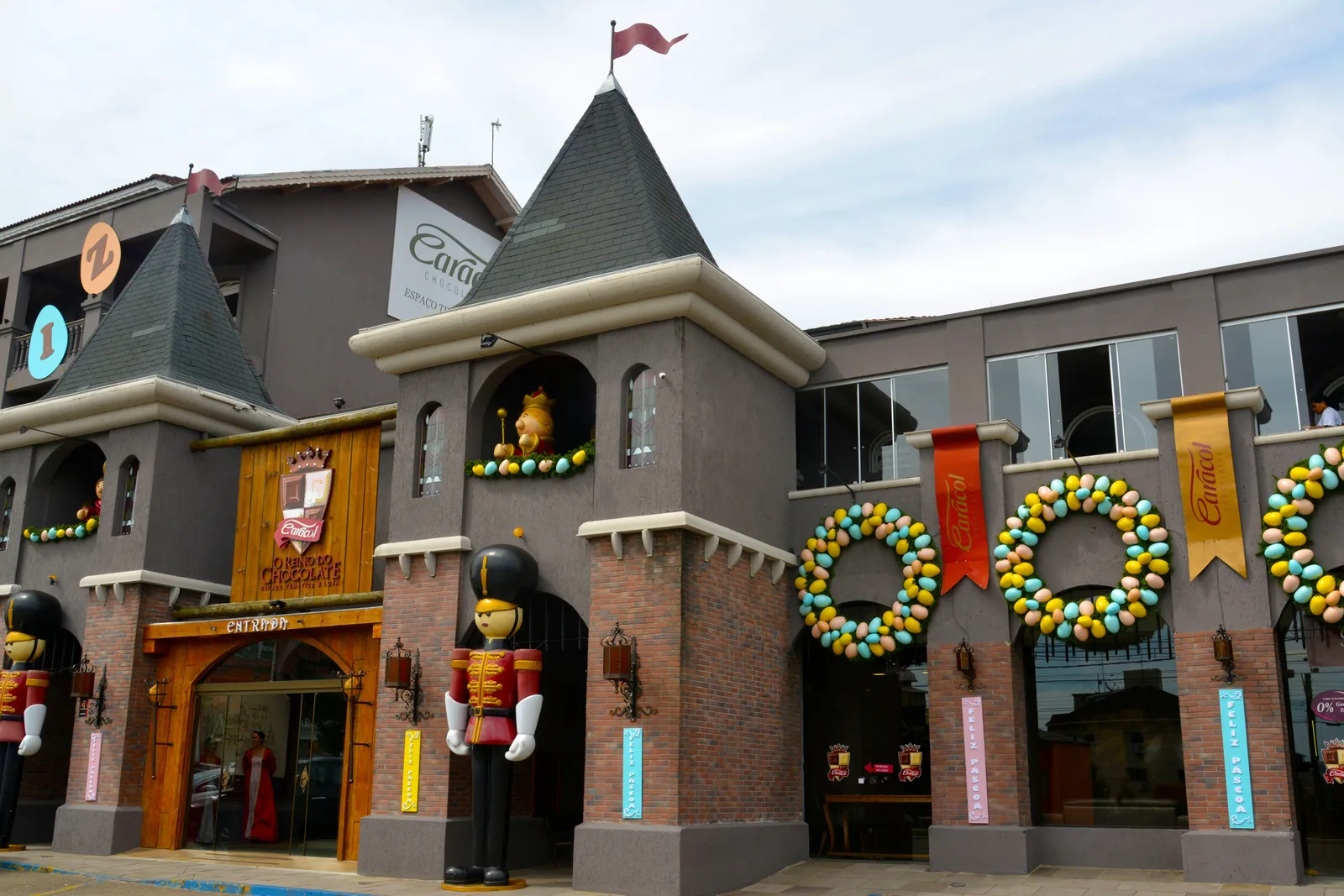
  • The Reino do Chocolate in Gramado, built to look like a castle, with gray turrets, giant toy-soldier figures at the doors and wreaths of colored Easter eggs on the front

    Avenida das Hortênsias, Gramado · about an hour

    The chocolate tour at the Reino do Chocolate

    Caracol Chocolates, in the Serra for more than 40 years, runs a tour of the history of chocolate at its castle-fronted Reino do Chocolate, daily 9:00am to 7:00pm, from $4 (R$19.90), or from $16 (R$79.80) with a make-your-own-chocolate session. For a working factory, Prawer, which bills itself as Brazil’s first artisan chocolate factory, guides 30–40 minute tours with a tasting for $14 (R$69) on weekdays and $12 (R$59) on weekends, when the line is not running. Book Prawer on its own site; the town’s tourism page still says tours are suspended.

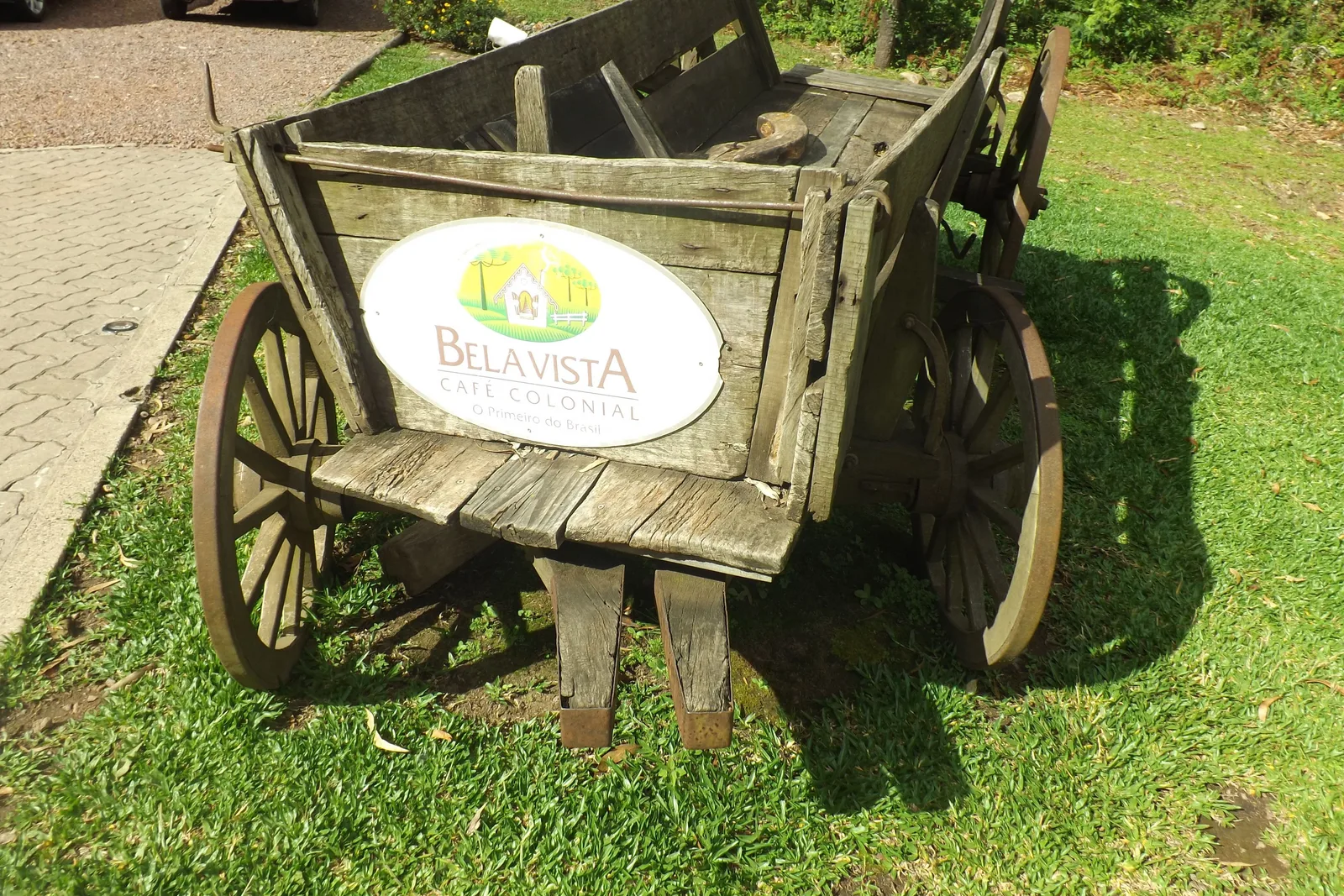
  • An old wooden farm cart on a lawn with an oval sign for the Bela Vista café colonial fixed to its side

    Avenida das Hortênsias, Gramado · a long afternoon

    A café colonial at Bela Vista

    The café colonial is the region’s answer to afternoon tea, from the German and Italian settlers’ tradition: one price, and the table fills with breads, cakes, pies, cold cuts, apfelstrudel, coffee, grape juice and hot chocolate. Bela Vista, which says it opened Brazil’s first in 1972, charges $29 (R$150) a head; Café Colonial Coelho charges $25 (R$129) and is closed on Tuesdays. Skip lunch.

The paid parks

  • Three life-size polar bear figures standing in artificial snow among bare white trees under blue-lit walls inside Snowland

    RS-235, Gramado · half a day

    Indoor snow at Snowland

    An indoor park of real snow kept at minus 5°C, with tubing, an ice slide and an ice rink, and the boots, jacket, trousers and gloves included in the ticket. From $28 (R$144.50) online, more at the gate. Our view: if you have seen snow before, this is the paid park on this list we would skip first.
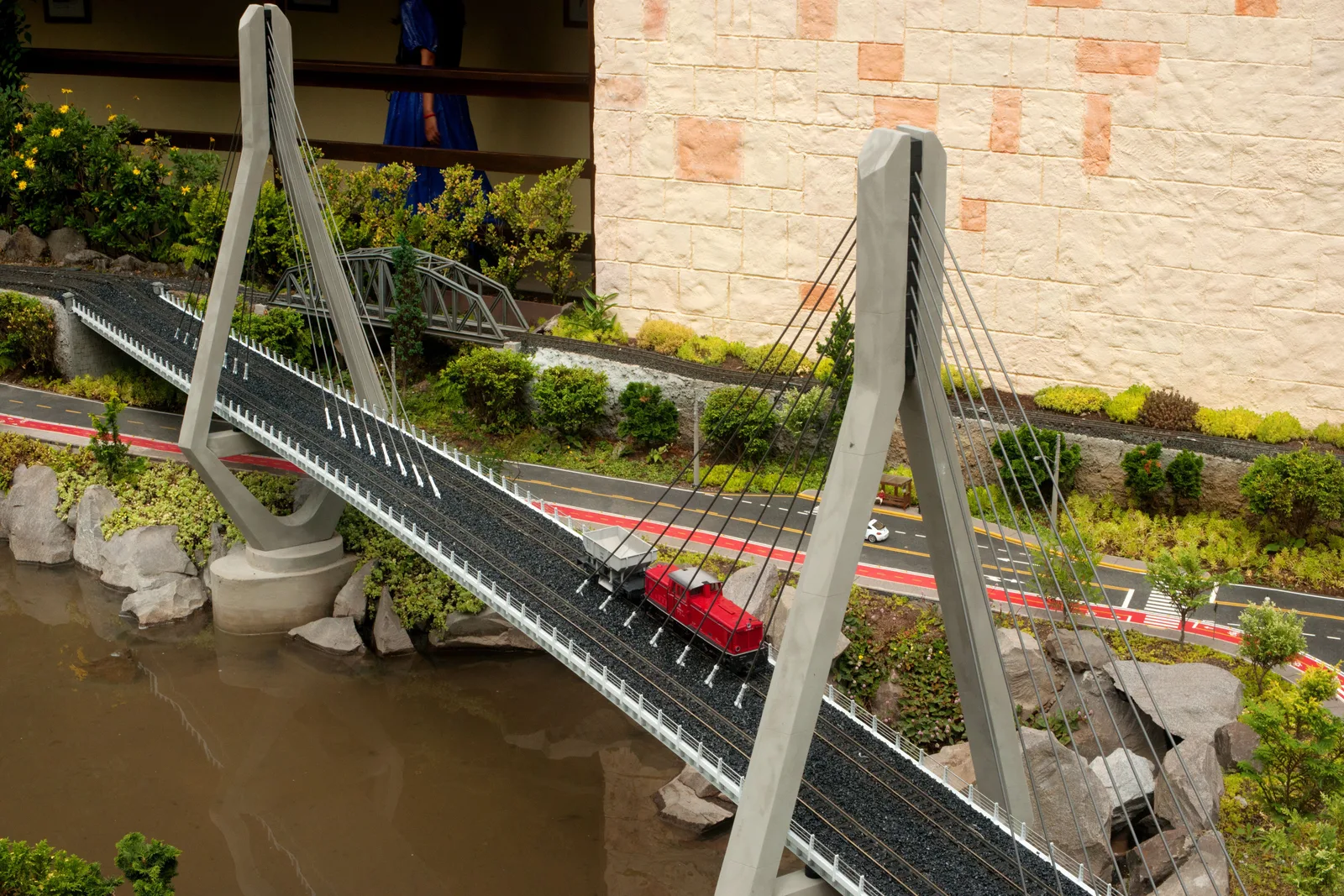
  • A model cable-stayed bridge at Mini Mundo with a small red train crossing it over a pond, model roads and planted rockwork around it

    Central Gramado · an hour or two

    Miniatures at Mini Mundo

    An outdoor park of model buildings at one twenty-fourth of their real size, with model trains running through it, open daily from 9:00am to 5:00pm. $31 (R$156) for an adult, half that for children from 3 to 15. Our view: a good one with young children.

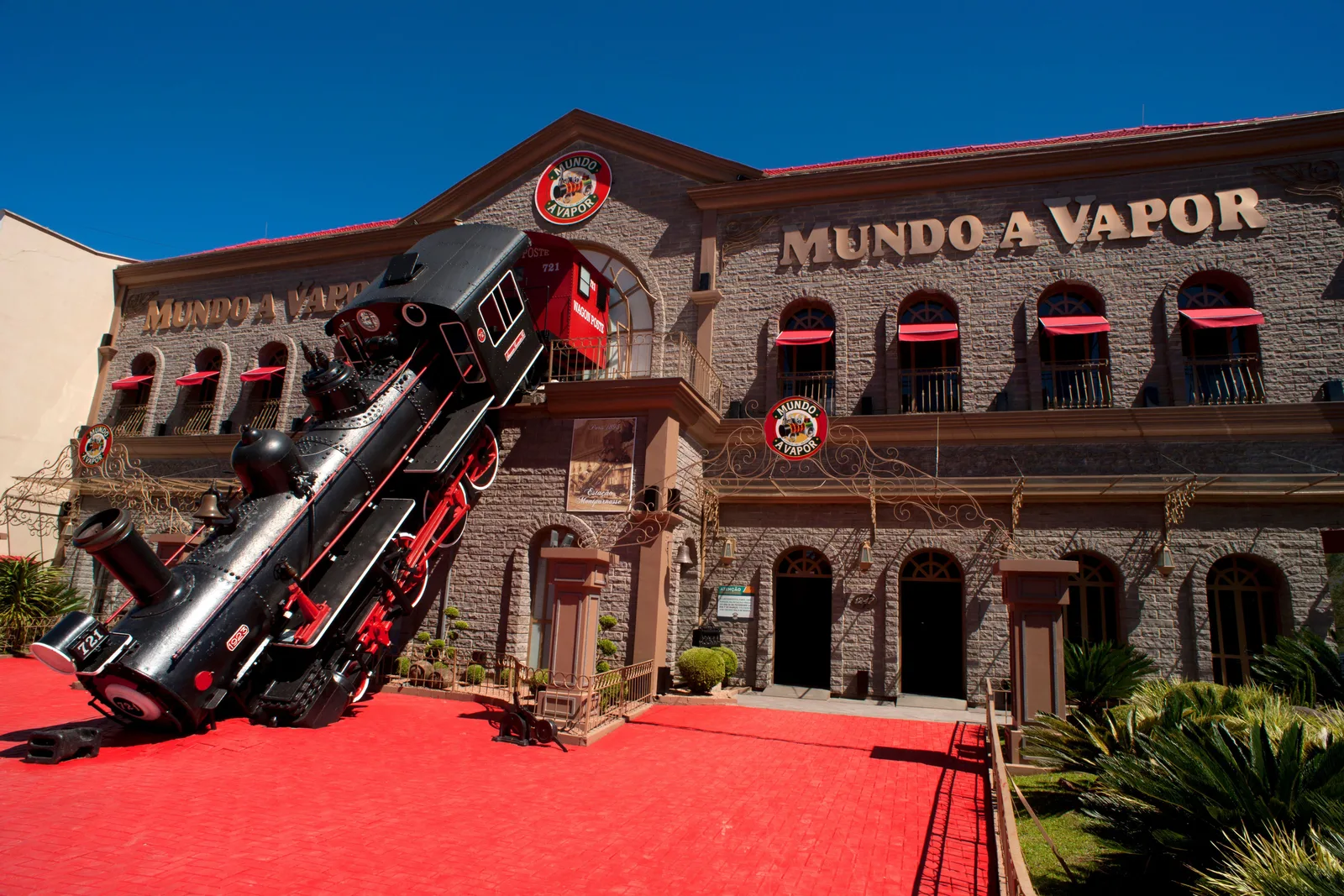
  • The Mundo a Vapor building in Canela: a stone façade with red awnings and a full-size black steam locomotive set at an angle as if crashing through the front, on a red forecourt

    Canela · two hours, closed Wednesdays

    Steam machines at Mundo a Vapor

    Working steam-powered miniatures built by the Urbani brothers, shown in ten rooms, with a train ride in the woods and a 52-meter Ferris wheel. You will know the building: a full-size locomotive bursts through its front wall. $25 (R$129) for an adult on the operator’s site.

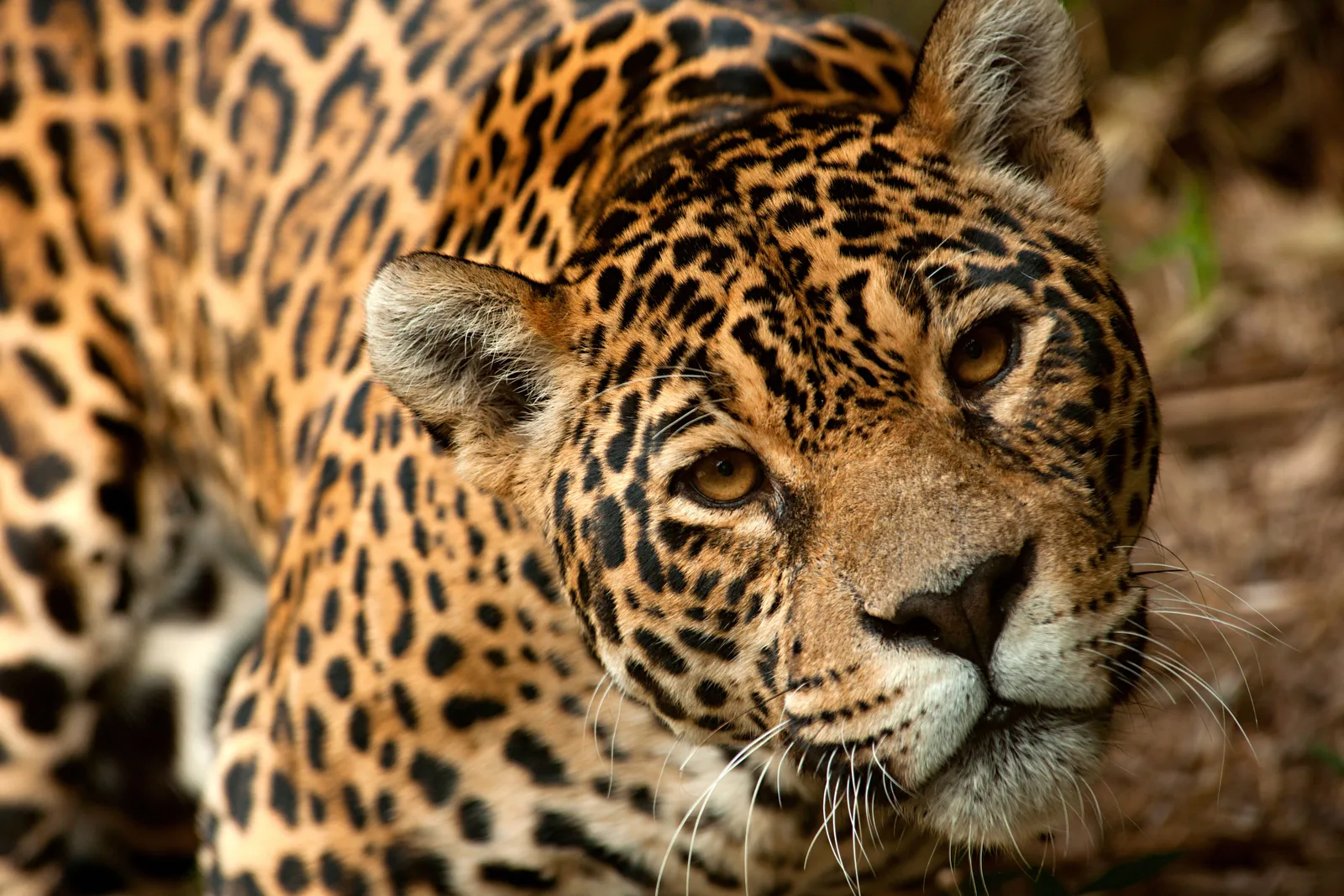
  • A close-up of a jaguar lying down, its spotted golden face turned toward the camera

    Near Gramado’s entrance gate · two hours

    Brazilian wildlife at GramadoZoo

    A zoo of Brazilian animals, open since 2008, where glass enclosures and walk-through aviaries stand in for cages, along one 1,800-meter trail. That description is the operator’s own. Open daily from September to December 2026 apart from a few closed days, otherwise Wednesday to Sunday, from 10:00am, last entry 4:00pm. $23 (R$115), parking $4 (R$20).

Vale dos Vinhedos

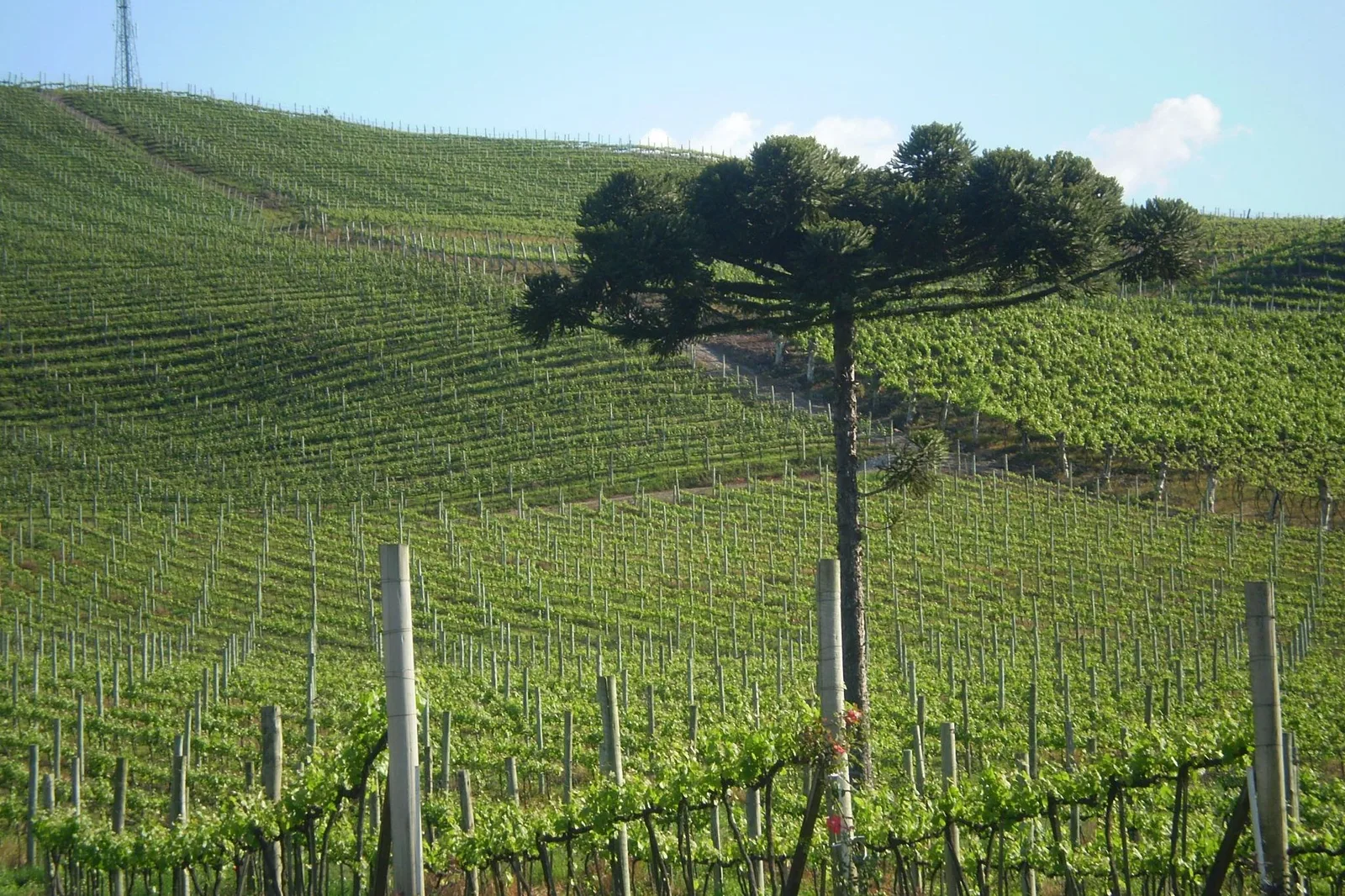
  • Rows of young vines running up a gentle green slope in the Vale dos Vinhedos with a single tall araucaria pine standing among them

    Bento Gonçalves · a full day from Gramado

    The Vale dos Vinhedos

    About 81 square kilometers of vineyards across Bento Gonçalves, Garibaldi and Monte Belo do Sul, settled by Italian immigrants from the late 1870s. In 2012 it became Brazil’s first Denominação de Origem for wine, and its producers’ association lists more than 30 wineries. It is about two hours from Gramado each way, so it is a day, not an afternoon.

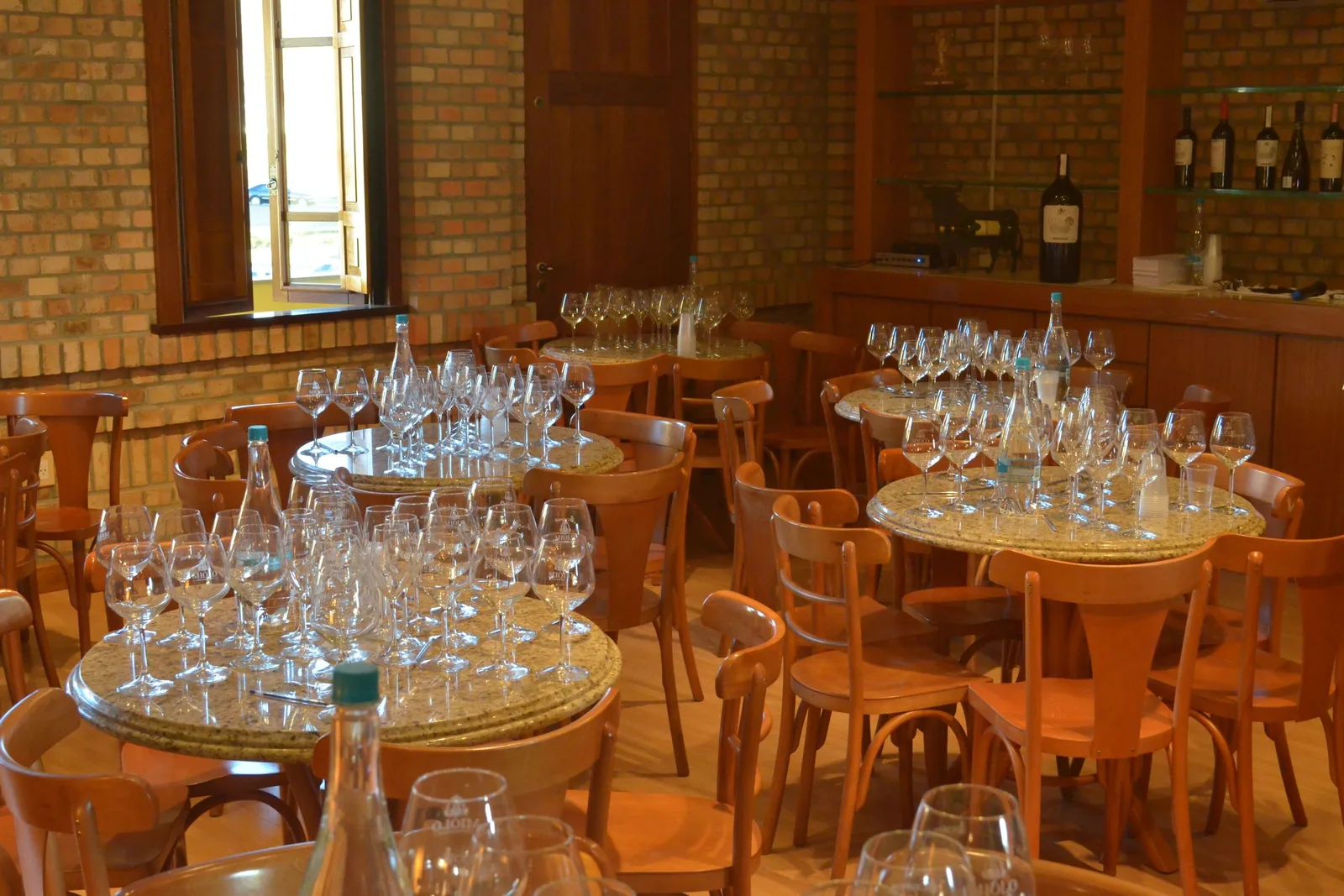
  • A tasting room at Miolo laid for a group: round tables covered with rows of empty wine glasses, wooden chairs and a brick wall with a window behind

    RS-444, Vale dos Vinhedos · about an hour

    A tasting at Miolo

    A large family winery with fixed tour times every day. The basic Tour Miolo is $18 (R$90) for adults and comes with a crystal glass and $2 (R$10) toward a bottle; longer tastings run up to $69 (R$350). Lidio Carraro, a few minutes away, pours five labels for $24 (R$120), daily 9:00am to 5:00pm.

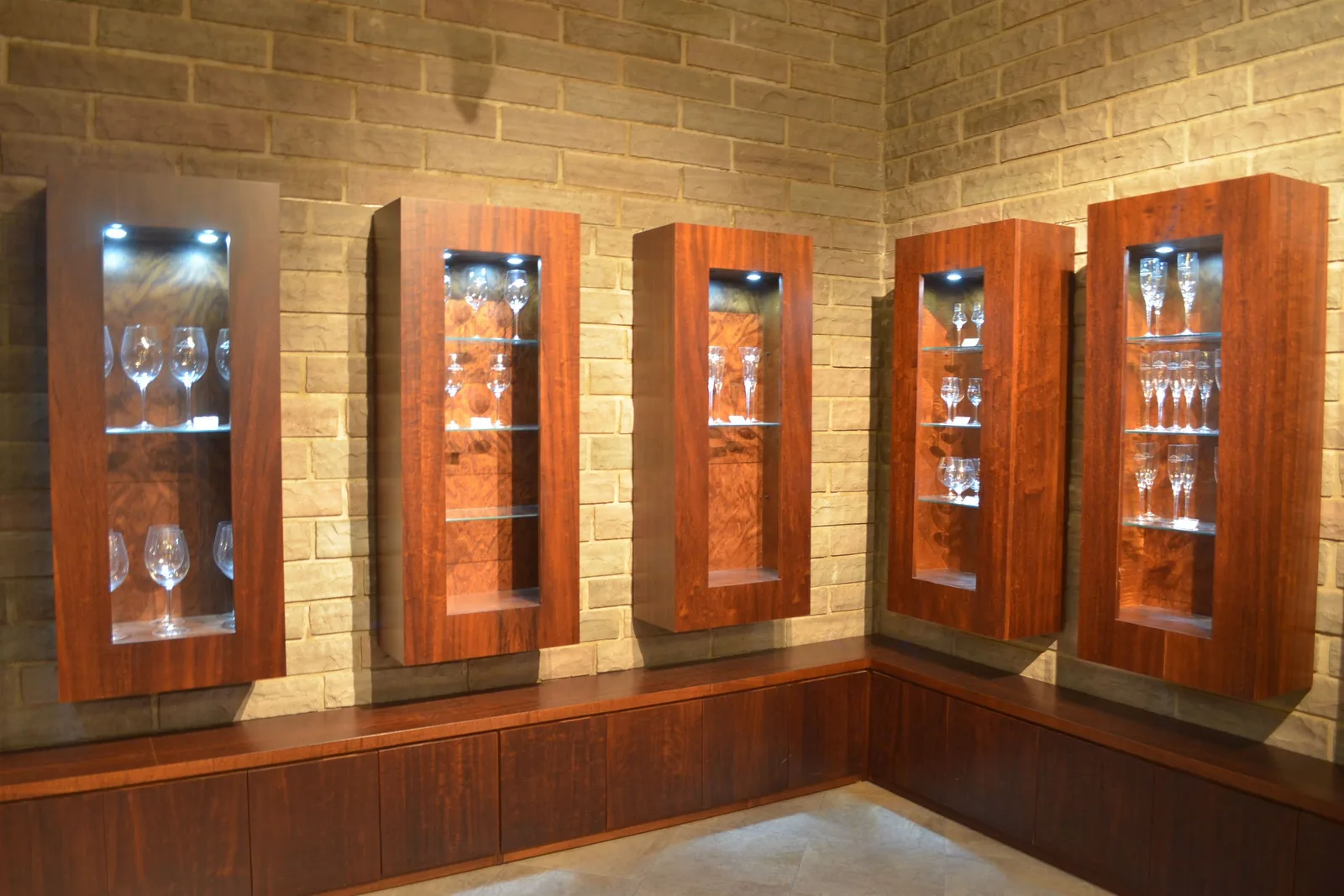
  • Lit wooden display niches holding wine glasses set into a pale brick wall at Casa Valduga

    Via Trento, Vale dos Vinhedos · two hours

    A tour at Casa Valduga

    A family winery open daily from 9:00am to 5:00pm, last visit at 3:00pm. Its traditional tour takes two hours and starts at $38 (R$195); the premium tastings go much higher. Booking is by WhatsApp with half paid in advance. If you want something free, Vinícola Aurora in Bento Gonçalves town runs a 45-minute tour and tasting at no charge, booked ahead by phone.

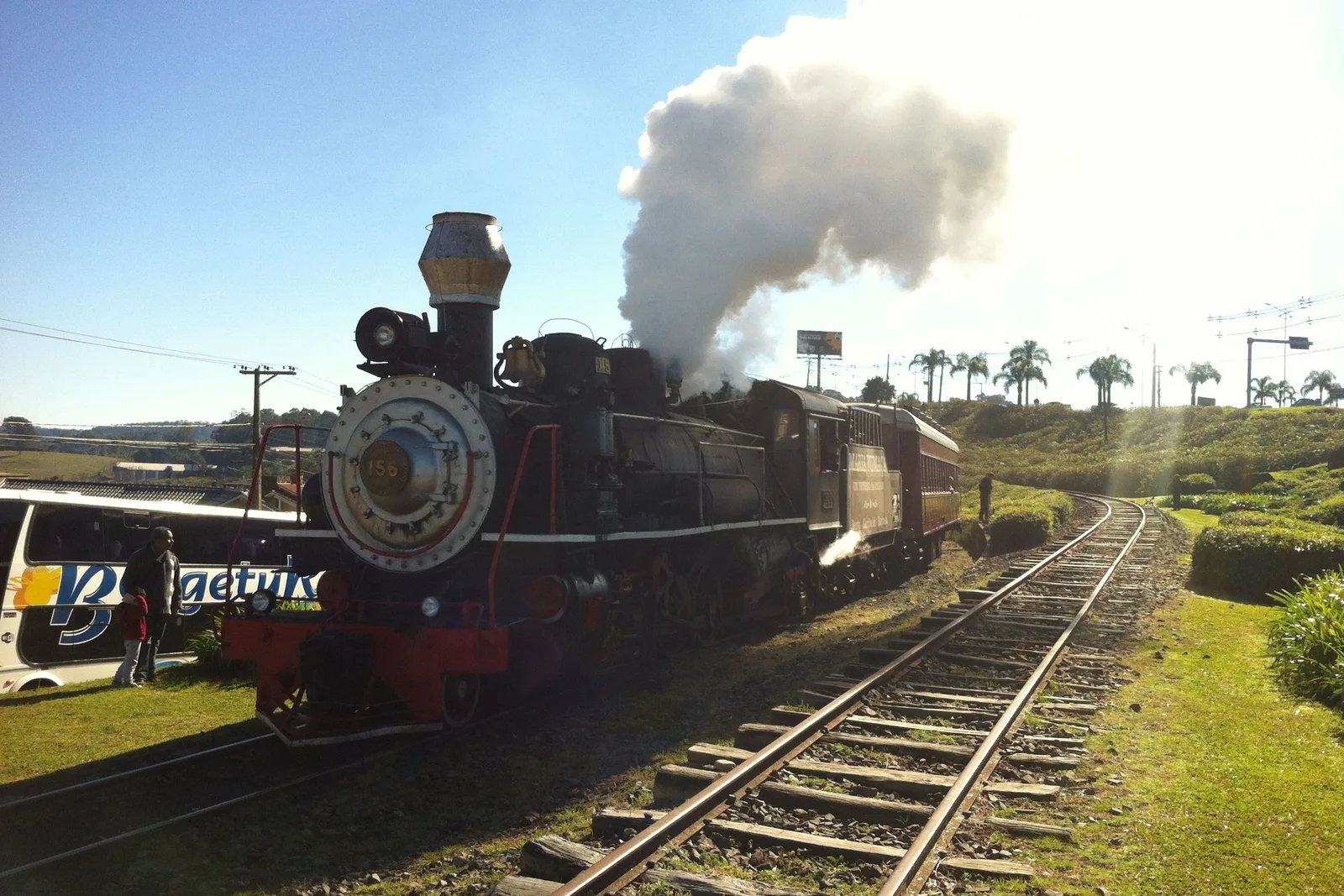
  • The Maria Fumaça steam locomotive standing on the track at Carlos Barbosa with white smoke pouring from its chimney into a bright sky

    Bento Gonçalves to Carlos Barbosa · about 3 hours

    The Maria Fumaça steam train

    A steam train on 23 kilometers of line from Bento Gonçalves through Garibaldi to Carlos Barbosa, with music, a wine and sparkling-wine tasting and a show at the Epopeia Italiana park. From $55 (R$280), usually Wednesdays, Fridays and weekends, leaving Bento at 9:00am and 2:00pm. It came back on 1 June 2024 after the floods, and the operator says weekends and holidays book up, so reserve ahead.

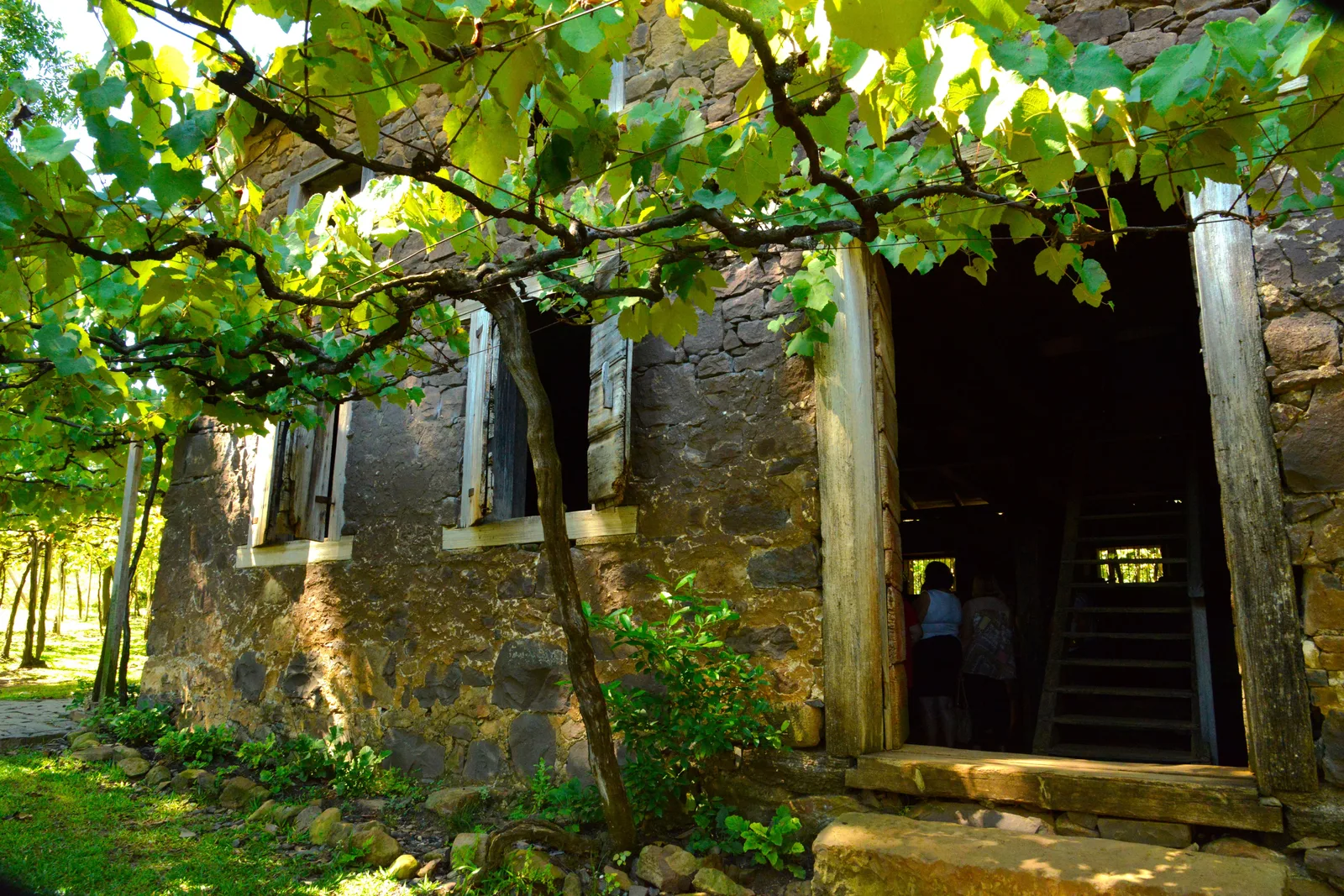
  • The doorway of an old stone house on the Caminhos de Pedra, a grapevine trained over the front and sunlight on the rough stone wall

    São Pedro district, Bento Gonçalves · two hours

    The Caminhos de Pedra

    Twelve kilometers of road lined with the basalt houses, cantinas and workshops of the Italian settlers, run since 1992 by their descendants and declared state heritage in 2009. About 30 stops sell wine, cheese, pasta and crafts. The stone cantina of the Strapazzon family dates to around 1880.

Where to stay

Gramado or Canela, and which end of Gramado.

Base yourself in one town and visit the other: the centers are about 8 kilometers apart. Gramado has the restaurants, the shops and the Natal Luz shows on its doorstep; Canela is bigger, a little cheaper-feeling and closer to the Caracol waterfall. Do not sleep in the Vale dos Vinhedos for this trip. It is about two hours each way, and it works best as one long day out with a driver.

Drag and zoom to explore.

Tap an area to open it and see it on the map

  • Our pick

    Best for: Walking to everything

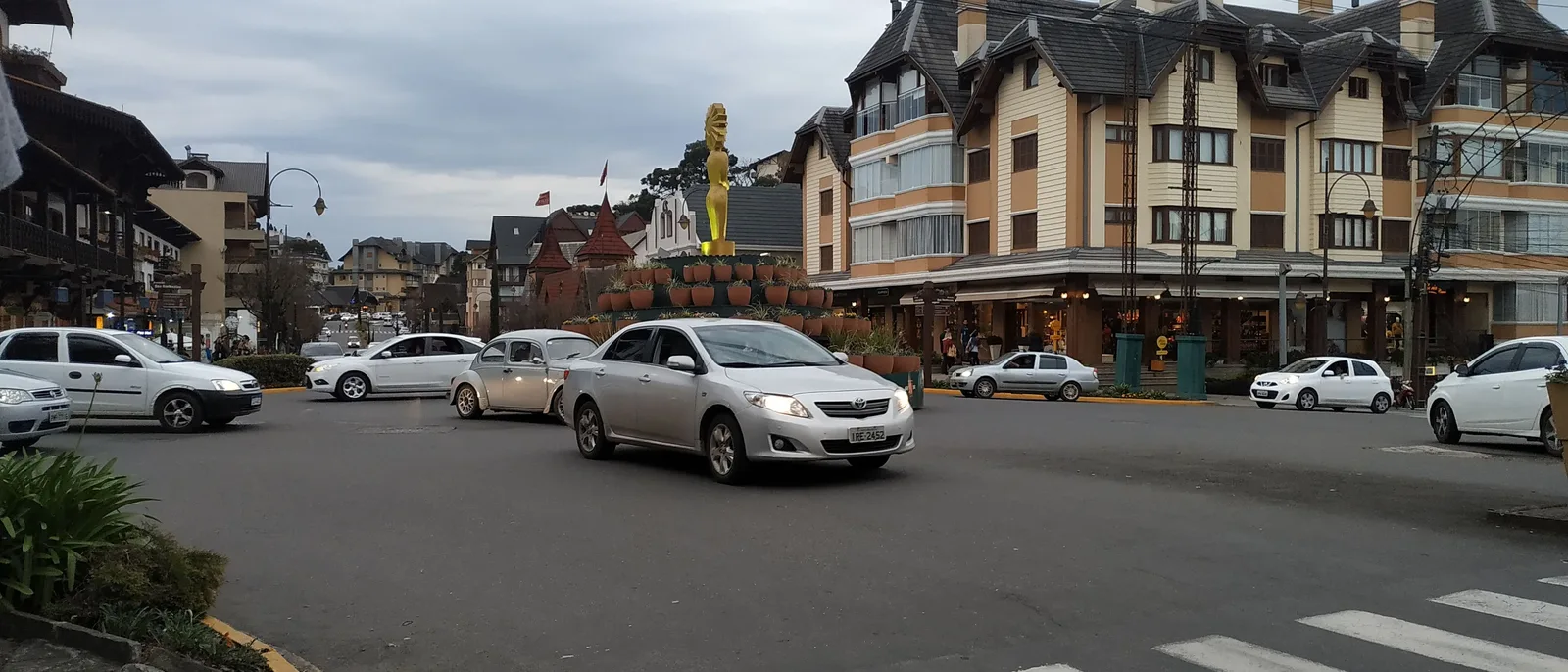
    A corner of the Avenida Borges de Medeiros in central Gramado on a gray day: cars at an intersection in front of a tall half-timbered apartment building and a golden statue on a flowerbed

    The blocks around the Rua Coberta, the Avenida Borges de Medeiros and the Igreja São Pedro. Restaurants, chocolate shops, the Palácio dos Festivais and the Natal Luz stages are all on foot, and the Lago Negro is about 2 kilometers away. It is the busiest and usually the most expensive part of the Serra, and in Natal Luz season the streets are crowded until late. Take it if you want to park the car and forget it.

    • Walk everywhere
    • Most restaurants
    • Natal Luz on the doorstep
    • Busiest
  • Best for: Quieter nights, still in Gramado

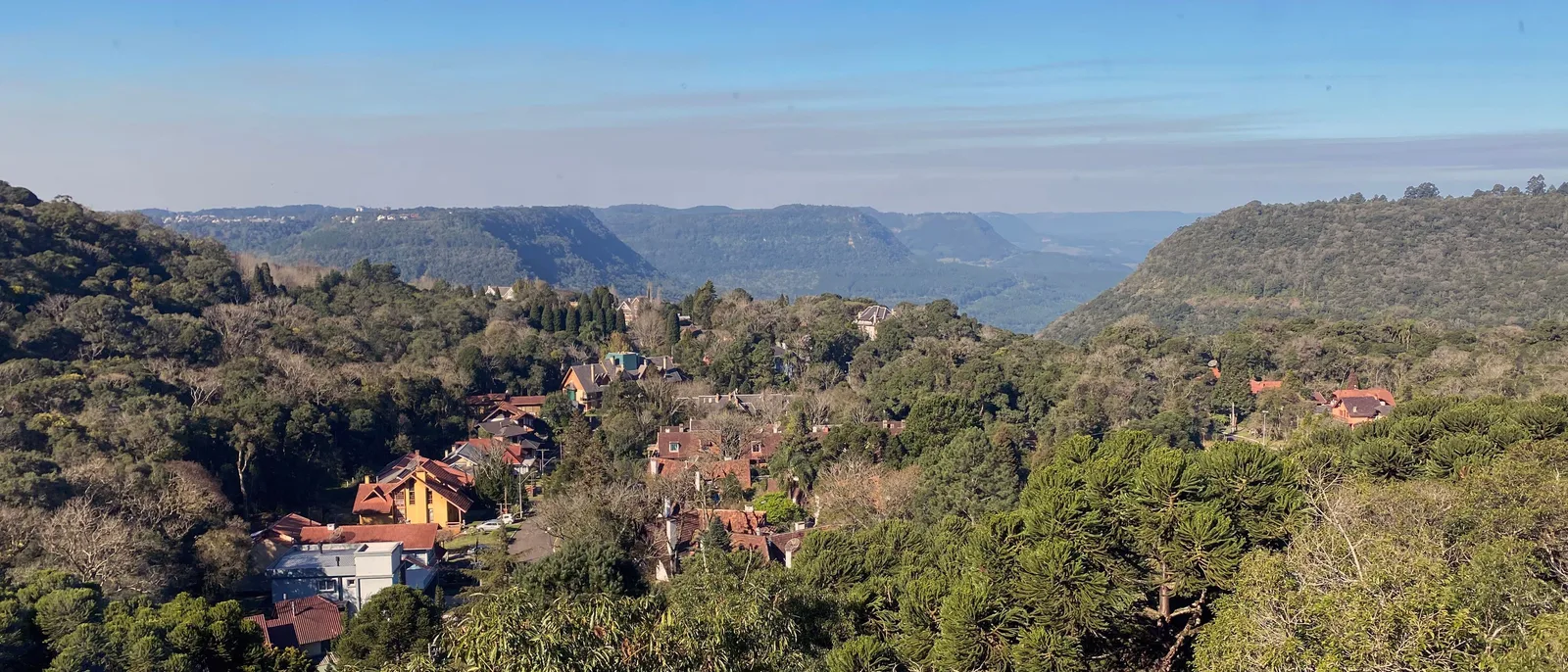
    Houses with steep red roofs among dense trees in Gramado’s Planalto district, with the long ridges of the Vale do Quilombo fading into haze behind

    The neighborhood south of the center, around the Lago Negro, where streets of houses and smaller hotels sit among the trees and some look out over the Vale do Quilombo. The center is a walk or a very short drive away, and the evenings are much quieter. You give up being able to stroll out to dinner in a minute. A car, or a willingness to walk uphill, helps.

    • Quieter
    • Near the Lago Negro
    • Valley views
    • Short walk to the center
  • Best for: The waterfall, the forest and a real town

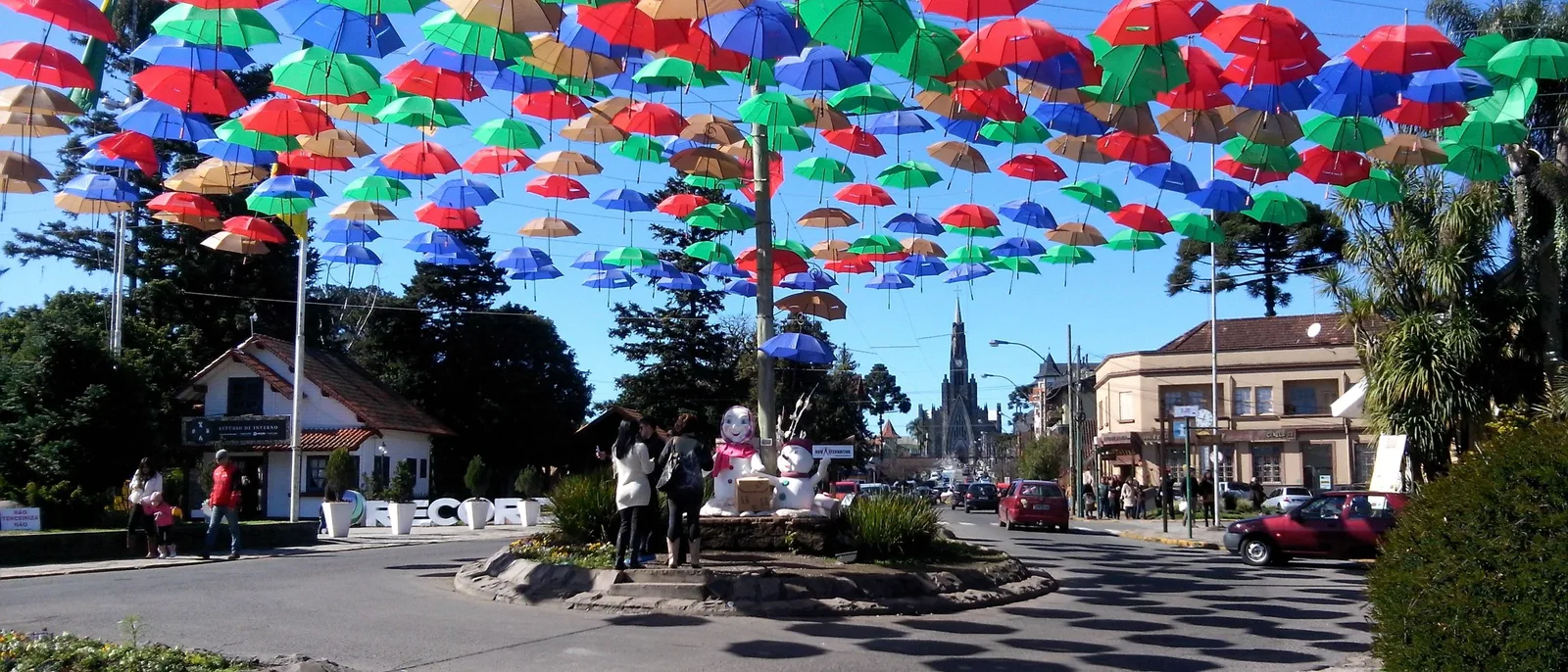
    A square in central Canela under a canopy of colored umbrellas strung overhead, with the spire of the Catedral de Pedra rising at the end of the street

    The streets around the Catedral de Pedra. Canela is the bigger town and feels more like a place where people live, and it is the closer town to the Parque do Caracol (about 9 kilometers by road), the Bondinhos and the Floresta Nacional. The cathedral’s light show is on your doorstep every night. Fewer restaurants than Gramado, and Gramado’s shows are a drive away.

    • Closest to Caracol
    • Cathedral square
    • Calmer
    • Car useful

A working plan

Four days, two towns and a wine valley.

Three nights covers both towns; four adds the wine valley. Add a fifth if you want a Natal Luz show or a paid park. The wine day is last so it can move if the weather is bad.

  1. 01
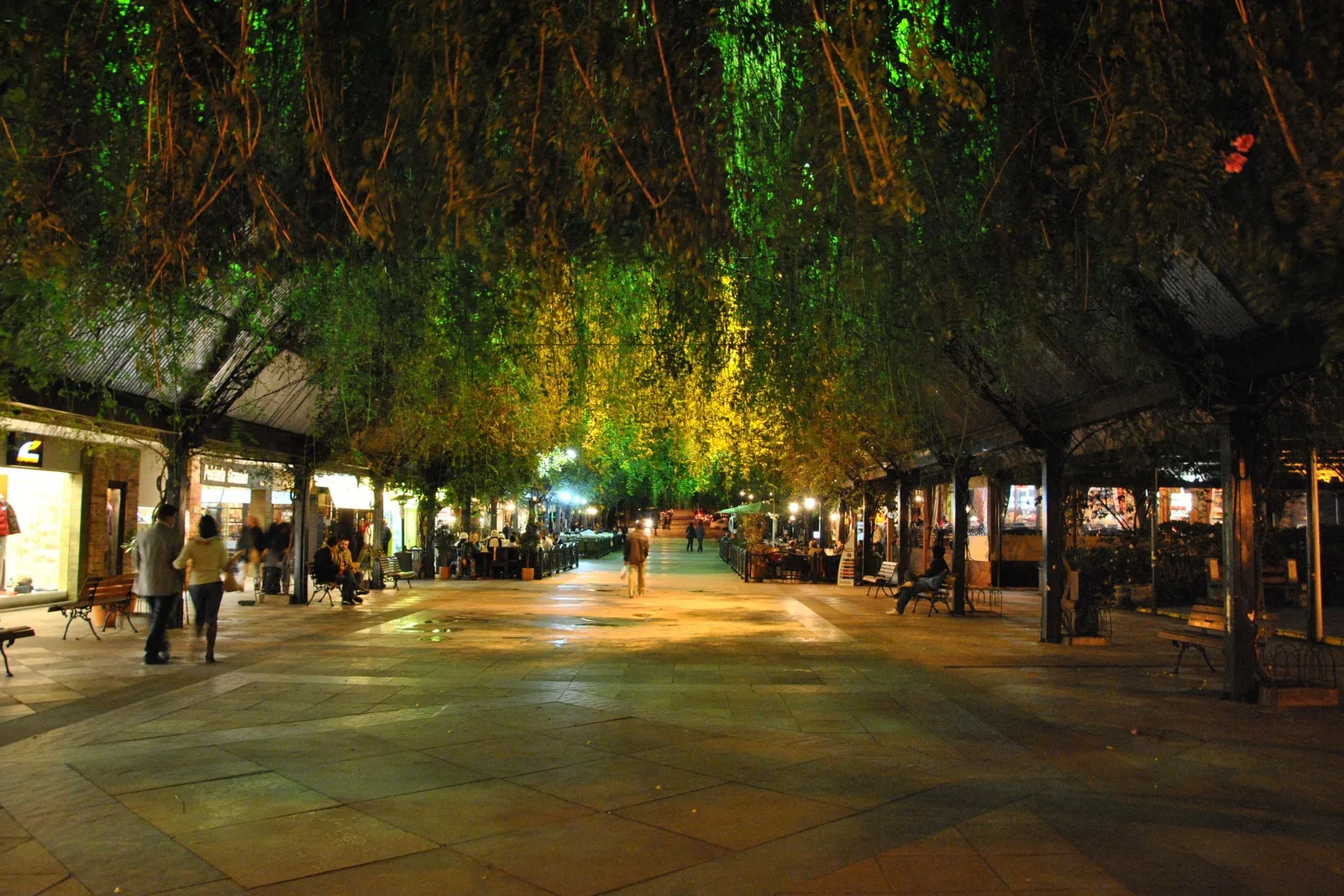
    A pedestrian street in Gramado at night under a canopy of hanging vines lit green and gold, with covered walkways and lit shopfronts along both sides

    Porto Alegre to Gramado

    Up from Porto Alegre

    On the November 2026 schedule, an overnight flight that lands in São Paulo by about 7:30am makes LATAM’s 10:35am connection, in Porto Alegre at 12:15pm, and Citral’s 2:15pm bus has you in Gramado at 4:30pm. Land later and the 1:35pm flight reaches Porto Alegre at 3:20pm, in time for the 5:15pm or 6:15pm bus and Gramado between 7:45pm and 8:15pm. Check in, then walk the Rua Coberta and the Borges after dark.

  2. 02
    The Lago Negro in bright sunshine from among hydrangea leaves, tall conifers on both banks and a few swan pedal boats far out on the water

    Lago Negro, the Borges & the Belvedere

    Gramado on foot

    The Lago Negro early, before the crowds, then up through the center: the Igreja São Pedro, the Borges and the Lago Joaquina Rita Bier. The Belvedere for the late light over the Vale do Quilombo, and fondue for dinner.

  3. 03
    The Caracol waterfall falling from the lip of a long overhanging cliff into a forested gorge, seen across the treetops

    Parque do Caracol & central Canela

    Canela and the Caracol

    The Parque do Caracol at 9:00am opening, then the Bondinhos or the Skyglass for the waterfall from another angle. A café colonial on the way back, and the 8:00pm light show at the Catedral de Pedra.

  4. 04
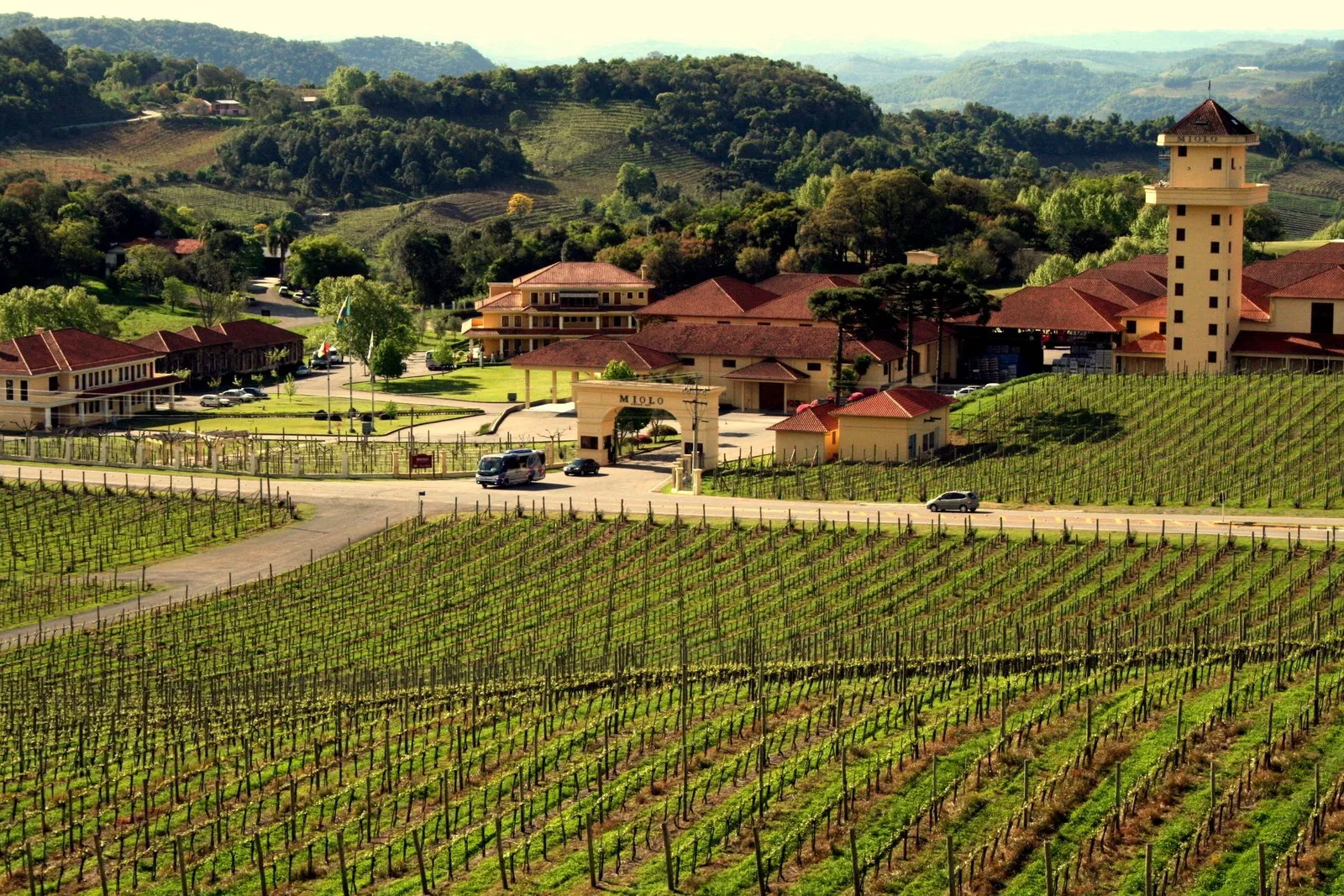
    Rows of vines in the Vale dos Vinhedos in front of the Miolo winery buildings and their tower, with wooded hills behind

    Bento Gonçalves, about two hours west

    The Vale dos Vinhedos

    A full day with a driver or a tour: two wineries in the valley, lunch in a cantina, and the Caminhos de Pedra or the Maria Fumaça steam train. Nobody in the car drinks and drives.

This is a starting shape, not a fixed departure — we rearrange it around your dates. Have it built for you

Timing

Rain all year, so choose your temperature.

There is no dry season here. At INMET’s Canela weather station, between Gramado and Canela, every month of the year gets between about 155 and 235 mm of rain, on 10 to 14 days. So the real choice is warmth. Summer afternoons reach the mid-20s Celsius. Winter afternoons stay in the mid-teens, nights drop to 8°C, and fog and the odd frost come with them. March and April sit in between, mild and among the driest months of the year.

Rainfall, rain days, air temperature and UV for Gramado and Canela, month by month. Choose a month to see what the weather is doing then.

January

Good
Air
16–26°C 61–79°F
UV
10 Very high
Rain
14 days 209 mm / 8.2 in

The warmest stretch and the most rain days of the year. Natal Luz runs to the middle of the month.

February

Good
Air
17–26°C 63–79°F
UV
10 Very high
Rain
12 days 180 mm / 7.1 in

As warm as January with fewer wet days. Hydrangeas still in flower around the Lago Negro.

March

Best
Air
15–24°C 59–75°F
UV
8 Very high
Rain
11 days 170 mm / 6.7 in

Warm days, cooler nights, and one of the drier months. The last of the grape harvest in the Vale dos Vinhedos.

April

Best
Air
13–21°C 55–70°F
UV
6 High
Rain
11 days 155 mm / 6.1 in

The driest month at the Canela station and the fewest rain days. Mild by day, cool enough at night for a fire.

May

Good
Air
10–18°C 50–64°F
UV
4 Moderate
Rain
12 days 210 mm / 8.3 in

Autumn proper: highs of 18°C, nights near 10, and the fog starting to settle in.

June

Trade-offs
Air
8–16°C 46–61°F
UV
3 Moderate
Rain
12 days 233 mm / 9.2 in

Cold and often gray, with about 195 to 233 mm depending on how the station’s gaps are counted.

July

Trade-offs
Air
8–17°C 46–63°F
UV
3 Moderate
Rain
11 days 194 mm / 7.6 in

The coldest nights of the year and the most frosty mornings. Fondue weather, with the fog that comes with it.

August

Good
Air
9–19°C 48–66°F
UV
4 Moderate
Rain
11 days 184 mm / 7.2 in

Still cold at night but brighter by day. The Festival de Cinema fills Gramado in the middle of the month.

September

Trade-offs
Air
10–20°C 50–68°F
UV
6 High
Rain
12 days 196 mm / 7.7 in

Spring arriving slowly: cool, often cloudy, and frost now rare.

October

Trade-offs
Air
11–21°C 52–70°F
UV
8 Very high
Rain
14 days 225 mm / 8.9 in

The wettest and grayest month of spring. Natal Luz opens in Gramado on 22 October 2026.

November

Good
Air
13–23°C 55–73°F
UV
9 Very high
Rain
11 days 193 mm / 7.6 in

Warming up, with fewer wet days than October and Natal Luz lighting the streets.

December

Good
Air
15–25°C 59–77°F
UV
10 Very high
Rain
13 days 169 mm / 6.7 in

Warm, one of the drier months by total, and Natal Luz at full strength through the holidays.

  • Best The one or two peak months
  • Good A real recommendation
  • Trade-offs Workable, with a catch
See Gramado & Canela on the Brazil calendar

UV is the monthly average of the daily peak, 2022 to 2025, calculated from Copernicus Atmosphere Monitoring Service data. Weather data by Open-Meteo.com, CC BY 4.0.

For mild, settled days

March–April

Highs of 21 to 24°C and nights of 13 to 15. April is the driest month at the Canela station, about 155 mm on 10 or 11 days, and March is close behind. The grape harvest in the Vale dos Vinhedos ends in March.

For the cold

June–August

Highs of 16 to 19°C, nights around 8 to 9, and the screen temperature at the station falls to freezing on about one morning a month. Fog is part of the deal. Snow is rare: most winters have no real snowfall.

The wettest month

October

October averages about 220 to 225 mm on 13 or 14 rain days at the Canela station, and it is the one month that ranks among the wettest however the station’s gaps are counted. It does not stop a trip, but plan indoor afternoons.

About the rain

The Serra has no dry season, and that surprises people who know Brazil from Rio or the northeast. On INMET’s automatic station at Canela, every month from 2009 to 2025 averaged between about 155 and 235 mm of rain, and every month had rain on between 10 and 14 days. The year-to-year swings are bigger than the gaps between months: one May brought 745 mm, and one March only 37. So no month is a safe bet for sun and none is a washout.

What does change through the year is temperature, and with it the kind of trip you get. From December to March afternoons reach 24 to 26°C. From June to August they stay at 16 to 19°C, nights fall to 8 or 9, and on about one morning a month the station’s thermometer reaches freezing. Fog can come in any month, and when it does it can sit on the streets all day. Pack layers whatever the season.
The dates worth planning around

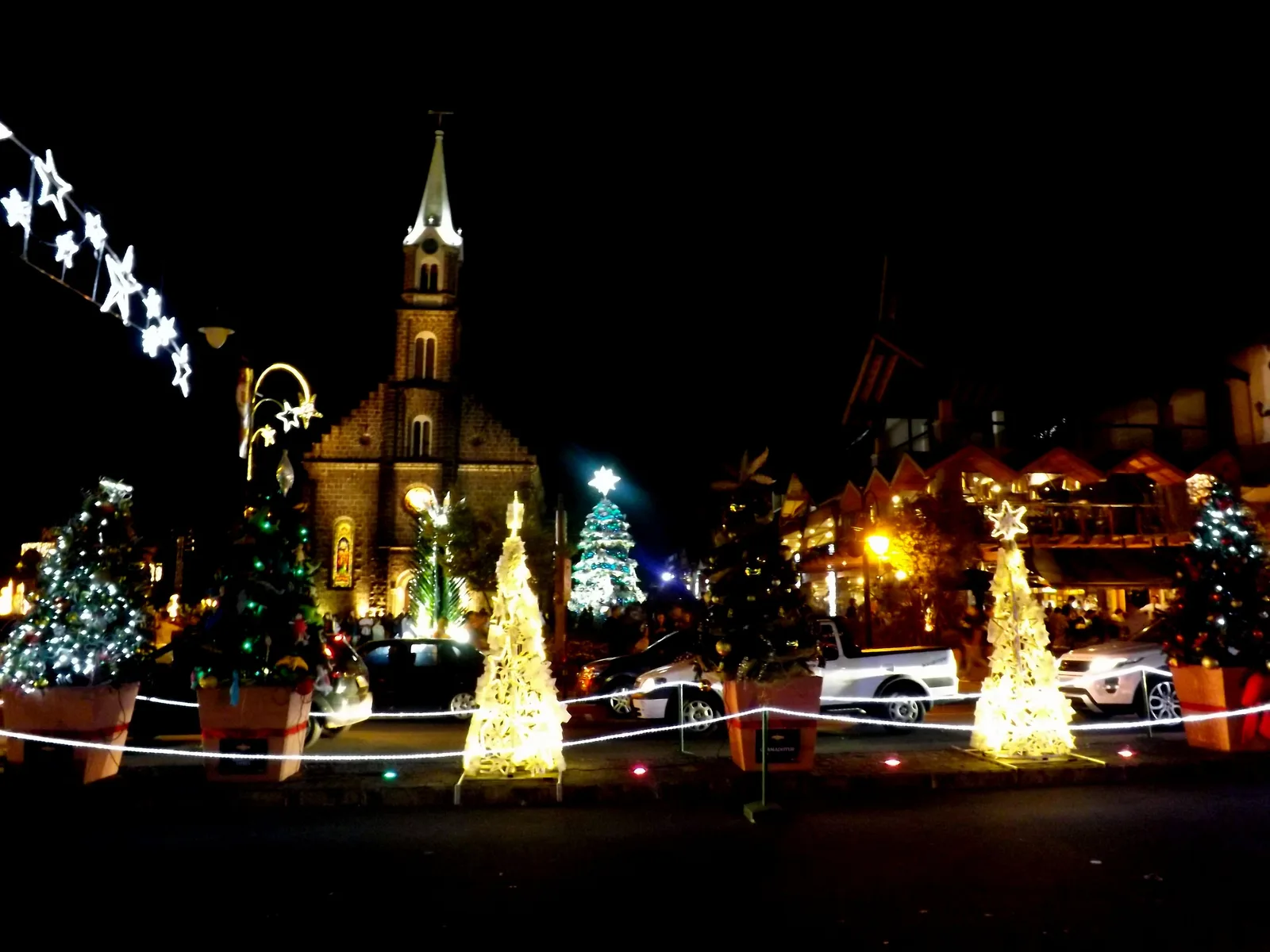
Gramado’s Igreja São Pedro at night during Natal Luz, its tower lit, with illuminated Christmas trees and strings of lights in the square in front

Natal Luz

22 October 2026 to 17 January 2027

Gramado’s Christmas festival runs 88 days and is in its 41st edition. Much of it is free: the decorated streets, the Christmas village on the Praça das Etnias and the 8:00pm lighting show at the Palácio dos Festivais, both daily until 10 January, the Friday-to-Sunday parades at 3:00pm and the shows on the Rua Coberta. The big shows are ticketed and priced like concerts: the Grande Desfile de Natal, indoors at Expogramado this year, is $82–102 (R$420–520) a seat, and Nativitaten, the nativity on the water, is at Serra Park this year and costs $71–102 (R$360–520).

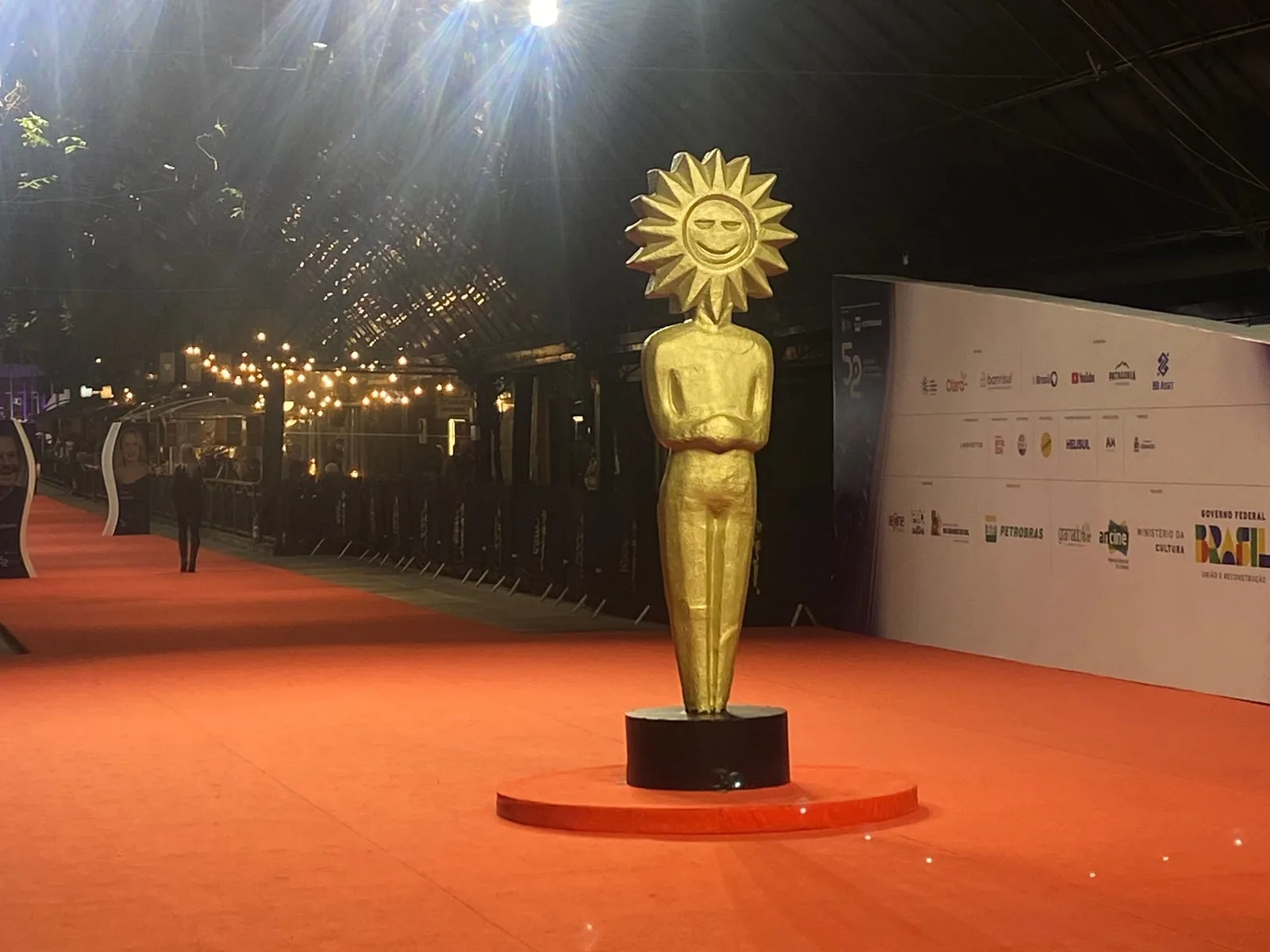
A tall golden Kikito, the sun-headed statuette created by the artisan Elisabeth Rosenfeld, standing on the red carpet at the entrance to the Gramado film festival, lights strung overhead

Festival de Cinema de Gramado

Every August; the 54th edition ran 12 to 22 August 2026

One of Brazil’s most important film festivals, held since 1973, now at the Palácio dos Festivais on the Borges, with its winners handed the Kikito statuette. The 2026 edition showed 96 films in ten sections. The 2027 dates are not announced yet. Rooms in central Gramado fill for it, so book early if you are coming in August.
White frost on the boards, a bench and the wooden railings of a lakeside deck at the Lago Joaquina Rita Bier on a sunny morning, with tall pines and a red-roofed building across the water

The winter cold

June to August

Not an event, but a season. Nights fall to single digits Celsius and frost whitens the lakeside decks. Snow is another matter. The private weather service MetSul calls snow like Gramado’s of 28 July 2021 very uncommon and says most winters have no real snowfall. Before that, the big ones were August 2013 and July 1994. Come for the cold, the fog and the fireplaces, and treat snow as a bonus.

Good to know

Before you come

Should I stay in Gramado or Canela? +

Gramado, if this is your first visit and you want to walk out of the hotel to dinner: the restaurants, chocolate shops and Natal Luz stages are all in its center. Canela, if you care more about the Caracol waterfall, the forest trails and a calmer town, or if Gramado is full. The centers are about 8 kilometers apart, so whichever you choose, you will spend a day in the other one.

Will I see snow? +

Almost certainly not. Snow in Gramado and Canela is rare: MetSul, the private weather service, calls a snowfall like 28 July 2021 very uncommon and says the great majority of winters have no big snowfall, naming July 1994 and August 2013 as the comparable falls before it. Since then Gramado has had only traces: a brief shower of snow pellets on 24 June 2025 and freezing rain on 6 September 2026. What you will get from June to August is real cold, fog and frosty mornings.

Is Natal Luz worth planning a trip around? +

If you like Christmas lights, yes, and you do not need to spend much. From 22 October 2026 to 17 January 2027 the streets are decorated, and the Christmas village and the nightly 8:00pm lighting show (both until 10 January), the weekend parades and the Rua Coberta shows are free. The ticketed shows cost $24 to $102 (R$120 to R$520) a seat at full price. The catch is the crowds and the room rates, which are highest on weekends and over the holidays. A weekday in November gets you the lights with the fewest people.

Which paid attractions are worth it? +

Our view: the Parque do Caracol first, and either the Bondinhos or the Skyglass for a second view of the same country. After that it depends on who you travel with. Gramado has a long list of paid parks, from Snowland and Mini Mundo to the wax museum and the car collections, and the four on this page cost $23 to $31 (R$115 to R$156) each. If you have snow at home, we would cut the indoor snow park first. Of the rest, we would pick Mundo a Vapor and the Reino do Chocolate’s history tour as the most particular to the place.

Can I do the wine valley without driving? +

Yes, and you should. Brazil’s traffic code penalizes any measurable alcohol at the wheel: a fine of about $575 (R$2,934.70) and a 12-month suspension of the right to drive, and a crime from 0.3 mg per liter of breath. Book a day tour from Gramado or hire a driver. The valley is about two hours each way, the wineries run tours from about 9:00am to 5:00pm, and Casa Valduga and the premium tastings at Miolo need booking ahead.

Free · 29 pages

Free guide

Beginner's Guide to Brazil

A free 29-page guide to everything a first-time visitor should know before landing: visas, safety, money, getting around, where to go, and what to eat.

We'll email you a link to confirm your address. Click it and the guide opens right away.

See what's inside
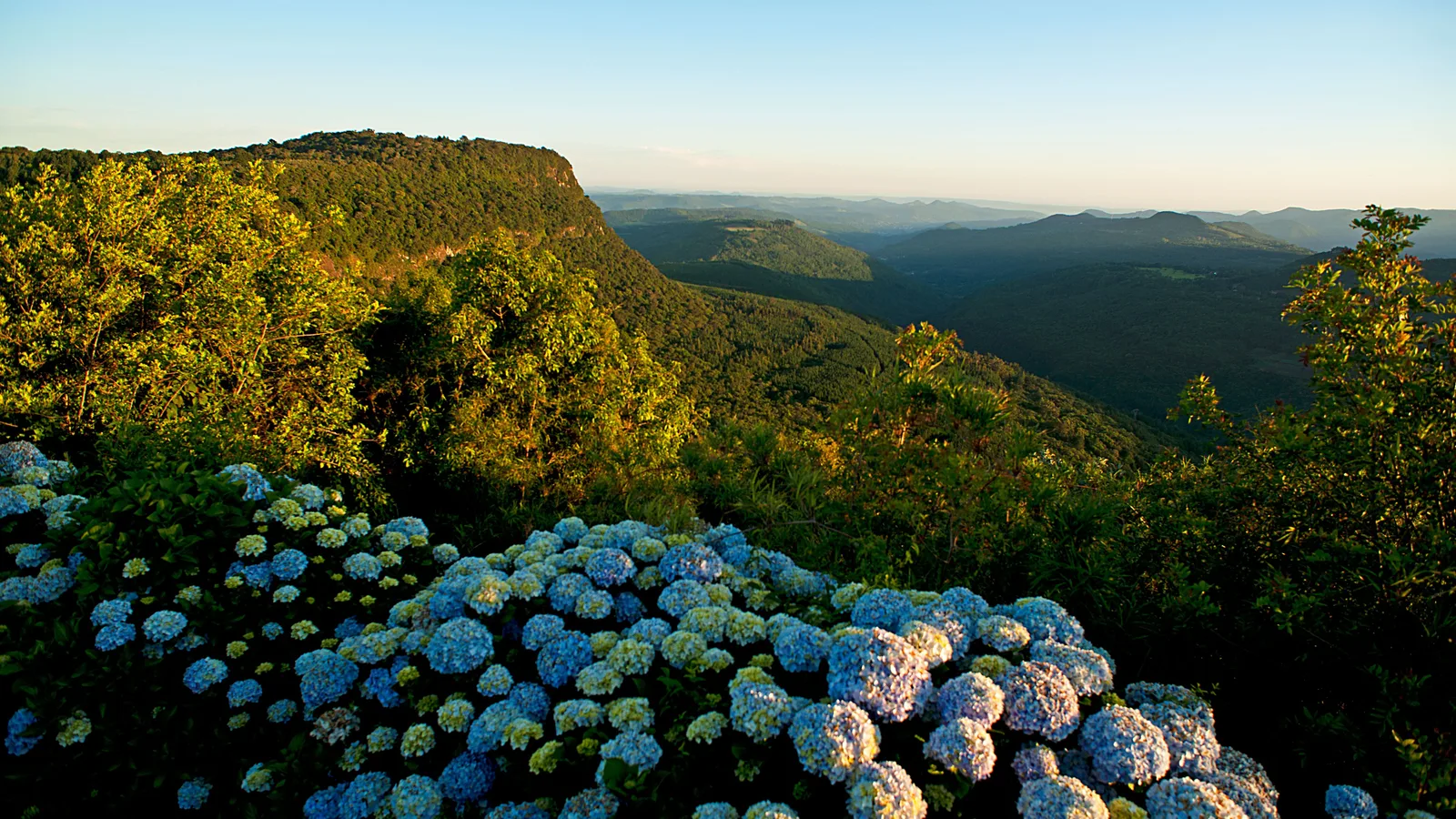
Blue hydrangeas in the foreground of a lookout over a wide valley of forested hills, with a flat-topped ridge lit by late sun and blue hills beyond

Skip the planning

Cold mountains, warm fondue. We’ll plan the trip.

Tell us your dates and we will tell you plainly whether to stay in Gramado or Canela, which paid attractions are worth your money, how to fit in the wine valley without driving, and how to join the Serra to Florianópolis, Iguaçu or Rio.

  • One person, living in Brazil, replying to you directly
  • A reply within one business day, no call center, no bots
  • No cost to plan, and no obligation to book
  • Built around your dates, not a fixed departure