Skip to content
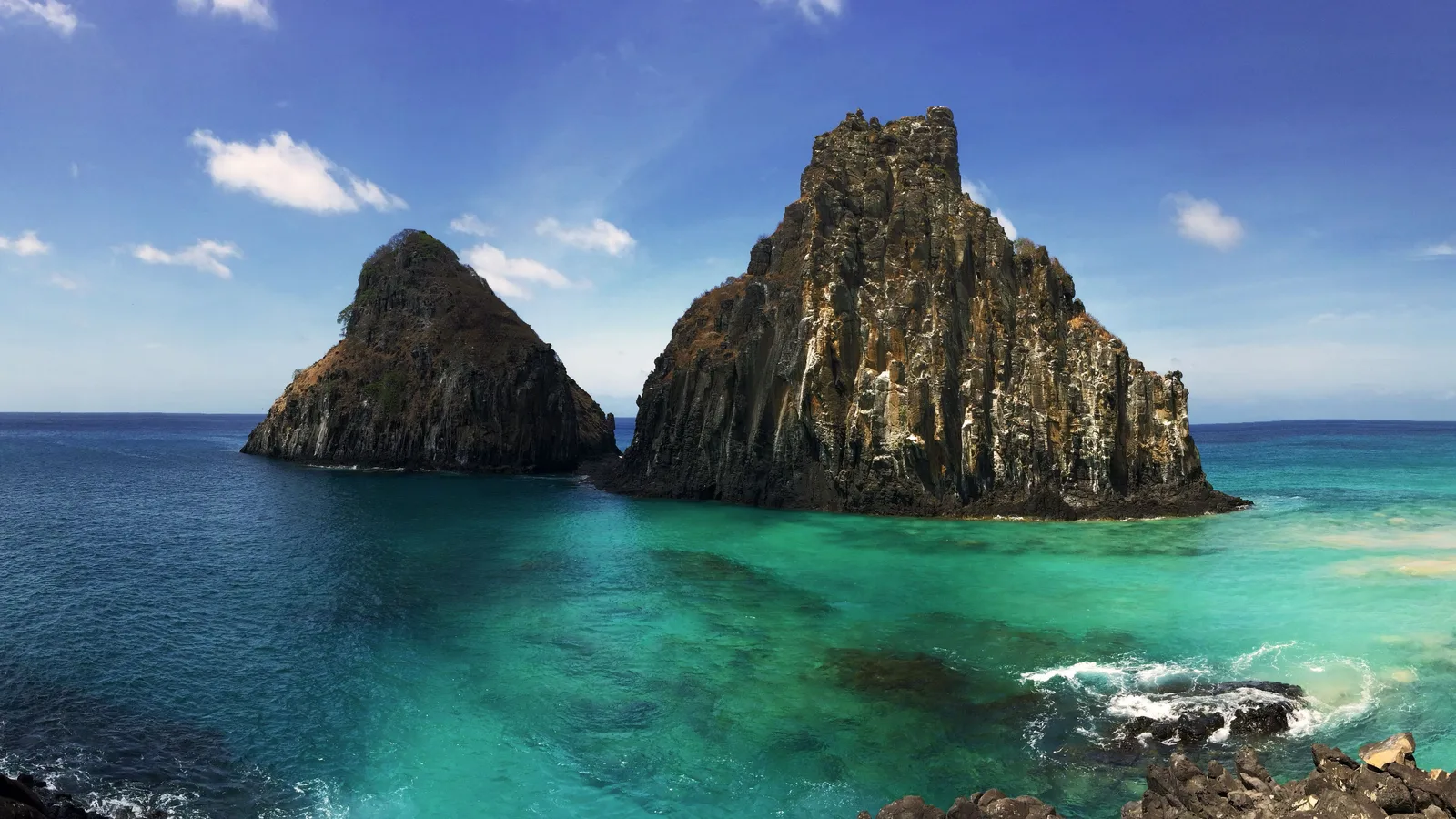
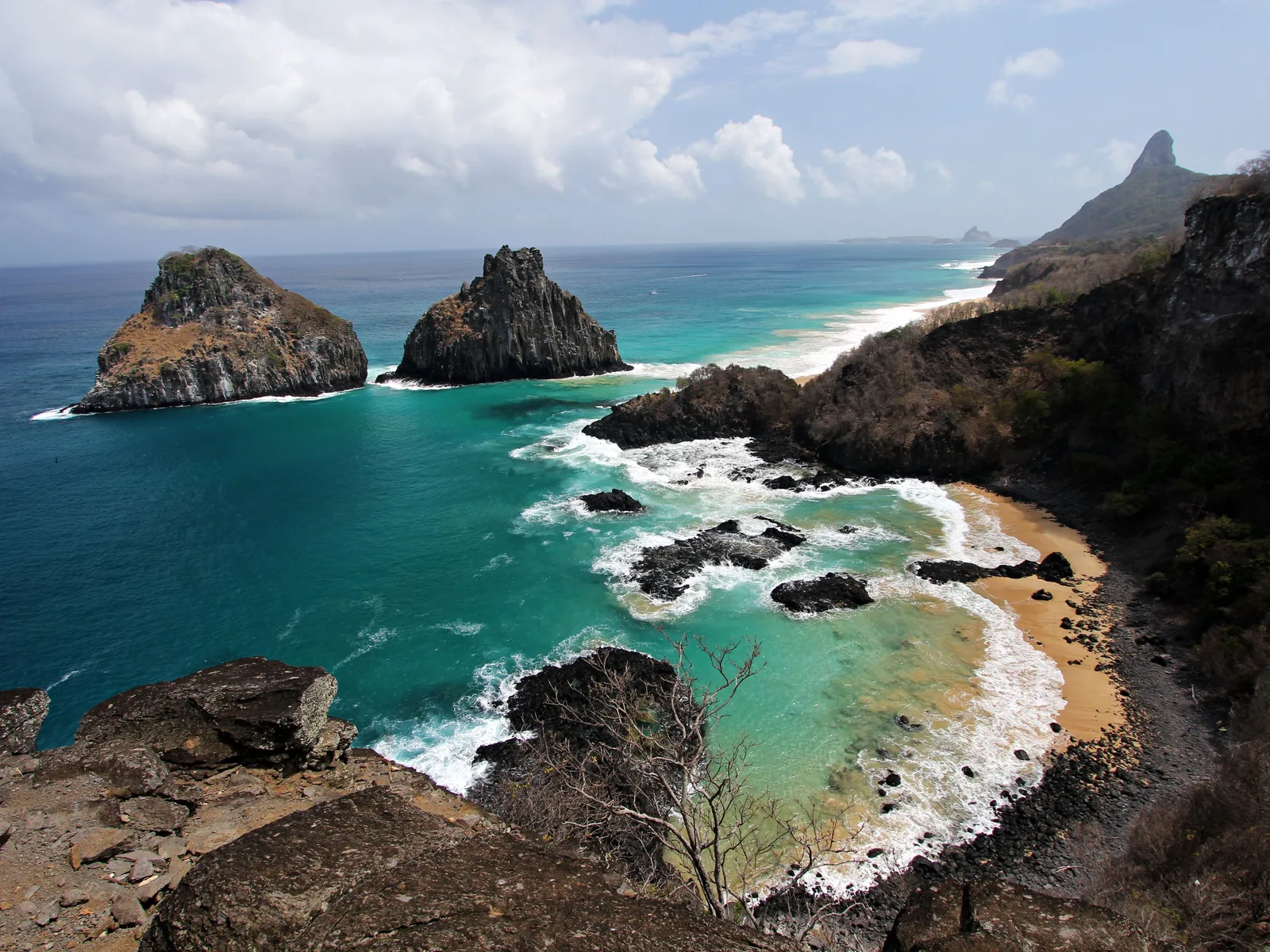
The twin volcanic peaks of Morro Dois Irmãos rising straight out of clear turquoise water at Baía dos Porcos, with dark rock breaking the surface in the foreground and open blue sea behind

Pernambuco

Fernando de Noronha

Brazil caps the number of people who can be here, and taxes every day you stay. Two people, one week: about $414 in fees before a bed or a meal.

Last checked October 2026

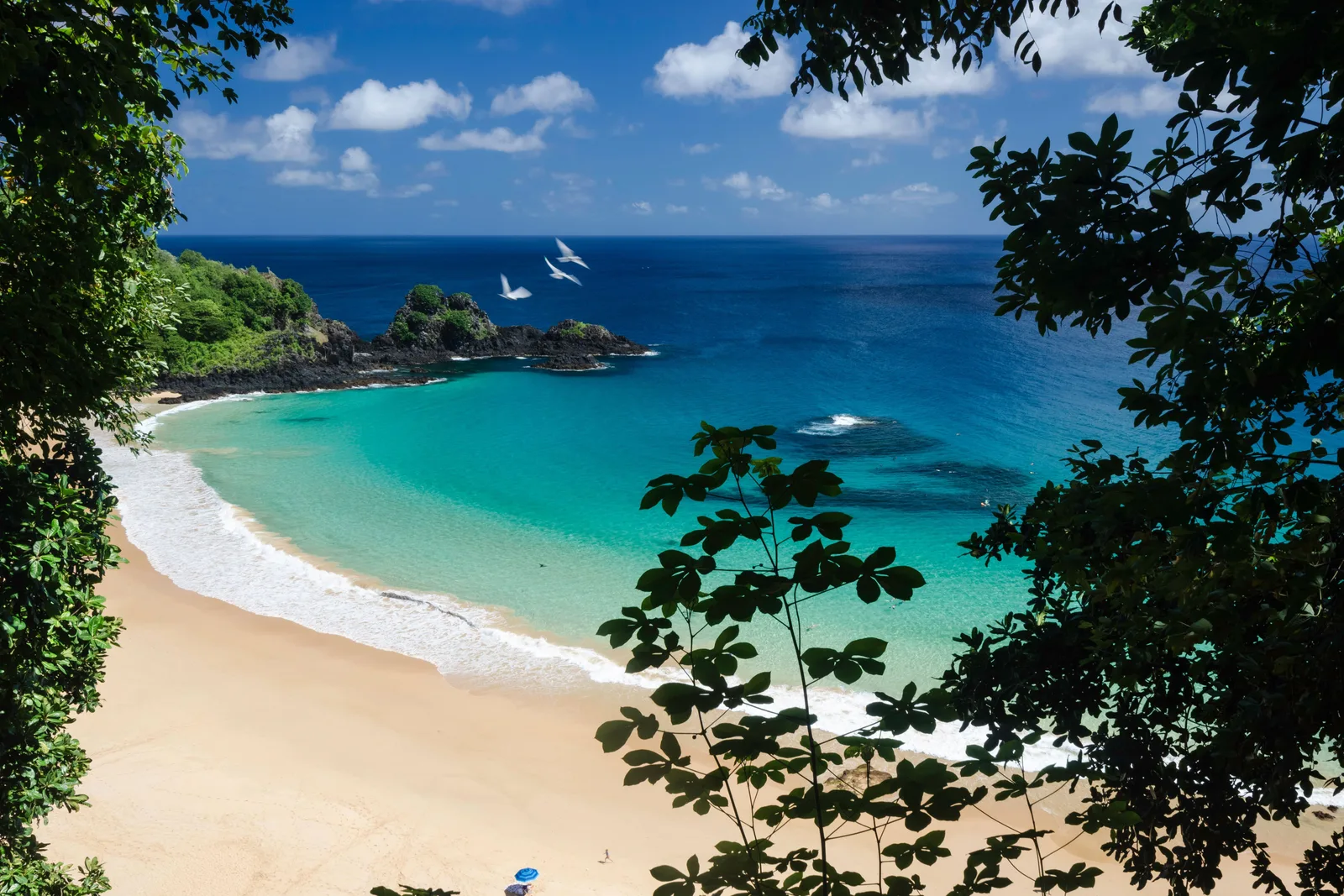
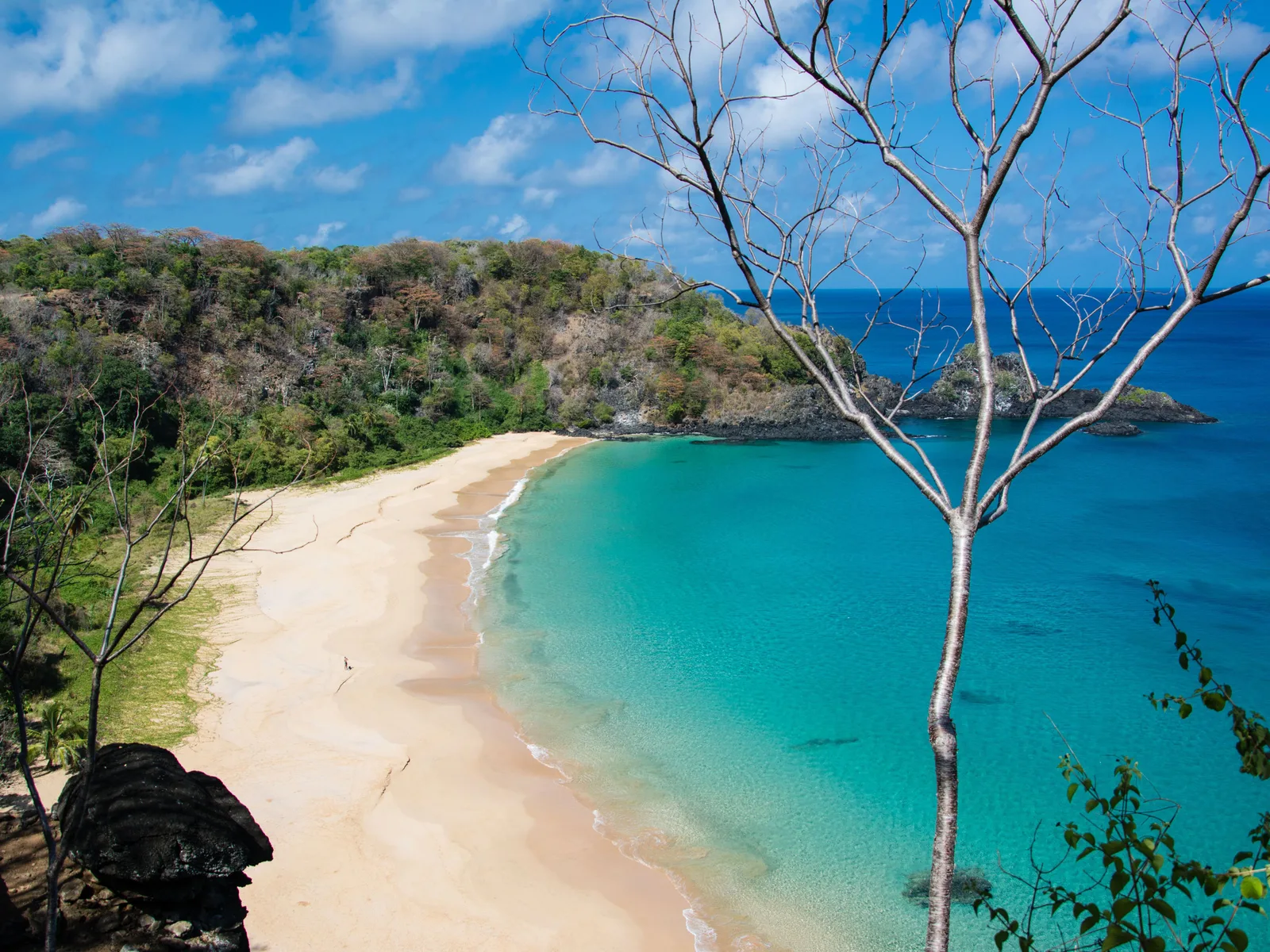
  • The crescent beach at Baía do Sancho framed by leaves and branches, with pale sand, shallow green water, three white seabirds in flight over the bay and a single blue parasol down on the sand
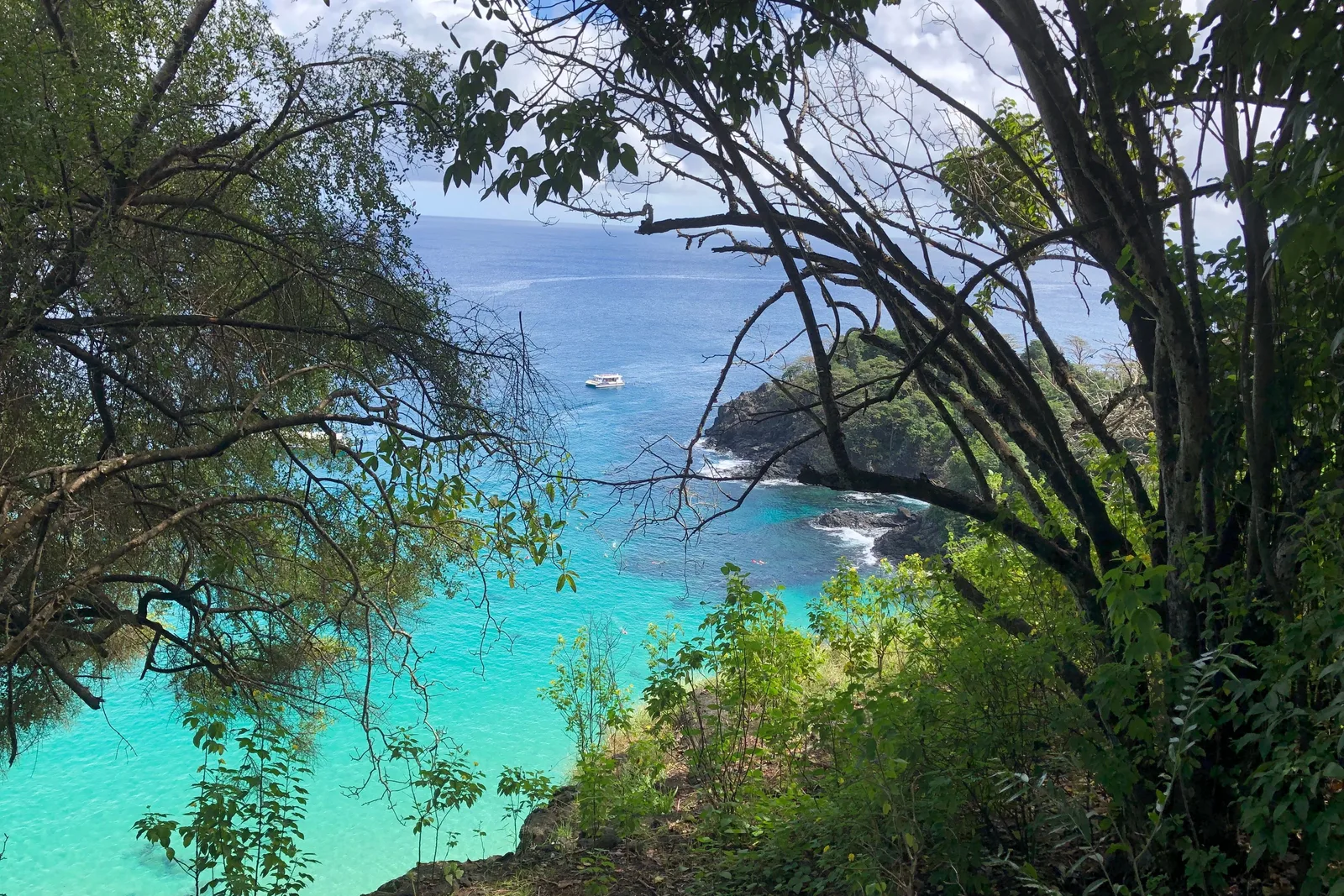
  • Bright turquoise water seen from a wooded clifftop above Baía do Sancho, through the trunks and leaves of the trees along the rim
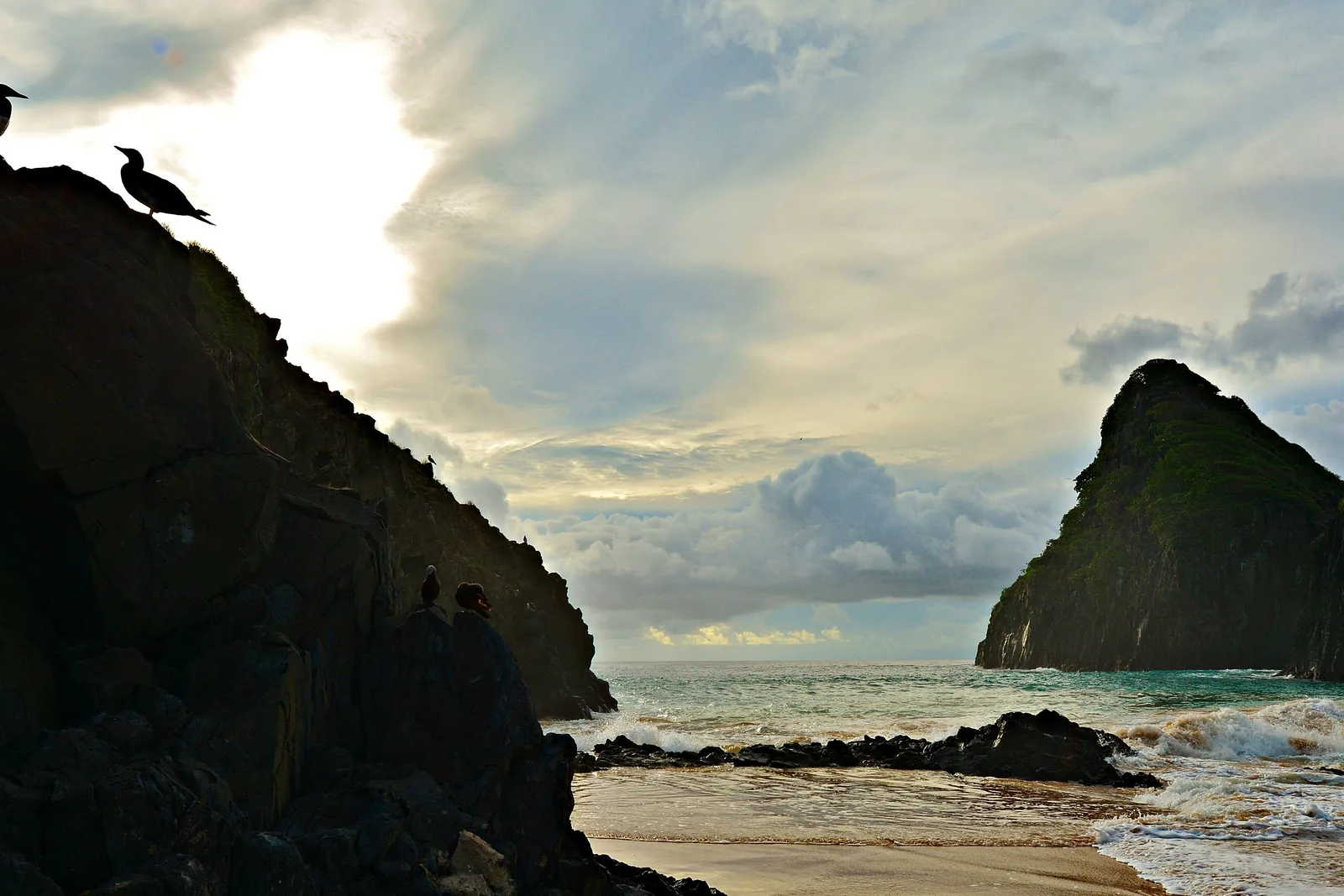
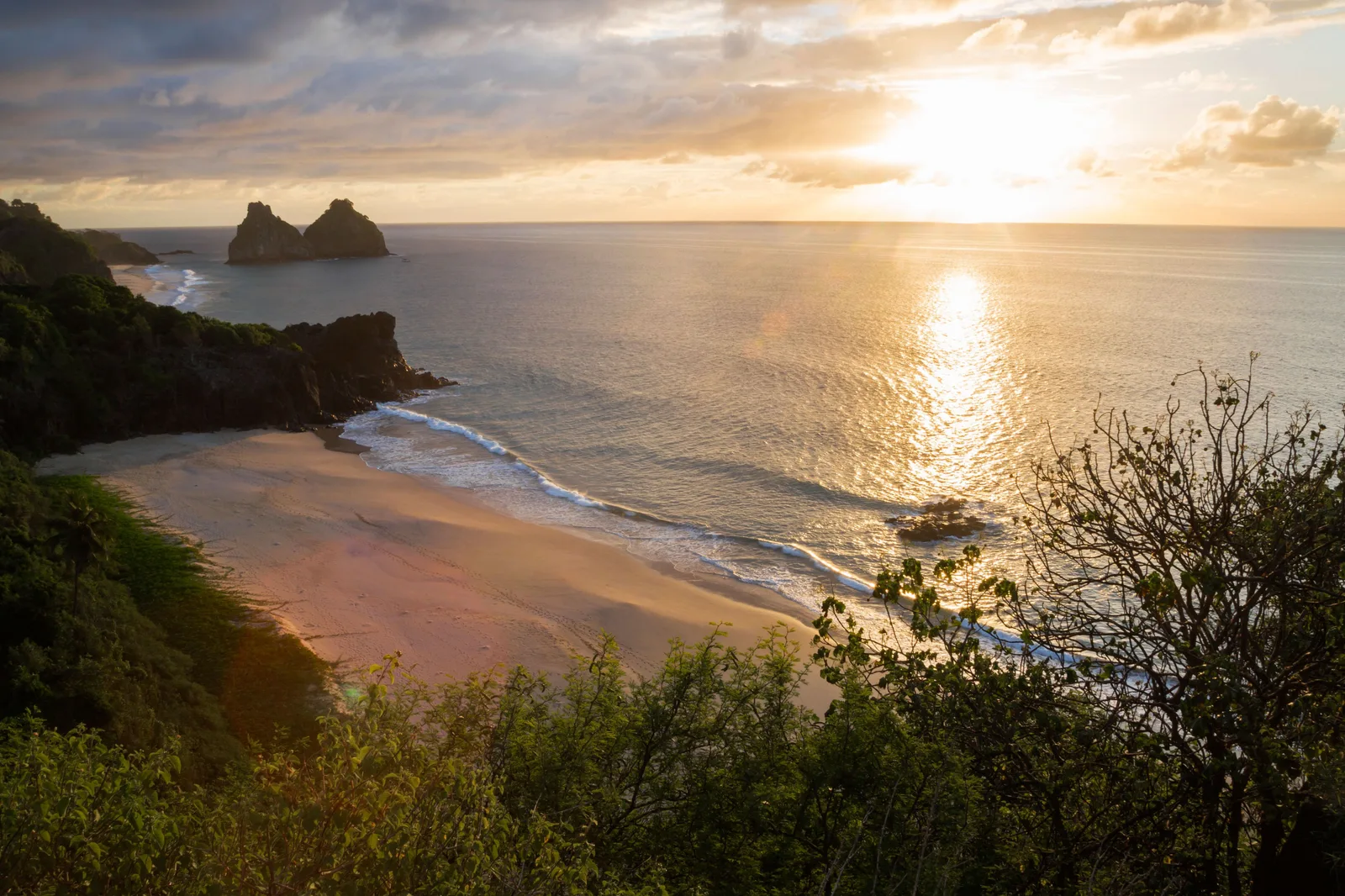
  • Birds on a dark rock in silhouette at Cacimba do Padre, two on the skyline and two lower down with two people sitting beside them, and a single peak of Morro Dois Irmãos on the right against a bank of backlit cloud
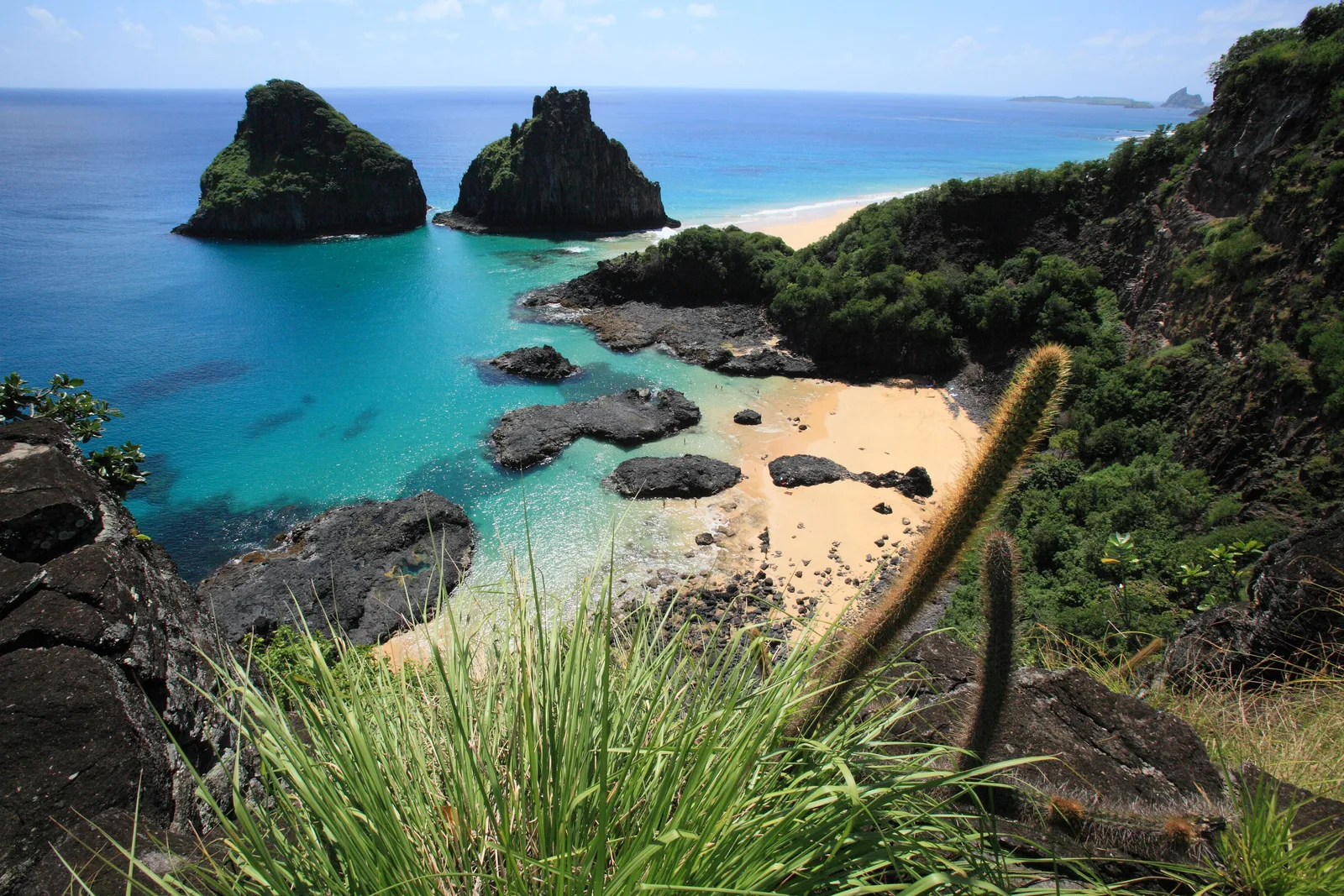
  • Baía dos Porcos from the clifftop path: coarse grass in the foreground, black volcanic rock, a small strip of sand and the twin peaks of Morro Dois Irmãos standing in blue-green water
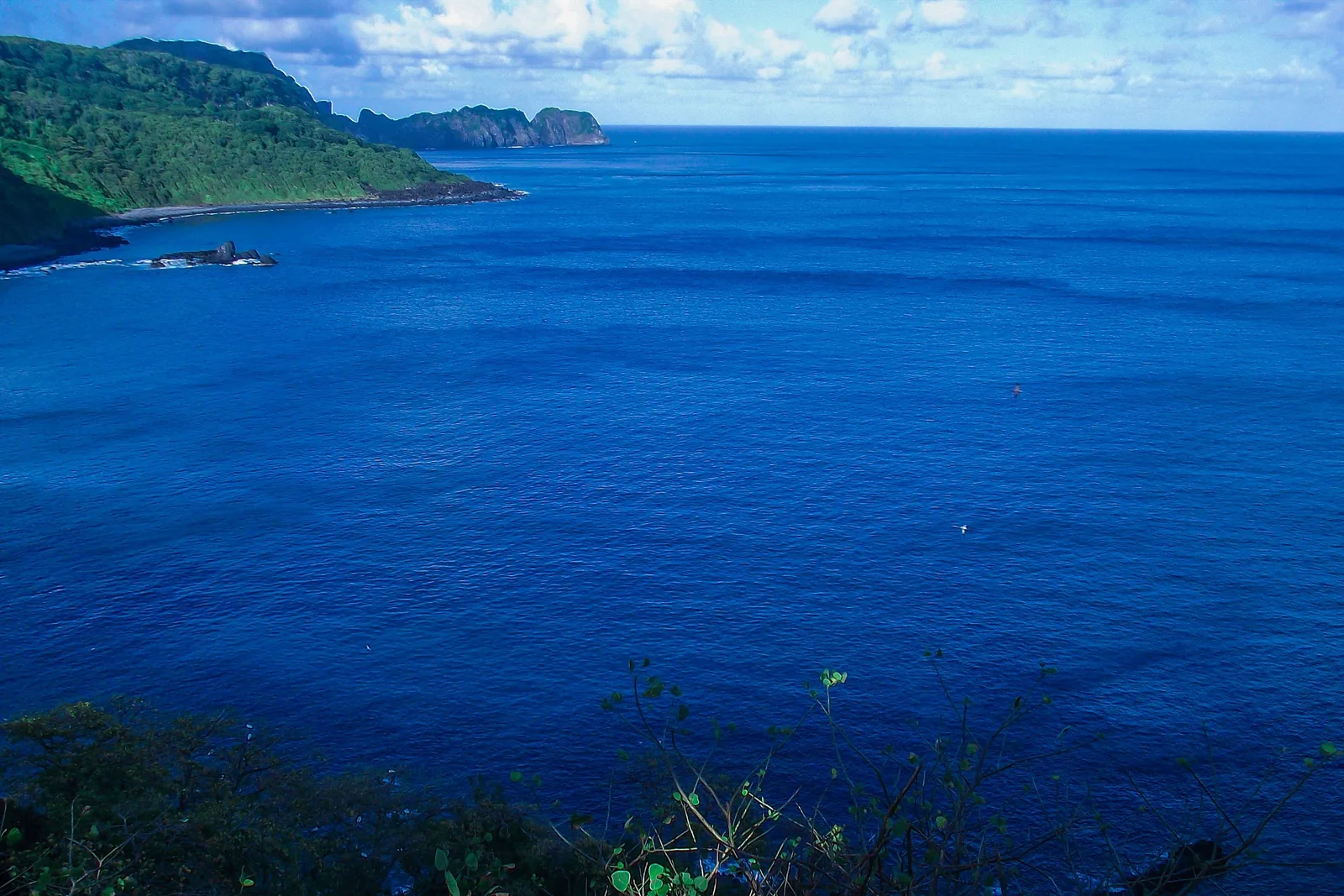
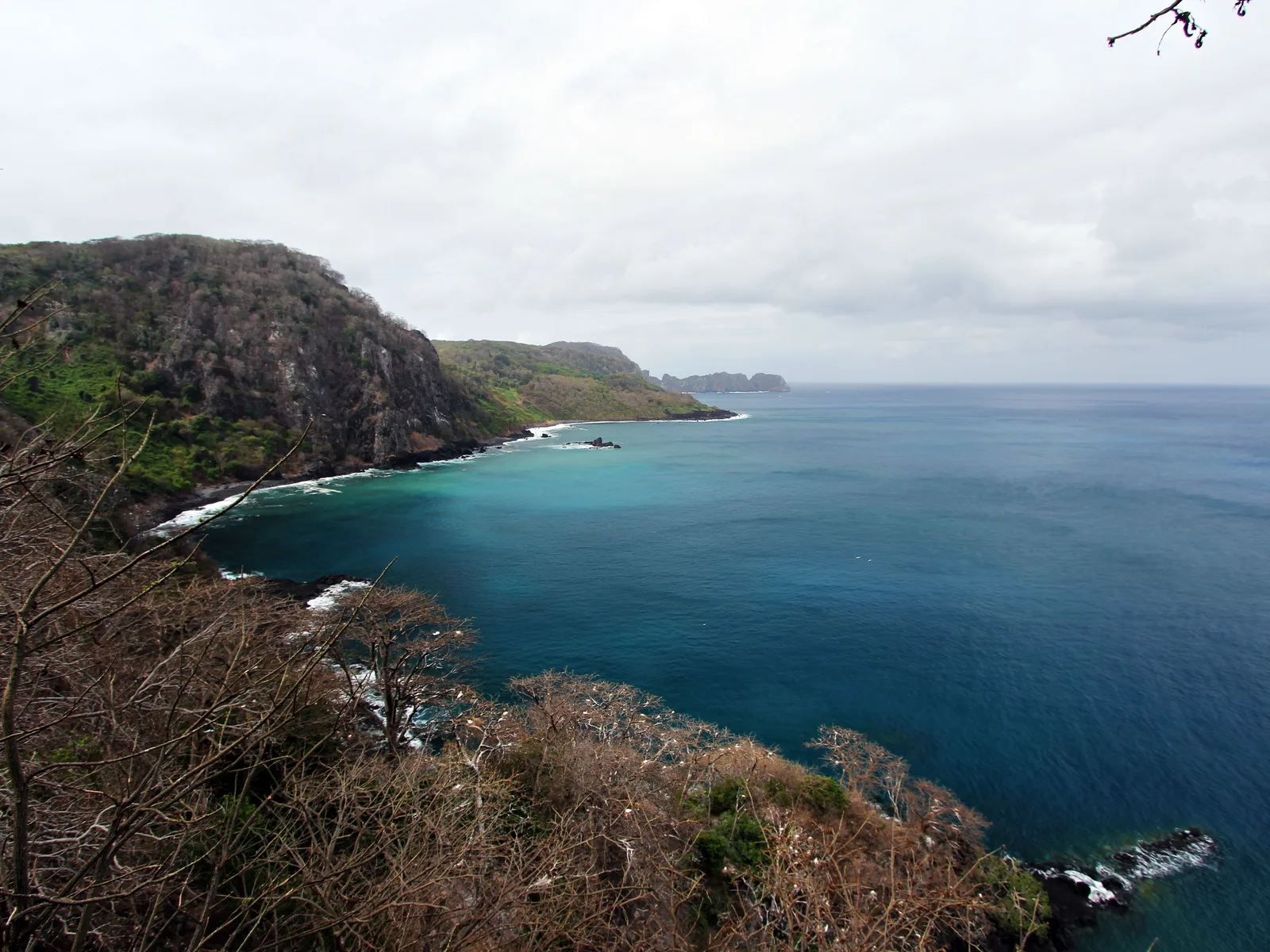
  • Deep blue open ocean seen from high on the cliffs near the dolphin viewpoint, with a wooded headland running out to the left and low islands on the horizon
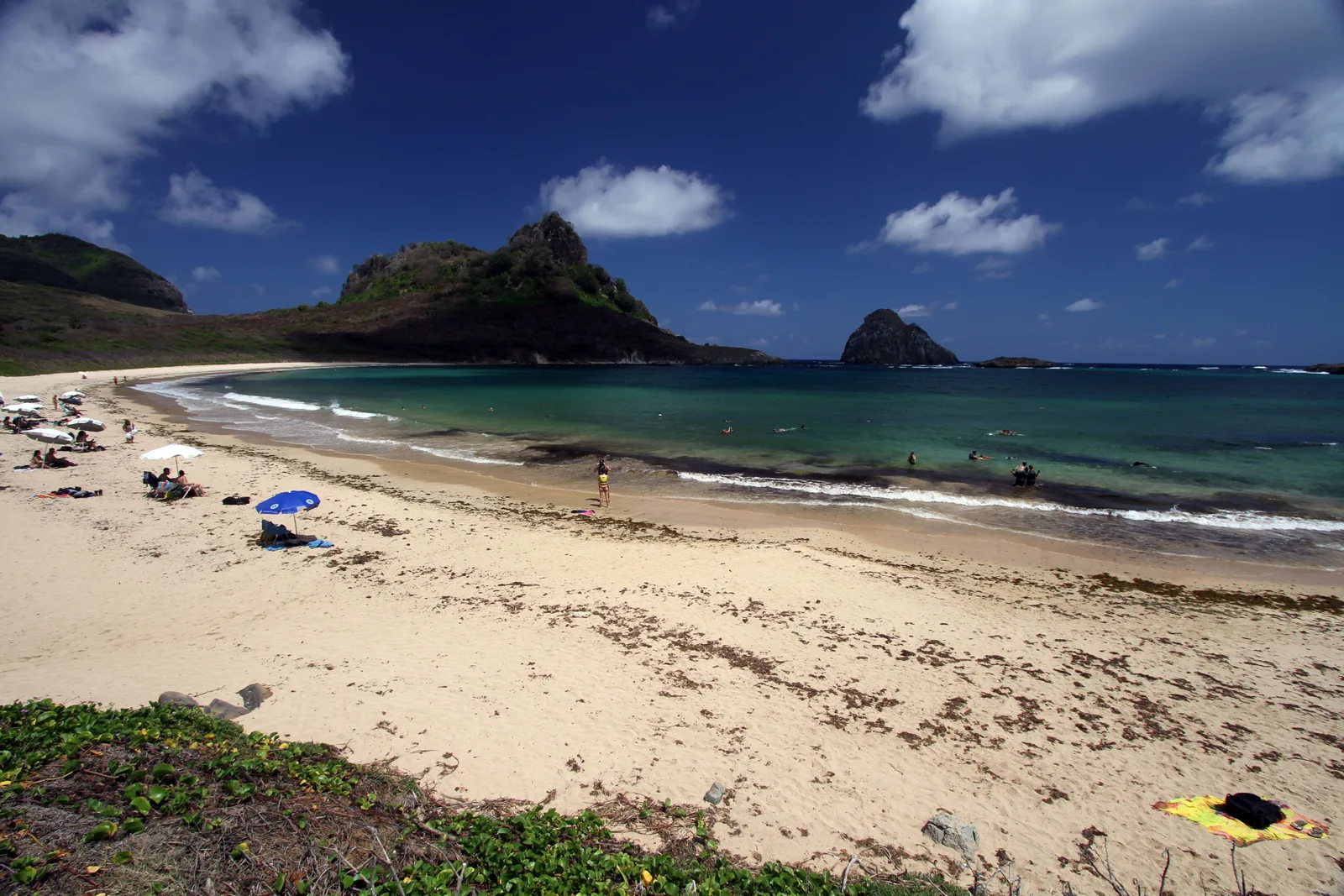
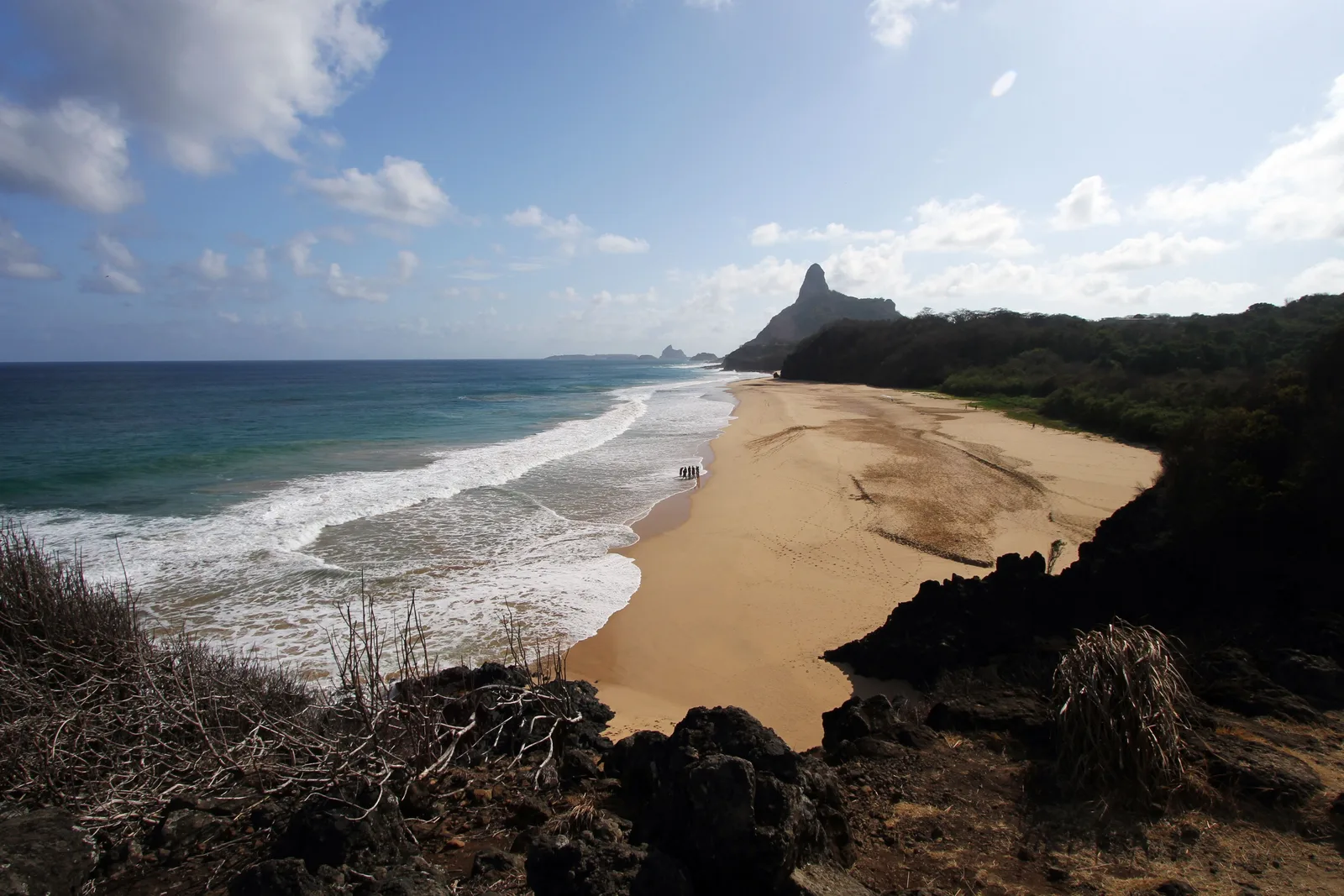
  • A wide sandy beach at Baía do Sueste with a blue parasol and a few bathers, a rounded green hill behind and a pointed rock standing offshore
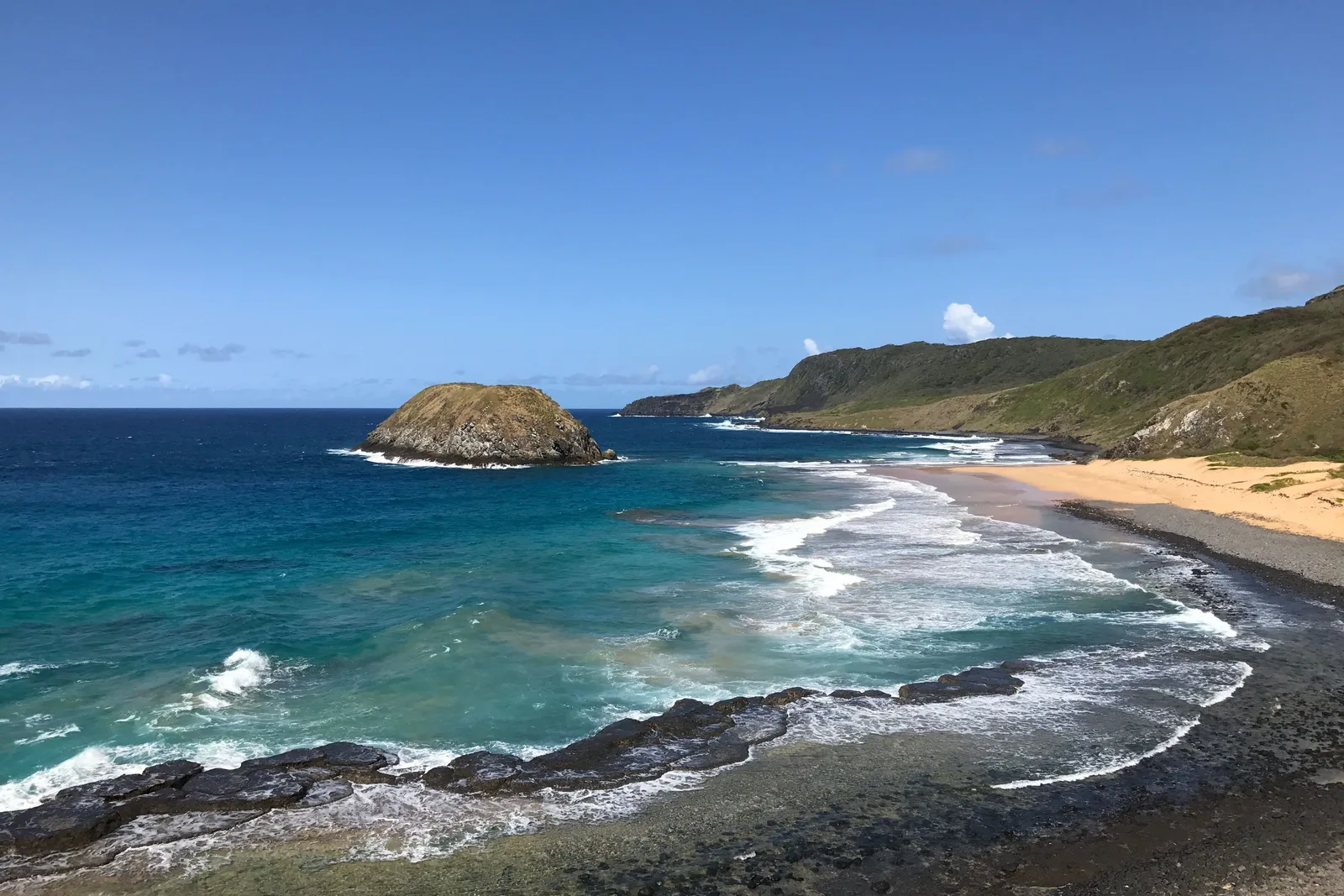
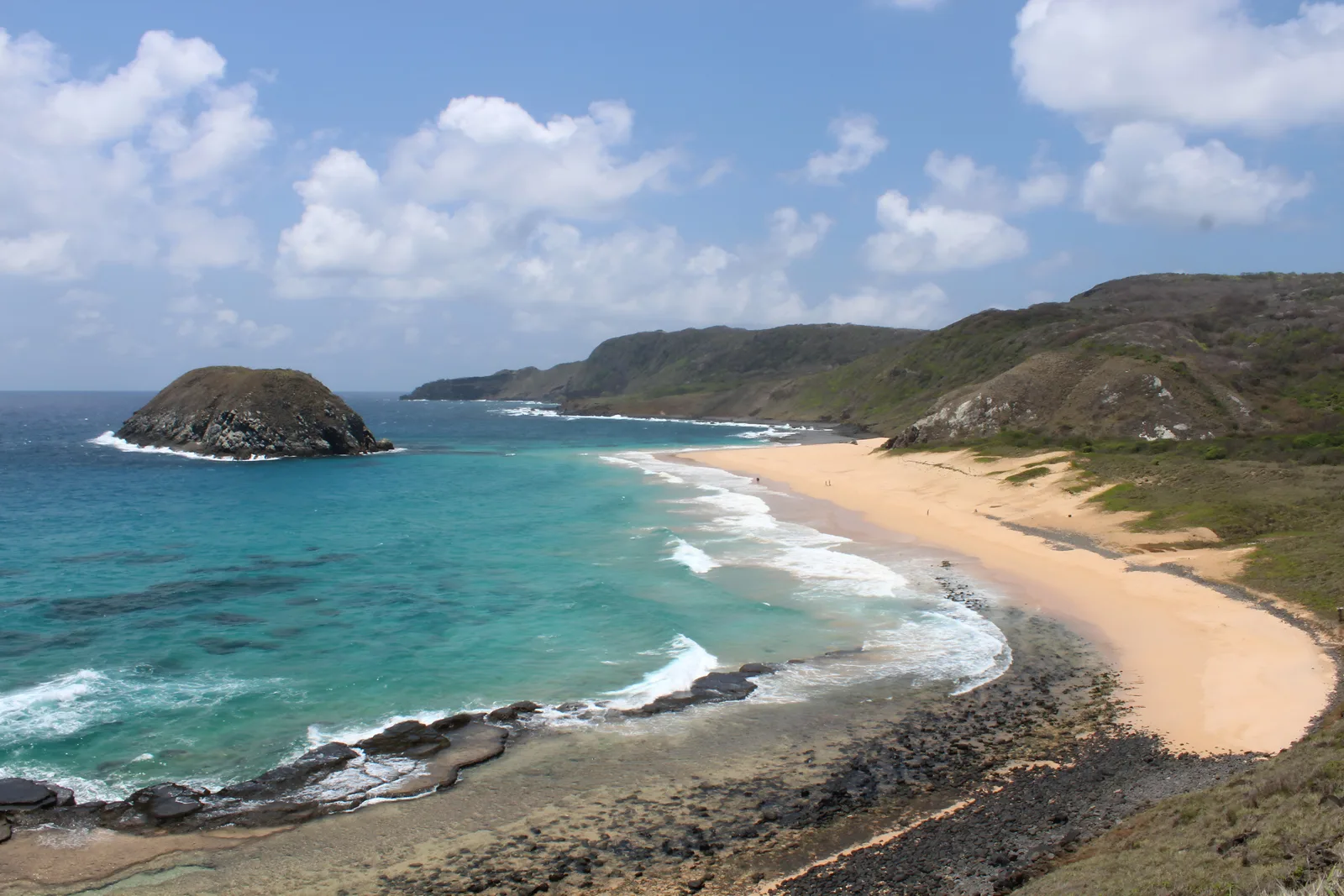
  • Praia do Leão in the morning: a dark rocky island standing off a long curve of pale sand, with surf breaking over a shallow reef in front of it
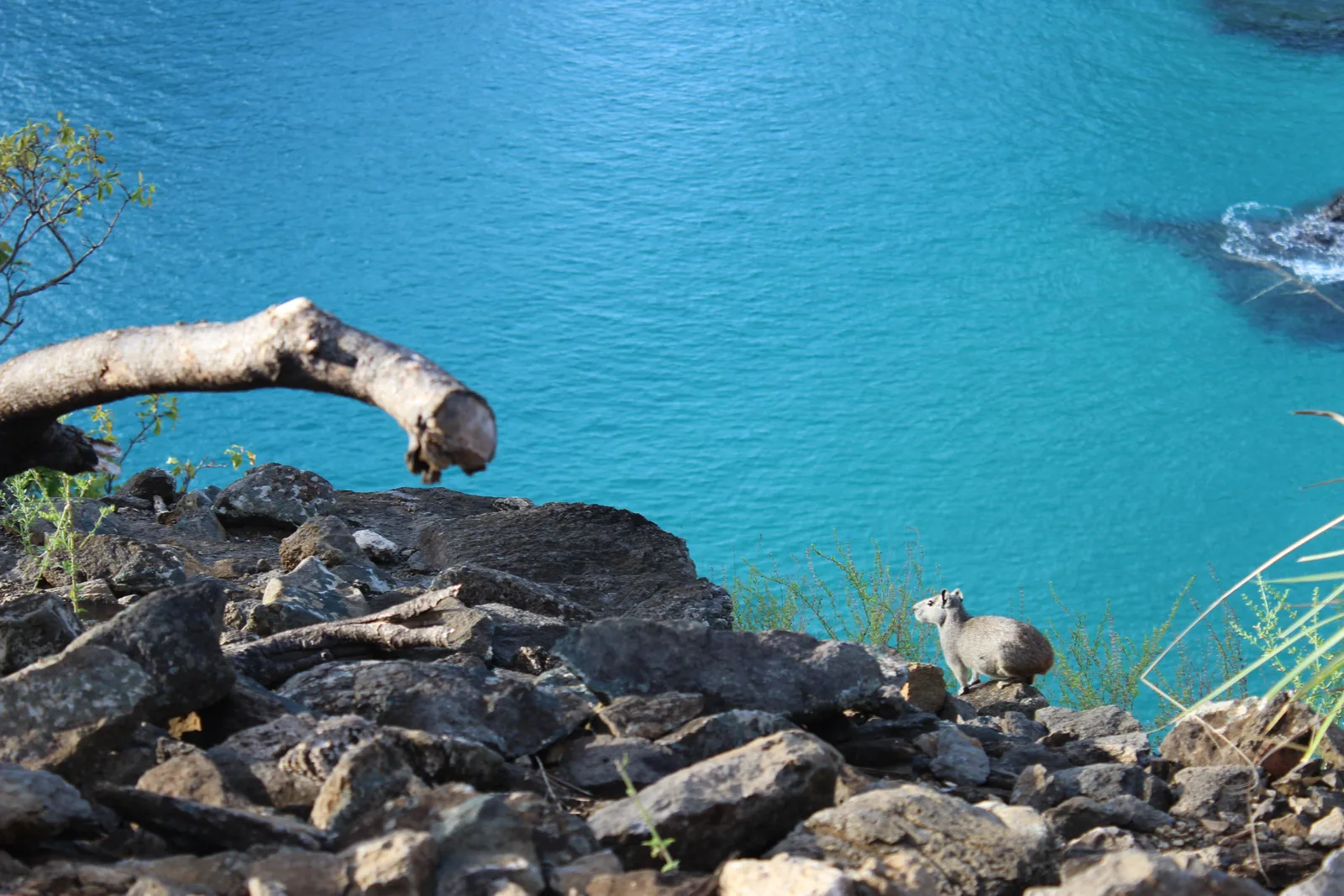
  • A small rock cavy sitting among black boulders on a headland, with a bare bleached branch in the foreground and vivid turquoise water below
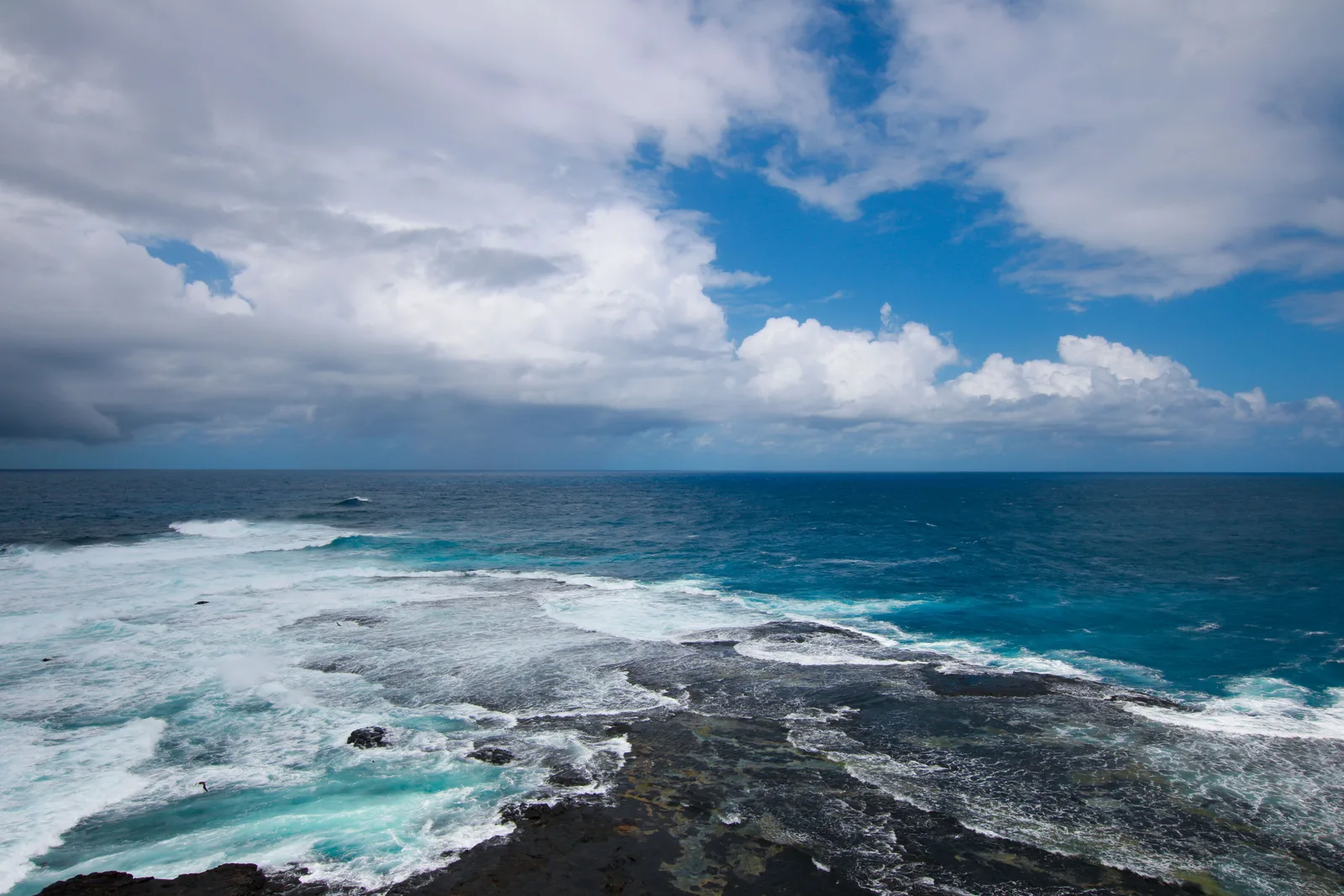
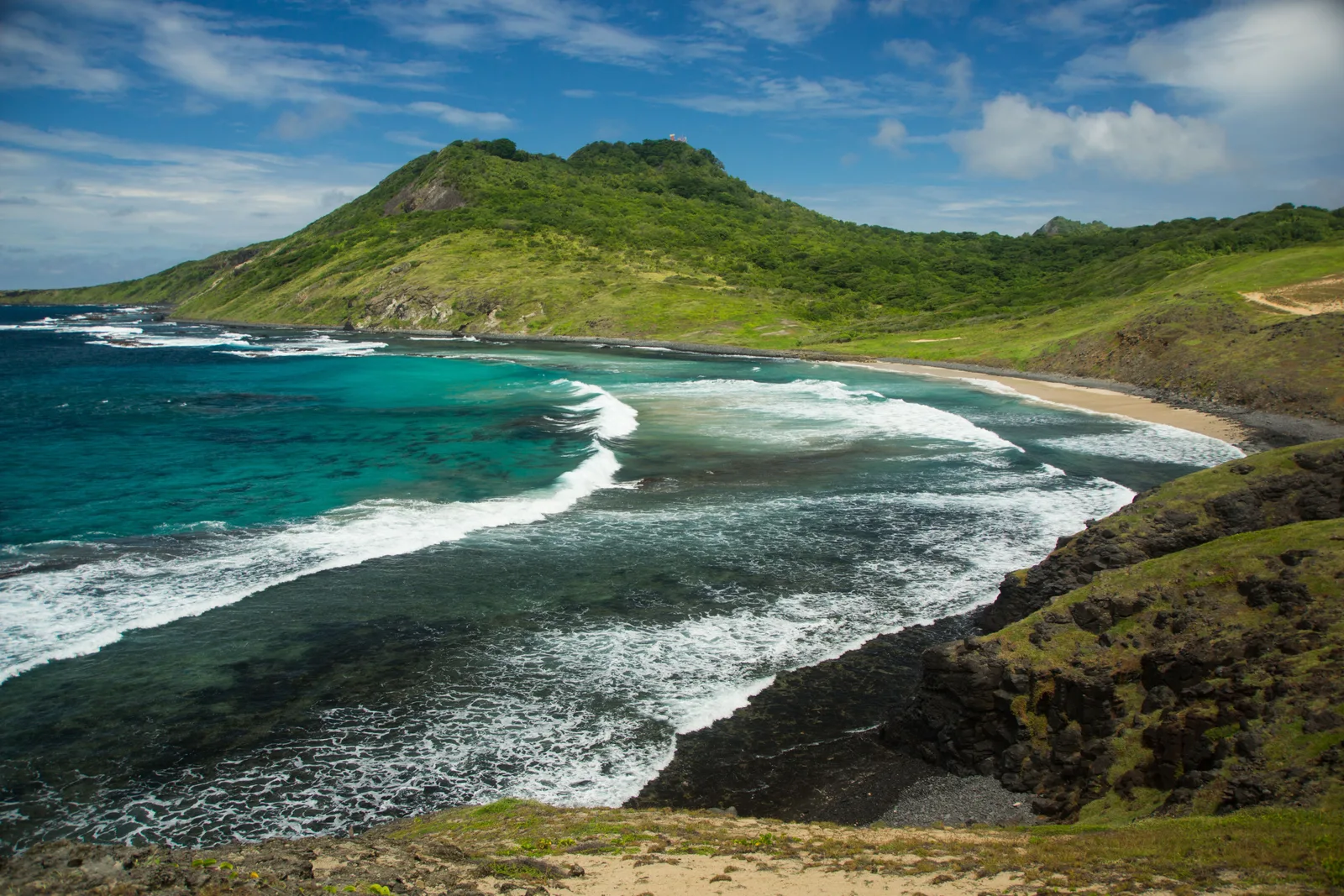
  • White surf breaking over black volcanic rock at Ponta das Caracas under a sky of scattered cloud, with open ocean running to the horizon
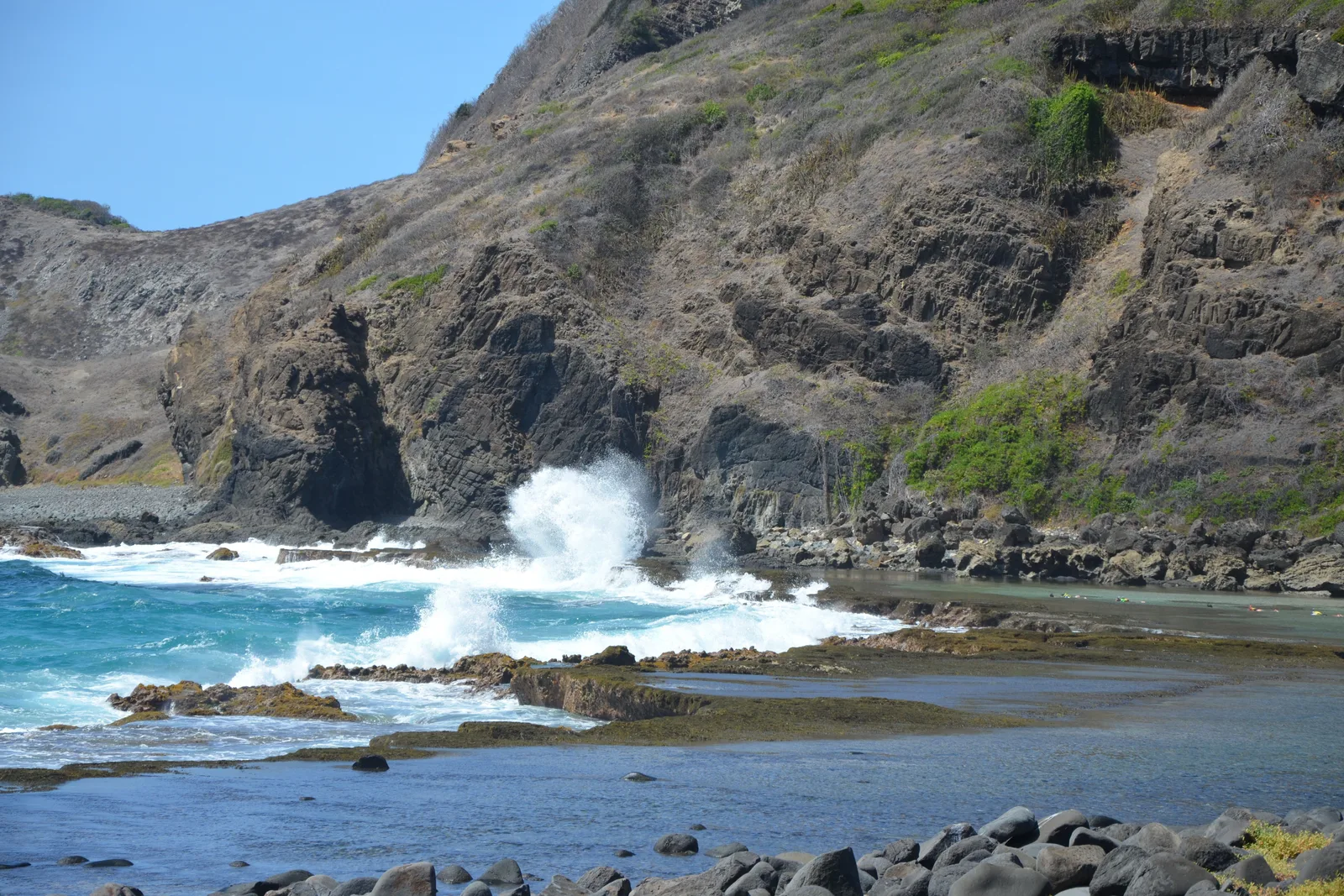
  • A wave bursting white against dark rocks at the foot of a steep brown-gray headland with sparse scrub on it, a shallow rock pool in the foreground
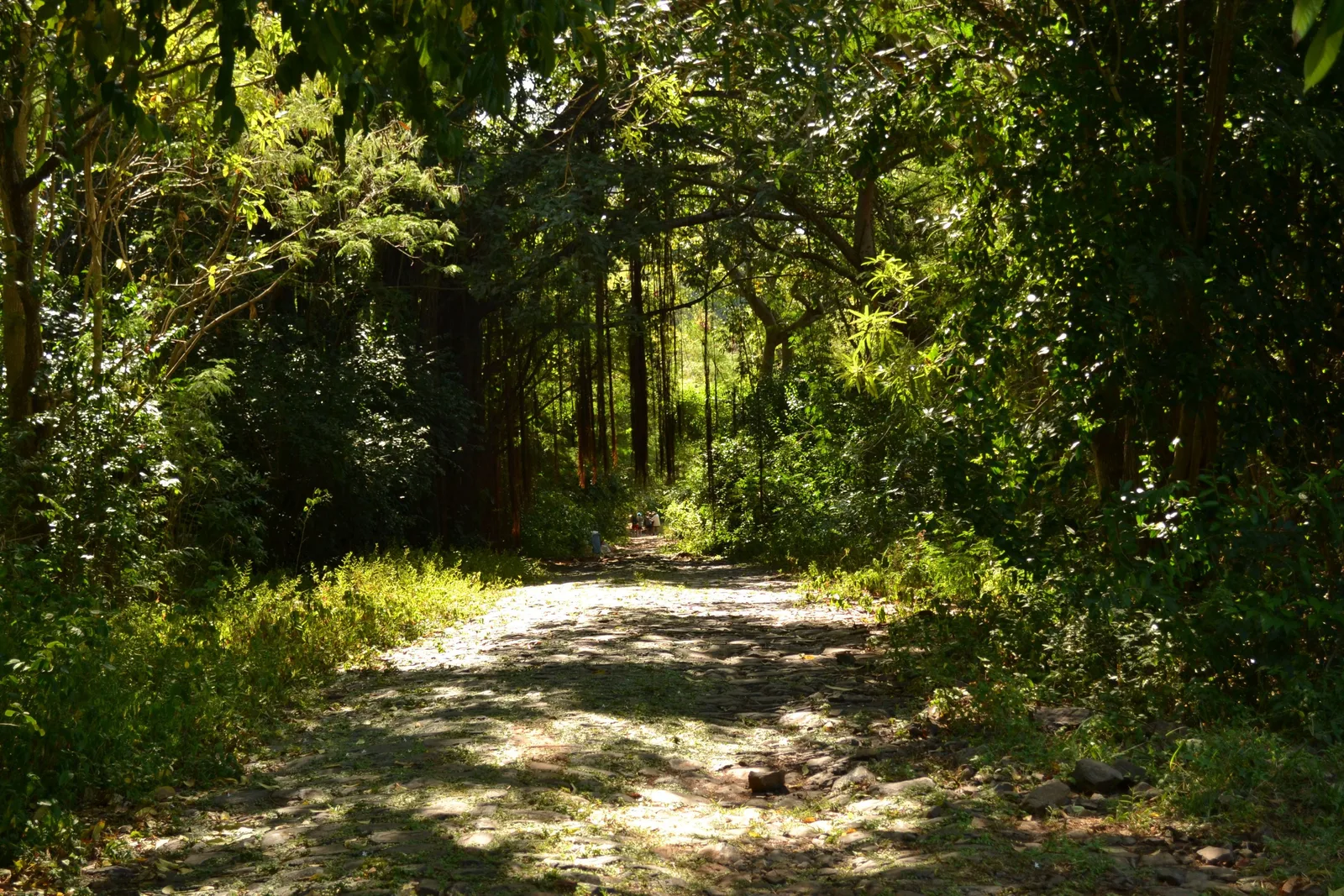
  • A dirt track running downhill through dense green forest on the old road to the port, dappled with sunlight through the canopy
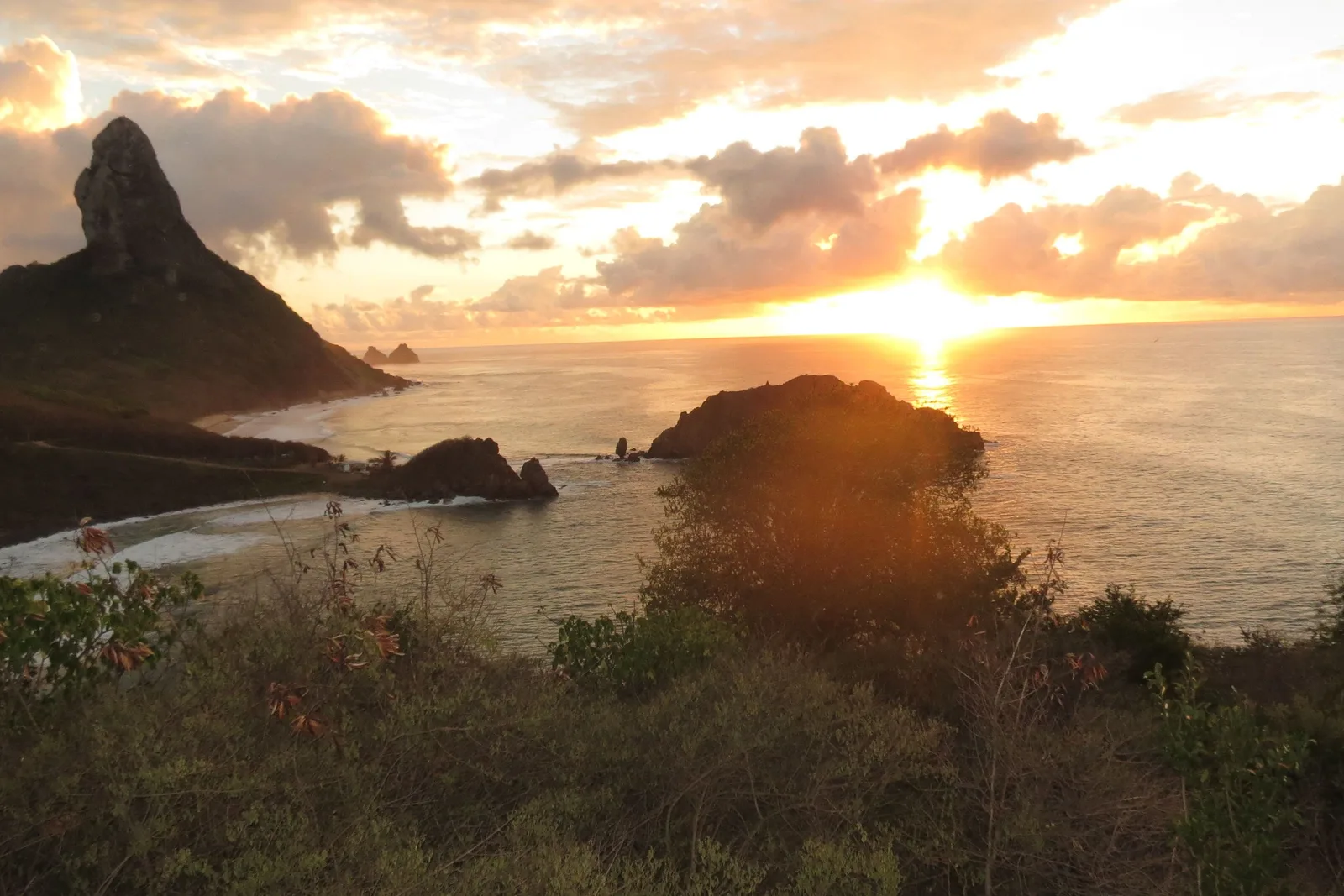
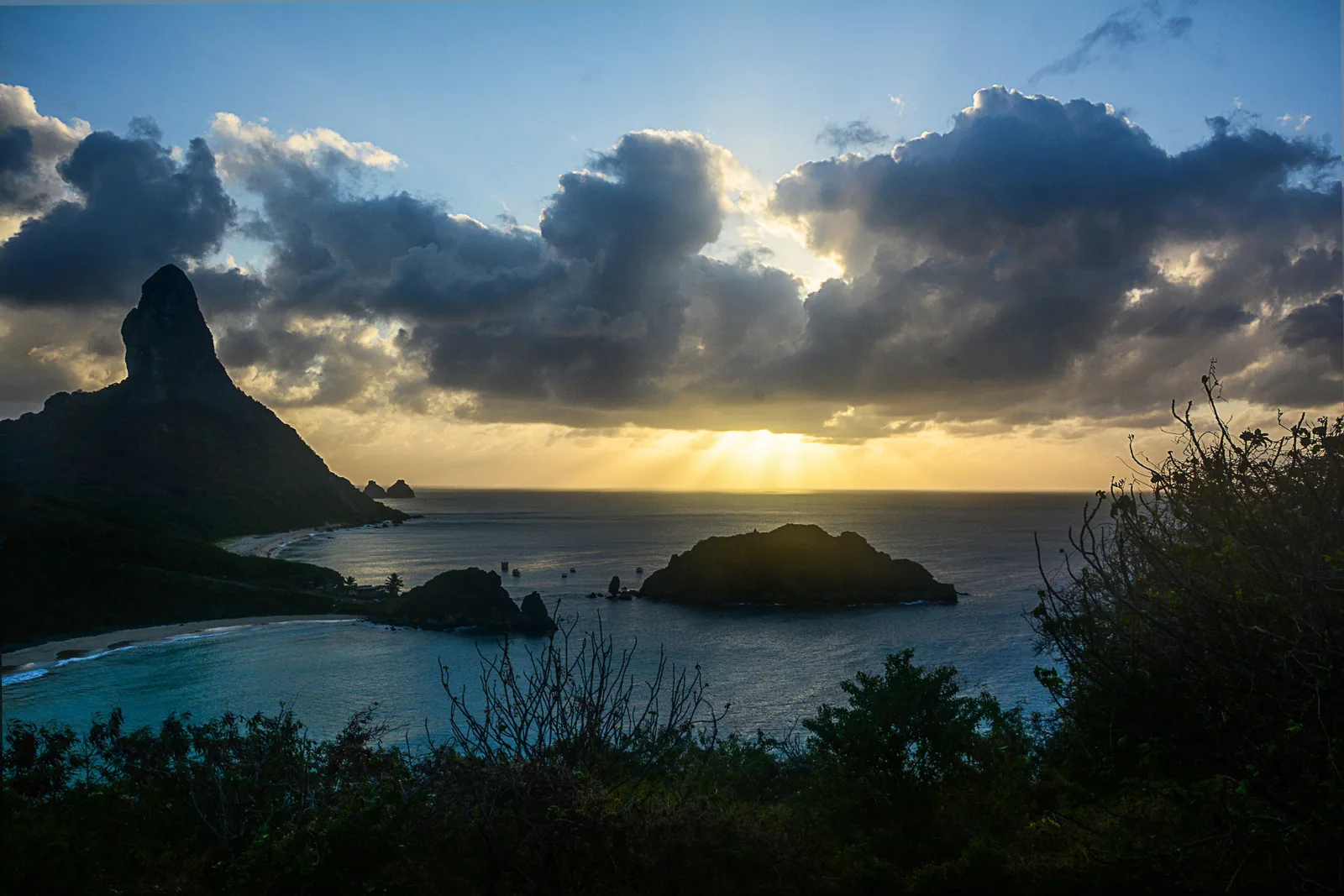
  • Sunset over the sea from the fort above the village, the pointed silhouette of Morro do Pico on the left and a low rock island catching the last light

Before anything else

What it costs, and who is allowed in.

Two taxes, few flights, and a fixed number of licensed beds. Read this part before you fall in love with the pictures.

The Cost

Two taxes, and then everything else

Noronha charges you twice before you have bought anything. Pernambuco levies a per-day environmental tax on every visitor, and the federal marine park sells a separate ten-day ticket without which most of the island is closed to you. For two Americans staying a week that is R$2,113.70, about $414, and it is non-refundable. After that the island behaves like the remote place it is: nearly everything arrives by boat or plane, and it is priced accordingly. The good news is that the spread is enormous. A lean week here is genuinely affordable. A comfortable one is not.

Estimated daily budget, per person

Budget

$100 / day

The cheapest licensed pousada domiciliar, buffet lunches, no buggy, one boat trip and one guided trail. Both taxes included.

Mid-range

$235 / day

A well-reviewed pousada with breakfast, restaurant dinners, three days of buggy, the boat trip, the island tour and one dive each. Both taxes included.

Comfortable

$585 / day

The top of the market with meals, a buggy all week, several dives and the long guided trails. Both taxes included.

Per person per day for a seven-night stay, with the environmental tax and the park ticket already inside the figure, because neither is optional. These daily tiers exclude flights. The week-for-two totals below do include the Recife round trip, which is why the two sets of numbers do not multiply into each other. Two people sharing a room lands well under the double of one.

What things cost

  • Environmental tax (TPA), per person per day $21 R$105.79
  • Environmental tax, per person, 7 days $132 R$672.85
  • Marine park ticket, foreigner, valid 10 days $75 R$384
  • Marine park ticket, Brazilian $38 R$192
  • Recife round trip, per person, typical $226 R$1,150
  • Recife round trip, cheapest seen $133 R$678
  • Cheapest licensed pousada room, per night $66 R$337
  • Comfortable pousada room, per night $157 R$800
  • Boat trip with snorkeling, per person $63 R$323
  • Boat dive, equipment and instructor, per person $226 R$1,150
  • Island tour, per person, 8 hours $49 R$250
  • Guided trail, per person $42 R$215
  • Buggy rental, per day $88–94 R$450–480
  • Fuel for a buggy, per day $16–20 R$82–102
  • Self-service lunch, per person $14–18 R$70–90
  • Dinner at a mid-range restaurant, per person $20–35 R$100–180

A week for two, all in but not counting how you got to Brazil: about $1,700 lean, $3,700 mid-range, $8,850 at the top. The middle figure is the one to plan against, and it does not include your flight from the United States, which for most people will be the largest single line of the trip.

The environmental tax is set by the Distrito Estadual de Fernando de Noronha and is published on its own site. It is R$105.79 per person per day in 2026, raised 4.4% on 1 January and indexed to Brazil’s IPCA inflation index. The legal basis is Lei 10.403 of 1989 as amended, regulated by Decreto Distrital 018/2004.

Do not calculate the tax as R$105.79 times the number of nights. The state publishes a table, not a multiplication. Days one to four are flat, and from the fifth day the marginal cost falls: the fifth day adds R$97.33 and the seventh through tenth add R$76.17 each. Seven days is R$672.85, not R$740.53. Day eleven adds R$126.95 and the escalation from there is steep, so thirty days costs R$7,460.56, an average of R$248.69 a day.

The park ticket is R$384 for a foreigner and R$192 for a Brazilian, valid ten consecutive days, and it is sold by the park concessionaire at parnanoronha.com.br. ICMBio’s own federal page still shows R$222 and R$111 from a 2019 portaria. That page is out of date and you will be charged R$384. The over-60 exemption is for Brazilians only, which matters: an American couple in their sixties pays full price twice. Children under 12 go free whatever their nationality.

Flight fares are what Momondo was quoting for Recife to Noronha and back in September 2026, cheapest R$678 and a typical band of R$1,152 to R$1,738. Room rates, tour prices and restaurant prices come from Brazilian travel and booking sites, because no official body publishes them. They are real quoted prices, not estimates, but they are commercial sources and they move.

The dive price is unusually solid: two operators quote almost the same number, R$1,150 at Noronha Total and R$1,147 at Civitatis. Budget R$1,150 and be ready for R$1,500 at a premium operator.

Checked October 2026 and converted at R$5.10 to the dollar. The two fees are exact published figures. Everything else is a real quoted price or an estimate built from them, not something anyone can be held to.


The Caps

There is no permit. There is a bottleneck.

This is the part most articles get wrong, and getting it wrong costs people trips. Entry to the marine park is limited to roughly 11,000 visitors a month, about 132,000 a year, agreed between the Pernambuco state government, the federal government and the environmental agencies. But you do not apply for anything and nobody approves you. The cap is enforced upstream, on airline seats and licensed beds, and by the time you are shopping it has already been applied. What that means in practice is simple: book the flight first, book the room second, buy the park ticket online, and pay the environmental tax at the airport counter when you land, because the online payment does not take cards issued outside Brazil.

  • There is no visitor permit, no application and no window to miss. If a site tells you to apply for permission to visit Fernando de Noronha, it is wrong.
  • The cap works through the flights. Control of tourist flow is done mainly through the supply of air seats, because part of every aircraft is allocated to residents and to people who work on the archipelago. Cap the flights and you cap the visitors.
  • The second half of the cap is the beds. You may only stay in a classified, licensed guesthouse, the number of those is finite by design, and you cannot rent a spare room from a stranger here. Nobody publishes a bed count, so this page does not give one.
  • The limit is being exceeded. A carrying-capacity study presented by the Pernambuco government in May 2026 put the ideal at about 7,000 people on the island at once, against more than 10,000 residents and visitors today, and any increase is tied to infrastructure rather than demand. In August 2026 the Pernambuco government went the other way and proposed reorganizing the flight schedule specifically to limit access.
  • With a Brazilian card you can pay the environmental tax online before you travel, at the island administration’s own portal. With a card issued outside Brazil, which means most Americans, you pay it at the airport counter when you land. Overstaying the dates you declared is charged at double.
  • Buy the park ticket online at tickets.parnanoronha.com.br for a QR code, or at the visitor center in Vila do Boldró, 8:00am to 7:00pm. You nominate the start of your ten-day window, and it does not have to be your arrival day. If you land late on a Friday and do nothing until Saturday, start the clock on Saturday.
  • Some trails are separately booked and separately capped. The Atalaia trail is scheduled with ICMBio, goes in small groups, and gives you about thirty minutes in the pool. Sunscreen and any other cosmetic is banned in the water there, because at low tide the pool is closed off and whatever is on your skin stays in it.
  • Baía dos Golfinhos is closed. You do not go down the cliff, you do not swim and you do not dive there. Spinner dolphins use the bay to rest and breed, it is watched from the viewpoint above, and boats may not circle in front of it or exceed five knots.

The Island

Twenty-six square kilometers, 354 km out to sea

Fernando de Noronha is a volcanic archipelago of twenty-one islands, islets and rocks lying 354 km off the Brazilian coast and 545 km from Recife, at 3.85° S, 32.42° W. There are 26 square kilometers of land in the whole group and about 17 of them are the main island, which is 10 km long and 3.5 km wide and had 3,167 residents at the 2022 census. It is a state district of Pernambuco even though Rio Grande do Norte is closer, it runs on UTC minus two, an hour ahead of Rio and São Paulo, and Morro do Pico, the spike you can see from almost everywhere, is 323 meters high.

Seventy percent of the archipelago has been the Parque Nacional Marinho de Fernando de Noronha since 1988, and in 2001 UNESCO listed it, with the Atol das Rocas, as a World Heritage site. The park is not a background detail. It contains Baía do Sancho, Baía dos Porcos, Praia do Leão, Baía do Sueste, Praia da Caieira, Ponta das Caracas, Baía dos Golfinhos and the trails and dive sites, which is to say almost everything anyone flies here to see. No ticket, no Sancho.

The island has two coasts and they behave differently. The mar de dentro faces Brazil and holds the sheltered, photogenic beaches: Sancho, Porcos, Cacimba do Padre, Conceição, Boldró, Praia do Meio, Cachorro. The mar de fora faces away from the continent and holds Leão, Sueste and Atalaia, which are wilder and where the turtles are. In the northern winter, roughly November to April, swell arrives on the mar de dentro and leaves the mar de fora alone. That single fact rearranges a trip more than the weather does, and most guides do not mention it.

Getting There

Two airports fly here, and Natal is not one of them

Noronha has one runway, 1,845 meters of it, and no international service. Getting here from the United States is two or three separate tickets, and the last leg is the one that sells out.

  • There are exactly two nonstop origins: Recife, flown by Azul and Gol, and São Paulo Guarulhos, flown by Gol and LATAM. On current schedules those two routes are 100% of arrivals, at roughly 94 flights a month from Recife and 38 from São Paulo.
  • Natal is not a nonstop gateway, whatever you have read. Almost every English article still says "Recife or Natal", and every Natal itinerary now routes through Recife with a connection, at a materially higher fare. Book Recife.
  • Recife to Noronha is 1 hour 15 to 1 hour 20 in the air. São Paulo Guarulhos is about 3 hours 40, which makes it a real option if you are already flying into São Paulo from the United States.
  • Fares move a lot. The cheapest Recife round trip on the market in September 2026 was R$678 and the typical band was R$1,152 to R$1,738. Azul and Gol average around R$1,000 to R$1,050 each on the route.
  • Book the flight before anything else. It is the bottleneck, it is how the visitor cap is actually enforced, and every other decision on this trip follows it.
  • Leave a buffer day on the mainland before your international connection home. This is a single-runway island airport that has been under reconstruction since September 2024 and had a restriction on simultaneous flights that was cleared in August 2025, once the apron works finished and ANAC confirmed the release.

Getting Around

A buggy, a taxi, or your feet, and no insurance on any of them

The main island is 10 km end to end and one road runs most of its length. You can do a good trip here with no vehicle at all, and most people rent a buggy anyway.

  • Rental vehicles on Noronha carry no insurance. Not "you declined it": there is no product to buy. Insurers do not write cover here because there are no accredited repair shops on the island and a damaged vehicle would have to be shipped to the mainland. The rental contract puts every real of any damage or collision on you, and your credit card’s collision waiver is unlikely to help.
  • A buggy runs about R$450 to R$480 a day, usually with a three-day minimum, dropping to around R$400 in low season and rising to R$690 or R$700 over the New Year fortnight. Fuel is on top, at about R$82 to R$102 a day, because gasoline here costs roughly half again what it does on the mainland.
  • Delivery to your pousada and emergency mechanical support are normally included, and rentals of six days or more usually get a progressive discount. The tank arrives with five liters in it and is expected back the same way.
  • You do not need a vehicle for the water. Every boat trip, dive and organized tour includes pousada pickup, and the whole reason most people rent is the freedom to sit on a beach until sunset without watching a clock.
  • There is a public bus along the main road and it is cheap, and taxis run for short hops. Between them and the tour transfers, a car-free week is entirely workable if you are staying in or just behind the village.
  • Vila dos Remédios and the neighborhoods behind it are walkable, and so is the run down to Praia do Meio, Praia do Cachorro and Conceição. Almost everything else is a hill, and the island is hotter and steeper than it looks in photographs.

Safety

The crime risk is close to nothing. The sea is not.

9 /10

Our rating, and the joint highest on this site. The number is about the water and the distance from a hospital, not about crime, which here is close to a non-issue.

This is a state district of about 3,200 people on 17 square kilometers with a single main road, a permanent administrative and police presence and no informal settlements. Everyone is accounted for and a stranger is visible. Petty theft happens the way it happens anywhere with tourists and unattended bags, and that is roughly the whole of the crime story. What actually hurts people here is the ocean and the sun, and both are easy to underestimate on an island this beautiful.

  • The mar de dentro beaches, which is most of the ones you came for, get real swell from roughly November to April. Cacimba do Padre is a world-class surf break in that window, with waves reported up to twelve feet, and the same water at Sancho, Porcos and Conceição turns from a swimming pool into a shorebreak. Ask locally before you get in, in those months.
  • Sancho is reached by a steel ladder set into a crack in the cliff, in two flights, and there is a queue at both ends. It is not difficult, but it is vertical, it is wet, and it is not the place for anyone unsteady on stairs. The alternative is arriving by boat.
  • The UV index here runs between 9 and 11 every month of the year, which is very high to extreme on the WHO’s scale in all twelve. There is almost no shade on the beaches or the trails. Rash guard, hat, and reapply.
  • Sunscreen is banned in the natural pools at Atalaia and on the guided pool trails, so plan to cover up with clothing on those mornings rather than with lotion.
  • The medical facility on the island is small and a serious case means a flight to Recife. Travel insurance that covers medical evacuation is worth more here than in most of Brazil, and this is a reasonable place to buy it.
  • The trails on the mar de fora side, Capim Açu and Pontinha Caieira in particular, are long, rocky and mostly unshaded, and several require an ICMBio-certified guide for good reason. Book them, take water, and start early.
  • Do not go down into Baía dos Golfinhos, do not swim with the dolphins and do not ask a boat to chase them. It is prohibited, it is enforced with fines, and the animals are there to rest.

The big four

What the island is actually made of.

Three of these are inside the national park and need the ticket. The fourth is the thirty percent of the archipelago where everybody lives.

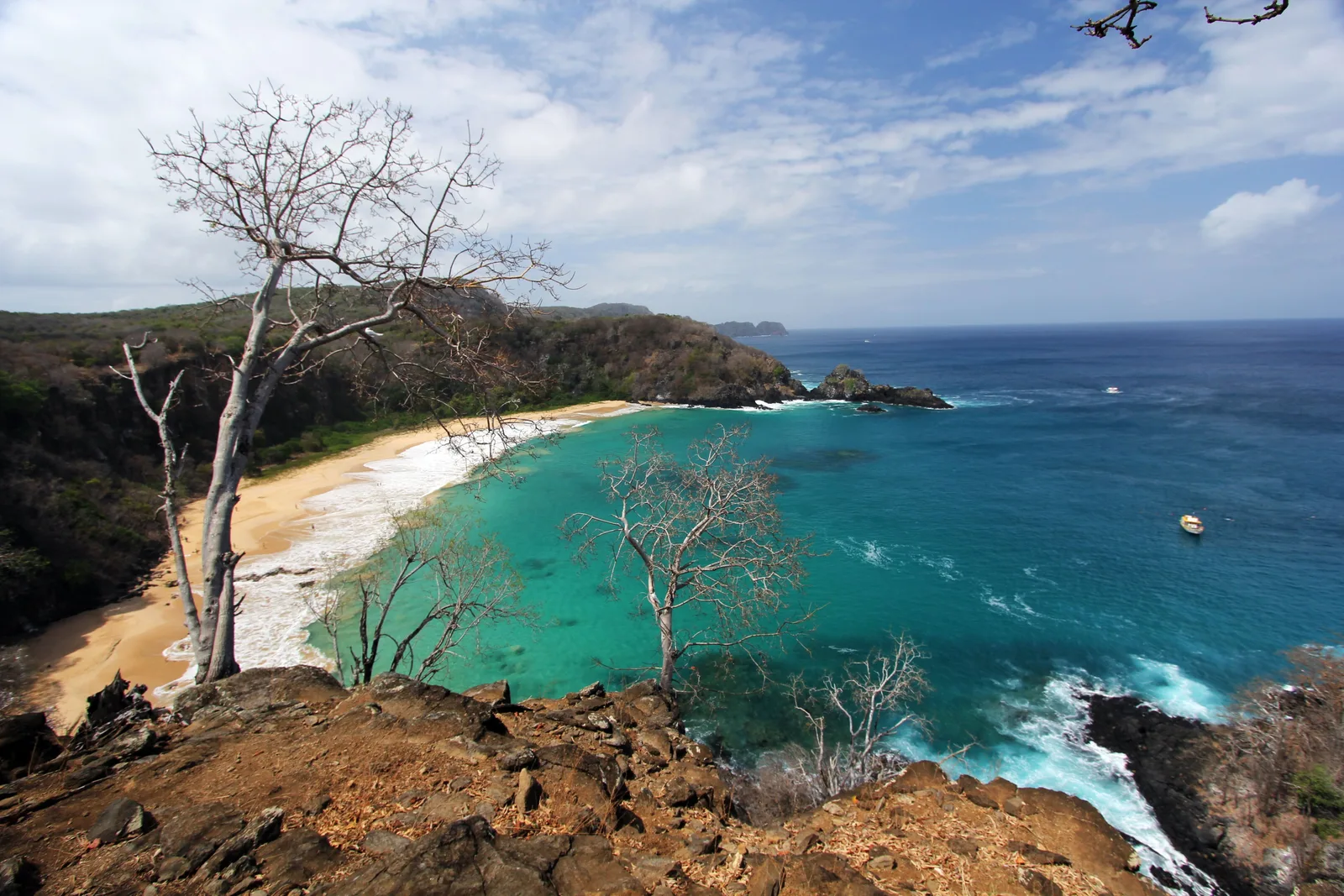
The crescent of pale sand at Baía do Sancho seen from the clifftop, backed by a green wooded slope, with a bare tree in the foreground and clear turquoise water shading into deep blue 01

The one in every photograph, and the one with a gate

Baía do Sancho

Inside
The national park
Getting down
A ladder in a rock crevice, or by boat
Needs
The R$384 park ticket

A short crescent of pale sand at the foot of a steep wooded cliff, with water that goes from clear to turquoise to deep blue in about forty meters. It has been voted the best beach in the world by TripAdvisor’s travelers more than once, and unusually for that kind of award it is difficult to argue with. Boats stop here on the standard morning trip and the snorkeling straight off the sand is as good as the swimming.

The part worth knowing before you book anything: Sancho is inside the Parque Nacional Marinho, and so are Baía dos Porcos, Praia do Leão, Baía do Sueste, Praia da Caieira and Ponta das Caracas. The park is about seventy percent of the archipelago and the ticket is the only way in. No ticket, no Sancho. Get down to it by the two flights of steel ladder bolted into a split in the rock, which is the way most people do it, or arrive by boat, which is the way to do it if stairs are a problem.

Baía dos Porcos from above: the twin peaks of Morro Dois Irmãos on the left, a small strip of sand, black volcanic rock breaking through pale green shallows and white surf beyond 02

Two rocks that put the island on a postcard

Morro Dois Irmãos and Baía dos Porcos

Inside
The national park
Best from
The clifftop path above Porcos
The rock pools
Only at low tide

The two peaks are the shape everyone recognizes, and Baía dos Porcos is the small rocky cove at their foot, reached on foot from the far end of Cacimba do Padre. It is a scramble over black volcanic rock rather than a beach, and at low tide the rock traps clear pools you can lie down in with the twin peaks directly overhead. There is no infrastructure at all, which is enforced rather than accidental.

One warning that has nothing to do with the island. Morro Dois Irmãos is also the name of a well-known hill in Rio de Janeiro, above Leblon and Vidigal, and a search for the name returns both. If a photograph of "Morro Dois Irmãos" has a city under it, it is the other one.

Baía dos Golfinhos seen from high on the cliff above it: an enclosed blue bay with a wooded headland running out around it and no way down to the water 03

A bay you are not allowed to enter

Baía dos Golfinhos

Access
From the clifftop viewpoint only
Prohibited
Descending, swimming, diving
Best time
Early morning

Spinner dolphins come into this bay in numbers to rest, to breed and to look after their young, and it is one of the most reliable places in the world to watch them do it. You watch from the mirante on the cliff above, where researchers from the Projeto Golfinho Rotador keep binoculars and explain what you are looking at. Early morning is when the animals come in.

Going down is prohibited, and so is swimming or diving in the bay, and boats may not circle in front of it or run above five knots. The reason is not squeamishness. People in the water make resting dolphins stop resting, and a bay full of swimmers costs them the energy they came here to save. ICMBio enforces it with fines, and it is one of the clearest examples on this island of a rule that exists because the alternative was tried.

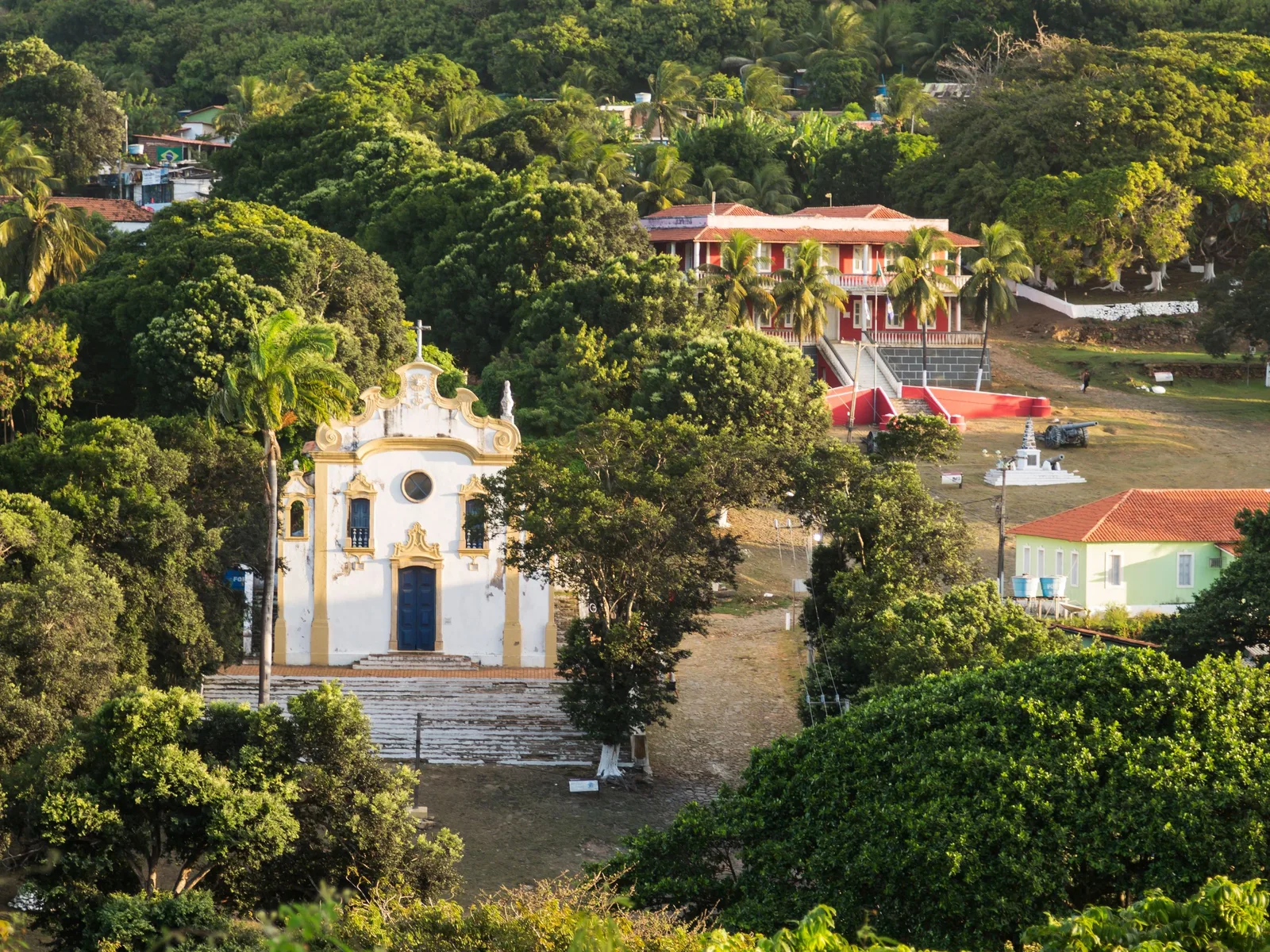
The white and yellow church of Nossa Senhora dos Remédios seen from above among tall trees and palms, its door blue, with the red and cream buildings of the village around it 04

The thirty percent where people live

Vila dos Remédios

Population
3,167 in the whole archipelago
What is here
Restaurants, bars, the church, the fort
Its own beach
Praia do Cachorro

The historic center of the island and the only place that reads as a town. It has the eighteenth-century church of Nossa Senhora dos Remédios, the ruins of the Forte dos Remédios above it, the administration building on its red plaza, the restaurants, the bars and the one street where anything happens after dark. Its own beach, Praia do Cachorro, is at the bottom of the hill, and Praia do Meio and Praia da Conceição run away from it northward.

The island has been a garrison, a penal colony and a US air base, and the built history is mostly forts and prison walls: Santo Antônio above the port, Remédios above the village, the ruined presídio at Praia do Cachorro. None of it takes long and all of it is free. It is also the answer to a question first-time visitors ask, which is whether there is anything to do here in the evening. There is one place, and this is it.

What to do

An island you spend in the water.

Almost everything here is a beach, a boat or a footpath, and most of it is inside the park you already paid for. Prices below are per person and none of them include the two taxes.

In the Water

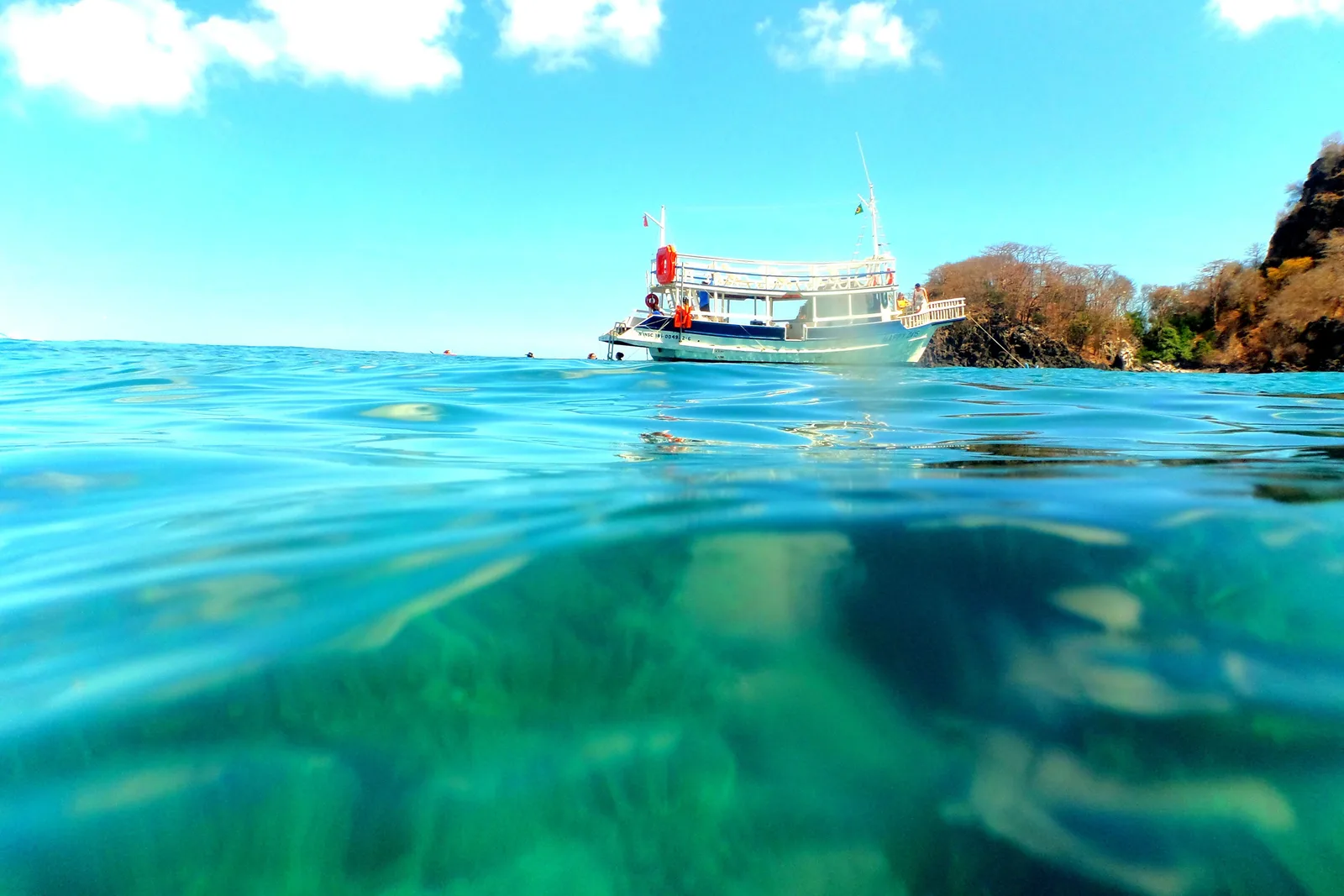
  • A half-underwater view off Baía do Sancho: clear green water over reef with two snorkelers at the surface, and a white tour boat moored against a rocky shore above them

    From Porto de Santo Antônio · about 3 hours

    The morning boat trip

    The one thing nearly every visitor does. Boats leave from the port at 7:30am, run down the mar de dentro past Dois Irmãos and the cliffs, stop to snorkel, and turn back mid-morning. Spinner dolphins alongside the boat are common rather than guaranteed. It is about R$323 a head, it includes pousada transfers, and it does not include the park ticket, which you buy separately and are asked for.

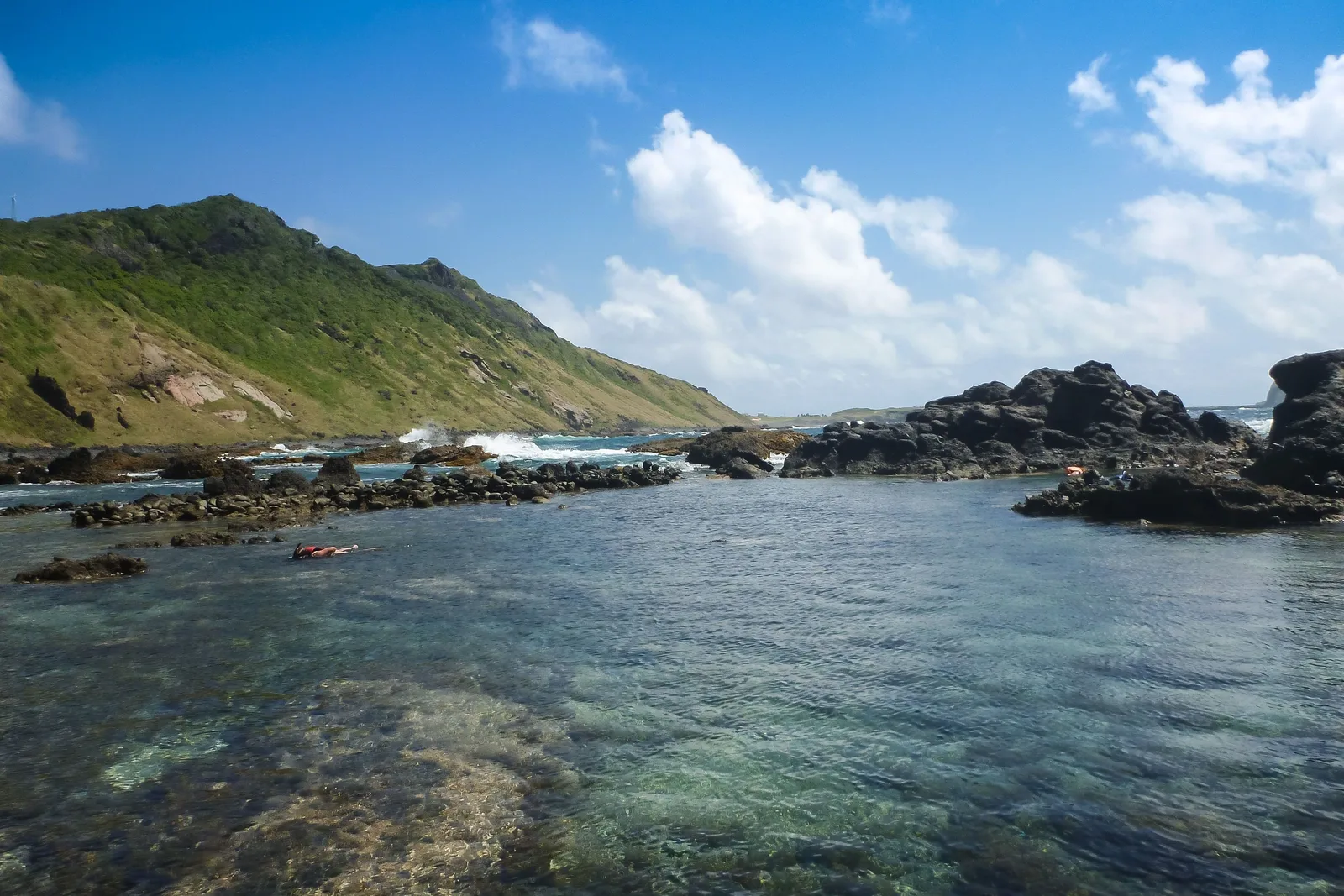
  • A shallow, glass-clear pool inside a low rocky shore with one snorkeler floating face down in it, a green and tan hillside running down on the left and surf breaking on the reef beyond

    Departures 7:30am and 2:00pm · from R$1,150

    Scuba diving off the boat

    Noronha is the best diving in Brazil and the single biggest line in most people’s budget here. The standard boat dive runs 30 to 40 minutes at 10 to 12 meters with a credentialed instructor and basic equipment, and it takes complete beginners as well as certified divers. An operator and a booking platform quote R$1,150 and R$1,147 for it, which is unusually consistent, and a premium operator may ask R$1,500. Visibility is at its best in the dry months, before the swell arrives and starts moving the seabed around.

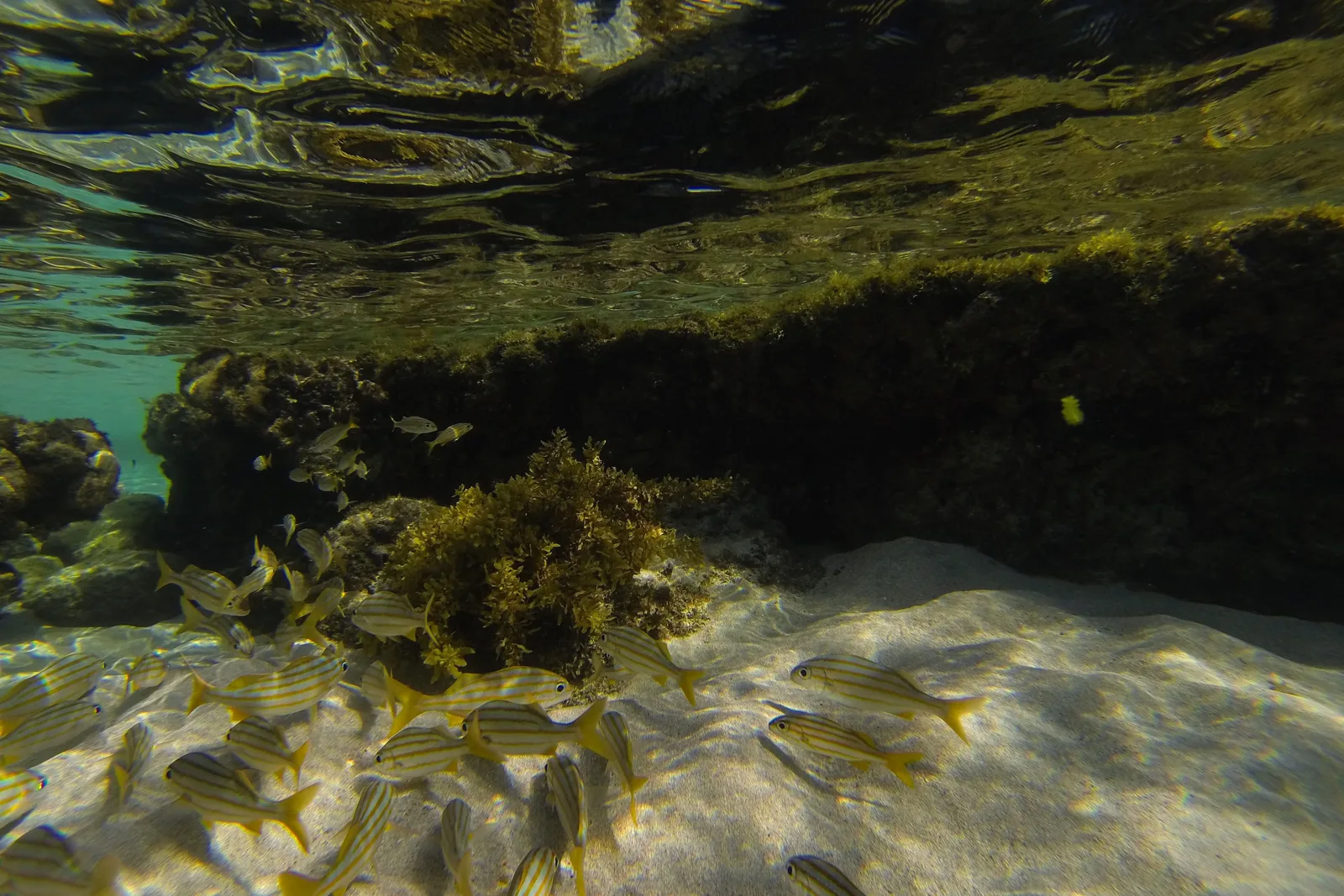
  • A half-submerged view inside a shallow natural pool at Atalaia, with a shoal of yellow-and-silver striped fish over pale sand and dark weed covering the rock above them

    Booked with ICMBio · about 30 minutes in the water

    The natural pool at Atalaia

    A tidal pool on the mar de fora that fills with fish when the sea drops off the reef, and the most tightly controlled thing on the island. You book it in advance, you go in a small group, you get roughly half an hour in the water, and you wear a mask, snorkel and life jacket and are not allowed to stand or kneel on the bottom. Sunscreen and any other cosmetic is banned before you get in, because at low tide the pool is cut off and whatever is on your skin stays there. The trail out and back is 3 km.

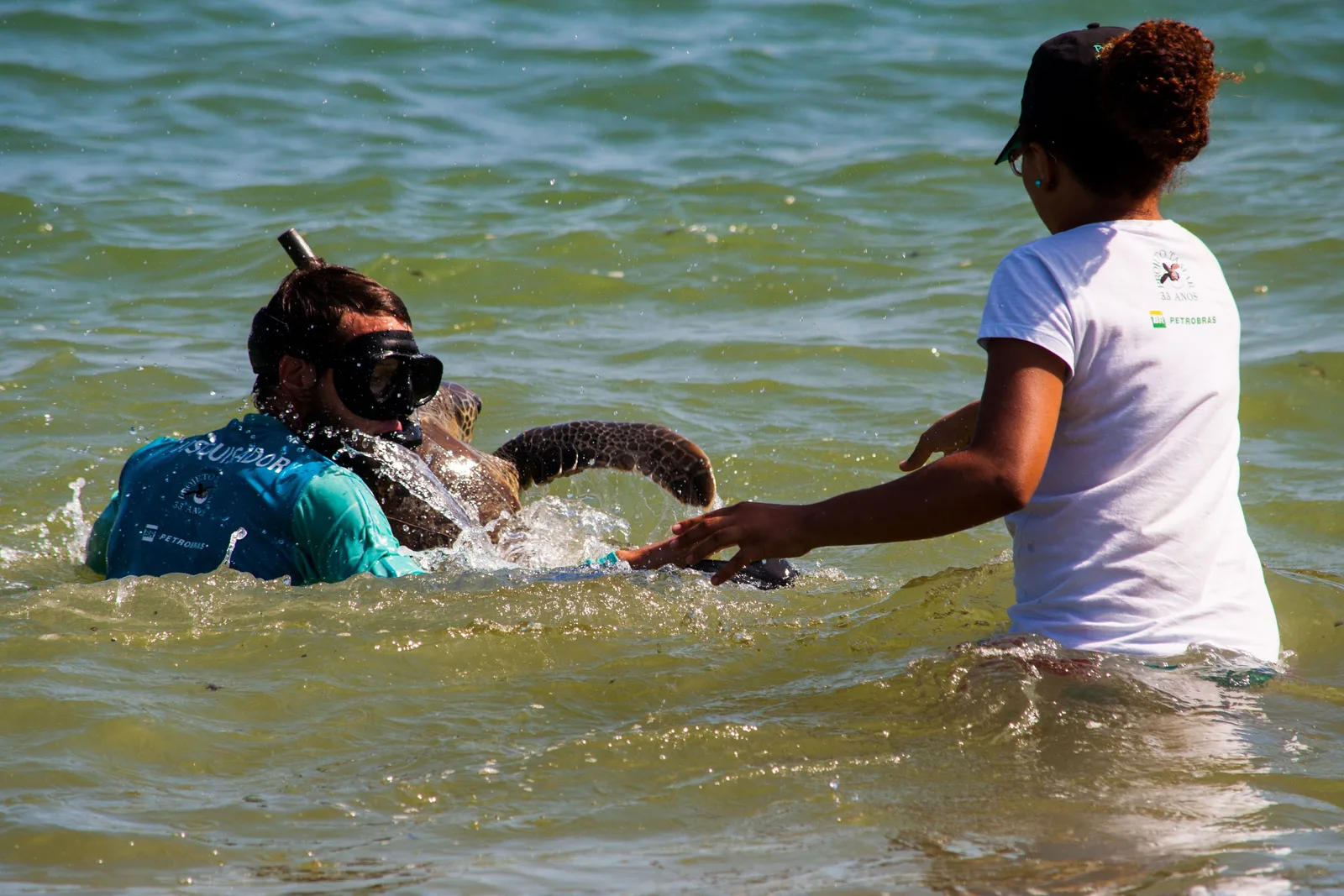
  • Two Projeto Tamar researchers in the shallows at Baía do Sueste, one standing waist-deep and the other submerged to the shoulders in a mask and snorkel, handling a green turtle at the surface

    Baía do Sueste · a morning

    Snorkeling with turtles at Baía do Sueste

    Swimming and snorkeling at Sueste are suspended for now by ICMBio, the park service, so check its notices before you plan on it; the beach stays open for walking and watching the water. When the water reopens, it is the one place you swim with green turtles here, and you do it from the beach rather than from a boat. Sueste is a shallow, protected bay on the mar de fora with a seagrass bed the turtles feed on, and it is inside the park. Projeto Tamar has worked this bay for decades and you will sometimes see researchers in the water tagging animals. Mask and snorkel rental is available at the entrance and a life jacket is required.

Beaches

  • The long pale beach at Cacimba do Padre from a rocky rise at one end, surf running up the sand and the pointed silhouette of Morro do Pico in the distance

    Mar de dentro · a full afternoon

    The long beach at Cacimba do Padre

    The widest beach on the island and the walk-in route to Baía dos Porcos, which is at the far end under the twin peaks. From December to March, when the swell is most reliable, it is also the best surf break in Brazil, with a left-hander that can reach twelve feet, and in those months the swimming here is for confident swimmers only. Outside the swell season it is a wide, calm, half-empty beach.

  • A wide empty beach at Praia do Leão curving between green headlands, with a dark rock island standing offshore and turquoise water breaking over a shallow reef

    Mar de fora · half a day

    Praia do Leão

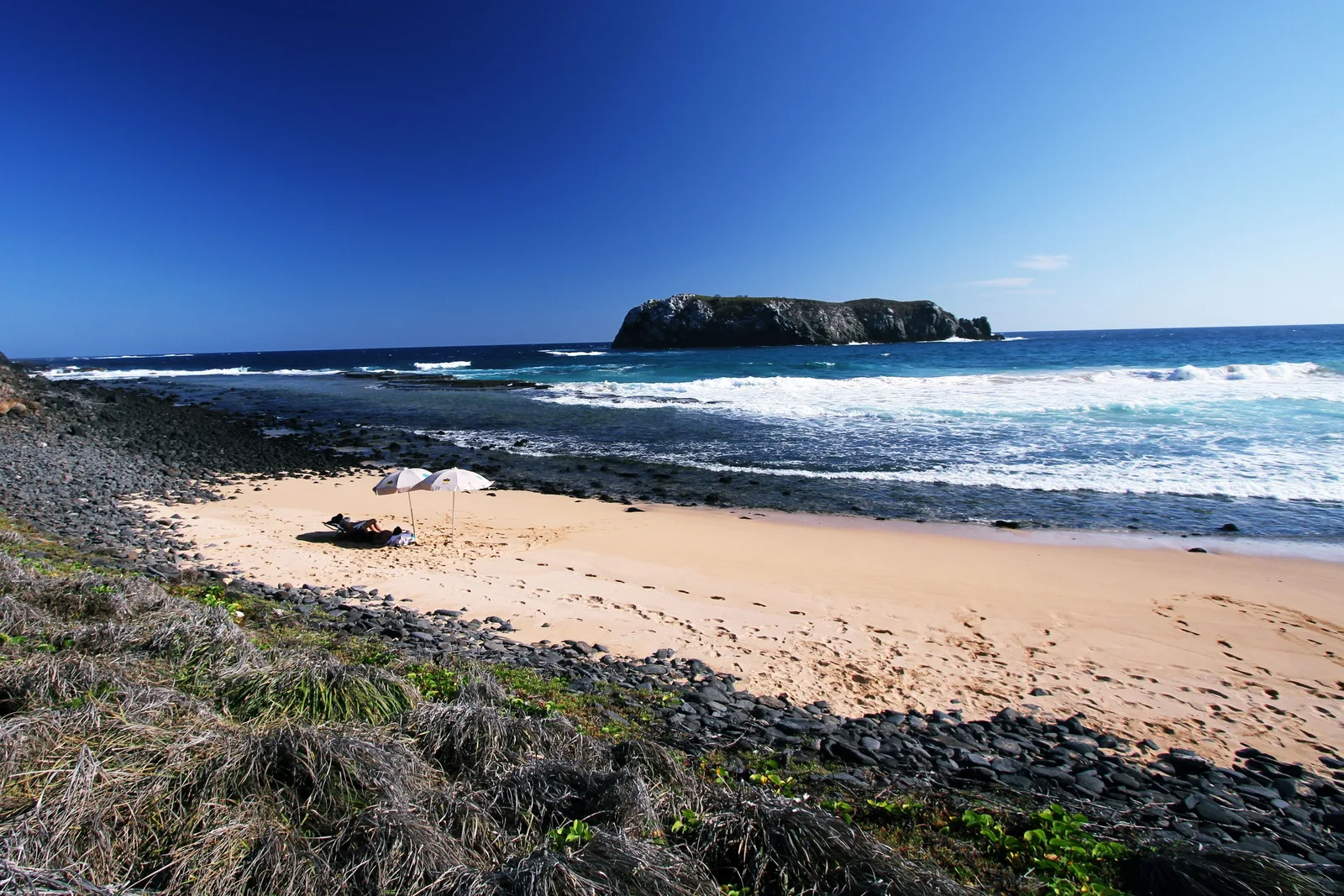
    The biggest beach on the ocean side, named for the rock lying offshore that is supposed to look like a sea lion. It is wilder than anything on the mar de dentro, there is nothing built on it, and it is a main nesting beach for green turtles, which means parts of it close in the nesting season. Come for the emptiness rather than the swimming: the currents here are real.

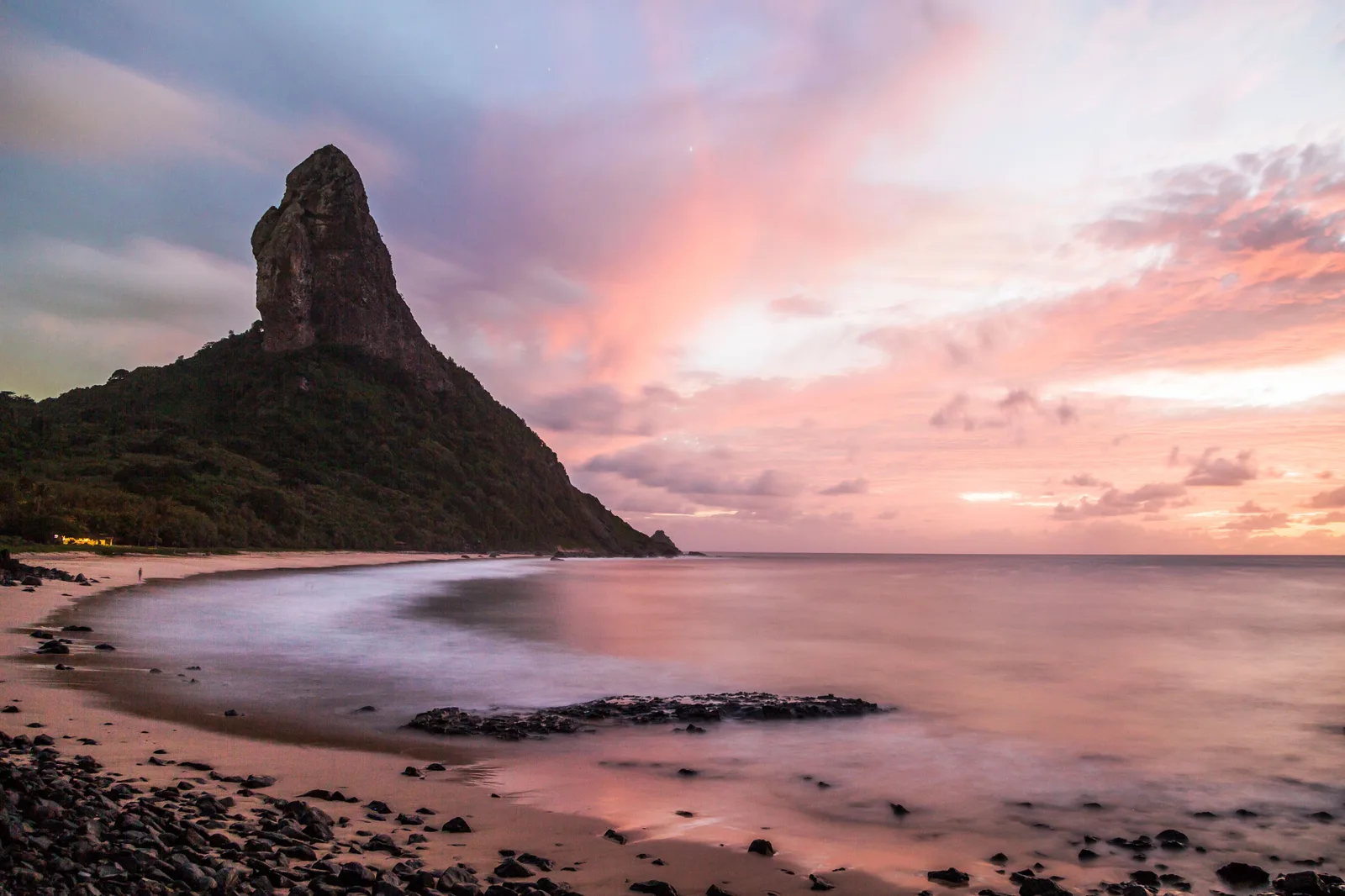
  • Morro do Pico standing dark against a pink and gray dusk sky above Praia da Conceição, with the wet sand and shallow water reflecting the light

    Below Morro do Pico · late afternoon

    Sunset at Praia da Conceição

    The island’s everyday beach, at the foot of Morro do Pico and a short walk from the village and the pousadas behind it. It is outside the park, so you do not need the ticket to sit on it, it has kiosks and a bar or two, and it is where people go in the evening when the day trips are over. The sunset over the water here is the reason the island keeps its restaurants open late.

  • A curved bay backed by steep green hills at Enseada da Caieira, with a pale beach and surf breaking over a wide shallow reef in the foreground

    Inside the park · a quiet half day

    Enseada da Caieira

    One of the coves people skip, which is exactly the argument for it. A green amphitheater of hills coming down to a reef-fringed bay, reached on the Pontinha Caieira trail, with almost nobody on it on an ordinary day. It is inside the park and the trail to it is one of the guided ones, so it takes planning that the roadside beaches do not.

Trails & Views

  • A half-submerged view inside a shallow natural pool at Atalaia, with a shoal of yellow-and-silver striped fish over pale sand and dark weed covering the rock above them

    Booked with ICMBio · about 30 minutes in the water

    The natural pool at Atalaia

    A tidal pool on the mar de fora that fills with fish when the sea drops off the reef, and the most tightly controlled thing on the island. You book it in advance, you go in a small group, you get roughly half an hour in the water, and you wear a mask, snorkel and life jacket and are not allowed to stand or kneel on the bottom. Sunscreen and any other cosmetic is banned before you get in, because at low tide the pool is cut off and whatever is on your skin stays there. The trail out and back is 3 km.

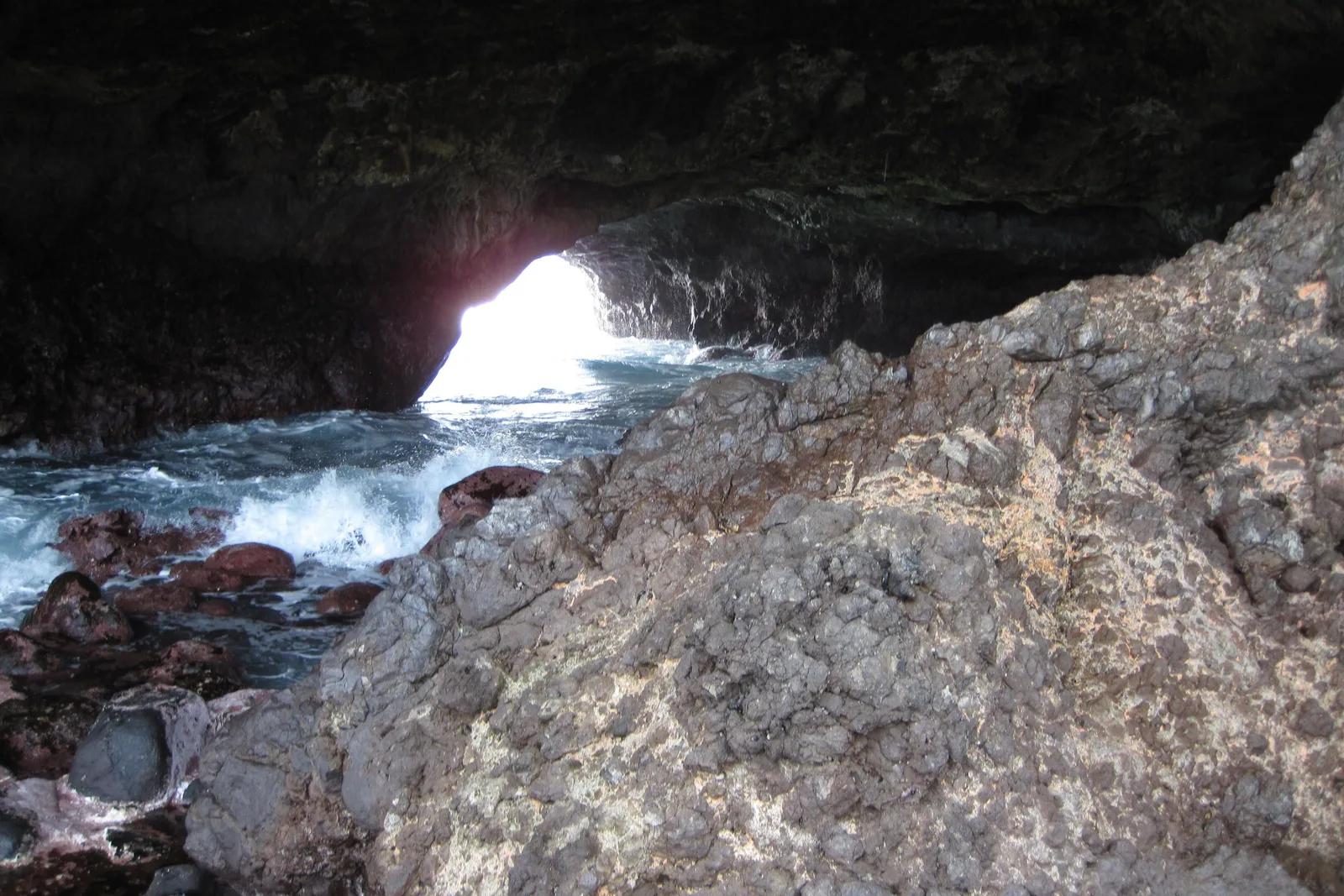
  • A wide sea cave on the Capim Açu trail, its rock roof arching over a sloping rock shelf with daylight and white surf breaking through the opening beyond

    7.5 km one way · guide required for the full route

    The Capim Açu trail

    The longest walk on the island, running out along the southern shore to the lighthouse, a natural pool and a sea cave, on rock most of the way and with almost no shade. The full route needs an ICMBio-certified guide; you can walk as far as the lighthouse without one. Budget most of a day, take more water than you think, and start early.

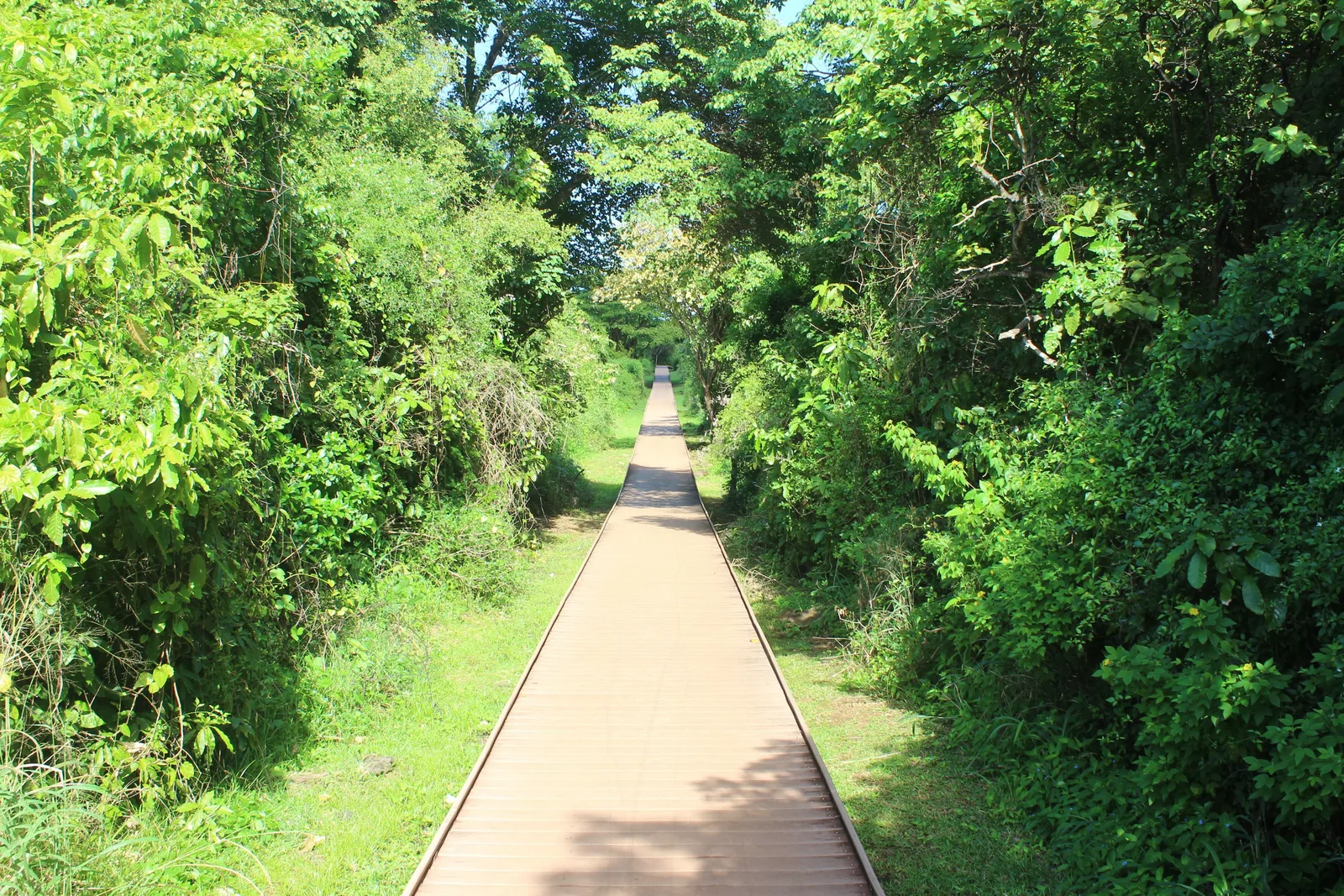
  • A boardwalk of reddish-brown timber running away between dense green forest on both sides, dappled with sunlight through the canopy

    Around the park visitor center · under an hour

    The short forest trails

    Not everything here is a hard walk on rock. Short boardwalk and gravel trails run through the remnant forest inland of the park, which is the only shade on the island and the easiest place to see the endemic birds and the rock cavies. It is the right thing to do with an hour after lunch when the sun is at its worst.

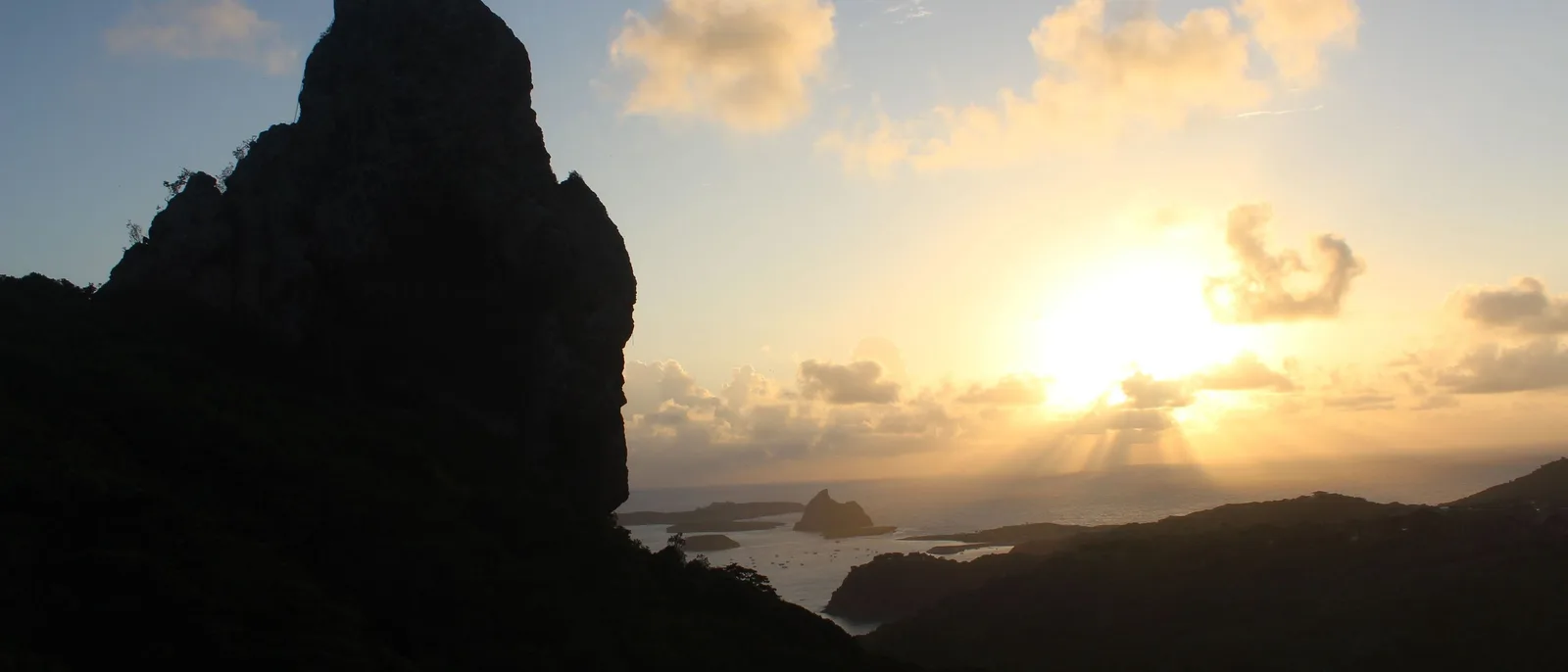
  • The sun dropping behind heavy cloud over the sea, seen from a clifftop viewpoint with the pointed silhouette of Morro do Pico on the left and a rock island below

    Above Boldró · an hour before sundown

    Sunset from the Mirante Dois Irmãos

    The island watches the sun go down, and this is where it does it. The viewpoint above Boldró looks straight down the coast with the twin peaks on the horizon, and it fills up in the last half hour. Arrive early enough to get a spot on the rocks, and remember that on an island an hour ahead of Rio the light goes sooner than you expect.

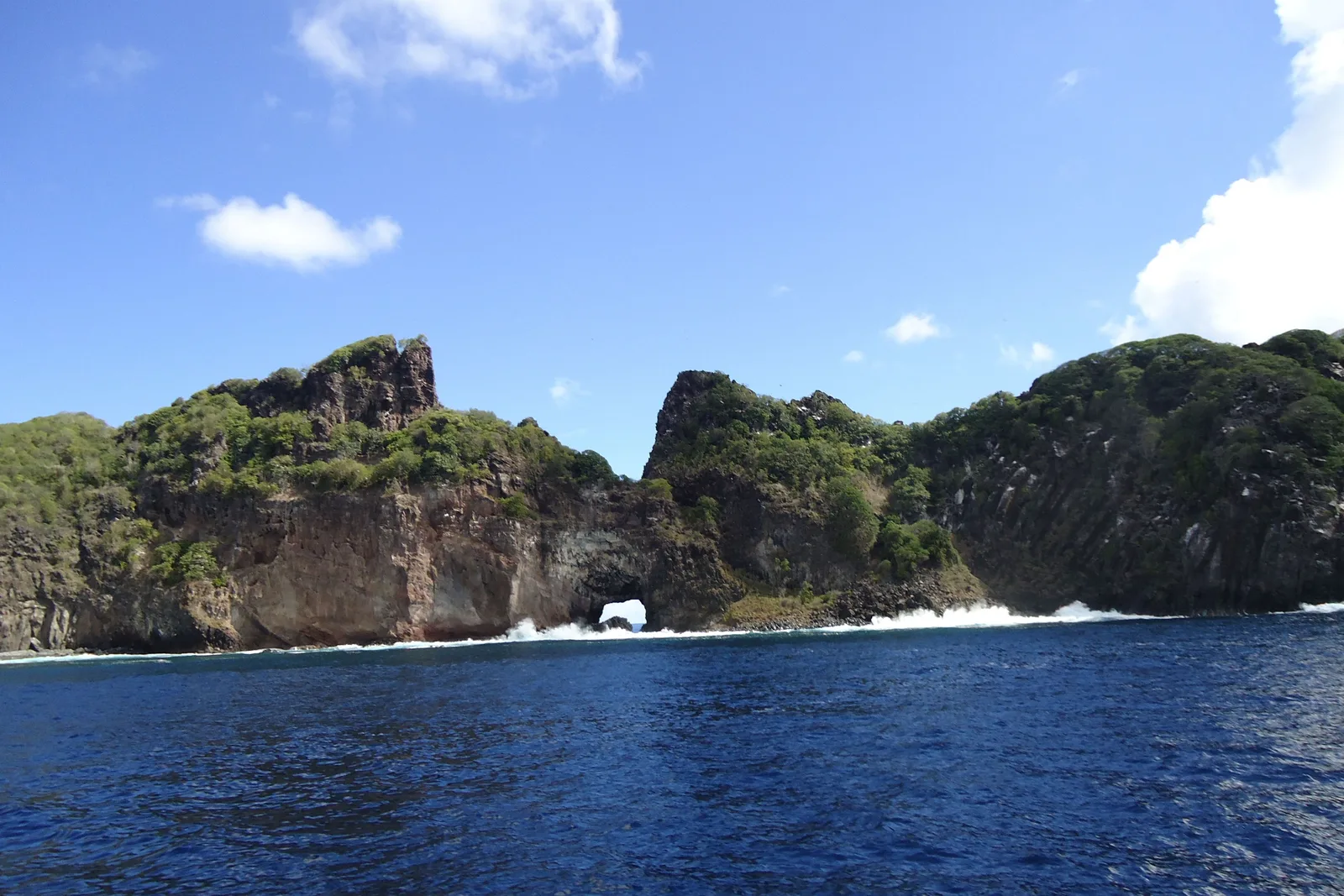
  • The cliffs at Ponta da Sapata seen from the water, with a natural rock arch punched through one headland and deep blue sea in the foreground

    The western tip · by boat or on foot

    Ponta da Sapata

    The far western end of the island, where the cliffs break up into stacks and a natural arch stands out of the water. Most people see it from the boat trip, which turns around here, and the walk out is long and exposed. It is the least developed corner of an island that has very little development anywhere.

Wildlife

  • Two Projeto Tamar researchers in the shallows at Baía do Sueste, one standing waist-deep and the other submerged to the shoulders in a mask and snorkel, handling a green turtle at the surface

    Baía do Sueste · a morning

    Snorkeling with turtles at Baía do Sueste

    Swimming and snorkeling at Sueste are suspended for now by ICMBio, the park service, so check its notices before you plan on it; the beach stays open for walking and watching the water. When the water reopens, it is the one place you swim with green turtles here, and you do it from the beach rather than from a boat. Sueste is a shallow, protected bay on the mar de fora with a seagrass bed the turtles feed on, and it is inside the park. Projeto Tamar has worked this bay for decades and you will sometimes see researchers in the water tagging animals. Mask and snorkel rental is available at the entrance and a life jacket is required.

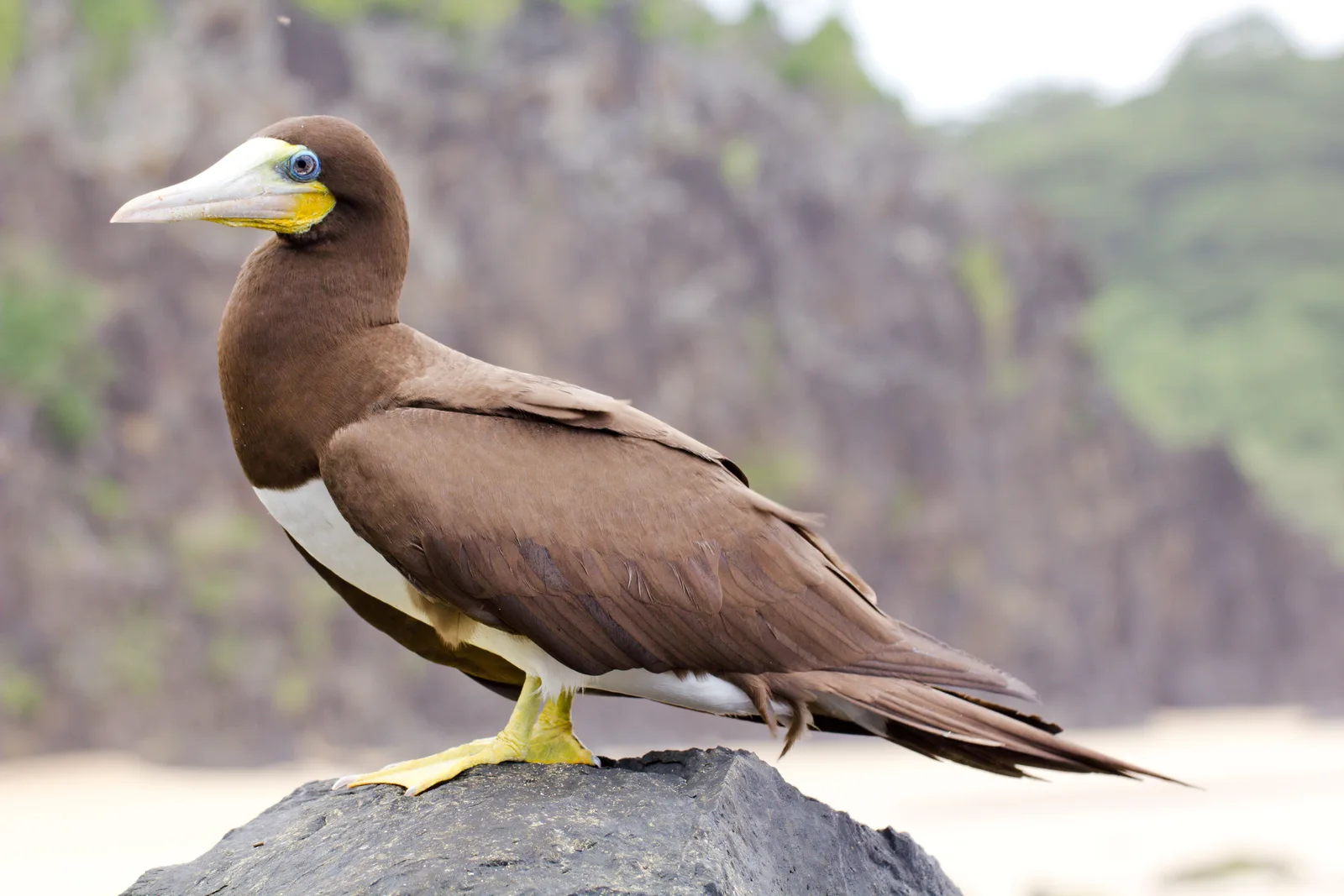
  • A brown booby standing on a gray rock in close-up, its pale yellow bill and white belly sharp against a soft background of green hillside and pale tan sand

    All over the island · free

    Seabirds at the cliffs

    Noronha is one of the most important seabird breeding sites in the tropical South Atlantic, and you do not have to look for them. Brown and masked boobies, frigatebirds, noddies and white terns nest on the cliffs and the offshore rocks and are visible from every viewpoint on the island. Bring whatever binoculars you own.

  • A steep uninhabited rock island of the archipelago rising out of blue water, its top covered in low green vegetation, with a second island behind it

    From the boat trip · no landing

    The secondary islands

    Twenty of the twenty-one islands in the archipelago have nobody on them, and the boat trip runs past several. Rata, Sela Gineta, Cabeluda and the Dois Irmãos rocks themselves are closed to landing and are where much of the birdlife actually breeds. They are also the clearest way to see that this is a volcano with its top above water rather than a beach that happens to be far away.

Village & Forts

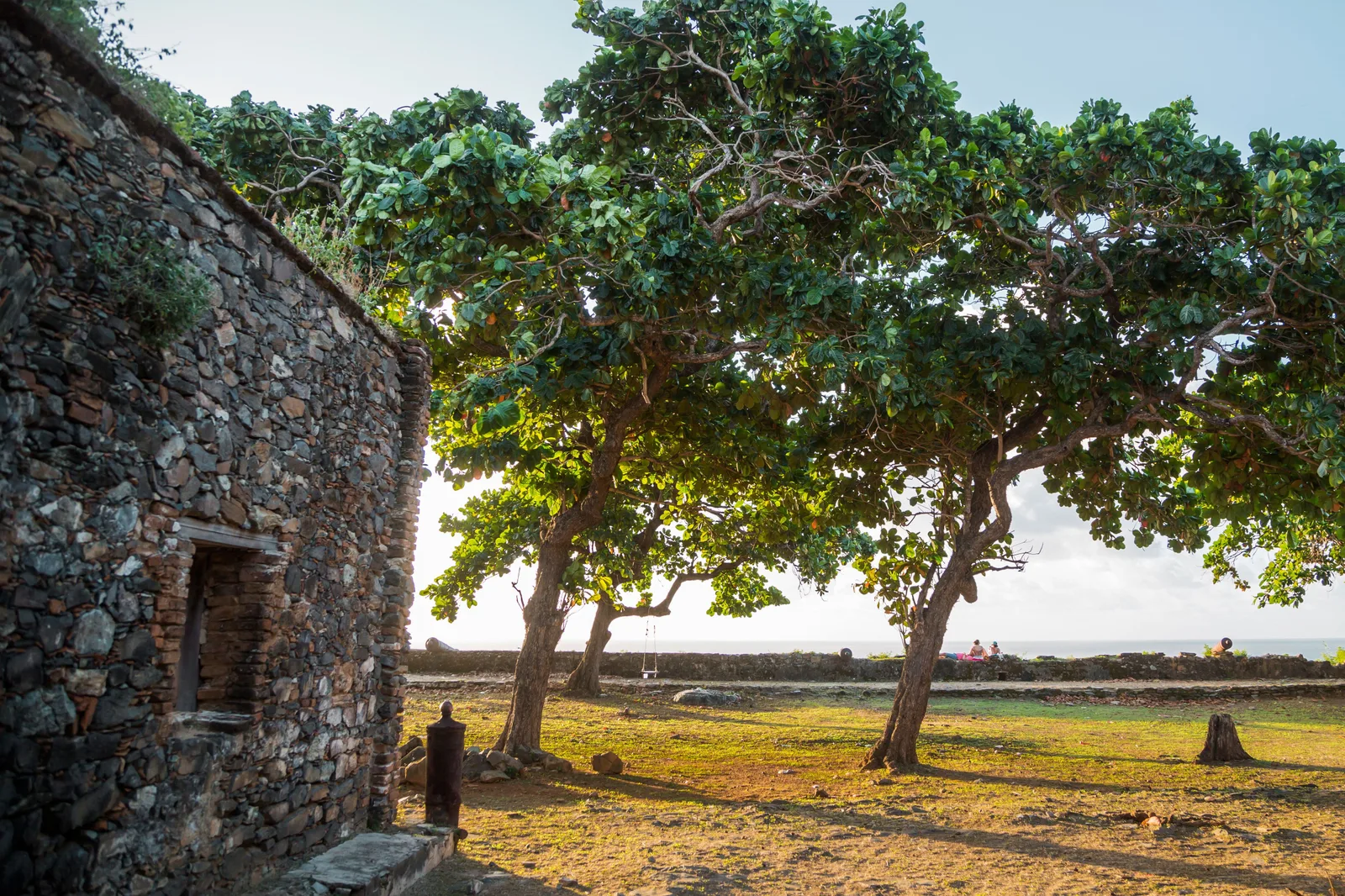
  • A weathered stone wall of the Forte dos Remédios with a low doorway in it, standing among broad shade trees on rough grass with the sea beyond

    Above Vila dos Remédios · an hour

    The Forte dos Remédios

    The largest of the island’s Portuguese forts, built in the eighteenth century to keep other European powers off an archipelago that had already changed hands several times. It later became part of the penal colony, and the walls, the gun positions and the cells are all still there in various states of ruin, above the village and looking out to sea. Free, unfenced and best in the late afternoon.

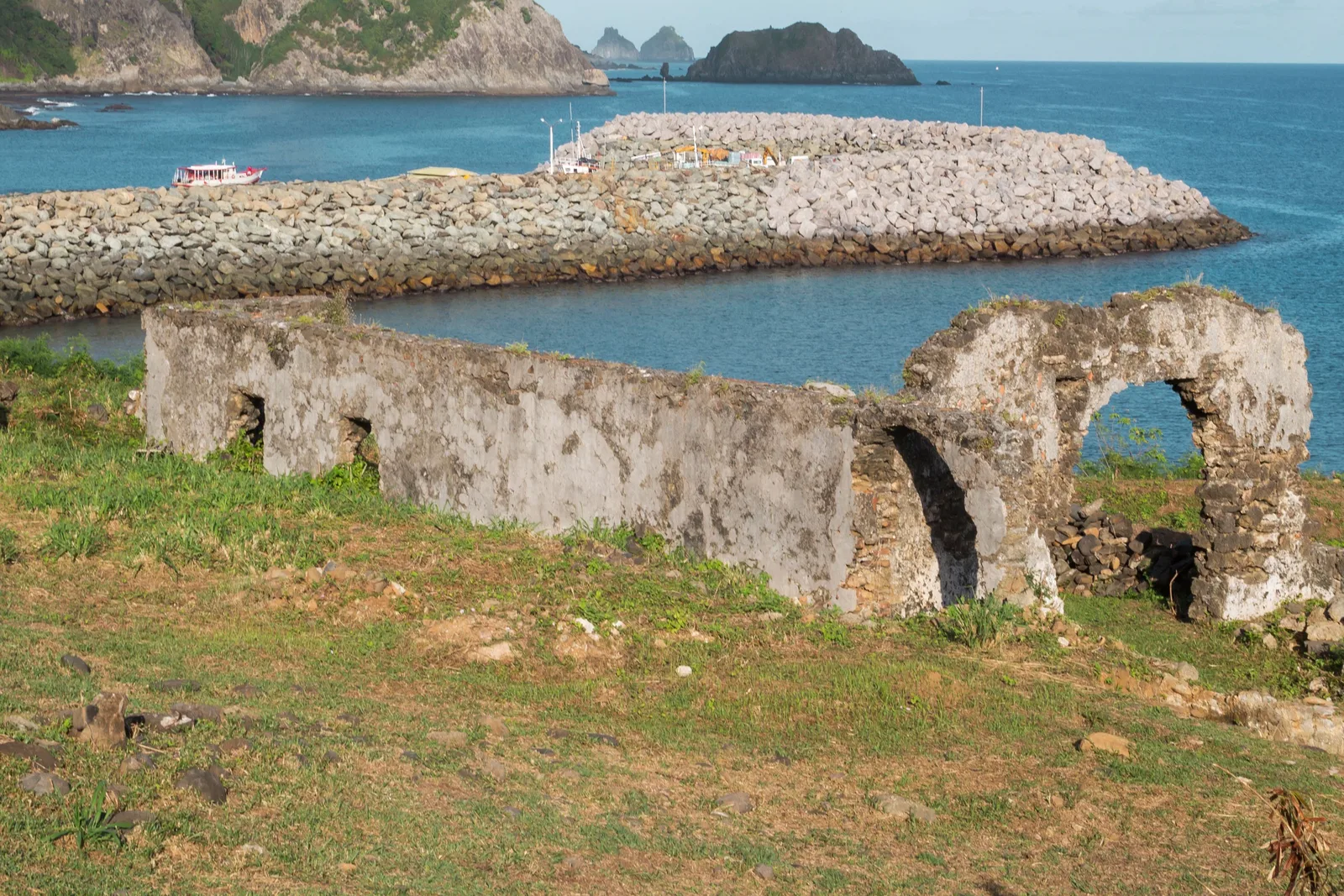
  • The ruined stone arches of the Forte de Santo Antônio standing on rough grass above the harbor, with the long breakwater and calm water behind them

    Forte de Santo Antônio · half an hour

    The ruins above the port

    A second, smaller fort on the headland above Porto de Santo Antônio, reduced to arches and foundations on a grass slope with the harbor breakwater below it. It takes twenty minutes and it is the best short walk on the island for understanding why anyone bothered fortifying a rock in the middle of the ocean.

  • Porto de Santo Antônio from the hillside above: a long stone breakwater curving into flat blue water, low port buildings and the spike of Morro do Pico behind

    Porto de Santo Antônio · early morning

    The port at Santo Antônio

    Where every boat trip and every dive leaves from, and where the island’s supplies come in. It is a working harbor rather than a marina, with a long breakwater, a slipway and Morro do Pico standing behind it, and it is worth being there at 7:00am even if you are not getting on a boat. The stretch of sand beside it, Praia do Porto, is the calmest water on the island.

Where to stay

You are staying in somebody’s house.

Noronha has almost no hotels. What it has is the pousada domiciliar, a licensed guest room in a resident’s home, classified by the island administration together with the state tourism board, the environment agency, the fire department and sanitary surveillance. The grades are dolphins rather than stars and the top mark is three. Every legal bed on the island is on that register, the register is finite, and it is the second half of the visitor cap: you cannot rent a spare room from a stranger here, by design. That is also why you book early. The three zones below are all on the north side of the island and none of them is more than about two kilometers from another.

Drag and zoom to explore.

Tap an area to open it and see it on the map

  • Best for: Walking to dinner

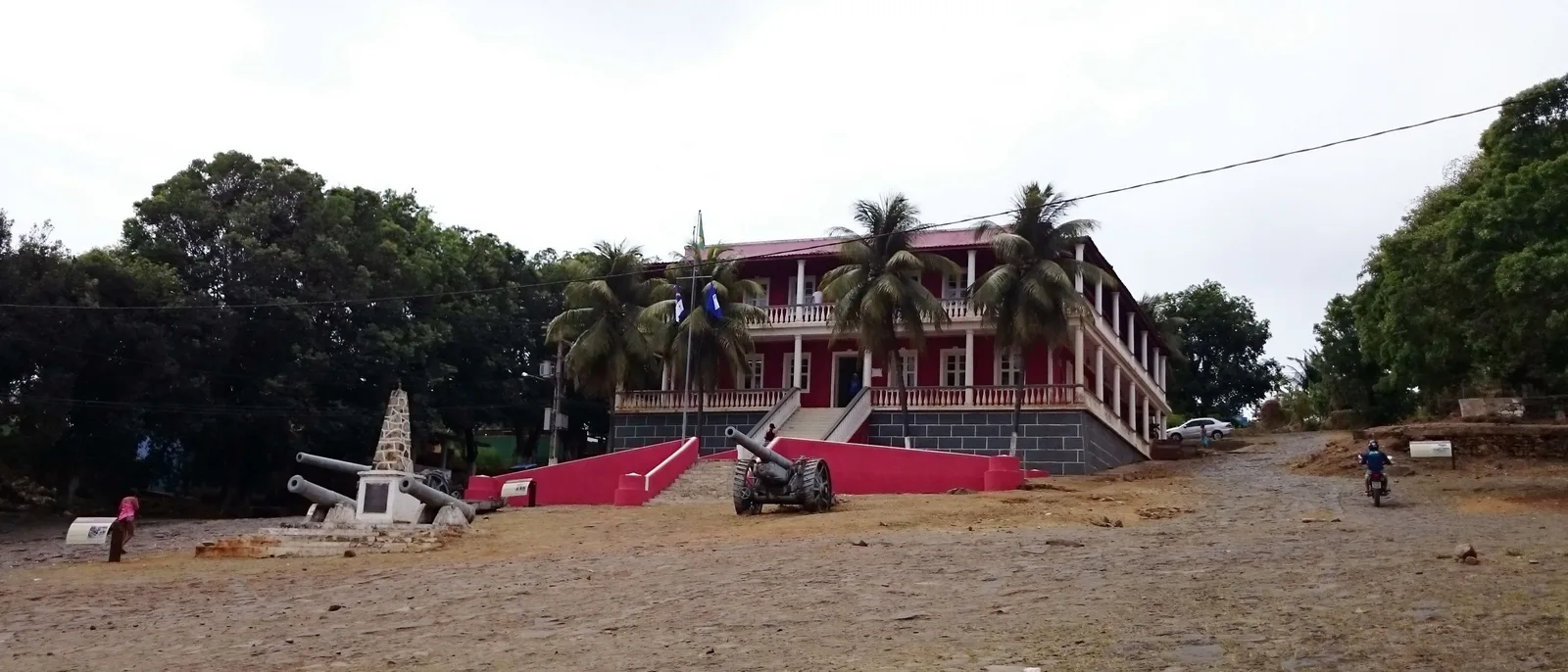
    The red and white two-story administration building of Fernando de Noronha behind a row of palms, with old cannon and a monument on the red-earth plaza in front of it

    The historic center and the only part of the island with an evening. The restaurants, the bars, the church, the fort and the shops are all here, Praia do Cachorro is at the bottom of the hill, and Praia do Meio and Conceição are a walk away. It is the one zone where you genuinely do not need a vehicle. It is also the noisiest by island standards, which means you can hear a bar, and the rooms tend to cost more for the location.

    • Restaurants and bars
    • Walkable
    • Historic center
    • No vehicle needed
  • Our pick

    Best for: The most rooms at the best prices

    The dark pointed silhouette of Morro do Pico against a low sun and broken cloud, seen across the wooded interior of the island with the sea beyond

    The residential belt immediately behind the village, and where most of the licensed pousadas actually are. Floresta Velha is the quiet, tree-lined half under Morro do Pico; Floresta Nova is the newer half with the biggest concentration of guesthouses; Vila do Trinta sits just along from both and is consistently named among the cheapest places to sleep on the island. All three are ten to twenty minutes on foot from the restaurants, which is the right trade on an island where a bed is the largest thing you pay for after the flight.

    • Most pousadas
    • Cheapest beds
    • Short walk to the village
    • Quiet
  • Best for: Quiet, and being first to the park

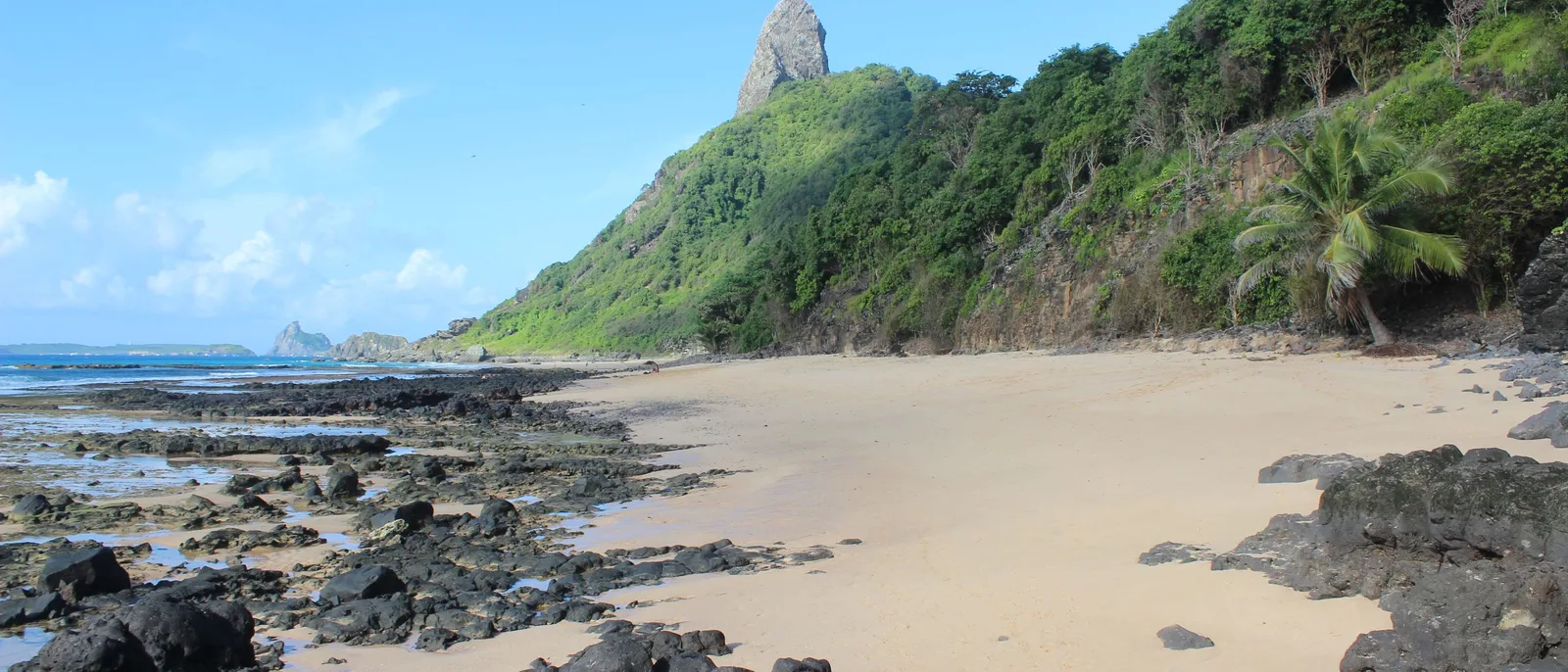
    The beach at Praia do Boldró in a wide frame: pale sand and black volcanic rock in the foreground, a steep green hillside and the peak of Morro do Pico rising behind it

    Further along the north coast, next to Praia do Boldró, the park visitor center and the Projeto Tamar base, and a short run from the sunset viewpoint at the Mirante Dois Irmãos. It is quieter than the village, it has some of the better rooms on the island, and it puts you at the park end of the road rather than the town end. The trade is that dinner is a taxi or a buggy ride, and on an island that eats early that matters more than the distance suggests.

    • Quiet
    • Park visitor center
    • Sunset viewpoints
    • Wheels recommended

A working plan

Five days, and the fifth one is cheaper than the first.

Four nights is the honest minimum and five is better, because the tax stops being flat on day five and the park ticket runs for ten. Keep one day loose: if the swell is up on the mar de dentro, the whole plan flips to the ocean side.

  1. 01
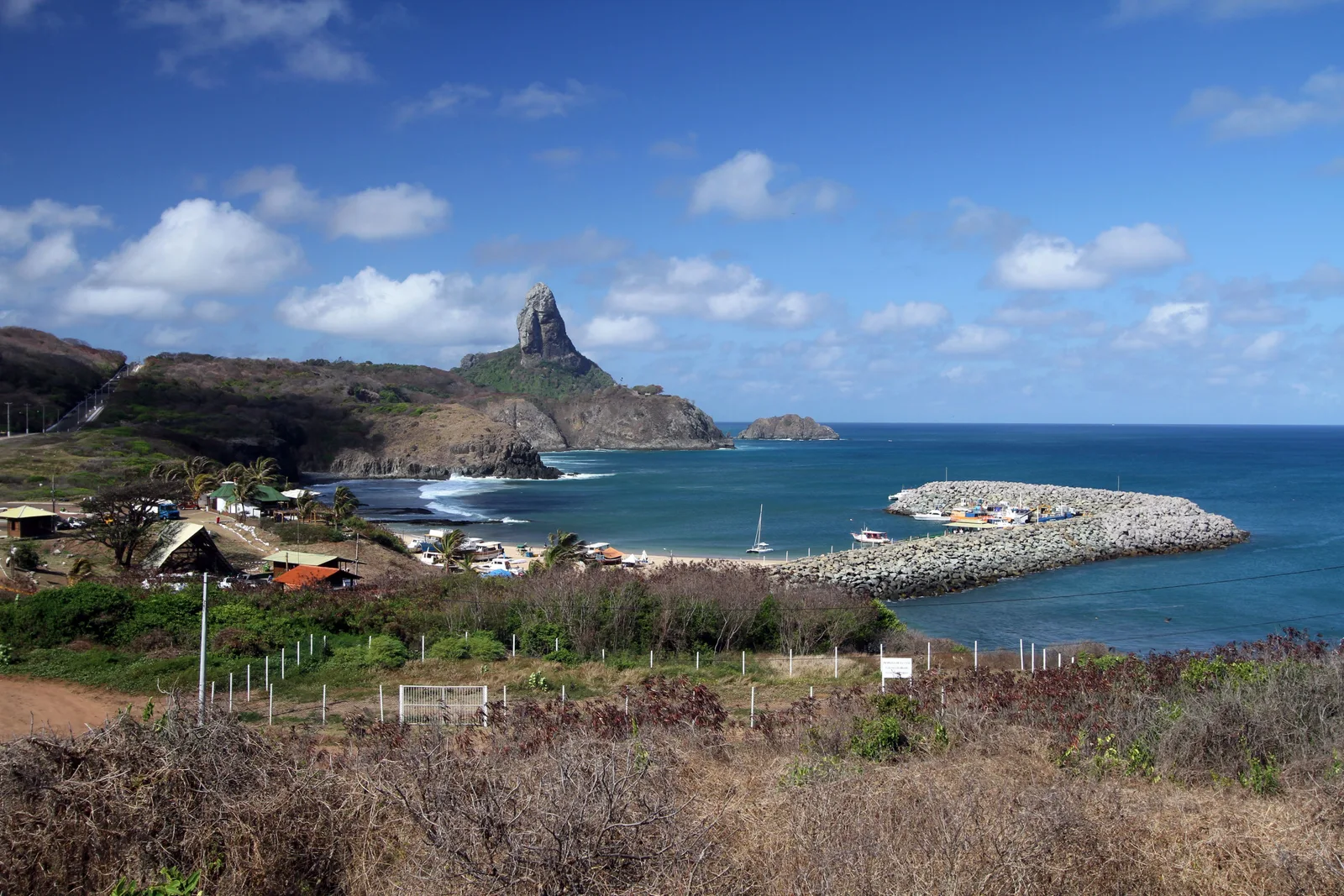
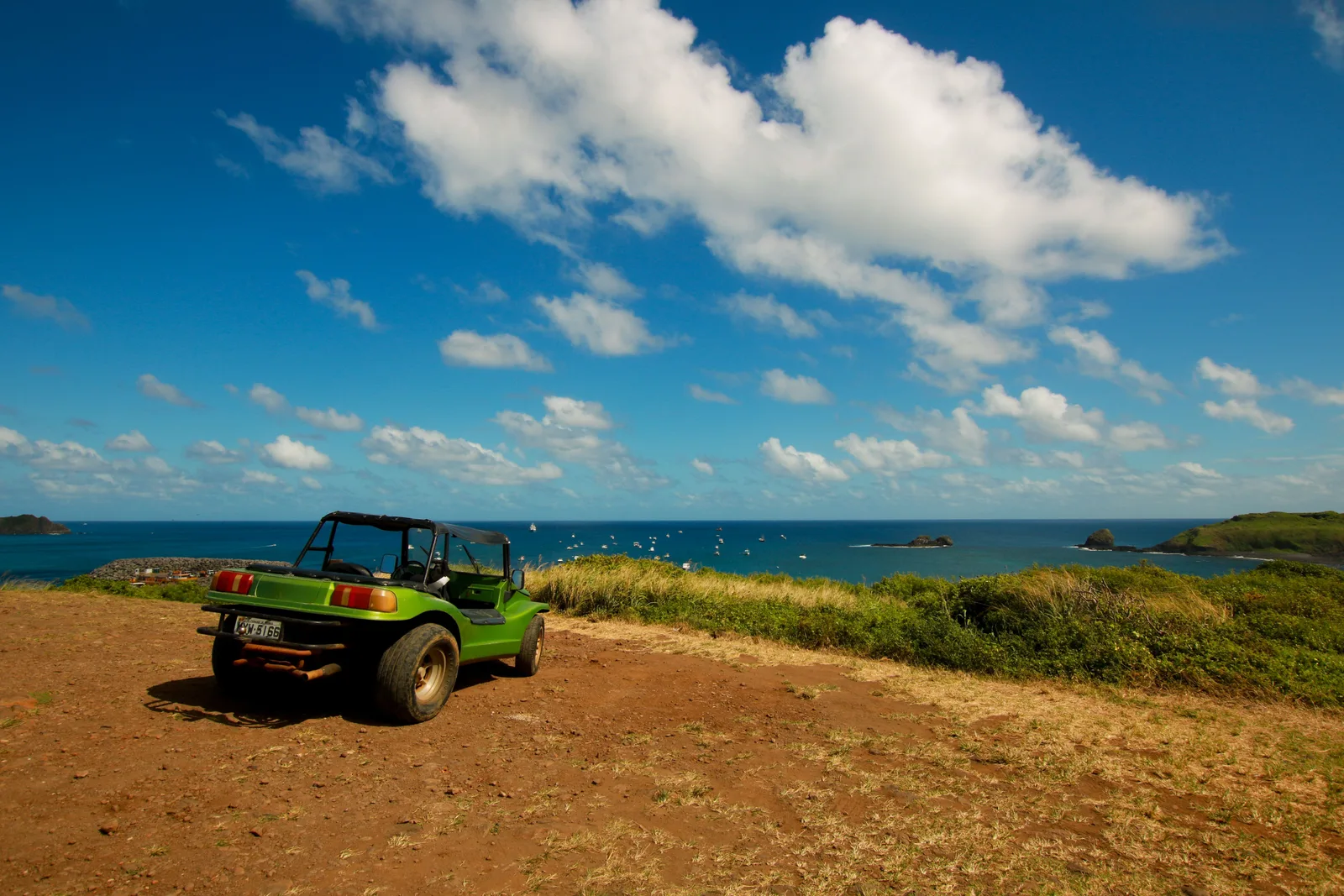
    A green open-topped buggy parked on a dirt track on a headland above the sea, under a blue sky with white cumulus

    Vila dos Remédios

    Land, collect the buggy, walk the village

    Pay the environmental tax at the airport counter (a US card cannot pay it online), pick up the buggy, and spend the afternoon on foot: the church, the fort above it, Praia do Cachorro and Praia do Meio. Start your park ticket tomorrow, not today.

  2. 02
    The bay at Baía do Sancho from the clifftop path, a curve of pale sand below bare trees with turquoise water running out to deeper blue

    Porto de Santo Antônio & Baía do Sancho

    The boat, then Sancho

    The 7:30am boat down the mar de dentro with a snorkeling stop and a real chance of spinner dolphins, back by lunch. Then the ladder down to Sancho in the afternoon, when the boat crowds have gone. This is the day the park ticket earns itself.

  3. 03
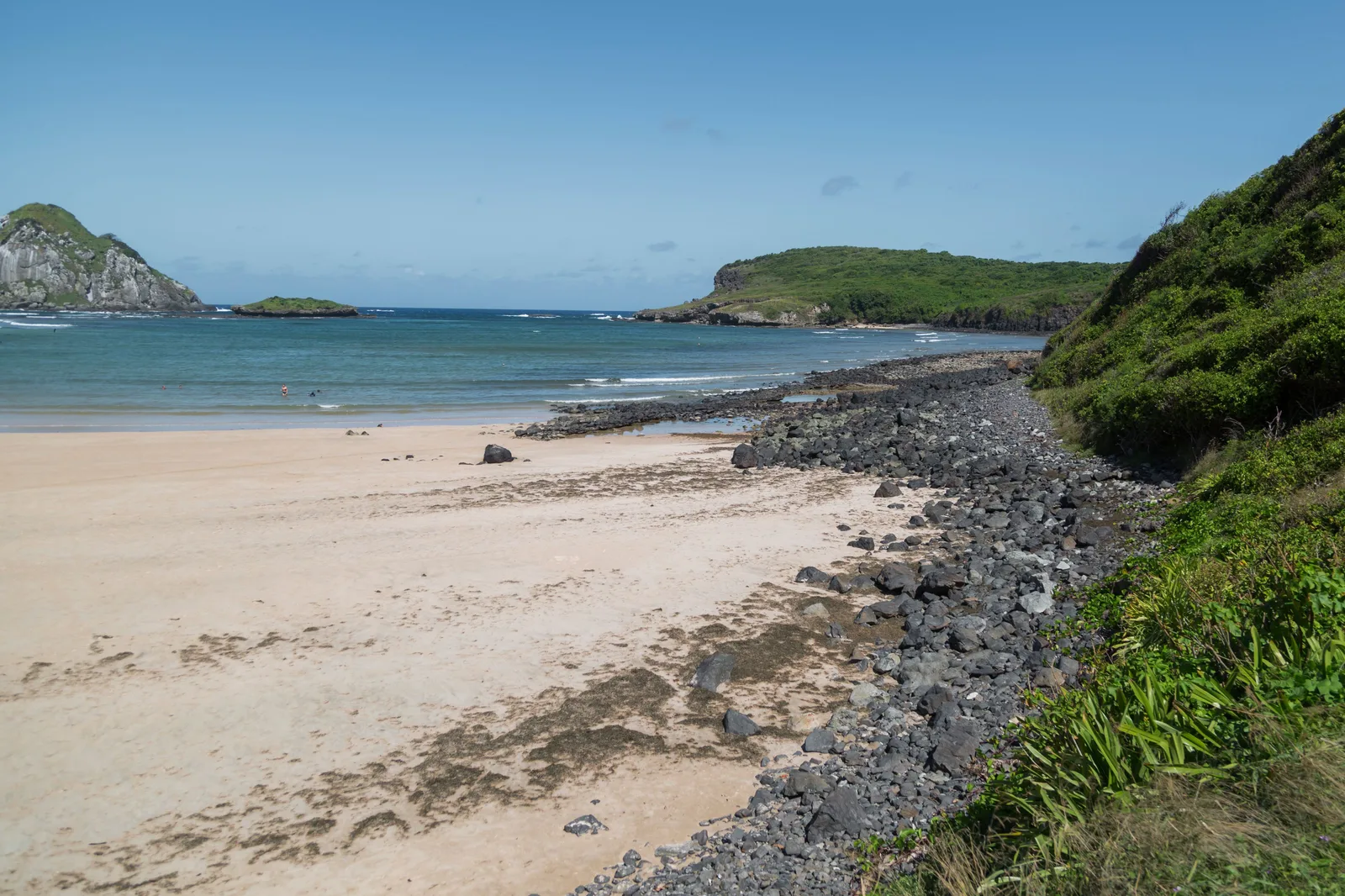
    The beach at Baía do Sueste: pale sand and scattered dark rocks in the foreground, a green hill on the right and low islands out on the water

    Baía do Sueste & Atalaia

    The ocean side and the turtles

    Cross to the mar de fora. Walk the beach at Sueste in the morning (its water is closed to swimming for now; if ICMBio has reopened it, snorkel with the green turtles over the seagrass), then the booked slot at the Atalaia pool, with no sunscreen on. This is the side of the island that works when the other side has swell on it.

  4. 04
    Praia do Leão from the rocks at one end, a long pale beach with a dark island standing offshore and pale green water over the reef

    The dive sites & Praia do Leão

    Dive in the morning, Leão after

    The 7:30am boat dive, which is the biggest single thing you will spend money on here and the reason a lot of people come. Then out to Praia do Leão for the emptiest beach on the island, and back for the sunset at the Mirante Dois Irmãos.

  5. 05
    The sun low over the sea seen from a clifftop above Praia do Boldró, warm light across the water and the beach curving away below

    Capim Açu or Pontinha Caieira, then Boldró

    A trail, and the last sunset

    One of the long guided trails on the southern shore, out early before the sun gets up. Back to Boldró or Conceição for the afternoon, and the last sunset from the beach rather than the viewpoint. Fly out tomorrow with a buffer day booked on the mainland.

This is a starting shape, not a fixed departure — we rearrange it around your dates. Have it built for you

Timing

Two peaks, and they are for two different trips.

Noronha is a mid-ocean archipelago and its year does not follow the coast facing it. The wet season runs February to July and peaks in April at 243 mm; the dry season runs August to January and bottoms out in October and November, at 9.5 and 9.3 mm on the Pernambuco state atlas. Air temperature barely moves, 24 to 31 degrees in every month, and the sea sits between 27 and 29 all year. What actually changes is the sea state, and that is what decides which of the two starred months you want.

Rainfall, rain days, air and sea temperature and UV for Fernando de Noronha, month by month. Choose a month to see what the weather is doing then.

January

Good
Air
25–30°C 77–86°F
Sea
28°C 82°F
UV
11 Extreme
Rain
5 days 67 mm / 2.6 in

Hot, bright and full. Brazilian summer holidays, peak prices, and swell still running on the mar de dentro.

February

Trade-offs
Air
25–31°C 77–88°F
Sea
28°C 82°F
UV
11 Extreme
Rain
7 days 77 mm / 3.0 in

The best month of the year for surfing and one of the worst for visibility. Carnival crowds on a capped island.

March

Trade-offs
Air
25–31°C 77–88°F
Sea
29°C 84°F
UV
11 Extreme
Rain
14 days 166 mm / 6.5 in

The rain steps up sharply and the wet season is properly under way. The surf is still good and the prices have started to fall.

April

Trade-offs
Air
25–30°C 77–86°F
Sea
29°C 84°F
UV
10 Very high
Rain
16 days 243 mm / 9.6 in

The wettest month of the year, 243 mm across sixteen days. The last of the swell, and the mar de dentro is going flat.

May

Trade-offs
Air
25–30°C 77–86°F
Sea
29°C 84°F
UV
10 Very high
Rain
14 days 206 mm / 8.1 in

Still very wet. The island is quiet, the water is calm and the rooms are at their cheapest.

June

Trade-offs
Air
25–29°C 77–84°F
Sea
28°C 82°F
UV
9 Very high
Rain
13 days 206 mm / 8.1 in

Level with May on rainfall. Low season, flat sea, and the fewest visitors of the year.

July

Trade-offs
Air
24–29°C 75–84°F
Sea
27°C 81°F
UV
9 Very high
Rain
13 days 179 mm / 7.0 in

The last wet month, easing late. Brazilian school holidays put some pressure back on the flights.

August

Good
Air
24–29°C 75–84°F
Sea
27°C 81°F
UV
10 Very high
Rain
11 days 61 mm / 2.4 in

The rain falls away to 61 mm and the dry season opens. The sea is calm and the visibility is coming back.

September

Good
Air
25–29°C 77–84°F
Sea
27°C 81°F
UV
11 Extreme
Rain
6 days 26 mm / 1.0 in

Dry, calm and quiet, and the first month of the good underwater window. One of the best value months here.

October

Best
Air
25–30°C 77–86°F
Sea
27°C 81°F
UV
11 Extreme
Rain
3 days 10 mm / 0.4 in

The peak for the water: 9.5 mm across three rain days, and the sunniest month of the year at 285 hours on the NOAA 1961–1990 series. Calm sea, clear water, no holiday crowds.

November

Good
Air
25–30°C 77–86°F
Sea
27°C 81°F
UV
11 Extreme
Rain
2 days 9 mm / 0.4 in

The driest month of the year on the 1991–2020 normals, 9.3 mm across two days, and the second sunniest. Still ahead of the holiday pricing.

December

Good
Air
25–31°C 77–88°F
Sea
27°C 81°F
UV
10 Very high
Rain
2 days 10 mm / 0.4 in

Dry, 10.4 mm across two days, and the month the swell arrives. Great if you surf. If you came for Sancho and the diving, October and November are the same weather with better water and lower prices.

  • Best The one or two peak months
  • Good A real recommendation
  • Trade-offs Workable, with a catch
See Fernando de Noronha on the Brazil calendar

UV is the monthly average of the daily peak, 2022 to 2025, calculated from Copernicus Atmosphere Monitoring Service data. Weather data by Open-Meteo.com, CC BY 4.0.

For clear water and the beaches

September–November

The end of the dry season, before the swell reaches the mar de dentro. October is 9.5 mm across three rain days and the sunniest month of the year at 285 hours on the NOAA 1961–1990 series. This is the window for diving, snorkeling and Sancho.

For surfing

December–March

Swell arrives on the mar de dentro and Cacimba do Padre becomes one of the best waves in Brazil, up to twelve feet, best in February and March. The same swell moves the seabed and cuts underwater visibility, and it is the most expensive and most crowded stretch of the year.

The wet season

February–July

April is the wettest month at 243 mm across sixteen rain days, with March, May, June and July all above 165 mm. It is also the cheapest and quietest time to be here, and the mar de dentro is flat.

About the rain

The thing to understand about this island is that the rainfall table does not decide your trip. The wet season here is February to July and peaks in April, which is already the opposite of what most people expect of northeastern Brazil, and it is genuinely wet: 243 mm in April and more than 165 mm in each of March, May, June and July. But the sea is 27 to 29 degrees in every one of those months, the mar de dentro is flat, the island is empty and the rooms are half price. A wet-season week here is a compromise, not a write-off.

What does decide the trip is the swell. From roughly November to April, wind and swell reach the mar de dentro, the side of the island that carries Sancho, Baía dos Porcos, Cacimba do Padre, Conceição and Boldró. That produces a world-class surf break at Cacimba, best in February and March, and at the same time it moves the seabed around and cuts the underwater visibility that Noronha is actually famous for. The mar de fora, which carries Leão, Sueste and Atalaia, is unaffected, which is why a week with swell on it is not a lost week, it is a week spent on the other coast.

So the two starred months are two different holidays. October is the calm, clear, dry end of the season, with the best water of the year and none of the summer pricing. December is dry too, and it is when the waves and the Brazilian summer arrive together. If you are coming to dive, snorkel and look at Sancho, which is most people, come in the September to November window.

The dates worth planning around

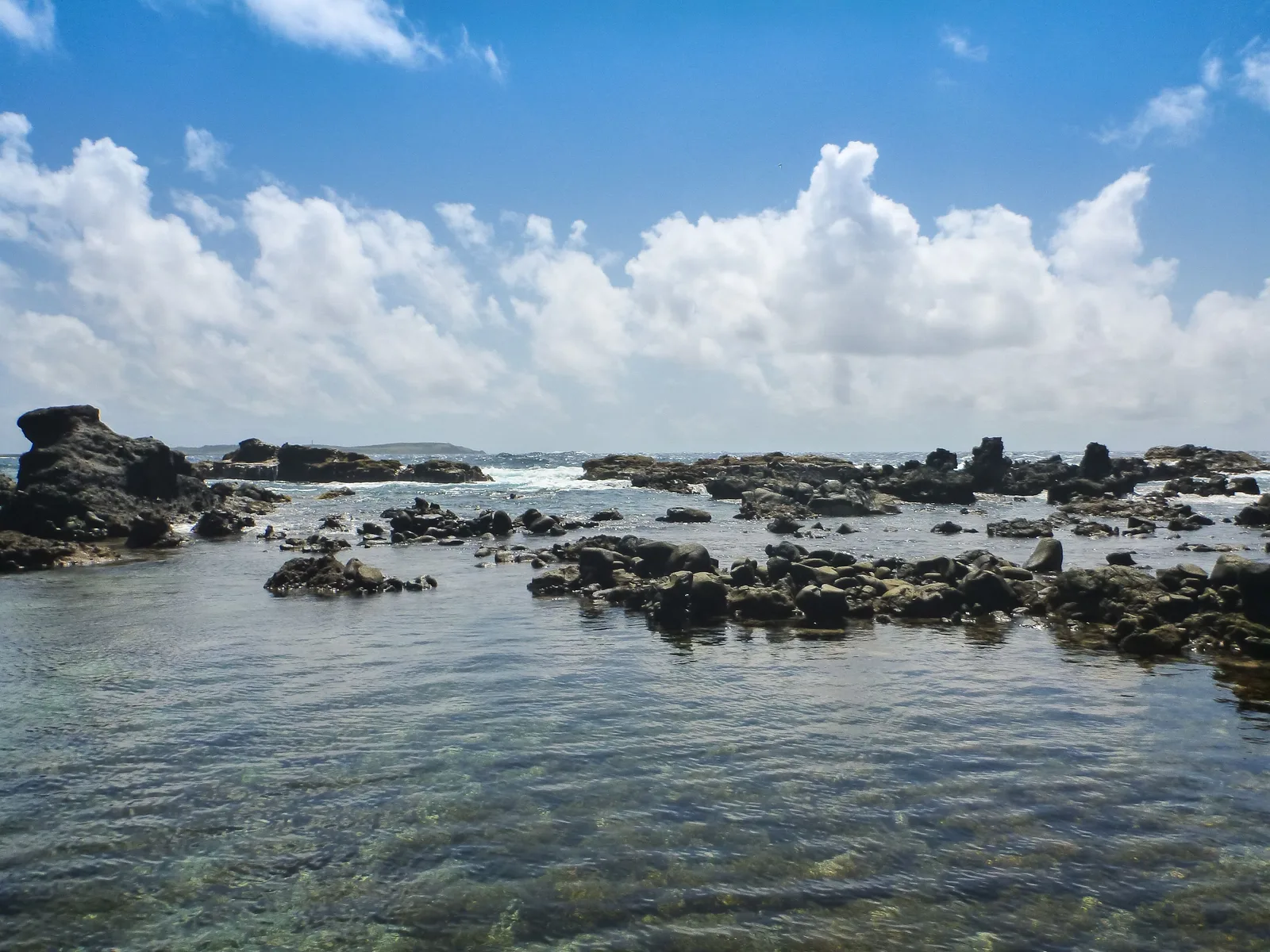
A broad shallow reef flat of clear water with dark volcanic rock breaking the surface across it, under a sky of tall white cumulus

The clear-water window

August to November, best in October

Not an event, and more important to this trip than any event. Through the dry months the swell is gone from the mar de dentro, the seabed stays where it is and the water goes glass clear, which is the condition Noronha’s diving reputation rests on. The Brazilian travel press names September, October and November as the three best months to come for exactly this. It is also, conveniently, the cheapest and quietest stretch of the dry season.

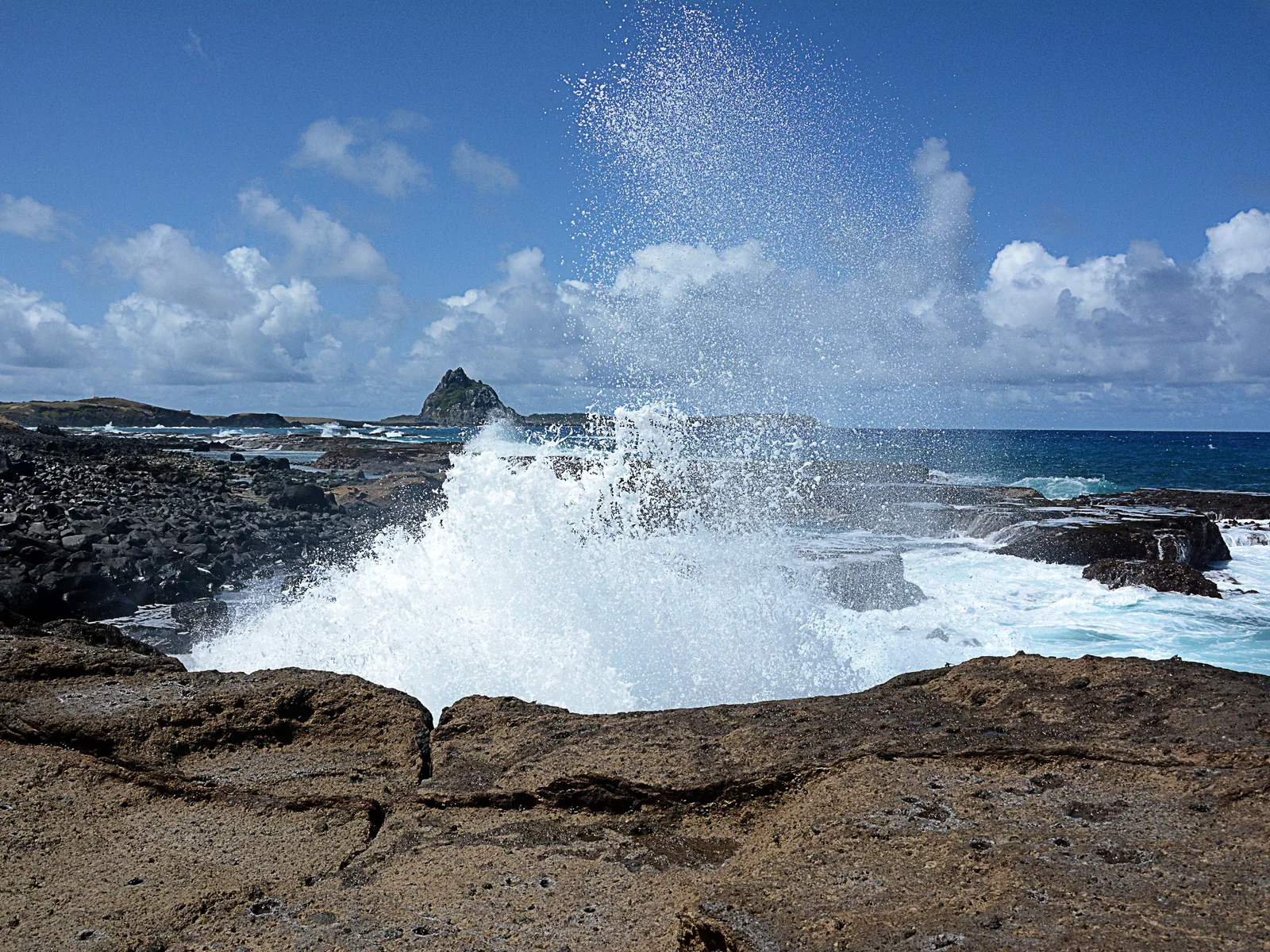
A wave bursting white and high against black volcanic rock at the shoreline, spray thrown up against a blue sky

The swell season

November to April, peaking February and March

The wind turns to the northeast and swell arrives on the mar de dentro. Cacimba do Padre gets the largest tubular waves in Brazil, a left-hander that breaks against volcanic rock and can reach twelve feet, and Conceição and Boldró both work as well. It is a genuine world-class season and it is why one of the two stars on our calendar sits in December. It is also the reason the beaches in every photograph of this island stop being swimming pools for a few months.

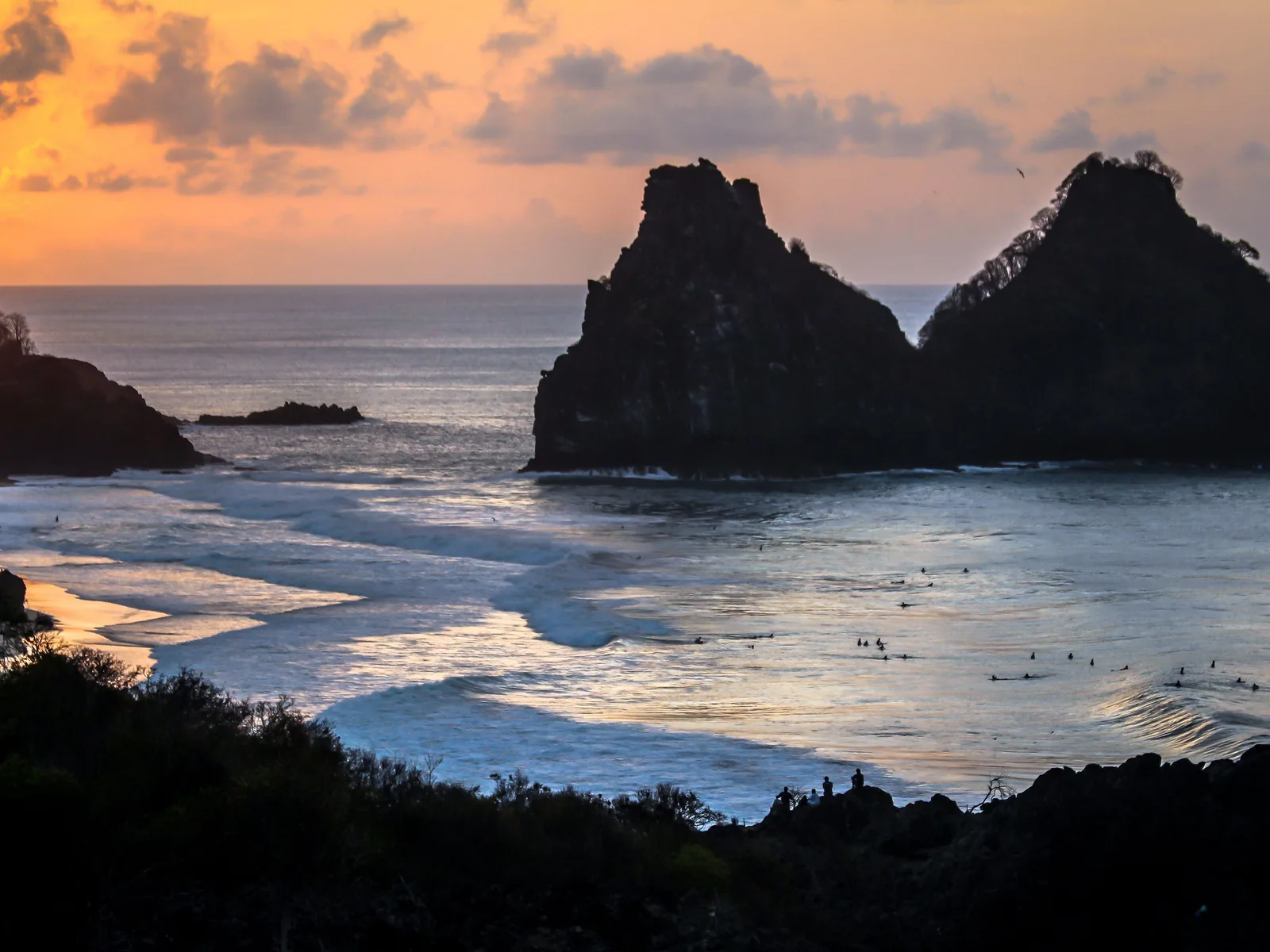
Morro Dois Irmãos in silhouette against an orange sunset at Cacimba do Padre, with surfers sitting out in the water and wet sand reflecting the sky

The high season squeeze

Mid-December to Carnival

On an island with a hard cap on beds and seats, the Brazilian summer holidays do not just make things busier, they make them scarce. Rooms and flights go early, buggy rates jump from about R$450 to R$480 a day to R$690 or R$700 over the New Year fortnight, and the environmental tax and the park fee do not move at all, so the fixed part of your bill stays the same while everything flexible climbs. If your dates are open, this is the fortnight to avoid, and September to November is the same island for a great deal less.

Good to know

Before you book

What does a week on Fernando de Noronha actually cost? +

For two people, seven nights, once you are in Brazil: roughly $1,700 lean, about $3,700 for a mid-range week, and $8,850 at the top of the market. Plan against the middle figure, and note that none of those include your flight from the United States, which is a separate ticket and for most people the biggest line of the trip. The unavoidable part is the taxes: R$2,113.70 for a couple, about $414, made up of the Pernambuco environmental tax at R$672.85 a head for seven days and the marine park ticket at R$384 a head for foreigners. Those two are paid to two different bodies on two different websites, they are non-refundable, and they are due whether it rains all week or not.

Do I need a permit to visit, and how far ahead should I book? +

There is no permit. Nobody approves you, there is no application and there is no window to miss, and any site telling you otherwise is wrong. The cap is real, about 11,000 visitors a month and roughly 132,000 a year, but it is enforced on airline seats and licensed beds rather than on visitors, so by the time you are shopping it has already been applied. What that means is that booking early is the whole game: get the flight first, because it is the bottleneck, then the pousada, then buy the park ticket online. The environmental tax you pay at the airport counter when you land, because its online payment does not take cards issued outside Brazil. We are not going to invent a number of months for you, because nobody publishes one, but the direction of travel is clear and the island took more visitors than its own limit in 2025.

When should I go, October or December? +

October, unless you surf. Both months are starred on our calendar and both are dry, but they are two different holidays. From roughly November to April a swell reaches the mar de dentro, the side of the island that carries Sancho, Baía dos Porcos, Cacimba do Padre and Conceição. That makes Cacimba one of the best waves in Brazil and at the same time stirs the seabed and cuts the underwater visibility the island is actually famous for. October and November are the calm, clear end of the dry season, 9.5 mm and 9.3 mm of rain across three days and two days, before the Brazilian summer pricing arrives. If you are coming to dive, snorkel and swim at Sancho, come then. If you are coming to surf, come in February or March.

Do I need to rent a buggy, and is it insured? +

You do not need one, and it is not insured. Take the second part seriously: rental vehicles on Noronha carry no insurance at all, and this is not a case of the renter declining cover. Insurers will not write it because there are no accredited repair shops on the island and a damaged vehicle would have to be shipped to the mainland, so the contract puts every real of any damage on you, and a credit card collision waiver is unlikely to apply. If you rent anyway, budget about R$450 to R$480 a day plus another R$82 to R$102 for fuel, and expect a three-day minimum. Plenty of people do the whole trip without one: the boat trips and tours all collect you from your pousada, there is a bus along the main road, and the village and the beaches below it are walkable.

What does the park ticket actually get me, and can I skip it? +

You cannot skip it if you want to see the island. The Parque Nacional Marinho is about seventy percent of the archipelago and the ticket is the only way in: Baía do Sancho, Baía dos Porcos, Praia do Leão, Baía do Sueste, Praia da Caieira, Ponta das Caracas, the Baía dos Golfinhos viewpoint, the park trails and the dive sites are all behind it. It is R$384 for a foreigner and R$192 for a Brazilian, and the over-60 waiver is for Brazilians only, so an American couple in their sixties pays twice at the full rate, though under-12s of any nationality go free. It is valid ten consecutive days and you choose the day the clock starts, which does not have to be your arrival day, so if you land on a Friday evening start it Saturday. One thing to watch: ICMBio’s own federal page still lists R$222 and R$111 under a 2019 regulation. That page is out of date. The concessionaire that sells the ticket charges R$384 and that is what you will pay.

Free · 29 pages

Free guide

Beginner's Guide to Brazil

A free 29-page guide to everything a first-time visitor should know before landing: visas, safety, money, getting around, where to go, and what to eat.

We'll email you a link to confirm your address. Click it and the guide opens right away.

See what's inside
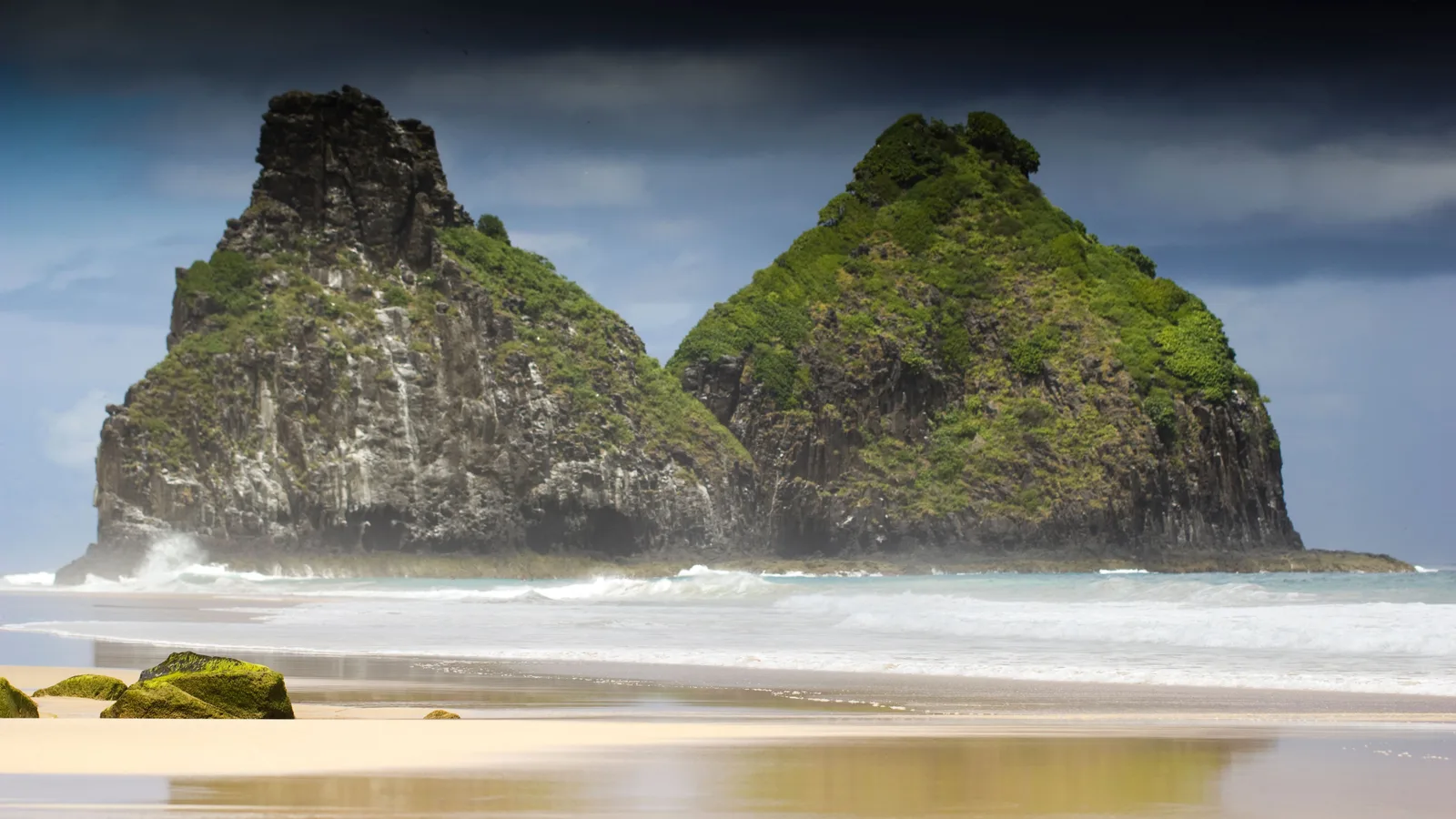
A long exposure of Morro Dois Irmãos from the beach under a dark storm sky, the twin peaks lit and green against it, and the water smoothed to a pale sheet across the sand

Skip the planning

Two taxes, one gateway, and a bed you have to book early.

Tell us your dates and we will tell you what the fees add up to for your party, whether your week lands in the clear-water window or the swell season, and how to fit Noronha together with Recife and the coast around it without wasting a day at the airport.

  • One person, living in Brazil, replying to you directly
  • A reply within one business day, no call center and no bots
  • No cost to plan, and no obligation to book
  • Built around your dates, not a fixed departure