
Skip to content
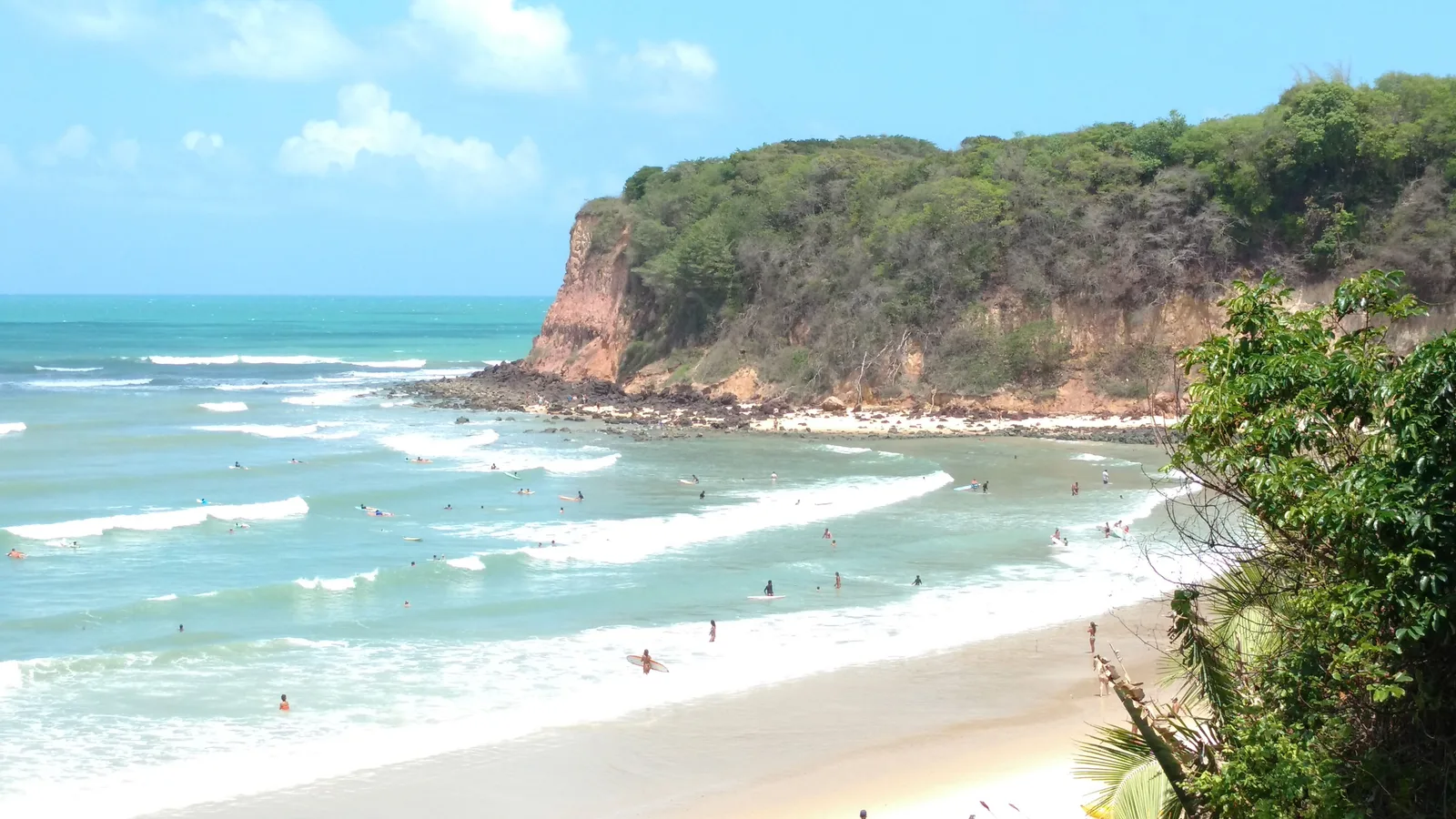
A green-topped headland with a bare red cliff face closing the far end of a beach at Pipa, dozens of surfers and swimmers spread across the turquoise water and a wide curve of pale sand in the foreground

Rio Grande do Norte

Pipa

Red cliffs, a string of coves, and resident dolphins in a bay you reach on foot at low tide.

Last checked September 2026

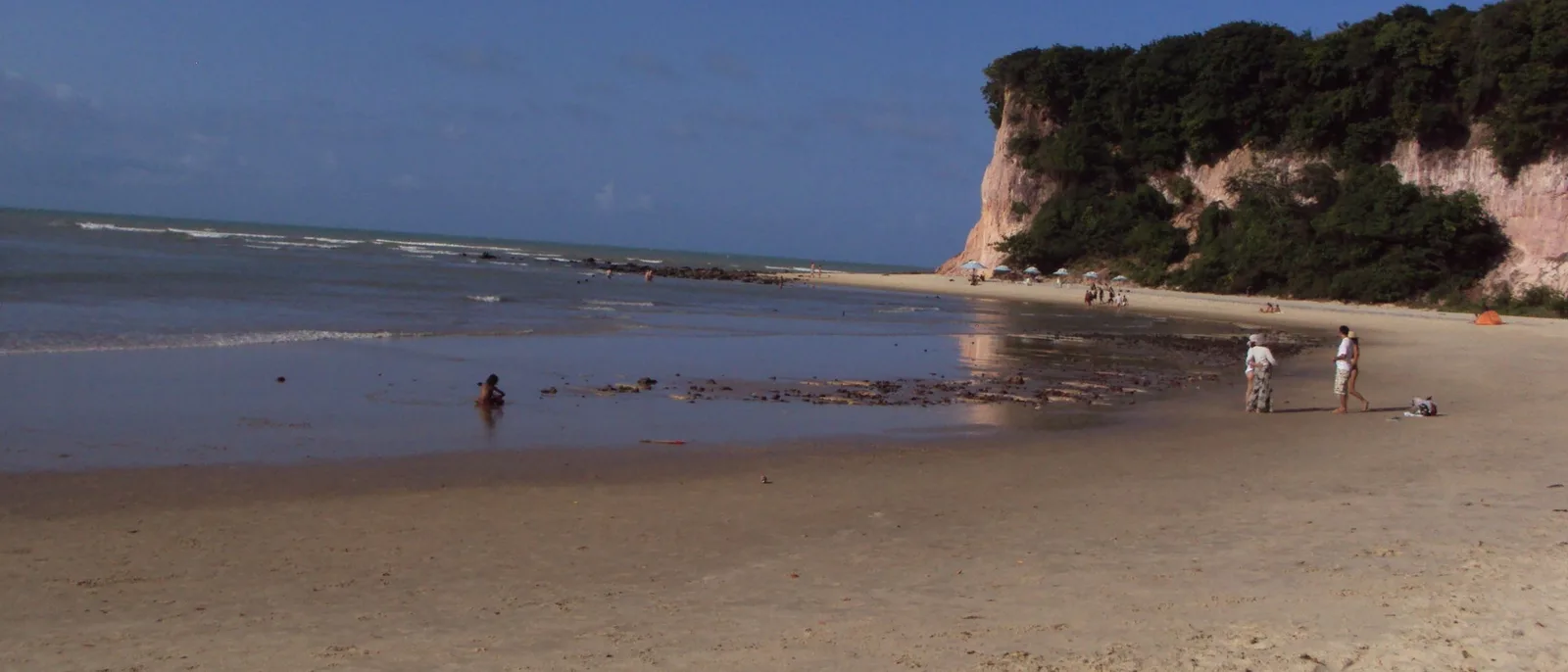
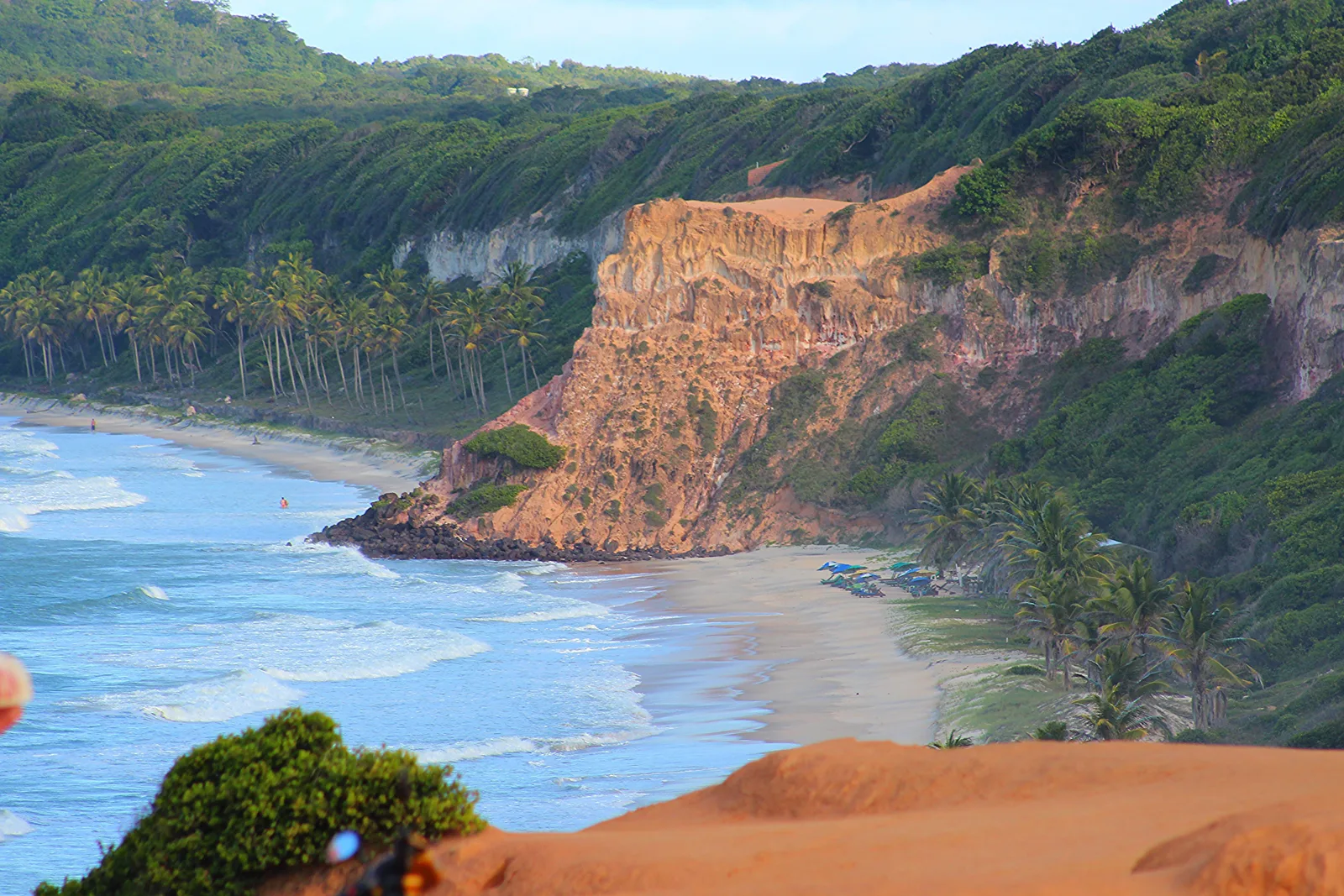
  • A beach below a tall red cliff headland at Pipa seen from a sandy clifftop, coconut palms along the back of the sand, blue parasols on the beach and surf running in from blue water
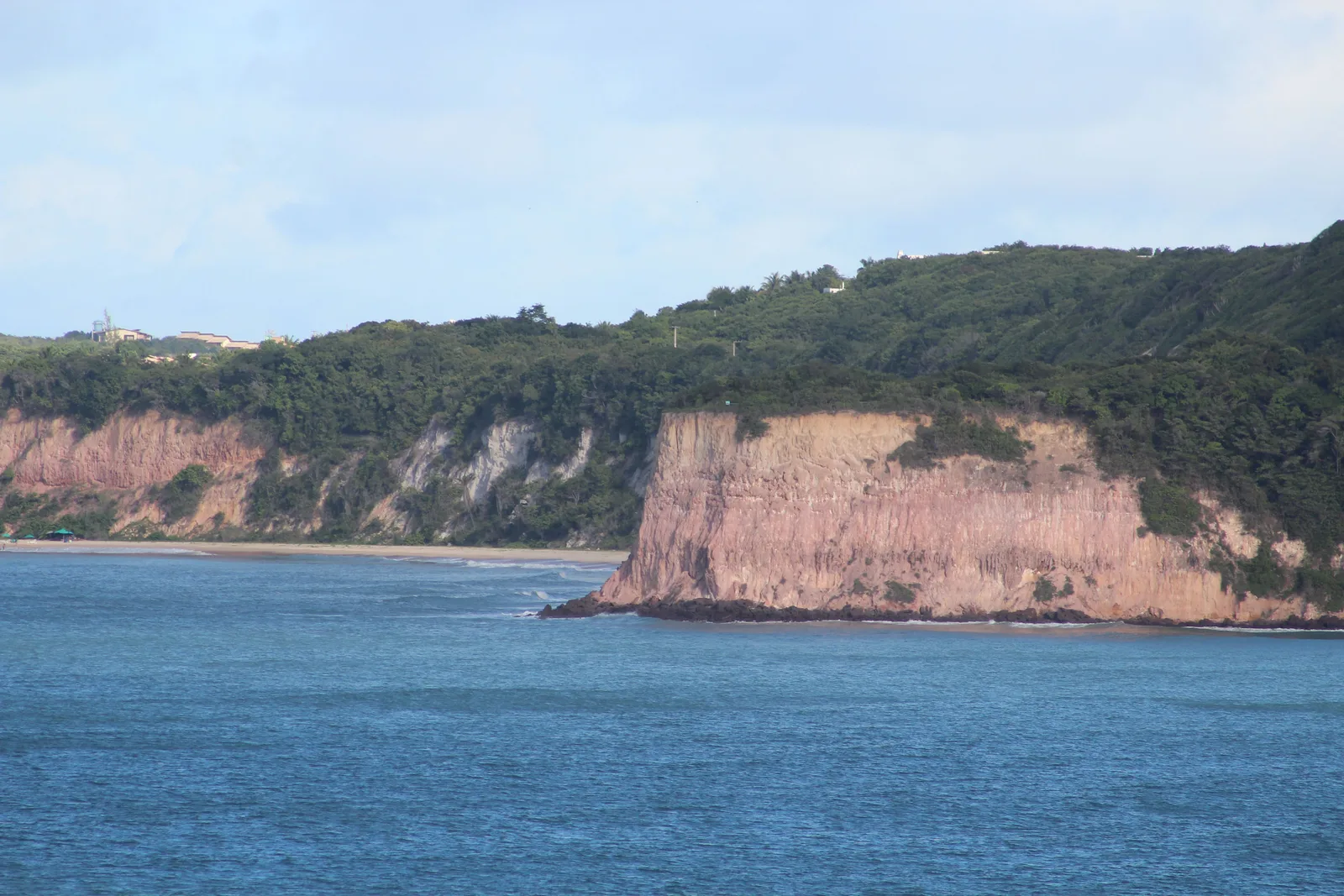
  • A long wall of pink and white cliffs at Pipa seen across open water, dense green forest running along the top of it and a strip of beach at its foot
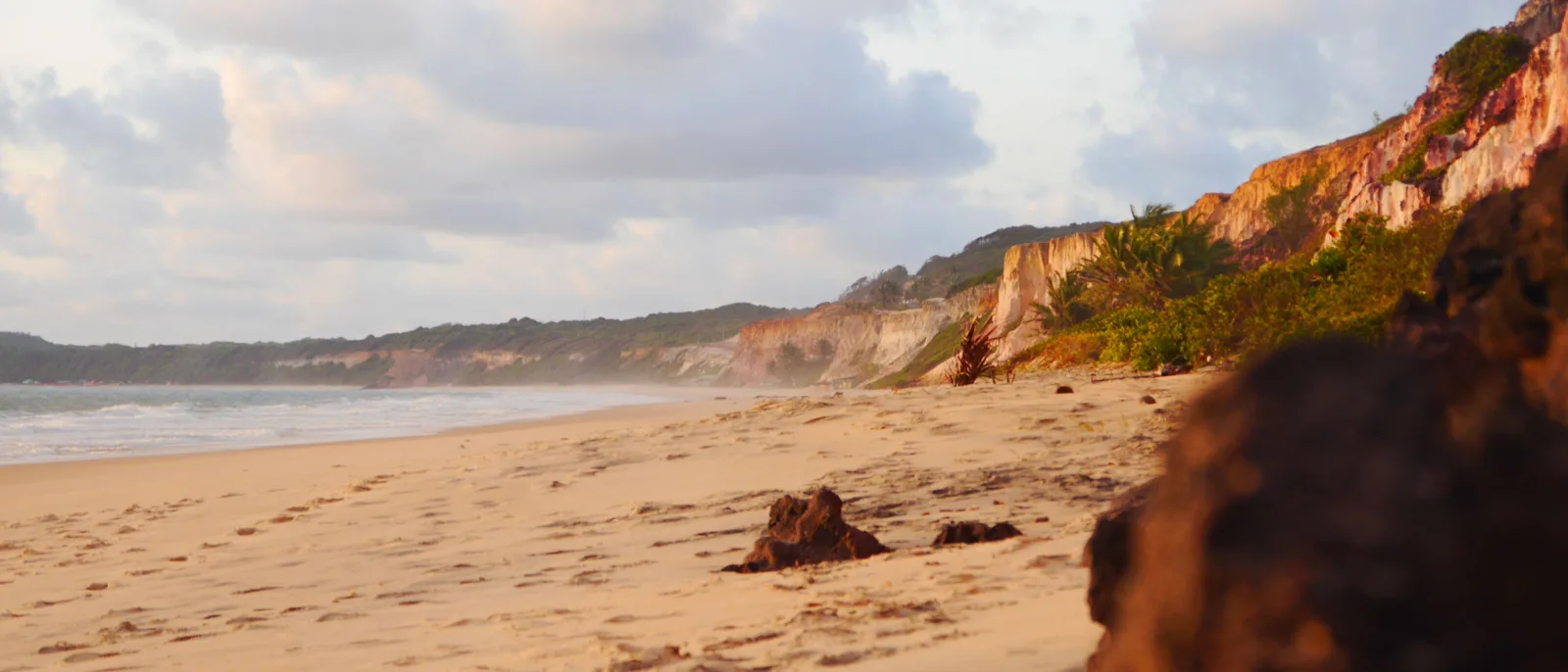
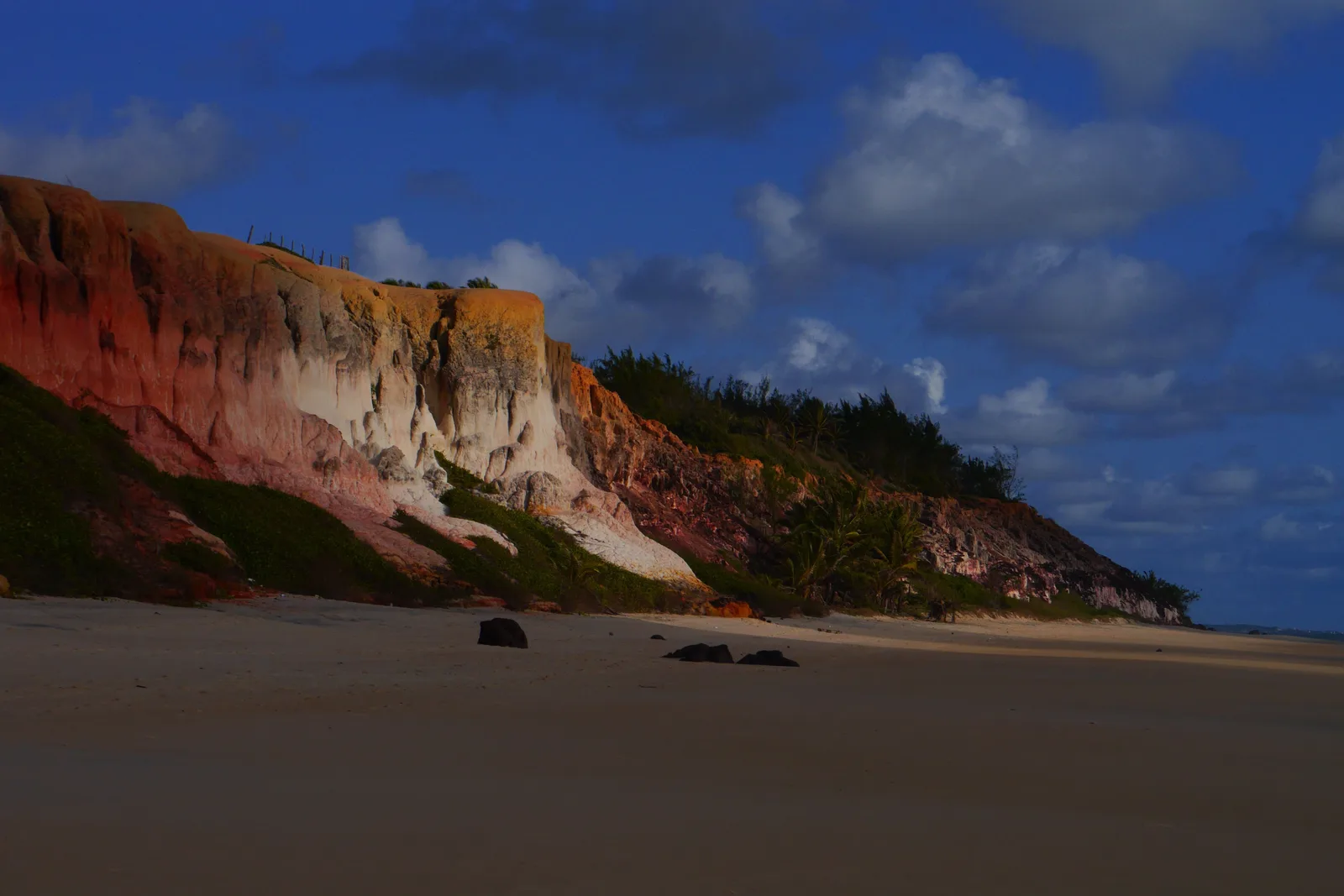
  • A banded red and cream cliff face rising straight off the sand at Praia de Cacimbinhas under a blue sky with heavy white cloud
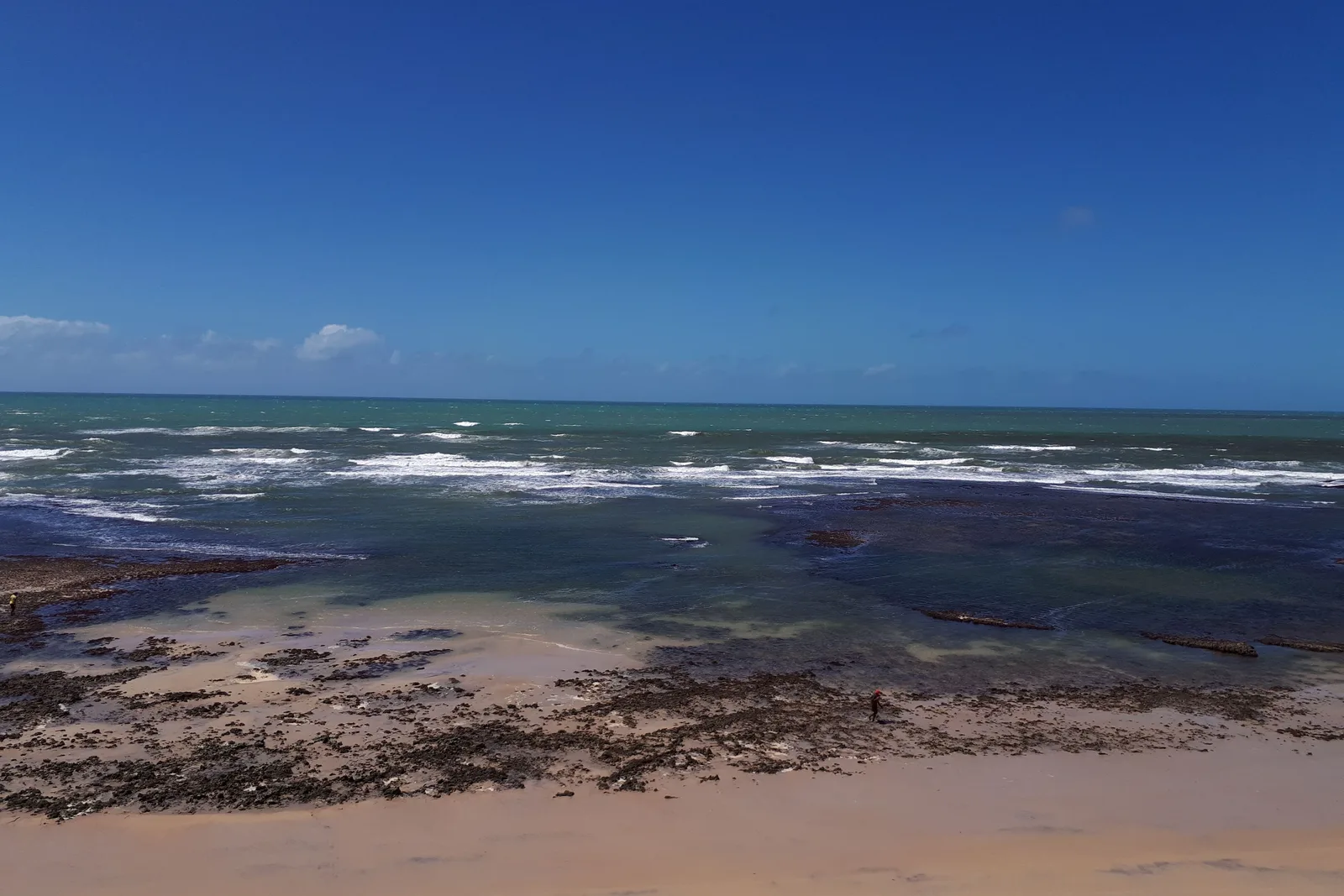
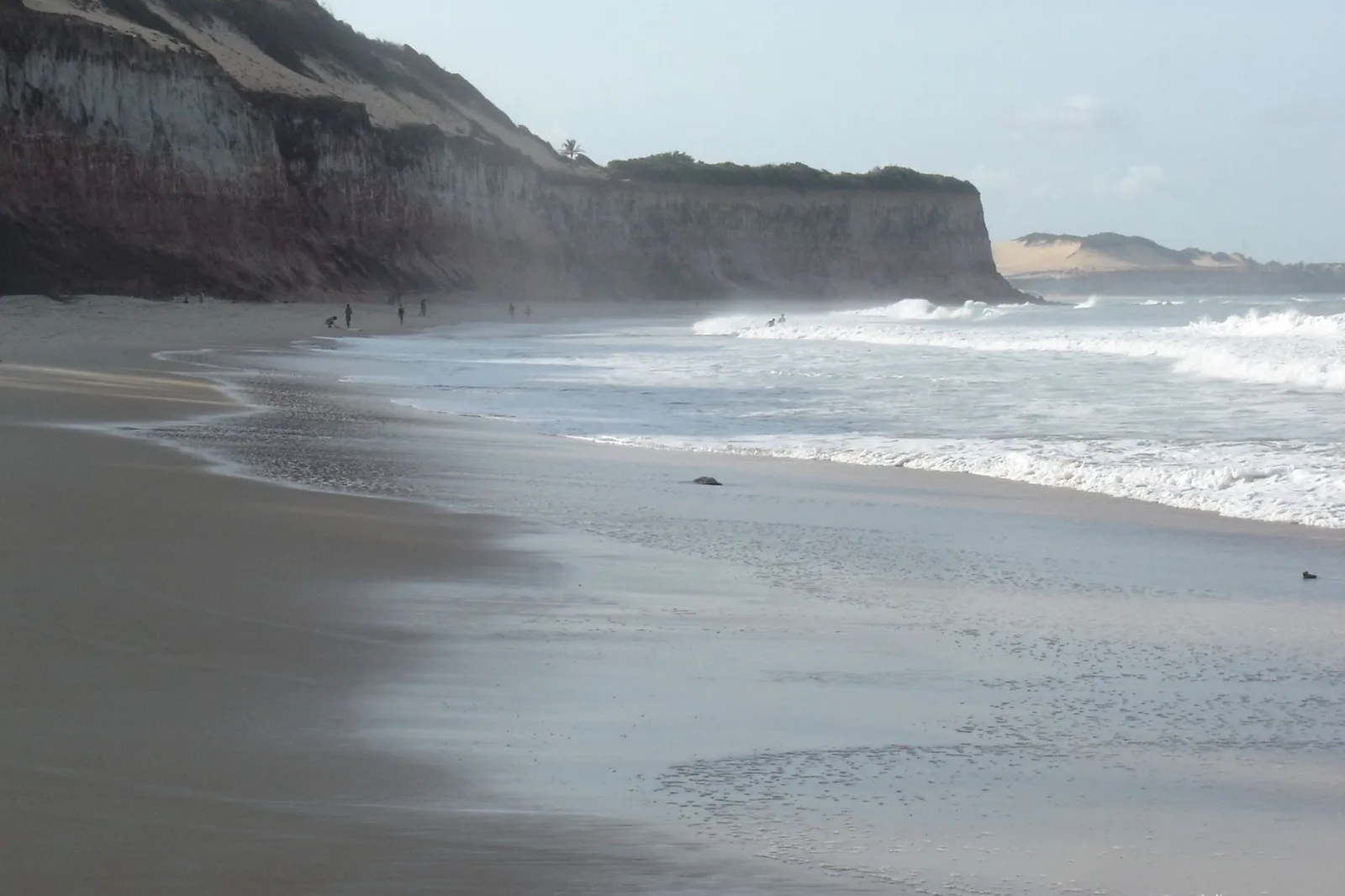
  • A wide stretch of wet sand exposed at low water below the cliffs at Pipa, with a line of surf beyond it and people small in the distance
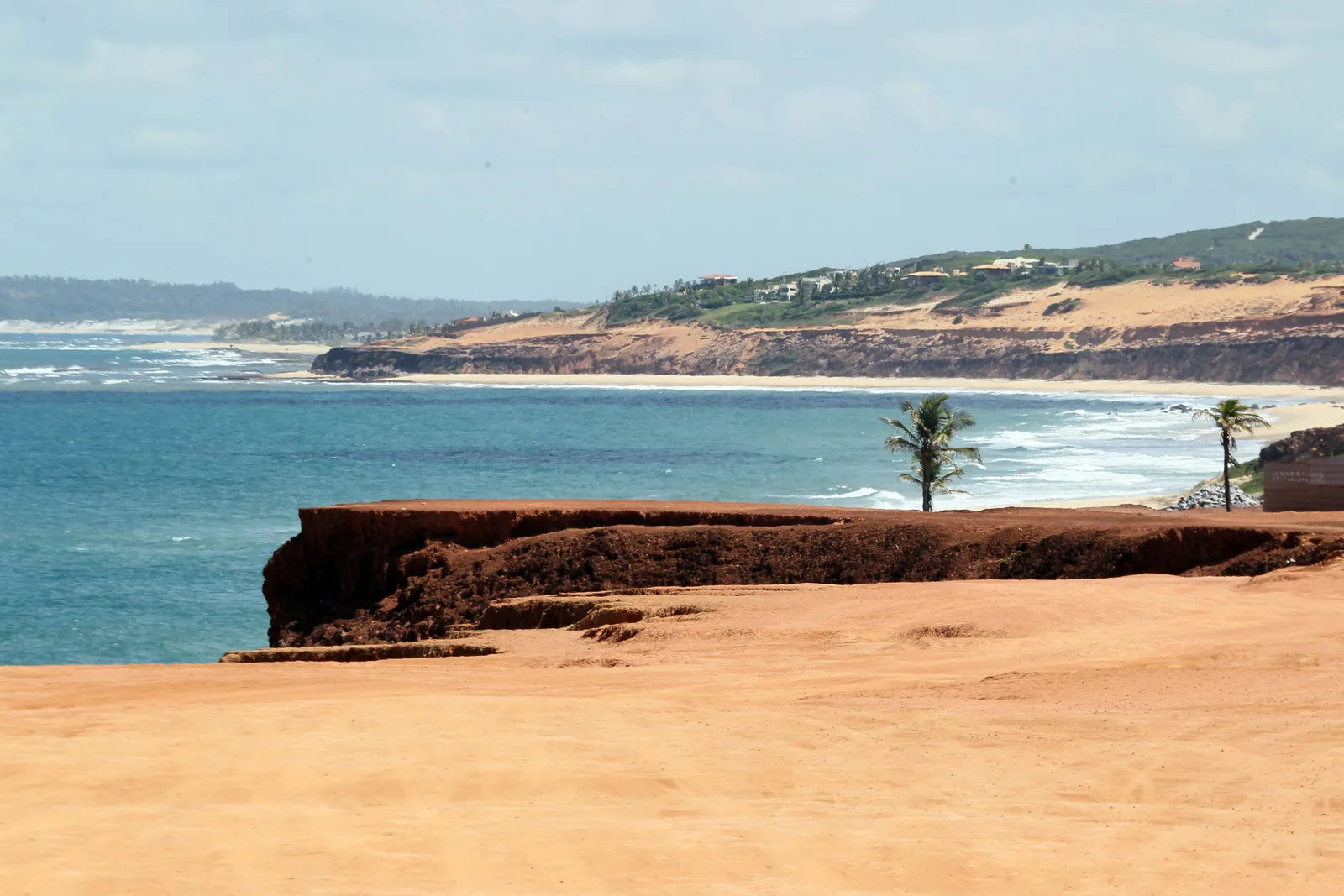
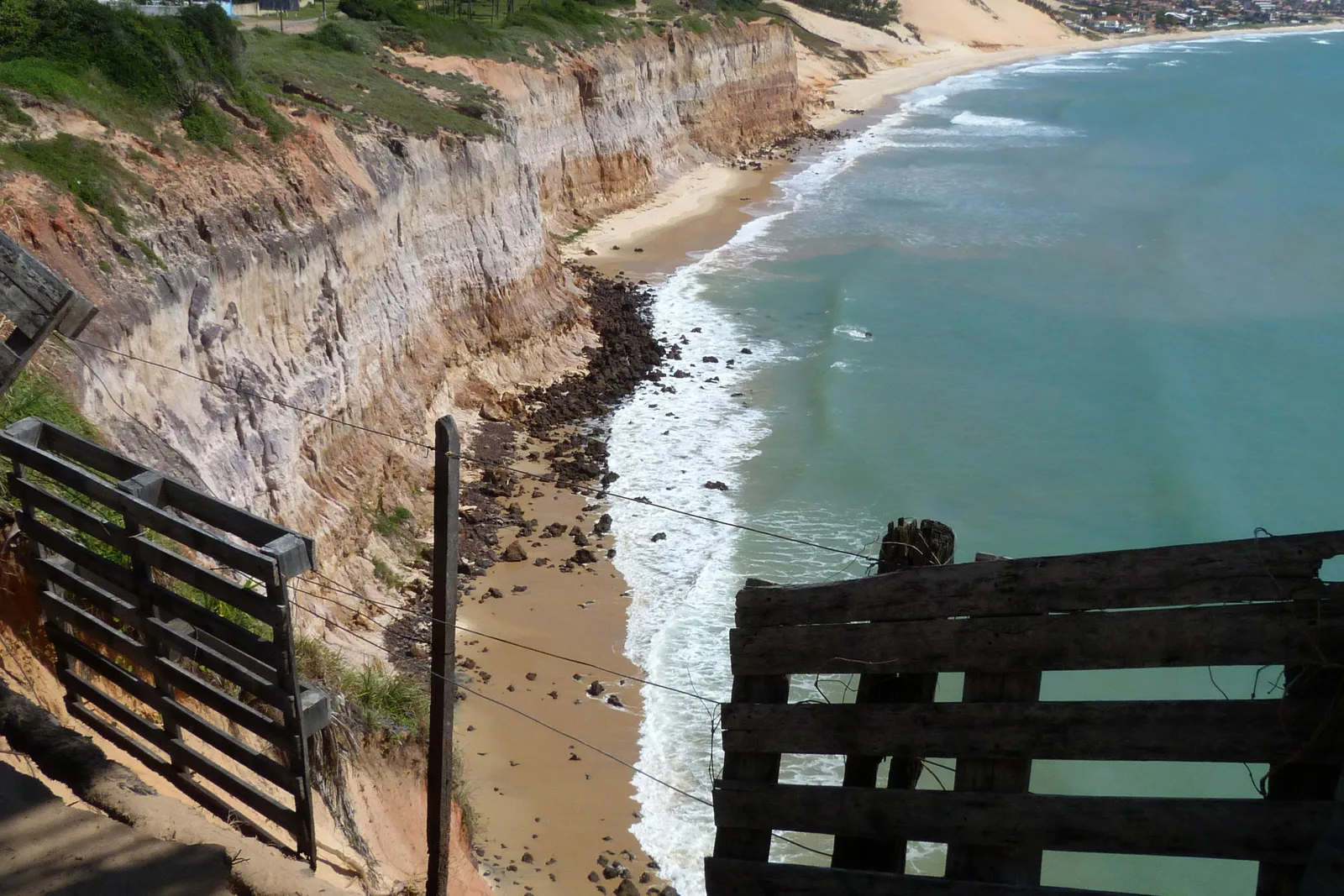
  • Looking down a long eroded cliff wall on the Rio Grande do Norte coast past a rough wooden gate and fence, a narrow strip of beach and dark rock at its foot, turquoise water along the shore and a town and dunes in the distance
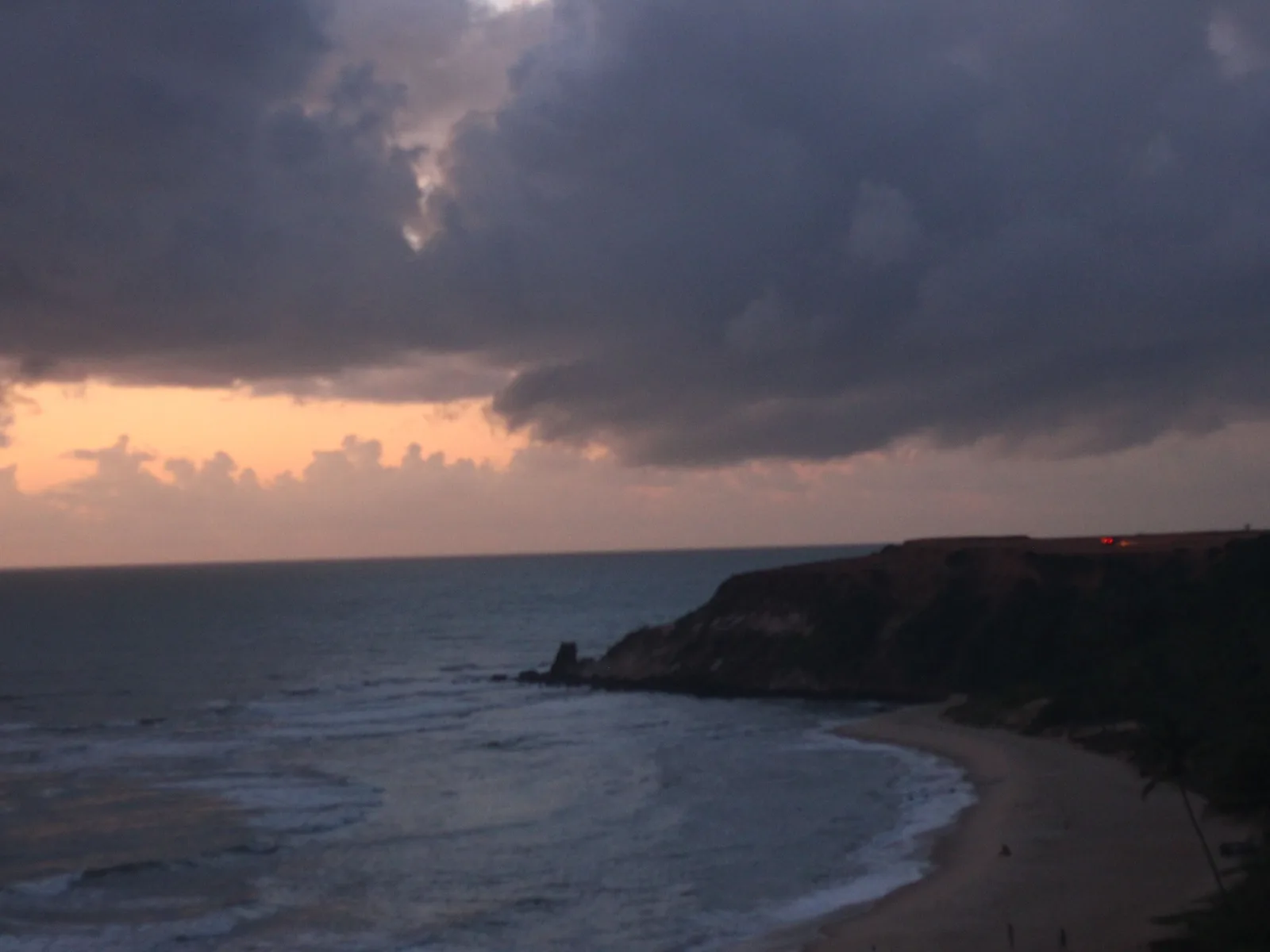
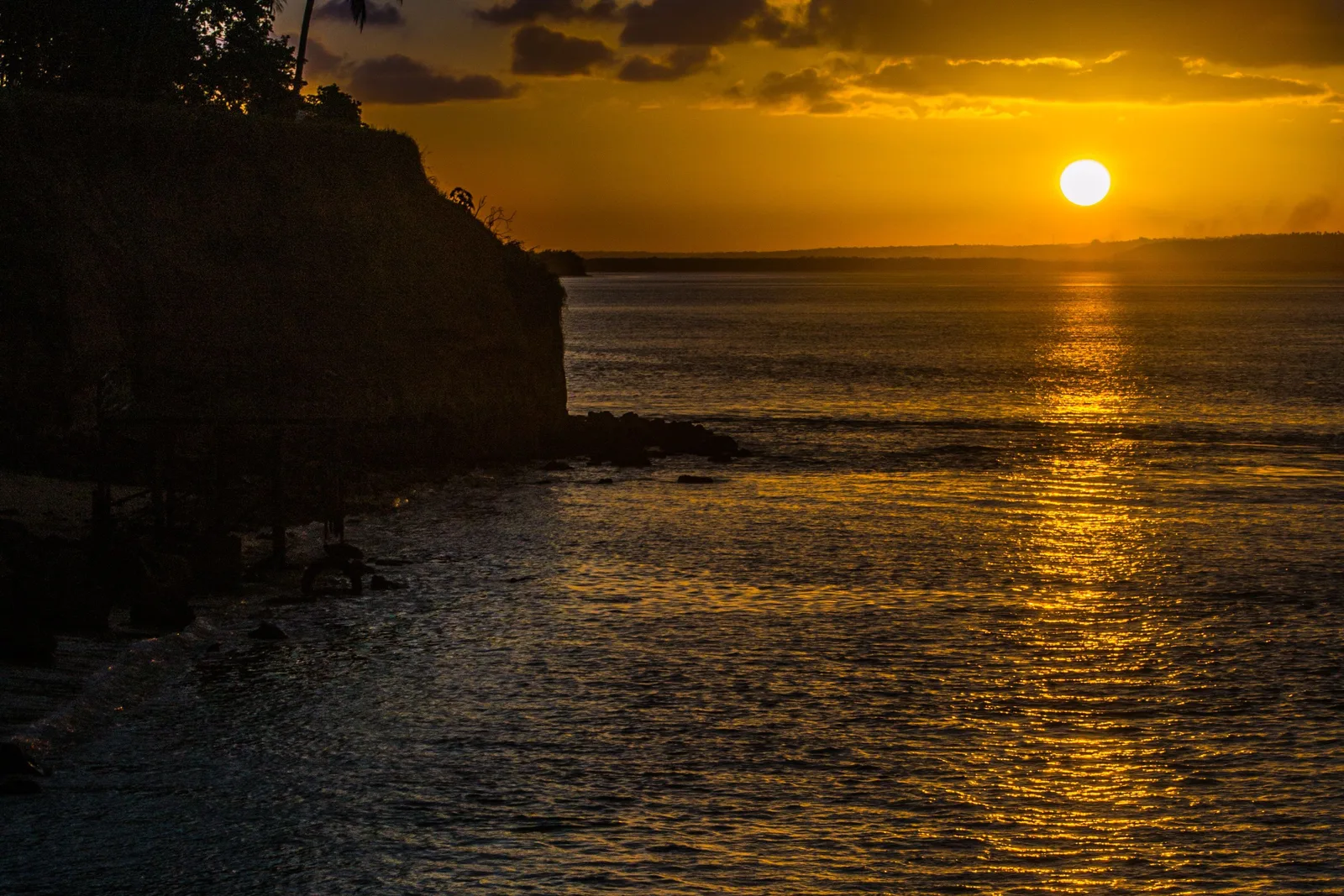
  • A gold sunset over calm water on the Tibau do Sul coast, a dark cliff, palms and a jetty in silhouette on the left and a low far shore along the horizon
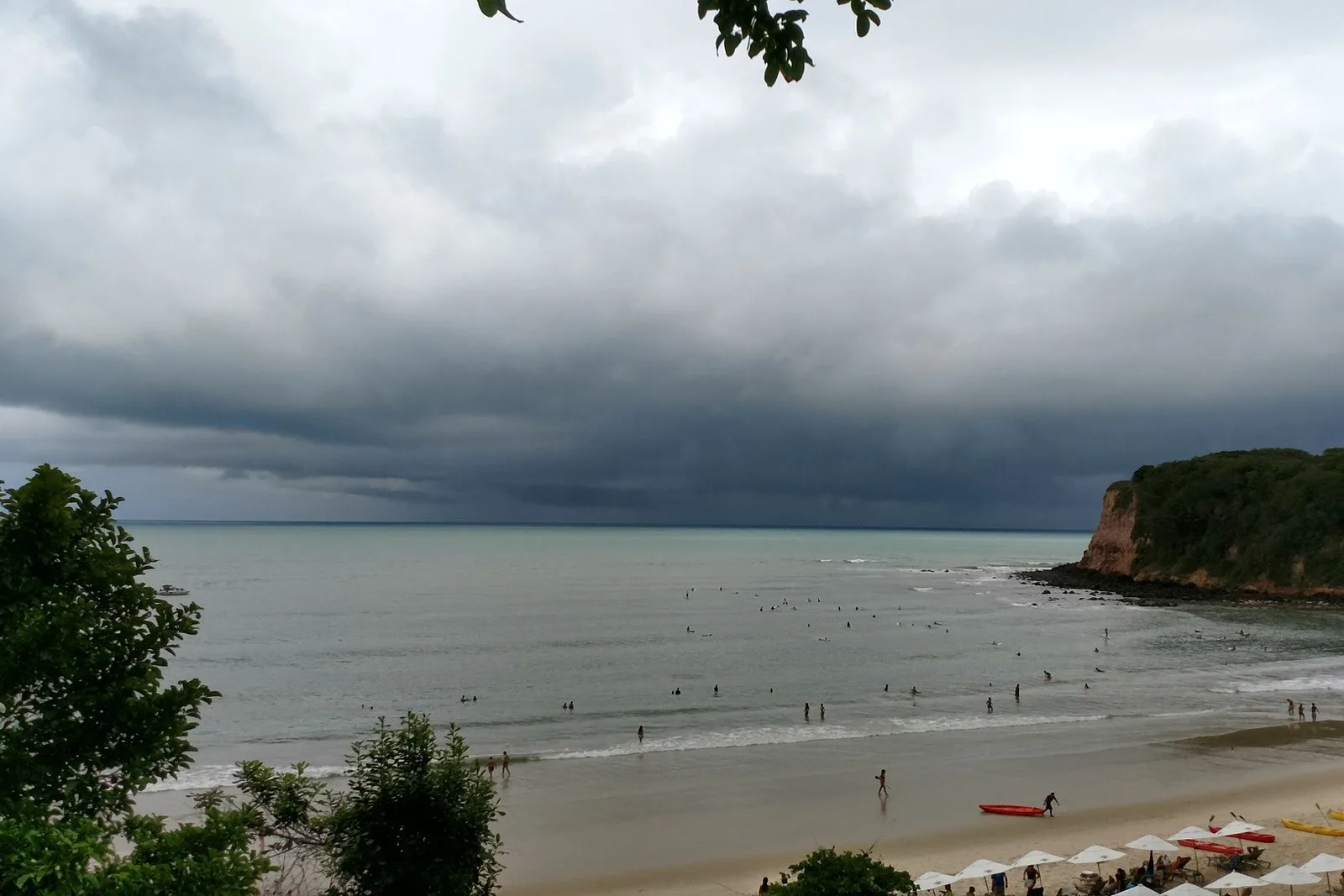
  • Heavy storm cloud sitting over the bay at Praia do Madeiro, swimmers and surfers spread across gray-green water and parasols and kayaks along the sand below
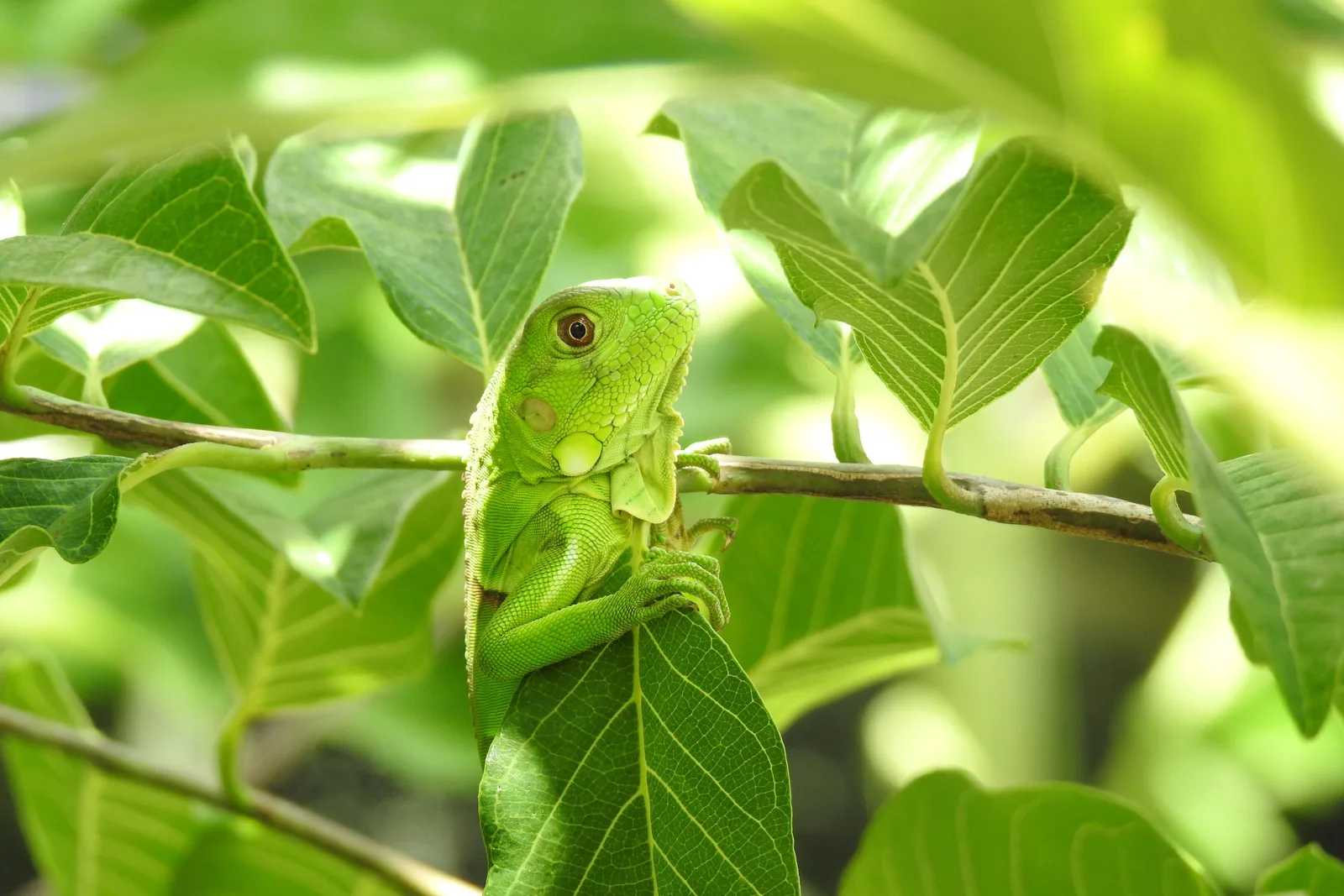
  • A young green iguana clinging to a thin branch among broad leaves, its head turned toward the camera
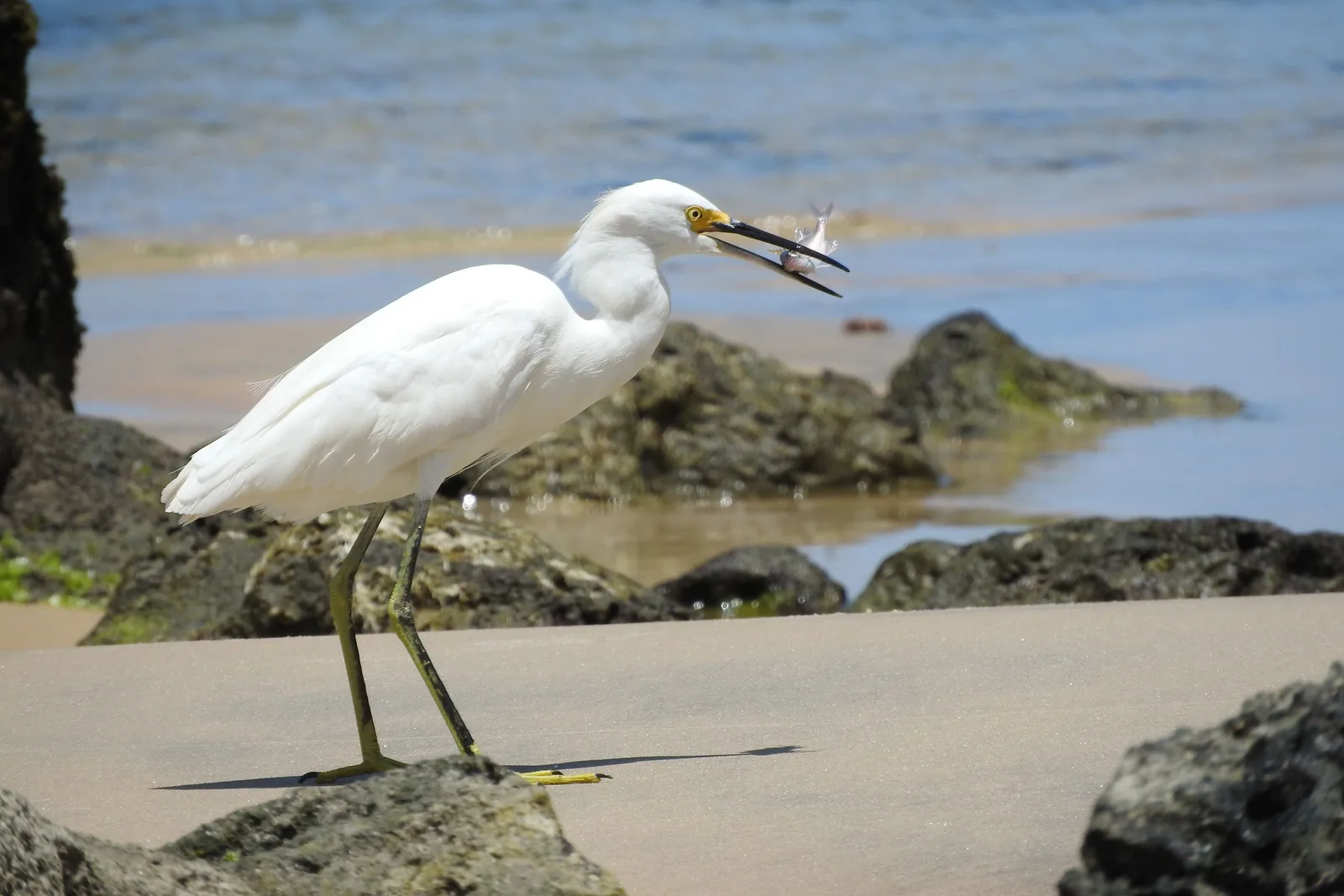
  • A snowy egret standing on wet sand beside dark beach rock at Pipa with a small silver fish held crosswise in its bill
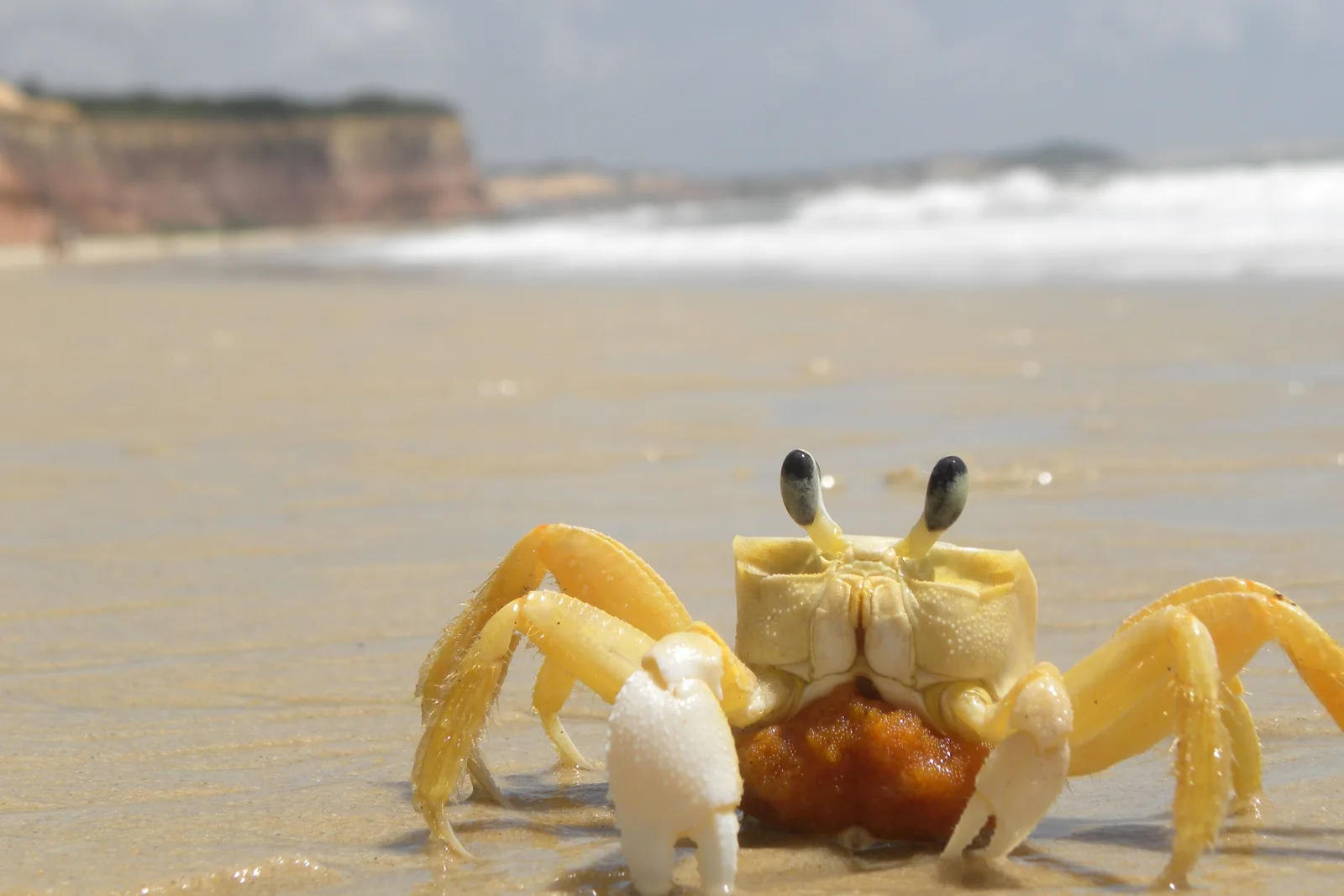
  • A pale ghost crab standing on wet sand at the waterline with its eyestalks up, the cliffs blurred behind it
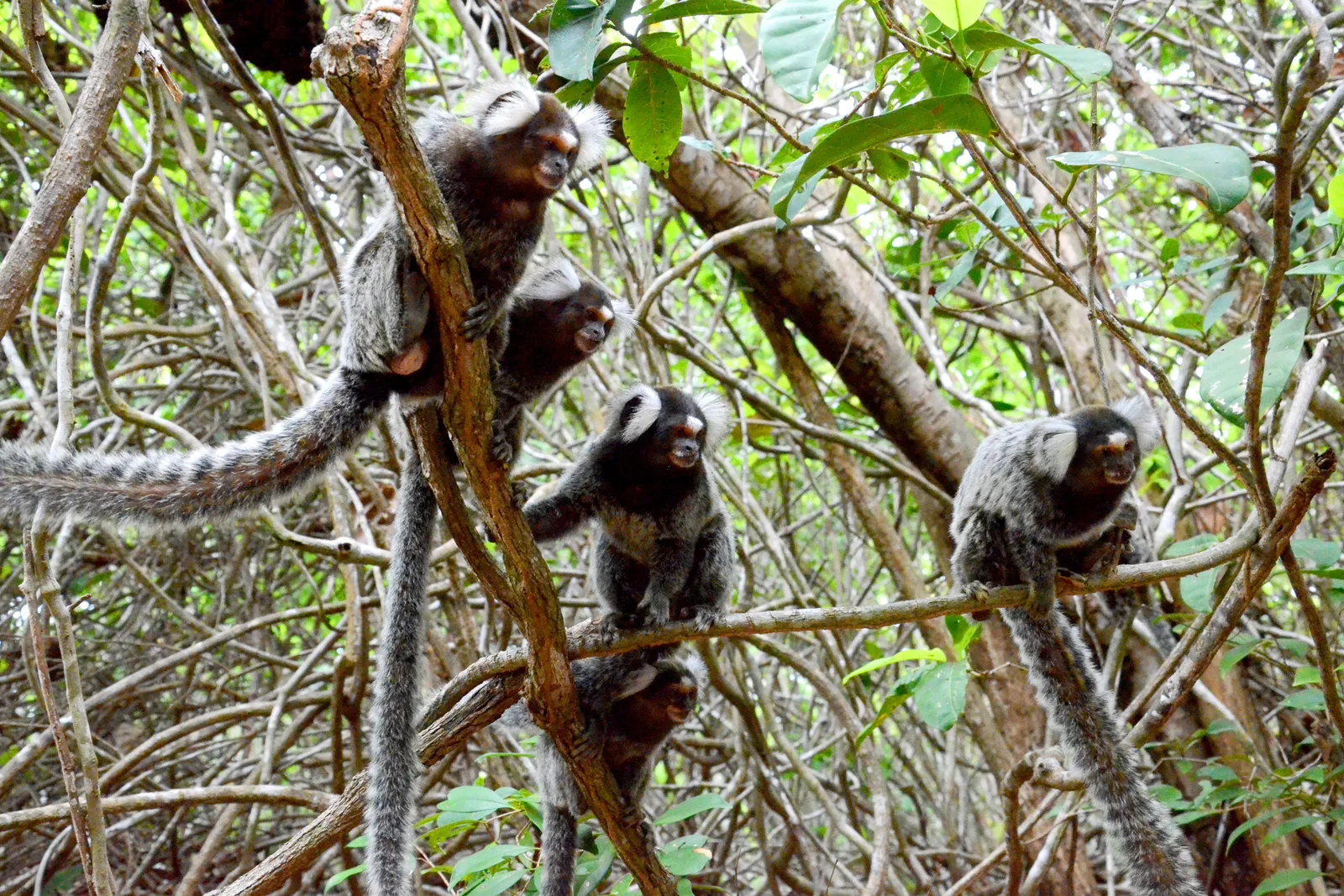
  • Five common marmosets sitting in a tangle of thin branches in coastal forest, their long striped tails hanging below them
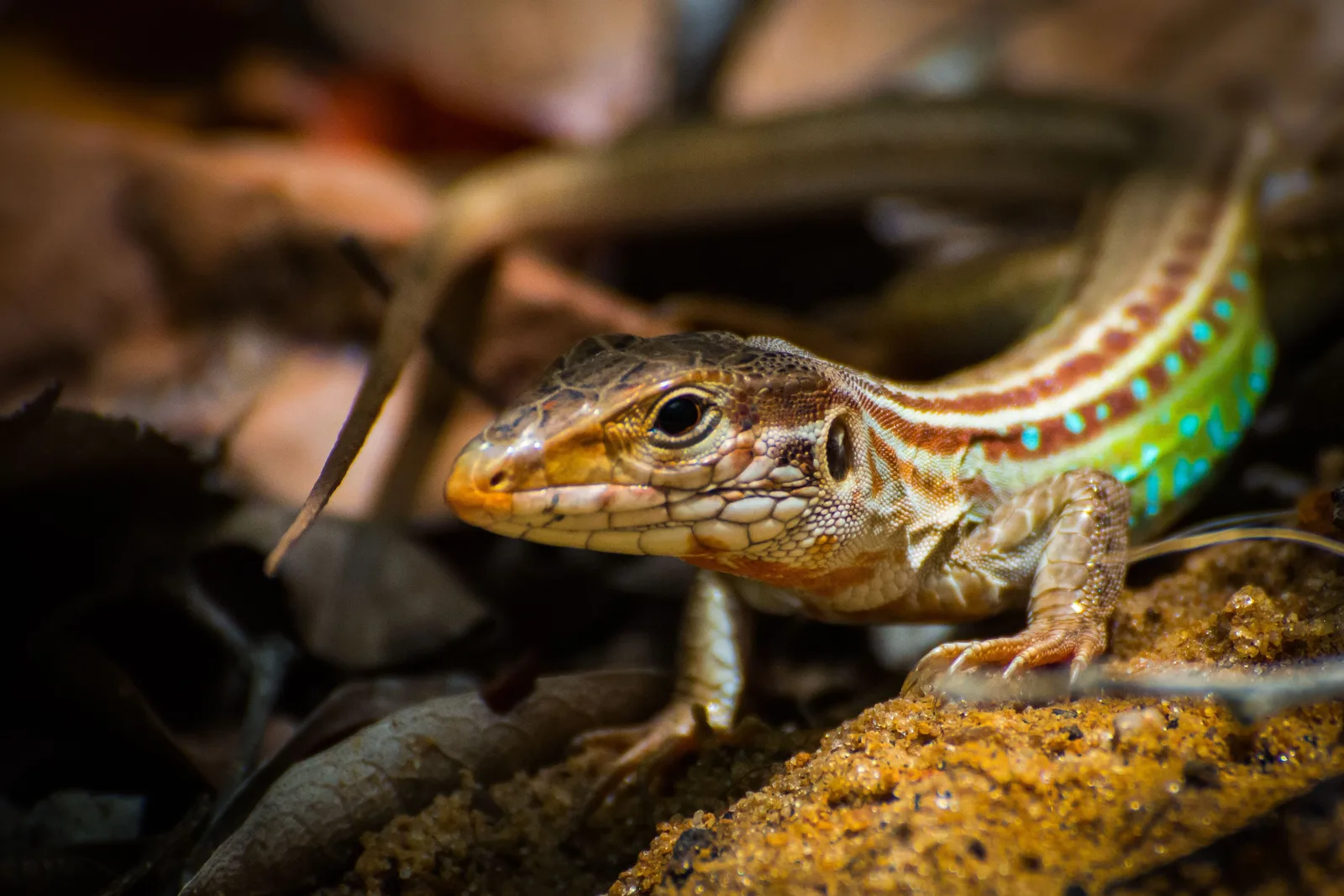
  • A small lizard with green and orange markings resting on leaf litter in dappled light
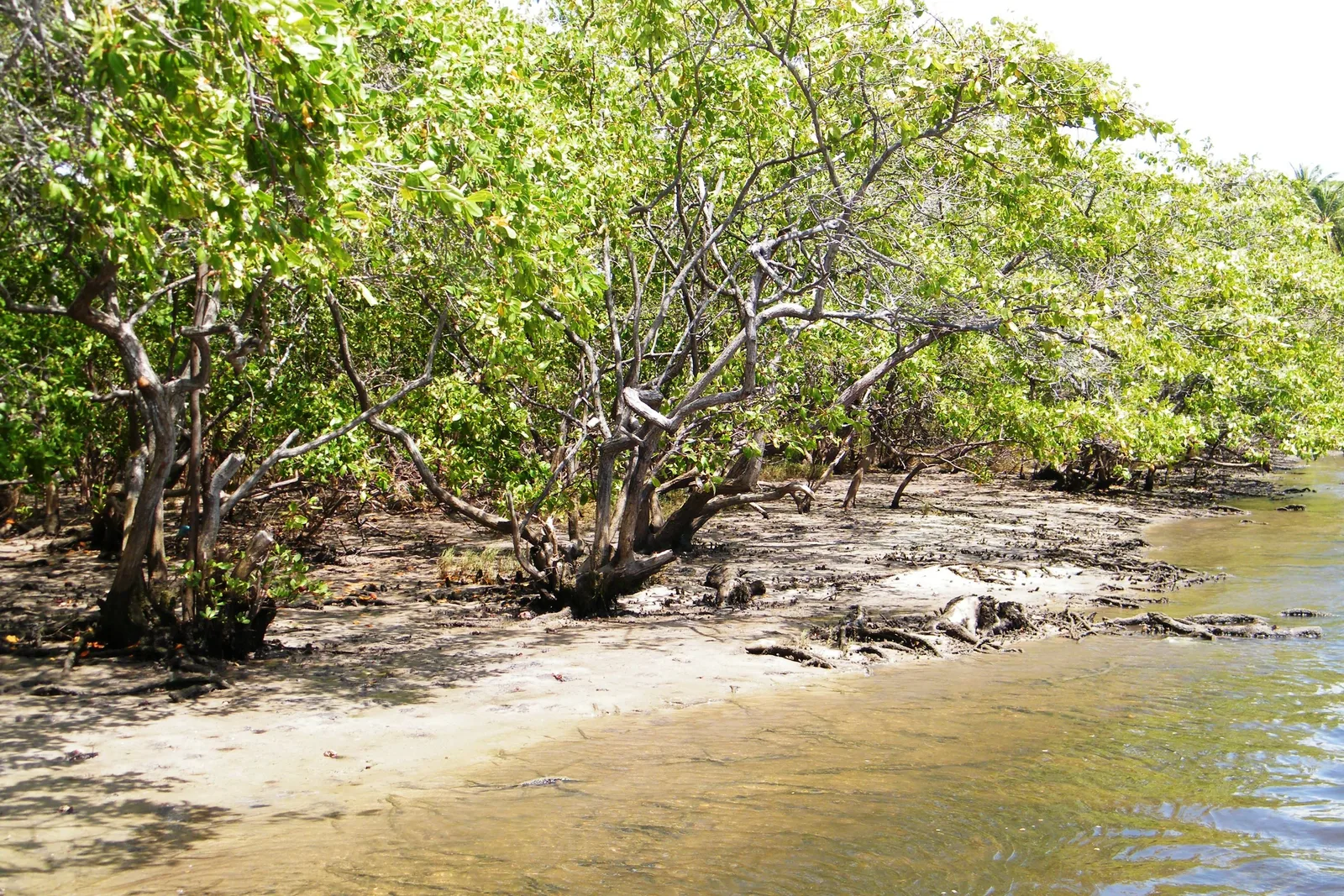
  • Mangrove trees along a muddy bank beside shallow brown water in Tibau do Sul, their tangled roots exposed at the waterline
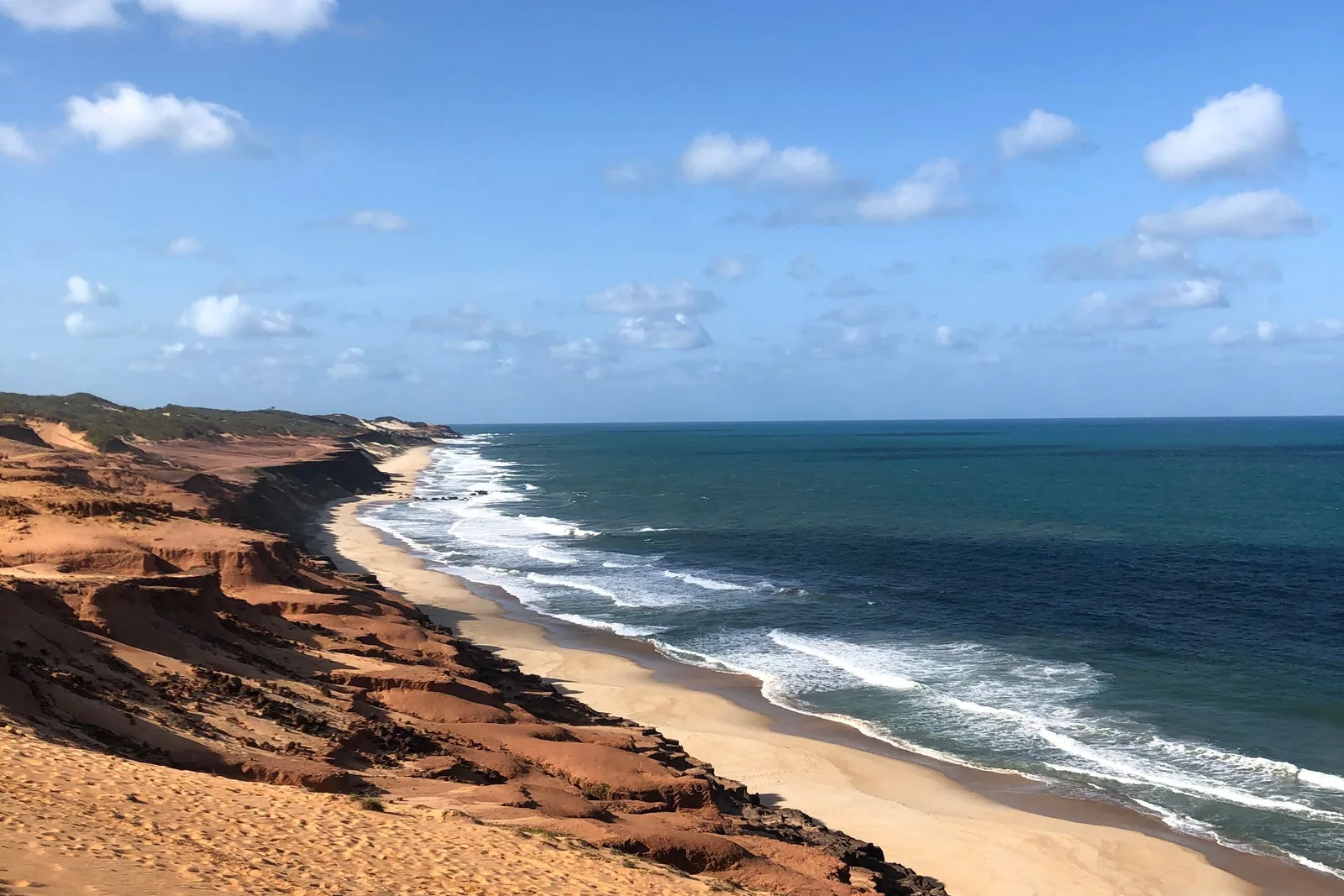
  • A long empty beach seen from a red clifftop, the eroded cliff line and pale dunes running away to the north and open blue ocean filling the right of the frame
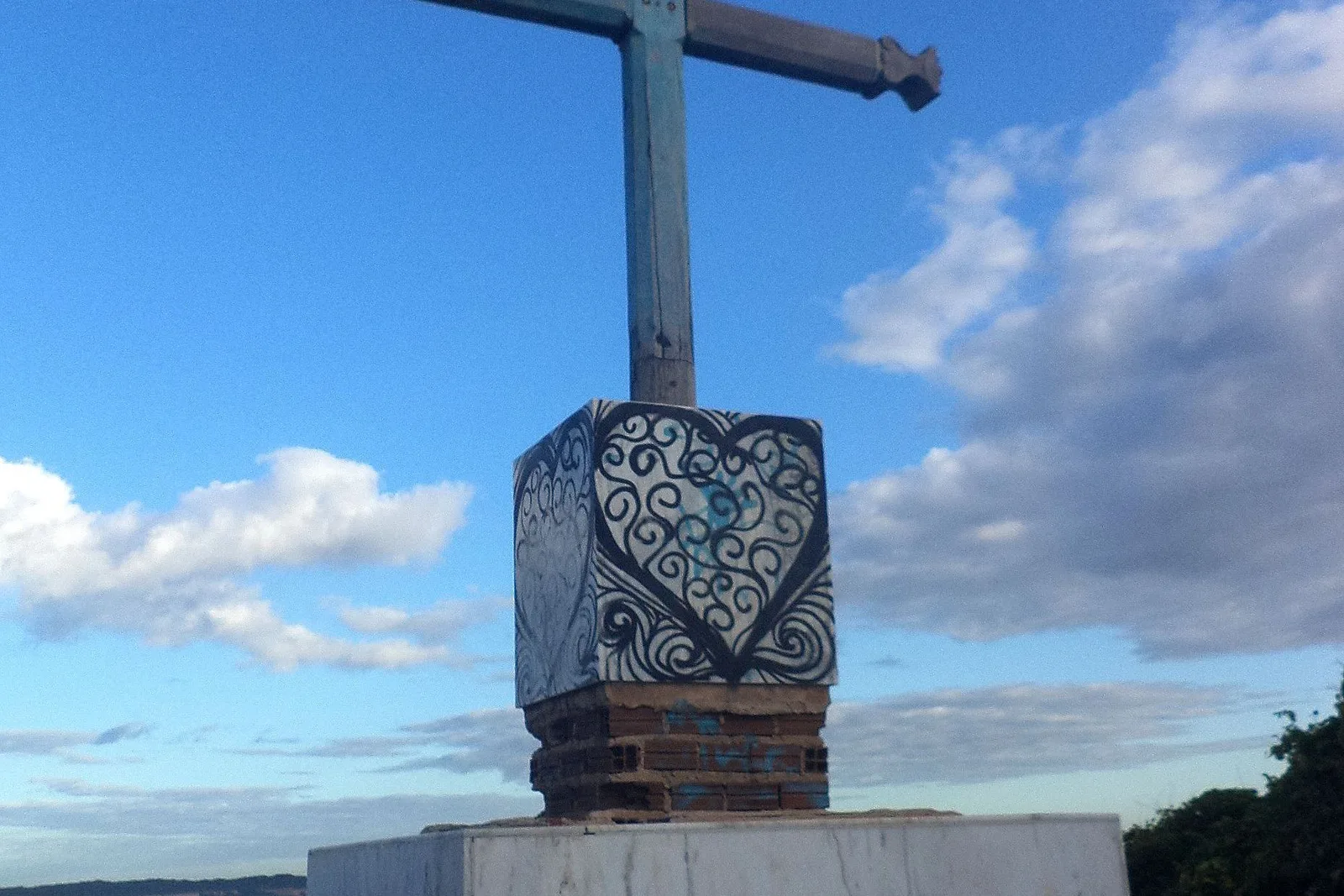
  • A metal cross in Pipa mounted on a plastered pedestal painted with a black and white heart and scroll design, standing against a blue sky with scattered white cloud

Orientation

A village at the top of a cliff, with the beaches underneath it.

What Pipa is, what the tide does to a day here, what it costs, and how you arrive.

General Info

A coast of cliffs, and a village on top of one of them

Pipa is a village in the municipality of Tibau do Sul, on the southern coast of Rio Grande do Norte. The municipality had 16,929 residents at the 2022 Census across 103 square kilometers, and it has been growing at 3.4% a year since 2010. The village itself is small: one main street, Avenida Baía dos Golfinhos, running back from the beach, with lanes of pousadas and restaurants either side of it.

The landform is the point. Tibau do Sul has some 14 to 16 kilometers of coast, and around Pipa almost all of it is active cliff, slopes of 20 to 40 meters cut into the Barreiras Formation and colored in bands of red, cream and pink. Those cliffs run out into the sea in headlands, and between the headlands sit a string of coves. That is the whole geography of a visit: you are not choosing a beach, you are choosing which cove, and the walk from one to the next is along the sand at the bottom. It is also what separates Pipa from the long open beaches elsewhere on this coast. The headlands chop the shore into rooms, and because they also break up the swell, each room has different water in it: surf at one end, flat shallow water at the other, twenty minutes apart on foot.

Surfers found Pipa in the 1970s and tourism followed them. Surfing stayed: Praia do Amor still holds regional championships rather than just surf lessons. Pipa now runs on visitors from end to end, and in the last week of December it is a different and much louder town than it is in November.

Where It Is

Six degrees south, off the RN-003

Pipa sits on the east-facing coast of Rio Grande do Norte, in the municipality of Tibau do Sul, whose town center is 9 km away on the Guaraíras lagoon. The road in is the BR-101 south and then the RN-003 east to the coast. South of the village the cliffs run on past Sibaúma toward Baía Formosa and the Paraíba border; north of it they run past Cacimbinhas to the lagoon mouth at Tibau do Sul.

Pipa Pipa

6.23° S, 35.05° W

See the Northeast on the interactive map

The Tide

The one thing to check before you plan a day here

The coves at Pipa are separated by cliff headlands that the sea reaches at high water, so the sand you walk on to get from one to the next is not there all day. Look at a tide table the night before and build the day around it, and everything else on this page gets easier.

  • The regime here is semidiurnal: two high tides and two low tides a day, roughly six hours apart. A 2023 coastal risk study of this stretch in the Revista Brasileira de Geomorfologia gives the tide a range of up to 2.79 meters, and on an ordinary day the difference between high and low water is around two meters. That is a lot of beach appearing and disappearing.
  • Baía dos Golfinhos has no road, no path down and no steps. The only way in on foot is along the sand from Praia do Centro or from Praia do Madeiro, and the local Praia da Pipa portal is blunt about it: that access is only advisable at low tide. Boats and kayaks can reach the bay at any state of the tide; your feet cannot.
  • Walk between the coves only on the low tide: leave while the water is still falling, and start back as soon as it turns. The sand strip narrows fast once the tide comes in.
  • Low water arrives about fifty minutes later every day, because the tide keeps to the lunar day rather than the solar one. A window that was perfect at 10:00am is a lunchtime window three days later and an afternoon window by the end of the week. Check the table for your actual dates rather than assuming mornings work.
  • Low water is also when the beachrock appears. The flat ledges off Praia do Centro and Praia do Amor trap clear pools you can sit in, and they are simply not there at high water. Reef shoes are worth packing, because beachrock is sharp.
  • The height of the sand also changes through the year, by as much as about three meters on the local portal’s account, and that can open or close a route whatever the tide is doing. Look at the beach as well as the table.

Cost

Cheap to be in, easy to spend more than you meant to

Pipa is not an expensive place by American standards, and the best things in it cost nothing: the walk between the coves, the clifftop views, the surf. What moves a budget is the room, and the range between a back-street pousada and a clifftop hotel with a pool over the sea is wide. Every figure below is an estimate rather than a published rate.

Estimated daily budget, per person

Budget

$35 / day

A hostel bed or a simple pousada on a back lane, meals at the per-kilo and prato feito end, and days spent walking between the beaches.

Mid-range

$70 / day

A good pousada with a pool, dinner out most nights, and one paid outing, such as the boat trip to the dolphin bay.

Comfortable

$140 / day

A clifftop room with a view, the better restaurants on the main street, private transfers, and a driver when you want one.

Per person per day once you are in Pipa, and flights are not in it. Two people sharing a room land well under double one person’s cost.

What things cost

  • Santuário Ecológico de Pipa, entry per adult $3–4 R$15–20
  • Simple pousada, double room, per night $39 R$200
  • Good mid-range pousada, double room, per night $78 R$400
  • Clifftop hotel or boutique room, per night $118 R$600
  • Shared boat trip to Baía dos Golfinhos, per person, plus a R$10 environmental fee $14–16 R$70–80
  • Private boat to the bay, whole boat, one hour $196–206 R$1,000–1,050
  • Lunch, prato feito $6 R$30
  • Dinner at a good restaurant, per person $16 R$80
  • Breakfast at a bakery $4 R$20

Every row is an estimate and should be read as the shape of a budget rather than as a quote. The boat prices are the ones operators on Praia do Centro advertise.

The shared boat is sold by the seat. The private boat is sold by the hour for the whole boat, which takes up to fifteen people.

Pipa has no bank branches, only Banco 24 Horas ATMs, and they stop dispensing at 10:00pm, so take out what you need in daylight. Carry cash for the beach kiosks and the sanctuary gate.

Checked September 2026 and converted at R$5.10 to the dollar. Estimates, not quotes.

Safety

A small tourist village, and a coastline that moves

7 /10

Our rating. A quiet village in a state with a bad and worsening violence statistic, and a cliff line that has killed people.

The crime picture and the natural one point in different directions here, and the natural one is the unusual part. Rio Grande do Norte recorded 29.1 intentional violent deaths per 100,000 people in 2025 against a Brazilian average of 19.1, and it was the state with the largest increase in the country that year, up 19.6%, on the Fórum Brasileiro de Segurança Pública’s 2026 yearbook. That is a state-level figure and it describes the state’s cities and its interior rather than a village whose whole economy is visitors. What has actually killed people here is the cliff.

  • Do not sit, sunbathe or shelter directly under a cliff face, anywhere on this coast. On 17 November 2020 a section of cliff came down onto the beach at Pipa and killed a couple and their seven-month-old son. Slides have kept coming since: one at Praia do Madeiro on 7 September 2025 hit the kiosks and injured two people, two more came down at Madeiro and Praia do Centro on 28 April 2026, and another at Pipa on 23 June 2026. The Defesa Civil closes stretches of beach when it judges the ground above them unstable, and those closures are not decoration.
  • The mechanism is worth understanding because it tells you when the risk is highest. The sea cuts notches into the base of the slope, which undermines the material above it, and heavy rain saturates that material and drops its strength. The municipality logged 168 mm of rain in April 2026 alone before the first of that year’s collapses. So the wettest months, roughly March to July, are also the ones when a cliff is most likely to let go.
  • Swim where the headlands protect you. Wave modeling of this shore puts significant heights of 1.8 to 2.4 meters on the exposed stretch below the Chapadão and 0.5 to 1.8 meters at Praia do Centro and in Baía dos Golfinhos, which are sheltered by the headland and by beachrock. Rip currents occur on this coast, including at Madeiro, so swim where others are swimming and ask a lifeguard or kiosk where it is safe that day.
  • Watch the water coming back. The commonest way a day goes wrong here is not drowning, it is being on the far side of a headland when the sand runs out. Turn around on the incoming tide, not on the clock.
  • The cliffs give shade for only part of the day, and there is nothing between you and the sun on a beach walk of two or three kilometers.
  • There is no hospital in the village. The municipality’s 24-hour emergency unit, the Unidade Mista de Saúde, is in Tibau do Sul, about 10 km north, and Goianinha, 25 km inland on the road to Natal, has a 24-hour general hospital. Travel insurance is not optional, and prescription medicines should come with you.

Getting There

One airport, one road, and then you walk

Pipa has no airport and no rail. Everybody arrives on the same road, and once you are here a car is close to useless: the village is small, the beaches connect along the sand, and the good stretches are ones you cannot drive to anyway.

  • Almost everyone arrives through Natal. Its international airport, Governador Aluízio Alves, is at São Gonçalo do Amarante on the far side of the city, about 95 kilometers from Pipa by road, and the city itself is about 85 kilometers north, about an hour and a half by road. Natal is a destination in its own right and this page does not try to cover it: it has its own guide on this site.
  • The road is the BR-101 south as far as Goianinha, then the RN-003 east to the coast. It is paved the whole way and an ordinary rental car does it without drama.
  • A private transfer is the simplest arrival. Shared vans also run it, and the scheduled bus, Viação Riograndense, takes a little over two hours from Natal and has no air conditioning.
  • The cheapest connection is the van route through Goianinha, 25 kilometers inland: vans leave continuously from about 5:00am to after midnight, with waits of 15 to 45 minutes, and take about fifty minutes. Use it by day; the area of Goianinha where the vans leave is not one to wait in after dark.
  • Inside Pipa you walk. The main street is a few hundred meters, the beach is at the end of it, and the coves connect along the sand. A car is worth having only if you plan to base yourself at Madeiro or Tibau do Sul and come into the village in the evenings.
  • For the stretches you cannot walk there are taxis, and local vans run between Pipa and Tibau do Sul about every fifteen minutes.
  • Pipa is hilly and sandy and the beaches are reached by steps or by ramps cut into the cliff. If steps are a problem, say so when you book: the difference between a pousada in the village and one at the top of the cliff is a flight of stairs you will use several times a day.

What to see

Three coves and a village.

Everything on this list is within three kilometers of everything else, and the sand joins them up at low water.

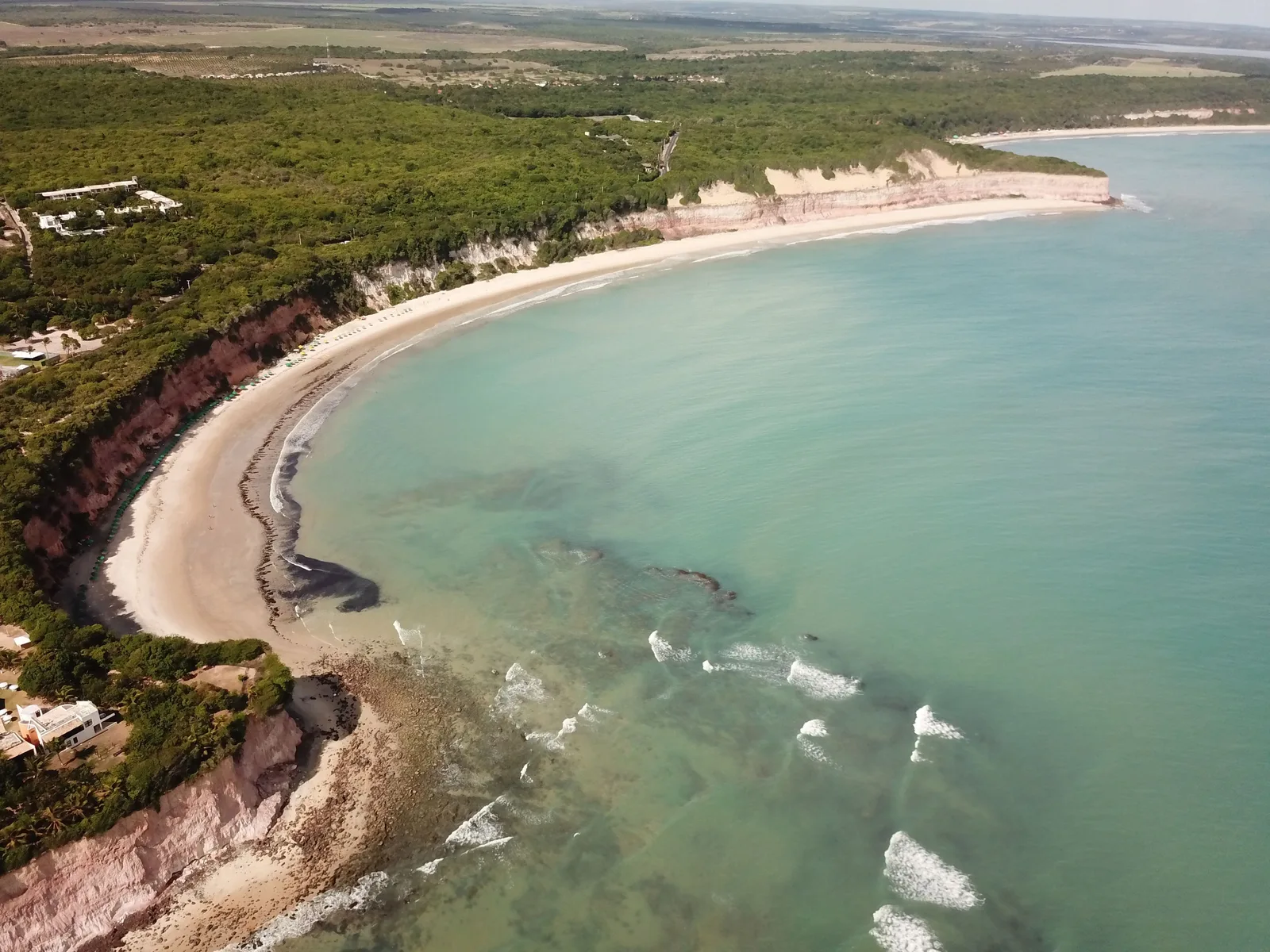
Baía dos Golfinhos from the air: a wide curve of pale sand under forested red and white cliffs, shallow turquoise water across the bay and small waves breaking over dark rock near the headland in the foreground 01

Reached on foot, and only at low water

Baía dos Golfinhos

From Praia do Centro
About a kilometer along the sand
Access
On foot at low tide, or by boat
The dolphins
Resident, all year

A cove between two headlands, with no road to it and no way down the cliff. You walk in along the beach from Praia do Centro, about a kilometer, or from Praia do Madeiro on the other side, and you can only do it at low tide. Older maps and the scientific literature call it the Enseada do Curral. Everybody else calls it the dolphin bay, and the reason is that gray dolphins come into it.

The species is Sotalia guianensis, the boto-cinza or Guiana dolphin, a small coastal dolphin that lives along this shore rather than passing through it. Researchers at the Federal University of Rio Grande do Norte spent 863 hours over 151 days watching the animals in this cove between 1999 and 2004 and published an ethogram of what they do here: feeding, chasing, social play, aerial behavior, and time spent with calves. The bay is protected because of them. Tibau do Sul created a coastal fauna reserve over it in 2006, and it remains the only conservation unit in Rio Grande do Norte set up specifically for the boto-cinza.

Nothing about that guarantees you a sighting. A four-year UFRN study from the clifftop found them most often in the bay in the morning, between 9:00am and 12:00pm, and they are wild animals in an open bay. What it does mean is that no month is better than another for it. If you are walking in, the variable you can control is the tide: pick a day when low water falls in the morning, walk in early, and give it an hour.
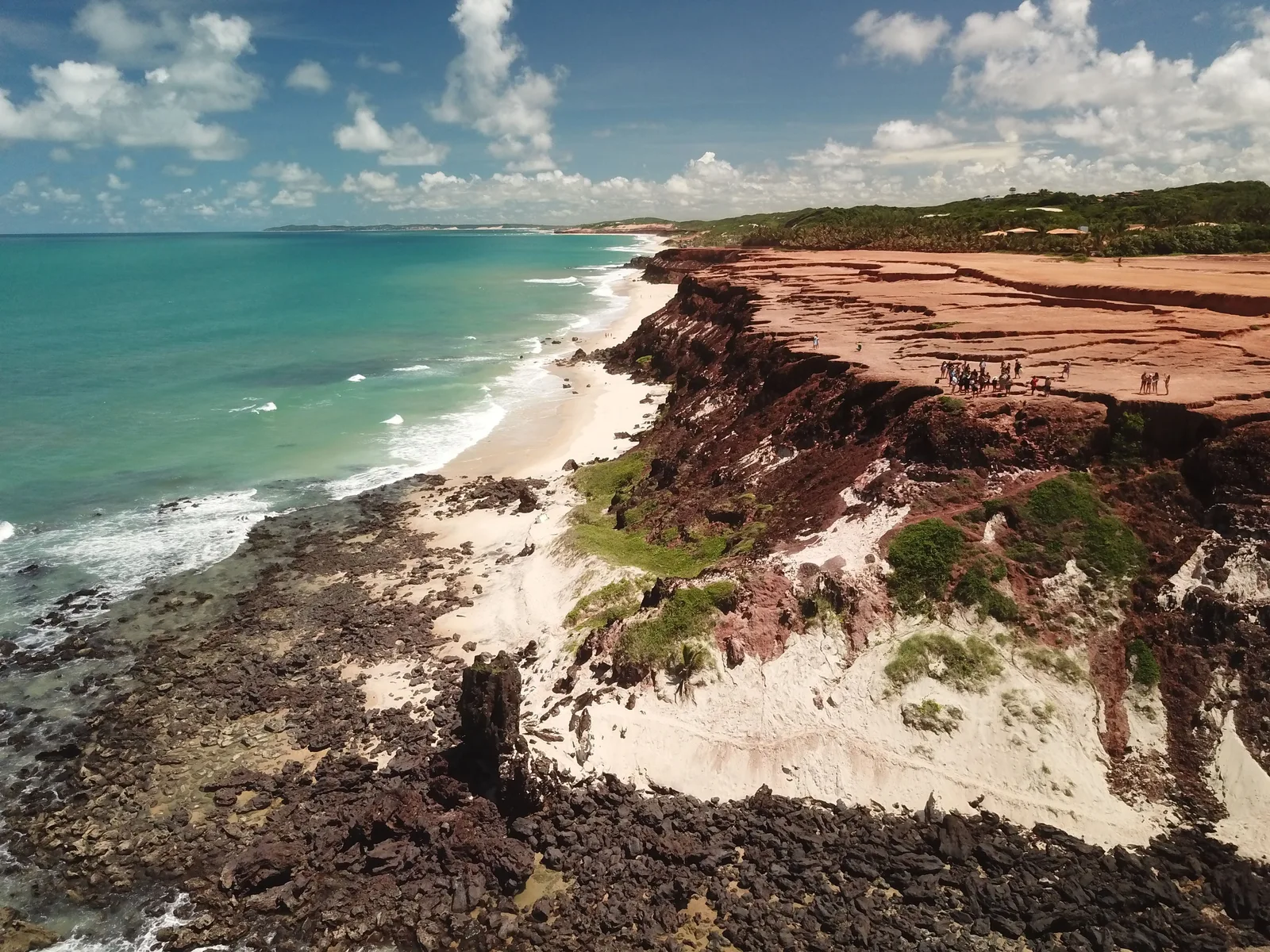
The Chapadão seen from the air: a flat red rock plateau with a group of people standing at its edge, dark rock at its base, and a pale beach and turquoise sea running away along the coast behind it 02

The headland the whole village is photographed from

Praia do Amor and the Chapadão

From the village
Along the sand at low tide, or by steps from the end of the main street
The Chapadão
A flat clifftop above the beach
Waves
The biggest on this shore

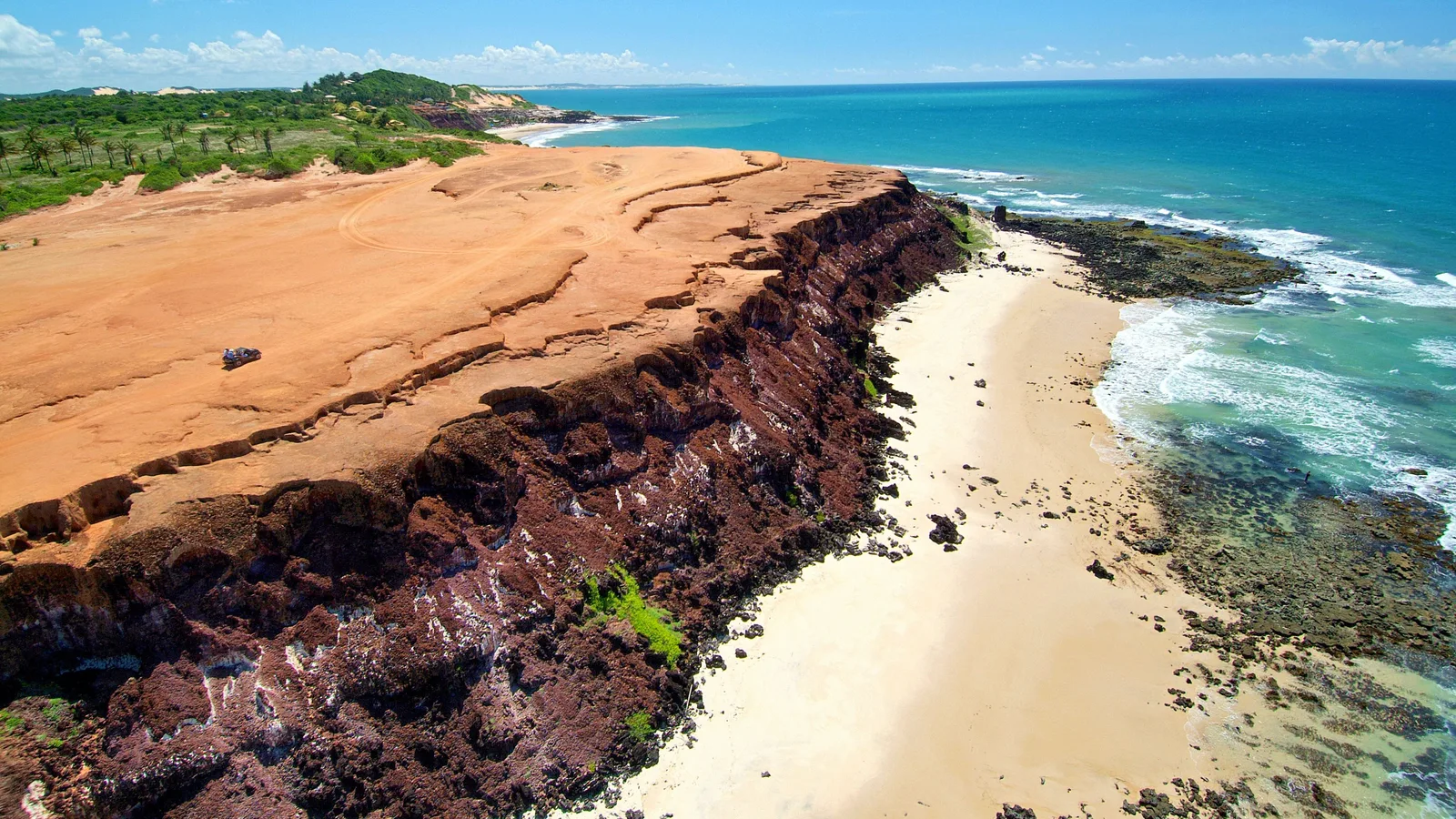
South of the village the coast turns and Praia do Amor opens up: a long beach with rock ledges at its northern end and the Chapadão standing over it, a bare, flat-topped headland of red rock that the sea has cut into steps. The view from the top runs back over the whole village side of the coast, and it is the picture most people have seen of Pipa before they arrive.

It is also the most exposed water here. The southeast swell wraps around the Chapadão and hits this stretch at a high angle, and wave modeling of the shore puts significant heights of 1.8 to 2.4 meters on it against 0.5 to 1.8 meters in front of the village. That is why the stretch locals call Praia dos Afogados, which runs into Praia do Amor, is the surf beach where the regional competitions happen. Keep children in the rock pools rather than the open surf.

At low tide the northern end of Praia do Amor becomes something else entirely. The beachrock ledges come out of the water and hold clear pools between them, warm, shallow and sheltered from the surf that is breaking a hundred meters away. It is the single clearest demonstration on this coast of what the tide is doing to your day.

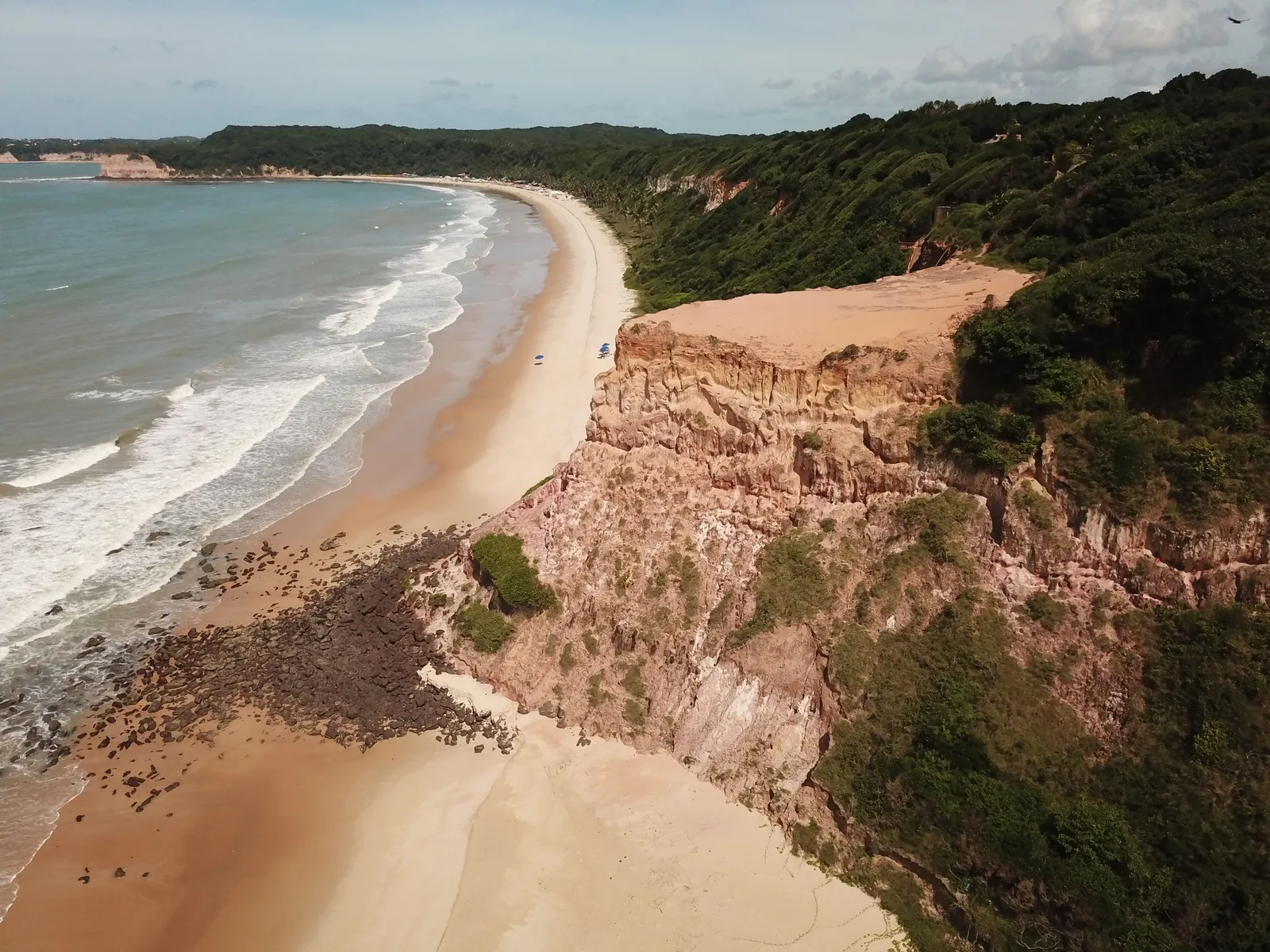
Praia do Madeiro from the air: a bare, banded red headland with dark rock at its foot in the foreground, and a long curve of pale sand running away under wooded cliffs with lines of surf breaking along it 03

The beginners’ end, and the one with staircases

Praia do Madeiro

From the village
About 2.5 km north
Water
Small surf, sand bottom
Access
By steps from the road, or along the sand at low tide

North of Baía dos Golfinhos, past the Ponta do Madeiro headland, the coast opens into the widest bay on this stretch. Praia do Madeiro has kiosks, umbrellas and a sand bottom, and the surf is small enough that this is where the surf schools take beginners. Rip currents still occur here, so swim where others are swimming.

Unlike the dolphin bay, Madeiro can be reached without waiting for the tide: several staircases come down from the road, including about 150 steps from the grounds of the Santuário Ecológico. That is what makes it a natural starting point for the low-tide walk to the dolphin bay.

It is inside the same municipal fauna reserve as the dolphin bay. The bay and the Madeiro cove are where the botos feed, rest and raise calves, which is why the boat and kayak traffic in both is now capped, and it is where Projeto Tamar releases sea turtle hatchlings.

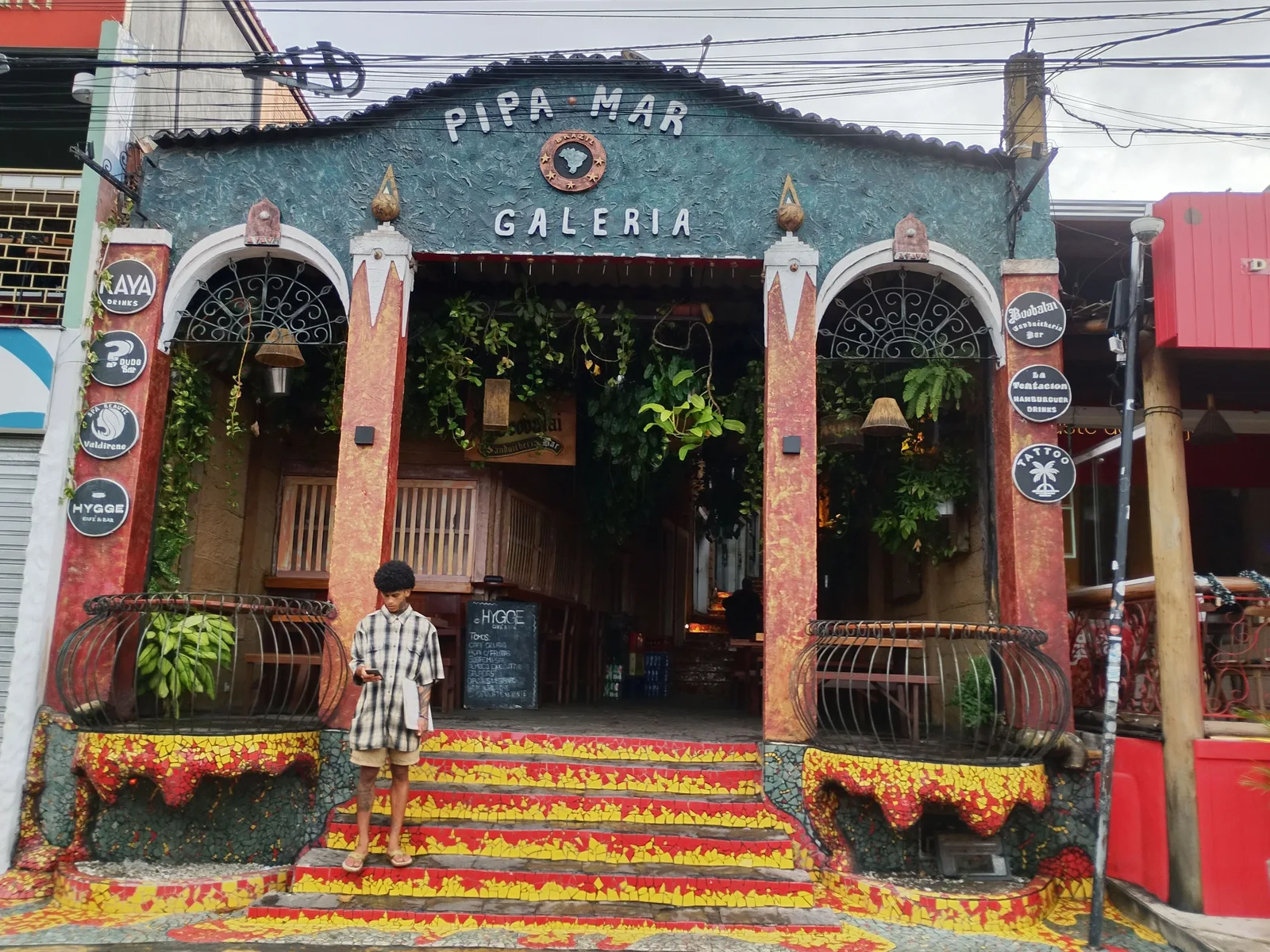
The front of a small shopping arcade in Pipa with painted arches, hanging plants inside and mosaic-tiled steps, and a young man standing on the steps looking at his phone 04

One street, and everything on it

The village

Main street
Avenida Baía dos Golfinhos
Municipality
Tibau do Sul, 16,929 people
Quiet hours
Before 10:00am

Pipa is one street with lanes off it. Avenida Baía dos Golfinhos runs back from the beach and carries almost everything: restaurants, bars, surf shops, arcades of small stores under thatched roofs, and the pousada gates in between them. It is a walking street in practice, busiest between 8:00pm and midnight, and dead quiet at 9:00am when the only people out are the ones going surfing.

What it is not is a fishing village any more, and any guide that describes it that way is thirty years out of date. Pipa has been drawing visitors since surfers found it in the 1970s, and it looks like it: the food is good and international, there is live music most nights in season, and the shops sell surfwear and beachwear rather than nets. What has survived is the scale. The buildings are low, the street is short, and you can be out of the noise and standing on an empty beach in ten minutes.

The one thing worth knowing before you book is how loud it gets. The village side is the convenient side and it is also the side where the music is, and in high season the difference between a room on the avenue and a room three lanes back is real sleep.

What to actually do

Time it to the tide, and the rest is easy.

Four of these are free and one of them is the best day you will have here. The tide sets the order, not the clock.

On the sand

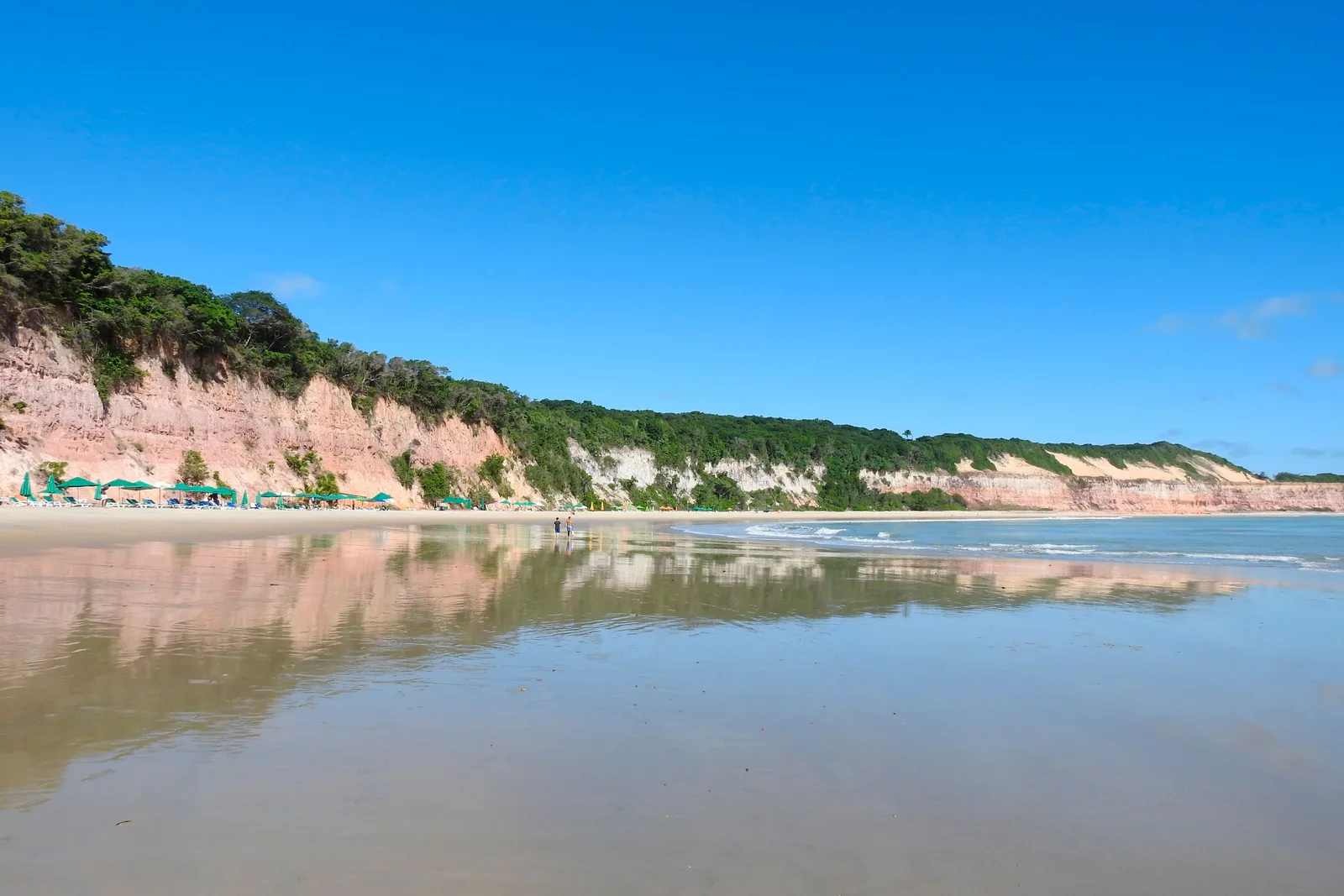
  • Wet sand in Baía dos Golfinhos reflecting the pink and white cliffs above it, a row of green parasols at the foot of the cliff and two people at the water’s edge

    From Praia do Centro · about a kilometer each way

    The low-tide walk to Baía dos Golfinhos

    The thing to do here, and it costs nothing but planning. Leave on the falling tide, walk north along the sand past the rock ledges and around the headland, and the bay opens up with nobody in it who did not also walk. Give yourself an hour there and start back before the water does. You can also walk in from Praia do Madeiro at the other end, on the same low tide.

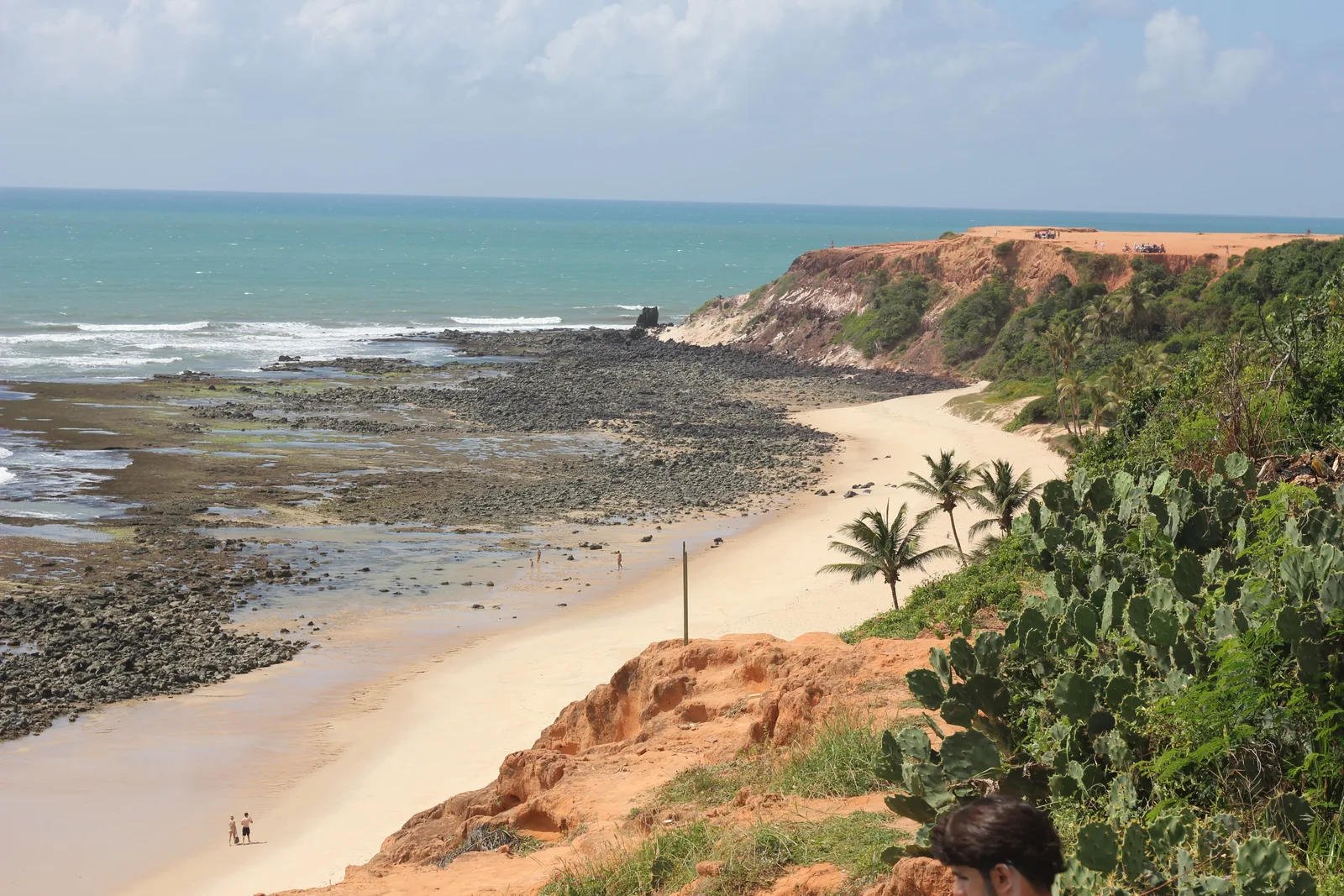
  • Wide dark ledges of beachrock and shallow pools exposed at low tide along Praia do Amor, seen from a clifftop with prickly pear cactus in the foreground, palms on the slope and a flat-topped red headland at the far end

    North end of Praia do Amor · low tide only

    The natural pools at Praia do Amor

    At low water the beachrock ledges at the top of Praia do Amor come clear of the sea and hold pools of warm, still water a few steps from surf that is breaking properly. It is the best swimming on the southern side of the village and it exists for about three hours a day. Reef shoes, because beachrock is sharp underfoot.

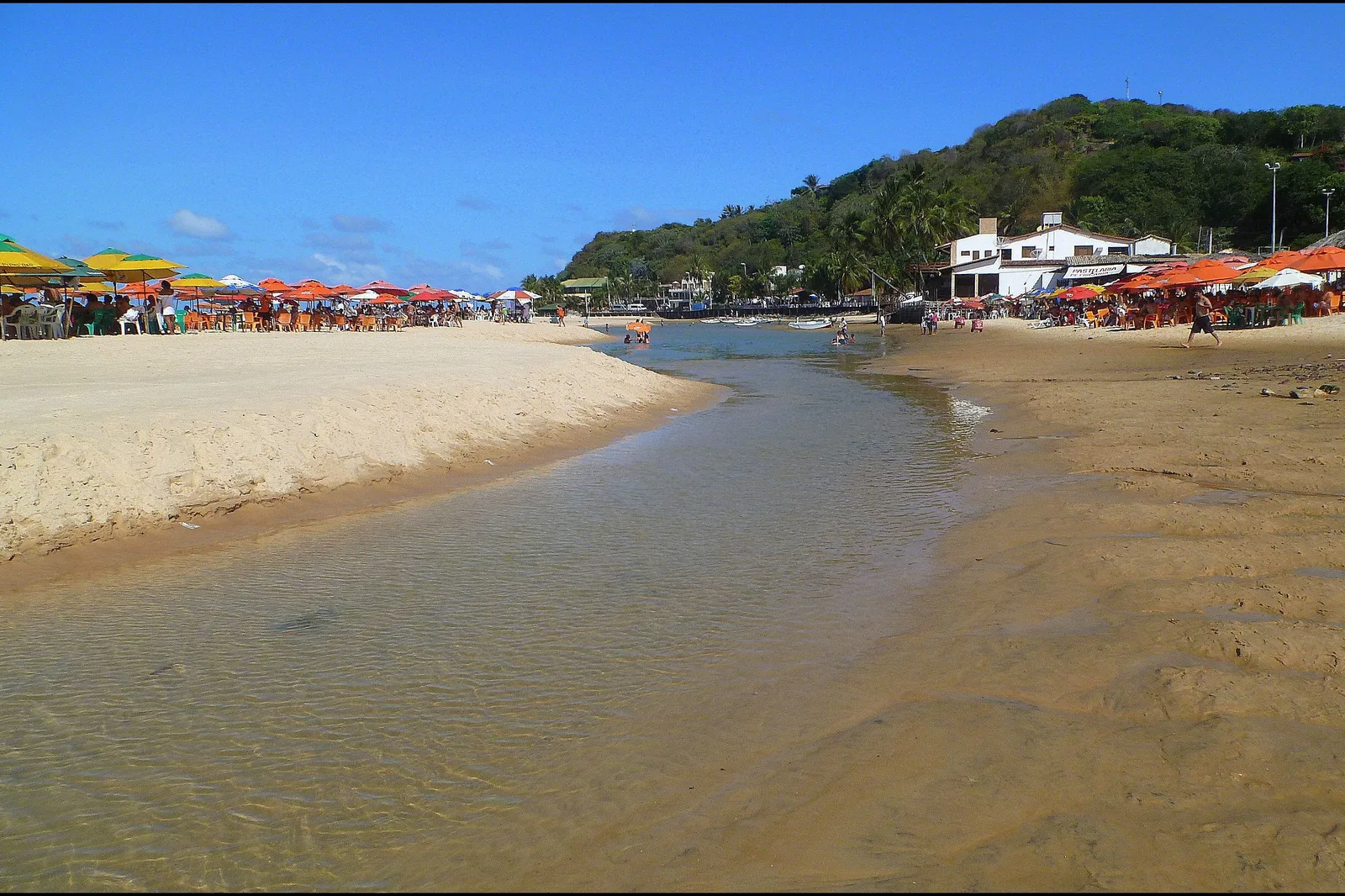
  • The beach in front of Pipa at low tide, a shallow channel of water running across wet sand with parasols and buildings along the shore and a green headland beyond

    Straight down from the main street · any tide

    A morning on Praia do Centro

    The village beach, and the only one you reach without a walk or a car. Boats sit on the sand at the northern end, kiosks run along the back of it, and at low water a wide flat foreshore opens up that children can wade across for a hundred meters. It is the beach for the day you do not want a plan.

  • Dark flat ledges of rock exposed at low tide along an almost empty beach south of Pipa, with the open sea beyond and no buildings in the frame

    South of Praia do Amor · low tide, and take water

    The quiet walk south past Praia das Minas

    Praia das Minas begins where Praia do Amor ends, at the rock the locals call the Pedra do Moleque, and it is the emptiest beach at Pipa. There is no row of kiosks and almost nothing to buy, the sea is open and not recommended for swimming, and turtles nest along it. Go on a falling tide for the walk and the low-water rock pools, carry your own water, and stay off the strip of sand directly under the cliff.

On the water

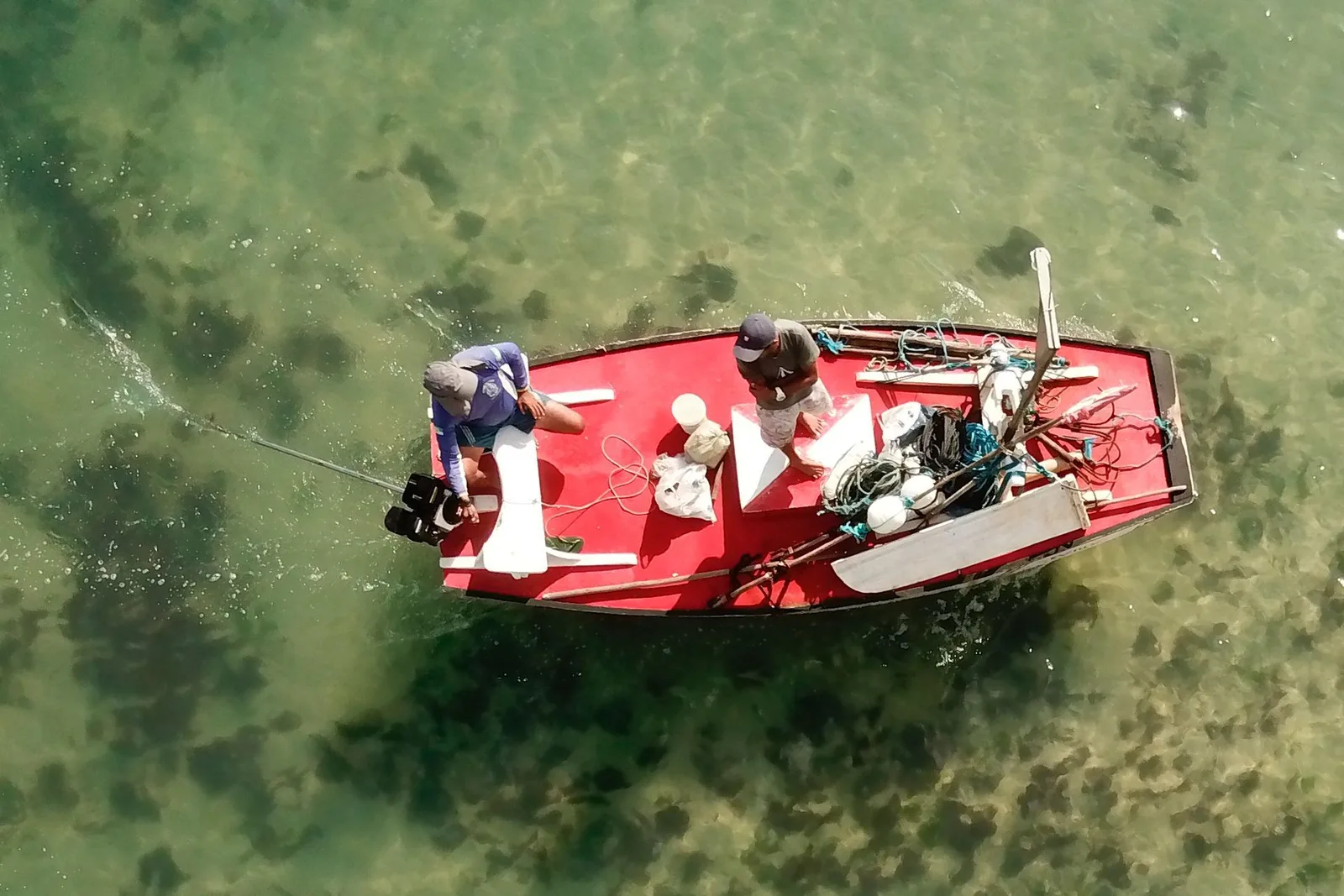
  • A small red wooden fishing boat photographed from directly above, two men aboard among nets, floats and rope, on clear green water over sand and dark weed

    From Praia do Centro · about an hour

    The boat trip to the dolphin bay

    The alternative to the walk, and the way to go if the tide will not cooperate. Small boats run north from the village beach, past the headland and into the bay, and hold there. Boats leave from Praia do Centro on the hour through the morning, and the last departures are early afternoon. The rules changed in March 2026 under an agreement between federal prosecutors, the municipality and the boat operators: a hundred meters minimum distance from the animals, five knots, ten minutes per approach, and no more than three boats in the bay at high tide or four at low. A good skipper will tell you all of that before you board.

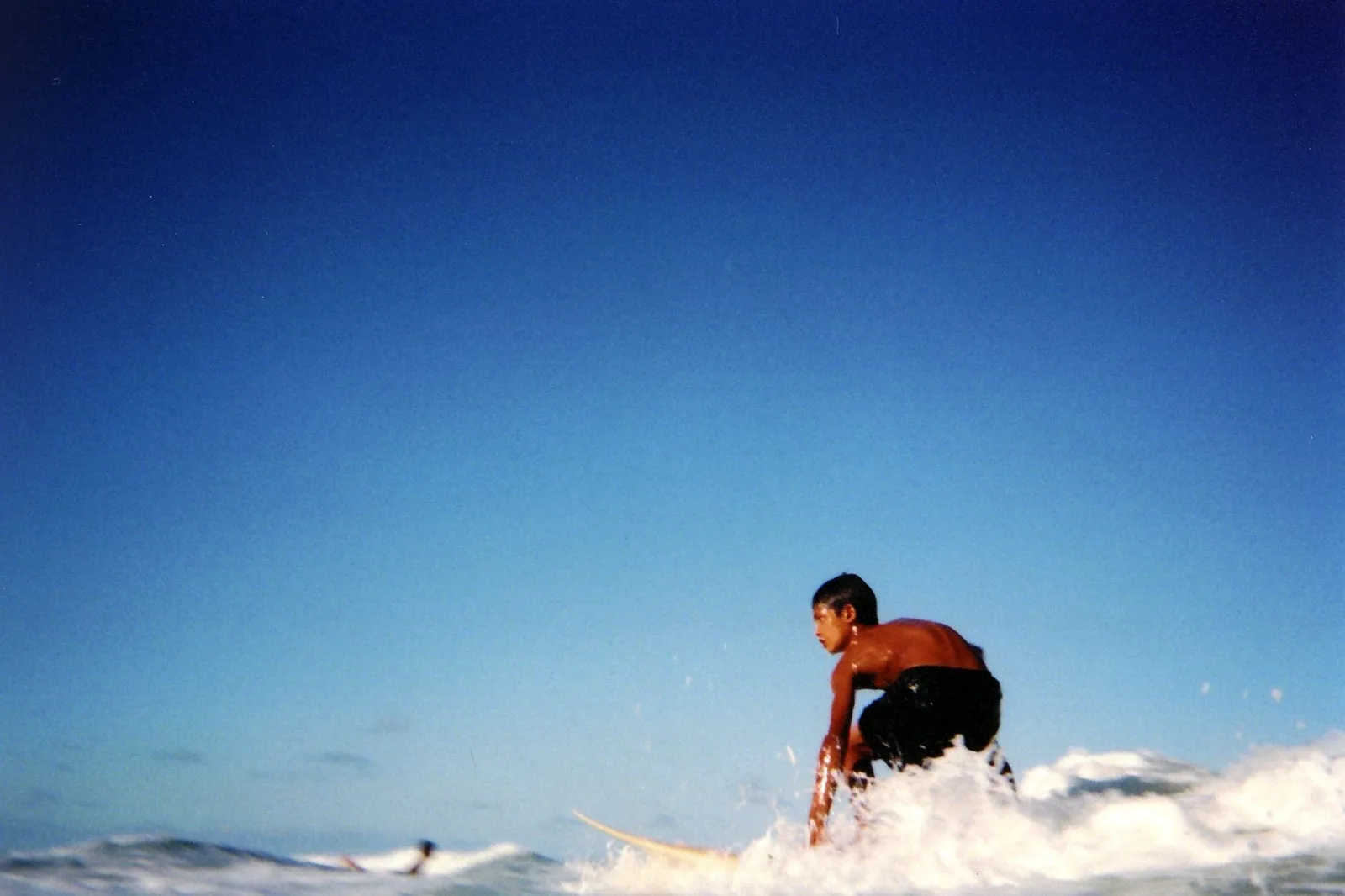
  • A young surfer crouched low on a board in the white water of a breaking wave, seen side-on from water level against a deep blue sky, with a second surfer lying on a board at the left

    South of the village · consistent year round

    Surfing at Praia do Amor

    Pipa has been a surf town since before it was a tourist town, and Praia do Amor is where the regional competitions are held. It is an exposed beach break, and surf-forecast rates Pipa’s break very consistent and warns that it gets crowded and localized. It is not the wave to learn on. Boards rent on the main street.

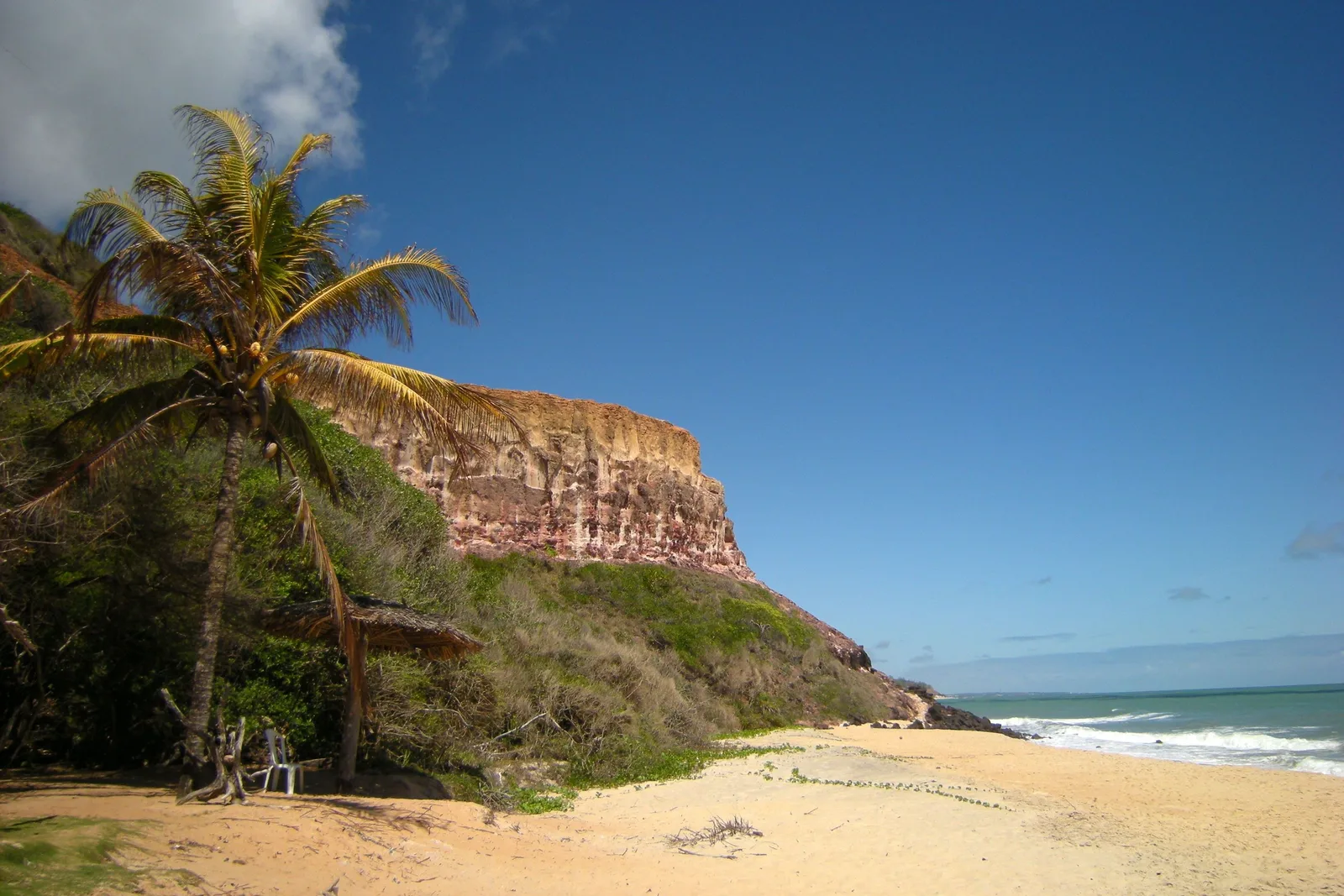
  • A single coconut palm and a thatched shade on the sand at Praia do Madeiro, a tall banded red cliff rising behind them and surf running up the beach

    North of the village · beginners and improvers

    Learning to surf at Praia do Madeiro

    A sand bottom and small waves, which is why the surf schools take their beginners here rather than to the beach the competitions are on. Lessons include the board and the transfer up.

Up on the cliffs

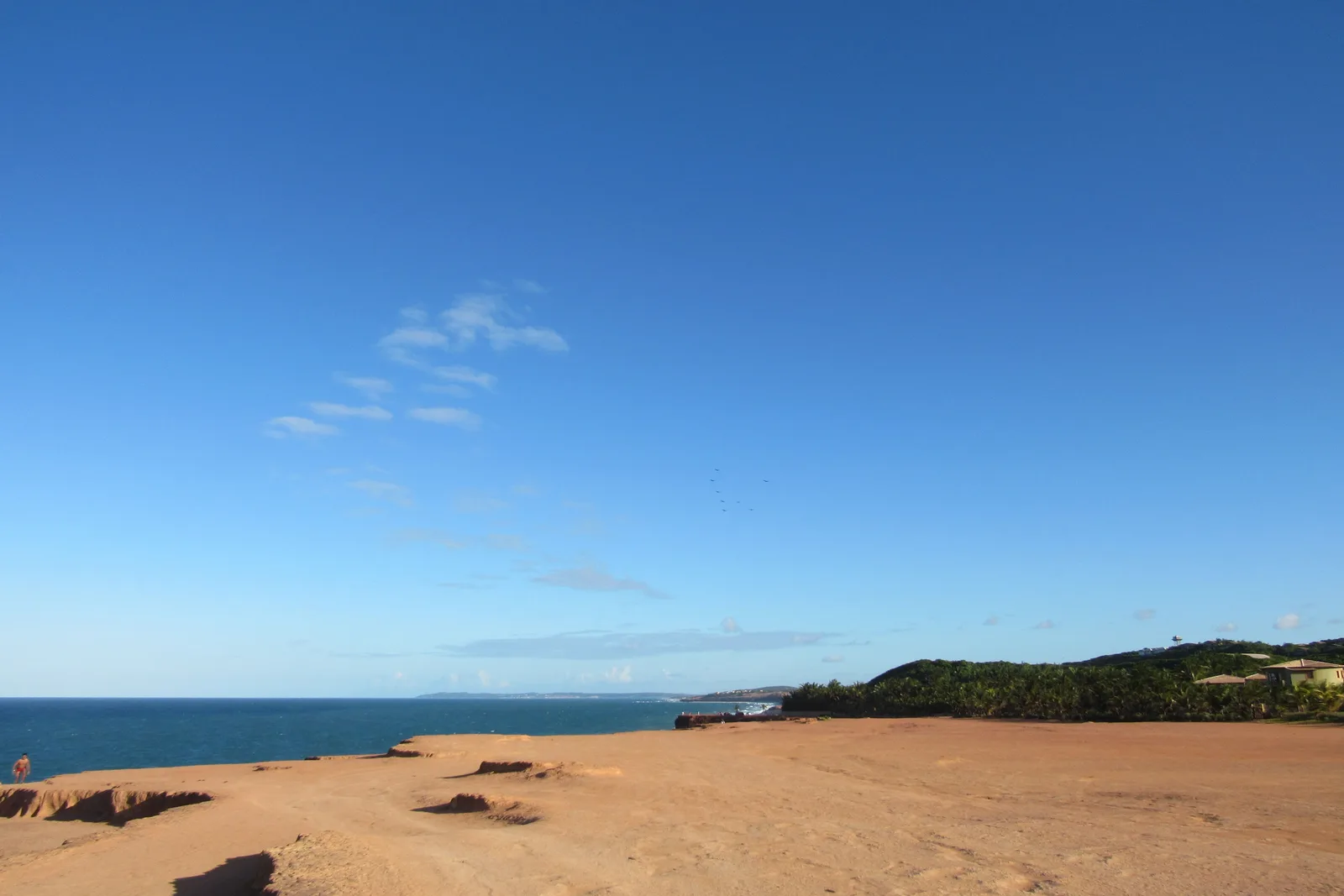
  • The flat sandy top of the Chapadão running out toward the sea, with bare red rock at the edge and the ocean horizon beyond

    Above Praia do Amor · free, and best late

    The view from the Chapadão

    A bare, flat headland of red rock at the southern end of the village, reached on foot up from the beach or along the lane behind it. The whole coast opens out from up there, north over the village beaches and south down the empty side. Go for the last hour of light. People have died going over this edge on quad bikes, and the municipality has fenced the worst sections. Stay behind the fence and well back from any unfenced edge, especially as the light goes: this is active cliff, and sections of this coast get closed when the ground moves.

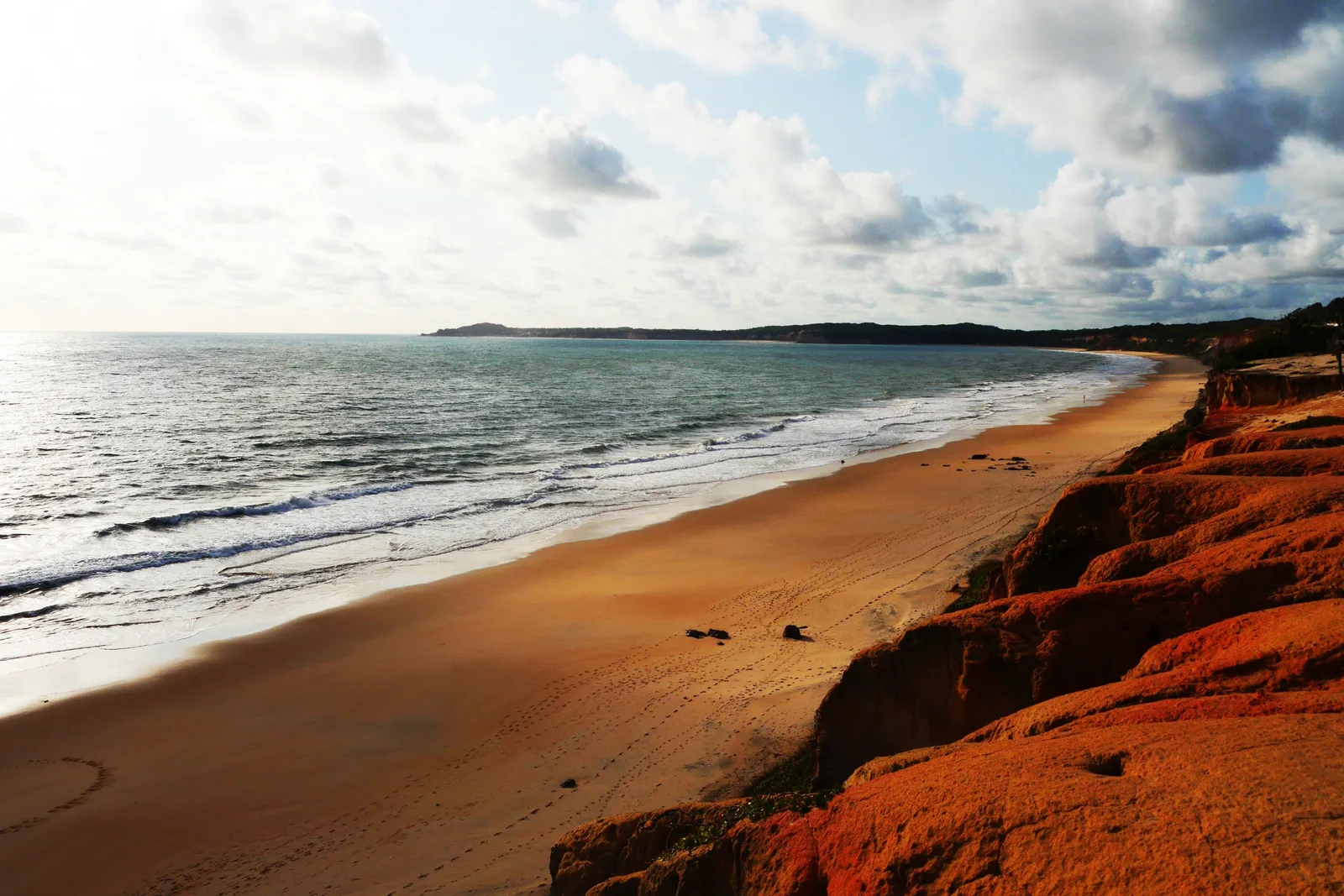
  • A long beach at Cacimbinhas seen from the top of the red cliffs, footprints across the sand, waves running in from the left and a low wooded headland on the horizon

    North of Madeiro · free

    The clifftop lookouts between Madeiro and Cacimbinhas

    North of Madeiro the road runs along the top of the cliffs toward Cacimbinhas, and the cliff edge there is the most visited lookout on this coast. From up there you can see the line of cliffs and beaches running back toward Pipa. Stay back from the edge. Worth doing on the first afternoon, before you plan anything.

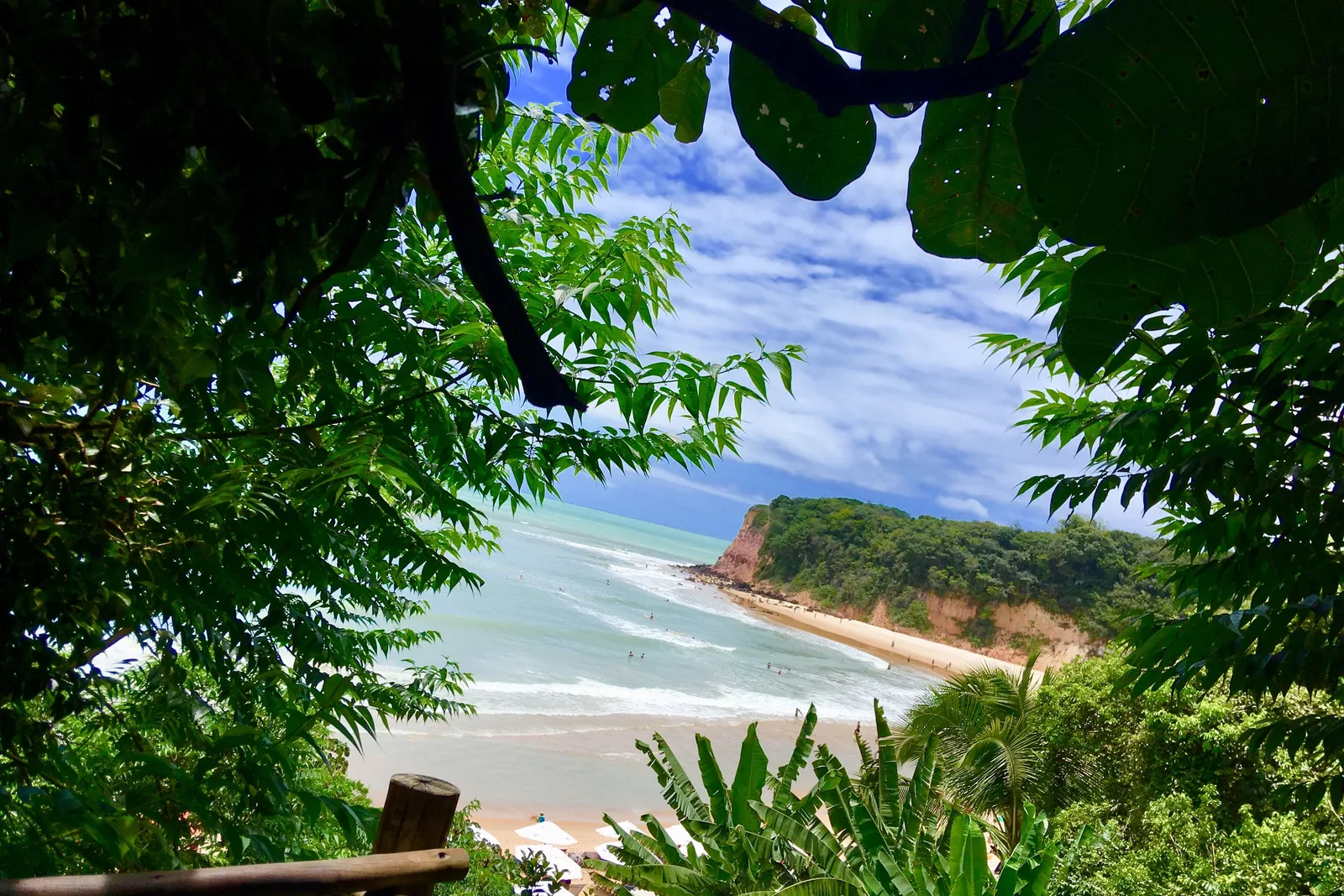
  • A view out through the leaves of coastal forest to a curve of pale beach and turquoise sea below, framed by branches on both sides

    Above Baía dos Golfinhos · 7:00am to 5:00pm

    Trails at the Santuário Ecológico de Pipa

    A private reserve of Atlantic forest on the clifftop above the dolphin bay, with a network of marked trails at graded difficulties, several clifftop lookouts and a staircase of roughly 150 steps down to Praia do Madeiro. It is the one place here where you get the forest as well as the coast, and one of its lookouts is a known spot for watching for dolphins.

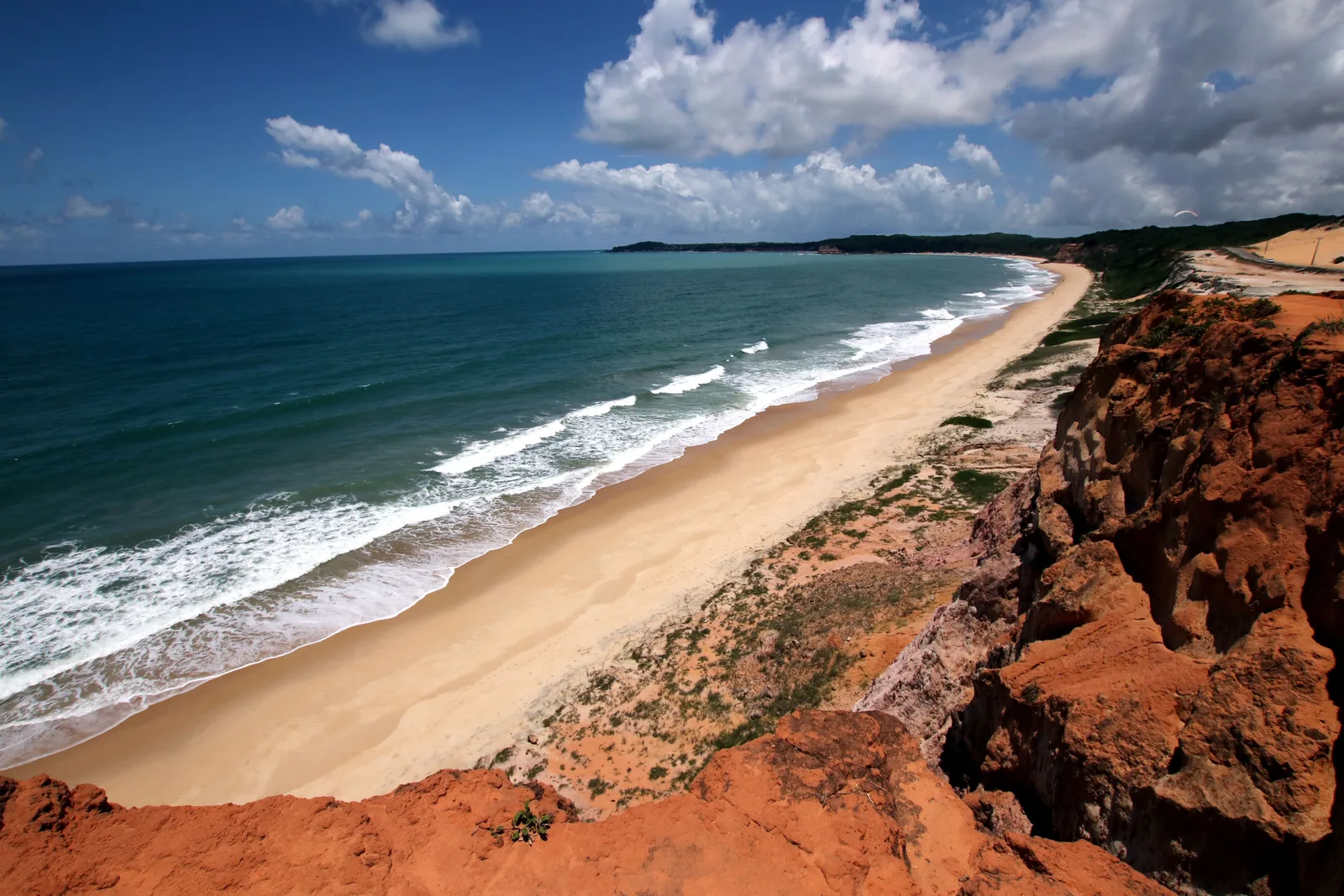
  • A long curving beach seen from a red clifftop at Cacimbinhas, lines of surf running up the pale sand, green scrub along the cliff edge and dunes in the distance

    On the road toward Tibau do Sul · a short drive north

    The dune and the flying at Cacimbinhas

    North of Madeiro the cliff line gives way to a big dune above Praia de Cacimbinhas, which is where sandboards get rented and where the paragliding ramp is. Instructors here are certified by the Brazilian free flight confederation and fly tandem from about November to April, on days the wind allows. From the top of the dune you can see the whole coast between Tibau do Sul and Pipa. Late afternoon, once the sand has stopped being unbearable.

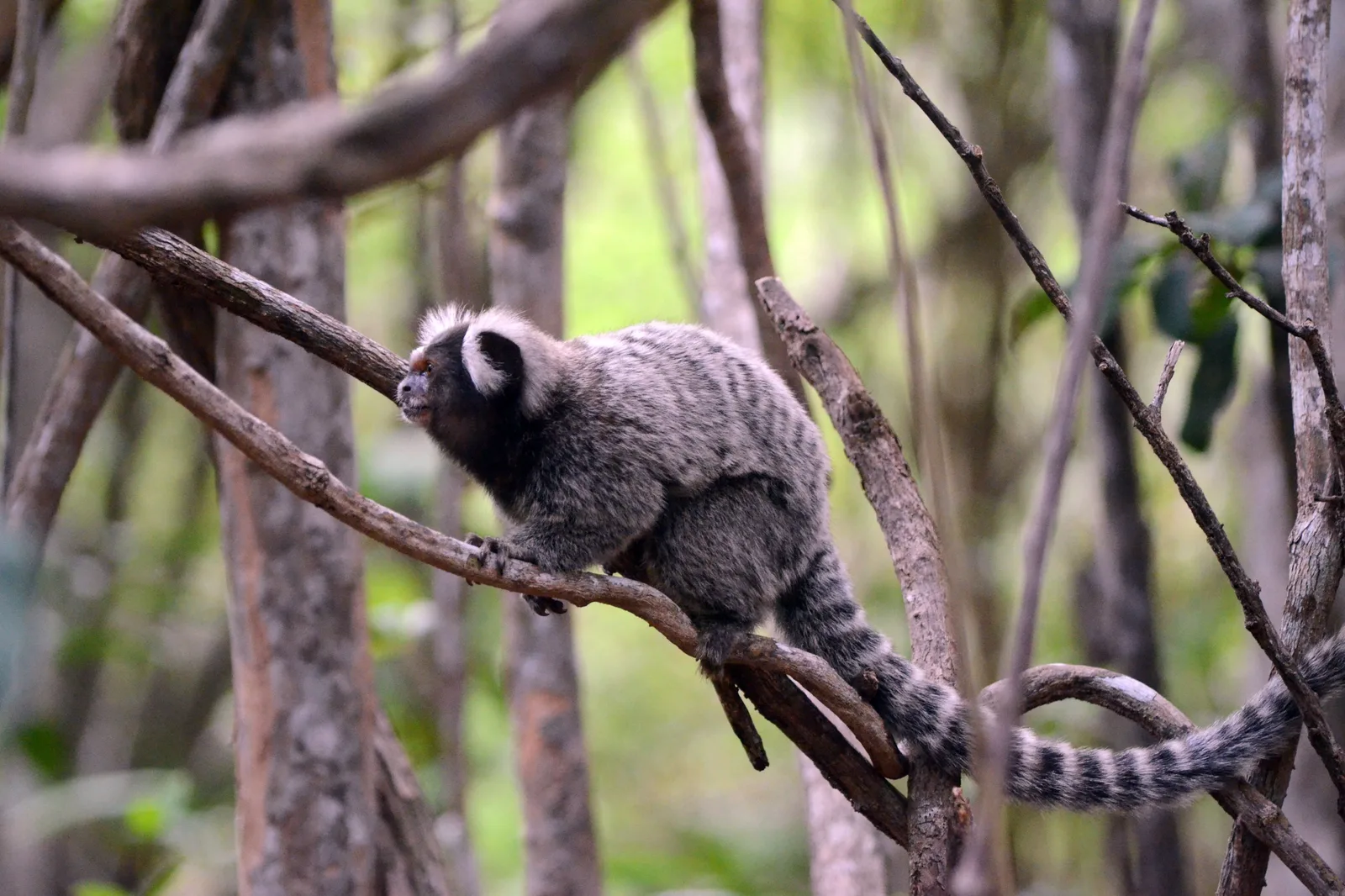
  • A common marmoset perched on a thin branch in coastal forest, its long striped tail curving down behind it

    The reserve and the wooded cliff edges · early morning

    Marmosets and forest birds on the clifftop

    The forest that survives on top of these cliffs is Atlantic forest, and it is full of small animals that are easy to see because the trees are low. Common marmosets move through the canopy in family groups, hummingbirds work the flowering trees, and lizards and iguanas sit out on the paths in the sun. First thing in the morning, on any of the clifftop trails.

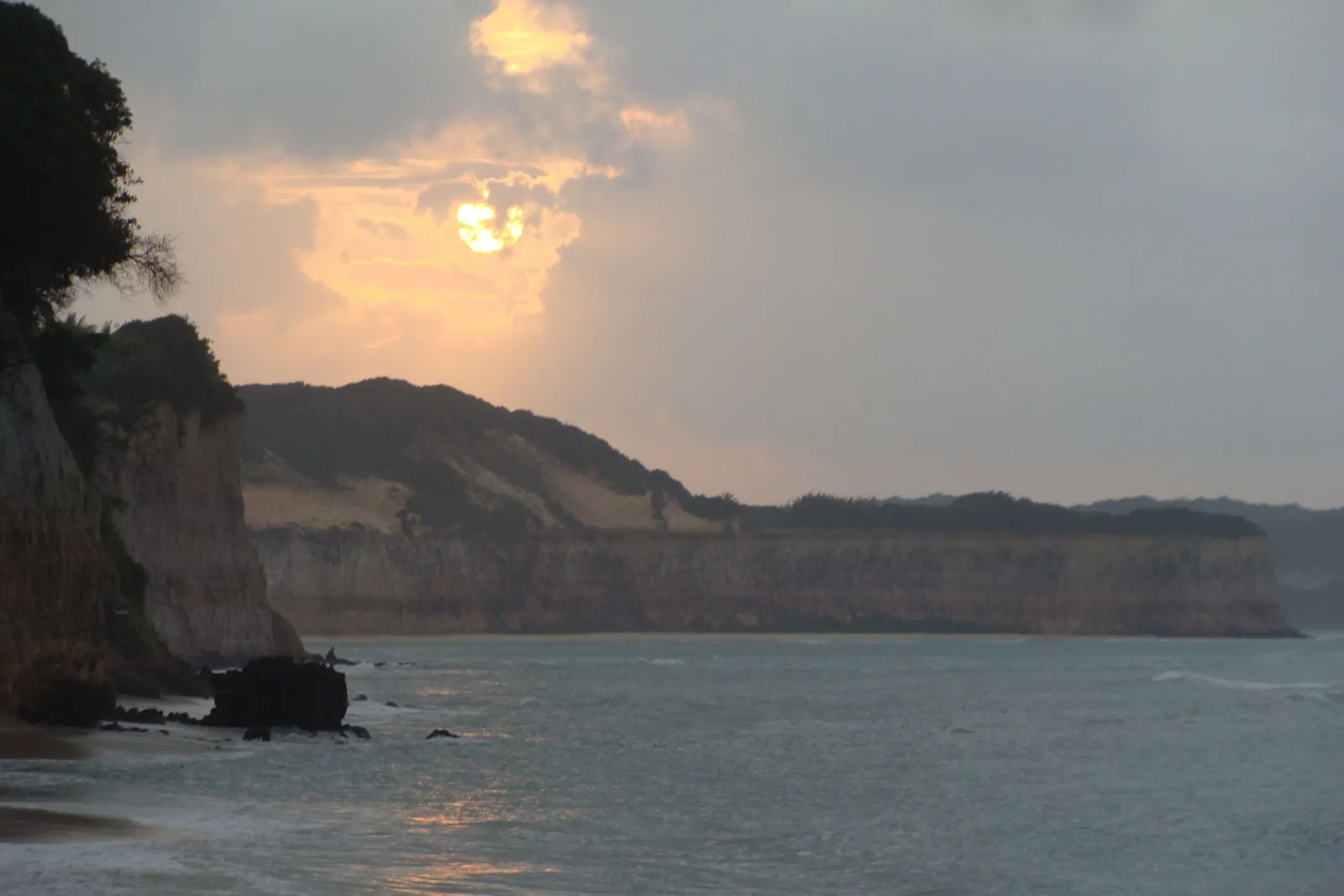
  • The sun low behind cloud above the cliff wall at Pipa, seen along the beach with dark rock standing in the shallows and the pale cliff line running away into haze

    Any clifftop bar · about forty minutes before dark

    Sunset from the cliff, and dinner after

    The clifftop bars are built for the last hour of light, and Praia do Centro is a good place to watch it from the sand. Then walk down into the village and eat.

Wildlife

  • Wet sand in Baía dos Golfinhos reflecting the pink and white cliffs above it, a row of green parasols at the foot of the cliff and two people at the water’s edge

    From Praia do Centro · about a kilometer each way

    The low-tide walk to Baía dos Golfinhos

    The thing to do here, and it costs nothing but planning. Leave on the falling tide, walk north along the sand past the rock ledges and around the headland, and the bay opens up with nobody in it who did not also walk. Give yourself an hour there and start back before the water does. You can also walk in from Praia do Madeiro at the other end, on the same low tide.

  • A small red wooden fishing boat photographed from directly above, two men aboard among nets, floats and rope, on clear green water over sand and dark weed

    From Praia do Centro · about an hour

    The boat trip to the dolphin bay

    The alternative to the walk, and the way to go if the tide will not cooperate. Small boats run north from the village beach, past the headland and into the bay, and hold there. Boats leave from Praia do Centro on the hour through the morning, and the last departures are early afternoon. The rules changed in March 2026 under an agreement between federal prosecutors, the municipality and the boat operators: a hundred meters minimum distance from the animals, five knots, ten minutes per approach, and no more than three boats in the bay at high tide or four at low. A good skipper will tell you all of that before you board.

  • A view out through the leaves of coastal forest to a curve of pale beach and turquoise sea below, framed by branches on both sides

    Above Baía dos Golfinhos · 7:00am to 5:00pm

    Trails at the Santuário Ecológico de Pipa

    A private reserve of Atlantic forest on the clifftop above the dolphin bay, with a network of marked trails at graded difficulties, several clifftop lookouts and a staircase of roughly 150 steps down to Praia do Madeiro. It is the one place here where you get the forest as well as the coast, and one of its lookouts is a known spot for watching for dolphins.

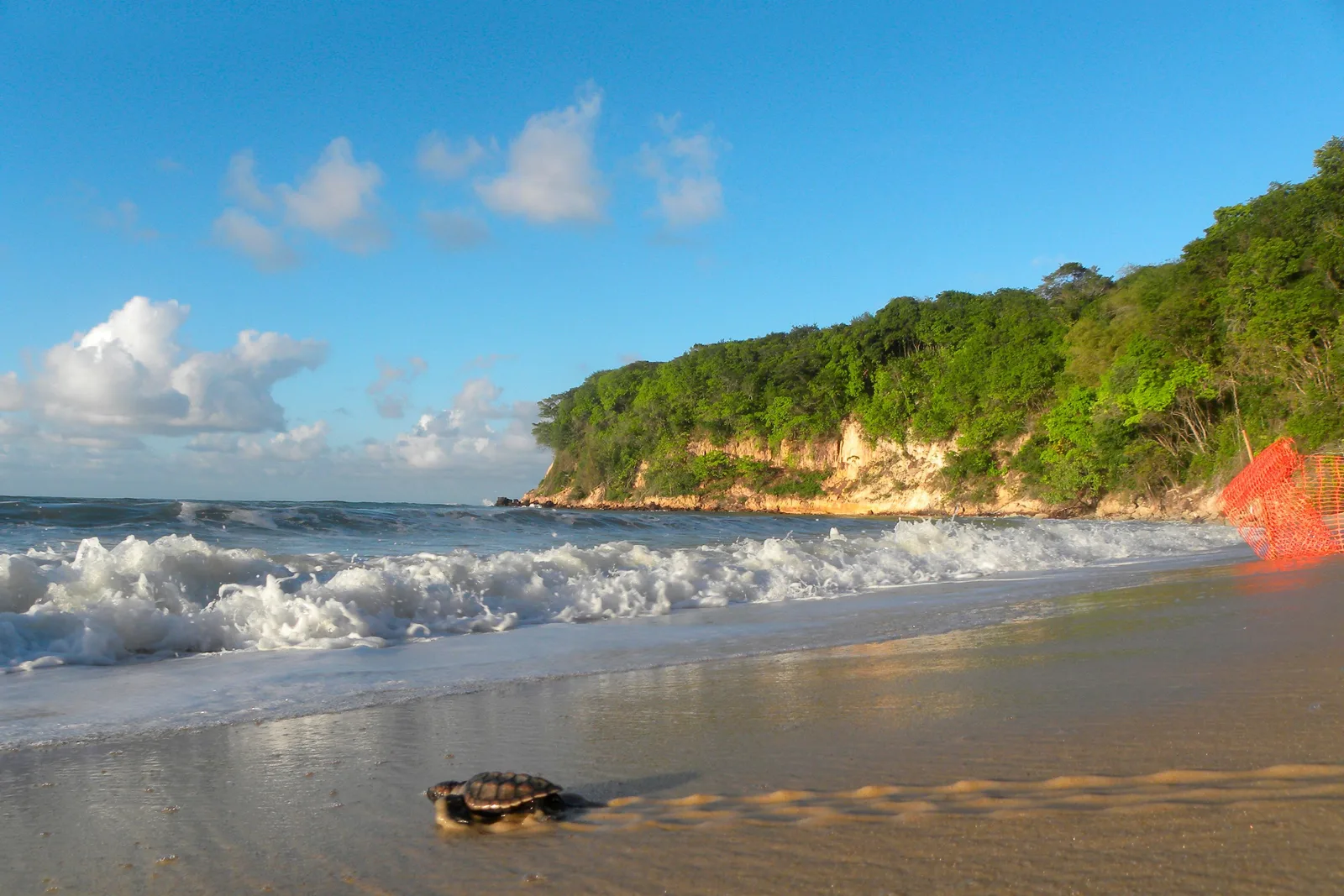
  • A sea turtle hatchling crossing the wet sand toward the surf at Praia do Madeiro, an orange nest-protection fence at the right and the wooded headland behind

    Nesting beaches · hatchling releases in the first half of the year

    Sea turtles at Praia do Madeiro and Praia das Minas

    Projeto Tamar, Brazil’s sea turtle program, runs a base at Pipa and monitors this coast through the nesting season. Hawksbill turtles occur here, and the releases of hatchlings, which are open to the public and announced locally, happen at Praia das Minas and Praia do Madeiro. If you are here in the first half of the year, ask at your pousada whether one is scheduled.

  • A common marmoset perched on a thin branch in coastal forest, its long striped tail curving down behind it

    The reserve and the wooded cliff edges · early morning

    Marmosets and forest birds on the clifftop

    The forest that survives on top of these cliffs is Atlantic forest, and it is full of small animals that are easy to see because the trees are low. Common marmosets move through the canopy in family groups, hummingbirds work the flowering trees, and lizards and iguanas sit out on the paths in the sun. First thing in the morning, on any of the clifftop trails.

The village

  • The beach in front of Pipa at low tide, a shallow channel of water running across wet sand with parasols and buildings along the shore and a green headland beyond

    Straight down from the main street · any tide

    A morning on Praia do Centro

    The village beach, and the only one you reach without a walk or a car. Boats sit on the sand at the northern end, kiosks run along the back of it, and at low water a wide flat foreshore opens up that children can wade across for a hundred meters. It is the beach for the day you do not want a plan.

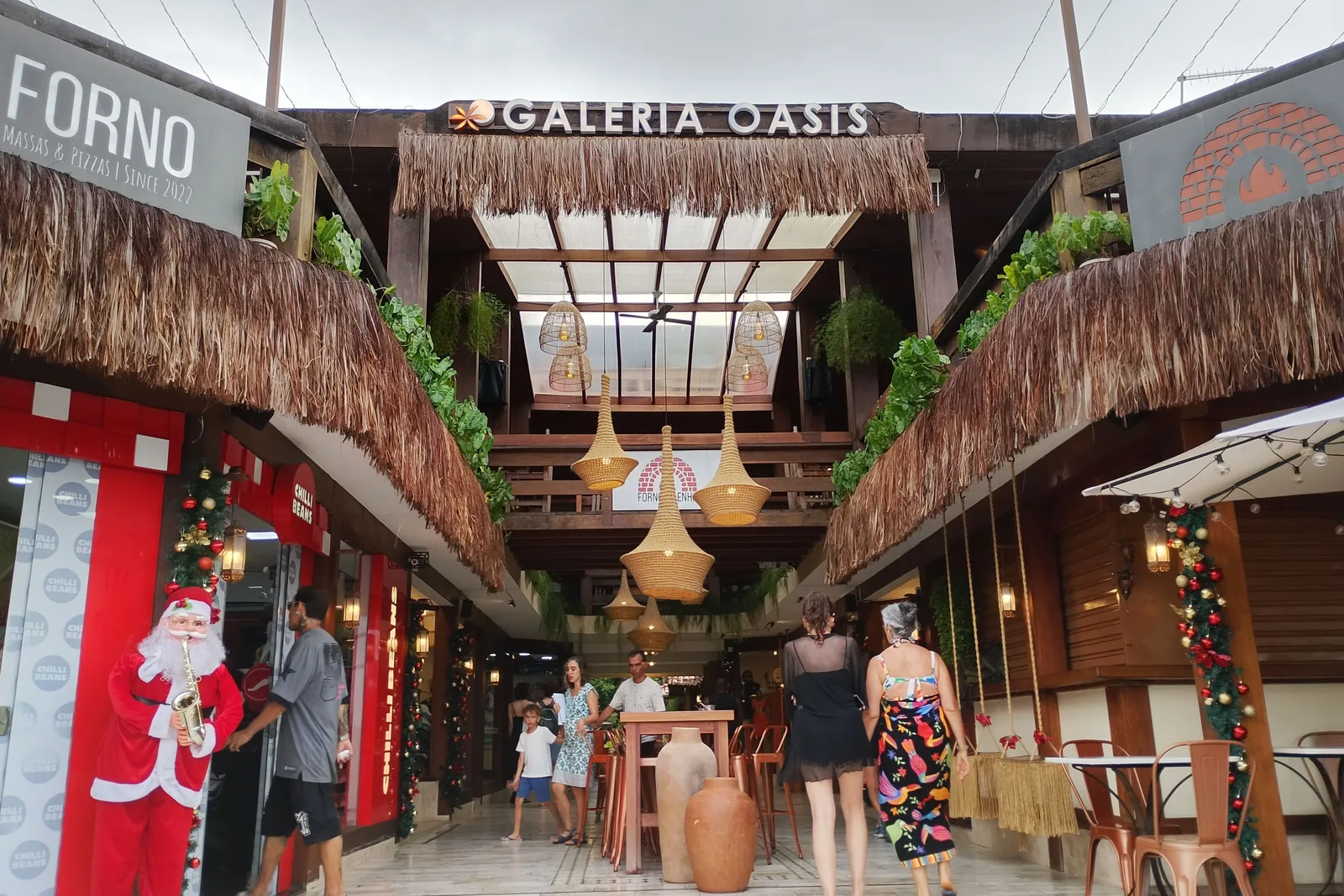
  • A covered shopping arcade in Pipa lined with small shopfronts under thatched eaves, woven lamps hanging overhead, Christmas decorations and a Santa figure at the entrance, and people walking through it

    The main street · from about 8:00pm

    An evening on Avenida Baía dos Golfinhos

    The one street does the work of a whole town. Arcades of small shops under thatched roofs, restaurants that run from açaí counters to properly good kitchens, live music in season, and a crowd that is a mix of Brazilian vacationers, long-stay surfers and Europeans who came for a week in 2009. Walk the length of it before you choose where to eat.

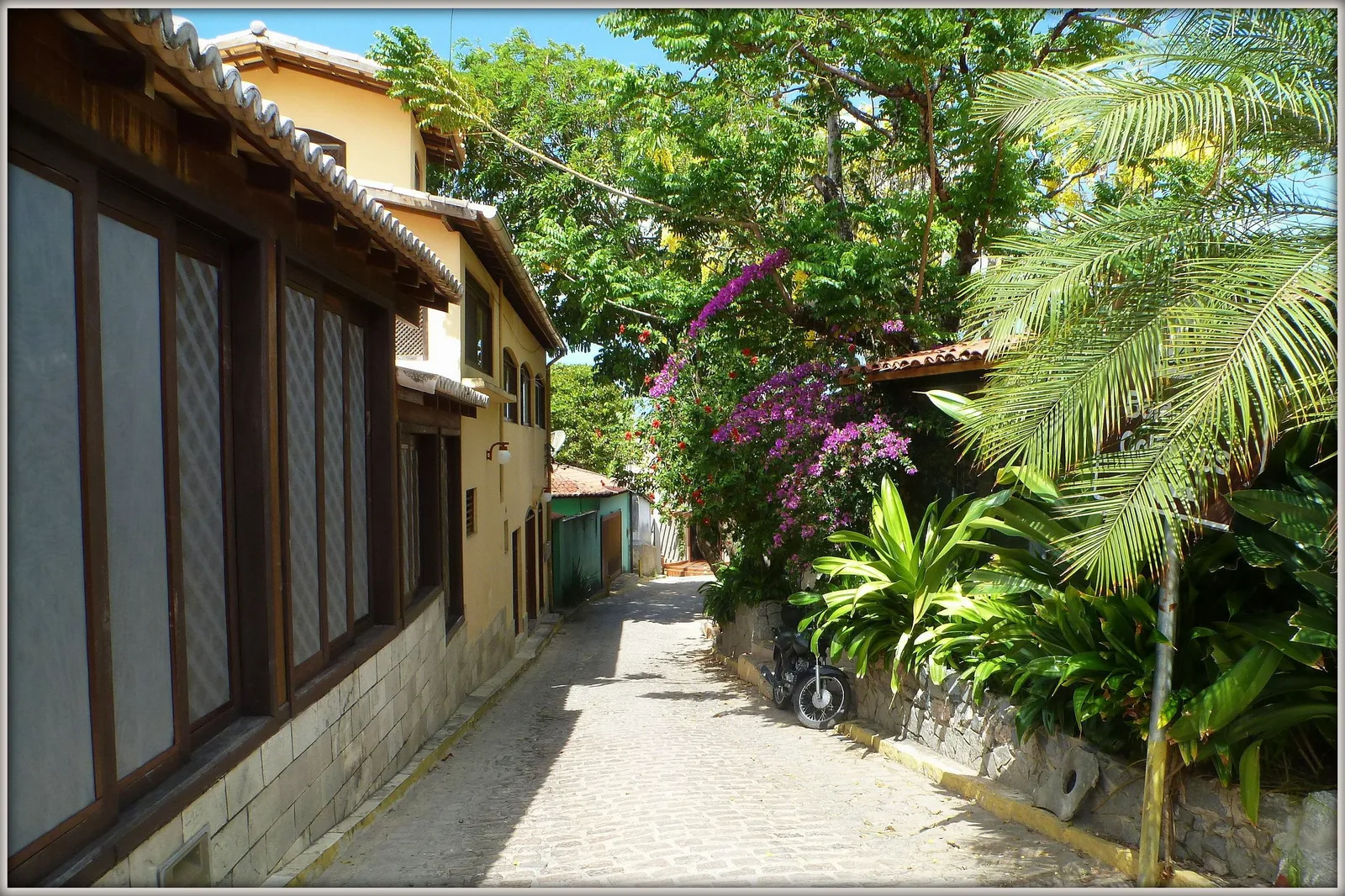
  • A narrow cobbled lane in Pipa between a yellow house and a stone garden wall, bougainvillea in flower over the wall, a palm leaning across the street and a motorbike parked at the side

    Off the main street · any time

    The lanes behind the avenue

    Step one street back and Pipa gets quiet immediately. The lanes are sand and stone, walled with bougainvillea, and lined with the small family pousadas that are the best value here. They are also where you find the bakeries and the per-kilo places that residents eat in rather than visitors. Ten minutes of wandering is worth more than any restaurant list.

  • The sun low behind cloud above the cliff wall at Pipa, seen along the beach with dark rock standing in the shallows and the pale cliff line running away into haze

    Any clifftop bar · about forty minutes before dark

    Sunset from the cliff, and dinner after

    The clifftop bars are built for the last hour of light, and Praia do Centro is a good place to watch it from the sand. Then walk down into the village and eat.

Where to stay

Four choices, and three of them are within a mile.

Almost everybody stays in or just above the village, and for a first visit they are right to: the street is short, the beach is at the end of it, and the walk between the coves starts at your door. What changes between the zones is how much noise you sleep through and how many steps you climb. The fourth option, Tibau do Sul on the lagoon, is a different trip rather than a different room.

Drag and zoom to explore.

Tap an area to open it and see it on the map

  • Our pick

    Best for: Walking to everything, including the tide walk

    The wide low-tide beach in front of Pipa with wet sand in the foreground, white cliffs closing the far end of the bay and a few people walking along the water’s edge

    The main street and the lanes off it, with Praia do Centro at the bottom. This is where the restaurants, the surf shops, the boats and most of the mid-range pousadas are, and it is the only zone from which the low-tide walk to the dolphin bay starts at your door. It is not silent: the avenue has music until late in season, and the closer to the beach end you sleep the quieter it gets. For a first visit this is the right position, and one lane back from the avenue is the right compromise.

    • Most pousadas
    • Walk everywhere
    • Noisy in season
    • Best for the tide walk
  • Best for: Views, quiet and surf on your doorstep

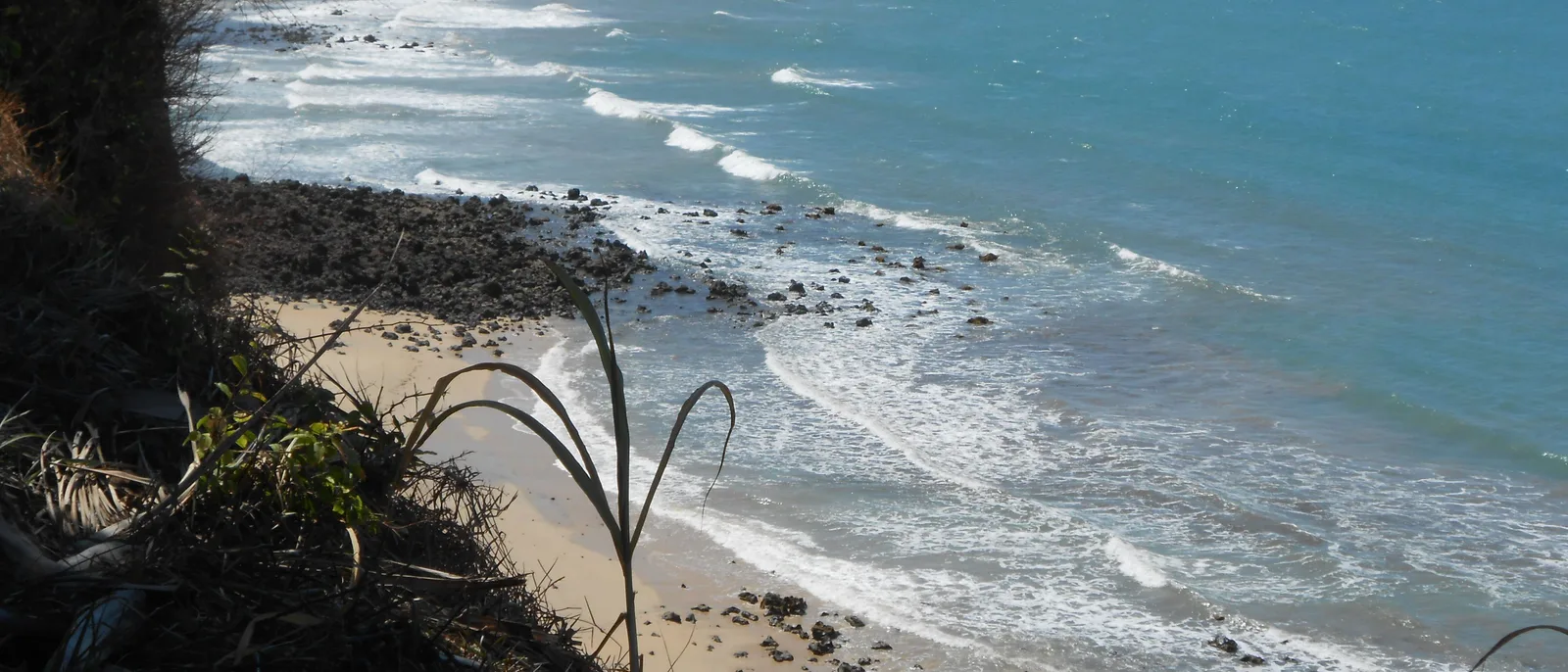
    Looking straight down from the clifftop at Praia do Amor onto a narrow strip of sand scattered with dark rock, lines of surf running in over blue water

    South of the village, on the high ground above Praia do Amor and the Chapadão. This is where the rooms with a real sea view are, and where the pools sit on the cliff edge. It is a ten to fifteen minute walk into the village, some of it up, and the walk home at night is dark. Right if you are here to surf, right if you want the view, wrong if you would rather not do that climb twice a day.

    • Sea views
    • Surf beach below
    • Quieter
    • A climb into town
  • Best for: Space, and the beach rather than the street

    A wide sandy beach in warm low light at Cacimbinhas, dark rock in the foreground and a red and cream cliff wall running away along the shore under green vegetation

    Two to five kilometers north of the village, on the bay and the coast above it. The hotels here are bigger and more resort-shaped, with more space and more garden. The trade is that you need a car or a taxi to get to dinner, and the village is a drive rather than a walk. Right for a couple who want the beach and not the street.

    • Resort-style
    • More space
    • Need a car
    • Beginner surf below
  • Best for: The lagoon and its sunset

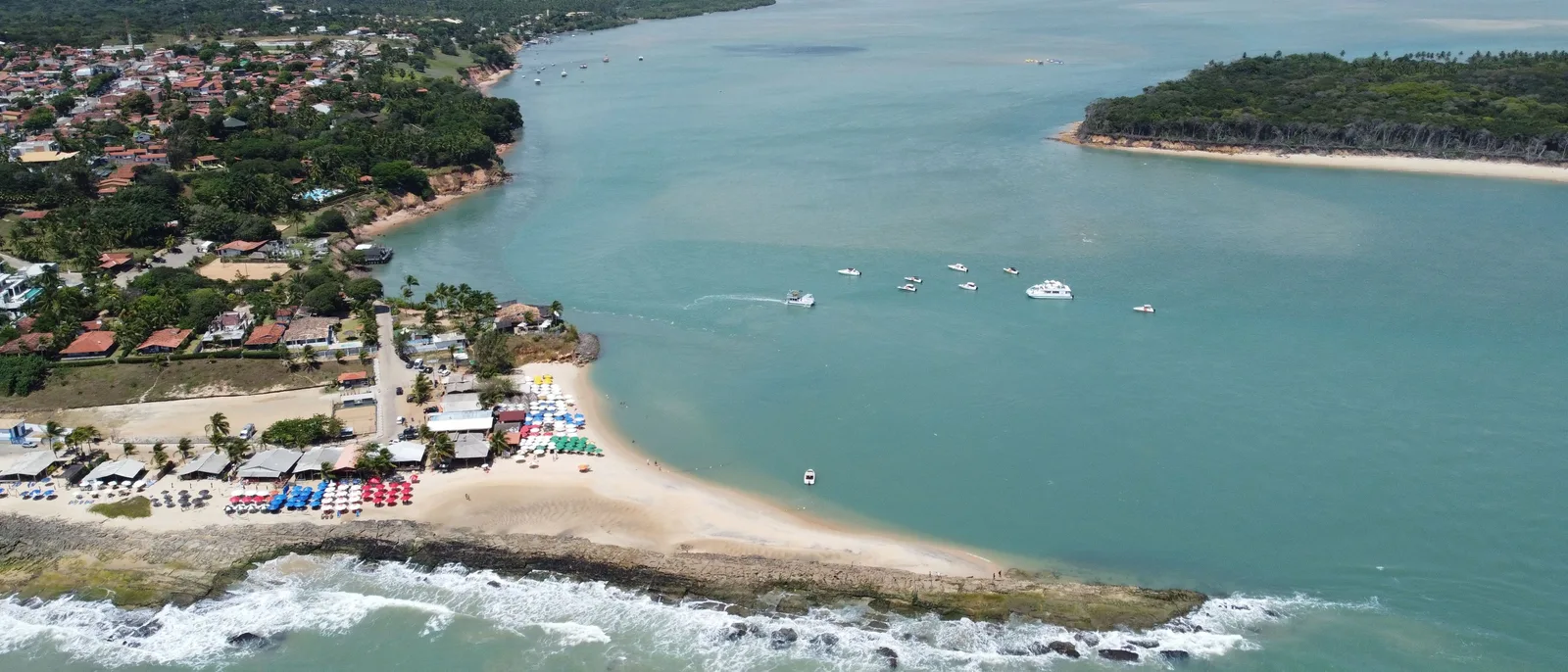
    The town of Tibau do Sul from the air where the Guaraíras lagoon meets the sea, with boats on the pale water, a sand spit between lagoon and ocean and the town along the shore

    The municipal seat, 9 kilometers north of Pipa where the Guaraíras lagoon meets the sea. It is a working town rather than a resort, and it faces west across the lagoon, where the sun sets over the water. What you give up is the coves: everything on this page is a drive away. Take it for the lagoon, or as a second base.

    • Lagoon sunsets
    • A working town
    • Need a car
    • Nine km from Pipa

A working plan

Four nights, and one of them decided by the moon.

Pipa is small and this is not a long trip. Four nights is enough to walk the whole coast, surf, get up on the cliffs and still have a day that does nothing. Build day two around whichever morning has the best low tide and let the rest follow.

  1. 01
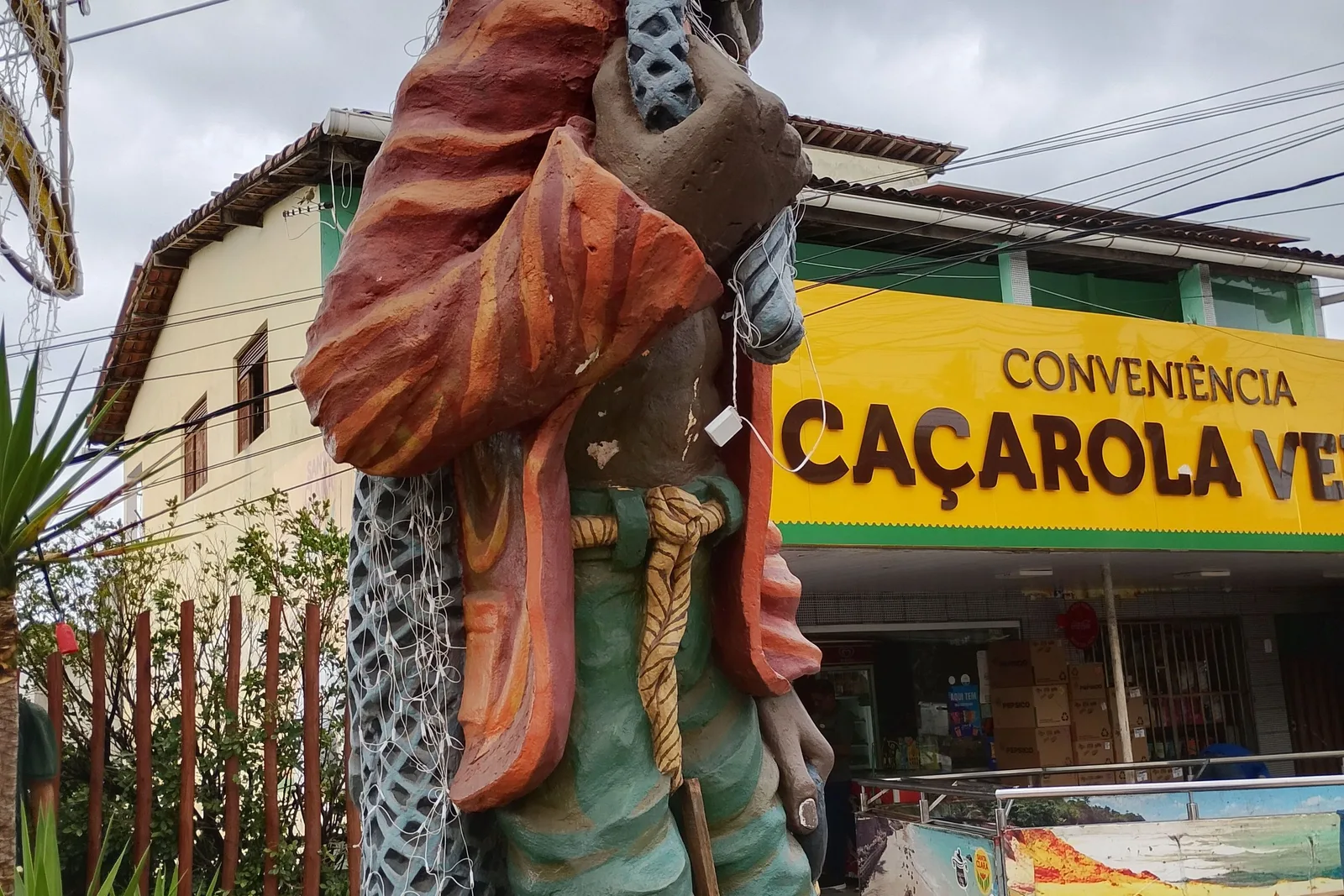
    The painted body of a large fisherman sculpture in Pipa, its head out of the frame, a net slung over its shoulder and a rope for a belt, in front of a convenience store’s yellow sign

    The village and the clifftop

    Arrive, and get your bearings from above

    About an hour and a half from Natal, then leave the car. Walk the length of the main street, get down to Praia do Centro, and spend the last hour of light on the Chapadão looking at the coast you are about to walk. Check the tide table before dinner.

  2. 02
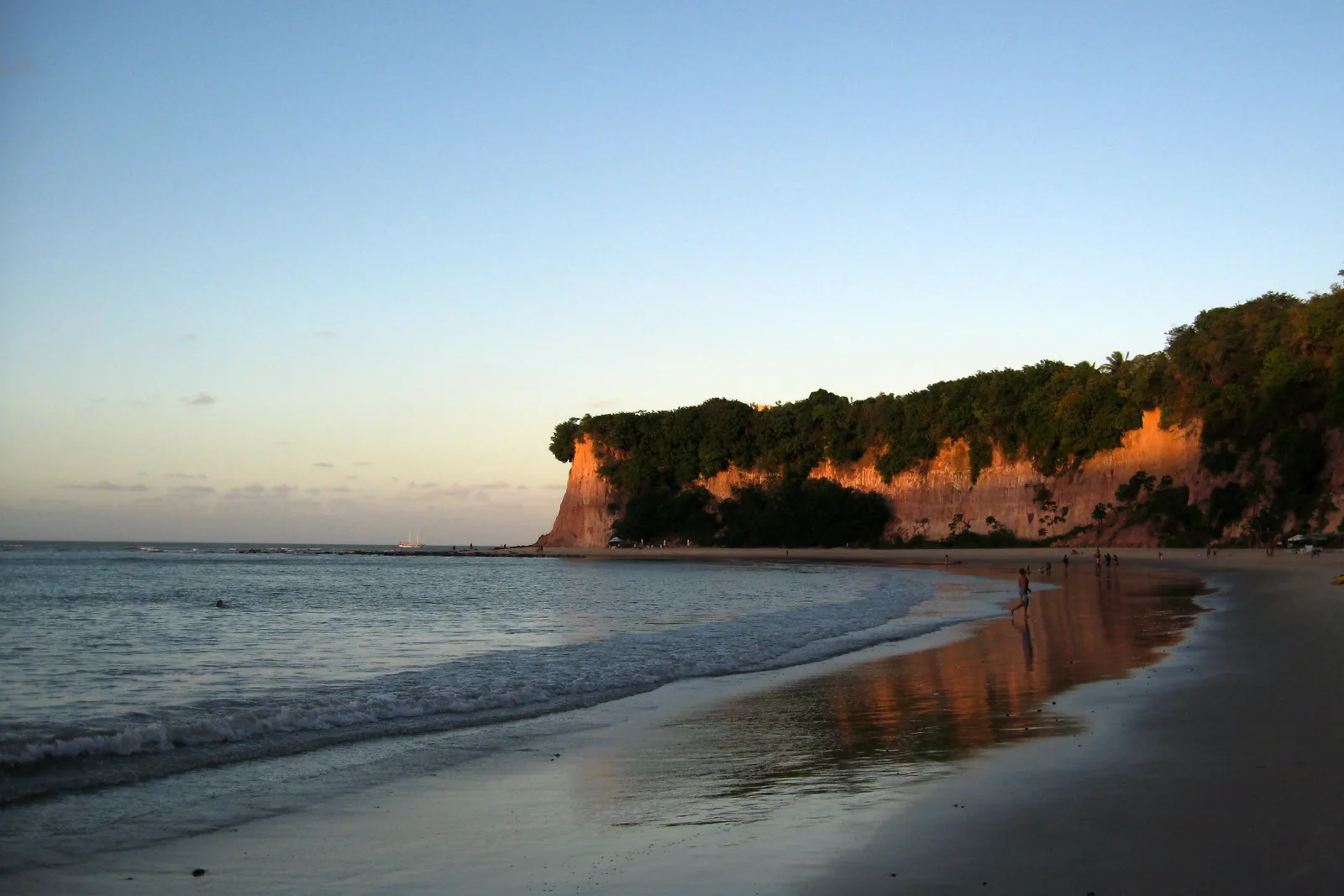
    A wooded red cliff headland lit orange by low sun at Pipa, reflected in the wet sand of the beach below, with a few people at the water’s edge and small waves running in

    Praia do Centro to Baía dos Golfinhos

    The tide day: walk to the dolphin bay

    Out on the falling tide, north along the sand and around the headland into the bay. An hour there, back before the water is. Then the natural pools at the top of Praia do Amor on the same low water if there is time, and a long lunch afterward.

  3. 03
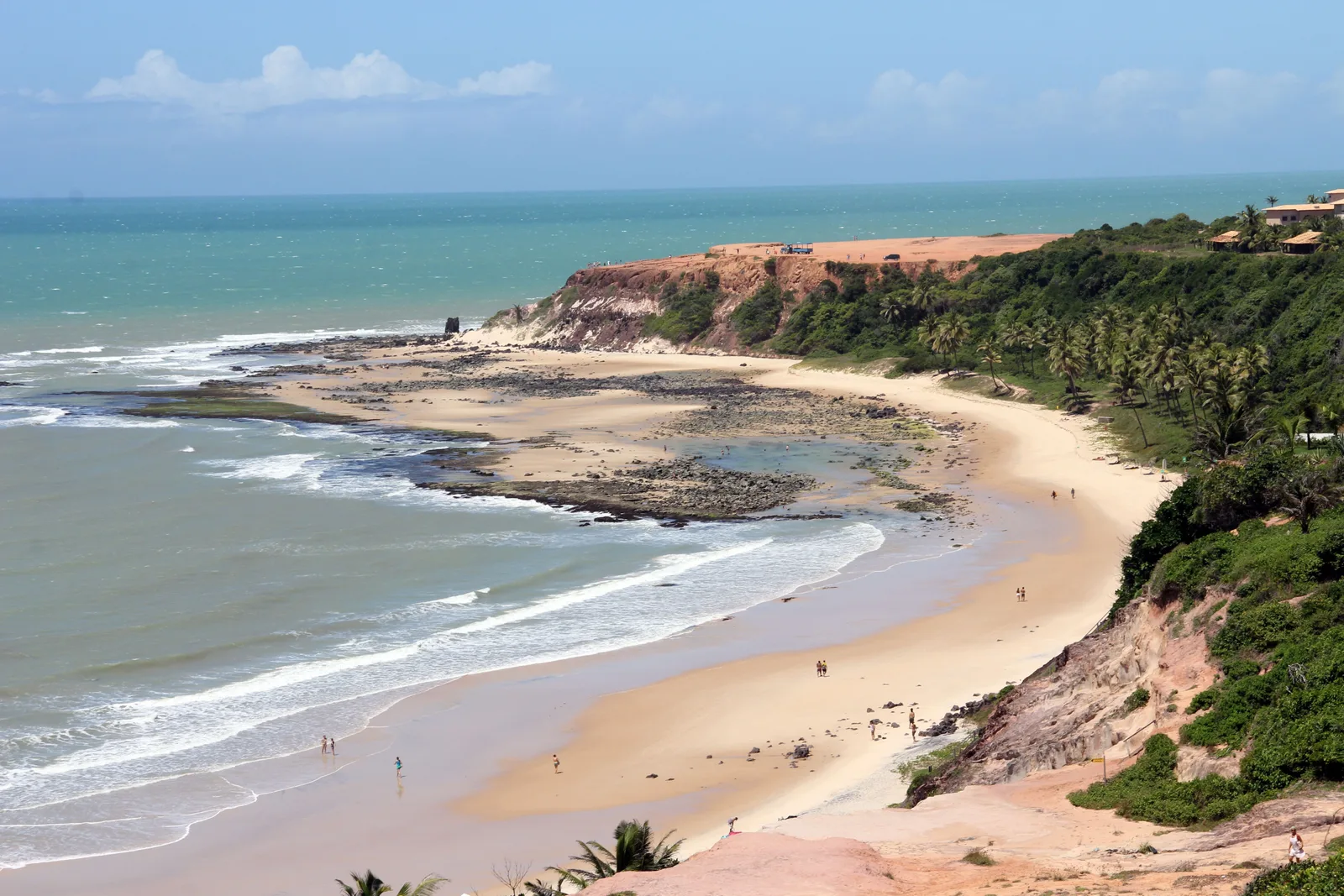
    Praia do Amor seen from above: a curving beach below palm-covered slopes, wide dark rock ledges exposed in the shallows, a few people on the sand and a flat-topped red headland at the far end

    Praia do Amor, the Chapadão and Praia das Minas

    South: the surf beach and the empty side

    A surf lesson or a morning watching one, then keep walking south past the Chapadão to where the kiosks stop and the beach empties out. Nothing to buy down there, so take water. Back up to a clifftop bar for the last of the light.

  4. 04
    A flat red clifftop with two coconut palms at its edge, and beyond it a long pale beach and the cliff and dune coast running away north toward Tibau do Sul

    Madeiro, the Santuário, Cacimbinhas and Tibau do Sul

    North: Madeiro, the forest and the lagoon

    Swim at Madeiro in the morning, walk the sanctuary trails on the clifftop above it, then go north to the dune at Cacimbinhas for the sandboard or the flight. Finish at Tibau do Sul for the sunset over the lagoon.

This is a starting shape, not a fixed departure — we rearrange it around your dates. Have it built for you

Timing

October if you can choose, but the hour matters more than the month.

The weather answer here is simple and the calendar agrees with it: October is the driest and sunniest month of the year on this coast, and September through December is one long dry stretch. The rest of the answer is that the thing most people come for, the walk around to the dolphins, is governed by the tide rather than the month. Pick October if the choice is open. Then pick your days inside it.

Rainfall, rain days, air and sea temperature and UV for Pipa, month by month. Choose a month to see what the weather is doing then.

January

Good
Air
24–30°C 75–86°F
Sea
28°C 82°F
UV
10 Very high
Rain
7 days 81 mm / 3.2 in

Hot, dry and completely full. Brazilian summer holidays run through the month and Pipa is priced accordingly.

February

Good
Air
25–31°C 77–88°F
Sea
29°C 84°F
UV
10 Very high
Rain
8 days 100 mm / 3.9 in

The last easy month before the rains, and Carnival fills the village for a week of it. Warm sea and long evenings.

March

Trade-offs
Air
24–31°C 75–88°F
Sea
29°C 84°F
UV
10 Very high
Rain
13 days 201 mm / 7.9 in

The rains arrive, 201 mm across thirteen days, but the days are still 31°C and the summer crowd has gone home.

April

Trade-offs
Air
24–30°C 75–86°F
Sea
29°C 84°F
UV
10 Very high
Rain
16 days 241 mm / 9.5 in

Wet season proper. The cheapest month here, and the one most likely to keep you off the sand and the cliffs least stable.

May

Trade-offs
Air
23–30°C 73–86°F
Sea
29°C 84°F
UV
8 Very high
Rain
15 days 222 mm / 8.7 in

Still wet, still warm, and low season all the way through. Green, quiet and good value if you can take the rain days.

June

Trade-offs
Air
22–29°C 72–84°F
Sea
28°C 82°F
UV
7 High
Rain
18 days 349 mm / 13.7 in

The wettest month of the year and the least sunny. Festa Junina fills the whole Northeast with bonfires and forró anyway.

July

Trade-offs
Air
21–28°C 70–82°F
Sea
27°C 81°F
UV
7 High
Rain
16 days 254 mm / 10.0 in

Still wet, and the Brazilian winter school break fills the pousadas regardless.

August

Good
Air
21–29°C 70–84°F
Sea
27°C 81°F
UV
8 Very high
Rain
12 days 119 mm / 4.7 in

The hinge. Rain drops by more than half and the sun comes back, but it still falls on twelve days out of the month.

September

Good
Air
22–29°C 72–84°F
Sea
27°C 81°F
UV
9 Very high
Rain
8 days 54 mm / 2.1 in

The dry season resumes properly, 54 mm across eight days with 267 hours of sun, and the village is still quiet.

October

Best
Air
24–30°C 75–86°F
Sea
27°C 81°F
UV
10 Very high
Rain
5 days 21 mm / 0.8 in

The peak, and it is not close: the driest month of the year and the sunniest at 295 hours. Pick a day with a daylight low tide and walk to the dolphins.

November

Good
Air
24–30°C 75–86°F
Sea
28°C 82°F
UV
10 Very high
Rain
4 days 23 mm / 0.9 in

The fewest rain days of any month, four, with 286 hours of sun. October weather at low-season prices, which makes it the value pick.

December

Good
Air
25–30°C 77–86°F
Sea
28°C 82°F
UV
10 Very high
Rain
5 days 29 mm / 1.1 in

Dry and hot, and quiet until the holidays. Then Réveillon, New Year’s Eve, fills the village.

  • Best The one or two peak months
  • Good A real recommendation
  • Trade-offs Workable, with a catch
See Pipa on the Brazil calendar

UV is the monthly average of the daily peak, 2022 to 2025, calculated from Copernicus Atmosphere Monitoring Service data. Weather data by Open-Meteo.com, CC BY 4.0.

For weather

September–December

The dry half of the year, and October is the peak of it: 21 mm of rain on five rain days and 295 hours of sun, the driest and the sunniest month on INMET’s 1991–2020 normals. November has the fewest rain days of any month at four. December is dry too, and the holidays fill the village at the end of it.

For the dolphins

Any month, but the right hour

The boto-cinza are resident here year round and are most often in the bay in the morning, so no month promises them and no month rules them out. What decides whether you can walk in to see them is the tide, because the bay is reached on foot along the sand and only at low tide. Check a tide table for your dates before you build a plan around it.

The wet half

March–July

June is the wettest month of the year at 349 mm across eighteen rain days, and the least sunny. It is also when the cliffs are least stable: the municipality logged 168 mm in April 2026 before the first of that year’s collapses. Prices are low, the coast is green and the sea is still 28°C, but you will lose days.

About the rain

Pipa has no weather station that publishes normals, so the rainfall, rain-day and temperature figures above are INMET’s 1991–2020 normals for its Natal station, number 82598, which sits 47 kilometers north-northwest of the village on INMET’s own published coordinates and about 85 kilometers away by road. That is a declared proxy and worth knowing about. It gets the shape of the year right: a wet season from March to July peaking in June, a dry season from September to December bottoming out in October and November, and a temperature range so narrow, highs of 28 to 31°C and lows of 21 to 25°C, that nothing here is ever ruled out by heat or cold. Annual rainfall at Natal is 1,691 mm across 127 rain days, with 2,980 hours of sun.

Sea temperature is NOAA’s OISST satellite analysis averaged over 2015 to 2024 for the water immediately offshore, and it barely moves: 27°C at its coldest in August and September, 29°C at its warmest in March and April. There is no month here when the sea is cold.

The dates worth planning around

Dawn breaking over the headland at Praia do Amor, heavy cloud above a dark sea and the wet sand of the empty beach catching the first light

The tide, which is not a season

Every day, about fifty minutes later than the day before

Not an event, but the thing this page exists to tell you about. Two low tides a day, about two meters of range between high and low water on an ordinary day, and a beach that joins the coves together around each low. The dolphin bay, the natural pools at Praia do Amor and the walk south past Praia das Minas all depend on it, and none of them depend on the month. The height of the sand also changes through the year, so look at the beach as well as the table. What you are looking for on a tide table is a low water that falls in daylight, ideally mid-morning, on a day you are actually here. Get that and everything else on this coast is easy. Miss it and you will spend the week looking at a bay you cannot reach.

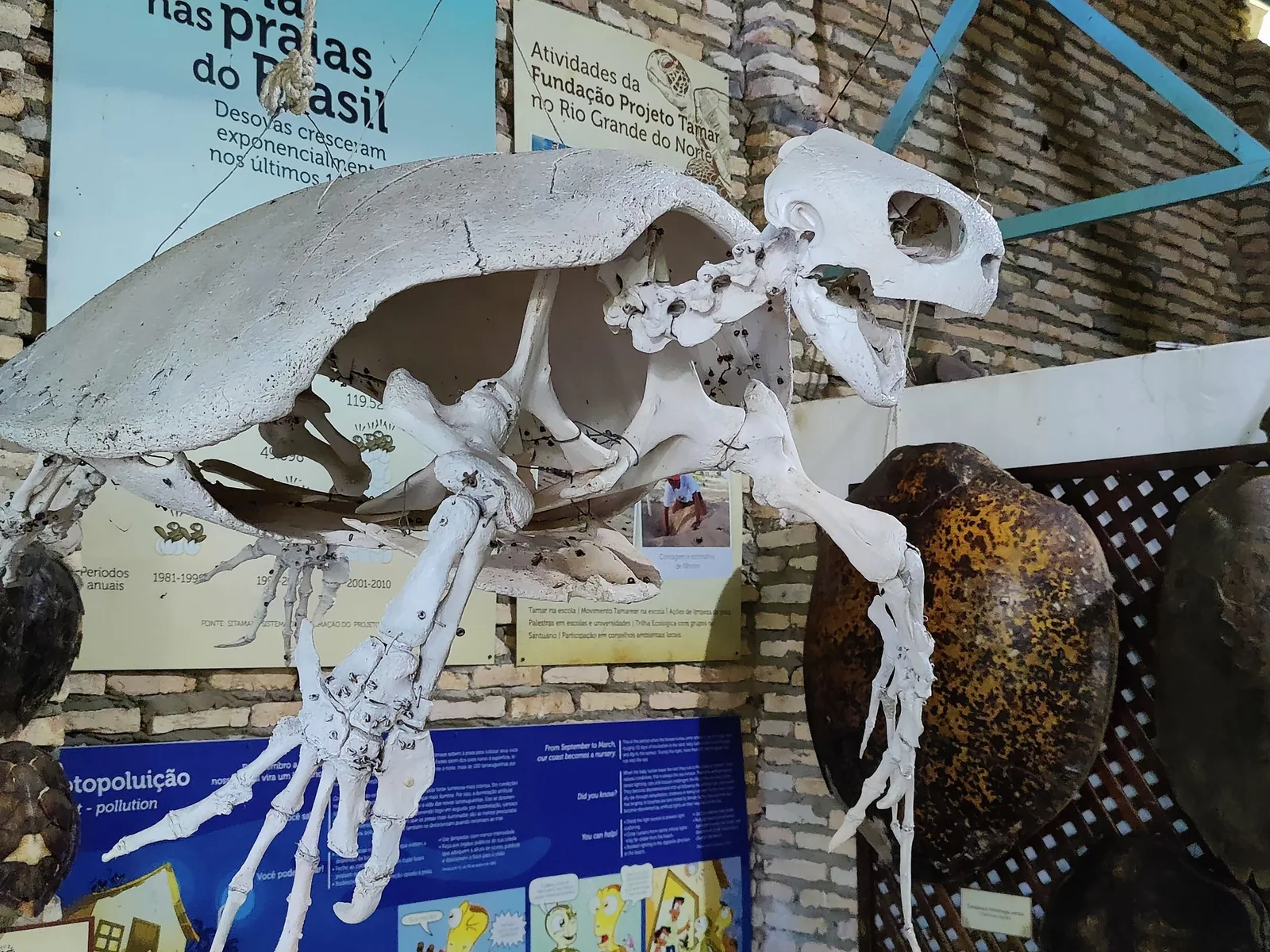
The mounted white skeleton of a hawksbill sea turtle hung in front of Projeto Tamar information panels at an exhibit in Pipa, with turtle shells displayed on a lattice beside it

Turtle season and the hatchling releases

Nesting roughly November to May, releases in the first half of the year

Projeto Tamar, the national sea turtle program, has a base at Pipa and follows this coast through the nesting season, which Tamar puts at November to May. The stretch it monitors runs 42 kilometers, from Natal down to Baía Formosa. Hawksbill turtles, which are endangered in Brazil, occur here. The public part of it is the release of hatchlings, which happens at Praia das Minas and at Praia do Madeiro and is announced locally rather than scheduled months ahead. If you are here in the first half of the year, ask your pousada. It is the single best thing that can happen to a beach evening.

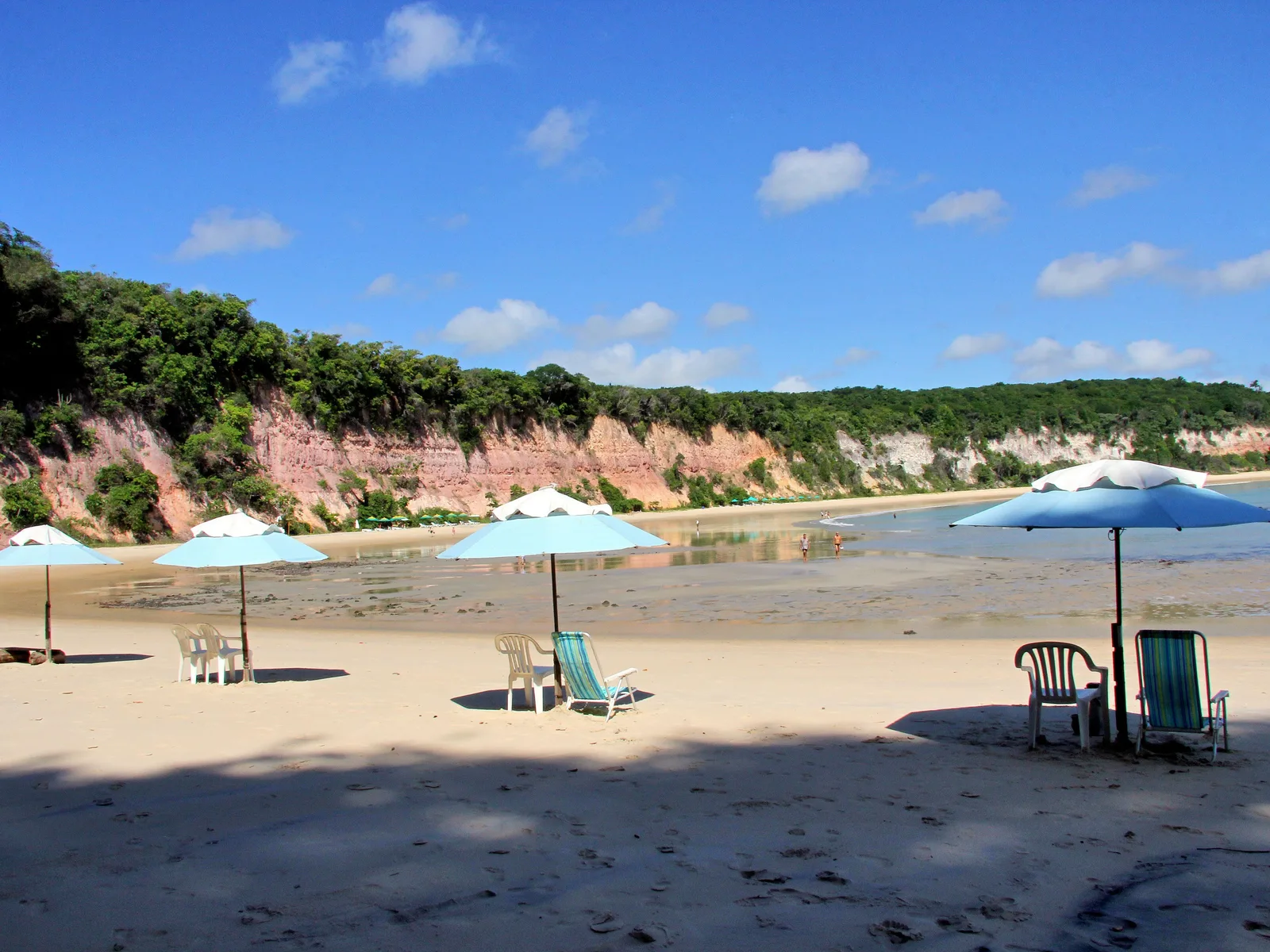
Blue and white parasols and empty beach chairs on the sand at low tide below a long wooded red cliff at Pipa, a few people far off at the water’s edge

Réveillon, Carnival and the Brazilian summer

New Year’s Eve, Carnival and the July school break

Pipa’s busiest weeks are domestic ones, and they change the place completely. At New Year’s Eve, at Carnival and in the July school holidays the village fills with Brazilian vacationers and the main street runs late every night. All of it is genuinely good fun, and none of it is what most first-time visitors are picturing when they read about a village under the cliffs. Come deliberately, or come in November.

Good to know

Before you come

How do I actually get to Baía dos Golfinhos, and will I see dolphins? +

You walk in along the beach, and only at low tide. From Praia do Centro in the village it is about a kilometer north along the sand, around one headland. From Praia do Madeiro on the other side the walk is the same, and so is the rule. There is no road, no path down the cliff and no steps, and at high water the sea reaches the rock in places, so this is not a walk to improvise. Check a tide table the night before, leave on the falling tide, and turn back as soon as the water starts returning. As for the dolphins: the boto-cinza that live here are resident year round rather than seasonal, a four-year UFRN study found them most often in the bay in the morning, between 9:00am and 12:00pm, and they are wild animals in an open bay. Nobody can promise you will see them.

Can I swim with the dolphins, or take a boat out to them? +

Boats yes, swimming with them no. The bay sits inside a municipal coastal fauna reserve created in 2006, the only conservation unit in Rio Grande do Norte set up specifically to protect the boto-cinza, and in March 2026 the federal prosecutor’s office signed an agreement with the municipality and the local boat operators that tightened the rules considerably. Boats must stay 100 meters from the animals, hold to five knots, spend no more than ten minutes on any approach, and stop departing after 3:15pm, and no more than three boats may be in the bay at high tide or four at low tide. Kayaks are capped at three at a time in the bay and three at Madeiro. Chasing, encircling or cutting across the animals is prohibited outright. A trip on a boat that follows those rules is a good outing. One that offers you a swim with them is not one to take.

How many days do I need? +

Four nights is right and three works. Pipa is small: the whole coast this page describes fits inside about five kilometers, and a fit person could walk all of it in a day at the right tide. What four nights buys you is the ability to wait for the tide rather than fight it, plus a surf lesson, a morning on the clifftop trails and a day that does nothing. Five or more makes sense if you are here to surf or if you are combining it with the beaches north of the village. Two nights is enough only if you are prepared to have the tide decide whether you see the dolphin bay at all.

Is it safe to walk under the cliffs? +

Along the beach, yes. Sitting or lying at the foot of the cliff face, no. These are active cliffs cut into soft sedimentary rock, they are 20 to 40 meters high, and they come down. A collapse killed a couple and their infant son on the beach here in November 2020, and there have been more slides since: at Praia do Madeiro in September 2025 and April 2026, and on Pipa’s village beaches in April and June 2026. The sea undercuts the base and heavy rain weakens the material above it, so the wet months from March to July are the riskiest. In practice this costs you nothing: walk on the seaward half of the beach, do not put your towel in the strip of shade at the bottom of the rock, and take the Defesa Civil’s closures seriously. They follow a technical assessment of the ground, not a hunch.

Is Pipa a party town, or can two people in their sixties enjoy it? +

Both, and they barely overlap. The main street has bars and live music that run late in high season, and there is a young long-stay surf and backpacker crowd here that has been part of the place since the 1970s. But that is one street, and it is loud from about 10:00pm. Everything else about Pipa suits an unhurried trip: short walks, good restaurants, clifftop hotels with pools and views, quiet beaches an easy stroll away, and the small surf at Madeiro. The single decision that settles it is where you sleep. A room on the avenue in January is a different holiday from a room on the clifftop in November, and it is the same town.

Keep going

Where Pipa fits on this coast.

Nobody flies to Brazil for one village. These are the trips that most often go either side of a few days here. Fernando de Noronha has a Baía dos Golfinhos of its own: a different bay, on an island out in the Atlantic.

Free · 29 pages

Free guide

Beginner's Guide to Brazil

A free 29-page guide to everything a first-time visitor should know before landing: visas, safety, money, getting around, where to go, and what to eat.

We'll email you a link to confirm your address. Click it and the guide opens right away.

See what's inside
The flat red top of the Chapadão from the air with a vehicle parked on it, its dark cliff face dropping to a strip of white sand, and rock ledges and turquoise surf beyond

Skip the planning

We will read the tide table for you.

Tell us your dates and we will tell you plainly which mornings have a low tide you can walk on, where to sleep so the walk starts at your door, and how to fit Pipa together with the rest of the Northeast without doubling back.

  • One person, living in Brazil, replying to you directly
  • A reply within one business day, no call center and no bots
  • No cost to plan, and no obligation to book
  • Built around your dates, not a fixed departure