
Skip to content
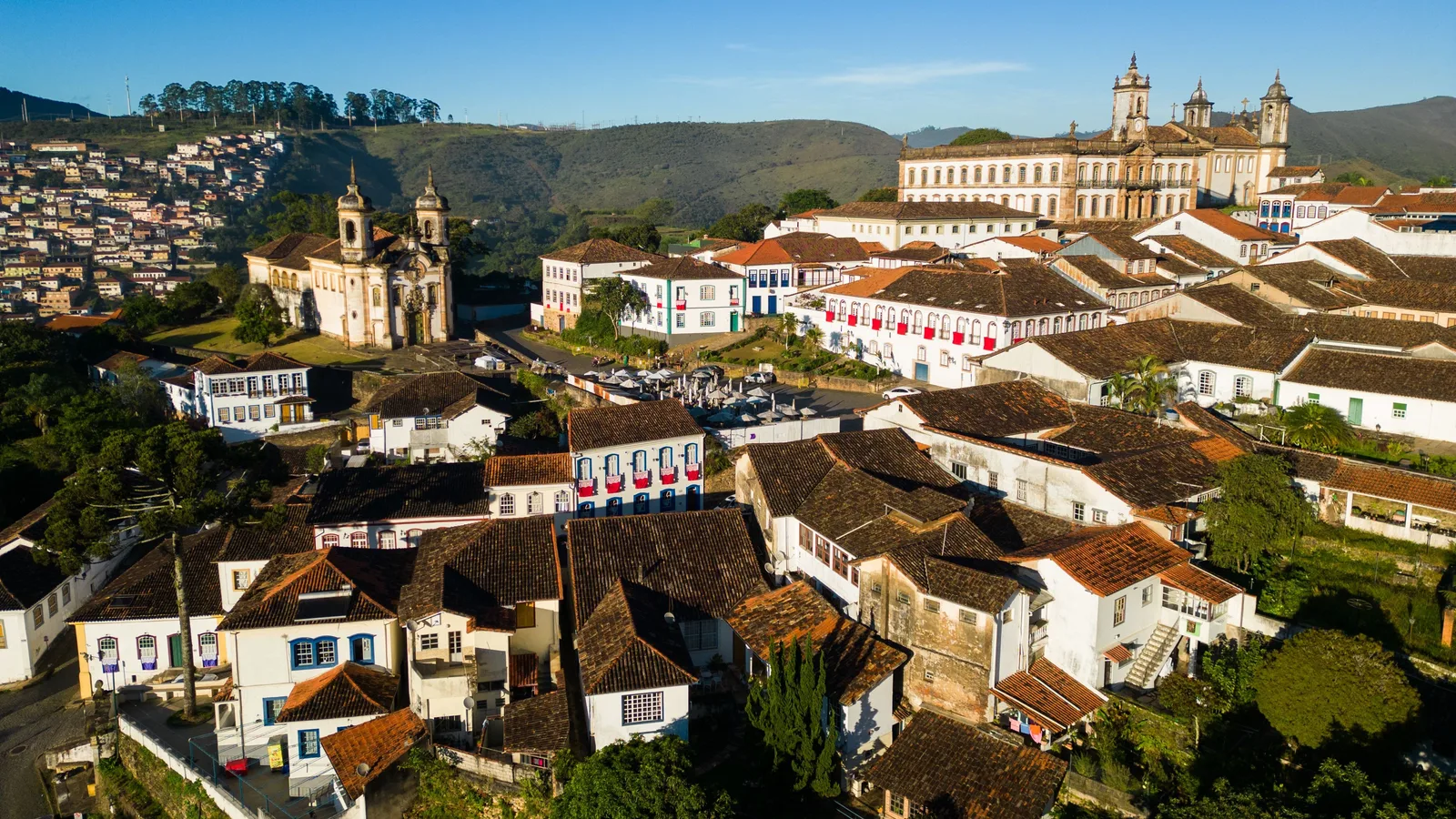
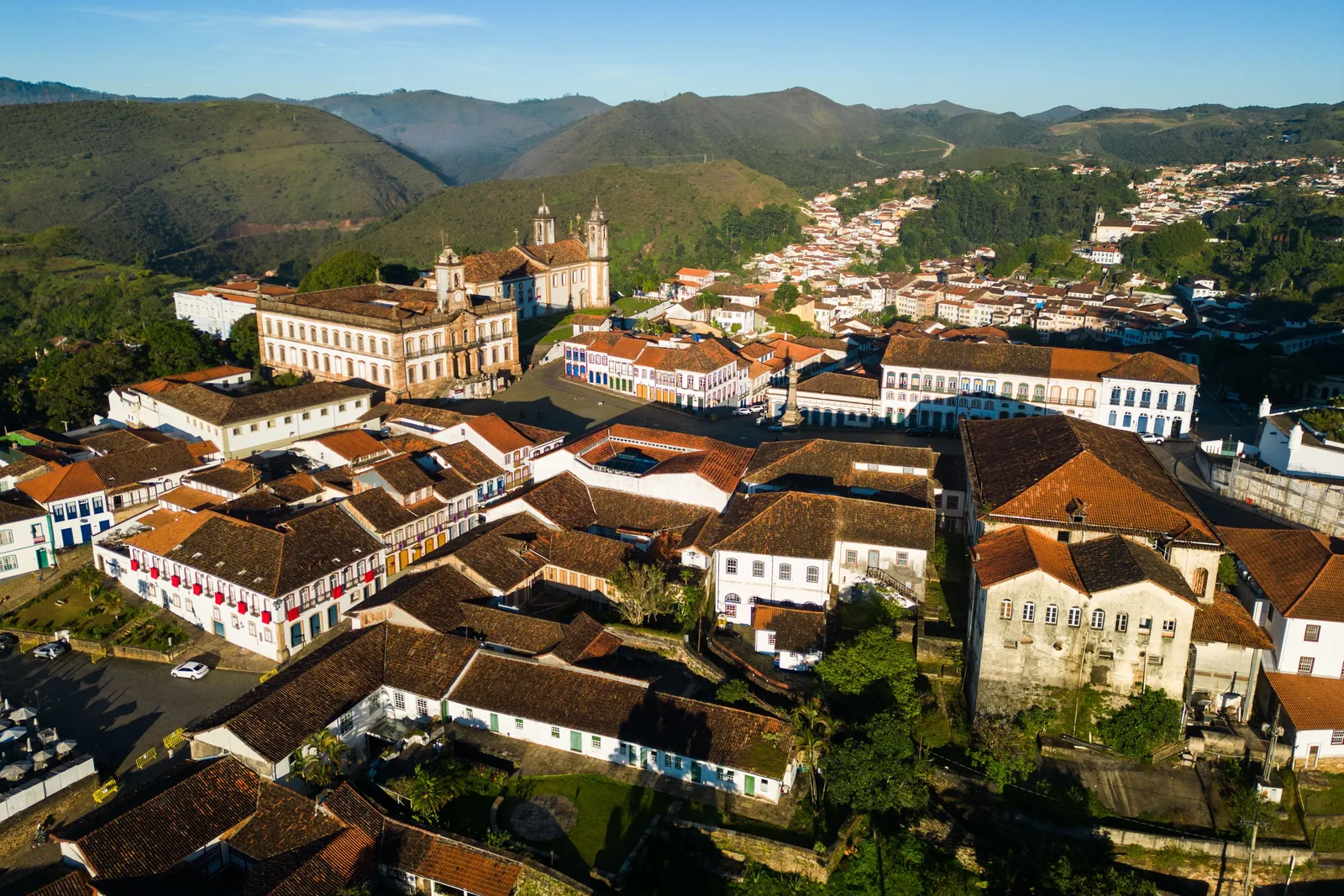
Ouro Preto from the air in early-morning light: white houses and red-tiled roofs packed down a steep hillside, a baroque church with twin domed bell towers standing on a green shoulder at the left, the long facade and clock tower of the Museu da Inconfidência ranged along the ridge opposite, and wooded hills behind

Minas Gerais

Ouro Preto

The town the gold built, and the art it left behind.

Last checked September 2026

  • Ouro Preto from above: rows of red-tiled roofs and white walls running down the hillside, a church tower among them, and blue mountains along the skyline
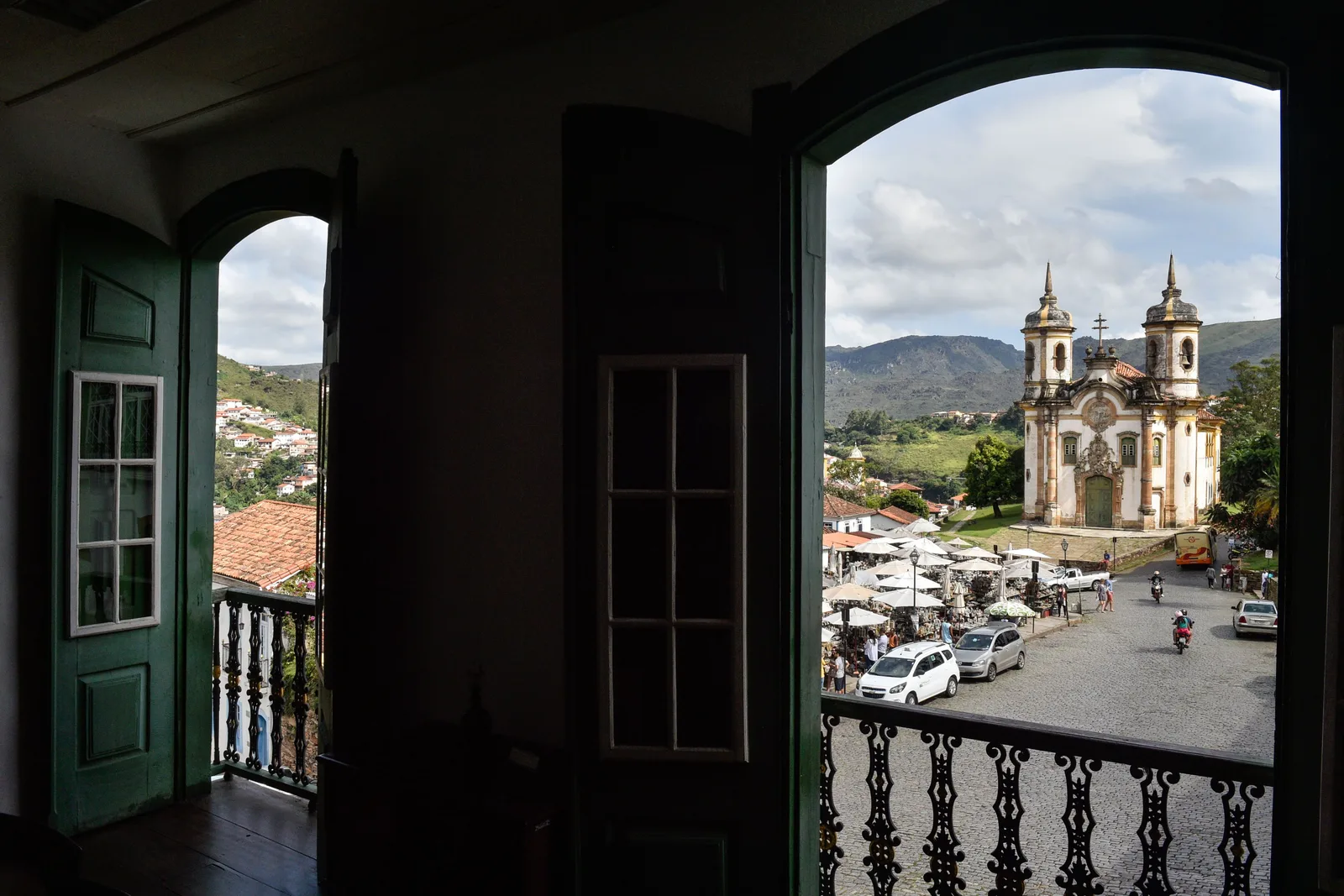
  • The Igreja de São Francisco de Assis seen from a dark colonial interior through an open doorway and an iron balcony, the square below it full of parked cars and the hills beyond
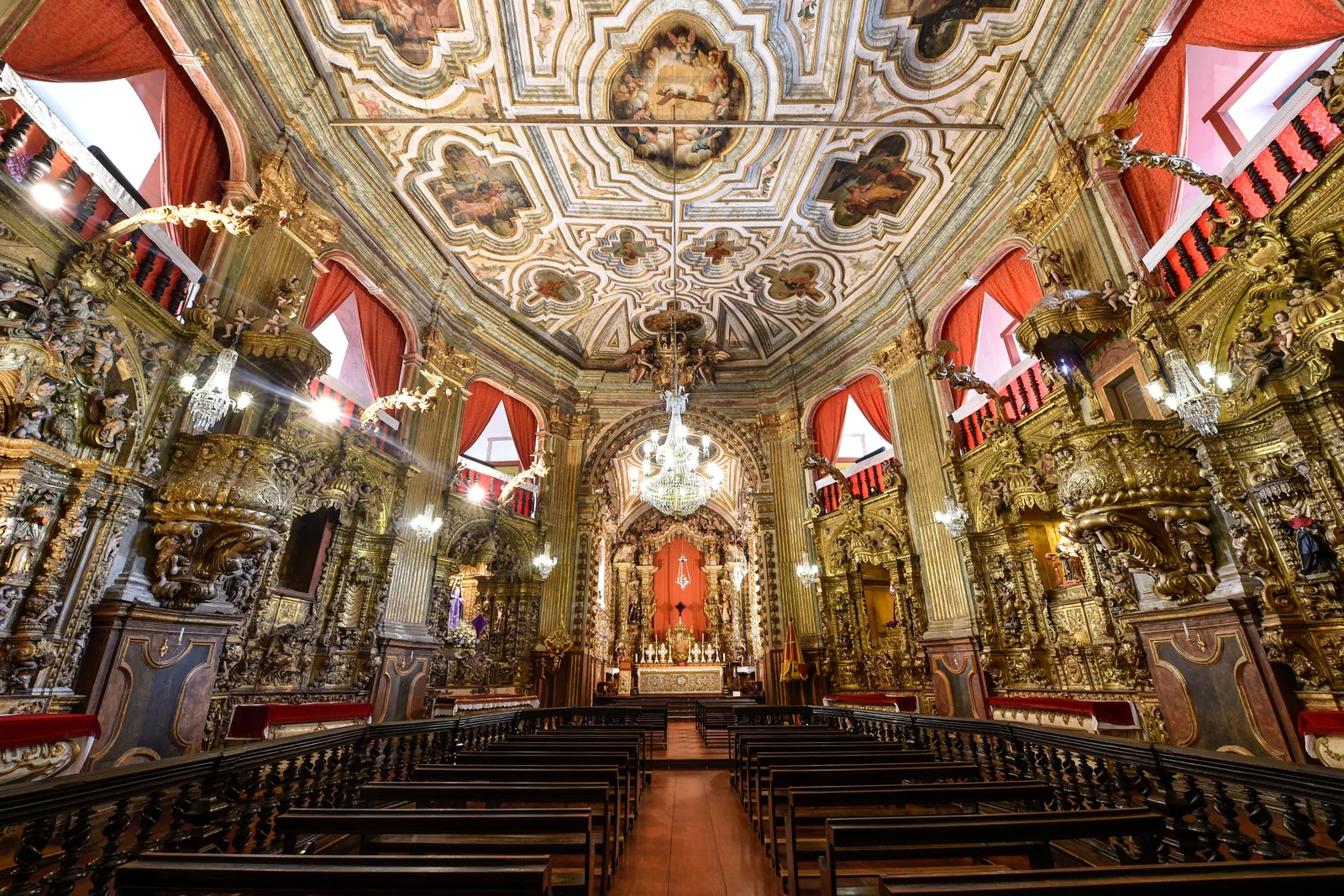
  • Inside the Matriz de Nossa Senhora do Pilar: a polygonal nave lined floor to ceiling with gilded carving, red and white drapery hung between the arches, and a painted ceiling above the pews
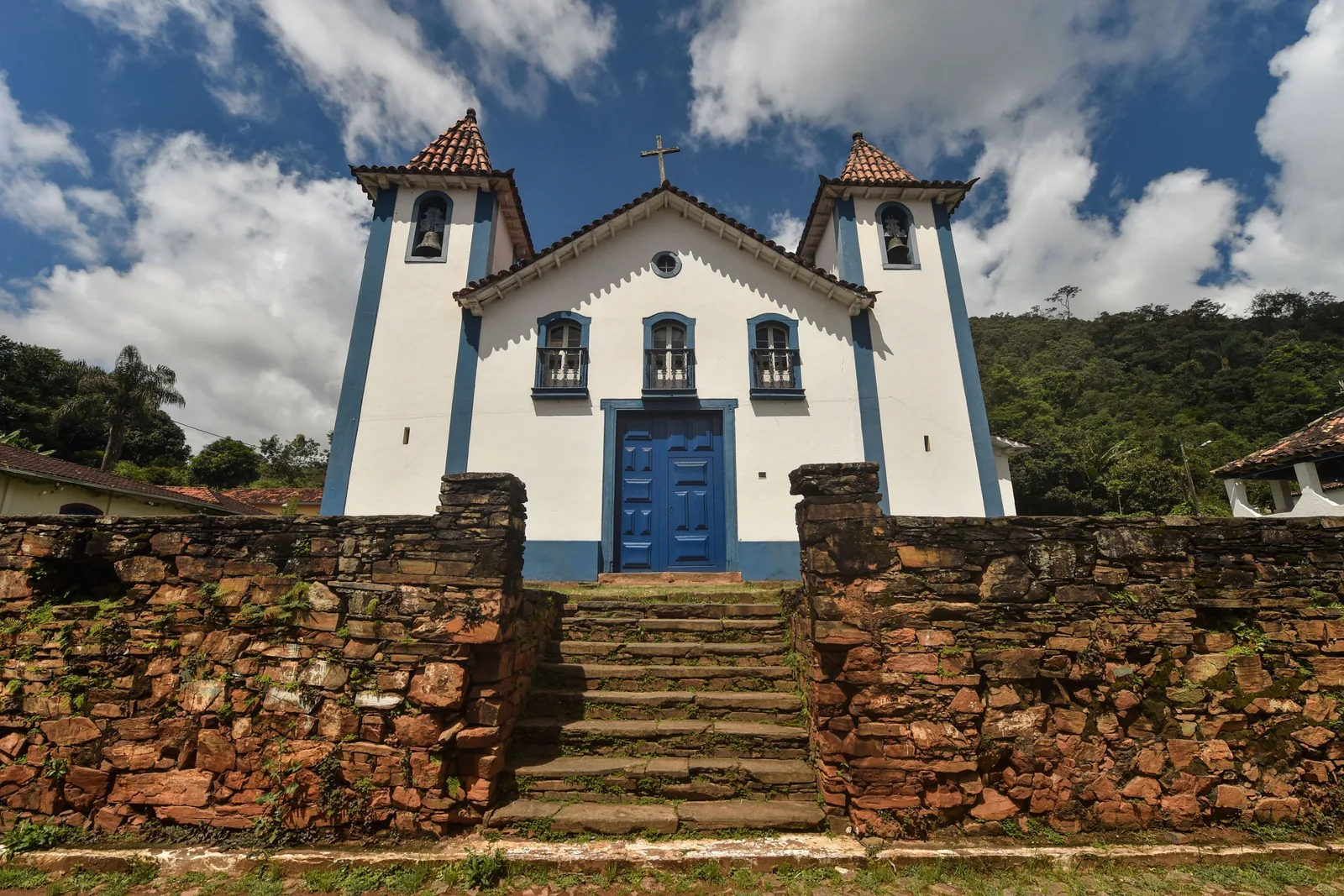
  • A small whitewashed chapel with a blue door and blue window frames at the top of a rough stone stairway in the rural district of São Bartolomeu, green hills behind it
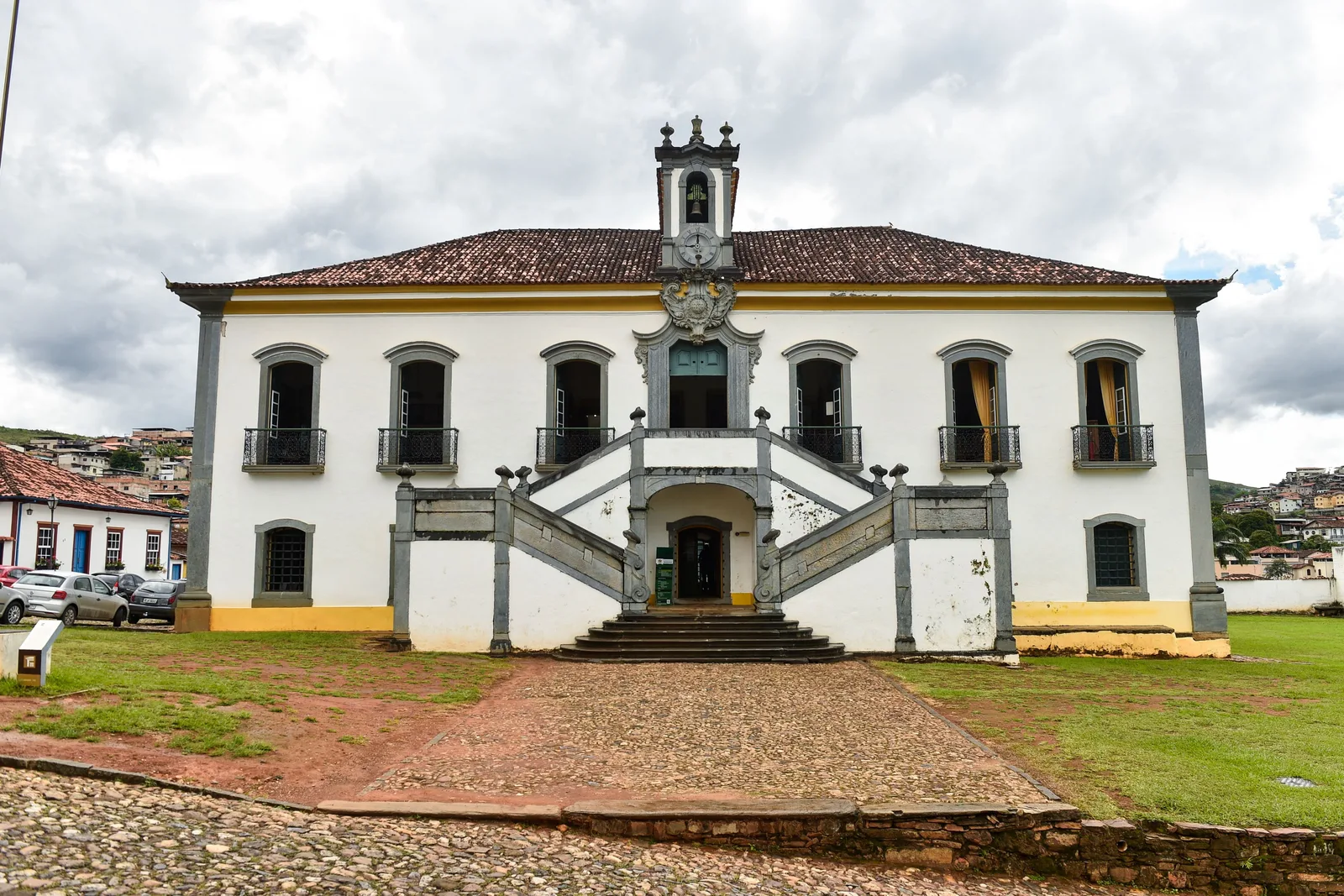
  • The Casa de Câmara e Cadeia in Mariana: a long white colonial building with a yellow base, a small belfry on the roof and a symmetrical double stone stairway climbing to the front door
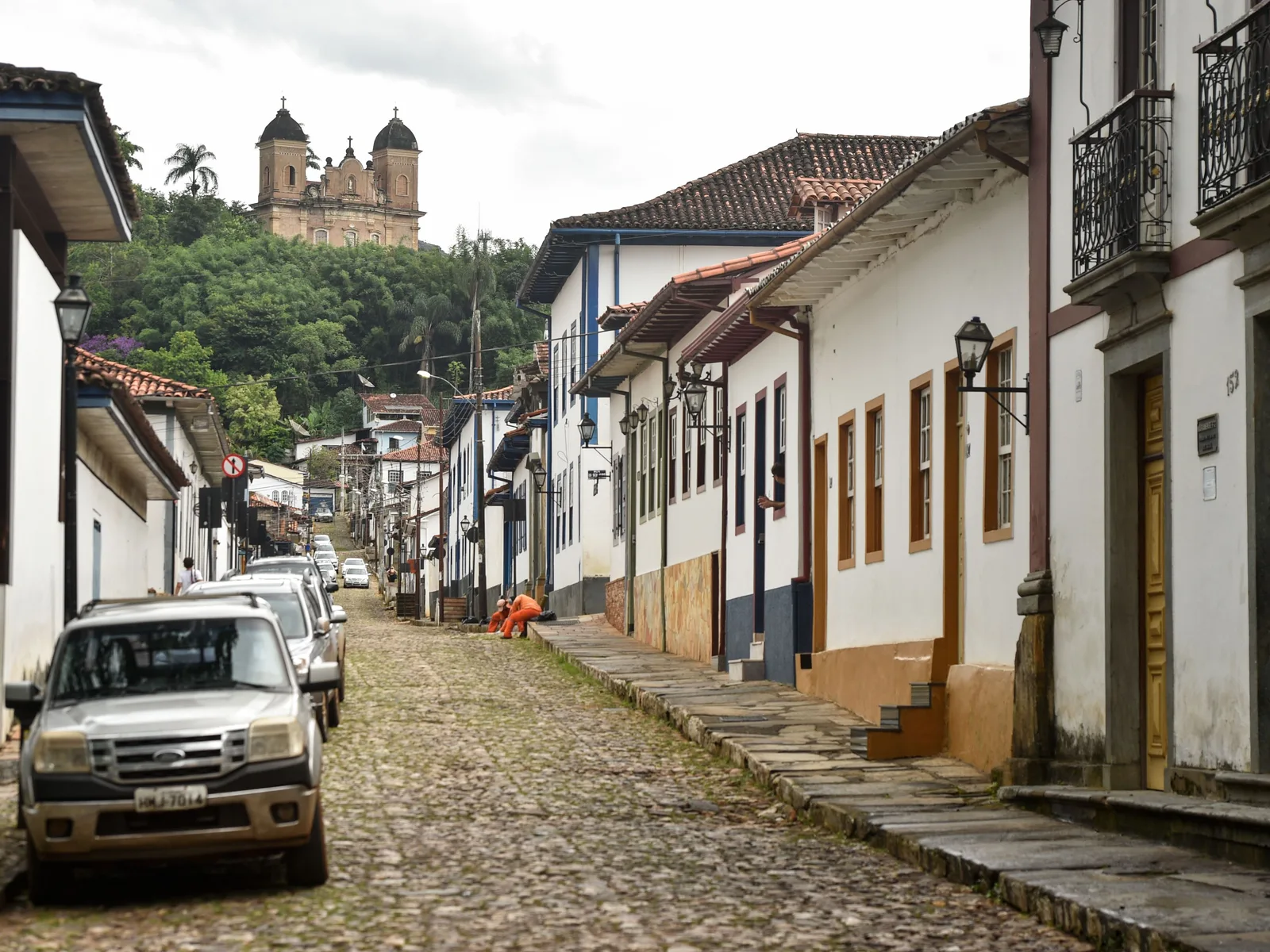
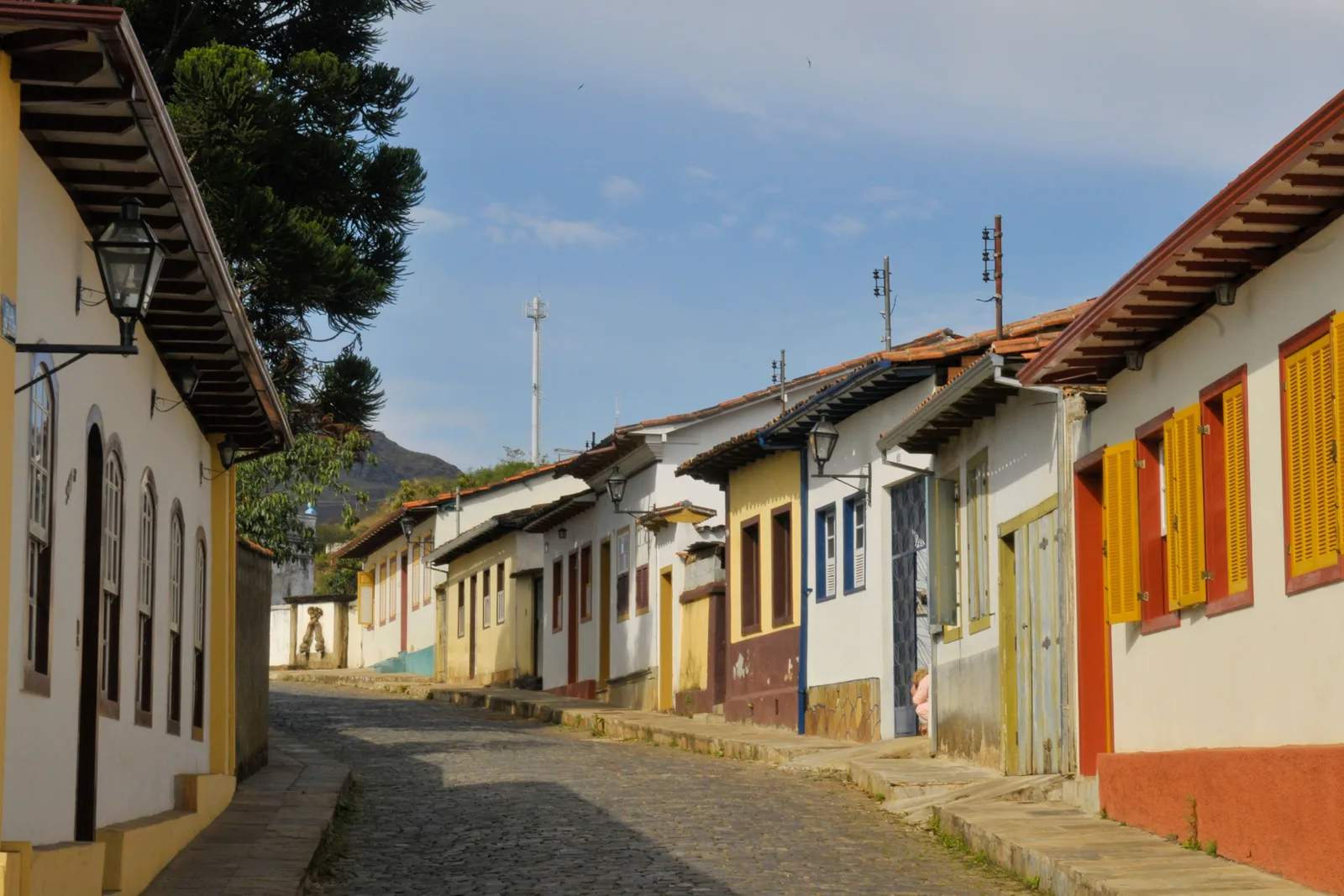
  • A quiet cobbled street in Mariana lined with single-story colonial houses painted white, yellow, orange and blue, with green hills at the end of it
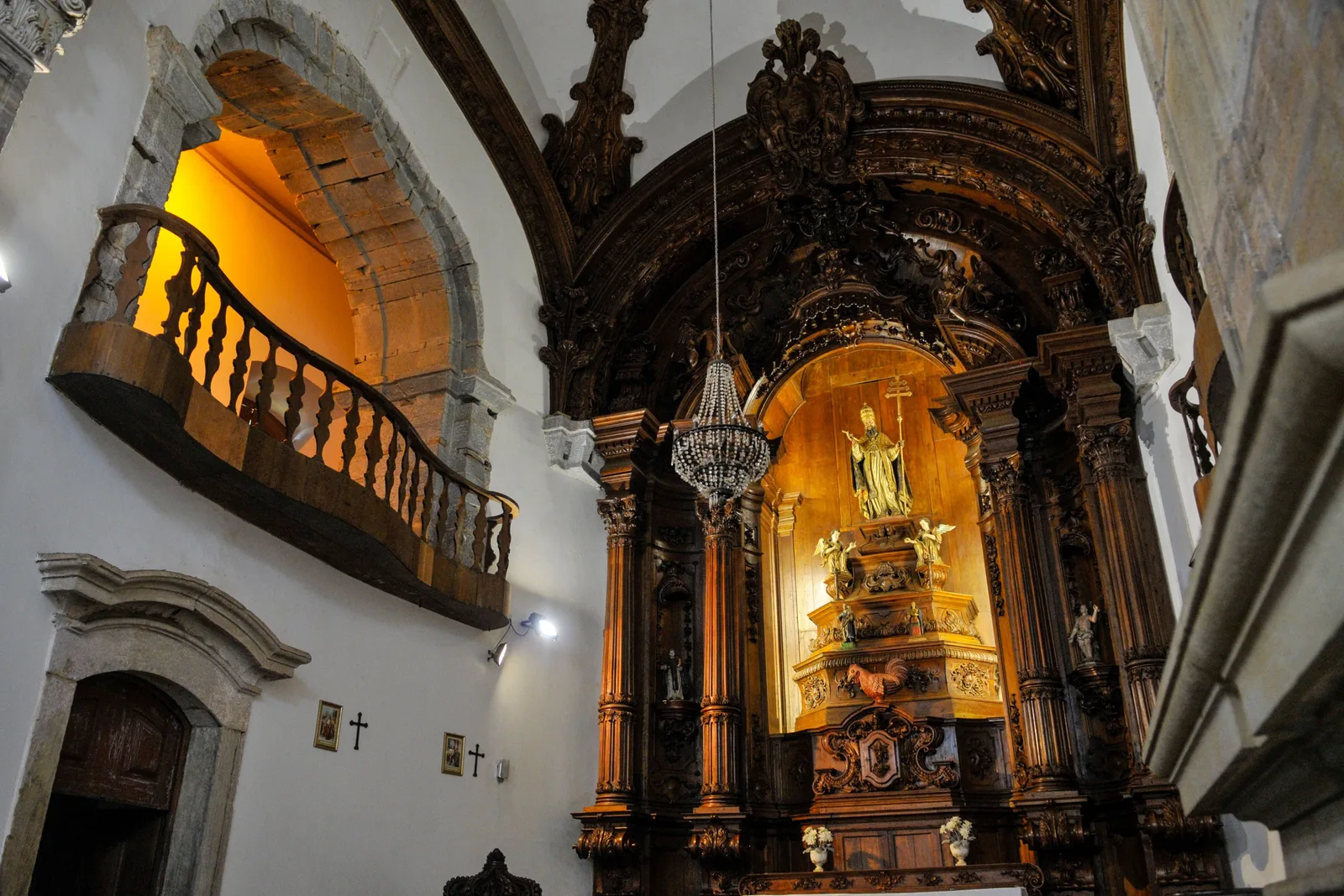
  • The gilded interior of the Igreja de São Pedro dos Clérigos in Mariana, a lit altar under a carved arch and a wooden tribune balcony running above the nave
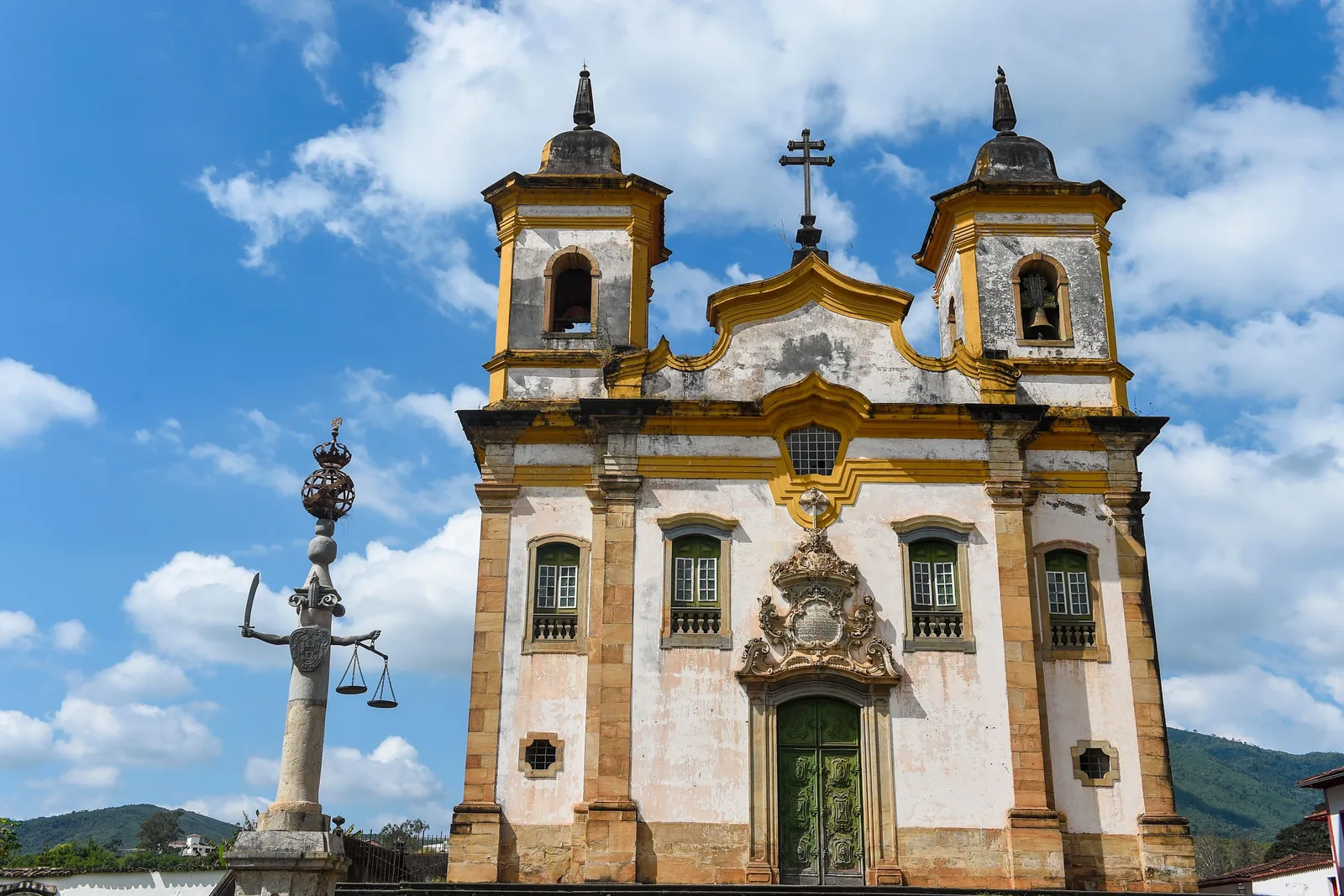
  • The Igreja de São Francisco de Assis on Mariana’s Praça Minas Gerais, twin bell towers and a carved stone portal against a blue sky, with the town’s stone pillory standing in front of it
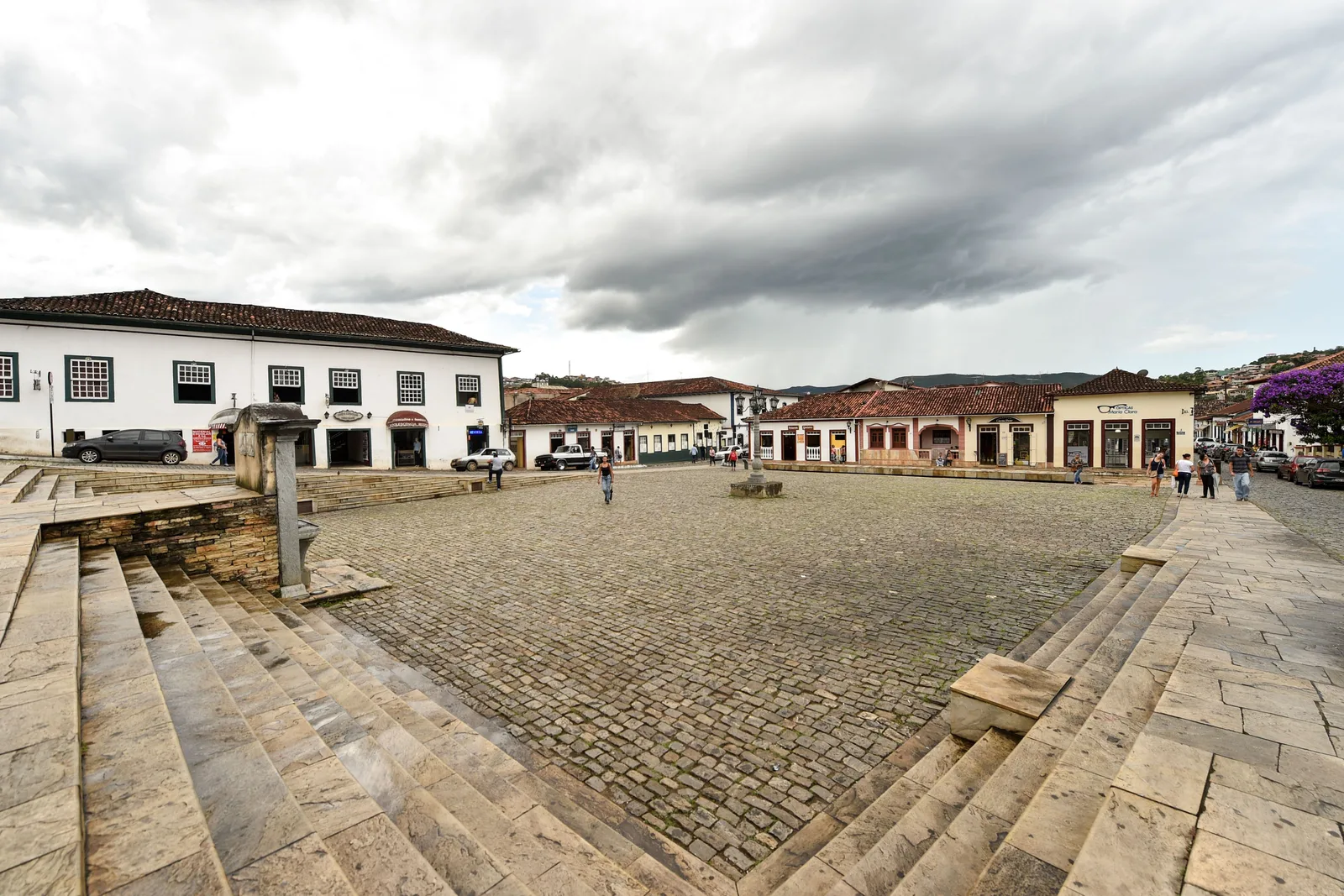
  • The wide stone-paved Praça Claudio Manoel da Costa in Mariana on an overcast day, ringed by low white colonial buildings with arcaded fronts and almost empty of people
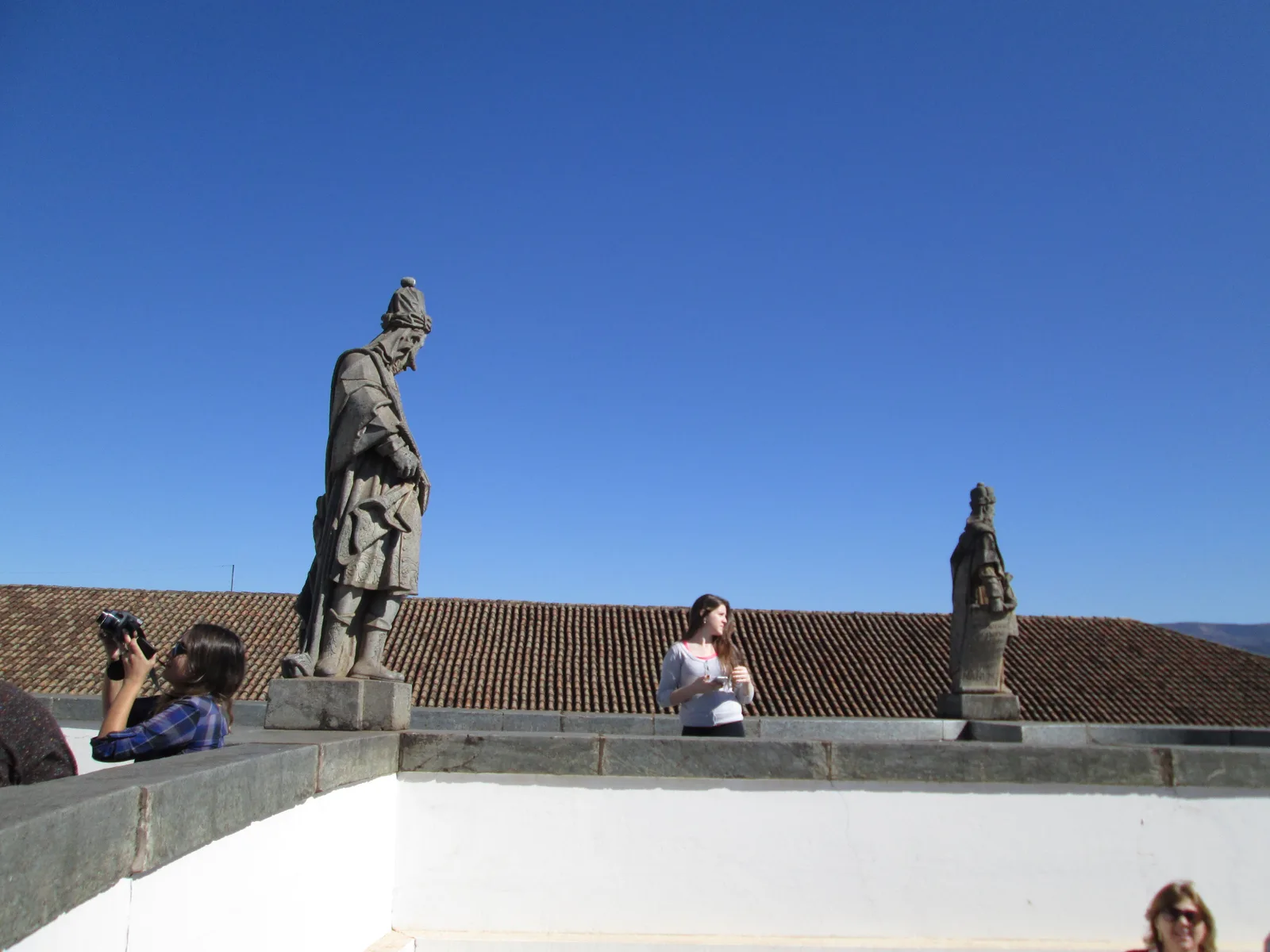
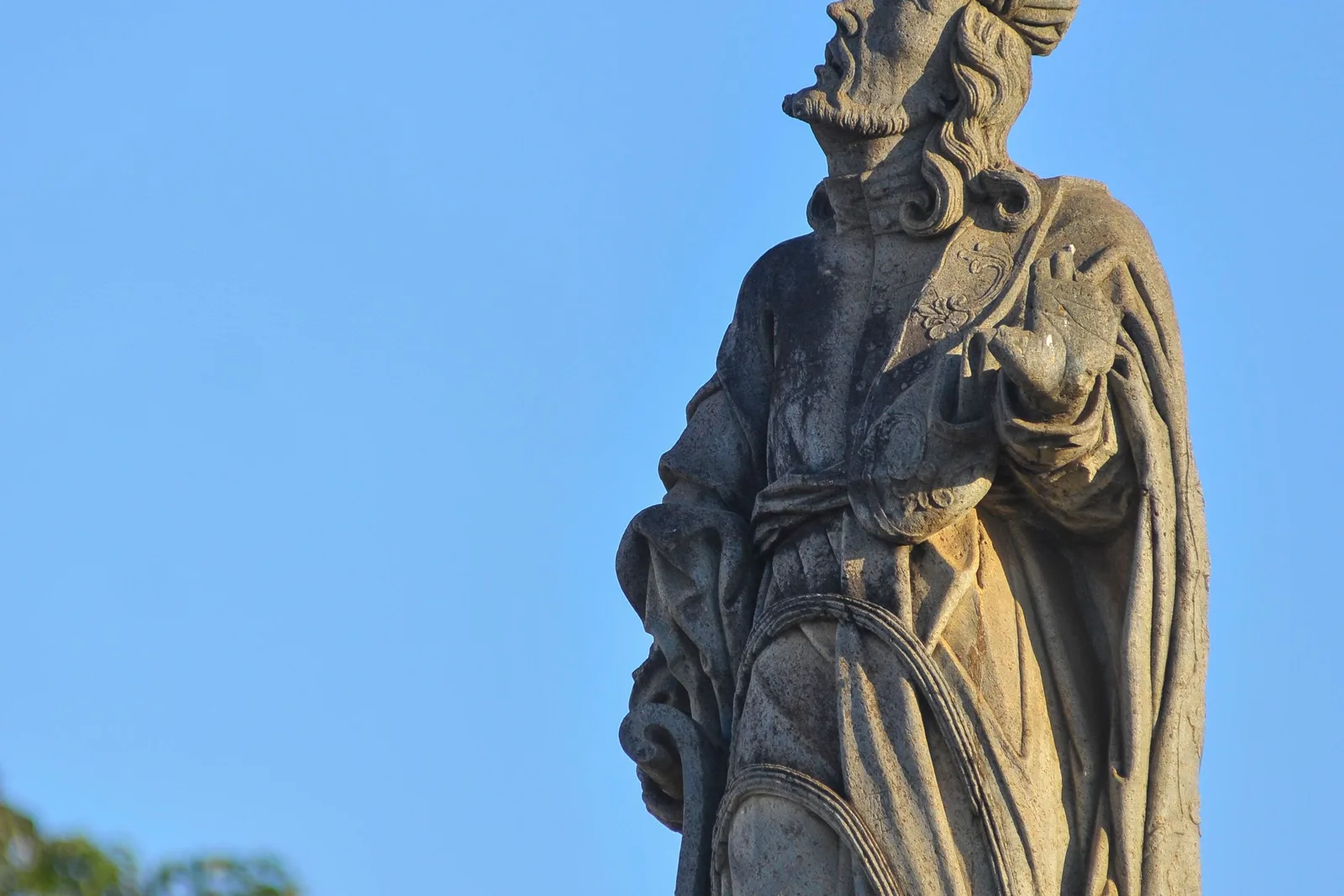
  • One of Aleijadinho’s soapstone prophets at Congonhas against a clear blue sky, a bearded figure in carved robes holding an open scroll, his name cut into the stone
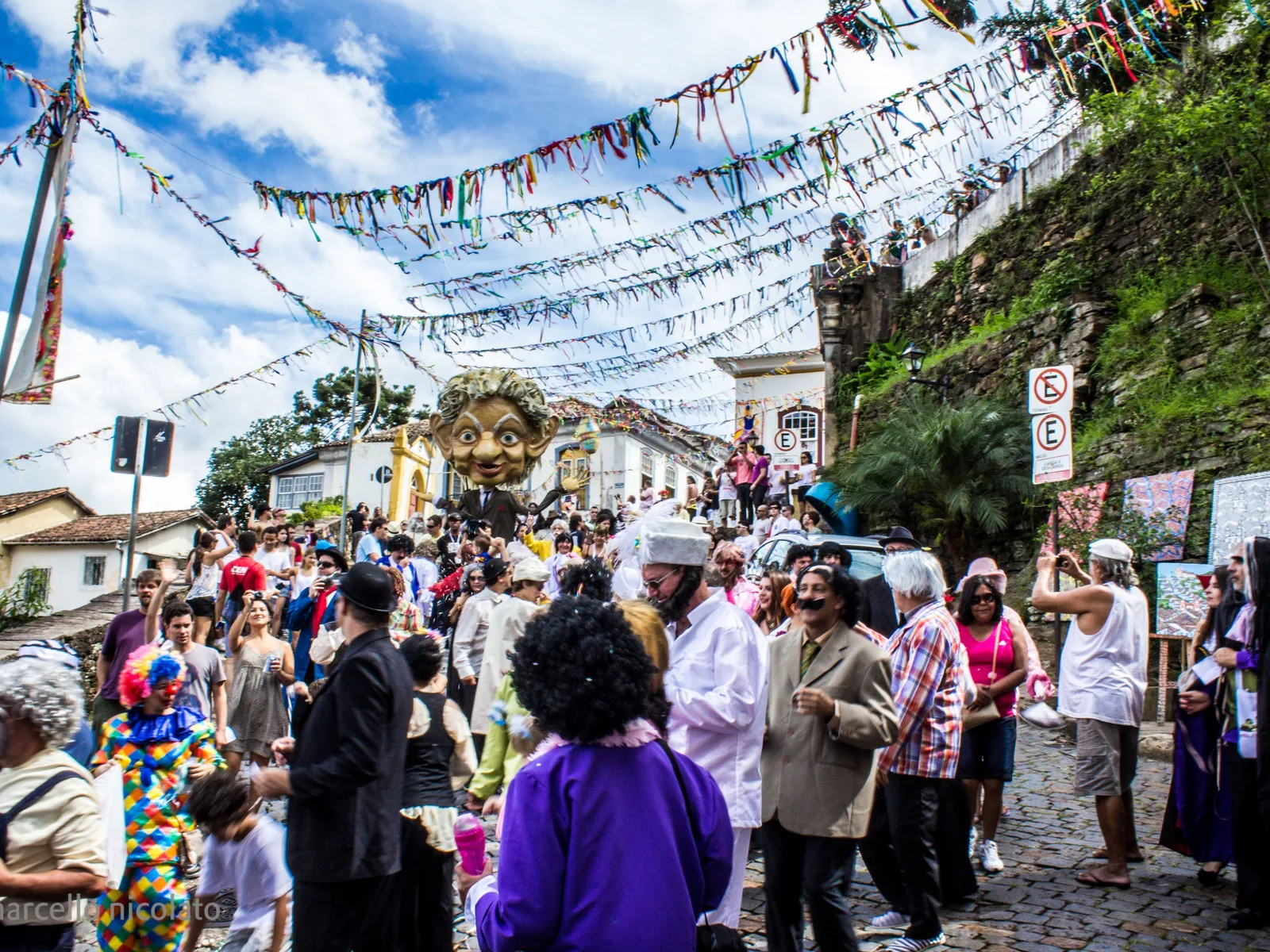
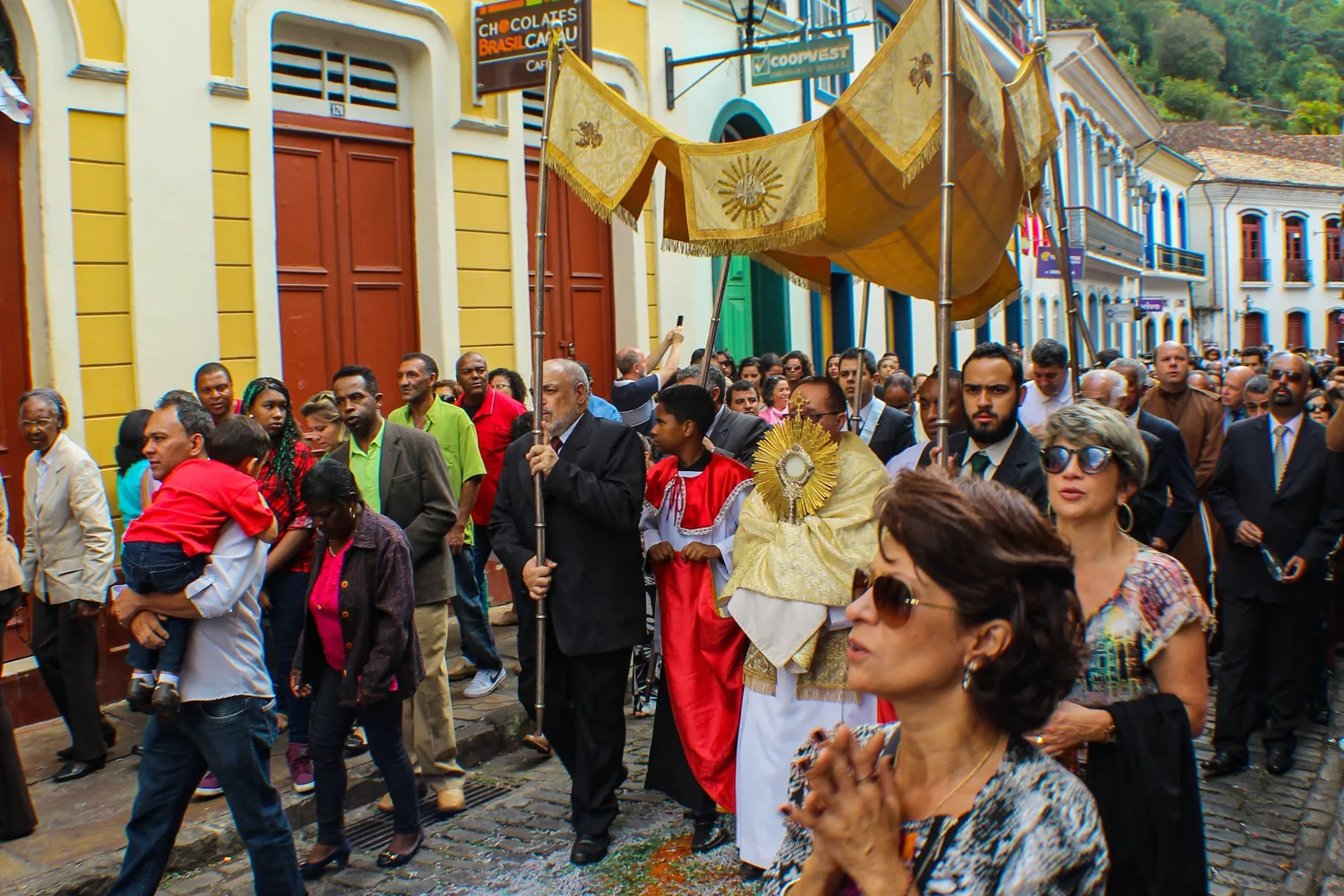
  • The Resurrection procession at Easter in Ouro Preto: a gold canopy carried over the clergy down a cobbled street between yellow and white colonial houses, with a crowd walking behind
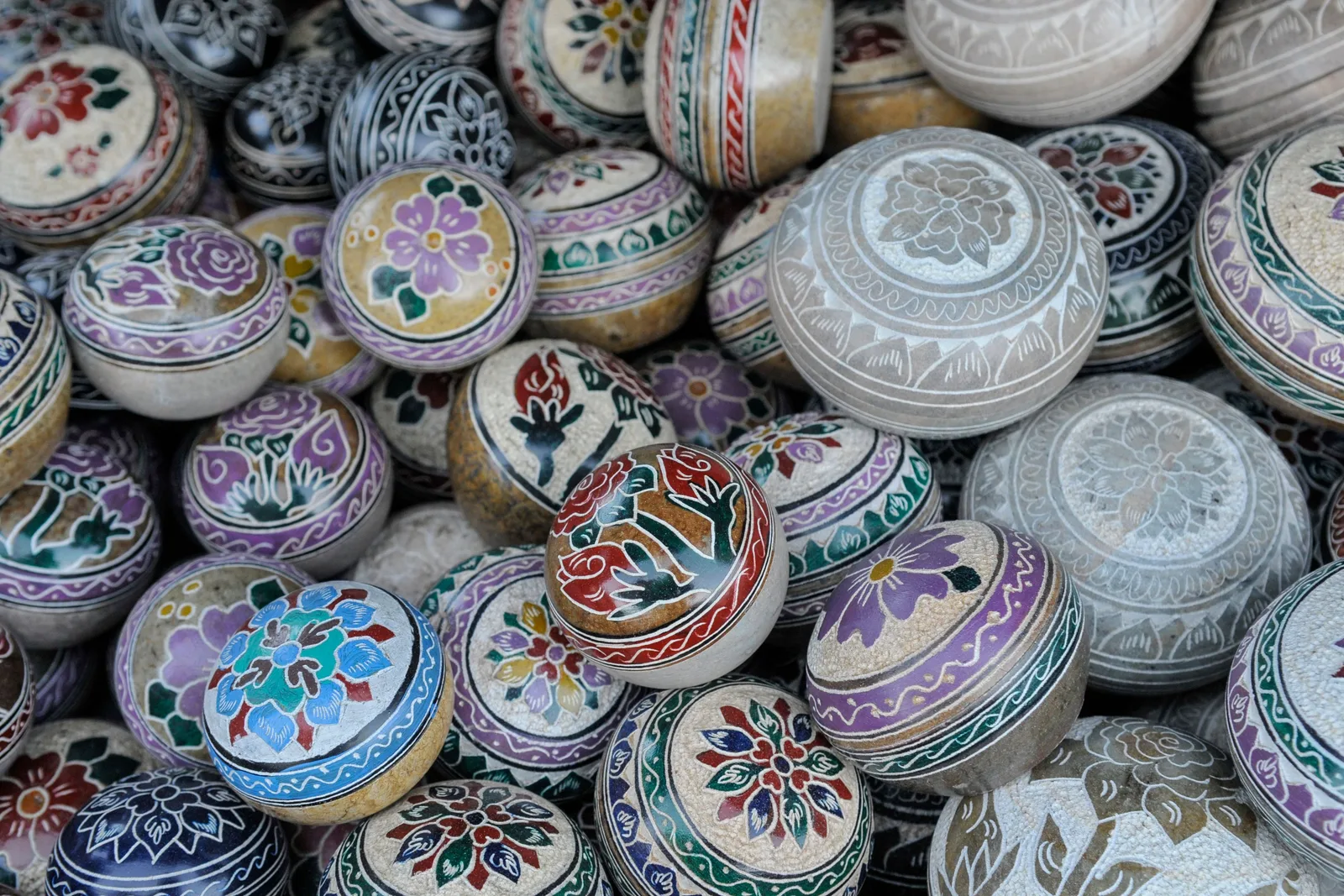
  • Dozens of round lidded soapstone pots stacked on a market stall, each carved and hand-painted in blue, green and pink floral patterns

Orientation

The town in one screen.

Everything logistical, before the pretty pictures start.

General Info

What makes Ouro Preto, Ouro Preto

For most of the eighteenth century this was the richest place in the Americas. Gold was found in the streams below the Pico do Itacolomi in the 1690s, the rush that followed built a town of some 80,000 people at 1,179 meters in the mountains, and for a while Vila Rica — Rich Town — produced a large share of the world’s gold. The mines emptied, the money left, the capital moved to Belo Horizonte in 1897, and what stayed behind is a small university town of about 74,800 people wearing the architecture of an empire it can no longer afford.

That is the whole appeal. Ouro Preto was made a national monument in 1933 and, in 1980, the first place in Brazil inscribed on the UNESCO World Heritage list. There are more than twenty churches inside the historic core, several of them designed or carved by Antônio Francisco Lisboa — Aleijadinho, the son of a Portuguese architect and an enslaved African woman, and the greatest artist Brazil produced before the twentieth century. His work is the reason this page exists, and it is not confined to Ouro Preto: it runs through Mariana, 12 km east, and reaches its peak at Congonhas, an hour southwest.

The other thing to know is that it is steep. The historic center is built across a saddle between two hills and almost every street is either a climb or a descent, on cobbles laid for mules. Ouro Preto is also a student town — the Federal University of Ouro Preto grew out of the 1876 Escola de Minas, and hundreds of student houses called repúblicas occupy the colonial buildings — which is why a town this size has this many bars, and why its Carnival is the size it is.

Where It Is

Inland Minas Gerais, in the mountains

Ouro Preto sits in the Serra do Espinhaço about 100 km southeast of Belo Horizonte, roughly 400 km from Rio de Janeiro and 600 km from São Paulo. Mariana is 12 km further east and Congonhas about 65 km southwest, which makes the three of them one trip rather than three.

Ouro Preto Ouro Preto

20.39° S, 43.50° W

See the Southeast on the interactive map

Cost

What a day here actually costs

Ouro Preto is cheap by Brazilian city standards and very cheap by American ones. Rooms are the biggest variable and they move sharply twice a year — Carnival and Holy Week are a different market from the other fifty weeks. The attractions themselves cost almost nothing, with one loud exception: the gold mine at Mariana.

Estimated daily budget, ordinary weeks

Budget

$35 / day

A hostel bed or a simple pousada room, lunch at a por-quilo place, the churches and the museums, and your own legs on the cobbles.

Mid-range

$75 / day

A comfortable double in the historic center split two ways, restaurant meals, a mine or a museum most days, and taxis for the steepest hills.

Comfortable

$165 / day

A well-reviewed pousada with a view, dinners at the good places, a licensed guide for a day, and a car or a driver for Mariana and Congonhas.

Estimates, per person per day, once you are in town — flights and the transfer from Belo Horizonte are not in them. Carnival and Holy Week are not ordinary weeks and are handled separately below.

What things cost

  • Mid-range double room, historic center $65 R$330
  • Simple pousada double or a hostel private room $33 R$170
  • Hostel dorm bed $16 R$80
  • Well-reviewed boutique pousada $120 R$610
  • Bus, Belo Horizonte to Ouro Preto, one way $13.50 R$69
  • Airport bus, Confins to the Belo Horizonte bus station $3.50–$8 R$18–R$40
  • Church admission, most of them $2 R$10
  • Museu da Inconfidência Free Free
  • Museu de Ciência e Técnica, Escola de Minas $2 R$10
  • Mina do Chico Rei $5 R$25
  • Minas da Passagem, Mariana — cash only $55 R$280
  • Parque Estadual do Itacolomi $4 R$20
  • Organ concert at Mariana cathedral $16 R$80
  • Lunch for two, comida mineira $22 R$110
  • Dinner for two at a well-known restaurant $39 R$200
  • Chopp (draft beer), 300 ml $1.60 R$8
  • Licensed guide, half day, per group $40–$100 R$200–R$510

Carnival and Holy Week are separate markets. Rooms go for several times the normal rate with minimum stays attached, and the good places in the historic center sell out months ahead. If your dates are flexible and you are not coming for the party, avoid both.

Minas da Passagem takes cash only at the gate — no card, no Pix — and at R$280 a head it is the single most expensive ticket in this guide. Bring notes or skip it for the Mina do Chico Rei in town, which is a tenth of the price.

Churches close on Mondays, almost without exception, and several close for lunch. A Monday in Ouro Preto is a walking-and-eating day, not a church day.

Cards work in restaurants, hotels and shops, and Pix is everywhere. Cash still matters for church admissions, the soapstone market and the smaller mines. Withdraw at a bank branch in the center rather than at a street machine.

Restaurants add a 10 percent service charge to the bill. It is customary rather than compulsory and it is almost always already on the total.

Checked September 2026 and converted at R$5.10 to the dollar. Estimates, not quotes — the shape of a budget rather than a price you can hold anyone to.

Safety

A safe town with a slippery floor

8 /10

Our rating. One of the more relaxed places on this site — and the one where the biggest risk to you is the pavement.

Ouro Preto is a town of 74,800 people where the tourist center and the university are the same few streets, and it feels like it. Violent crime against visitors is rare and almost nobody reports the kind of street robbery that shapes a day in Rio or Salvador. That said, the municipality’s recorded crime rate runs above the Minas Gerais average, the historic center empties out on ordinary weeknights, and the usual Brazilian city habits are still worth keeping. The hazard that actually sends visitors home early is the ground.

  • The cobbles are the real risk. The historic streets are laid with irregular stone set at gradients a car struggles with, and they are slick after rain — which, in the summer months, is most afternoons. Wear shoes with grip and a stiff sole, take the handrails where there are any, and do not read your phone while walking downhill.
  • It is a hard town for limited mobility. There is no flat route through the center, few sidewalks worth the name, and steps everywhere. If stairs and steep gradients are a problem, base yourself in Mariana, which is flat, and come to Ouro Preto by car for the parts you want.
  • Daytime in the center is easy. Walk anywhere, phone out, camera out. The squares, the churches and the main streets are busy and policed through the day and the atmosphere is that of a small town, because it is one.
  • After dark, stay where the lights and people are. Praça Tiradentes, Rua Direita and the bar streets around them stay lively; the lanes running down and away from them do not, and the outer neighborhoods have nothing in them for a visitor. Take a taxi or a ride app back to your pousada rather than a shortcut down an unlit ladeira.
  • Carnival is a crowd risk, not a violence risk. Pickpocketing in a packed street is near-universal anywhere in Brazil during Carnival and Ouro Preto is no exception. Carry a card, a phone and nothing else, in a zipped pocket.
  • Altitude is not an issue but the sun is. At 1,179 meters the UV index runs high even in winter and the air is dry and cool enough that you will not feel it happening. Hat, sunscreen, water.
  • Driving in the center is unpleasant and mostly pointless. Steep one-way cobbled streets, almost no parking, and a historic core small enough to cross on foot in twenty minutes. Park once and leave it.

Getting There

Fly to Belo Horizonte, then drive two hours

Ouro Preto has no airport and no passenger rail. Everyone arrives through Belo Horizonte, and in practice through Confins — Belo Horizonte/Confins–Tancredo Neves International (CNF), 44 km north of the city and about 140 km from Ouro Preto.

  • There is one nonstop from the United States. Azul flies Orlando to Confins year-round, about nine hours, roughly five times a week — the only direct US service into Minas Gerais. Everything else connects, most often through São Paulo (GRU) or Rio (GIG), where the onward leg to Confins is about an hour and runs many times a day on Gol, LATAM and Azul.
  • From Europe, TAP flies Lisbon to Confins daily, and Copa connects the whole of North America through Panama City. Confins is Azul’s main hub, which is why its domestic network is so good and its long-haul network is so short.
  • Confins to Ouro Preto is about 140 km and two to two and a half hours by road: the BR-040 south past Belo Horizonte, then the BR-356, the Rodovia dos Inconfidentes, southeast into the mountains. A private transfer is the painless option and is priced per car rather than per person; agencies in Ouro Preto arrange them and so do we.
  • The cheap way is two buses. Conexão Aeroporto runs from Confins to the Belo Horizonte bus station for R$18 to R$40 depending on the class of coach, and Viação Pássaro Verde runs from there to Ouro Preto through the day, about two hours twenty, from around R$69. Allow four hours door to door and do not attempt it on a late arrival.
  • Driving from Rio is about 400 km and six hours on the BR-040; from São Paulo it is about 600 km and eight. Both are ordinary highway drives on good road, and both are longer than they look on a map because the last stretch is mountain.
  • A car is worth having if Congonhas, Lavras Novas or the Estrada Real are on your list, and a nuisance if they are not. You can also do all three with a driver for the day, which costs less than you would expect and removes the parking problem entirely.

Getting Around

On foot in town, on wheels between towns

The historic core is about a kilometer and a half end to end and everything in it is walkable, in the sense that you can walk it — not in the sense that it is flat. Between the towns you need a bus, a car or a driver.

  • Walking is the whole point in Ouro Preto and it is genuinely hard work. Reckon on climbing and descending the equivalent of several flights of stairs between any two churches, and plan a lunch in the middle.
  • Taxis and ride apps work in town and are cheap. Locals use them for exactly what you will use them for: getting back up the hill at the end of the day. Coverage thins out at night and in the outer districts.
  • Ouro Preto to Mariana is 12 km. Municipal buses run between the two bus stations frequently through the day and the trip takes about half an hour; a taxi or ride app is around twenty minutes.
  • The tourist train between Ouro Preto and Mariana is not running. The Trem da Vale — a one-hour ride along an 1888 line — has been stopped since August 2020. Vale started restoring the Ouro Preto station and the 18 km of track in February 2026 and Ouro Preto’s mayor has cited 2027, but no return date has been confirmed. Plan the day on the road, and treat the train as a bonus if it reappears.
  • Congonhas is about 65 km and an hour and a quarter each way, and there is no useful public transport for a day trip. Drive, or take one of the excursions the Ouro Preto agencies run — most can arrange one at short notice, though not every day.
  • Lavras Novas, the mountain village in the same municipality, is 17 km and about twenty-five minutes up a partly unpaved road. Fine in a normal car in the dry season; think twice in heavy summer rain.

The big four

The four things worth building days around.

Not a top-ten list. These are the four you would be sorry to have missed — three of them in Ouro Preto, and one an hour down the road that is arguably the best of the lot.

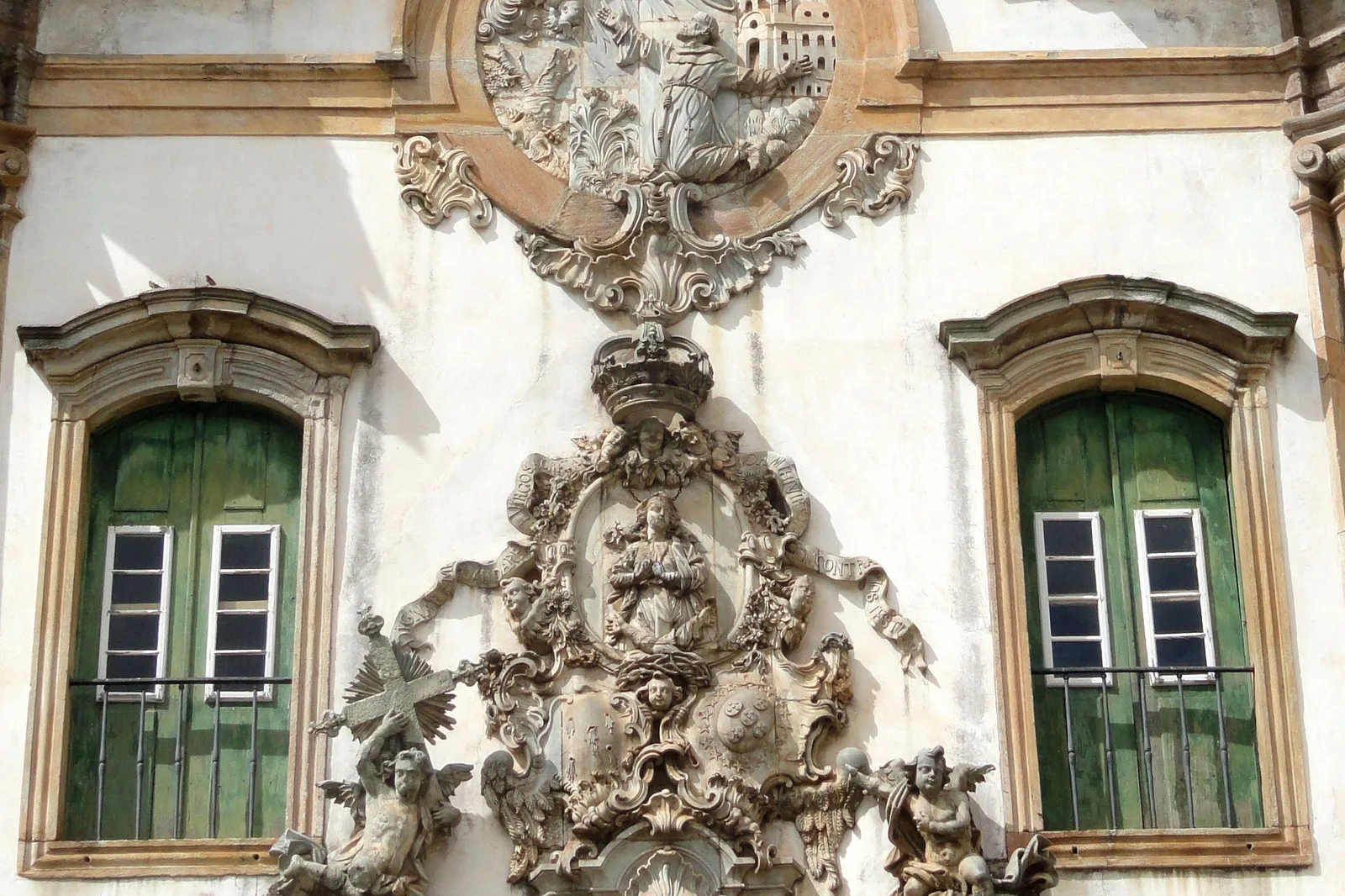
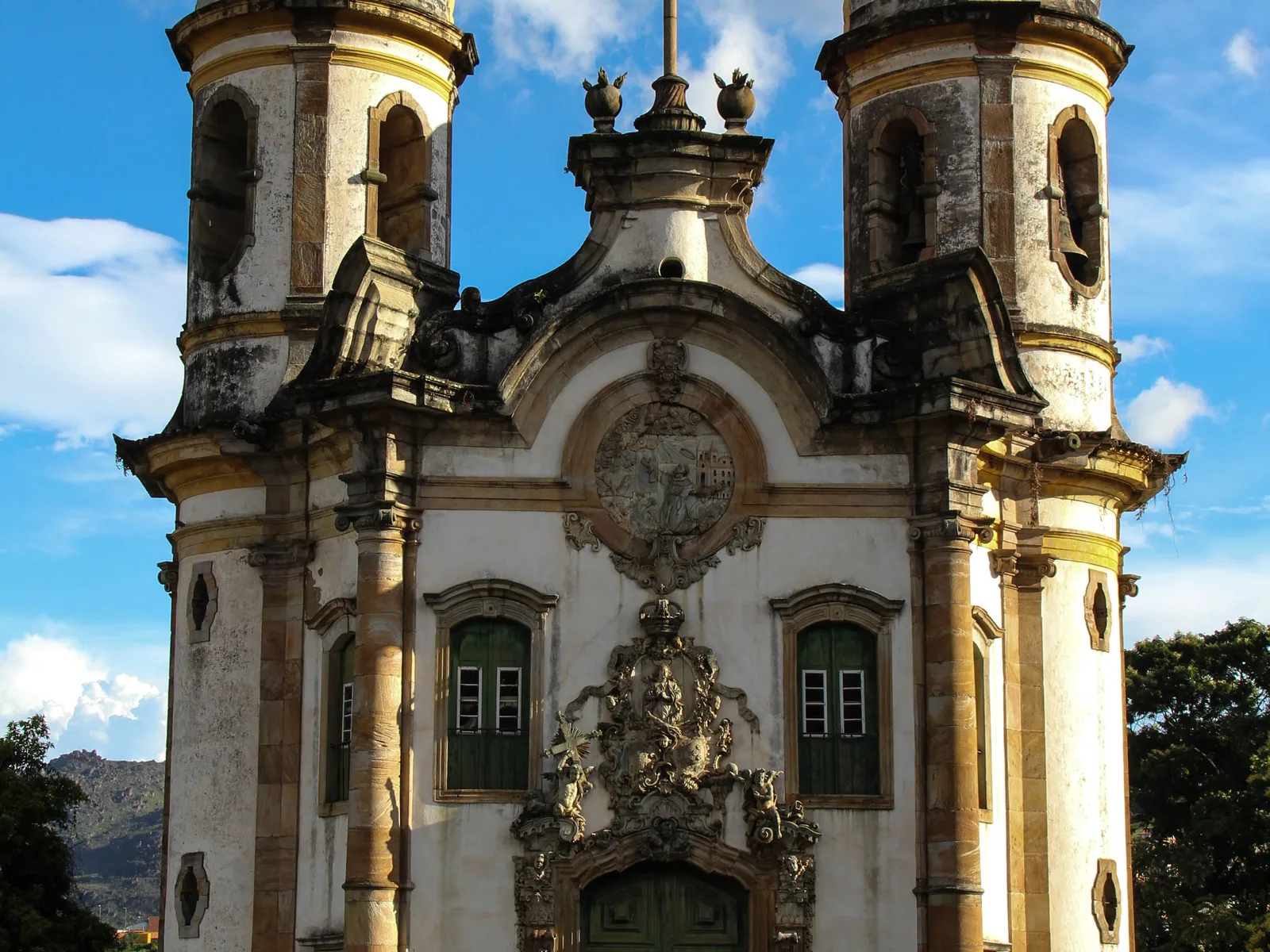
The upper facade of the Igreja de São Francisco de Assis in Ouro Preto against a blue sky: two cylindrical bell towers with domed caps flanking a scrolled white pediment, and Aleijadinho’s deeply carved soapstone medallion set above the doorway between green-shuttered windows 01

Aleijadinho’s own church, inside and out

Igreja de São Francisco de Assis

Begun
1766
By
Aleijadinho, painted by Mestre Ataíde
Closed
Mondays

The most complete surviving statement of what Brazilian baroque became once it stopped copying Portugal. Antônio Francisco Lisboa — Aleijadinho — designed the building, carved the soapstone medallion over the door and the altarpieces inside, and the ceiling was painted by Manoel da Costa Ataíde, whose Virgin has the face of a mixed-race Brazilian woman rather than a European one. The two of them worked on it for decades. It is the church that art historians point at when they argue that the colony developed something of its own.

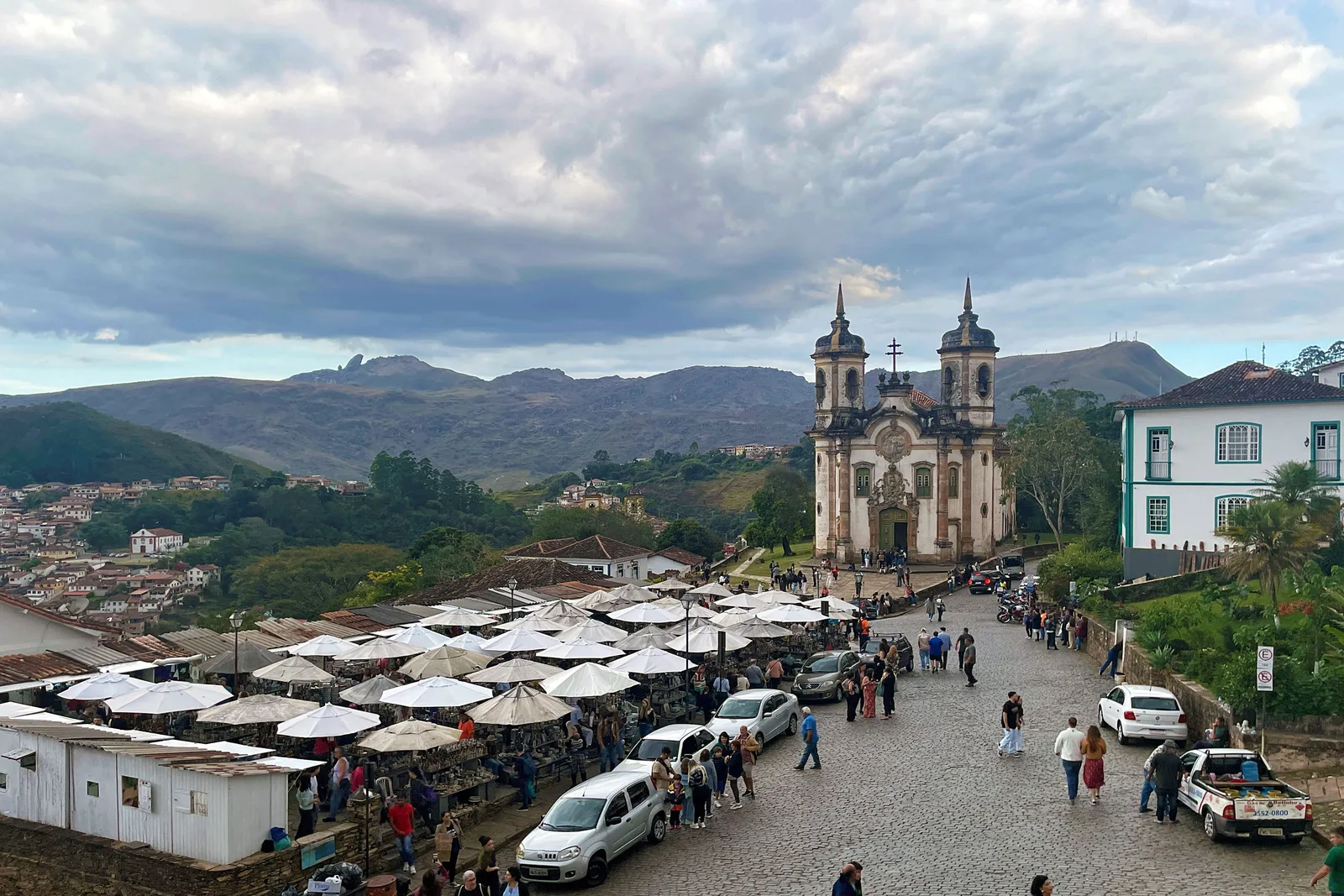
It stands on the Largo de Coimbra, a sloping open square below Praça Tiradentes, with the Pico do Itacolomi filling the gap between the buildings behind it. The soapstone market sets up under white umbrellas across the same square most days, which means the classic view of the church is over a hundred carved bowls and birds. Admission is a few reais and the ticket normally also covers the small Museu do Aleijadinho next door.
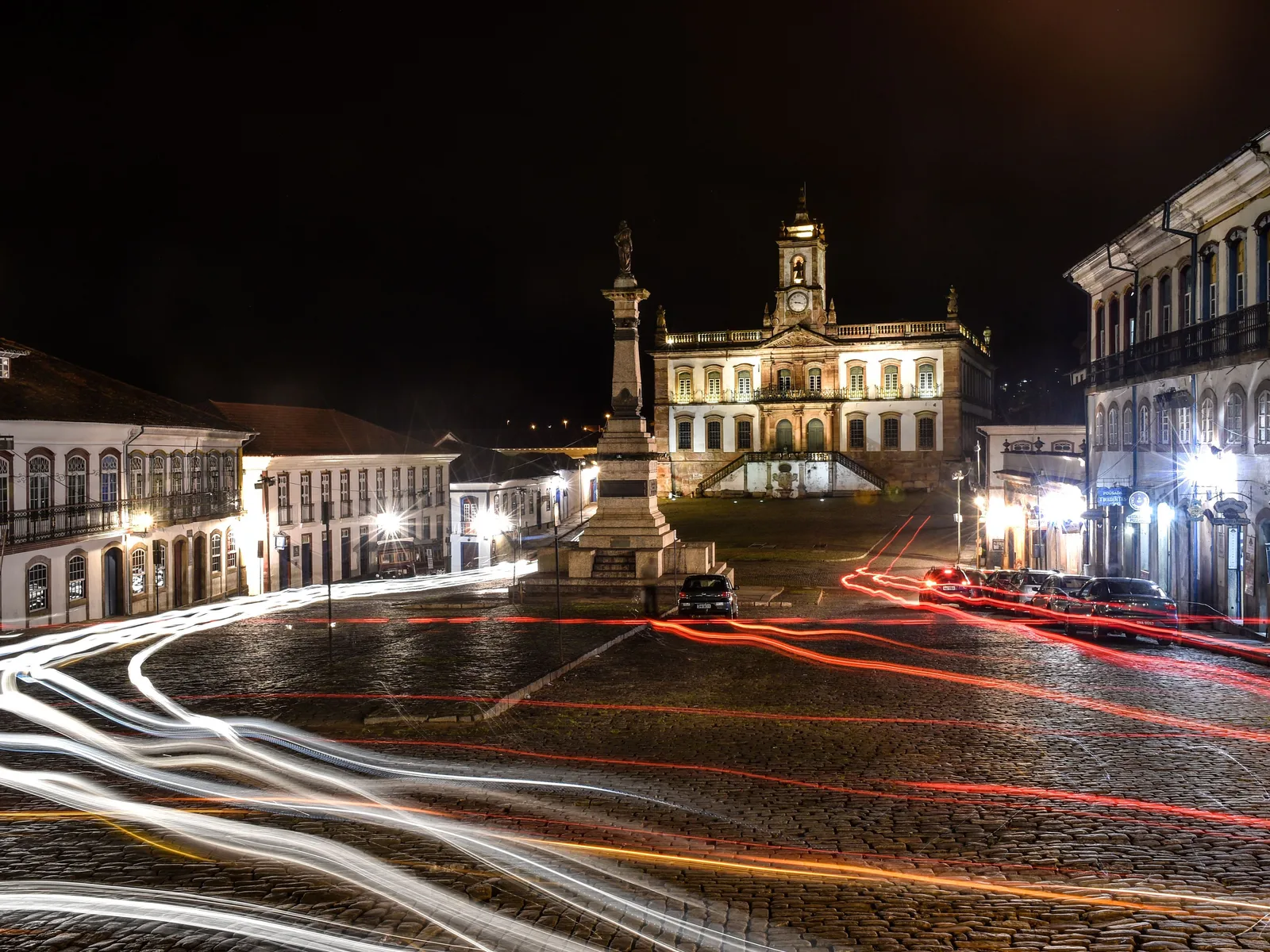
Praça Tiradentes at night in a long exposure: the floodlit Museu da Inconfidência standing at the head of the square with the lit Tiradentes column in front of it, and red and white streaks of car light curving across the wet cobbles in the foreground 02

The square where Brazil first rehearsed independence

Praça Tiradentes & the Museu da Inconfidência

Plot
The Inconfidência Mineira, 1789
Museum
Free, Tuesday to Saturday
Holds
The Panteão dos Inconfidentes

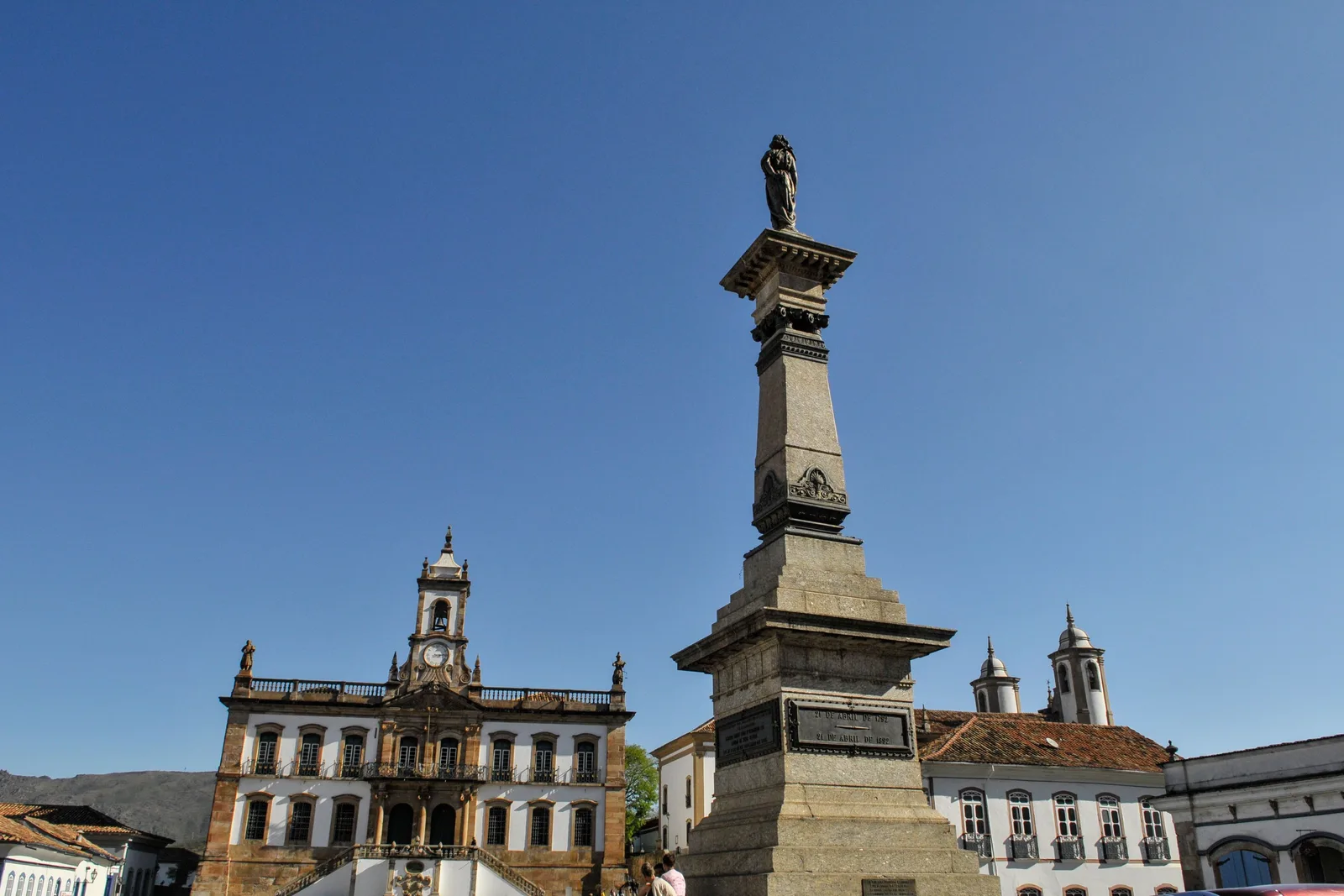
The high point of the town and the head of every street in it. In 1789 a group of poets, priests, officers and mine owners met in Vila Rica to plan a republic, largely because the Portuguese crown was about to enforce a brutal back-tax on gold production. They were betrayed before anything happened. Most were exiled to Africa; one — Joaquim José da Silva Xavier, a cavalry ensign and part-time tooth-puller known as Tiradentes — was hanged in Rio in 1792, quartered, and his head displayed in this square as a warning. The column in the middle of it now carries his statue.

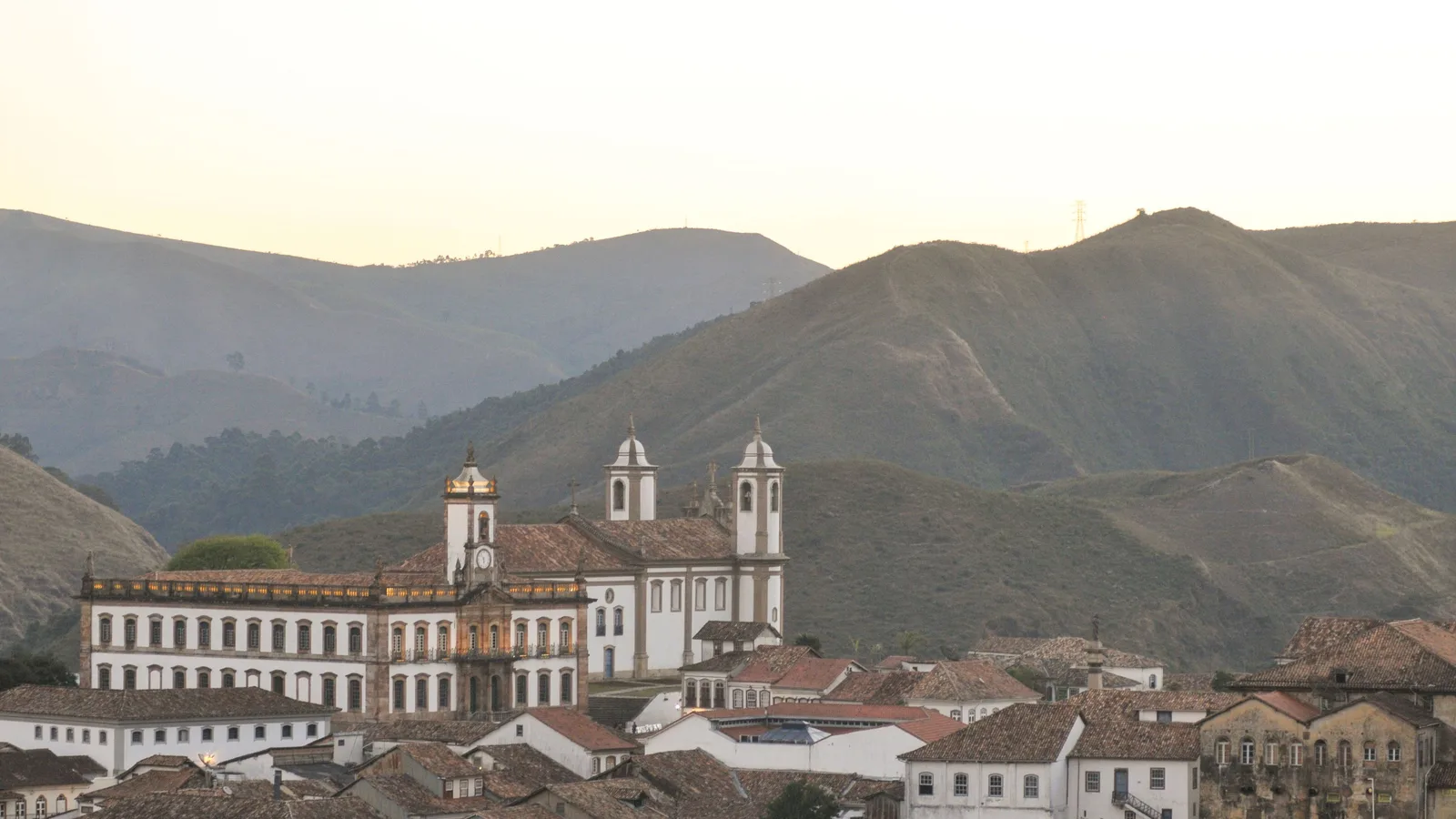
The old Casa de Câmara e Cadeia along one side, a heavy eighteenth-century civic building that was council chamber and jail at once, is now the Museu da Inconfidência: some four thousand objects, a substantial collection of Aleijadinho’s sculpture, and the Panteão dos Inconfidentes holding the remains of sixteen of the conspirators. Admission is free. At the other end of the square the long white Palácio dos Governadores, the colonial governors’ residence, became the Escola de Minas in 1876 and now houses a mineral collection of about twenty thousand specimens.

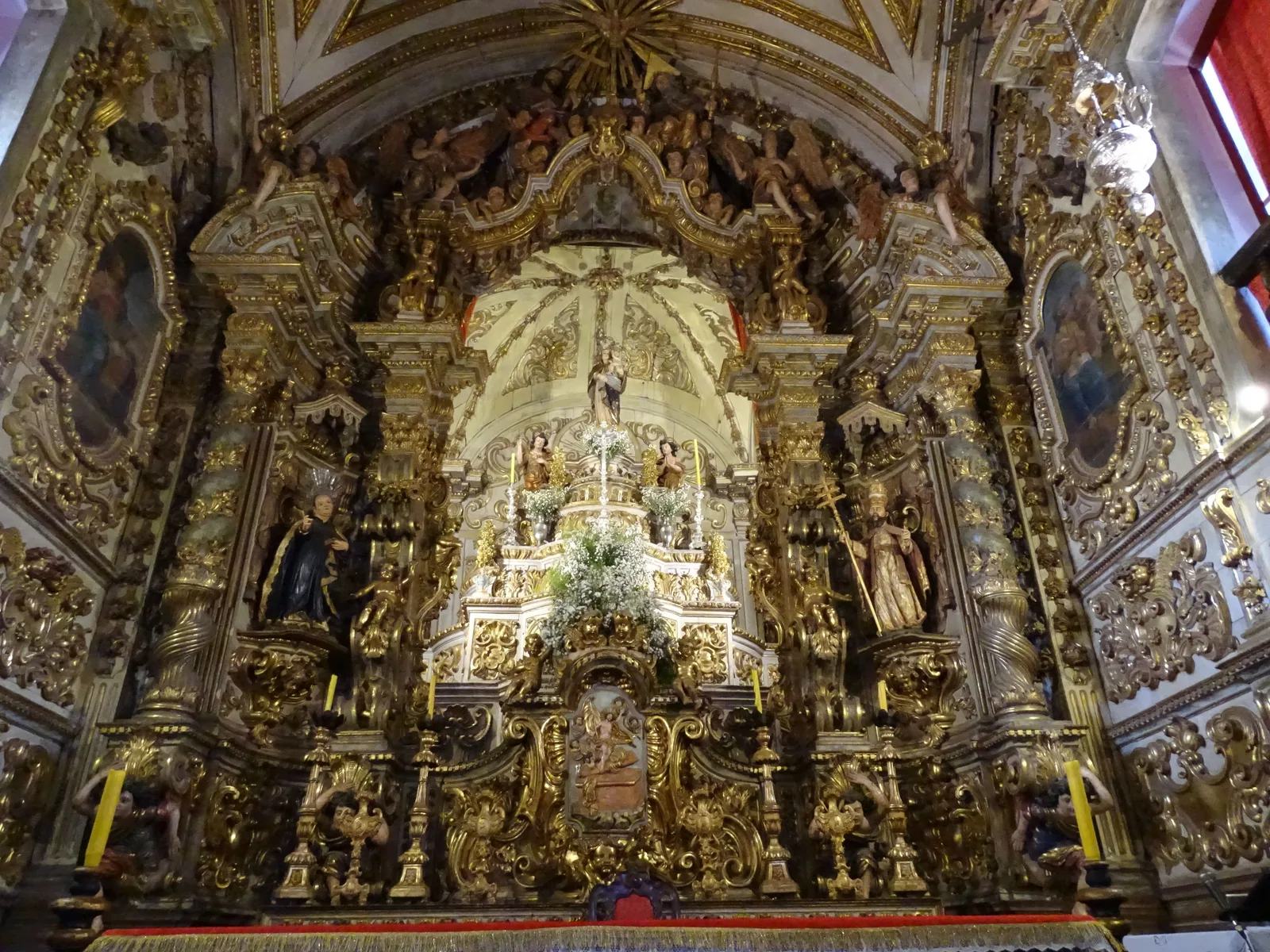
The high altar of the Basílica de Nossa Senhora do Pilar in Ouro Preto: tiers of gilded baroque carving rising into the vault, gold columns and scrollwork on every surface, painted saints standing in niches either side, and a small lit image at the center 03

Four hundred kilos of gold on the walls

Basílica de Nossa Senhora do Pilar

Finished
1786
Gilding
Over 400 kg of gold
Nave
Polygonal, 1730s

From the street it is a plain colonial box with two blunt towers. Inside it is the second most richly gilded church in Brazil: more than four hundred kilograms of gold laid over carved cedar, floor to ceiling, on every surface of a polygonal nave that curves in a way almost no other Brazilian church does. Pilar was the wealthiest and most populous parish in Vila Rica, with the most brotherhoods competing to decorate it, and the result is the clearest single answer to the question of where the gold actually went.

It is the counterpart to São Francisco de Assis rather than a repeat of it. São Francisco is one artist’s controlled design; Pilar is a hundred years of guilds outdoing each other, and it is overwhelming in a way the other is not. There is a small sacred art museum in the basement. Like every church in town it is shut on Mondays and it closes over the middle of the day.

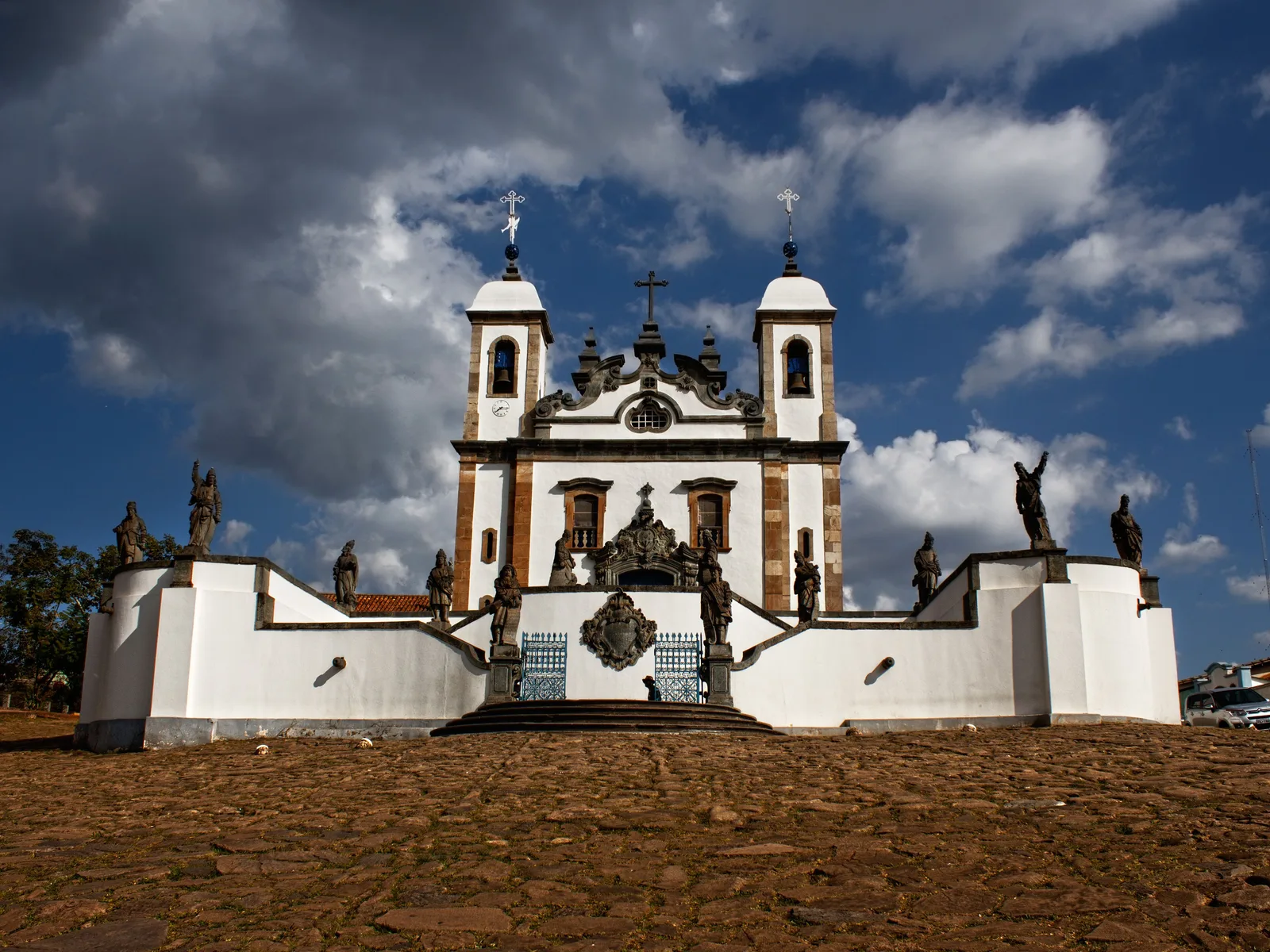
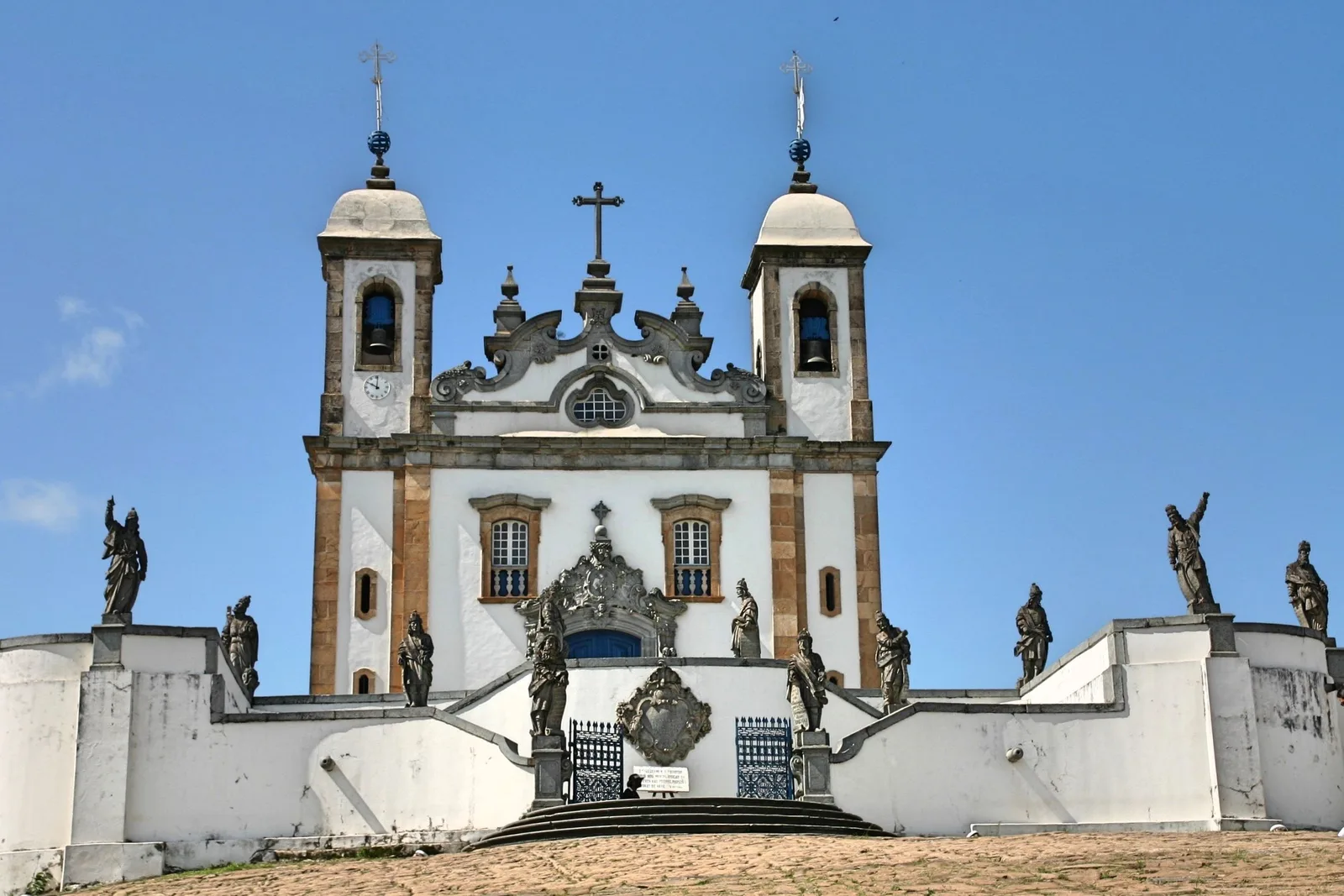
The Santuário do Bom Jesus de Matosinhos at Congonhas under heavy cloud: a white baroque church with two bell towers behind a curving terrace wall, Aleijadinho’s soapstone prophets standing along the balustrade and either side of the double stone stairway 04

Twelve prophets carved by a dying man

Os Doze Profetas, Congonhas

Carved
1800–1805, in soapstone
Also here
66 cedar figures in six chapels
Listed
UNESCO World Heritage, 1985

On the terrace in front of the Santuário do Bom Jesus de Matosinhos, an hour and a quarter from Ouro Preto, twelve life-size Old Testament prophets stand along a balustrade above a double stairway. Aleijadinho carved them out of soapstone between 1800 and 1805, when he was in his late sixties and had spent twenty years losing the use of his hands to an illness nobody has ever definitively named; by then his assistants strapped the tools to his wrists and carried him to the work. They are gaunt, twisting, faintly theatrical figures, and there is nothing else like them in the Americas.

Below them, six chapels stepping down the hill hold sixty-six life-size figures in polychrome cedar — the Stations of the Cross, carved by Aleijadinho and his workshop between 1796 and 1799 and painted by Mestre Ataíde’s circle. UNESCO listed the whole sanctuary in 1985. Congonhas itself is an ordinary working town with very little tourist infrastructure, and that is part of the effect: you drive up a hill past nothing much, and there they are. Entry to the sanctuary is free.

What to actually do

Three towns, six ways to spend a day.

Pick a category, then scroll sideways through it. Every one of these is a realistic half day or morning, and almost all of them are within an hour of Praça Tiradentes.

Churches & Baroque

  • Aleijadinho’s carved soapstone medallion on the facade of São Francisco de Assis, a deeply cut relief of figures and scrollwork under a crown, set into whitewashed stone between two tall windows with green shutters

    Largo de Coimbra · 1 hour

    The soapstone portal at São Francisco de Assis

    Worth stopping under before you go in. The medallion above the door — Saint Francis receiving the stigmata, framed in deep scrollwork and cut from the same gray-green soapstone the local craft market still works — is Aleijadinho carving at full strength, and it is the single most reproduced piece of sculpture in Minas Gerais. Inside, the ceiling by Mestre Ataíde is the other half of the argument. A few reais gets you both, plus the Museu do Aleijadinho next door.
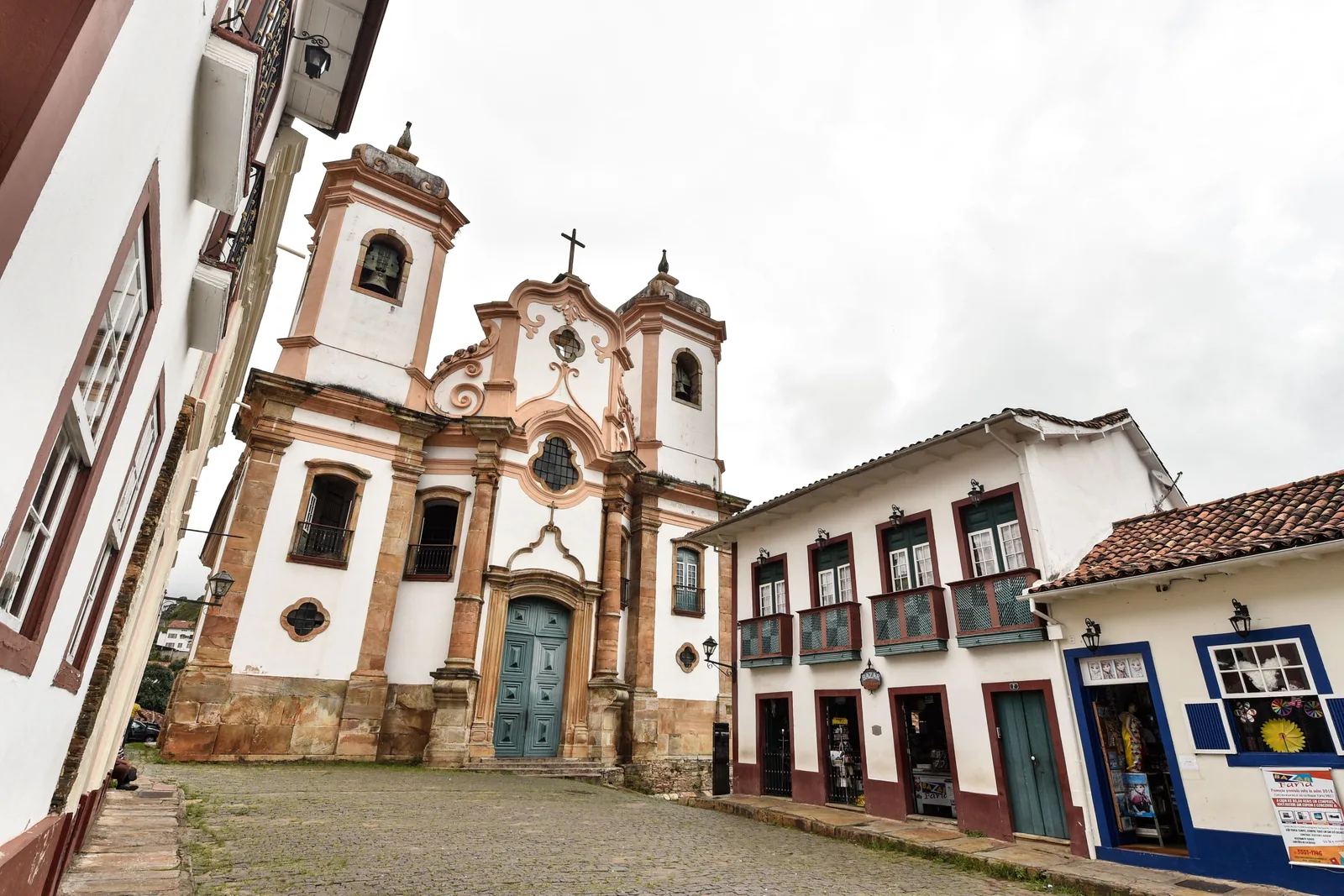
  • The white twin-towered facade of the Matriz de Nossa Senhora do Pilar standing at the head of a steep cobbled street in Ouro Preto, colonial shopfronts and painted houses running down either side toward the camera

    Praça Monsenhor Castilho Barbosa · 1 hour

    The gilded nave at Nossa Senhora do Pilar

    Ouro Preto’s parish church and its loudest one. The polygonal nave is covered in more than four hundred kilograms of gold over carved cedar, and the effect in low light is genuinely disorienting. It is a short, steep walk down from Praça Tiradentes on Rua Direita — the same street the restaurants are on — so it slots naturally into a morning. There is a sacred art museum downstairs holding pieces from parishes across the region.

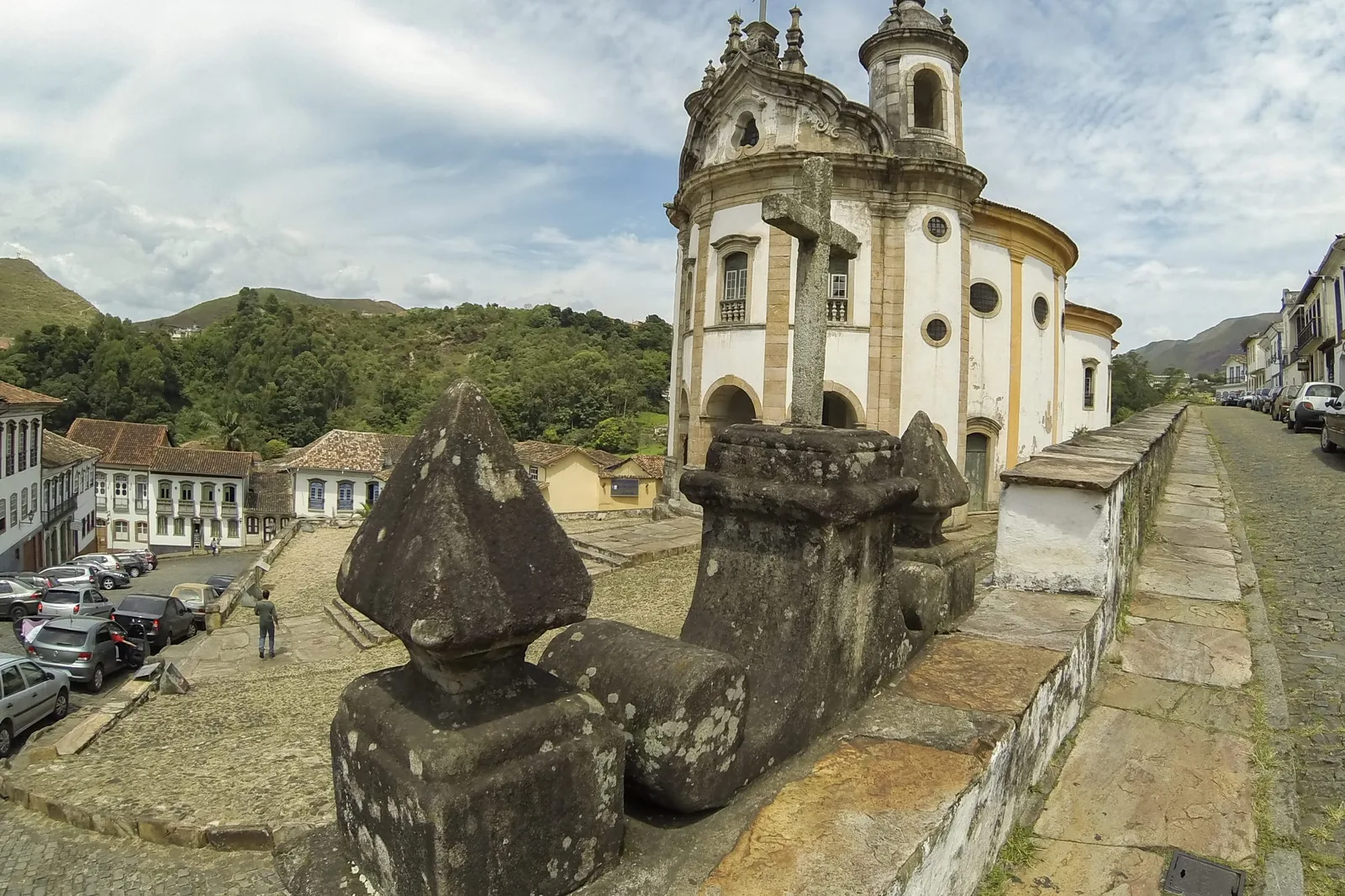
  • The Igreja de Nossa Senhora do Rosário in Ouro Preto seen from below on its slope: a curved white baroque facade between two rounded bell towers, a dark carved stone monument in the foreground and green hills rising behind the rooftops

    Rosário · 45 minutes

    The oval church at Nossa Senhora do Rosário

    The strangest building in town and the one most people walk past. Its plan is a pair of interlocking ovals — curves that belong in Bavaria or Piedmont and appear almost nowhere else in Brazil — and it was built from 1785 by the black brotherhood of Our Lady of the Rosary, on ground below the wealthy parishes, with money raised by people who in many cases were still buying their own freedom. The interior was never finished to the standard of the gold churches, and the reason for that is the whole story.

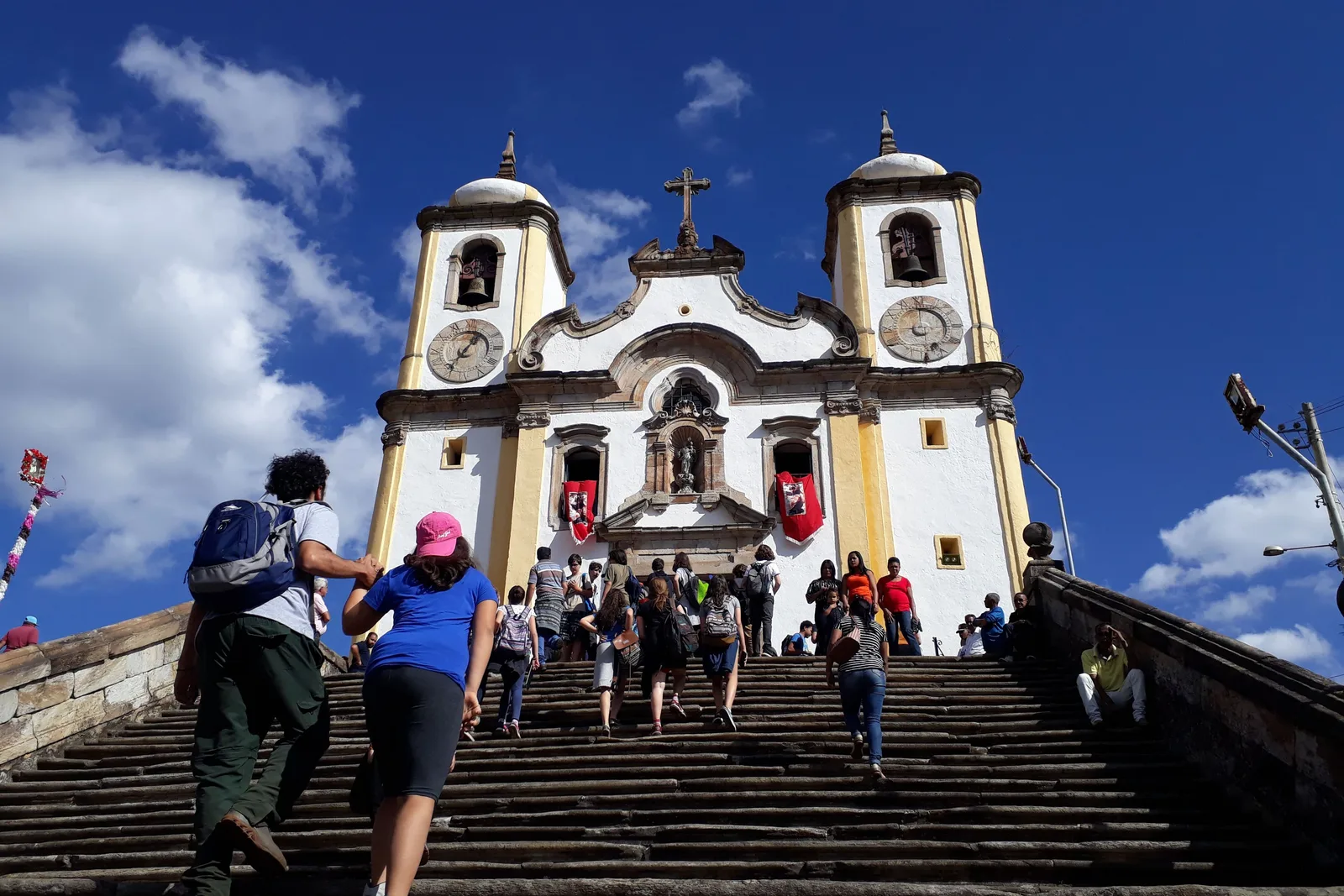
  • Visitors climbing the wide stone stairway to the Igreja de Santa Efigênia in Ouro Preto, a white church with two bell towers and a clock face standing above them against a bright sky with scattered cloud

    Alto da Cruz · 1 hour, and a climb

    Santa Efigênia and the Chico Rei story

    High on the eastern hill above the old mining quarter, reached by a long flight of stone steps, and worth the effort for the view back over the town as much as for the interior. The church was built through the mid-eighteenth century by another black brotherhood, and tradition attaches it to Chico Rei — by the telling, a Congolese king sold into slavery in Vila Rica who bought his own freedom and his people’s, and owned a gold mine. The Congado brotherhood that crowns a king and queen here every January is the living end of that story.

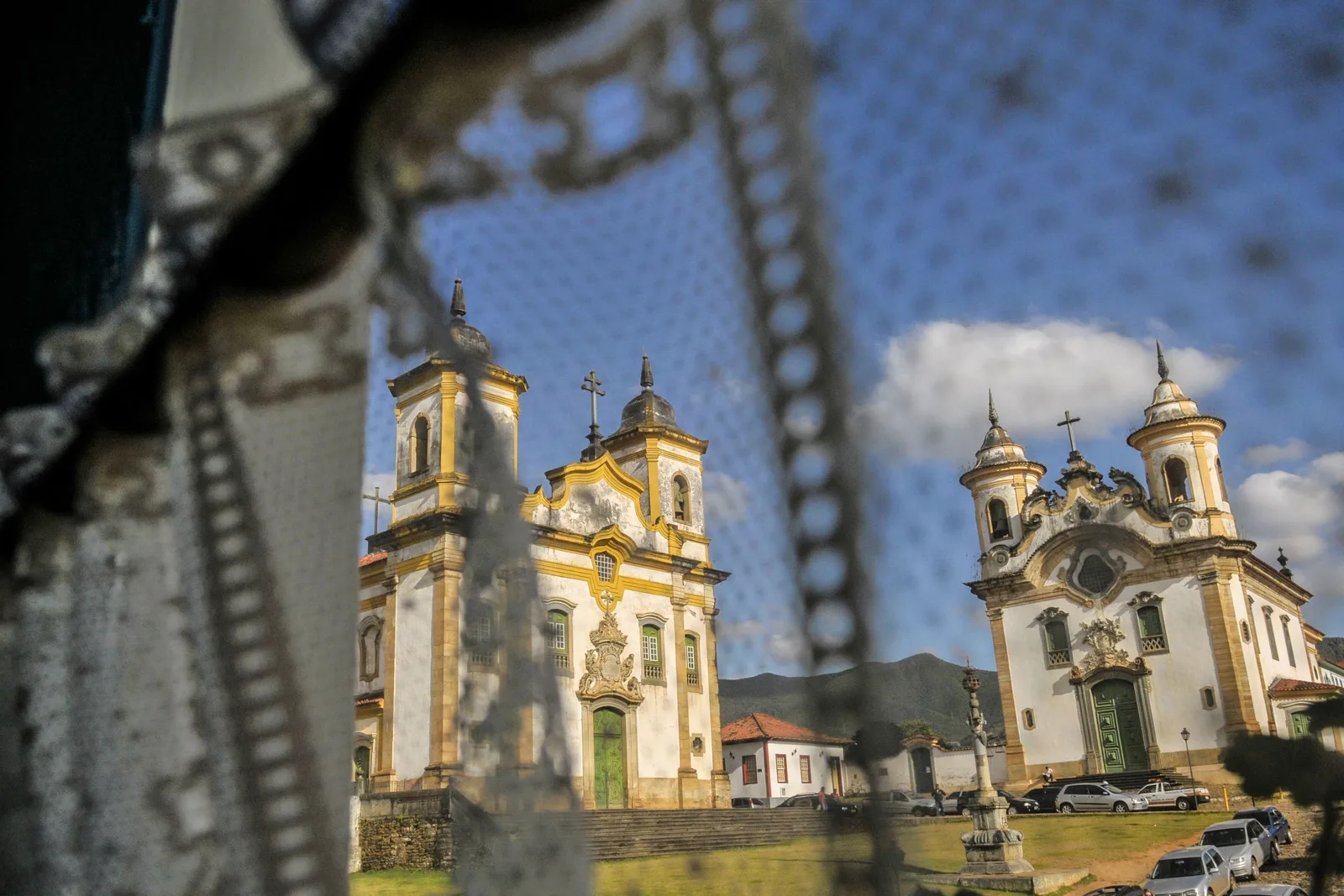
  • The two baroque churches of Mariana’s Praça Minas Gerais seen through an out-of-focus wrought-iron screen, their pale twin-towered facades standing at an angle to each other across the paved square

    Mariana · half day

    Two churches facing each other on Praça Minas Gerais

    The best-composed square in the region and one of the most complete colonial ensembles in Brazil: São Francisco de Assis and Nossa Senhora do Carmo built facing one another from about 1760, the Casa de Câmara e Cadeia closing the third side, and the town’s stone pillory still standing between them. São Francisco has painting by Mestre Ataíde in the nave and sacristy and soapstone pulpits attributed to Aleijadinho; the Carmo is the more delicate of the two and one of the last good rococo interiors in Minas.

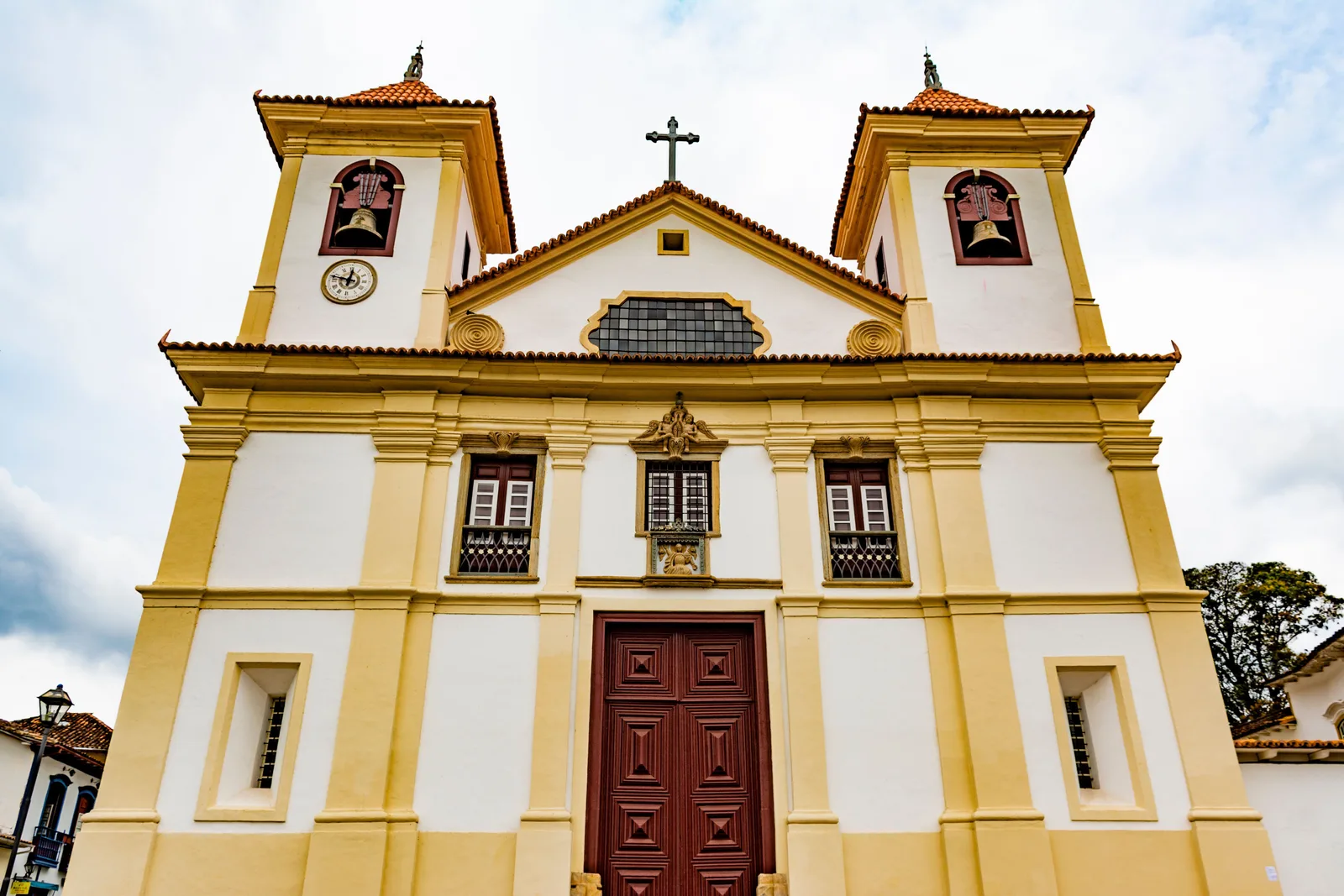
  • The yellow-and-white facade of Mariana’s Catedral Basílica da Sé in strong afternoon sun, two low bell towers either side of a central pediment and a dark wooden door at the top of the steps

    Praça Cláudio Manoel · 1 hour, or a concert

    The 1701 organ at Mariana cathedral

    The Catedral Basílica de Nossa Senhora da Assunção holds a German baroque pipe organ built around 1701 and attributed to the Arp Schnitger workshop — a gift from King João V to the first bishop of Minas, hauled up from the coast by mule. It is the most important instrument of its kind outside Europe. The cathedral runs ticketed concerts on the second and fourth Saturday of the month at 5:00pm, around R$80, sold at the door on the day; otherwise you can hear it in the big liturgical celebrations.

  • The Santuário do Bom Jesus de Matosinhos at Congonhas straight on in bright sun: a white church with two bell towers behind a low curving wall, soapstone prophets ranged along the balustrade and around the stone stairway in front of it

    Congonhas · half day with the drive

    The Passos chapels at Congonhas

    Before you reach the prophets you climb past six small chapels set into the hillside, each holding a scene from the Passion in life-size polychrome cedar — sixty-six figures in all, carved by Aleijadinho’s workshop between 1796 and 1799 and painted in the Ataíde style. You look at them through grilles rather than walking among them. They have been under a long conservation program, so individual chapels can be shut on any given day; the terrace and the twelve prophets above are the constant.

The Gold Story

  • The white twin-towered facade of the Matriz de Nossa Senhora do Pilar standing at the head of a steep cobbled street in Ouro Preto, colonial shopfronts and painted houses running down either side toward the camera

    Praça Monsenhor Castilho Barbosa · 1 hour

    The gilded nave at Nossa Senhora do Pilar

    Ouro Preto’s parish church and its loudest one. The polygonal nave is covered in more than four hundred kilograms of gold over carved cedar, and the effect in low light is genuinely disorienting. It is a short, steep walk down from Praça Tiradentes on Rua Direita — the same street the restaurants are on — so it slots naturally into a morning. There is a sacred art museum downstairs holding pieces from parishes across the region.

  • Visitors climbing the wide stone stairway to the Igreja de Santa Efigênia in Ouro Preto, a white church with two bell towers and a clock face standing above them against a bright sky with scattered cloud

    Alto da Cruz · 1 hour, and a climb

    Santa Efigênia and the Chico Rei story

    High on the eastern hill above the old mining quarter, reached by a long flight of stone steps, and worth the effort for the view back over the town as much as for the interior. The church was built through the mid-eighteenth century by another black brotherhood, and tradition attaches it to Chico Rei — by the telling, a Congolese king sold into slavery in Vila Rica who bought his own freedom and his people’s, and owned a gold mine. The Congado brotherhood that crowns a king and queen here every January is the living end of that story.

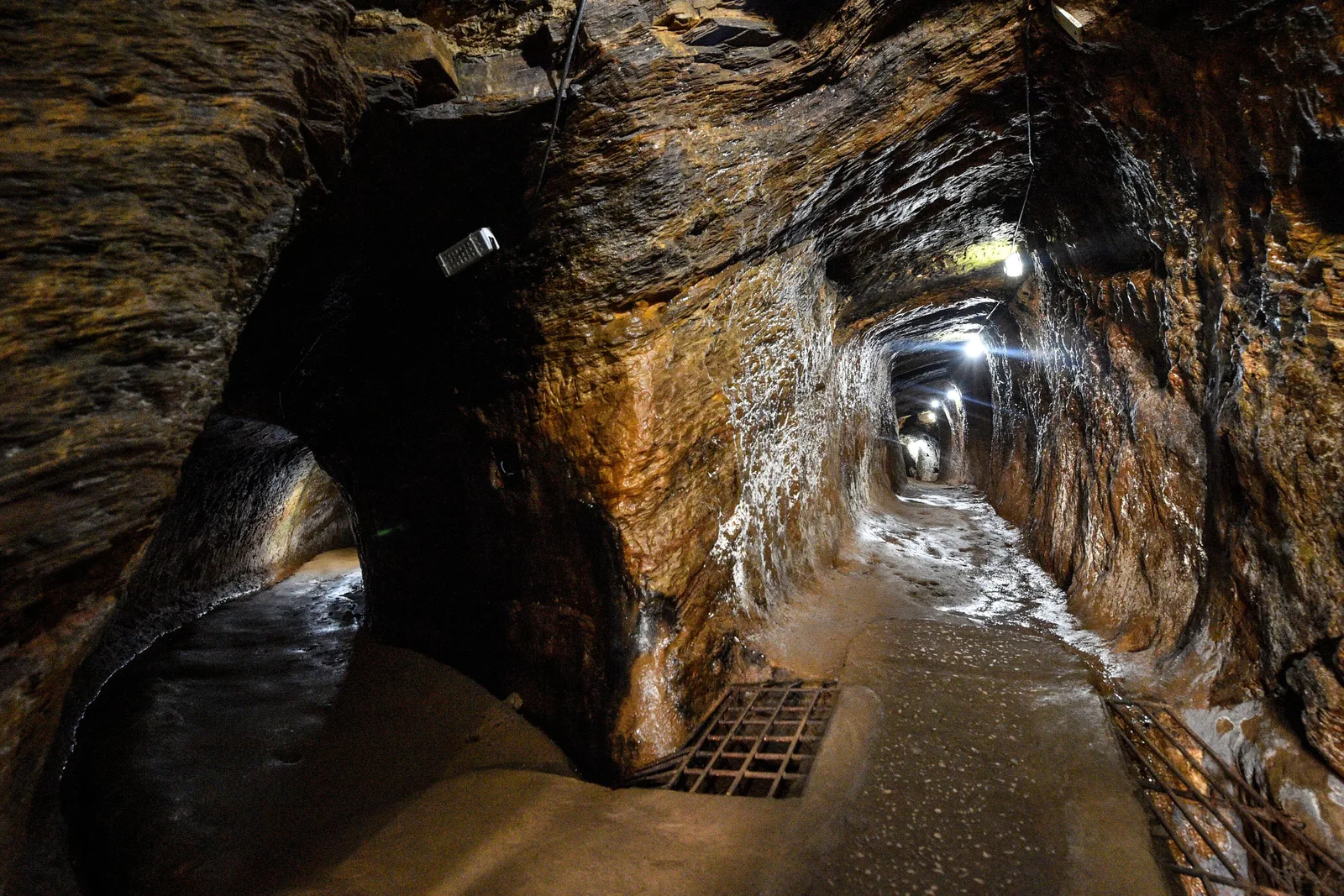
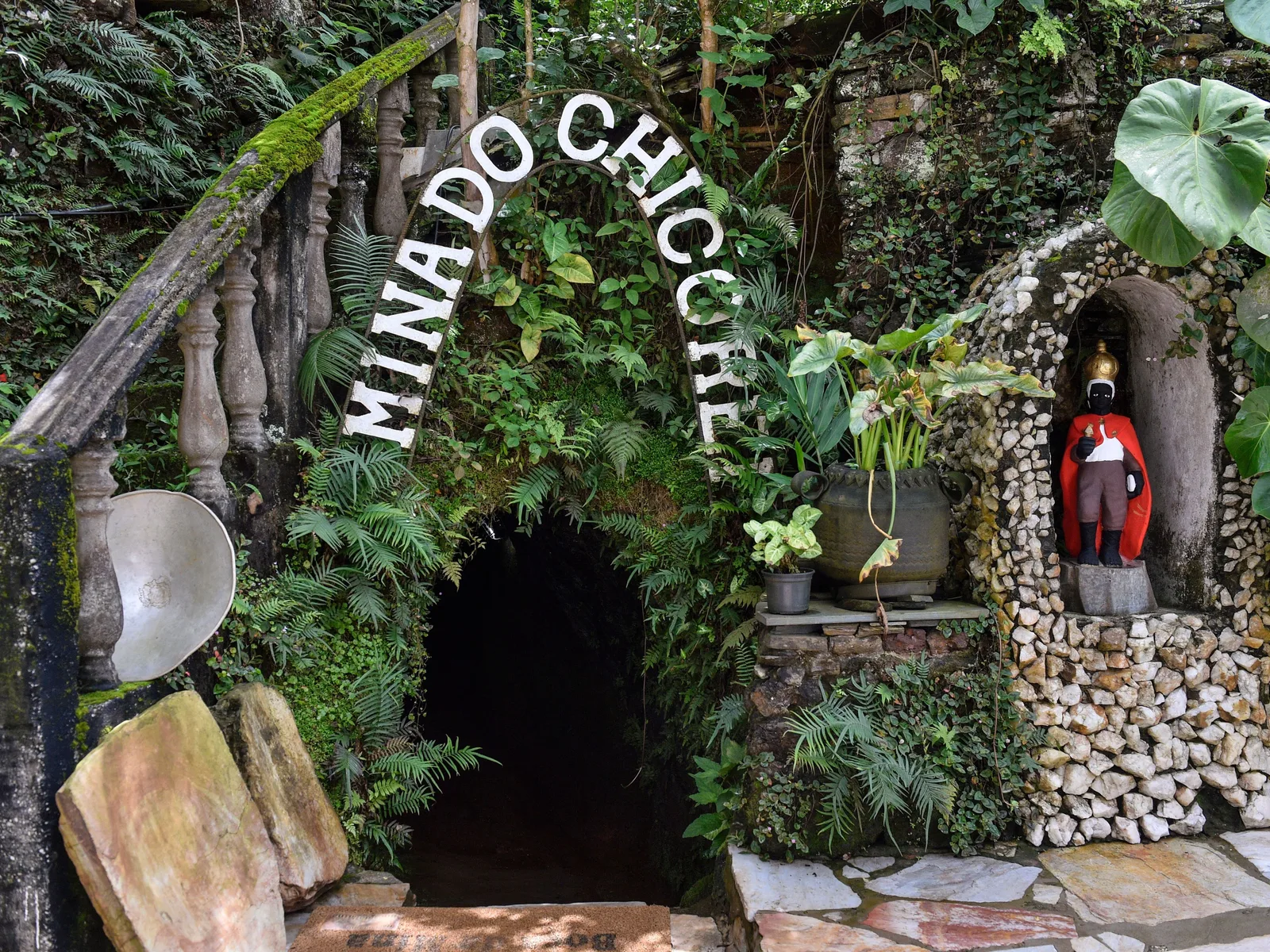
  • Inside the Mina do Chico Rei: a low rough-hewn rock tunnel with water on the floor and a strip of small lamps receding into the dark, the raw ore face lit close to the camera

    Alto da Cruz · 1 hour

    Down the shaft at the Mina do Chico Rei

    A real eighteenth-century gold mine on the hill below Santa Efigênia, and the easiest one to visit: you walk in through a low arch on a residential street and follow lit galleries hacked out of the rock by hand. The tunnels are cramped, wet and low enough that tall people stoop, which is the point — this is the working end of all that gilding. Around R$25, open daily, and there is a longer adventure version through unlit galleries if an hour is not enough.

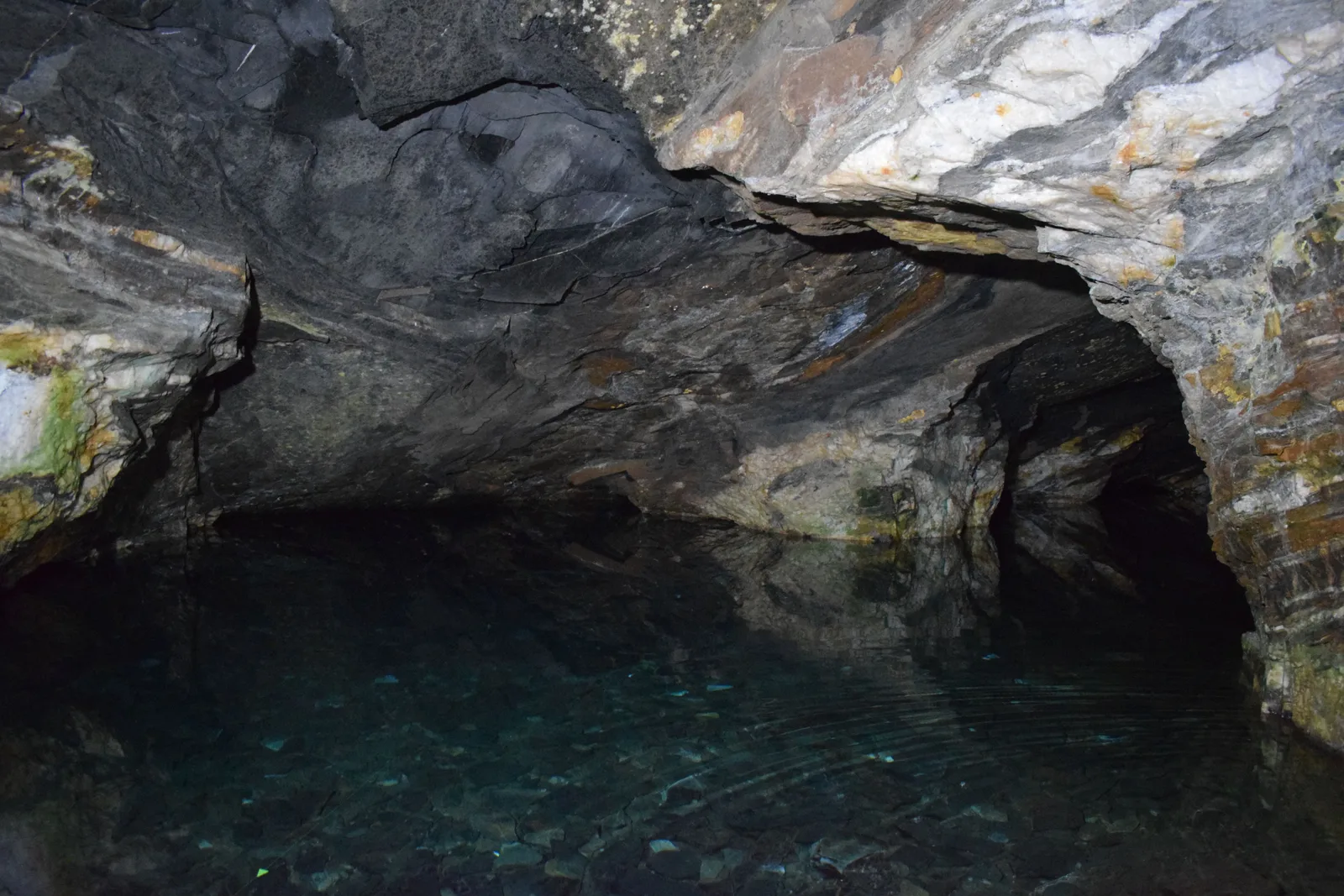
  • The underground lake inside Minas da Passagem near Mariana, clear blue-green water filling the floor of a dark rock cavern lit from one side, the mine roof arching low over it

    Between Ouro Preto and Mariana · 2 hours

    Riding a cable car into Minas da Passagem

    The big one, and the one that costs money: a working gold mine from 1719 on the road to Mariana, with about thirty kilometers of galleries, into which you descend on an open wooden funicular trolley that has been running since the 1940s. At the bottom there is an underground lake of startlingly clear water. It is R$280 a head and cash only at the gate — no cards, no Pix — which catches people out. Open daily; the tour runs about forty-five minutes.

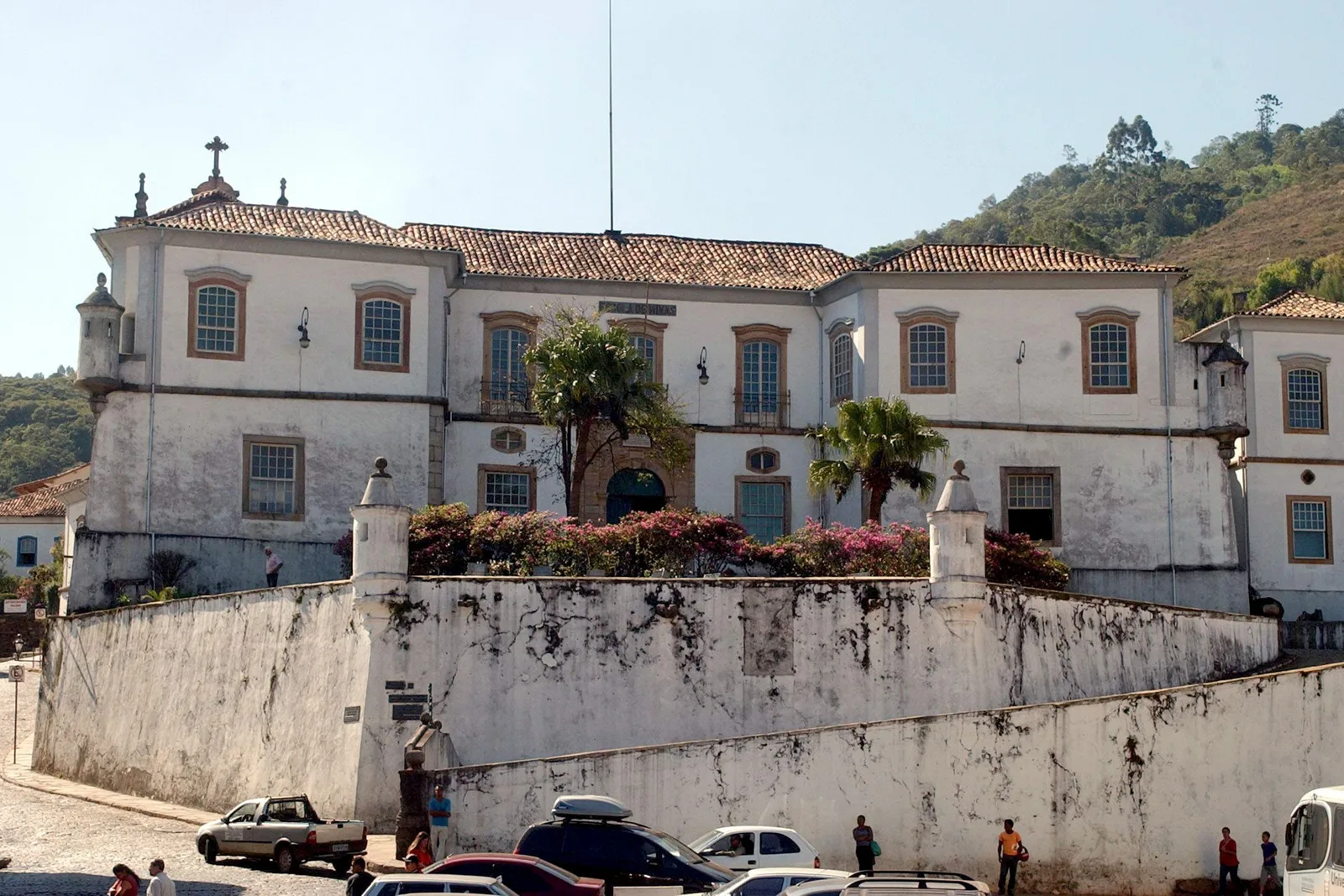
  • The long white two-story facade of the old Palácio dos Governadores in Ouro Preto, now the Escola de Minas, standing behind a high curved retaining wall with cars parked along the street below it

    Praça Tiradentes · 2 hours

    Twenty thousand minerals at the Escola de Minas

    The colonial governors’ palace at the top of the square became Brazil’s first school of mining engineering in 1876, and its Museu de Ciência e Técnica holds one of the largest rock and mineral collections in the world — around twenty thousand specimens, plus rooms of nineteenth-century surveying, metallurgy and astronomy equipment and a reconstructed mine gallery. Around R$10, Tuesday to Sunday, afternoons only. It is the best rainy-afternoon building in town.

Museums & Theater

  • The yellow-and-white facade of Mariana’s Catedral Basílica da Sé in strong afternoon sun, two low bell towers either side of a central pediment and a dark wooden door at the top of the steps

    Praça Cláudio Manoel · 1 hour, or a concert

    The 1701 organ at Mariana cathedral

    The Catedral Basílica de Nossa Senhora da Assunção holds a German baroque pipe organ built around 1701 and attributed to the Arp Schnitger workshop — a gift from King João V to the first bishop of Minas, hauled up from the coast by mule. It is the most important instrument of its kind outside Europe. The cathedral runs ticketed concerts on the second and fourth Saturday of the month at 5:00pm, around R$80, sold at the door on the day; otherwise you can hear it in the big liturgical celebrations.

  • The long white two-story facade of the old Palácio dos Governadores in Ouro Preto, now the Escola de Minas, standing behind a high curved retaining wall with cars parked along the street below it

    Praça Tiradentes · 2 hours

    Twenty thousand minerals at the Escola de Minas

    The colonial governors’ palace at the top of the square became Brazil’s first school of mining engineering in 1876, and its Museu de Ciência e Técnica holds one of the largest rock and mineral collections in the world — around twenty thousand specimens, plus rooms of nineteenth-century surveying, metallurgy and astronomy equipment and a reconstructed mine gallery. Around R$10, Tuesday to Sunday, afternoons only. It is the best rainy-afternoon building in town.

  • The tall stone Tiradentes column standing in the middle of Praça Tiradentes in Ouro Preto against a clear sky, the long facade of the Museu da Inconfidência behind it and colonial houses and a church tower along the far side of the square

    Praça Tiradentes · 2 hours

    The Museu da Inconfidência on Praça Tiradentes

    The old council chamber and jail, and the museum of the 1789 conspiracy that got Tiradentes hanged and made him Brazil’s national martyr. About four thousand objects across the colonial period, an important group of Aleijadinho sculptures, and the Panteão dos Inconfidentes holding the remains of sixteen conspirators brought back from exile in Africa. Admission is free, Tuesday to Saturday. Casa dos Contos, the eighteenth-century treasury house a few streets down, is also free and worth twenty minutes.

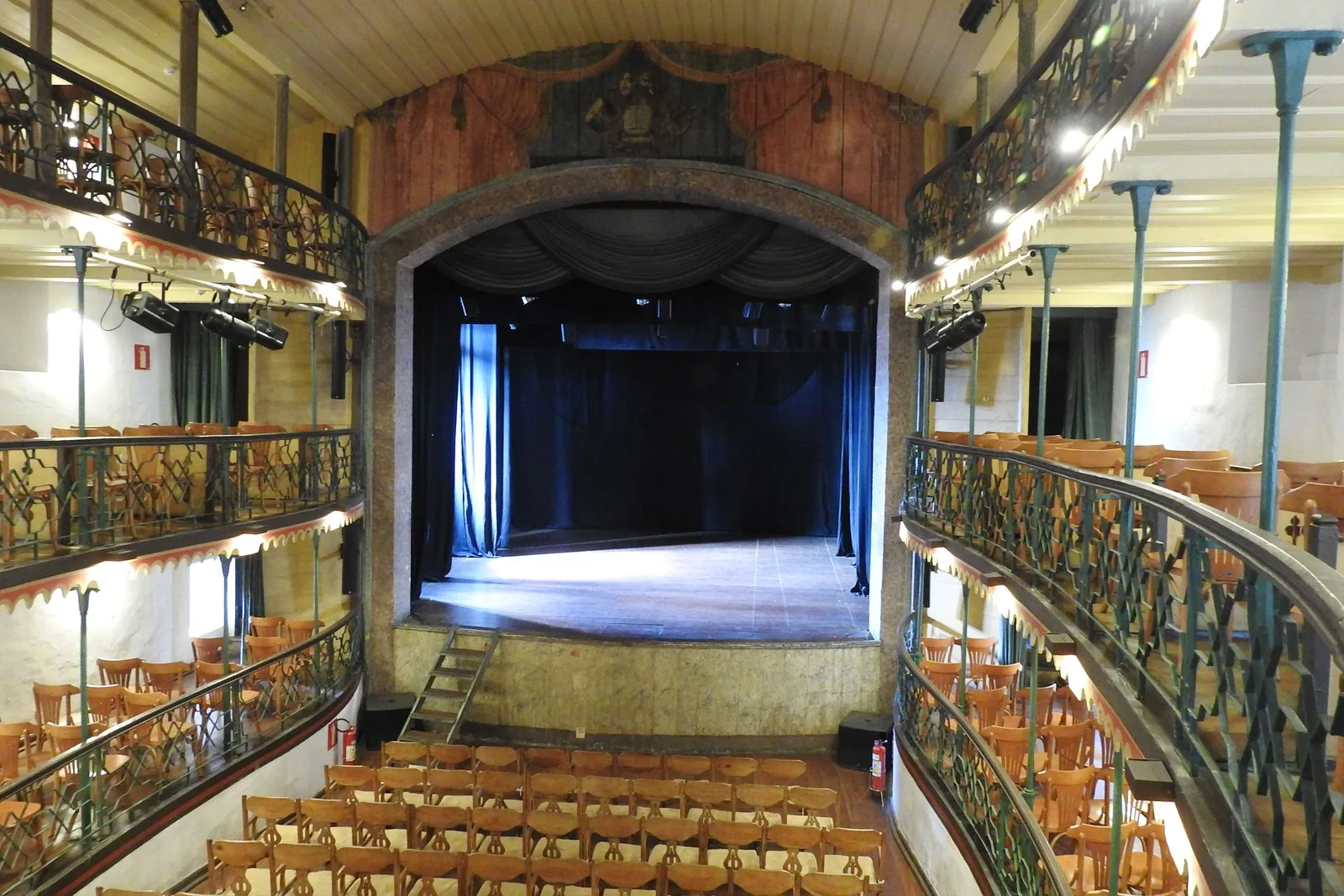
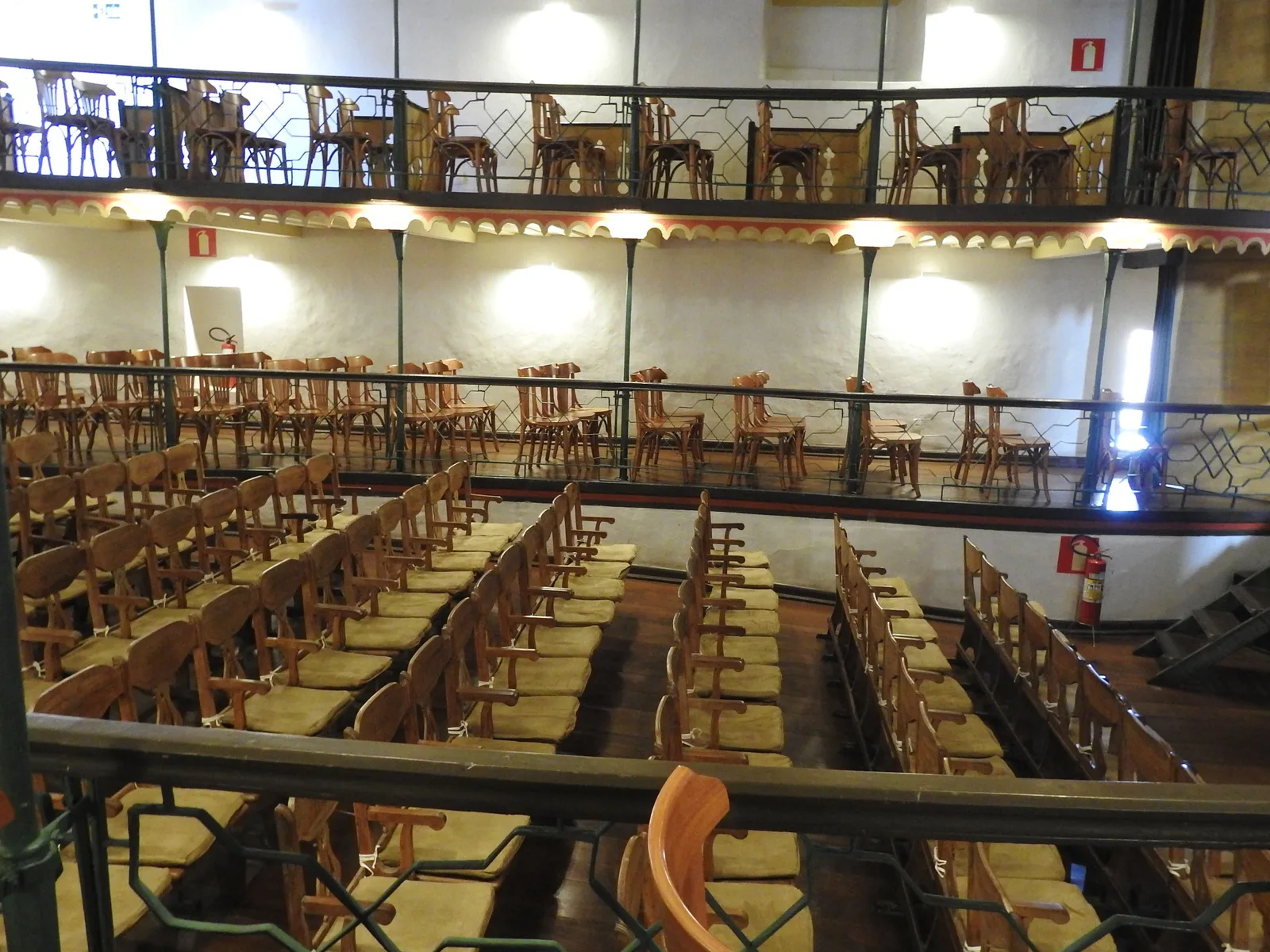
  • The interior of the Casa da Ópera in Ouro Preto seen from a box: rows of wooden chairs on the raked floor, curved balconies with iron railings running around the walls, and the empty lit stage at the far end

    Rua Brigadeiro Musqueira · 45 minutes, or an evening

    A performance at the Casa da Ópera

    Opened in June 1770 and still in use, which makes it the oldest working theater in the Americas. It is small, steeply raked and entirely wooden, with three tiers of boxes curving around a stage that once carried plays by Cláudio Manuel da Costa — a poet who was also one of the Inconfidência conspirators. You can walk in and look at it for a few reais during the day, and it is much better to see it with something on: the winter festival programs it heavily through July.

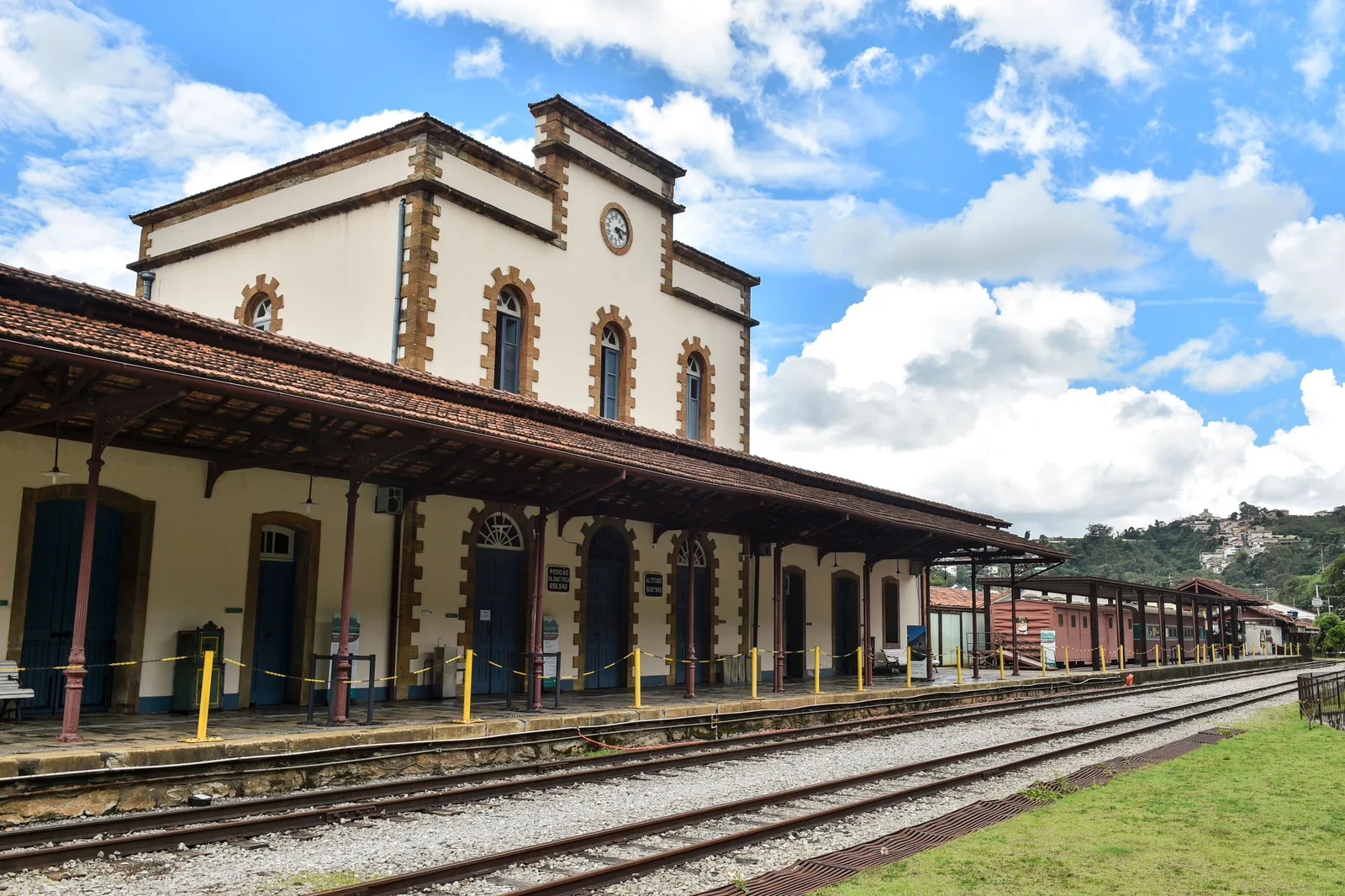
  • The empty platform of Ouro Preto’s train station under a bright sky, a long white station building with arched windows and a canopy along one side and the rails running away into the distance

    Praça Cesário Alvim · 30 minutes

    The station the train has not left since 2020

    Ouro Preto’s 1888 train station is a handsome piece of ironwork and yellow stucco with a platform, a signal box and a museum in it, and no departures. The Trem da Vale ran the 18 km down to Mariana as a tourist service until August 2020 and has not run since; Vale began restoring the building and the track in February 2026 and the town’s mayor has cited 2027. Go for the building and the railway museum, and check whether the train is back before you build a day around it.

Hills & Waterfalls

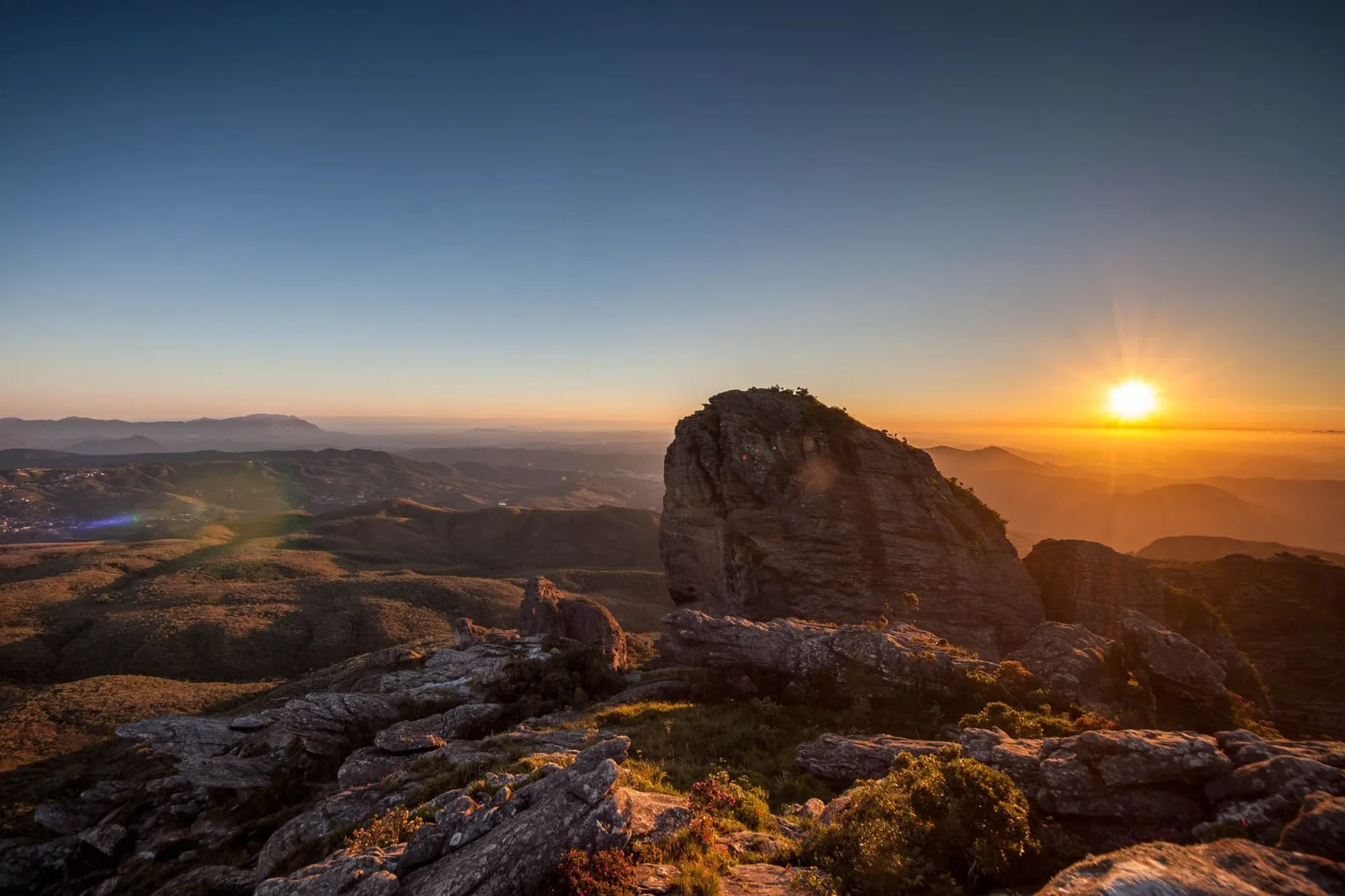
  • Sunrise from the rocks at the top of the Pico do Itacolomi, bare boulders in the foreground and the sun breaking over layered blue ridges and a valley of low mist below

    Parque Estadual do Itacolomi · full day

    Climbing the Pico do Itacolomi

    The blunt stone finger on the skyline south of town is the reason Ouro Preto is where it is: for two hundred years it was the landmark bandeirantes steered by to find Vila Rica. It stands at 1,772 meters inside a state park of Atlantic forest and high-altitude grassland, with marked self-guided trails, a reservoir, a viewpoint and a few colonial buildings including an old tea-house museum. R$20 to get in, Tuesday to Sunday, 8:00am to 5:00pm. Start early and take more water than feels necessary.

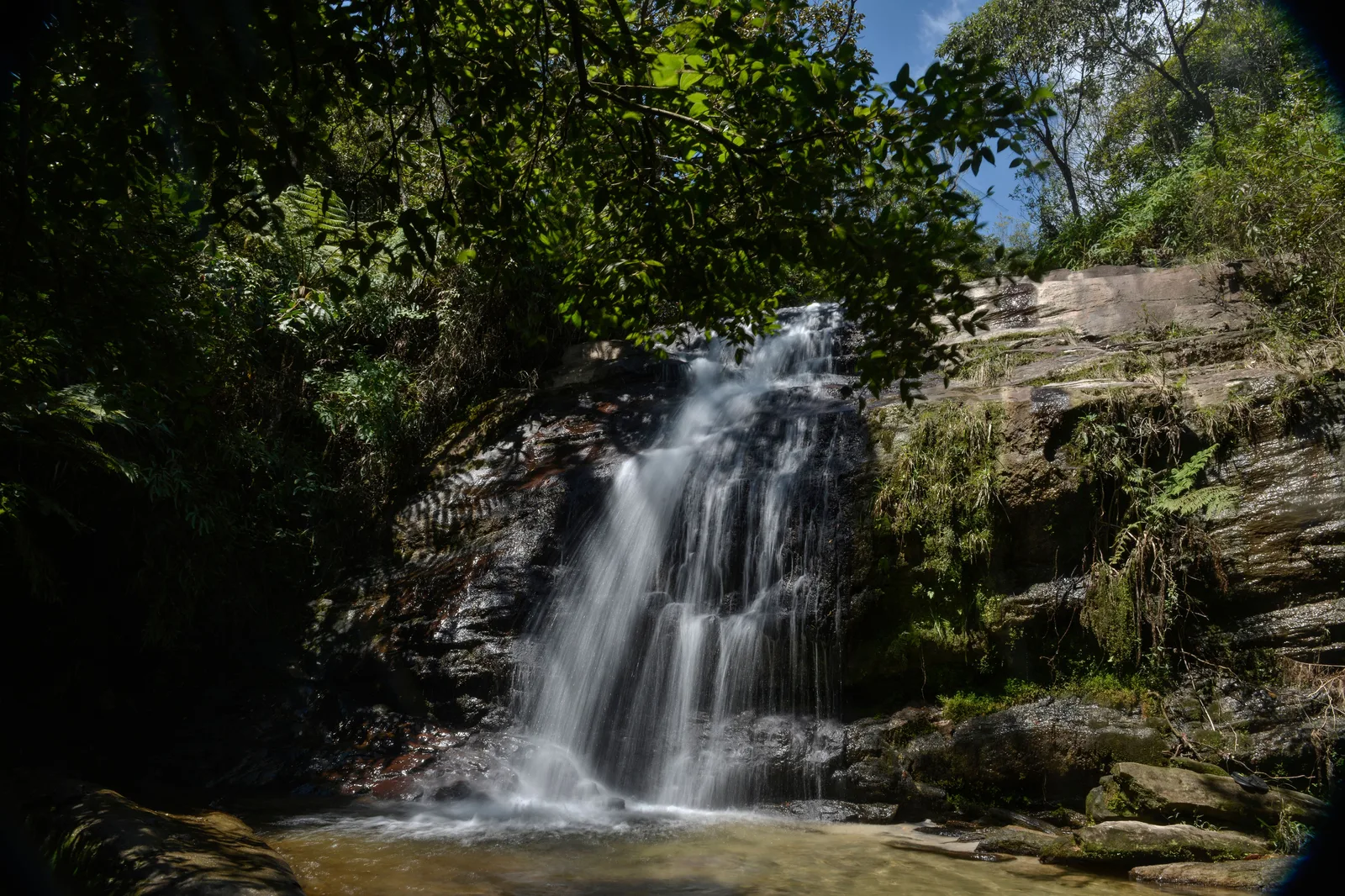
  • A waterfall dropping in several steps down a dark rock face into a shallow pool at Lavras Novas, dense green forest closing in on both sides

    17 km south · half day

    Waterfall-hunting around Lavras Novas

    The hills above the village are full of them, and most take a walk of twenty minutes to an hour to reach — the Cachoeira das Andorinhas, Três Pingas, Falcão and a dozen smaller ones on the streams running off the Serra do Espinhaço. The water is cold all year and swimmable in the summer months, when it is also brownest after rain. Local guides run half-day circuits; quad-bike tours cover the same ground more noisily.

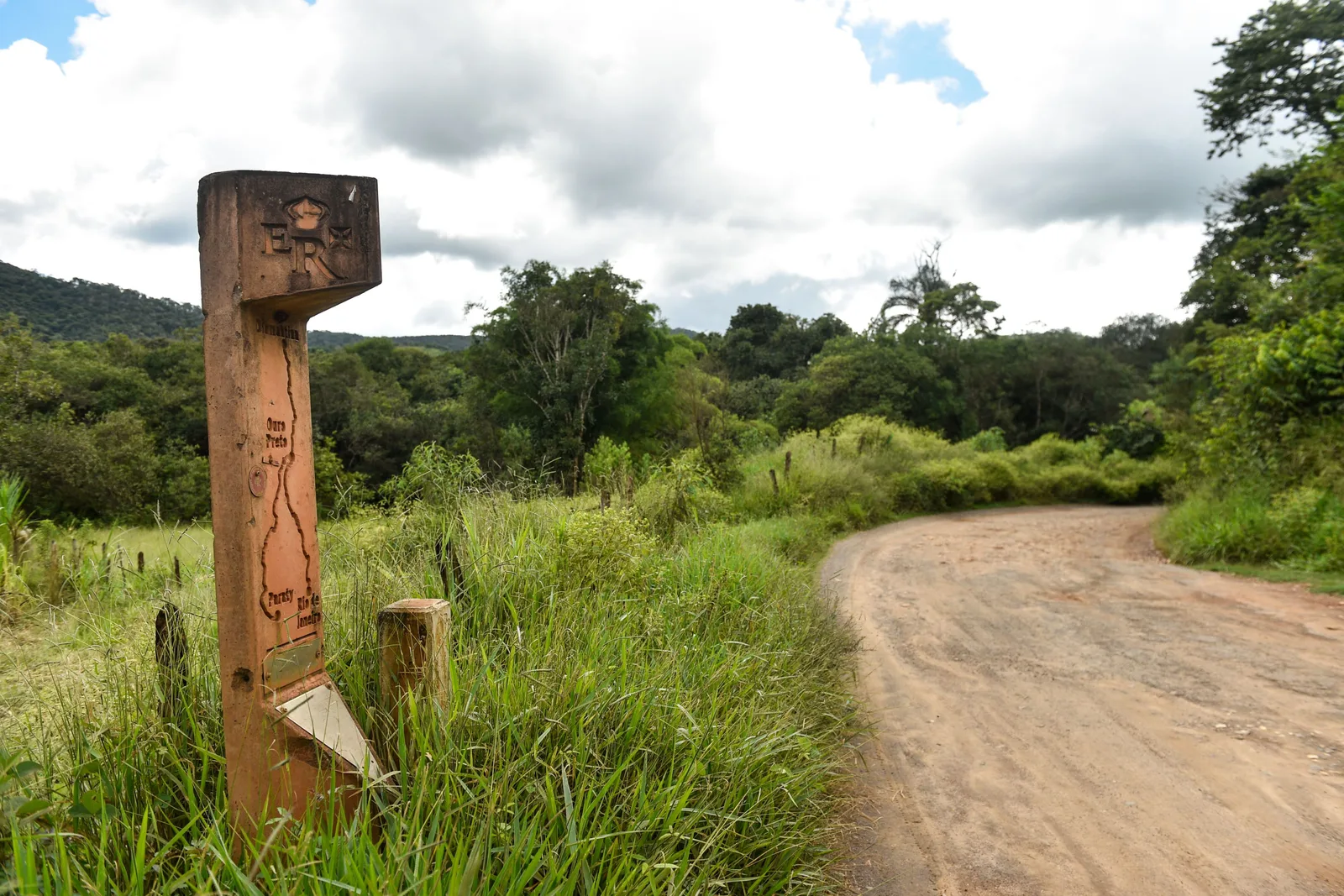
  • A carved wooden waymarker post standing in long grass beside a red dirt track curving away through green scrub and low trees on the Estrada Real near Ouro Preto

    Around Ouro Preto · half day

    Walking a stretch of the Estrada Real

    The Estrada Real is the network of colonial roads the crown built and policed so that every ounce of gold and every diamond had to pass a checkpoint on its way to the coast. Long stretches of the original stone paving survive in the hills around Ouro Preto and are now waymarked as a walking and cycling route. The section toward Lavras Novas and the Ponte da Caveira is the easiest to do as a half day, and a guide is worth having — the marking is honest rather than generous.

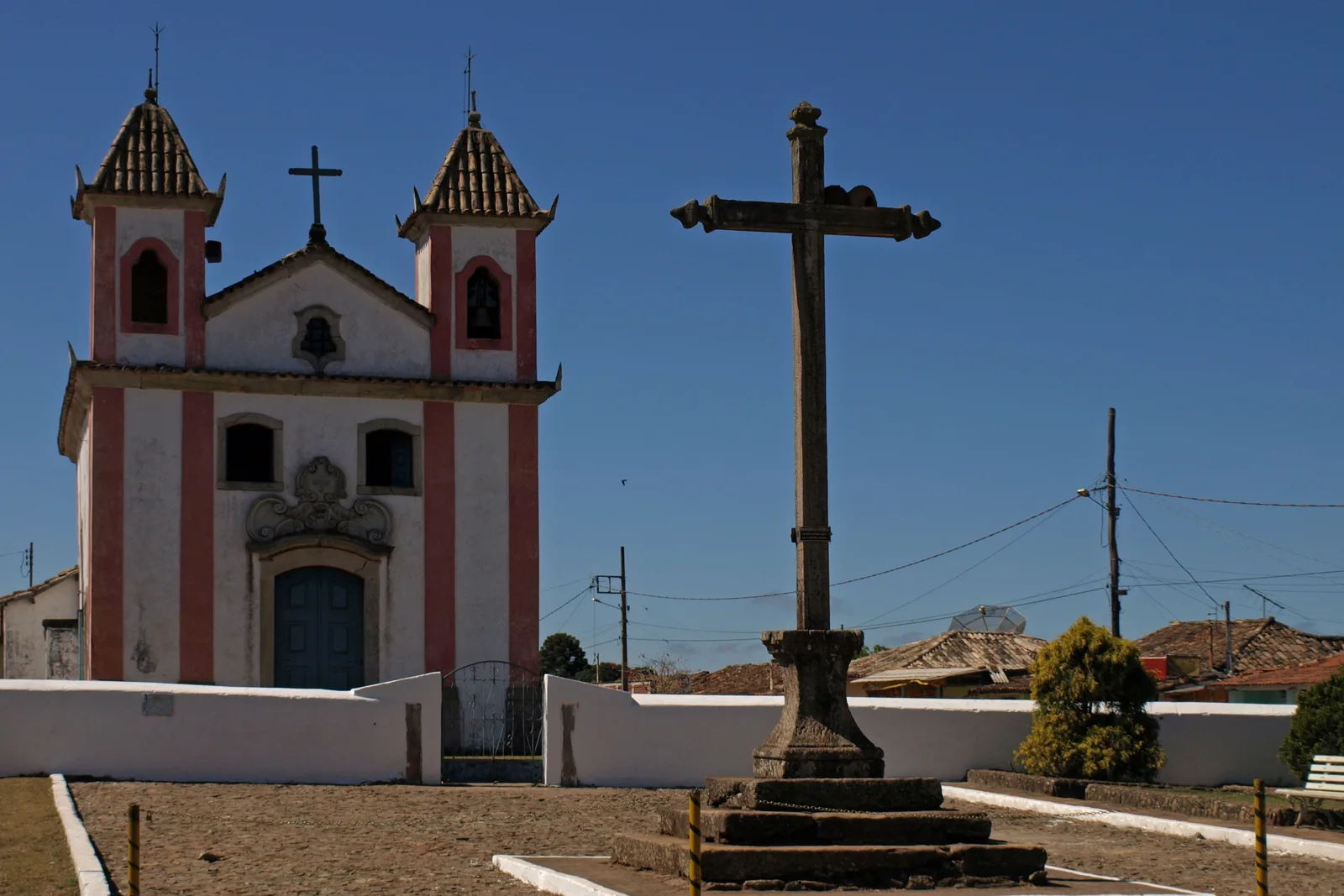
  • The small white church at Lavras Novas with two low bell towers, a tall dark wooden cross standing on a stone base in the open square in front of it against a deep blue sky

    17 km south · half day or a night

    An afternoon in Lavras Novas

    A hamlet of maybe a thousand people at the top of the range, founded in the eighteenth century by freed and escaped slaves, with a single church, cobbled lanes shared with horses and cows, and more pousadas and fireplaces than the size of it can explain. Brazilians come up here for cold nights, cachaça and quiet. Twenty-five minutes from Ouro Preto on a partly unpaved road, and a genuinely different climate — it is regularly several degrees colder than town.

Food & Crafts

  • A wide pan of feijão tropeiro: brown beans mixed through cassava flour with chopped egg, crisp pork, sliced sausage and dark green collard, filling the frame

    Historic center · lunch

    Eating feijão tropeiro on Rua Direita

    Comida mineira is the most distinctive regional cooking in Brazil and this is its home ground. Feijão tropeiro — beans cooked down with cassava flour, bacon, sausage, egg and collard greens — was mule-drivers’ food and is now the dish the state is known for; alongside it you will meet frango com quiabo, tutu à mineira and pork with couve. Rua Direita, the street running down from Praça Tiradentes, has most of the long-established restaurants on it, several in eighteenth-century houses.

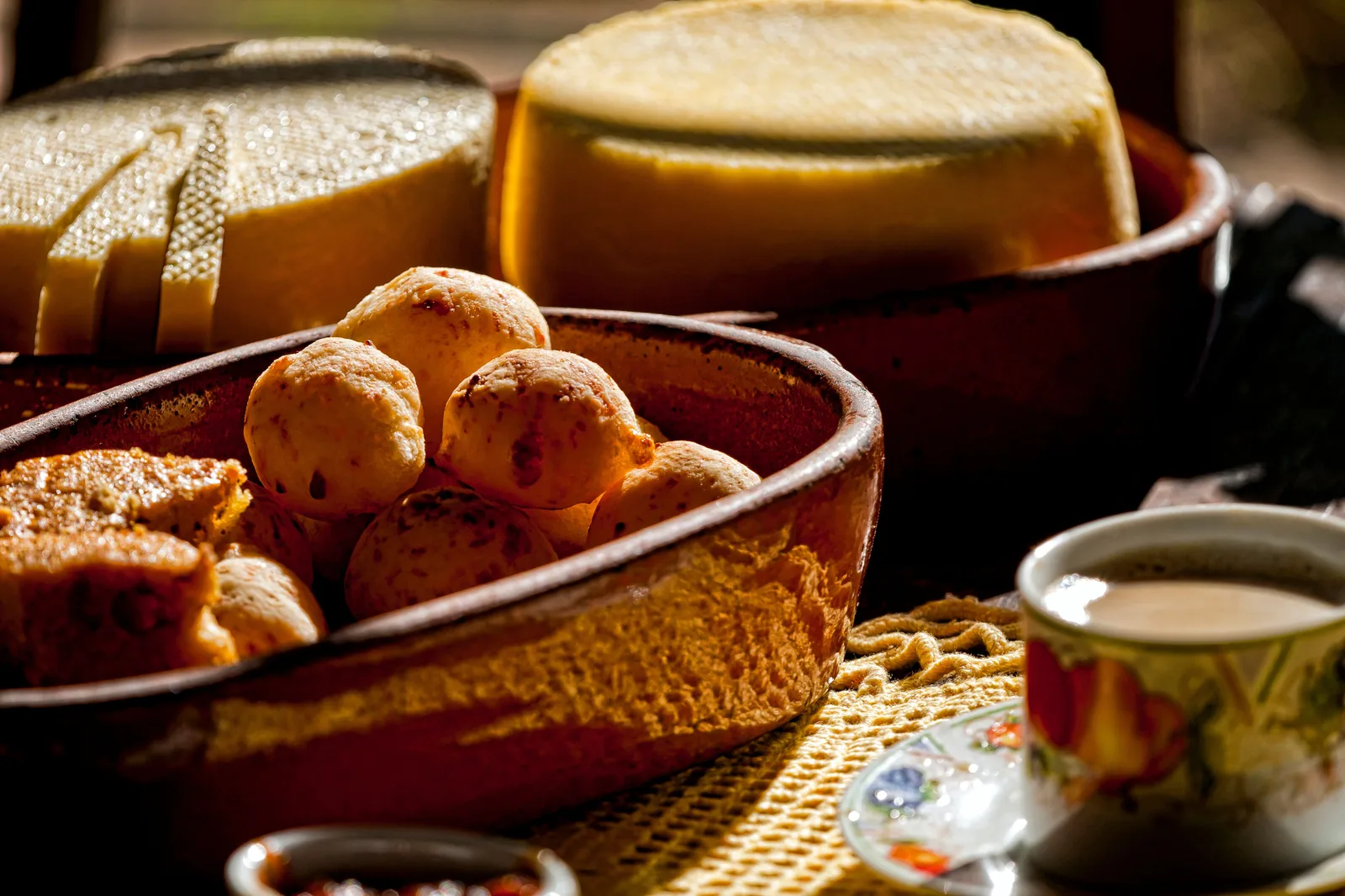
  • A wooden bowl of golden pão de queijo on a breakfast table beside a cup of black coffee, a slice of cake and a pale wheel of Minas cheese behind it in warm low light

    Anywhere, from about 7:00am

    Pão de queijo and Minas cheese

    Pão de queijo — small chewy cheese rolls made with cassava starch — was invented in this state and is eaten here for breakfast with strong coffee, not as a snack. It is made with queijo minas, the raw-milk cow’s cheese whose production method UNESCO added to its intangible heritage list in 2022, and which comes in wheels of increasing sharpness depending on how long it has sat. Buy a wedge from a market stall along with a bottle of cachaça and doce de leite, and your suitcase is done.

  • The soapstone market under rows of white umbrellas on the open square below the Igreja de São Francisco de Assis in Ouro Preto, the church standing beyond the stalls with the Pico do Itacolomi on the skyline behind it

    Below São Francisco de Assis · 1 hour

    The soapstone market at Largo de Coimbra

    Pedra-sabão — soapstone — is soft enough to carve with hand tools and hard enough to cook in, which is why it built the region’s sculpture and its pots. The open-air market on the square below São Francisco de Assis sells both: carved and painted lidded pans, mortars, birds, chess sets and small reproductions of the Congonhas prophets, most of them made in the villages around town. Prices are negotiable, the good pieces are heavier than they look, and bring cash.

Day Trips

  • The two baroque churches of Mariana’s Praça Minas Gerais seen through an out-of-focus wrought-iron screen, their pale twin-towered facades standing at an angle to each other across the paved square

    Mariana · half day

    Two churches facing each other on Praça Minas Gerais

    The best-composed square in the region and one of the most complete colonial ensembles in Brazil: São Francisco de Assis and Nossa Senhora do Carmo built facing one another from about 1760, the Casa de Câmara e Cadeia closing the third side, and the town’s stone pillory still standing between them. São Francisco has painting by Mestre Ataíde in the nave and sacristy and soapstone pulpits attributed to Aleijadinho; the Carmo is the more delicate of the two and one of the last good rococo interiors in Minas.

  • The yellow-and-white facade of Mariana’s Catedral Basílica da Sé in strong afternoon sun, two low bell towers either side of a central pediment and a dark wooden door at the top of the steps

    Praça Cláudio Manoel · 1 hour, or a concert

    The 1701 organ at Mariana cathedral

    The Catedral Basílica de Nossa Senhora da Assunção holds a German baroque pipe organ built around 1701 and attributed to the Arp Schnitger workshop — a gift from King João V to the first bishop of Minas, hauled up from the coast by mule. It is the most important instrument of its kind outside Europe. The cathedral runs ticketed concerts on the second and fourth Saturday of the month at 5:00pm, around R$80, sold at the door on the day; otherwise you can hear it in the big liturgical celebrations.

  • The Santuário do Bom Jesus de Matosinhos at Congonhas straight on in bright sun: a white church with two bell towers behind a low curving wall, soapstone prophets ranged along the balustrade and around the stone stairway in front of it

    Congonhas · half day with the drive

    The Passos chapels at Congonhas

    Before you reach the prophets you climb past six small chapels set into the hillside, each holding a scene from the Passion in life-size polychrome cedar — sixty-six figures in all, carved by Aleijadinho’s workshop between 1796 and 1799 and painted in the Ataíde style. You look at them through grilles rather than walking among them. They have been under a long conservation program, so individual chapels can be shut on any given day; the terrace and the twelve prophets above are the constant.

  • The underground lake inside Minas da Passagem near Mariana, clear blue-green water filling the floor of a dark rock cavern lit from one side, the mine roof arching low over it

    Between Ouro Preto and Mariana · 2 hours

    Riding a cable car into Minas da Passagem

    The big one, and the one that costs money: a working gold mine from 1719 on the road to Mariana, with about thirty kilometers of galleries, into which you descend on an open wooden funicular trolley that has been running since the 1940s. At the bottom there is an underground lake of startlingly clear water. It is R$280 a head and cash only at the gate — no cards, no Pix — which catches people out. Open daily; the tour runs about forty-five minutes.

  • A waterfall dropping in several steps down a dark rock face into a shallow pool at Lavras Novas, dense green forest closing in on both sides

    17 km south · half day

    Waterfall-hunting around Lavras Novas

    The hills above the village are full of them, and most take a walk of twenty minutes to an hour to reach — the Cachoeira das Andorinhas, Três Pingas, Falcão and a dozen smaller ones on the streams running off the Serra do Espinhaço. The water is cold all year and swimmable in the summer months, when it is also brownest after rain. Local guides run half-day circuits; quad-bike tours cover the same ground more noisily.

  • The small white church at Lavras Novas with two low bell towers, a tall dark wooden cross standing on a stone base in the open square in front of it against a deep blue sky

    17 km south · half day or a night

    An afternoon in Lavras Novas

    A hamlet of maybe a thousand people at the top of the range, founded in the eighteenth century by freed and escaped slaves, with a single church, cobbled lanes shared with horses and cows, and more pousadas and fireplaces than the size of it can explain. Brazilians come up here for cold nights, cachaça and quiet. Twenty-five minutes from Ouro Preto on a partly unpaved road, and a genuinely different climate — it is regularly several degrees colder than town.

Where to stay

How much hill you are willing to climb.

Ouro Preto is small enough that everything is close and steep enough that closeness is not the same as convenience. These four are the real choice, and the trade-off in every one of them is atmosphere against gradient.

Drag and zoom to explore.

Tap an area to open it and see it on the map

  • Our pick

    Best for: A first visit, and evenings on foot

    The blocks around Praça Tiradentes and down Rua Direita: guesthouses in eighteenth-century townhouses, the churches and museums at the end of the street, and the restaurants and bars where the students are. It is the only part of town where walking out for dinner is uncomplicated, and the reason to accept the trade-offs — no parking to speak of, ladeiras in every direction, and noise on the weekends the repúblicas are throwing parties.

    • Praça Tiradentes
    • Rua Direita
    • Largo de Coimbra
    • Rosário
  • Best for: Arriving by car, and flat ground

    The shoulder of town northwest of the core, along the road out toward the university and the highway. Bigger hotels and pousadas, actual parking, lower rates, and — the thing people book it for — a walk into the center that goes gently downhill instead of up a staircase. You are ten to twenty minutes on foot from Praça Tiradentes and there is nothing to walk to in the evening, so it is a base rather than a neighborhood.

    • Rua Padre Rolim
    • Rodoviária
    • Bauxita
    • Rodovia dos Inconfidentes
  • Best for: Flat streets and lower prices

    The older town, 12 km east — first vila, first capital and first bishopric of Minas Gerais, and half the price of Ouro Preto for a comparable room. The great advantage is that its historic center is flat: a grid of colonial streets you can cross without climbing anything. The disadvantage is that it is quiet in the evening and you will be driving or bussing into Ouro Preto most days. One thing worth knowing, because searching the name will turn it up: the Samarco tailings dam that failed in November 2015 and killed nineteen people stood at Bento Rodrigues, a district 35 km away in the same municipality. It did not touch the historic town.

    • Praça Minas Gerais
    • Praça da Sé
    • Rua Direita de Mariana
  • Best for: Cold nights, fireplaces and waterfalls

    A village at the top of the range 17 km south, on a partly unpaved road, and a completely different trip: chalé pousadas with fireplaces, walking to waterfalls, and nothing at all to do after dinner except sit by the fire. It is what Brazilians book here in winter. Best as one or two nights on the end of a stay in town rather than the whole thing — the drive in and out is twenty-five minutes each way and it is not one you want to do daily after dark.

    • Lavras Novas
    • Cachoeira das Andorinhas
    • Estrada Real

A working plan

Four days, one subject a day.

Built around what each day asks of your legs as much as what it shows you — two days in Ouro Preto, then two out of it. The last day is the one to move if the rain sets in.

  1. 01
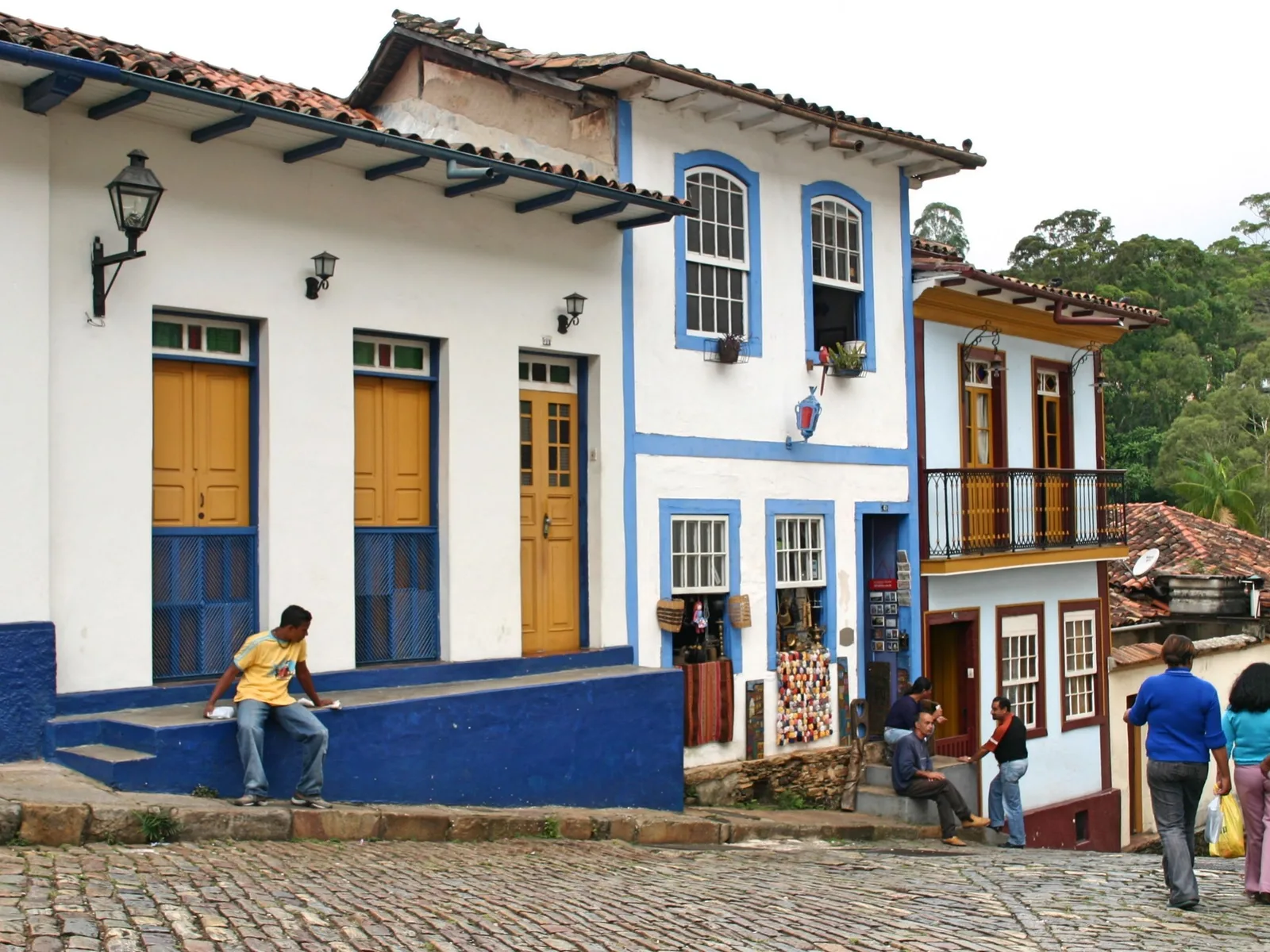
    A steep cobbled street in Ouro Preto’s historic center lined with white colonial houses trimmed in blue, people sitting on the steps and walking uphill past shopfronts in strong midday sun

    Praça Tiradentes & Largo de Coimbra

    The upper town, on foot

    Start high at Praça Tiradentes, do the Museu da Inconfidência while your legs are fresh, then drop down to São Francisco de Assis and the soapstone market. Lunch on Rua Direita and stay out for the evening.

  2. 02
    The entrance to the Mina do Chico Rei in Ouro Preto: a low dark tunnel mouth in a stone-faced wall overgrown with tropical plants, with the mine’s name spelled out in white letters on the rock above it

    Pilar, Casa dos Contos & Alto da Cruz

    Where the gold came from

    The gilded nave at Pilar and the treasury house at Casa dos Contos in the morning, then up the hill to Santa Efigênia and down the shaft at the Mina do Chico Rei. The Escola de Minas collection if it rains.

  3. 03
    A cobbled street of white colonial houses in Mariana climbing gently toward the twin towers of the Basílica de São Pedro dos Clérigos on the hill above, cars parked along one side

    Minas da Passagem & Mariana

    Mariana, and a mine on the way

    Break the 12 km at Minas da Passagem for the trolley ride down to the underground lake, then Praça Minas Gerais and the cathedral. Time it for a second or fourth Saturday and you get the 1701 organ.

  4. 04
    Two of Aleijadinho’s soapstone prophets standing on the terrace wall at Congonhas against a deep blue sky, visitors sitting and taking photographs on the low wall between them

    Congonhas

    Out to the prophets

    An hour and a quarter each way to the Santuário do Bom Jesus de Matosinhos for the six Passos chapels and Aleijadinho’s twelve prophets, and back by mid-afternoon. Swap it for Lavras Novas if you would rather walk.

This is a starting shape, not a fixed departure — we rearrange it around your dates. Have it built for you

Timing

Twenty times more rain in December than in July.

Ouro Preto sits at 1,179 meters and its calendar is built around rain rather than heat — the temperature barely moves across the year, but the rainfall moves by a factor of twenty. May to August is dry, clear, cold at night and the reason to come; November to February is hot, humid and soaked, with storms most afternoons. The two biggest events on the calendar, Carnival and Holy Week, both fall outside the good weather, which is the trade this page keeps coming back to.

How good each month is in Ouro Preto. Choose a month for its average air temperature, rainfall and what the town is like then.

January

Trade-offs
Air
16–26°C 61–79°F
UV
9 Very high
Rain
14 days 283 mm / 11.1 in

Hot, humid and among the wettest months, with storms most afternoons. The Congado festival at Santa Efigênia is in the first half.

February

Trade-offs
Air
16–26°C 61–79°F
UV
11 Extreme
Rain
12 days 208 mm / 8.2 in

Still hot and wet, and usually Carnival — six days that turn a small town into a very large party.

March

Good
Air
14–25°C 57–77°F
UV
10 Very high
Rain
13 days 175 mm / 6.9 in

The rain easing off and the summer crowds gone. Holy Week lands here in some years, and it is the reason to pick the month.

April

Good
Air
13–24°C 55–75°F
UV
7 High
Rain
7 days 82 mm / 3.2 in

The dry season starts. Rainfall drops by more than half, the light turns clear, and Easter often falls in it.

May

Good
Air
11–23°C 52–73°F
UV
6 High
Rain
3 days 29 mm / 1.1 in

Dry, mild and quiet. Three wet days in the whole month, and the hills still green from summer.

June

Good
Air
9–22°C 48–72°F
UV
6 High
Rain
2 days 17 mm / 0.7 in

Cold at night — single figures, and occasionally close to frost in the hills. Bright days and Festa Junina in the villages.

July

Best
Air
8–21°C 46–70°F
UV
6 High
Rain
1 day 15 mm / 0.6 in

The driest and coldest month of the year, and the best one. The town’s birthday on the 8th and the winter festival through the month.

August

Good
Air
10–23°C 50–73°F
UV
7 High
Rain
1 day 24 mm / 0.9 in

Dry, warming and reliably clear. The strongest month for walking the Estrada Real and the Itacolomi trails.

September

Good
Air
12–24°C 54–75°F
UV
9 Very high
Rain
5 days 57 mm / 2.2 in

Warm days, cool nights, and the rain beginning to creep back. Still one of the better months and still uncrowded.

October

Good
Air
14–24°C 57–75°F
UV
9 Very high
Rain
10 days 115 mm / 4.5 in

Rain clearly returning and the humidity with it, but a workable month with the hills at their greenest.

November

Trade-offs
Air
15–25°C 59–77°F
UV
9 Very high
Rain
14 days 223 mm / 8.8 in

Hot, humid and properly wet. Afternoon storms are the pattern rather than the exception.

December

Trade-offs
Air
15–25°C 59–77°F
UV
8 Very high
Rain
17 days 324 mm / 12.8 in

The wettest month of the year, at more than twenty times July. Quiet until about the 20th, then the holidays fill the town.

  • Best The one or two peak months
  • Good A real recommendation
  • Trade-offs Workable, with a catch
See Ouro Preto on the Brazil calendar

UV is the monthly average of the daily peak, 2022 to 2025, calculated from Copernicus Atmosphere Monitoring Service data. Weather data by Open-Meteo.com, CC BY 4.0.

For the town at its best

May–August

Dry, bright and cool. Fifteen to thirty millimeters of rain a month, clear light on the stone, and nights cold enough to want a jacket. July is the peak inside it, the driest month of the year at 15 mm, and it adds the winter festival.

For Holy Week

March or April

The sawdust carpets and the processions are the biggest thing that happens here all year. It falls in the wet tail of summer, and rooms cost several times normal.

The wet months

November–February

December averages 324 mm across seventeen wet days and January 283 mm. Warm, green and often spectacular between storms — and the cobbles are lethal when they are wet.

About the rain

The single most useful thing to know about Ouro Preto’s weather is the size of the swing. July averages 15 mm of rain across one wet day; December averages 324 mm across seventeen. That is not a wet season and a dry season in the usual sense — it is a monsoon that stops. Total annual rainfall is around 1,552 mm and roughly two-thirds of it falls between November and February.

Temperature barely participates. Every month of the year runs to a daytime high between 21 and 26 degrees, so the difference between January and July is not warmth, it is whether you are looking at the town or at the inside of a cloud. What does change is the night: winter minimums drop to eight or nine degrees and the hills above town occasionally see frost, and almost nothing here is heated. Bring layers for June and July, and be ready to peel them off by 11:00am.

The practical consequence for a visitor is footing. These streets are steep irregular cobble, they were laid for mules, and after a summer downpour they are slick. Plan the church-and-museum days for the afternoons in the wet months, keep the walking for the mornings, and wear something with a sole.

The dates worth planning around

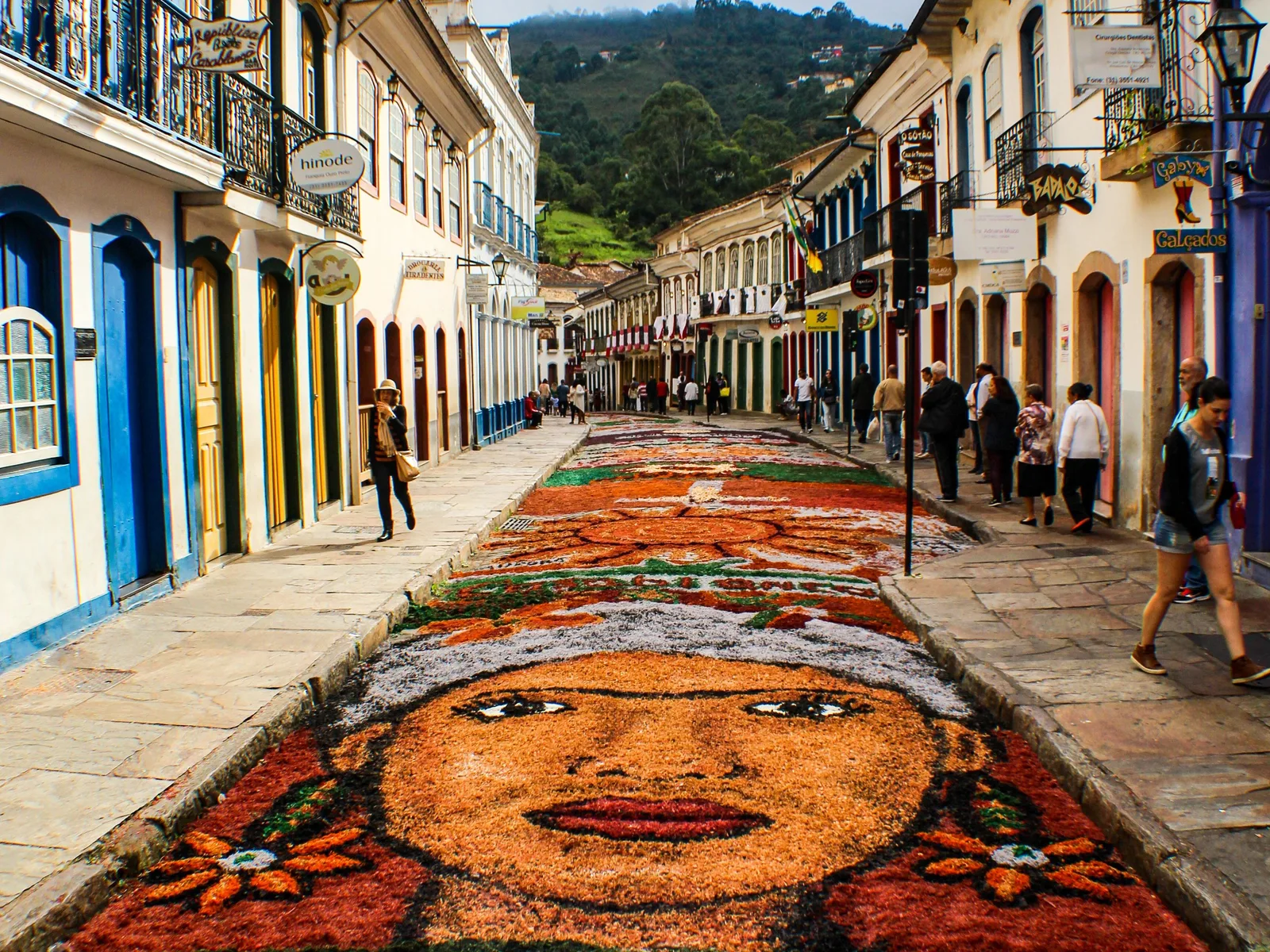
A devotional carpet laid down the middle of a cobbled Ouro Preto street for Holy Week, the face of Christ picked out in orange, red and green dyed sawdust, with people walking along the pavements either side between colonial houses

Semana Santa

Holy Week, moving with Easter — March 21–28 in 2027

The biggest thing that happens in Ouro Preto, and the tradition it is known for nationally. Through the night before Easter Sunday, thousands of people kneel in the streets laying devotional carpets — tapetes — out of dyed sawdust, coffee grounds, eggshell and flowers, in designs that run the full length of a street and are walked over and destroyed by the Resurrection procession the next morning. The custom goes back to the 1730s here. Holy Thursday brings the Procissão do Fogaréu, a torchlit procession of figures dressed as Roman soldiers hunting Christ through the dark. Rooms are booked months out and cost several times the normal rate.

A Carnival crowd in costume filling a cobbled Ouro Preto street under strings of bunting, colonial houses on both sides and a green hillside of houses rising behind them

Carnaval

Six days in February, moving with Easter

The largest university Carnival in Brazil, and structurally unlike anything on the coast. There is no sambadrome and no ticketed parade: what there is is around sixty street blocos winding through the historic center by day — some of them, like the Bloco do Caixão, with decades of history behind them — and the student repúblicas throwing ticketed open-bar parties in their colonial houses by night. The town roughly triples in population, the cobbles are wet more often than not, and it is very much a young person’s festival. Book a room in the autumn or accept staying in Mariana.

The wooden auditorium of the Casa da Ópera in Ouro Preto seen from an upper box, rows of chairs on the raked floor below and curved balconies with iron railings running around three sides

Festival de Inverno de Ouro Preto

Through July, with the university program from late July

Running since 1967 and one of the oldest arts festivals in Brazil: several weeks of concerts, theater, dance, workshops and debates spread across the town’s theaters, churches and squares, and shared with Mariana. Most of it is free. It sits inside the driest, clearest, coldest month of the year and overlaps the town’s own birthday on July 8, which brings big open-air concerts of its own. If you want Ouro Preto at its best and at its busiest with Brazilians rather than tourists, this is the window.

Good to know

Before you come

How many days do I need in Ouro Preto? +

Four, which is why the itinerary above is built that way: two days for Ouro Preto itself, one for Mariana, one for Congonhas. Three is the common compromise and it works — you keep the town and Mariana and lose Congonhas, which is the biggest single loss available, because Aleijadinho’s twelve prophets are arguably the best thing in the region. Two days covers the historic center and nothing else, and that is still worth doing if it is all you have. Five lets you add Lavras Novas or the Itacolomi trails and slow down, which a town this steep rewards.

Is Ouro Preto safe? +

Yes, by Brazilian standards and by most others. It is a university town of 74,800 people where the historic center is busy and policed through the day, and street robbery of the kind that shapes advice for Rio or Salvador is not a routine feature of a visit here. The ordinary precautions still apply after dark — stay on the lit streets around Praça Tiradentes, take a taxi back up the hill rather than an unlit shortcut, and treat a packed Carnival street as a pickpocket’s workplace. The thing most likely to ruin your trip is not crime, it is the pavement: the cobbles are steep, irregular and slippery when wet, and falls are the injury the local clinics see.

Can I take the tourist train from Ouro Preto to Mariana? +

Not at the moment. The Trem da Vale ran the 18 km between the two towns on an 1888 line, took about an hour, and stopped in August 2020. It has not run since. Vale began restoring Ouro Preto’s station building and the track in February 2026 and Ouro Preto’s mayor has said the company is talking about 2027, but no return date has been confirmed and the railway preservation groups involved are not counting on one. Plan Mariana as a half-hour bus or twenty-minute taxi ride, and treat the train as a bonus if it comes back.

Do I need to visit Congonhas, and how do I get there? +

Not need — but it is the single strongest reason on this page to have a car or a driver for one day. The Santuário do Bom Jesus de Matosinhos is about 65 km southwest of Ouro Preto, an hour and a quarter each way, and holds Aleijadinho’s twelve soapstone prophets and the sixty-six cedar figures in the six Passos chapels. Entry is free and the site itself takes about an hour to see properly, so the day is mostly driving. There is no useful public transport for a day trip; drive, or book one of the excursions the Ouro Preto agencies run, which most of them can arrange at short notice though not every day.

When is the best time to visit Ouro Preto? +

July, inside a dry May-to-August season, and it is not a close call. Those four months are the dry season: fifteen to thirty millimeters of rain a month against 283 in January, clear light on the stone, daytime highs in the low twenties and nights cold enough for a jacket. July is the driest and the best, with the winter arts festival running through it. The months to think twice about are November to February, when it rains hard most afternoons — December averages 324 mm — and the cobbles get dangerous. The exceptions are the two dates worth traveling for: Carnival in February and Holy Week in March or April, both of which are wonderful, expensive, and wet.

Keep going

Where Ouro Preto fits in a bigger trip.

Nobody flies to Brazil for Ouro Preto alone, and nobody should. It is three or four days that pair naturally with Rio, with the other gold towns two hundred kilometers south, or with the colonial coast the gold was carried down to.

Free · 29 pages

Free guide

Beginner's Guide to Brazil

A free 29-page guide to everything a first-time visitor should know before landing: visas, safety, money, getting around, where to go, and what to eat.

We'll email you a link to confirm your address. Click it and the guide opens right away.

See what's inside
Ouro Preto in hazy late light seen across the valley: white colonial houses and red roofs stacked along the slope with a twin-towered baroque church standing among them, and layered blue mountains filling the background

Skip the planning

See the gold towns properly, without losing a day to the logistics.

Tell us your dates and whether you are coming for the art, the history or the walking. We will shape a private Minas itinerary around it — the right base for how much hill you want to climb, a licensed guide who can actually read the churches for you, Congonhas and Mariana placed on the days that work, and Holy Week or Carnival rooms held before they disappear.

  • One person, living in Brazil, replying to you directly
  • A reply within one business day — no call center, no bots
  • No cost to plan, and no obligation to book
  • Built around your dates, not a fixed departure