
Skip to content
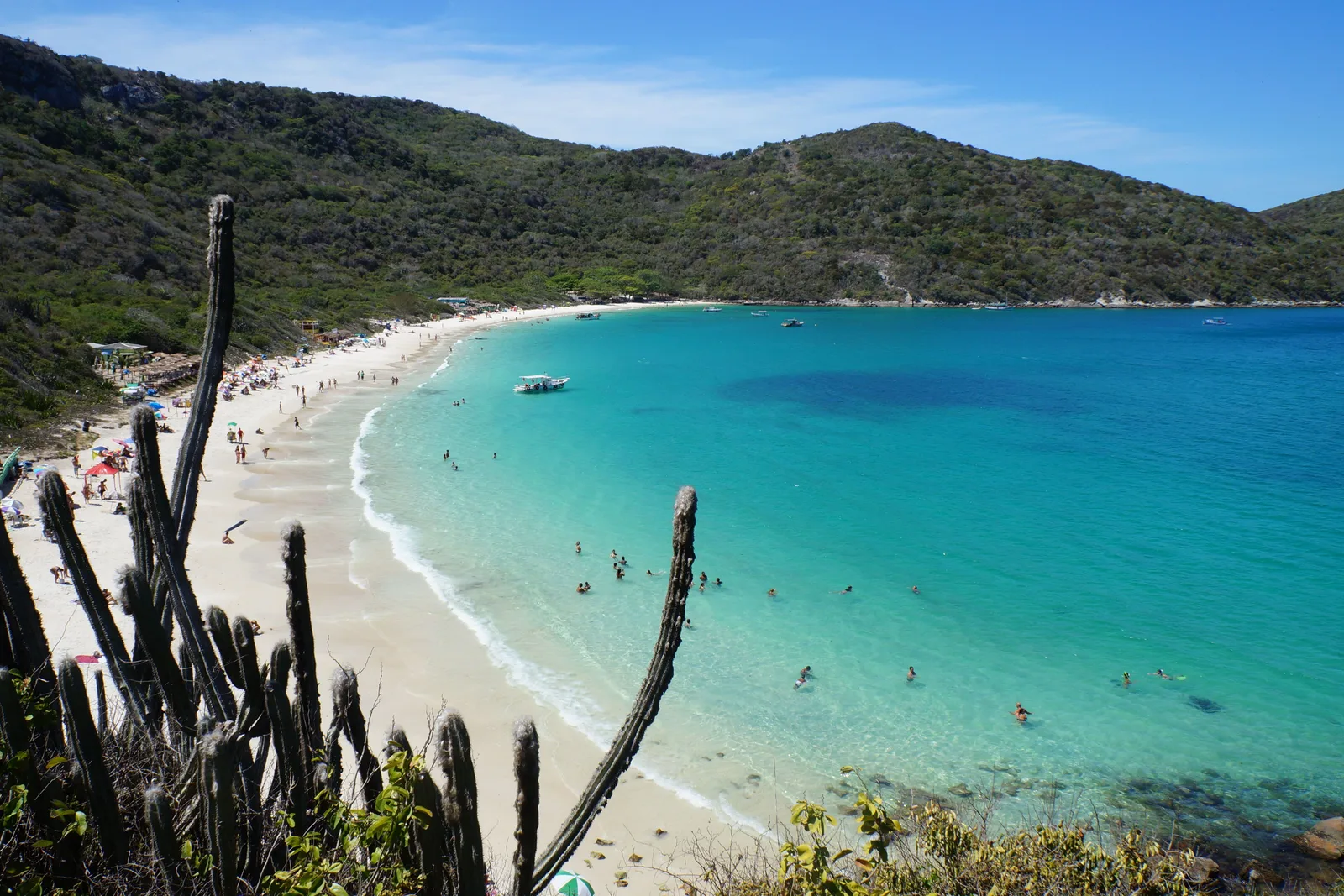
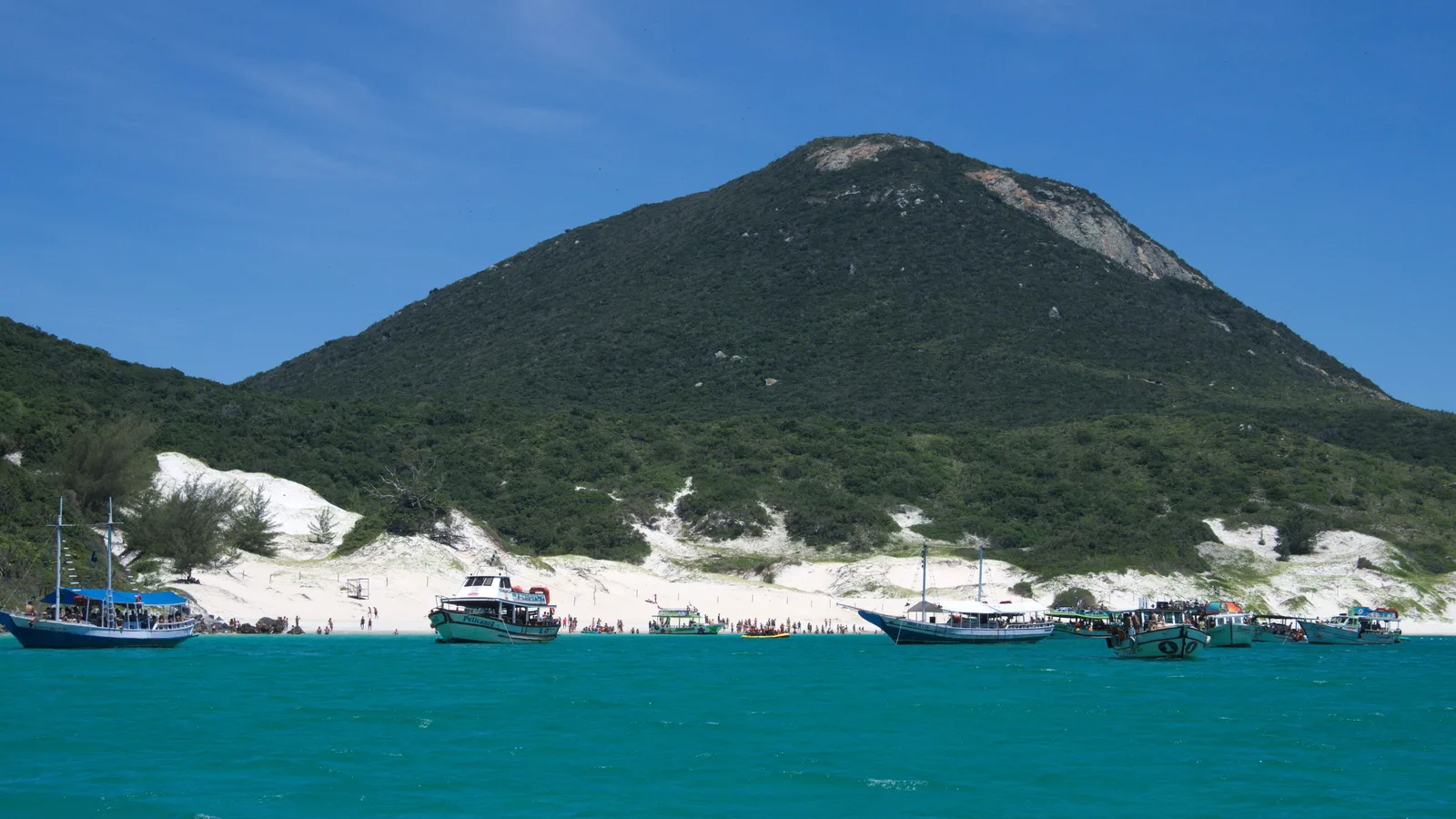
Turquoise water off Praia do Farol at Arraial do Cabo with a line of wooden tour boats anchored close in, a white beach and low white dunes behind them, and the green conical peak of Ilha do Cabo Frio rising above

Rio de Janeiro

Búzios & Arraial do Cabo

Cold, clear water and a town built for dinner.

Last checked September 2026

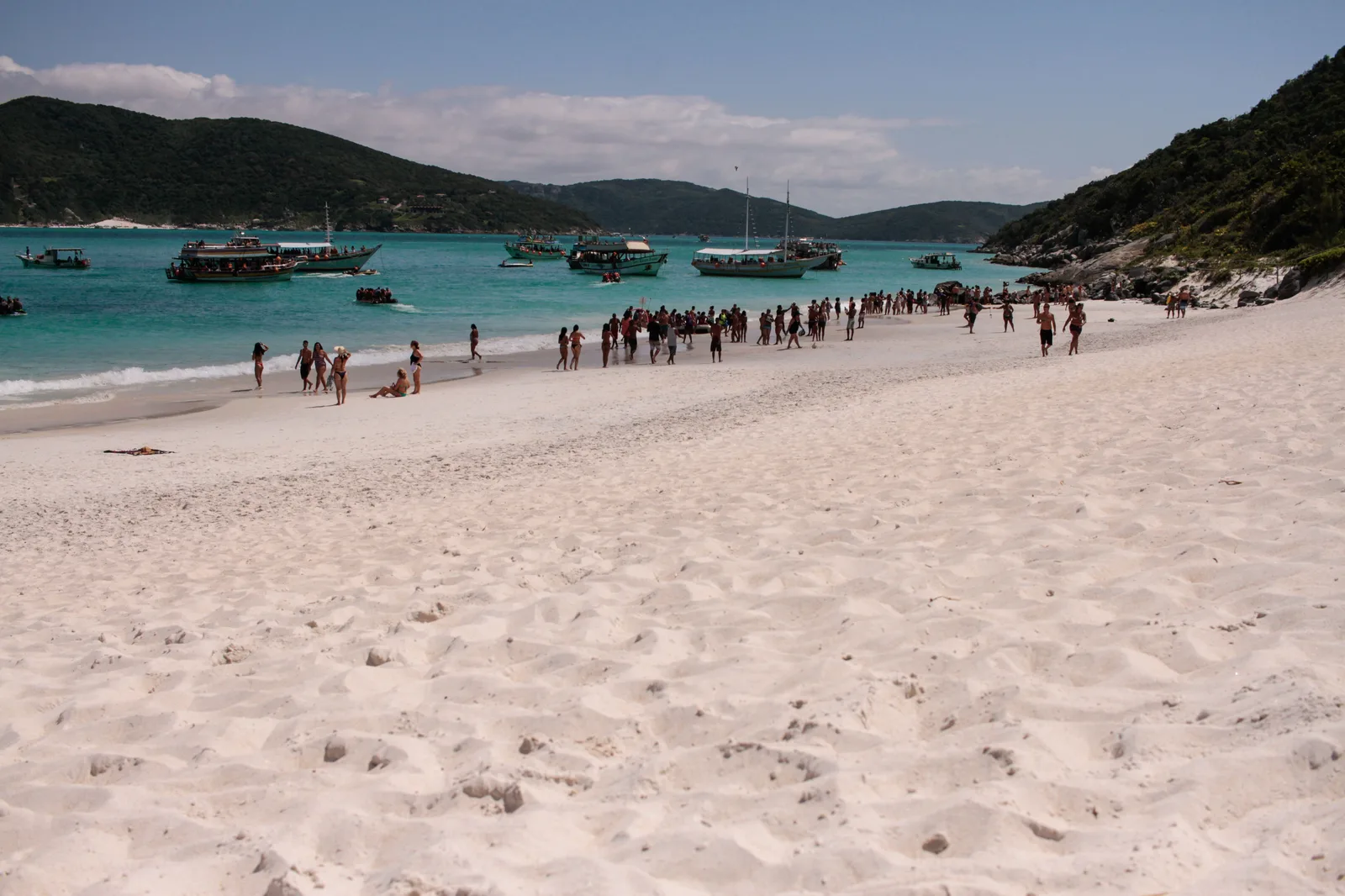
  • A crowd of people at the waterline of Praia do Farol on Ilha do Cabo Frio, with a wide stretch of white sand in the foreground, tour boats anchored in turquoise water offshore and green hills on both sides
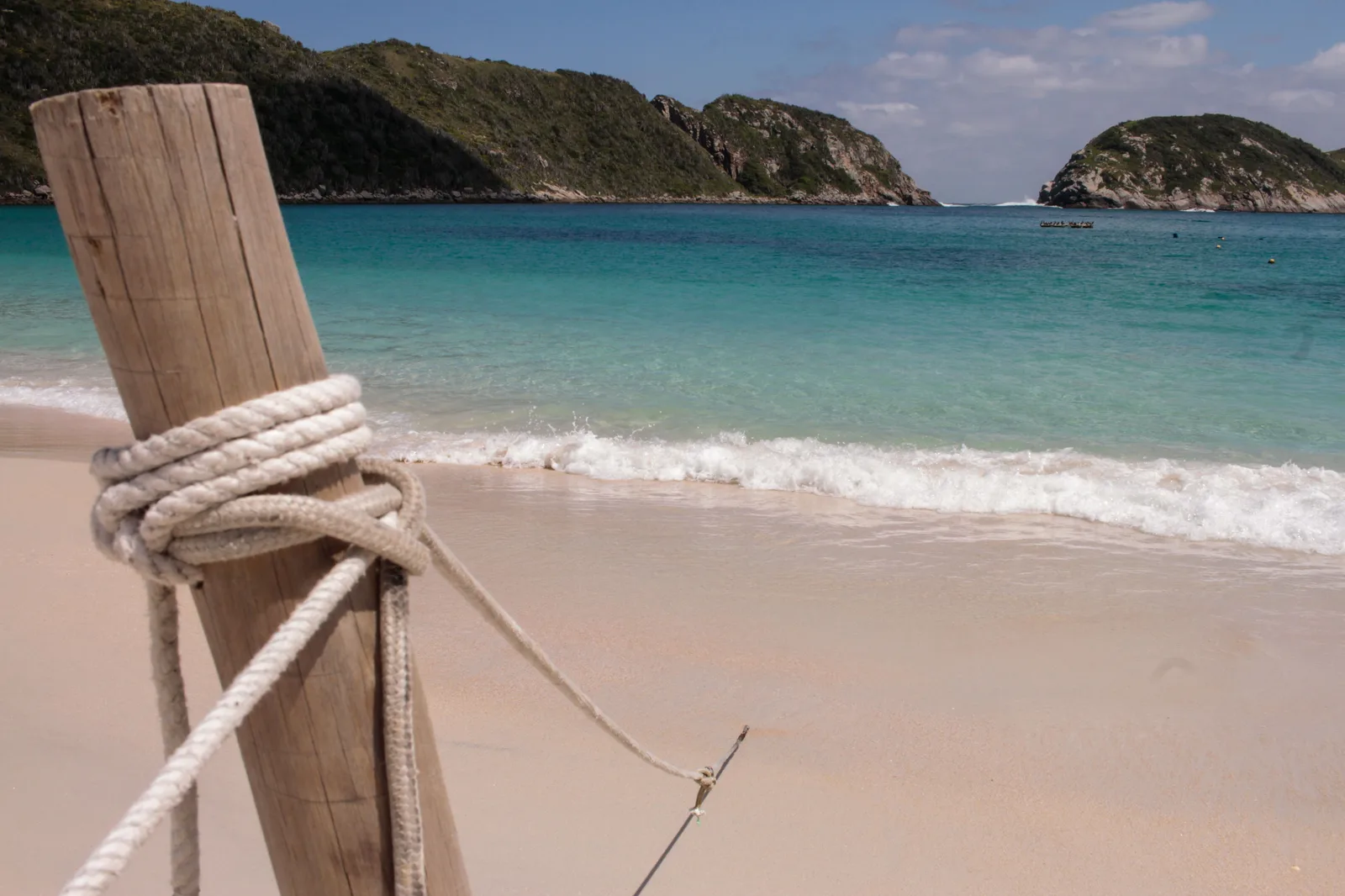
  • A rope knotted around a weathered wooden post on the sand on Ilha do Cabo Frio, with small waves breaking, clear turquoise water, and green rocky headlands and an islet behind it
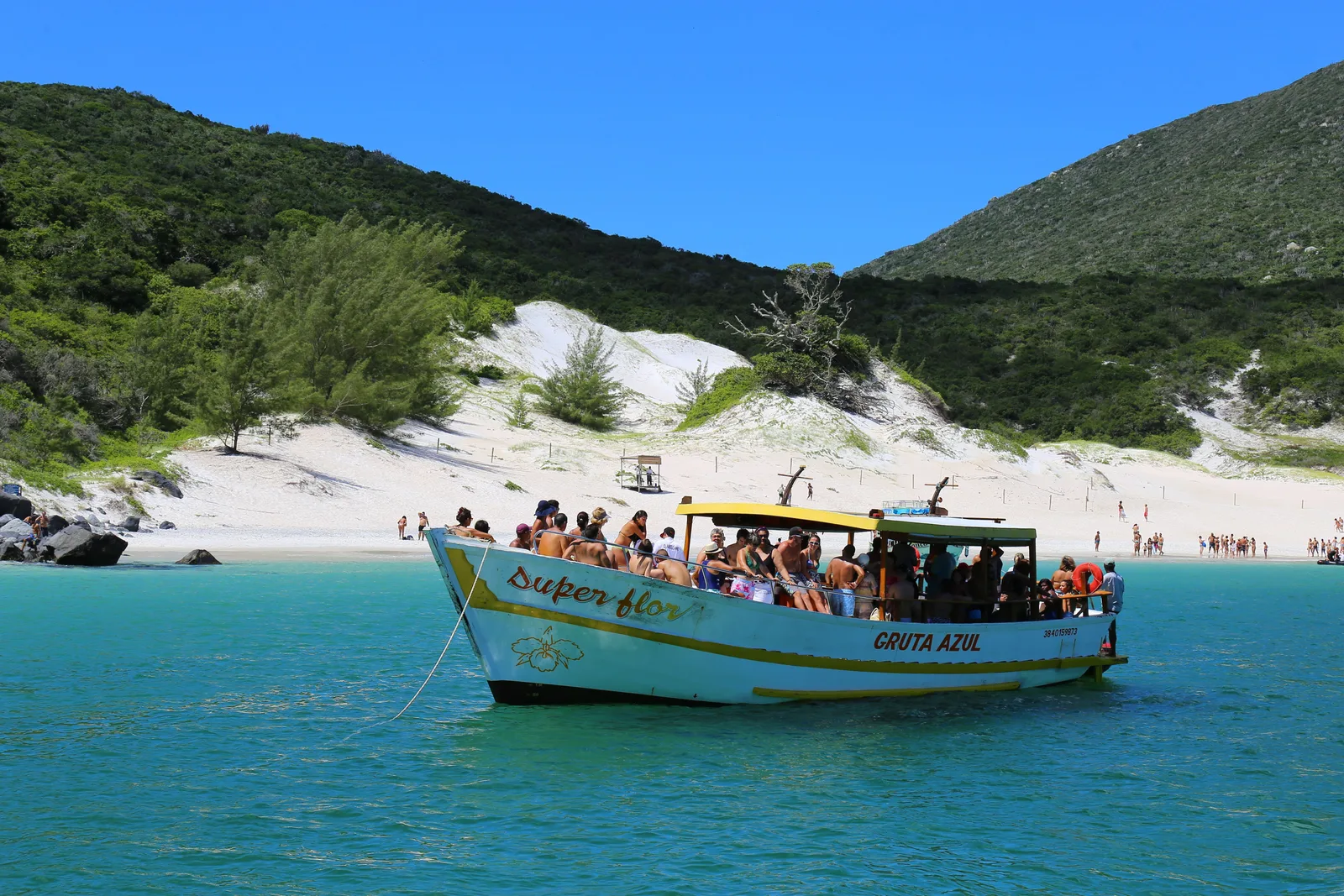
  • A pale blue wooden tour boat with a yellow and green canopy, crowded with passengers, anchored in turquoise water off a white beach at Arraial do Cabo, with pale dunes and a green hill behind
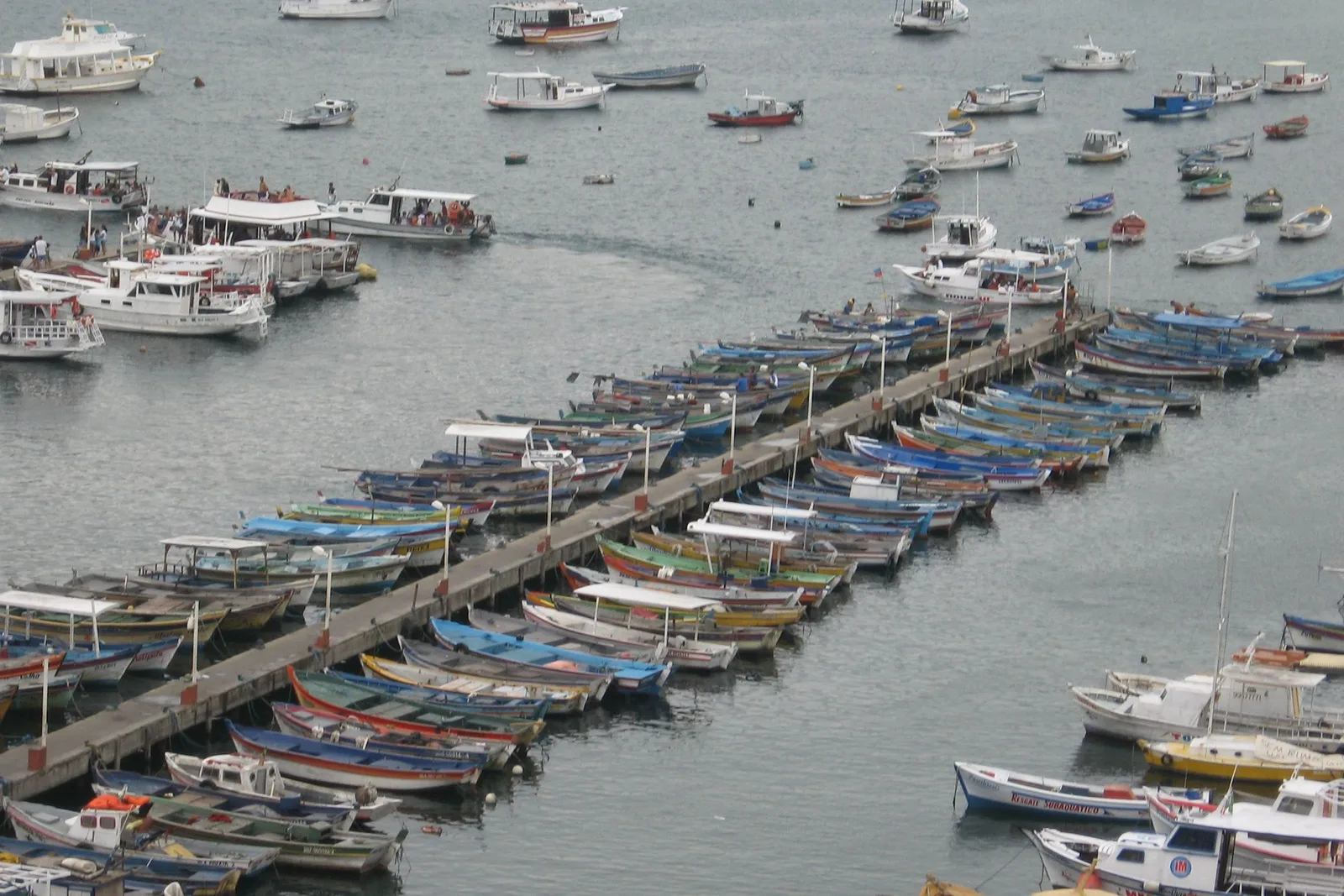
  • A long jetty at Praia dos Anjos in Arraial do Cabo seen from above, with dozens of small painted boats moored in rows along both sides of it and larger tour boats anchored beyond
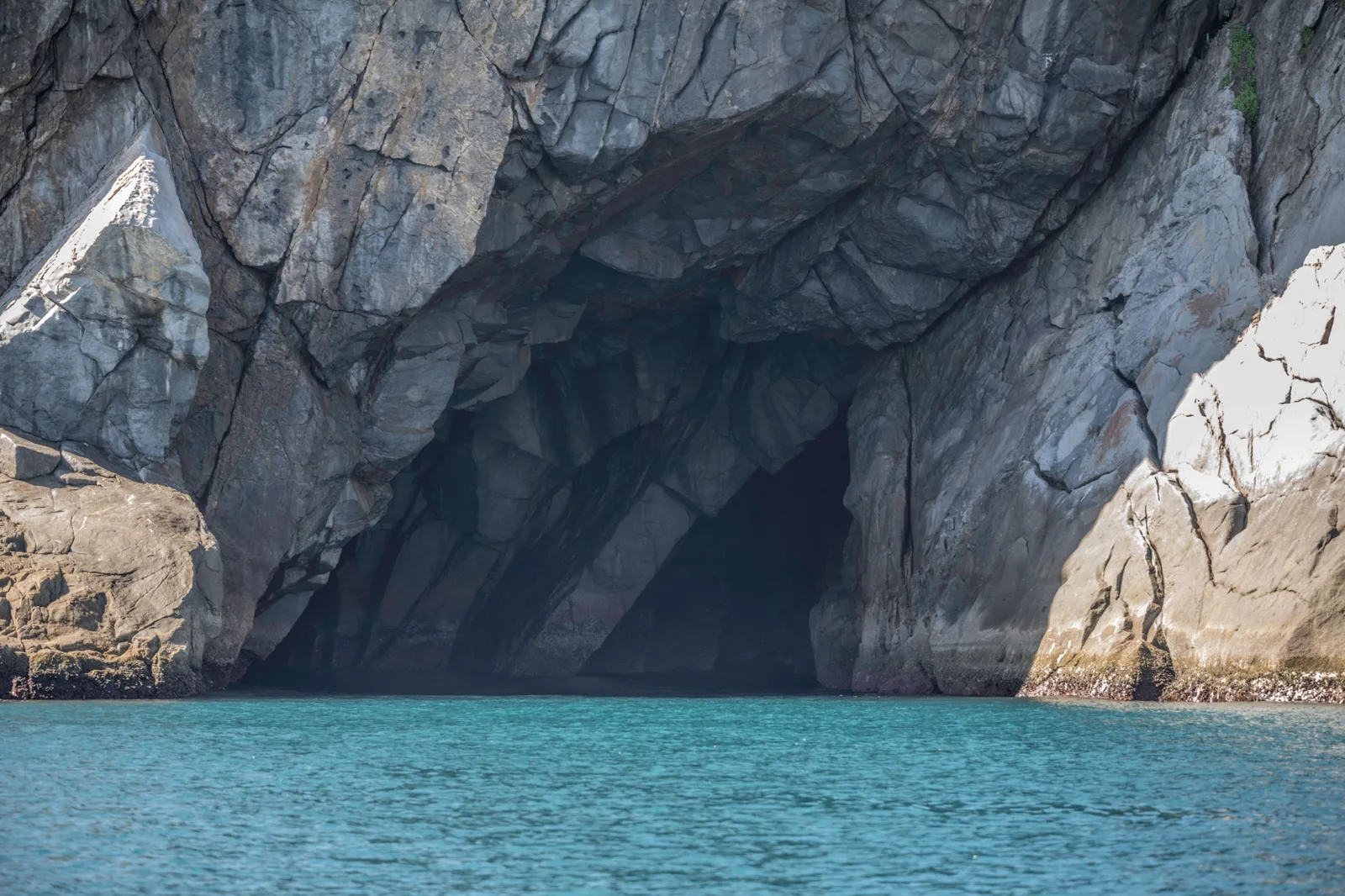
  • The dark mouth of a sea cave in gray angular rock at Arraial do Cabo, with bright turquoise water washing into it
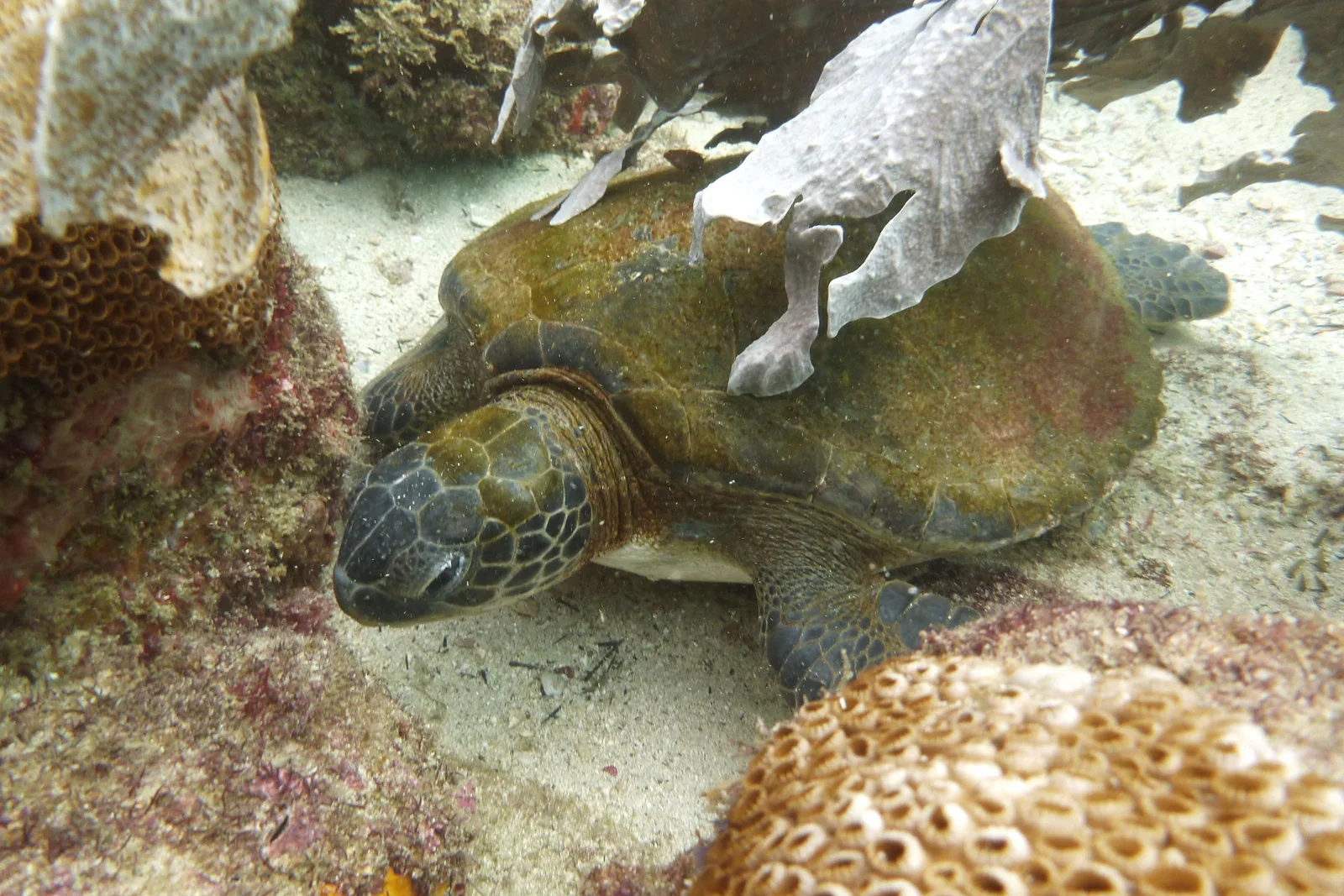
  • A green sea turtle resting on a sandy seabed between coral-crusted rocks, with a strip of pale seaweed lying across its shell, photographed underwater at Arraial do Cabo
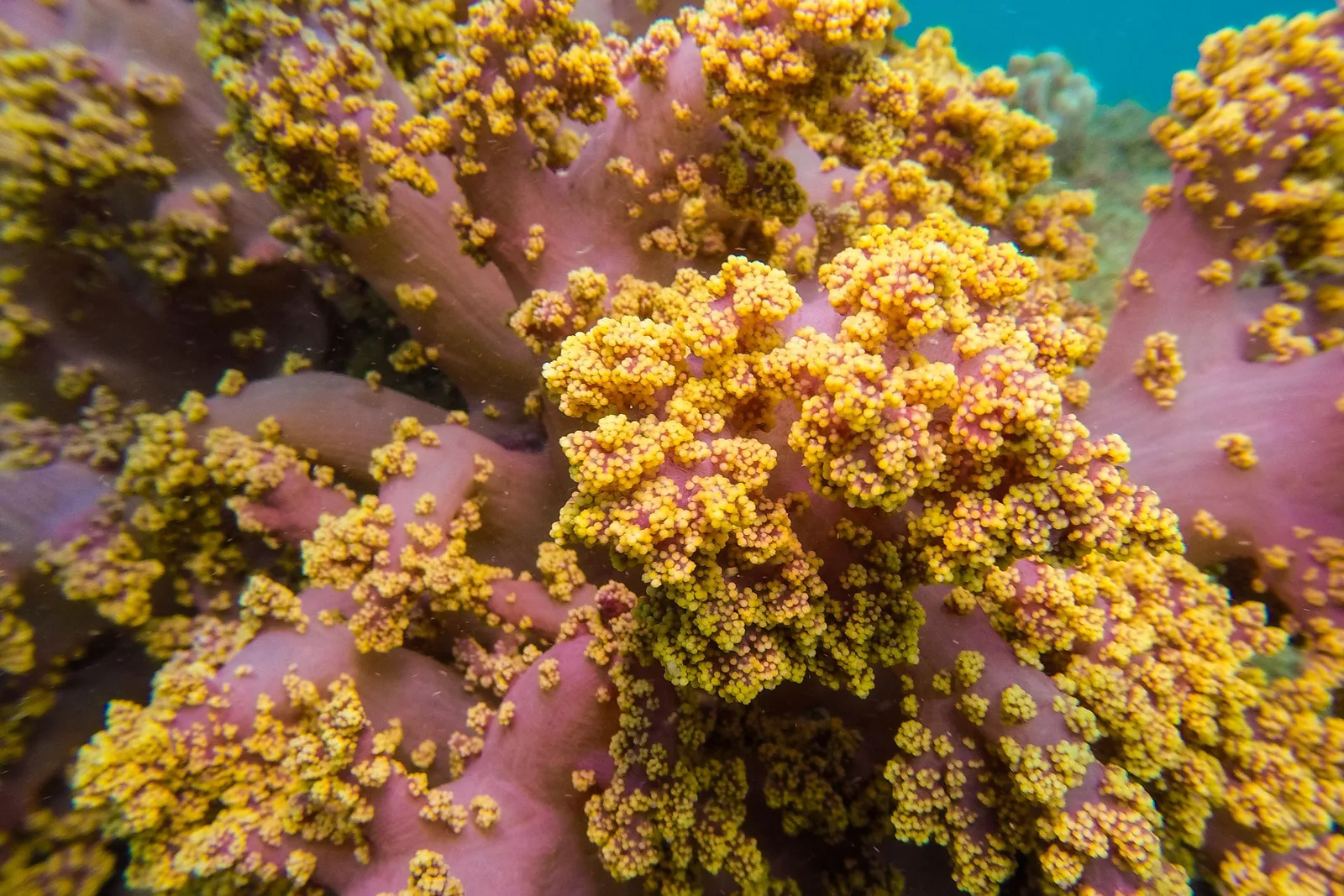
  • A close underwater view of a soft coral at Arraial do Cabo: fleshy pink branches covered in dense clusters of tiny yellow polyps
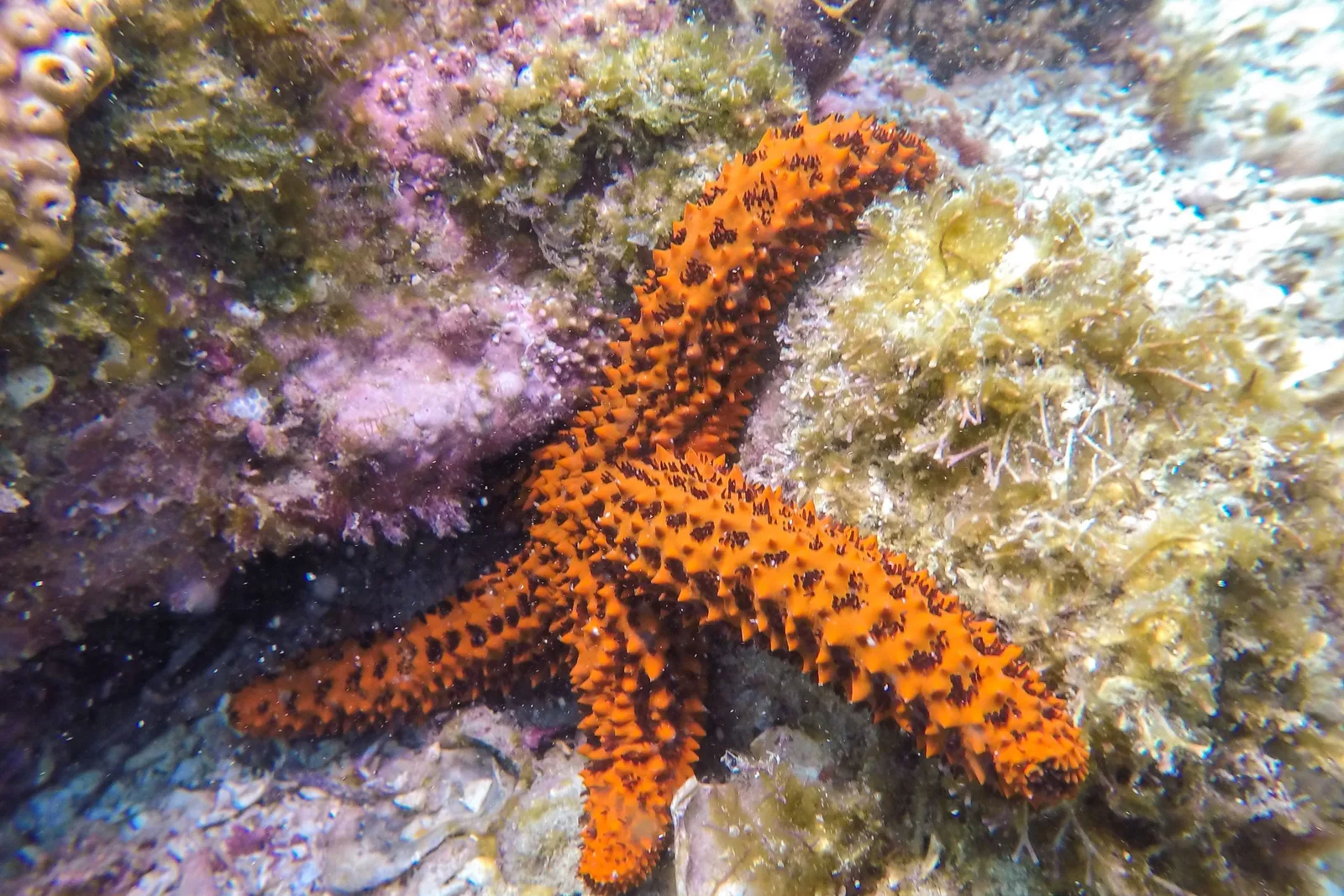
  • A bright orange starfish spread across a rock crusted with pink and green growth, photographed underwater at Arraial do Cabo
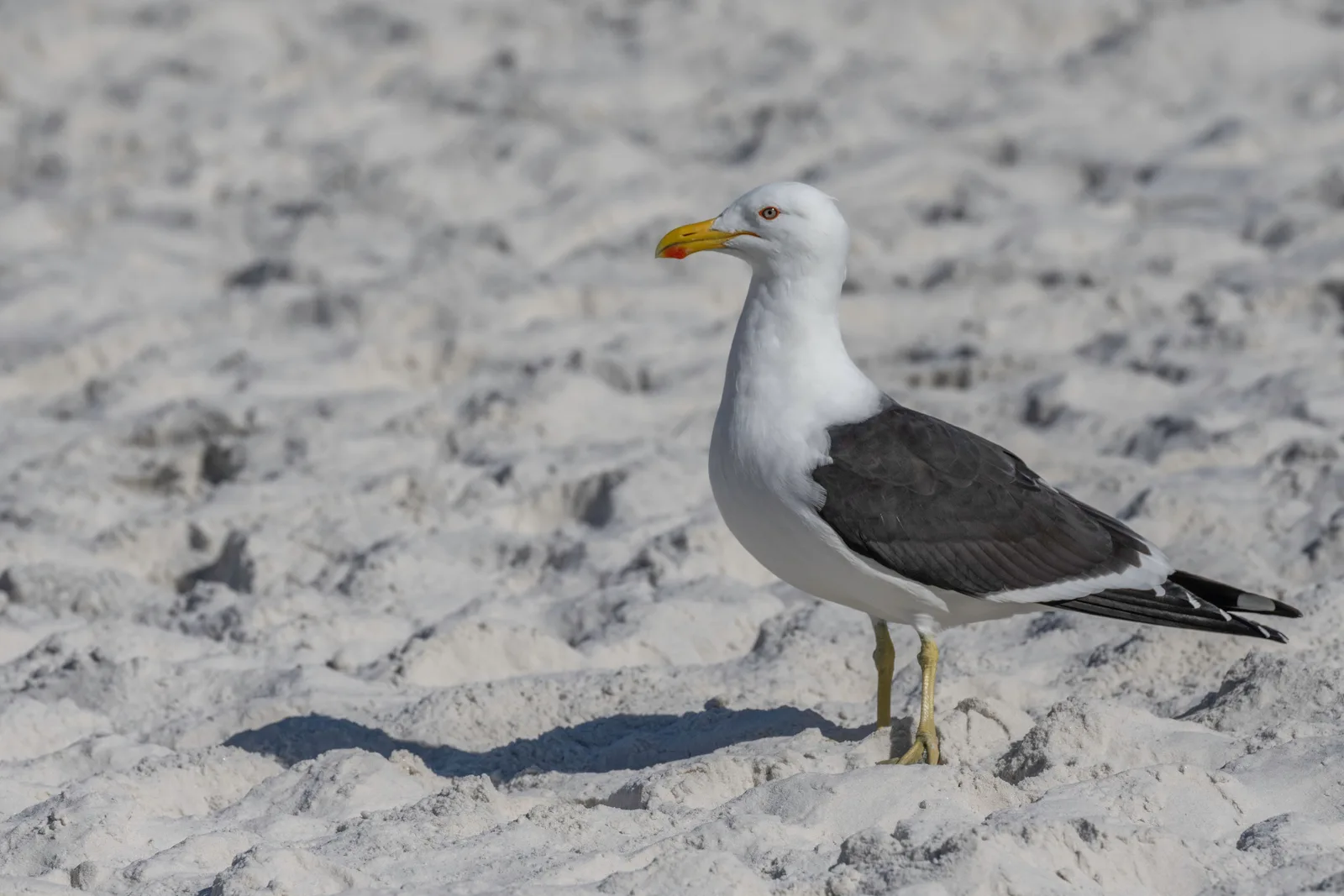
  • A kelp gull with a black back and a yellow bill standing on pale sand, its shadow beside it
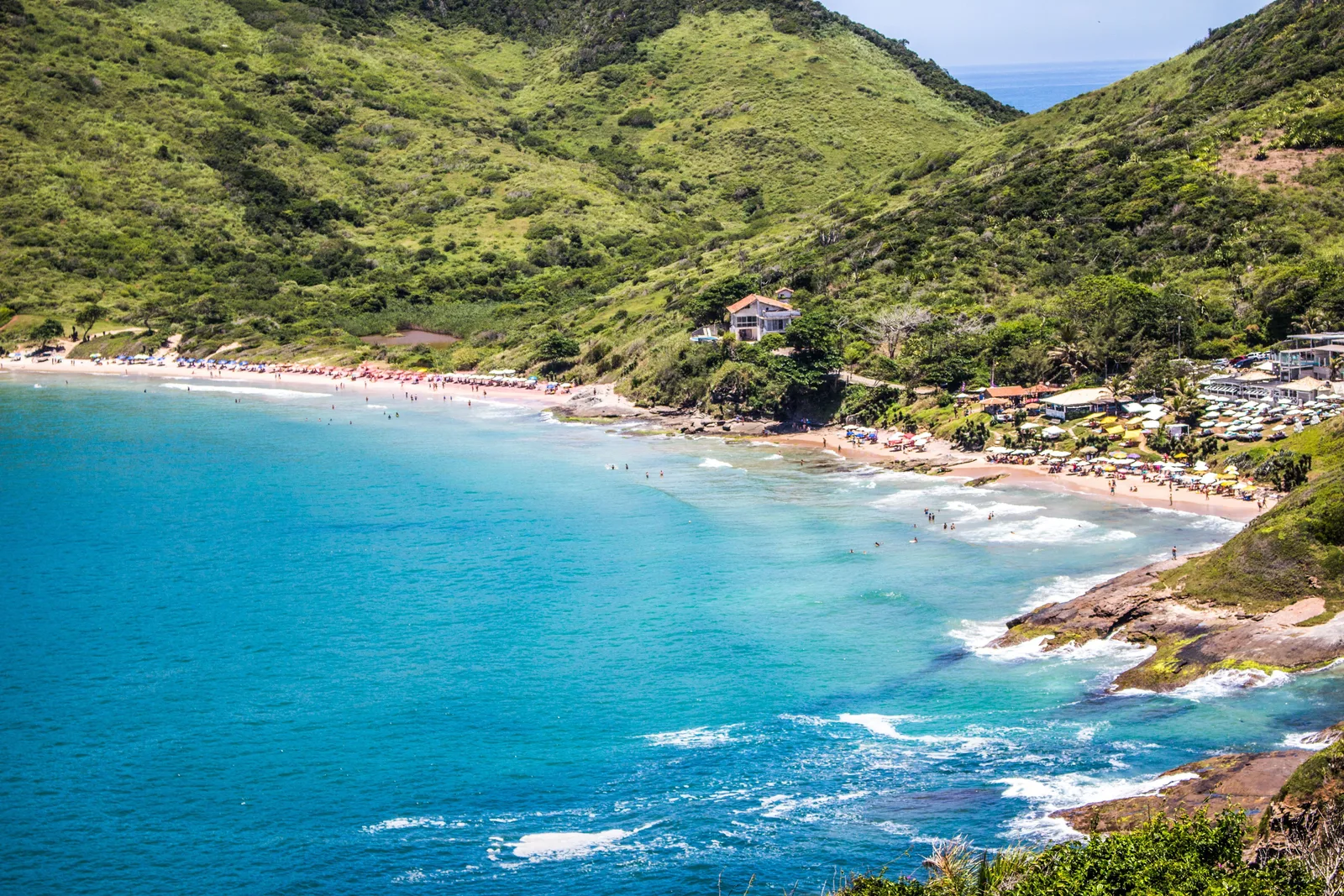
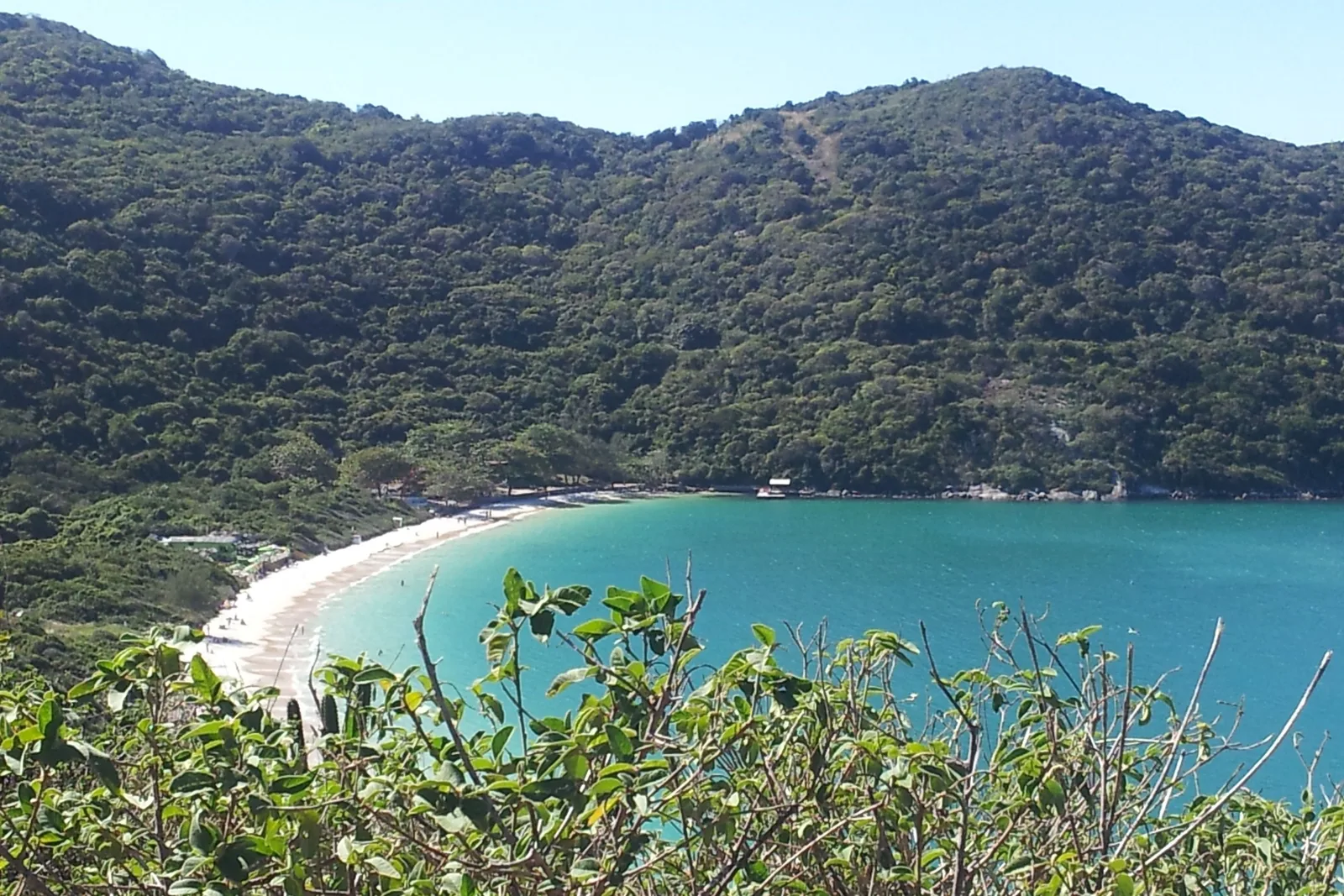
  • A curving white beach along a turquoise bay at Arraial do Cabo, under a steep forested hill, seen from above over leafy shrubs
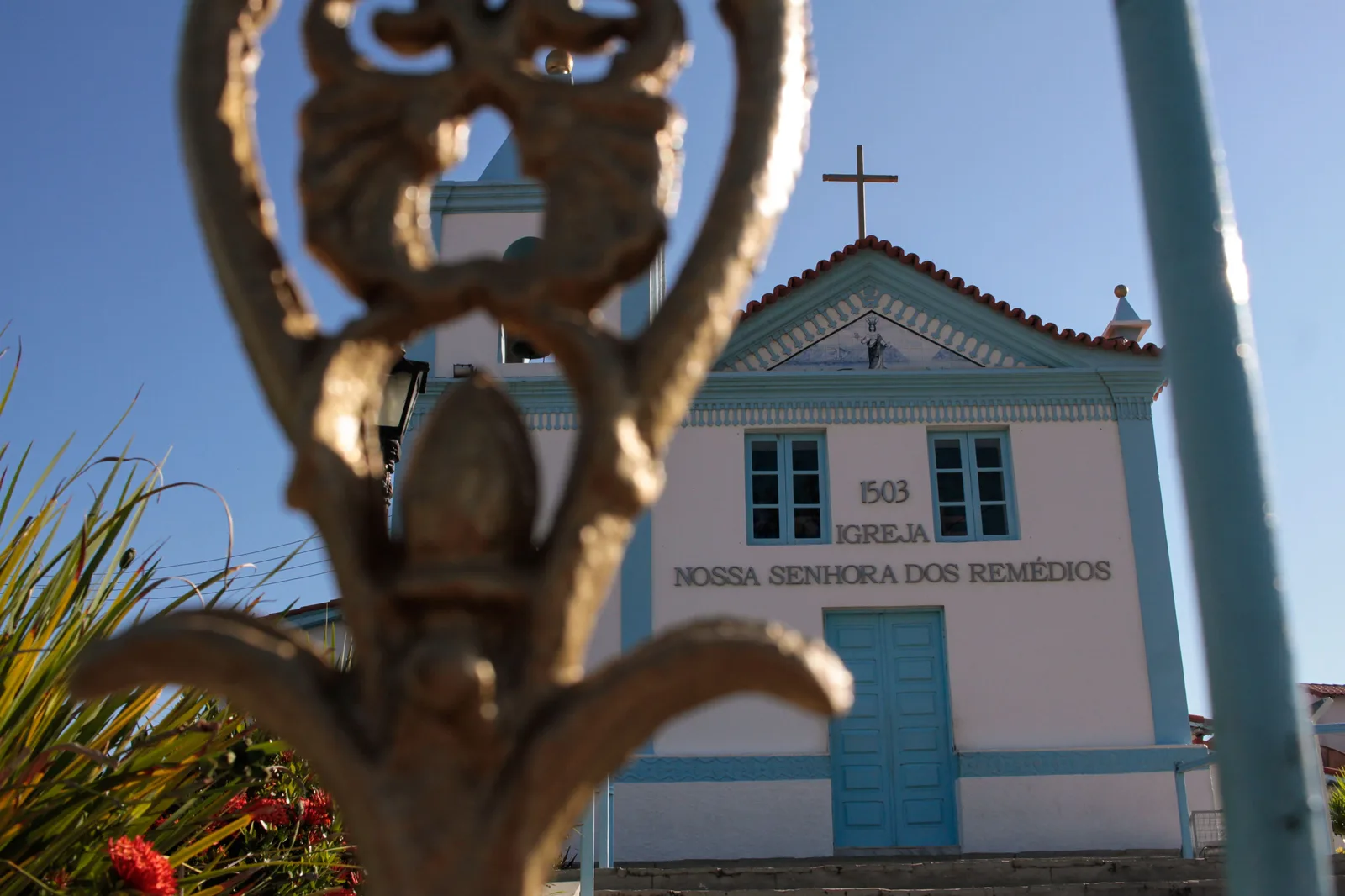
  • The white and blue facade of the Igreja Nossa Senhora dos Remédios in Arraial do Cabo, with 1503 and the church’s name lettered above its blue door, seen past a blurred bronze railing finial in the foreground
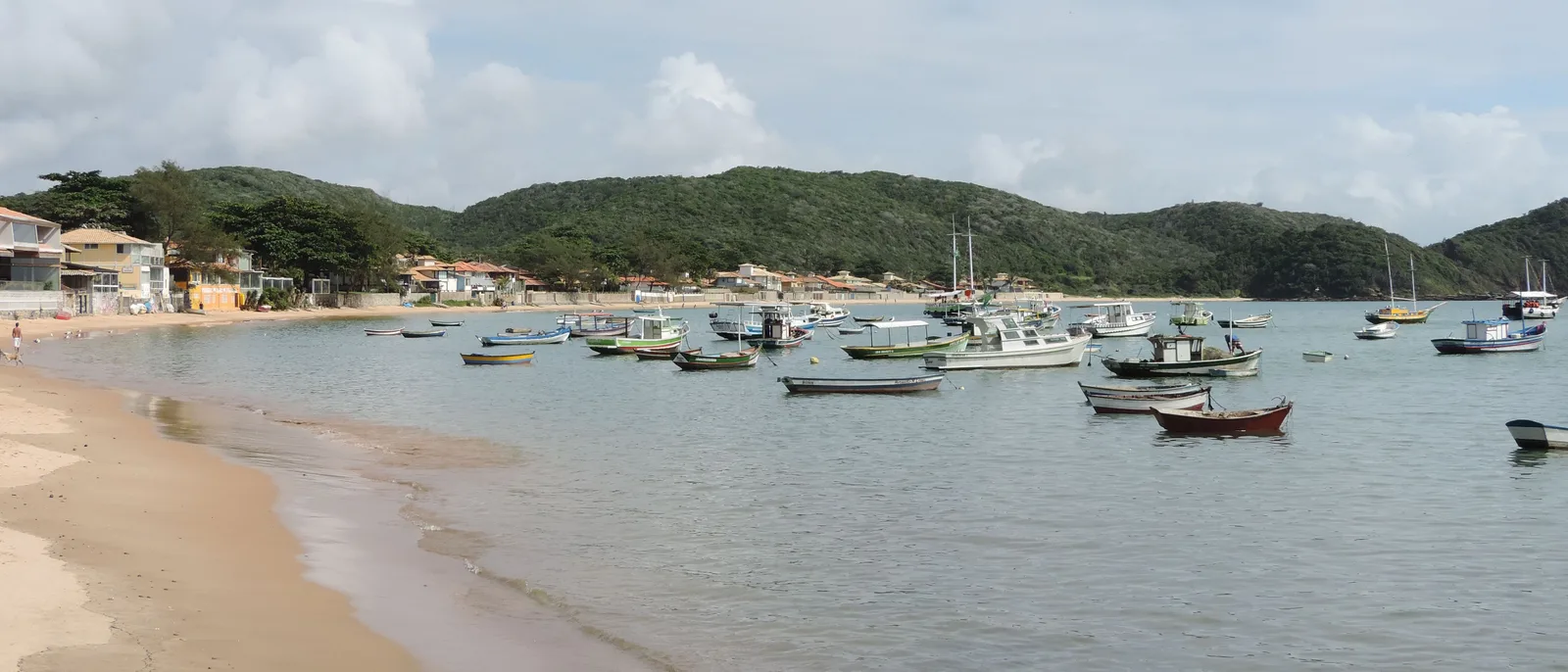
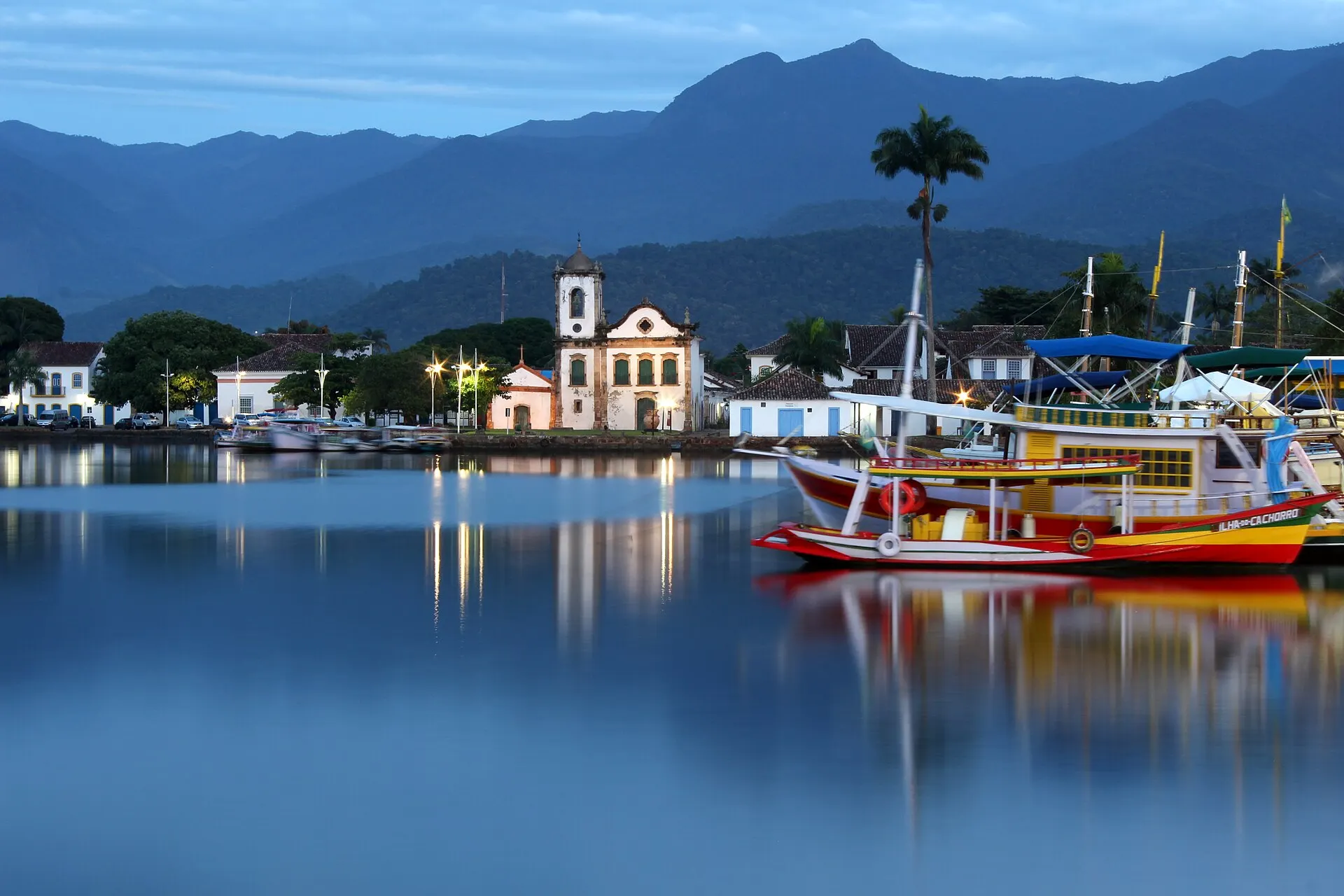
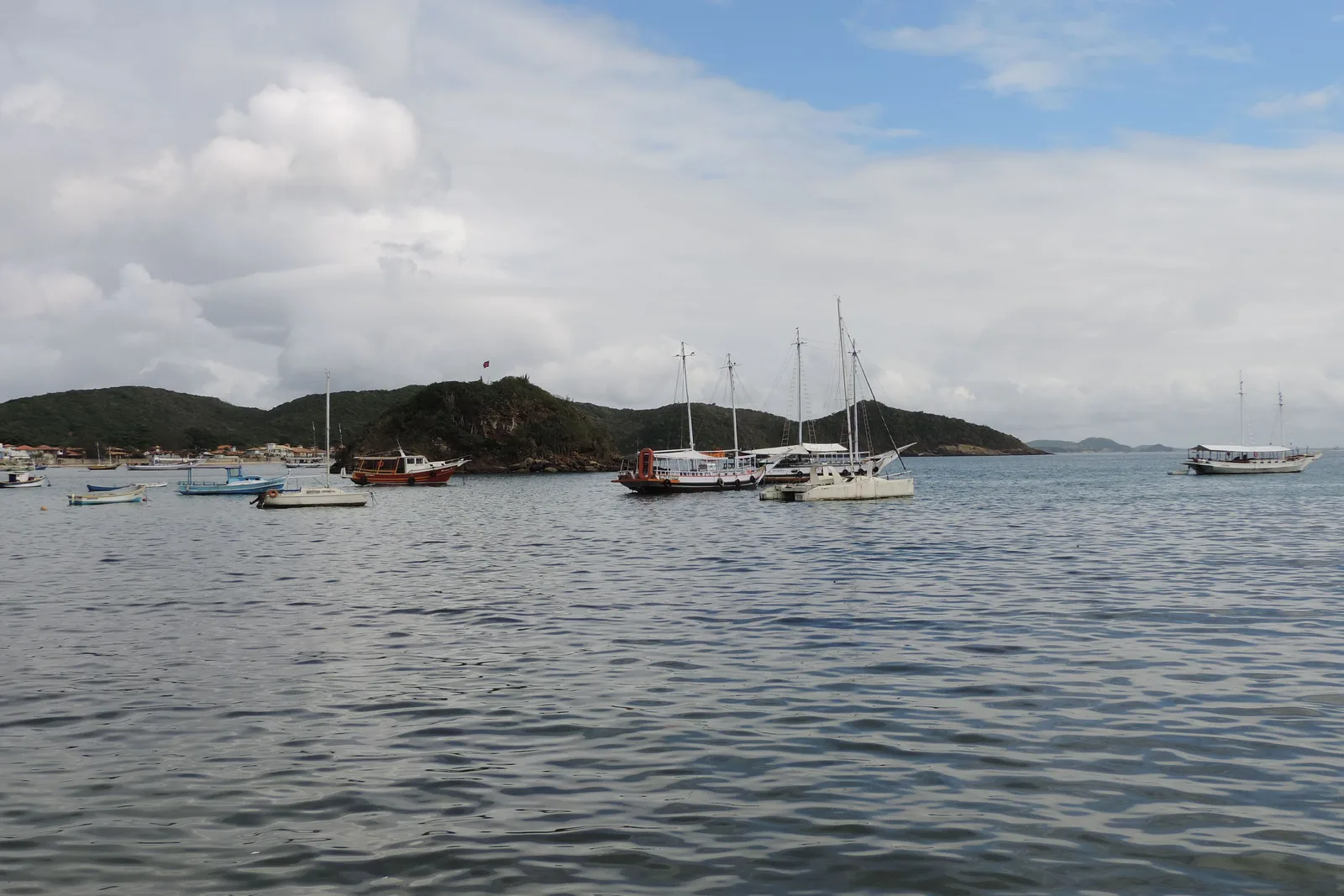
  • Two-masted wooden schooners and small launches at anchor in flat water in the bay at Búzios, with a low green headland behind
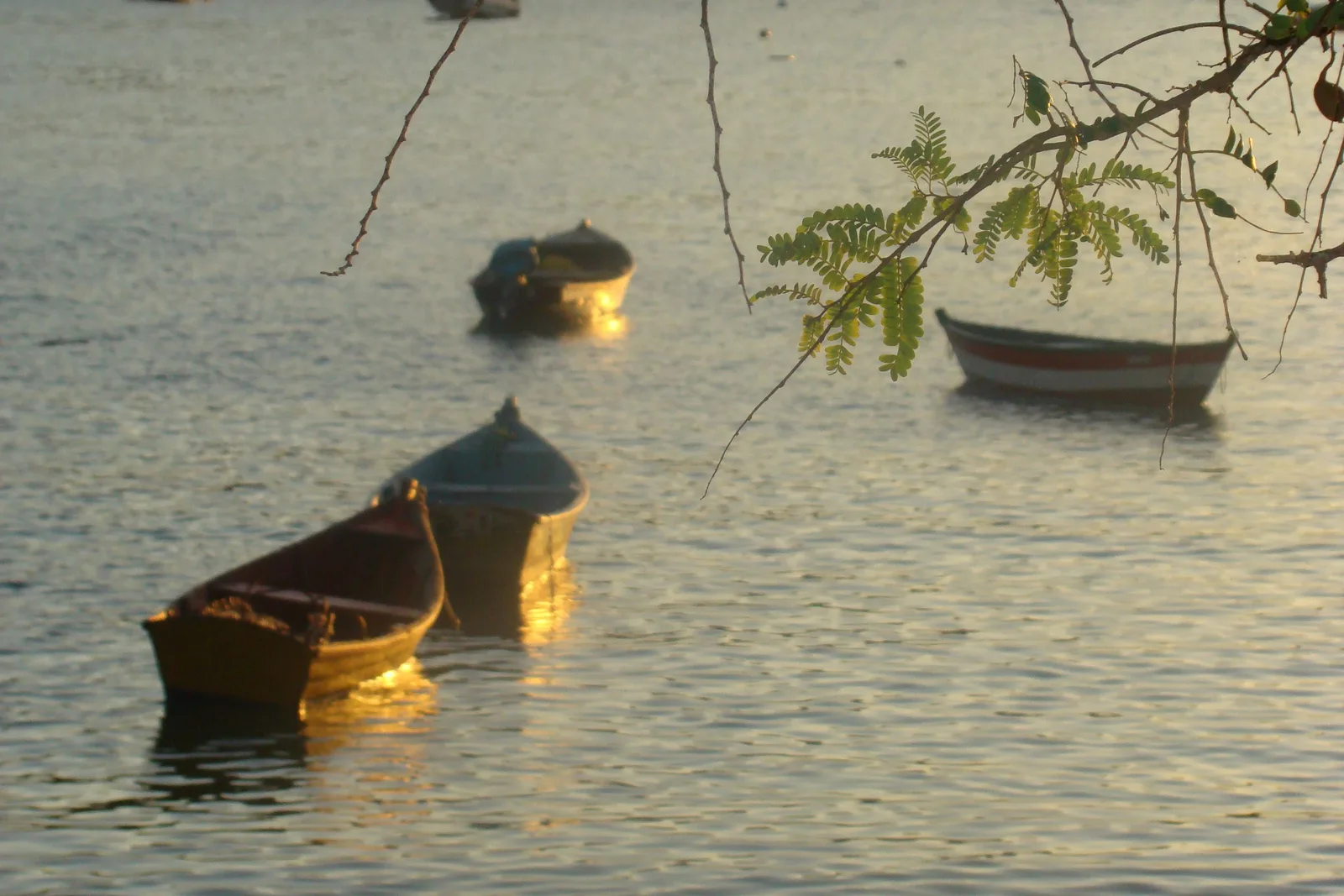
  • Four small wooden rowboats moored on gold-lit water at sunset in Búzios, with a branch of feathery green leaves hanging into the top of the frame
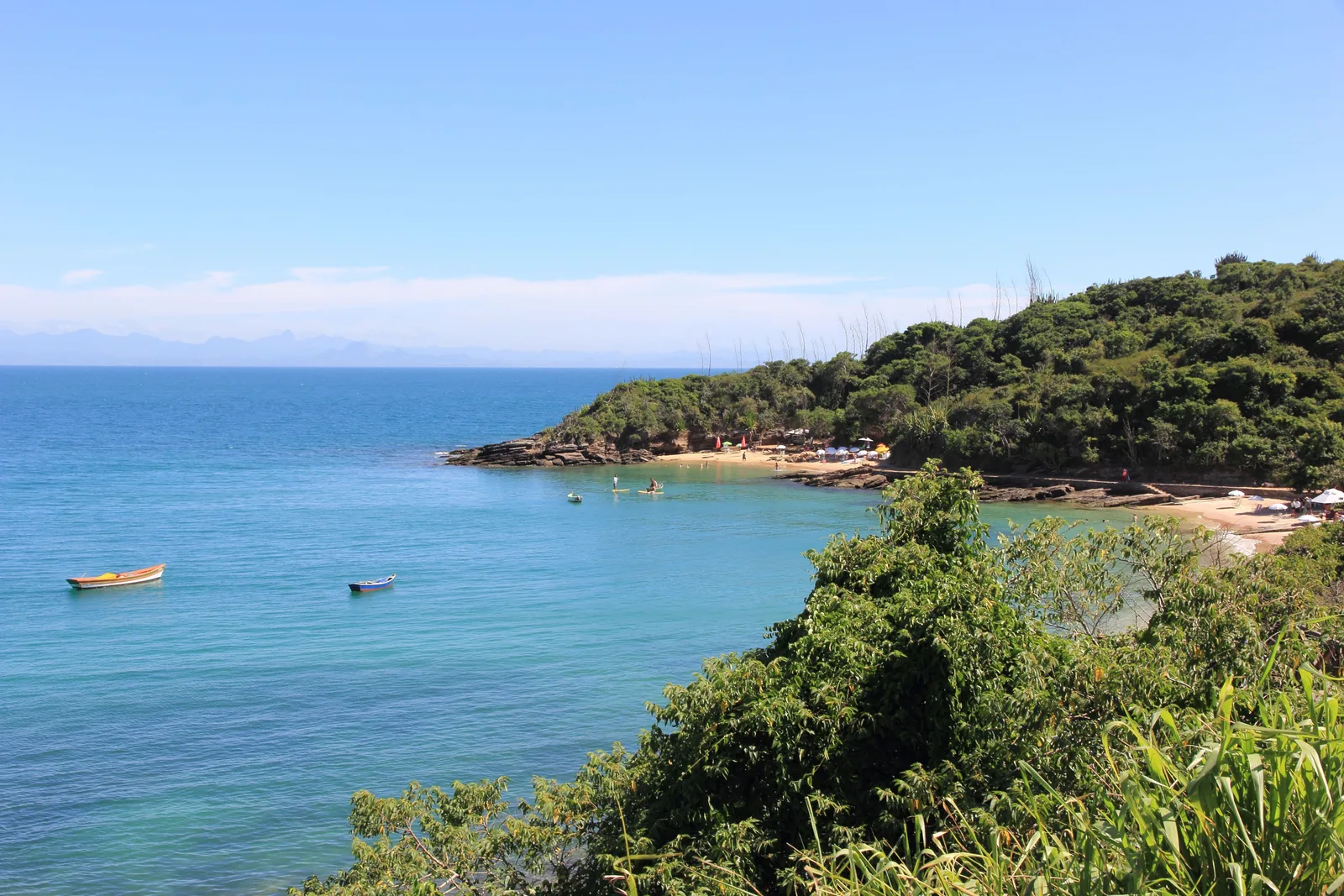
  • A small Búzios cove seen from the hillside above: parasols along the sand at the foot of a wooded headland, clear blue water with two small boats on it, and green shrubs in the foreground
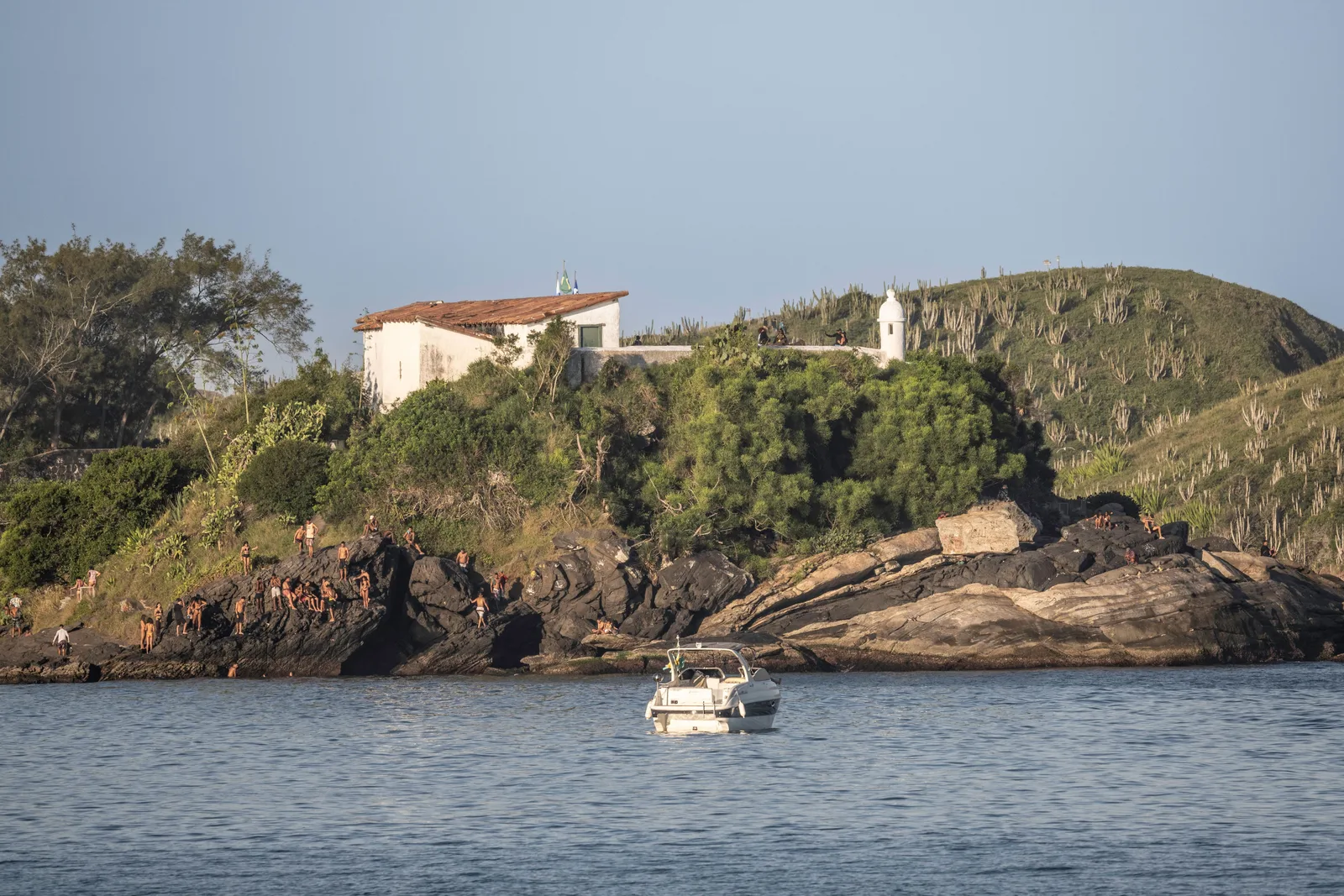
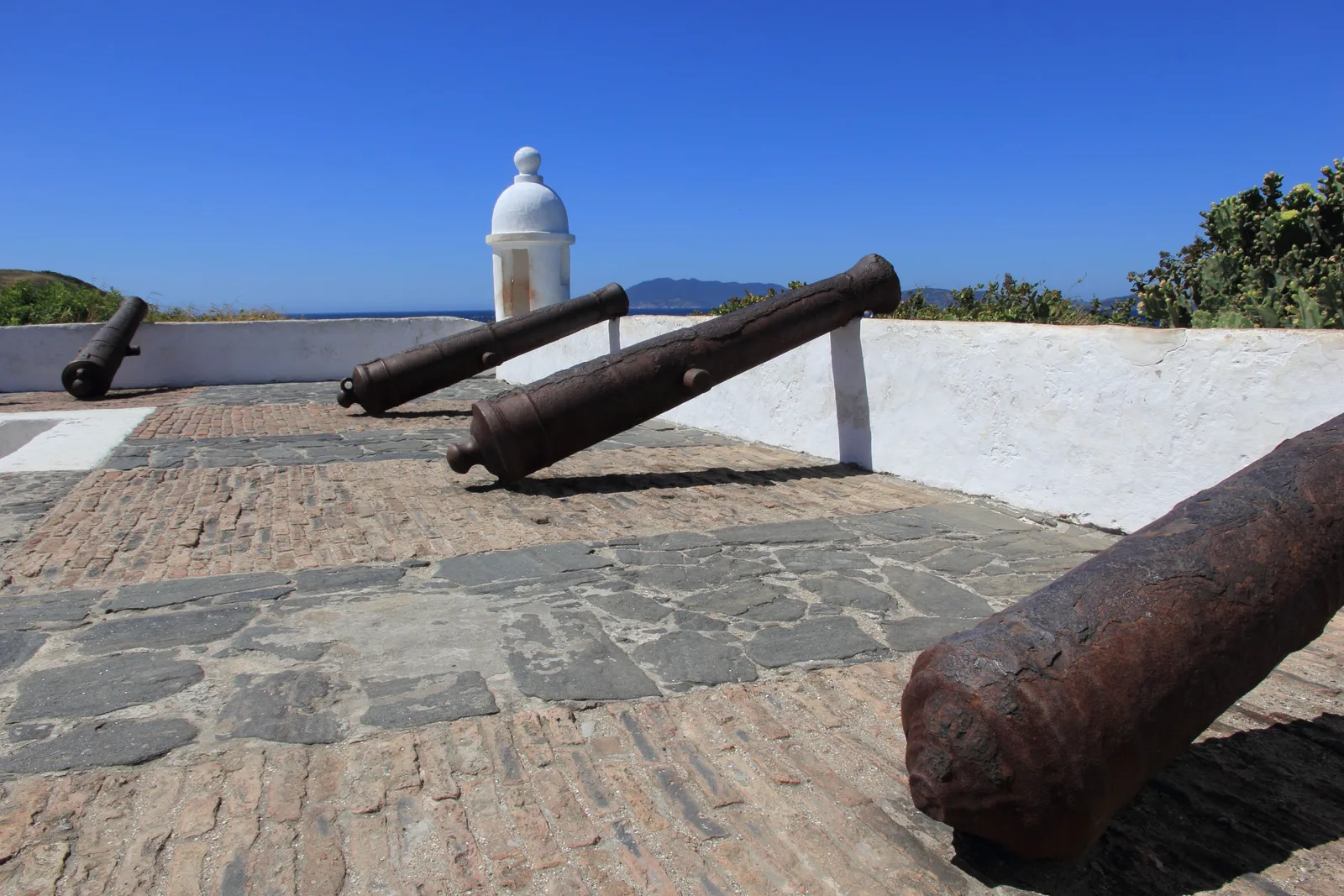
  • Four old iron cannons resting against the whitewashed parapet on the brick and stone terrace of the Forte São Mateus at Cabo Frio, with a white domed sentry box at the corner and the sea beyond
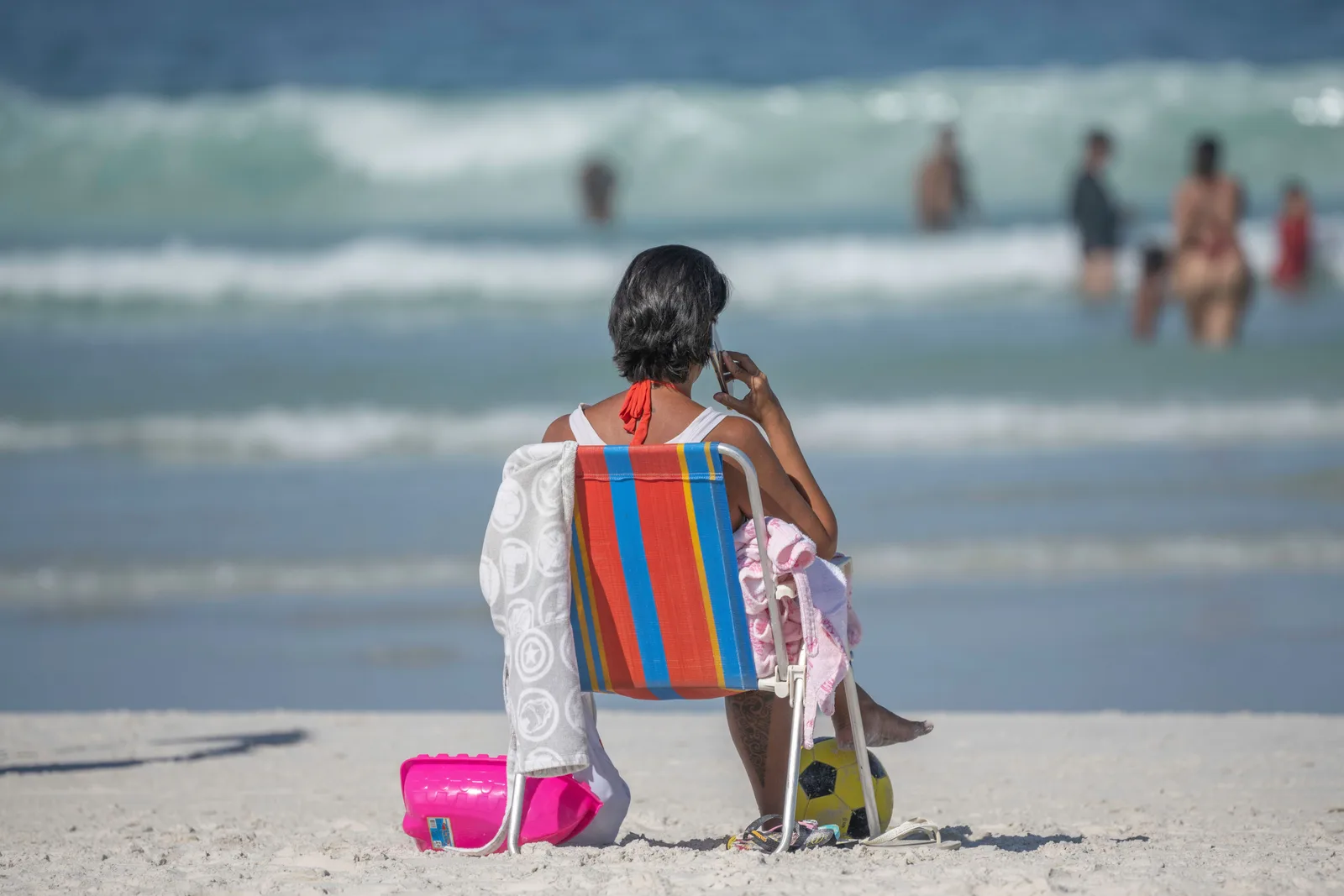
  • A woman sitting in a striped beach chair on the sand at Cabo Frio with a phone to her ear, surf and other bathers blurred behind her

Orientation

One stop, two towns, cold water.

What this page covers, what it costs, and how you get out of Rio to it.

General Info

Two towns 40 kilometers apart, and one stop on a Rio trip

The Região dos Lagos is the stretch of coast that begins where Brazil turns the corner: east of Rio the shoreline runs out to a headland and then bends north, and the three towns on that corner are Cabo Frio, Arraial do Cabo and Armação dos Búzios. Cabo Frio had 222,161 people at the 2022 census, Búzios 40,006 and Arraial do Cabo 30,986 (IBGE, Censo 2022, read from IBGE’s own API). Búzios and Arraial are 40 kilometers apart by road, about an hour, with Cabo Frio sitting between them.

The two towns do completely different jobs and this page keeps them apart on purpose. Arraial do Cabo is a working fishing town whose tour boats leave from Praia dos Anjos; you go there to get on the water. Búzios is a peninsula with 23 beaches on it by the municipal tourism office’s count, a cobbled main street of restaurants, and an evening. Cabo Frio in between is a real city with a seven-and-a-half-kilometer beach, a fort from the 1600s, and not much reason to plan a day around it.

The thing nobody tells first-time visitors is that the sea here is cold, and cold on purpose. Northeast winds along this coast push the warm surface layer offshore and pull cold South Atlantic Central Water up in its place. That is the Cabo Frio upwelling, and it is why the Portuguese named the cape after cold water in the first place. Monthly mean sea temperature runs 21 to 25°C across the year on NOAA’s OISST v2.1 analysis, against 26 to 29 on the northeastern beaches this site also covers, and the coldest month is September rather than July. It can also turn cold at short notice in the middle of summer.

Where It Is

The corner of Brazil, three hours east of Rio

Búzios sits on a peninsula pointing northeast off the corner of Rio de Janeiro state, about 175 km from the city by road and about three hours in normal traffic. Arraial do Cabo is 40 km southwest of it on the far side of the headland, and Cabo Frio is between the two. Everything on this page is inside a triangle whose longest side is about 40 km by road.

Búzios & Arraial do Cabo Búzios & Arraial do Cabo

22.75° S, 41.88° W

See the Southeast on the interactive map

Cost

Búzios is expensive for Brazil, and Arraial is not

These two towns sit at opposite ends of the price range and they are an hour apart, which is the single most useful thing to know before you book. Búzios has been an international resort since the 1960s and prices like one: the pousadas above Ferradura and João Fernandes are the most expensive rooms on this page and the restaurants on Rua das Pedras are Rio prices in a smaller town. Arraial do Cabo is a fishing town that takes day-trippers. Cabo Frio is in between on both. The other budget line that matters is the road, because almost nobody flies here.

Estimated daily budget, per person

Budget

$50 / day

A pousada a few streets back in Arraial do Cabo or Cabo Frio, the standard boat trip, kiosk lunches on the sand, and the local bus between the towns.

Mid-range

$120 / day

A good pousada in Búzios, a rental car for the stay, dinner on Rua das Pedras, the Arraial boat day and one dive or snorkel trip.

Comfortable

$260 / day

The boutique pousadas above Ferradura or João Fernandes, a private transfer from Rio, a private boat for a day, and the restaurants people drive out from Rio for.

Per person per day once you are here, transport from Rio not included. Two people sharing a room lands well under the double of one.

What things cost

  • Mid-range pousada room in Búzios, per night $80 R$410
  • Simple pousada in Arraial do Cabo, per night $35 R$180
  • Hotel room in Cabo Frio, per night $45 R$230
  • Arraial do Cabo boat trip, shared, per person $20 R$100
  • Marina fee for Arraial do Cabo boat trips, per person, cash $3 R$15
  • Whale-watching trip in Arraial, four hours, per adult $65 R$330
  • Beginner dive with an instructor in Arraial $59 R$300
  • Dinner for two on Rua das Pedras, with wine $59 R$300
  • Bus, Rio (Novo Rio) to Búzios, one way $18 R$90
  • Private transfer, Rio airport to Búzios, up to four $118 R$600
  • Rental car, per day $24 R$120
  • Via Lagos toll, car, each way, weekday rate $3.60 R$18.40
  • Via Lagos toll, car, each way, weekend and holiday rate $6 R$30.60

Four lines here are published prices. The two Via Lagos tolls are the tariffs AGETRANSP, the state transport regulator, publishes for a passenger car on the RJ-124, in force since 1 August 2025 under Deliberação 1630. The whale-watching figure is Onda Arraial’s own listed price for its four-hour trip. The marina fee is set by the Fundação Instituto de Pesca de Arraial do Cabo, which runs the pier. Everything else on this list is an estimate.

The weekend rate is 66% higher and applies in both directions from 12:00pm Friday to 12:00pm Monday, and from 12:00pm the day before a national holiday to 12:00pm the day after. Leave Rio before 12:00pm on a Friday and come back after 12:00pm on a Monday and you pay the weekday rate both ways.

Cards work everywhere. Carry some cash for beach kiosks, boat crews, the marina fee and the smaller pousadas in Arraial.

The high season runs from Christmas to Carnival. Late March and April are still summer weather, and the sea is at its warmest in March and April.

Checked September 2026 and converted at R$5.10 to the dollar, the rate every page on this site uses. Four published prices and nine estimates, so read this as the shape of a budget rather than a quote anyone can be held to.

Safety

Very little street crime, and one number that looks worse than the trip is

7 /10

Our rating: two small beach towns with very little street crime, and a bigger city between them with more.

The honest picture here has two halves that point in opposite directions. Street crime against visitors is rare to the point of being hard to measure: on the Instituto de Segurança Pública do Rio de Janeiro’s own municipal series, Armação dos Búzios recorded 21 robberies of pedestrians in the whole of 2025 and Arraial do Cabo recorded four, against 17,662 in the city of Rio. Cabo Frio, five times bigger than either, recorded 147. At the same time Búzios registered 17 violent deaths in 2025, which on its 2022 census population is 42.5 per 100,000 against a Rio state rate of 24.2. That is a real number. The crime that is most likely to spoil your trip is not on the street at all: fraud is the largest recorded category in all three towns, and Cabo Frio’s estelionato count went from 1,859 in 2024 to 2,492 in 2025.

  • Book accommodation through a platform that holds the money, and be suspicious of a Búzios or Arraial rental that wants a Pix transfer to a personal account before you arrive.
  • The two beach towns are walkable at night in the parts you will be in. Rua das Pedras and the Orla Bardot in Búzios are busy and lit until late, and so is the Prainha waterfront in Arraial.
  • Take to the beach only what you can carry into the water. A phone on a towel is the ordinary loss on any Brazilian beach and these are no exception.
  • Cabo Frio is a city, and the rules there are city rules: ride apps after dark rather than long walks, and stay on the lit stretches of the beachfront and the canal.
  • The sea is the real hazard here and it is underrated. Praia Grande in Arraial and the ocean-facing Búzios beaches like Geribá and Brava have open Atlantic surf and rip currents; the sheltered coves on the other side are flat. Read the flags, and ask which side of the peninsula you are on.
  • The water is cold enough to matter. A summer swim in 21°C water after an upwelling event catches people out, and it is the same sea that looks tropical in the photographs. Wetsuits are normal on dive boats here in every month.
  • The summer sun is fierce, and a sea breeze hides it completely.

Getting There

You fly into Rio and then you drive

This is a road destination, and that is not a complaint: it is what lets the Região dos Lagos work as an add-on to a first Rio trip rather than a separate vacation. Cabo Frio has an airport of its own, but nothing flies there from the United States and its domestic flights are seasonal, so plan on arriving from Rio.

  • Fly into Rio de Janeiro Galeão (GIG), which is the international airport. Santos Dumont (SDU) is the downtown domestic airport and works too.
  • The drive is about 175 km to Búzios and takes roughly three hours in normal traffic: the Rio-Niterói bridge, then the BR-101, then the Via Lagos, the RJ-124, which is a tolled private highway. Cabo Frio and Arraial do Cabo are on the same run, a little short of Búzios.
  • Auto Viação 1001 runs the bus from the Novo Rio bus station to Búzios, Cabo Frio and Arraial do Cabo through the day. Allow three and a half to four hours.
  • A private transfer is the easy answer with luggage. Door to door from the airport, no bus station, and you can stop in Cabo Frio on the way.
  • Cabo Frio International (CFB) is about 50 minutes from Búzios. Nothing flies there from the United States, and its domestic flights are seasonal.
  • The Friday afternoon traffic out of Rio on this road in high season is a genuine event, and so is Sunday evening coming back. Travel midweek if the dates are yours to choose.

Getting Around

A car if you want both towns, a boat if you want Arraial

Each town is small enough to walk. What a car buys you is the 40 km between them, and the beaches at the far ends of the Búzios peninsula, which are the good ones.

  • Búzios town is walkable end to end: Rua das Pedras, the Orla Bardot, Praia da Armação and Praia dos Ossos are one continuous stroll of about a kilometer and a half.
  • The Búzios beaches are not walkable from town. Geribá, Ferradura, João Fernandes and Tucuns are spread around a peninsula, and the far ones are 20 minutes of driving from the center. A car, a scooter or a lot of taxi rides.
  • Arraial do Cabo needs no car at all if you are only there for the water. Every boat leaves from Praia dos Anjos, and the town beaches, Prainha and Praia Grande, are a short walk from anywhere in it.
  • The one thing you cannot drive to is the best beach. Praia do Farol, on Ilha do Cabo Frio, is inside a Navy-controlled area and can only be reached on an authorized boat trip.
  • Uber and 99 work in all three towns, thinly in Arraial and reliably in Búzios and Cabo Frio. Between towns they are workable but not cheap.

The big five

What you actually came for.

Two things in Arraial do Cabo, two in Búzios and one in Cabo Frio, which is roughly the ratio a good three or four nights here works out at.

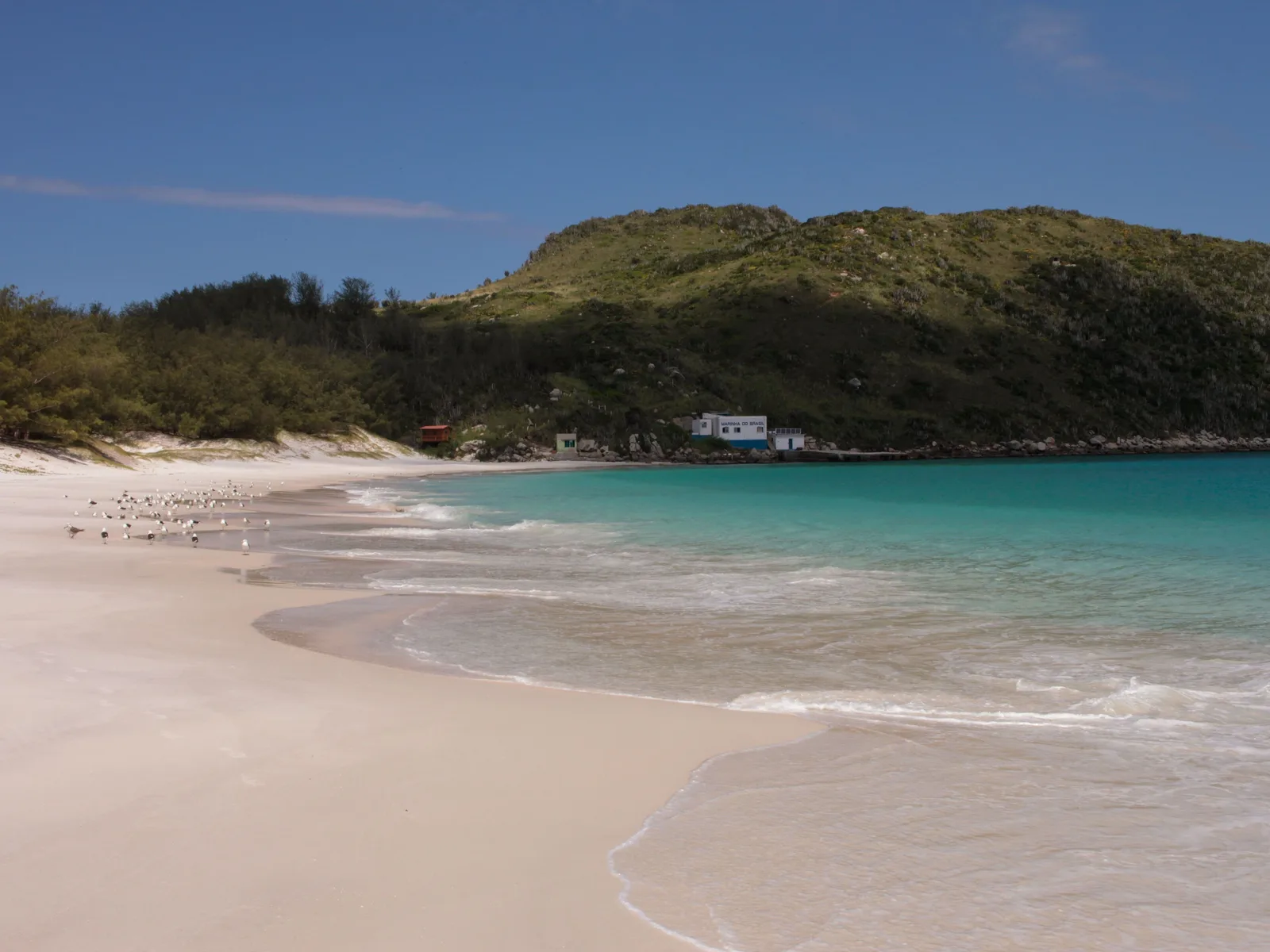
A wide empty beach of pale sand on Ilha do Cabo Frio at Arraial do Cabo curving away to the right, with a flock of gulls standing on the wet sand, clear green shallows along the waterline, and two small white buildings at the foot of a green scrub-covered hill 01

The best beach here, and the only one you cannot drive to

Praia do Farol, Ilha do Cabo Frio

Access
Authorized boat only
Boats leave from
Praia dos Anjos
On the island
No kiosks, no bar, no restrooms

Ilha do Cabo Frio is the island that closes the bay at Arraial, a green cone rising straight out of turquoise water, and the beach on its landward side is the picture everyone has seen of this coast. It is Navy ground. The Brazilian Navy runs an oceanographic institute at Arraial and controls access to the island, so the only lawful way onto that sand is a boat trip licensed to land there, with no more than 300 visitors on the beach at once and no more than 50 minutes ashore.

What that means in practice is that the best beach in the Região dos Lagos comes with a schedule, a boat and a crowd, all at once. It also means it has no barracas, no vendors and no restrooms. Every operator sells more or less the same circuit out of Praia dos Anjos.
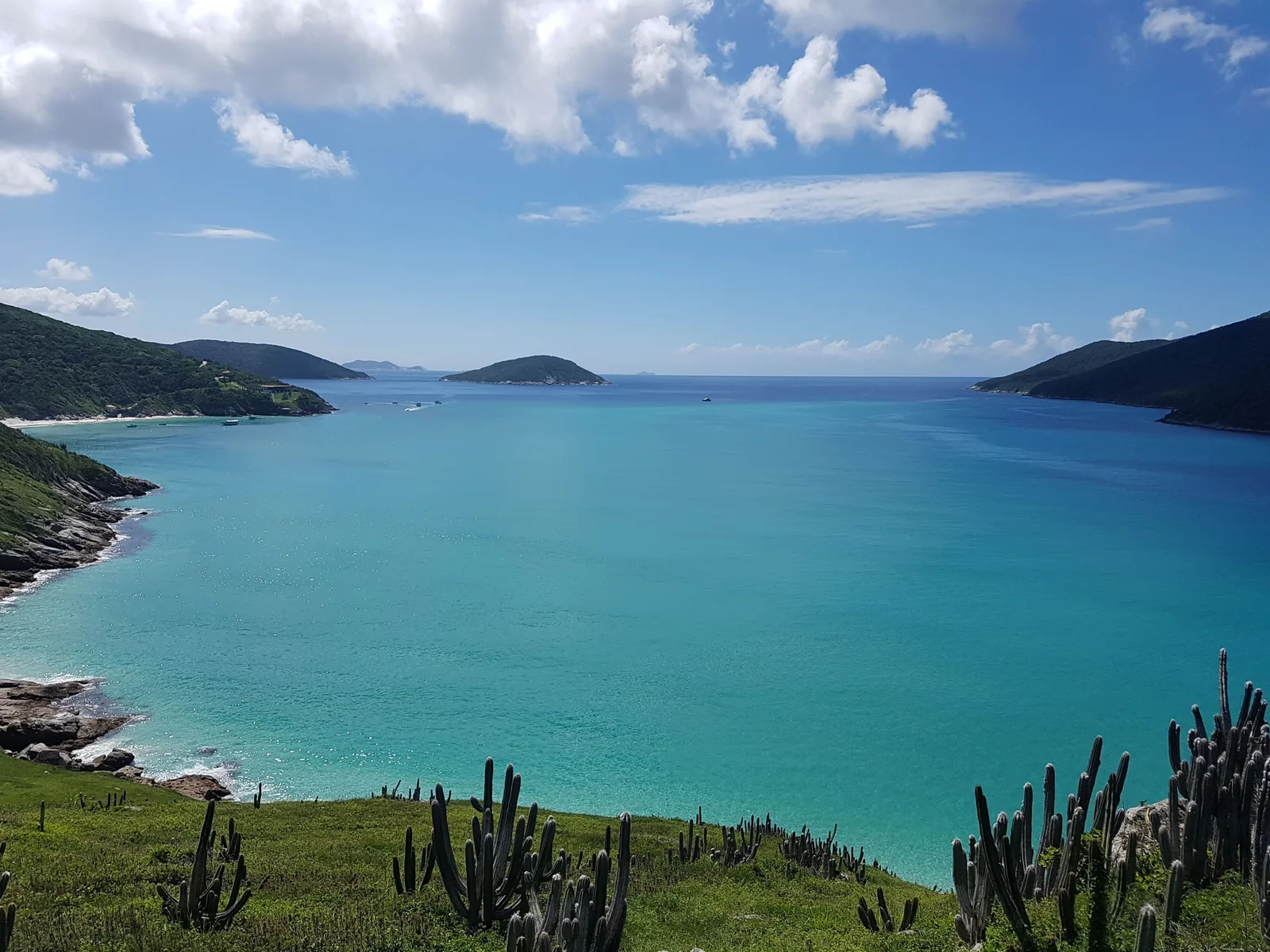
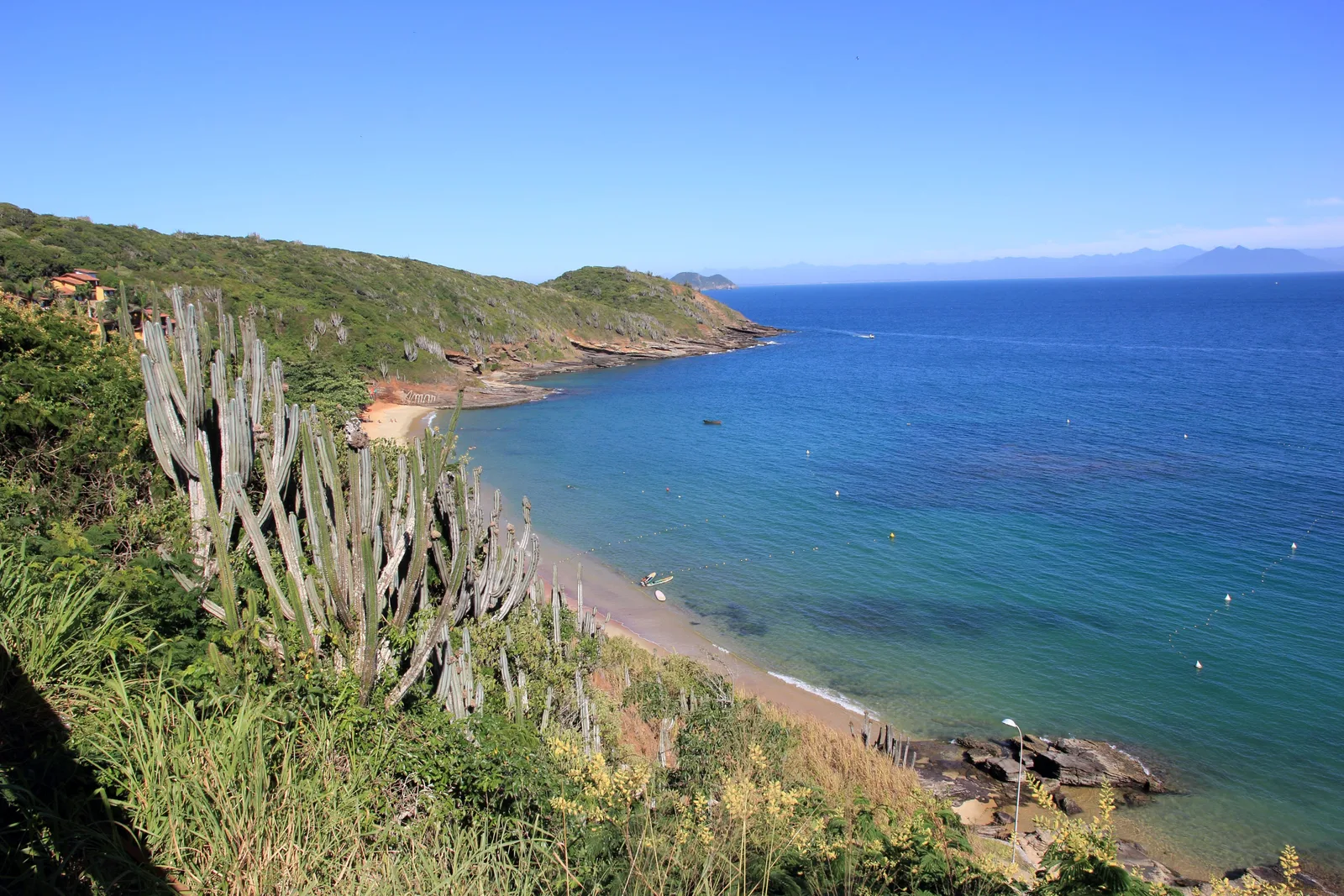
The view from the Pontal do Atalaia clifftop at Arraial do Cabo, framed by a row of tall columnar cacti along the grassy edge: a wide bay of pale turquoise water with rocky shore below it, and green headlands and small islands on the horizon 02

Two coves at the bottom of a staircase

The Prainhas do Pontal do Atalaia

Getting down
A long staircase of more than 200 steps
What is there
Two coves that join at low tide
Above it
The Pontal do Atalaia lookout

The headland south of Arraial town ends in a lookout with the whole coast laid out below it, and under the lookout, down a long, steep staircase, are the Prainhas: two small coves separated by rock that become one beach when the tide drops.
It is work: the staircase is the whole entrance fee, there is very little shade, and everything you want on the sand you carry down and back up. Private cars are no longer allowed on the road to the top; take a taxi from Praia dos Anjos, walk, or take the boat taxi. Go early, and stop at the lookout on the way in rather than on the way out.
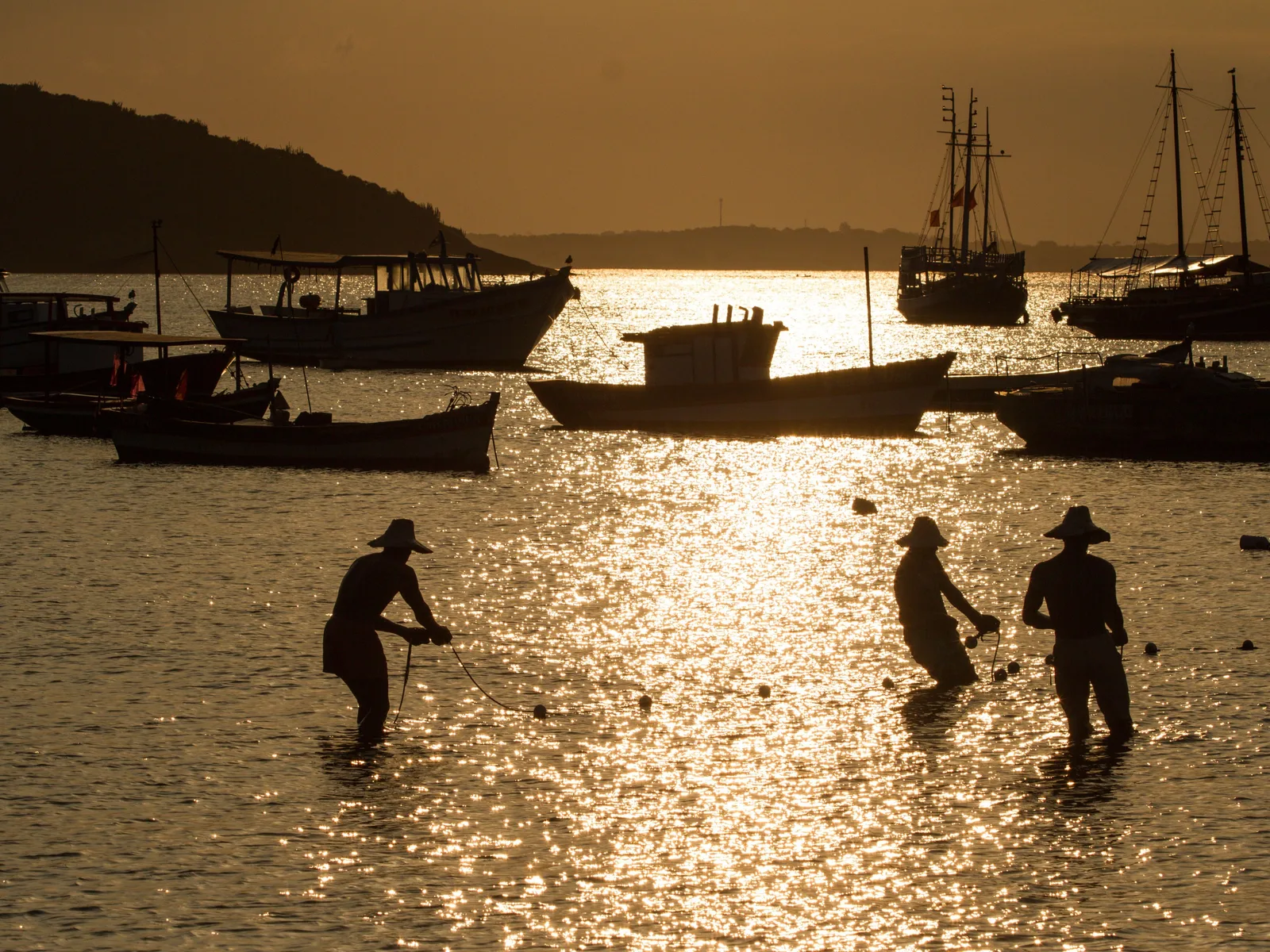
The Monumento dos Três Pescadores on the Orla Bardot at Búzios at sunset: three bronze fishermen silhouetted standing in shallow gold water hauling a net, with moored boats and masts behind them 03

A cobbled street, three bronze statues and dinner

Rua das Pedras and the Orla Bardot

What it is
The main street and its seafront walk
Named for
Brigitte Bardot, who came in 1964
Sculptor
Christina Motta

Búzios was a fishing village until 1964, when Brigitte Bardot came with her boyfriend Bob Zagury, the international press followed her, and the place stopped being a fishing village. That is the founding story and the town has never let go of it: the seafront walk is called the Orla Bardot, and there is a bronze of her on it by the sculptor Christina Motta.

Rua das Pedras is the street behind it, irregular stone paving from end to end, and it is where the town spends its evenings. Restaurants, bars, bikini shops, ice cream, and a slow crowd that starts moving around 8:00pm and does not thin out until late. The other bronzes on the Orla are better than the Bardot one: three fishermen standing in the shallows hauling a net, which at sunset with the boats behind them is the best thing anyone has built in this town.

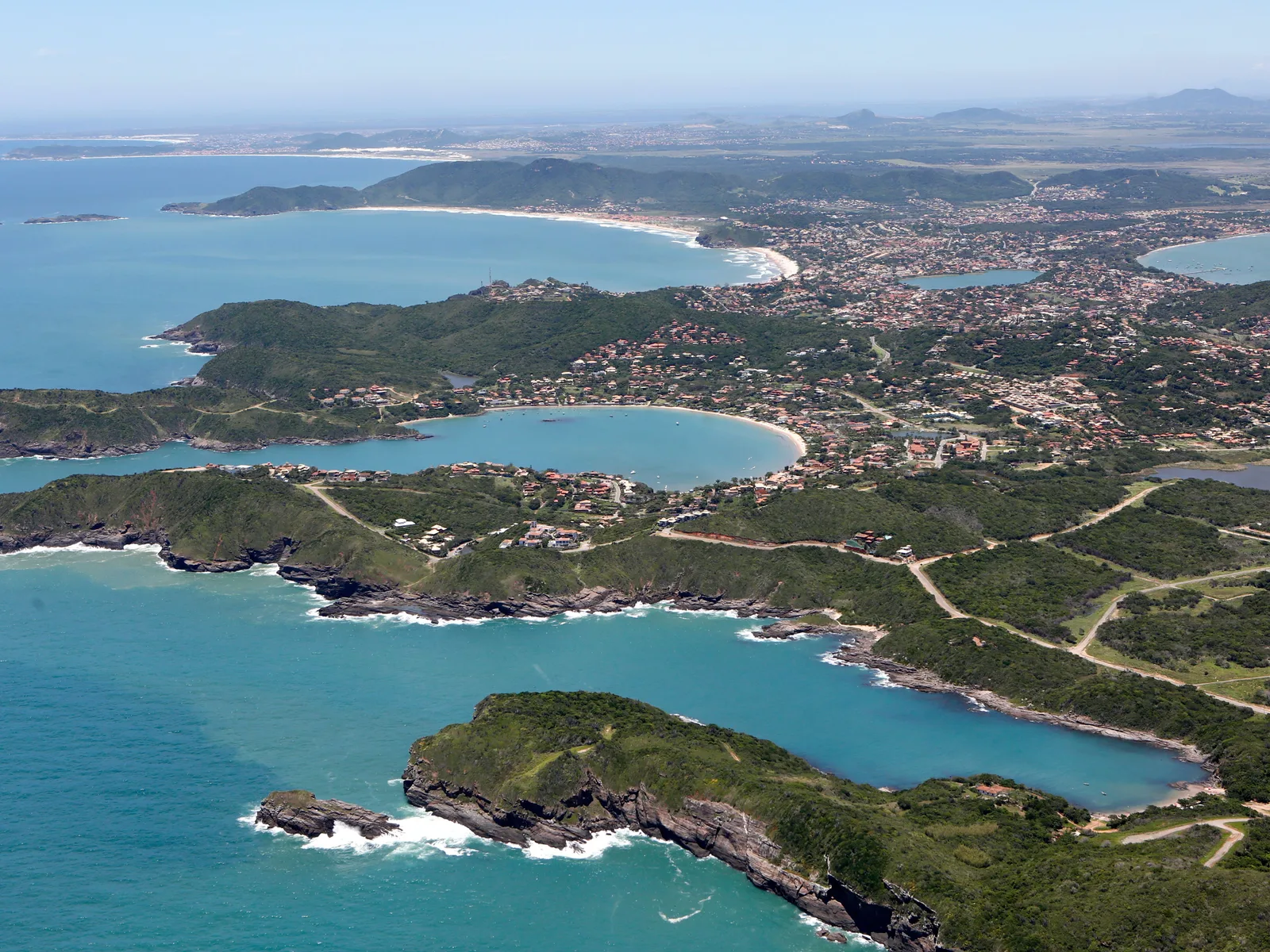
The Búzios peninsula from the air: a headland of low green hills with several separate curving bays cut into it, pale sand along each one and the town spreading inland behind 04

Twenty-odd beaches on one small peninsula

The Búzios beaches

How many
About 23
Municipal area
About 71 km²
The split
Calm bay side, open ocean side

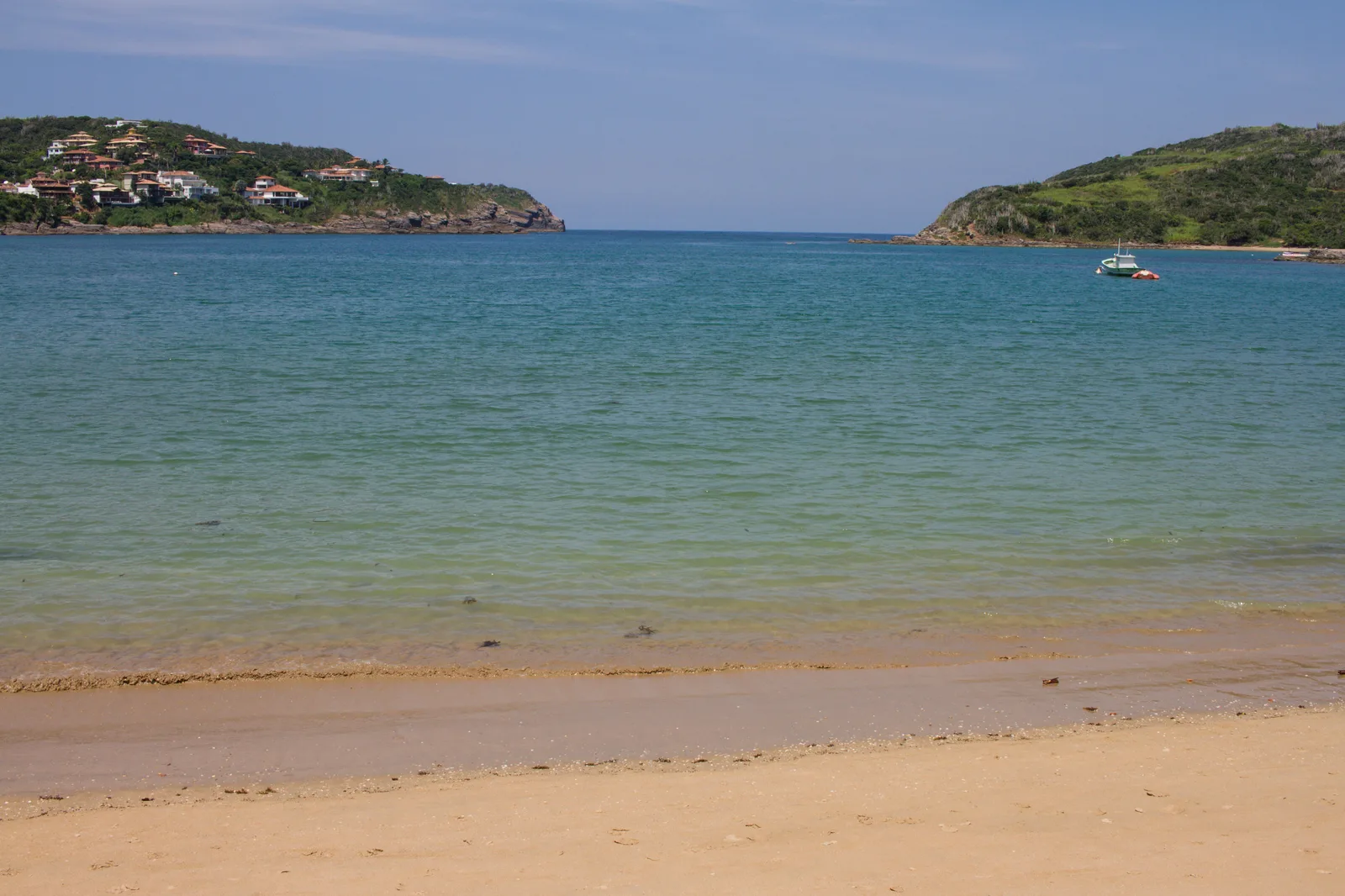
Búzios is a peninsula about eight kilometers long and the beaches are strung all the way around it, roughly 23 of them by the usual count. The useful thing to understand is that the peninsula has two sides. The ones on the bay side, facing back toward the mainland, Azeda and Azedinha, João Fernandes, Tartaruga, are flat, clear and swimmable. The ones facing the open ocean, Geribá, Brava, Tucuns, get real surf and real wind.

That means you can pick the day you want rather than take what you are given, which is not true of most Brazilian beach towns. One warning about names: Búzios has a Praia do Forno and so does Arraial do Cabo, they are 40 km apart, and half the photographs online are filed under the wrong one.

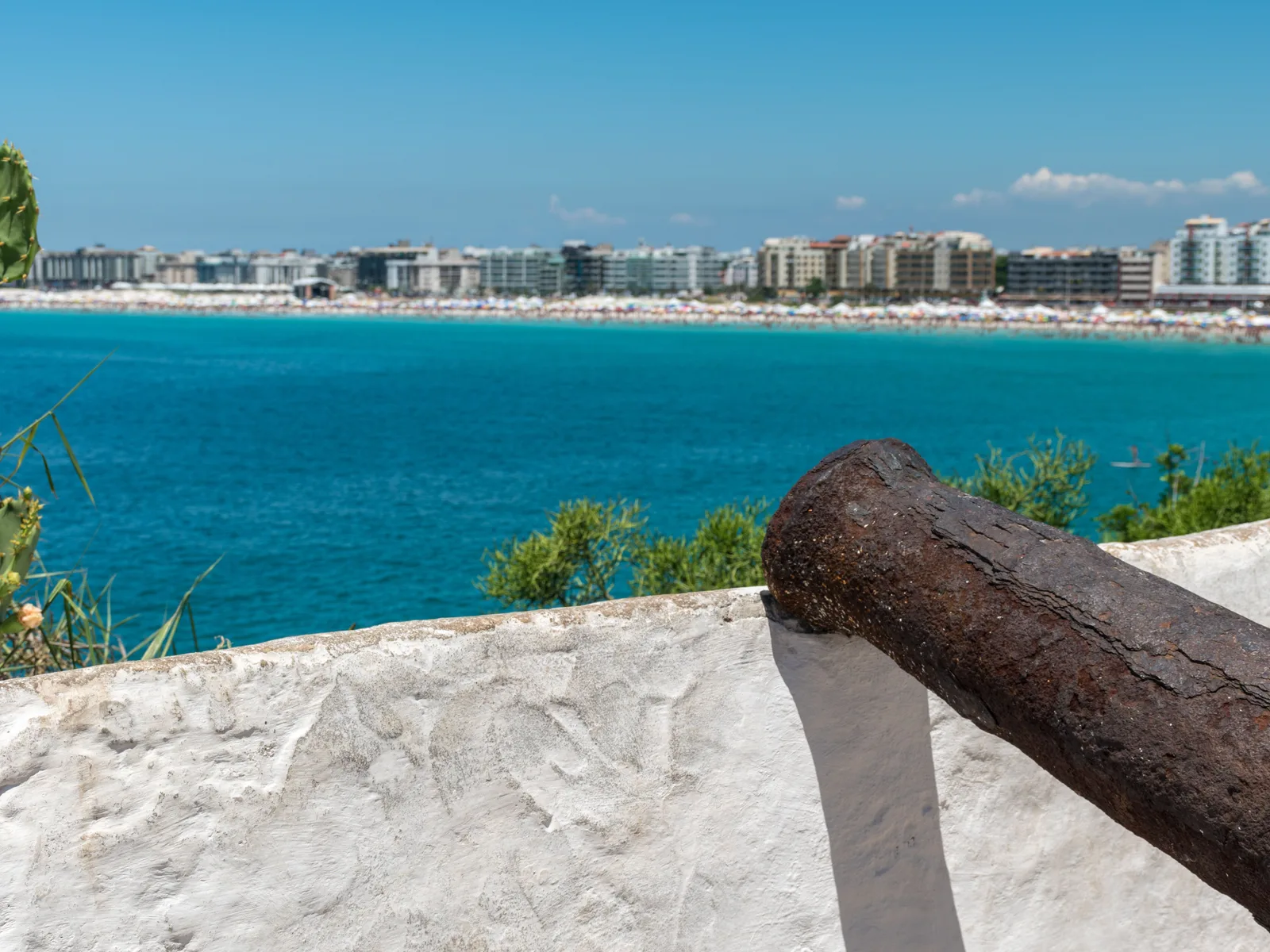
An iron cannon on the whitewashed rampart of the Forte São Mateus at Cabo Frio, pointing out over turquoise water toward the long city beach and the line of apartment towers behind it 05

The fort the cape was defended from, and the beach named after it

Forte São Mateus, Cabo Frio

Built
1616–1620
Listed
IPHAN, 1956
The beach
7.5 km, the city’s main one

Cabo Frio was founded in 1615 and the fort went up immediately after it, between 1616 and 1620, on a rock at the mouth of the channel. It was built against the French, the English and the Dutch, all of whom had been working this coast for the brazilwood, and it was listed by IPHAN, the federal heritage institute, in 1956. It is small, it is open every day, and the view back along the beach from its terrace is the best thing in Cabo Frio.

The beach that runs away from it is 7.5 kilometers long and is the city’s main one (Prefeitura de Cabo Frio). It is also called Praia do Forte, which is worth flagging: there is a much better known Praia do Forte in Bahia, 1,200 km up the coast, and search engines mix the two up constantly. Cabo Frio’s is a broad, busy, open-Atlantic city beach with a wall of apartment towers behind it and white dunes at the far end. It is not why you came, and it is a perfectly good afternoon.

What to do

Twenty-six things worth the drive out.

The two towns want different days from you. Filter by which one you are in, or by what you want the evening to look like.

Arraial by Boat

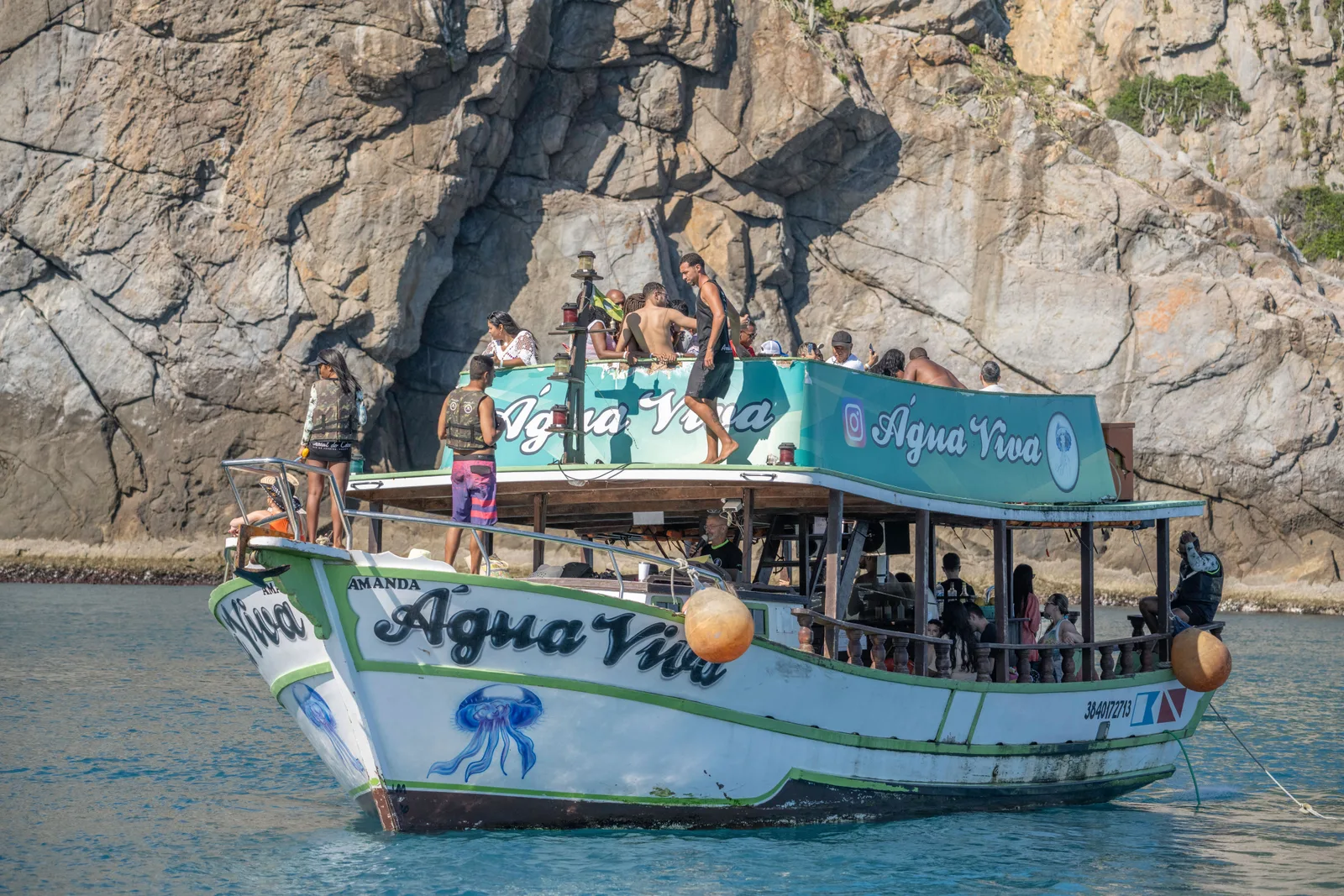
  • A wooden tour boat painted white and green, with passengers on both decks and a jellyfish painted on its bow, anchored in front of a tall gray rock cliff at Arraial do Cabo

    Arraial do Cabo · three to four hours

    The standard boat trip from Praia dos Anjos

    The thing everybody comes to Arraial to do, and it is worth doing. Wooden boats with canopies leave Praia dos Anjos all morning and run the same rough circuit: the Gruta Azul, the cliffs of Ilha do Cabo Frio, a swim stop or two, and a landing at Praia do Farol. Shared trips run about R$70 to R$180 a head, more with lunch. Every passenger also pays a R$15 marina fee at the pier, in cash, and coolers and glass are not allowed on board. Take the earliest departure, because the wind gets up after lunch and so does the swell.

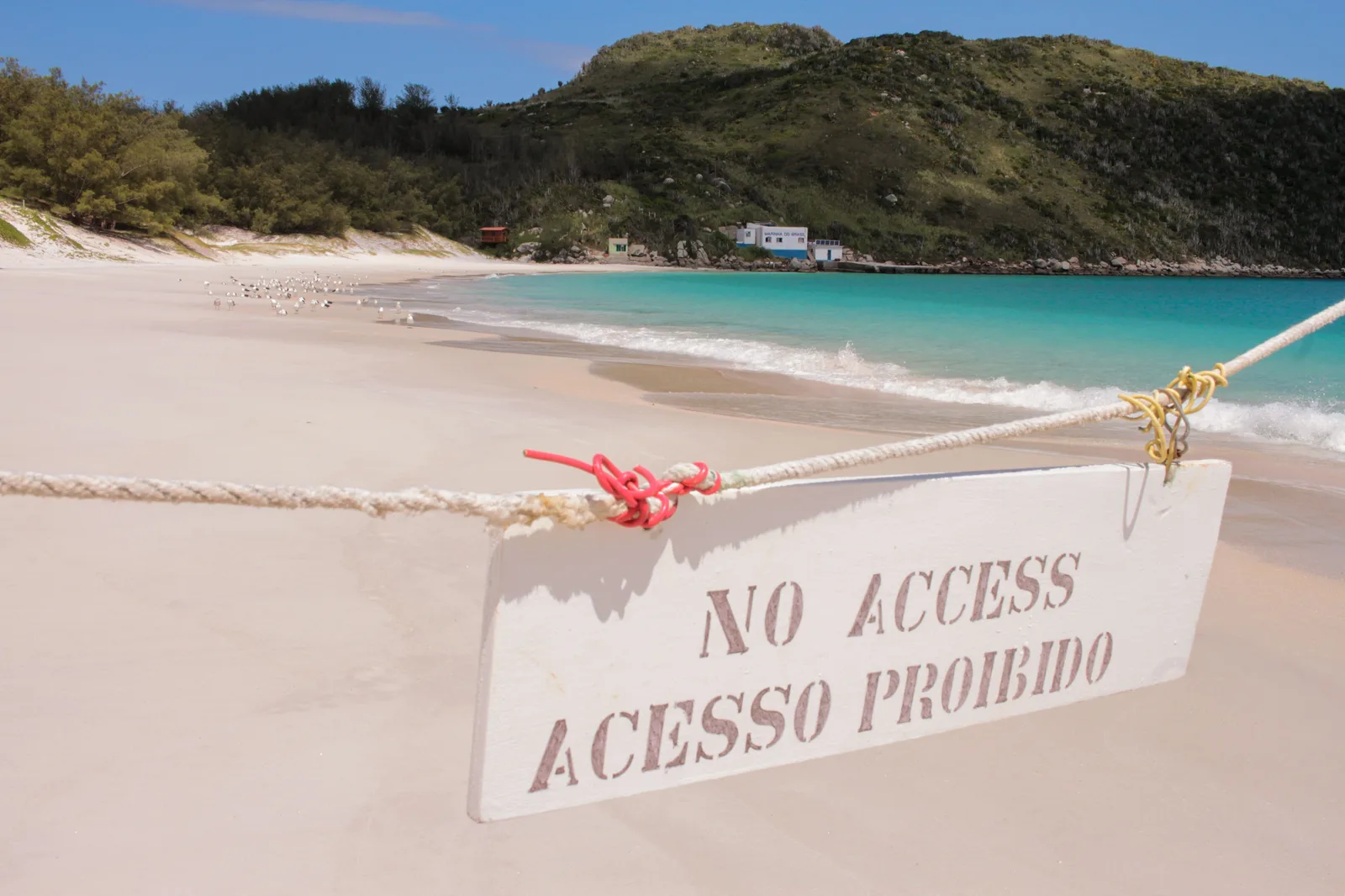
  • A stenciled wooden sign reading NO ACCESS and ACESSO PROIBIDO hanging from a rope strung across the sand at Praia do Farol, with gulls on the beach, turquoise water and a small white building at the foot of a green hill behind it

    Ilha do Cabo Frio · up to 50 minutes ashore

    Going ashore at Praia do Farol

    The landing on the island is the point of the trip. The Navy controls the island and only boats it has credentialed may put people on the sand: no more than 300 visitors at once, for no more than 50 minutes, and in rough sea the skipper leaves without landing. Bring nothing you cannot carry back to the boat. What you get for the rules is water the color of a swimming pool.

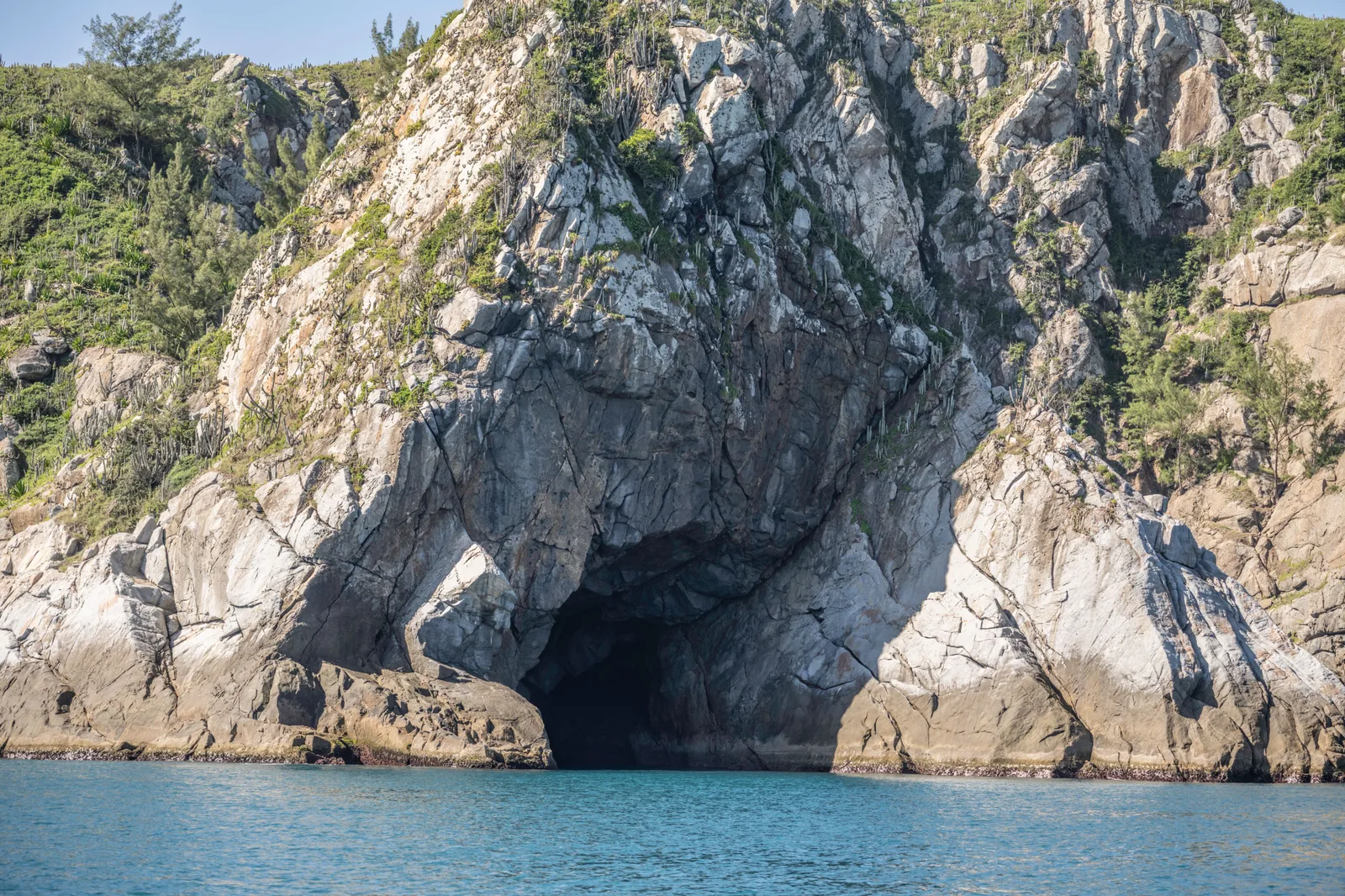
  • A pale gray rock headland on Ilha do Cabo Frio with a wide dark cave mouth at the waterline, green scrub growing over the rock above it and turquoise water washing in

    Ilha do Cabo Frio · seen from the boat

    The Gruta Azul

    A sea cave at the waterline of the island. Boats are not allowed into it under the marine reserve’s rules, so the tour sees it from outside the mouth.

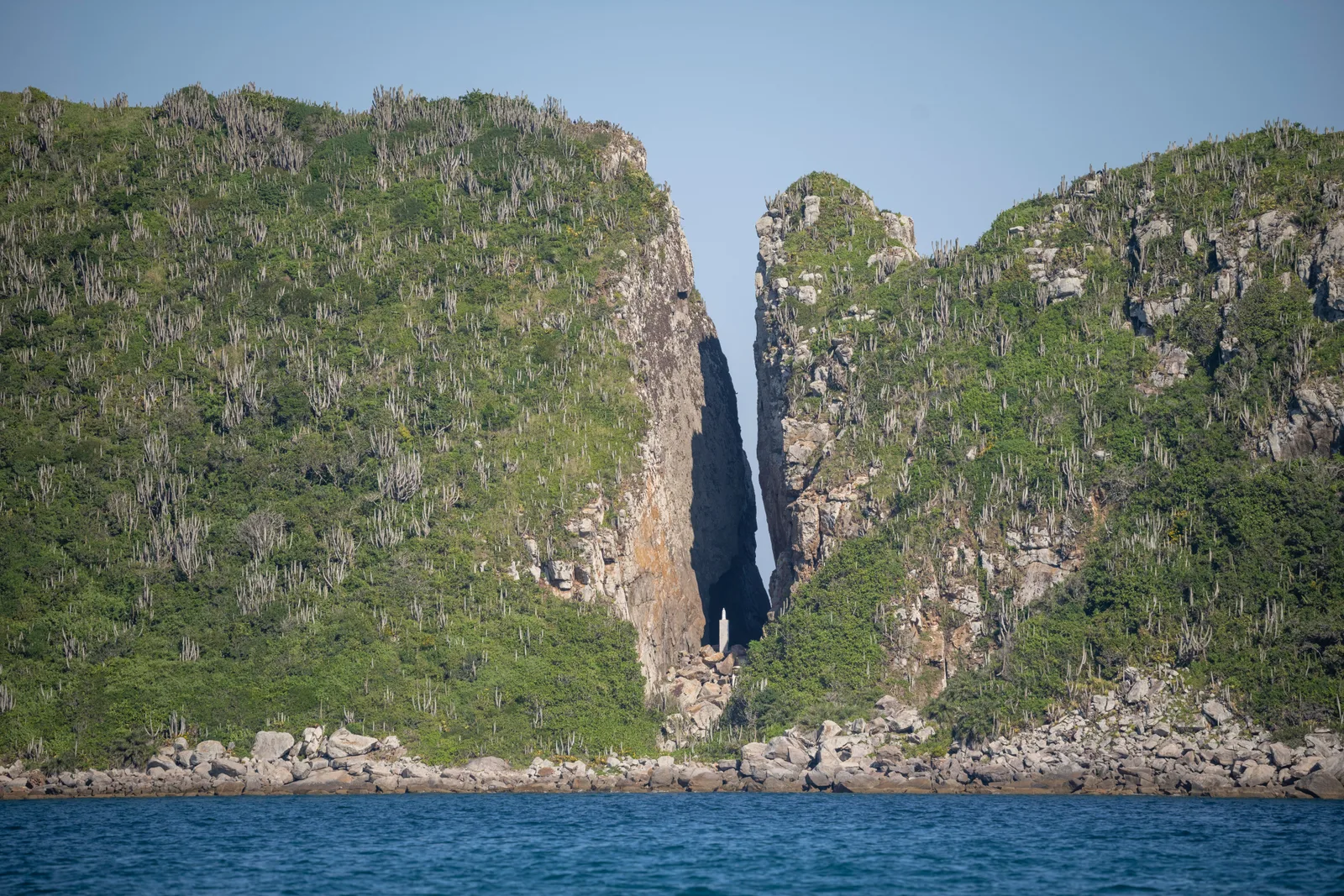
  • A narrow vertical cleft splitting a steep, cactus-dotted coastal cliff on Ilha do Cabo Frio from the ridge almost to the sea, with a small white statue standing on the boulders at its foot and a rocky shore along the waterline

    Ilha do Cabo Frio · seen from the boat

    The Fenda de Nossa Senhora

    A vertical cleft splitting the island’s cliff from the ridge almost to the sea, with a small white statue on the rocks at its foot. Boats are not allowed to stop there, so it goes by in passing, and it is the moment on the circuit where the scale of the island lands, and it photographs badly and looks extraordinary, which is the right way round.

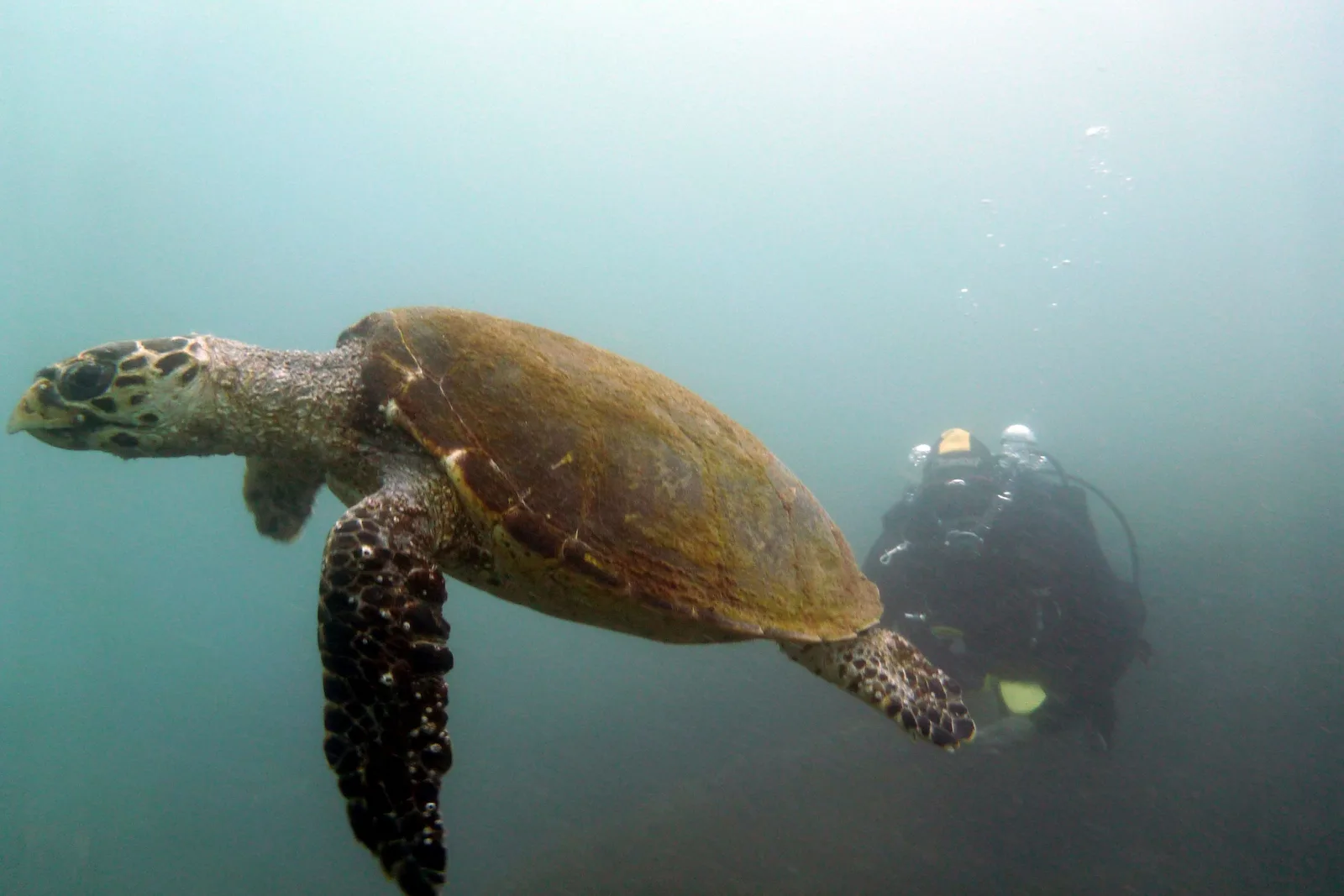
  • A hawksbill turtle swimming through hazy green-blue water at Arraial do Cabo with a scuba diver following a few meters behind it

    Arraial do Cabo · half a day

    Diving at Arraial do Cabo

    A 2023 federal law named Arraial Brazil’s national diving capital, and the title is about the water rather than the reef. On a good day visibility runs past 15 meters. Green turtles are the usual headline sighting and there are moray eels, lobster, big schools of bigeye and soft coral on the rock walls. Every school in town runs a beginner dive with an instructor, no certification needed. Bring the expectation of a wetsuit in every month of the year.

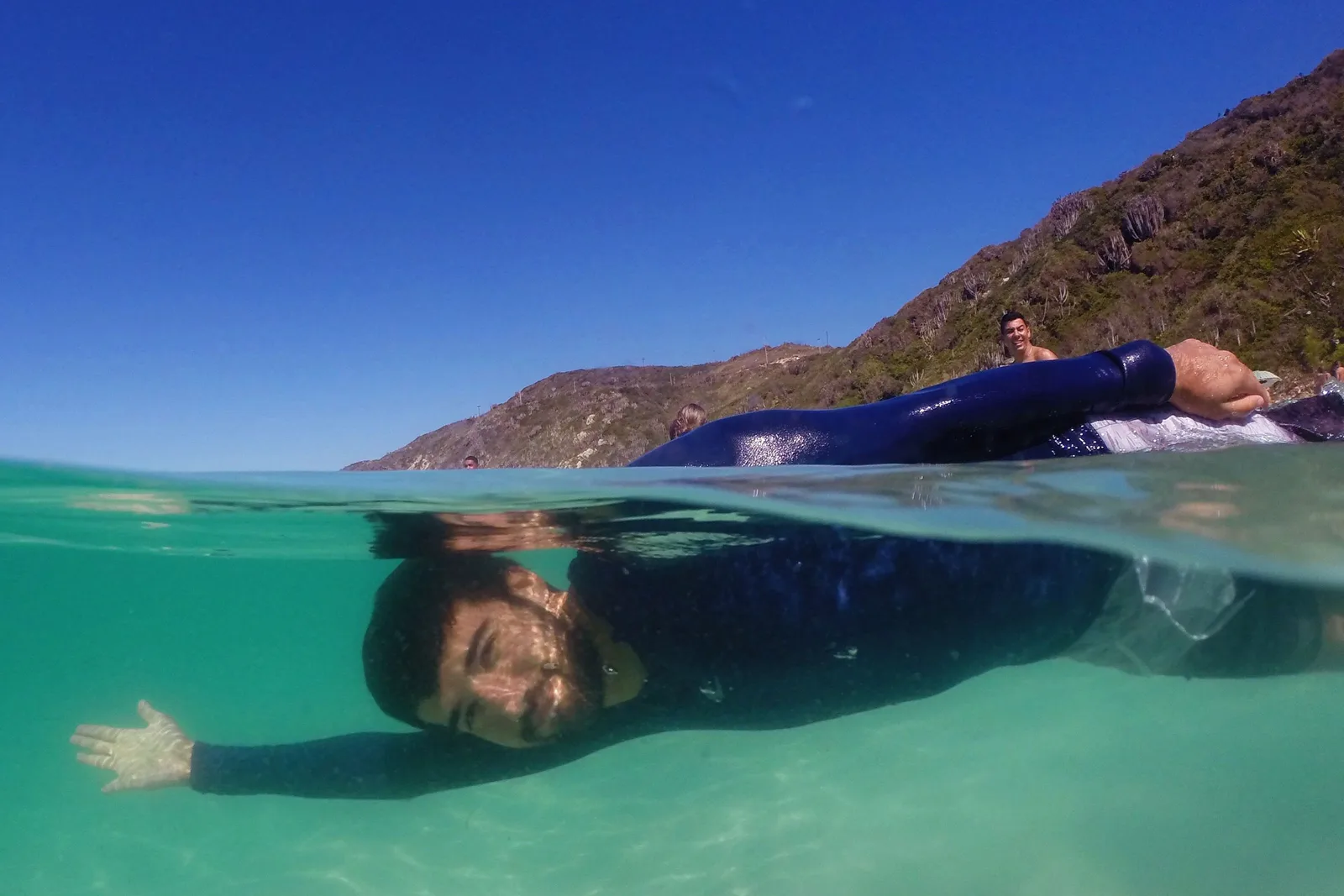
  • A half-underwater photograph at Arraial do Cabo: a person in a blue wetsuit floating at the surface with their face visible through clear green water, and a green headland and blue sky above the waterline

    Arraial do Cabo · included on most trips

    Snorkeling off the boat

    You do not need a tank to get the good part. The boats stop over rock and sand in a few meters of water, hand out masks, and the visibility does the rest. This is also where the temperature stops being an abstraction: the surface is one thing and two meters down after a northeast blow is another, and people come up faster than they went in. Ask for a shorty wetsuit if the boat has one.

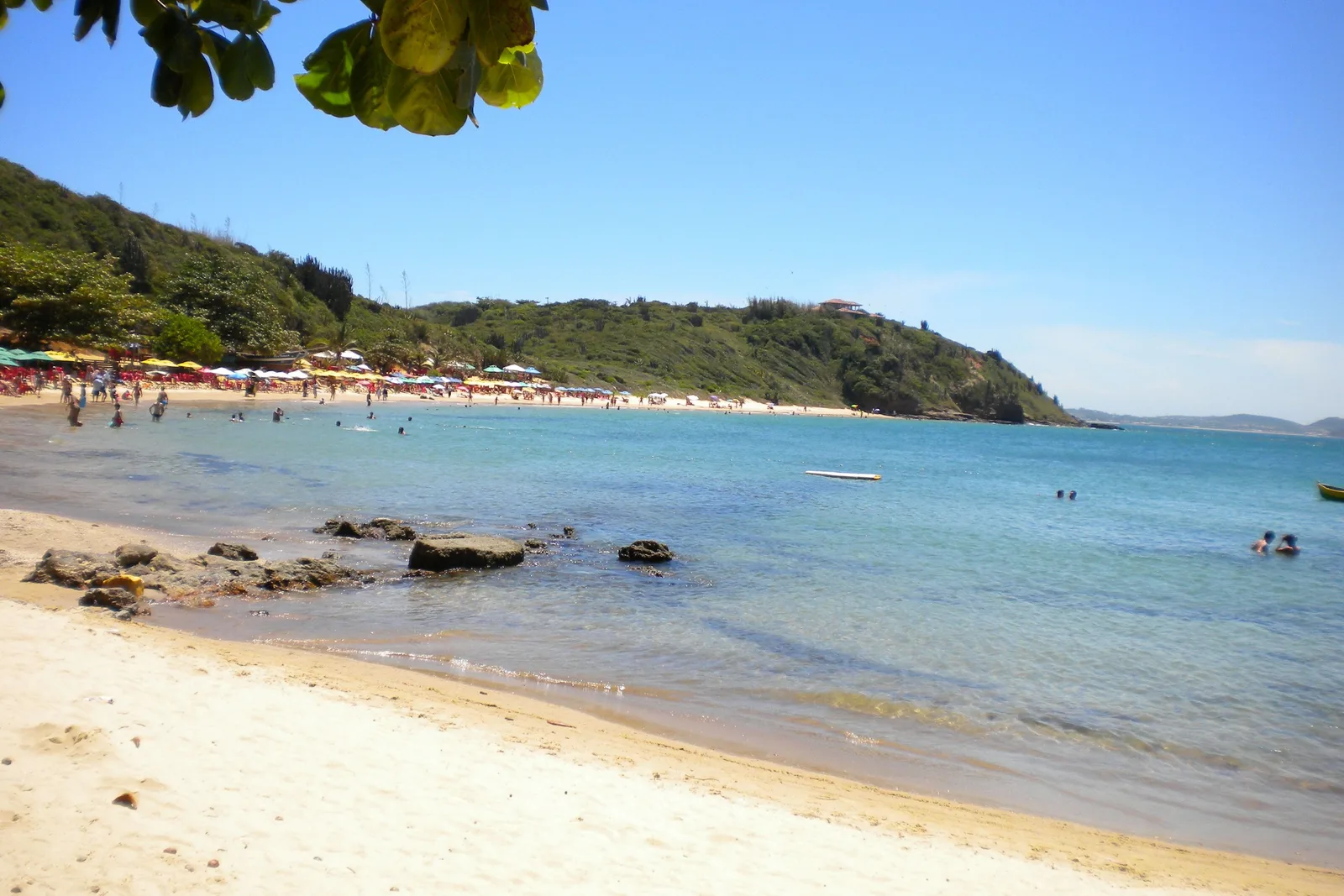
  • Praia do Forno at Arraial do Cabo seen from the rocks above through tall cacti: a small crescent of sand with people swimming in flat turquoise water, closed in by green hills

    From Praia dos Anjos · about 15 to 20 minutes each way

    The trail to Praia do Forno

    A short path over the headland from the end of Praia dos Anjos, and at the bottom of it a small bay closed in on both sides where the water is flat and the color is absurd. There is a boat taxi if you would rather not walk, and kiosks on the sand. This is Arraial’s Praia do Forno, not the one in Búzios, and it is the best half day here that does not involve a schedule.

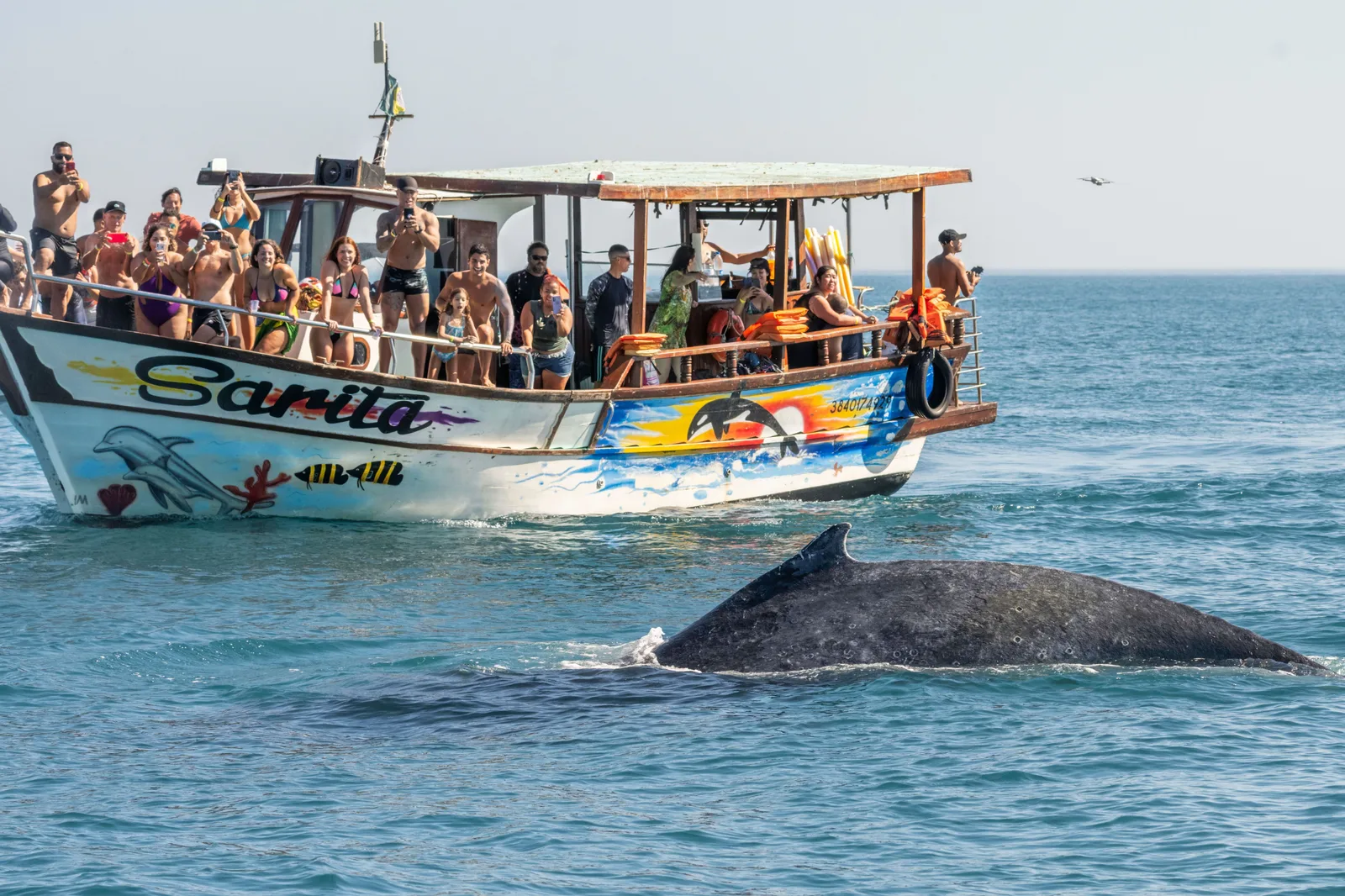
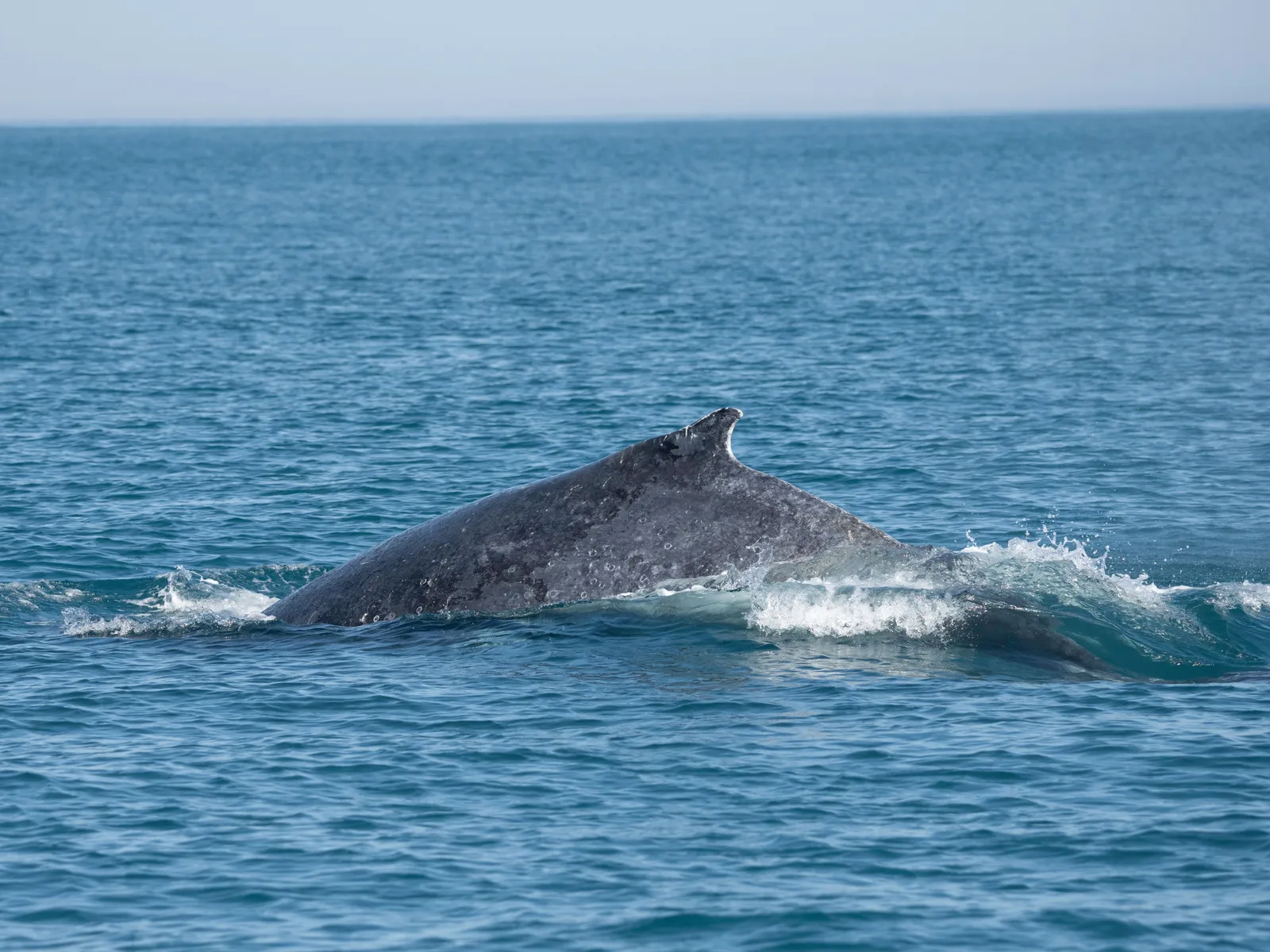
  • A humpback whale surfacing right beside a small tour boat crowded with standing passengers off Arraial do Cabo, its dark back breaking the blue water

    Arraial do Cabo · four hours

    Whale watching in the southern winter

    Humpbacks pass this cape on the migration between the Antarctic and their breeding grounds off Bahia, and Arraial sits close enough to the route that dedicated boats go out for them. Onda Arraial lists a four-hour trip at R$330 an adult. Published season dates vary between sources from May through to November, so if you want to plan a date around it, confirm with the operator rather than with a blog.

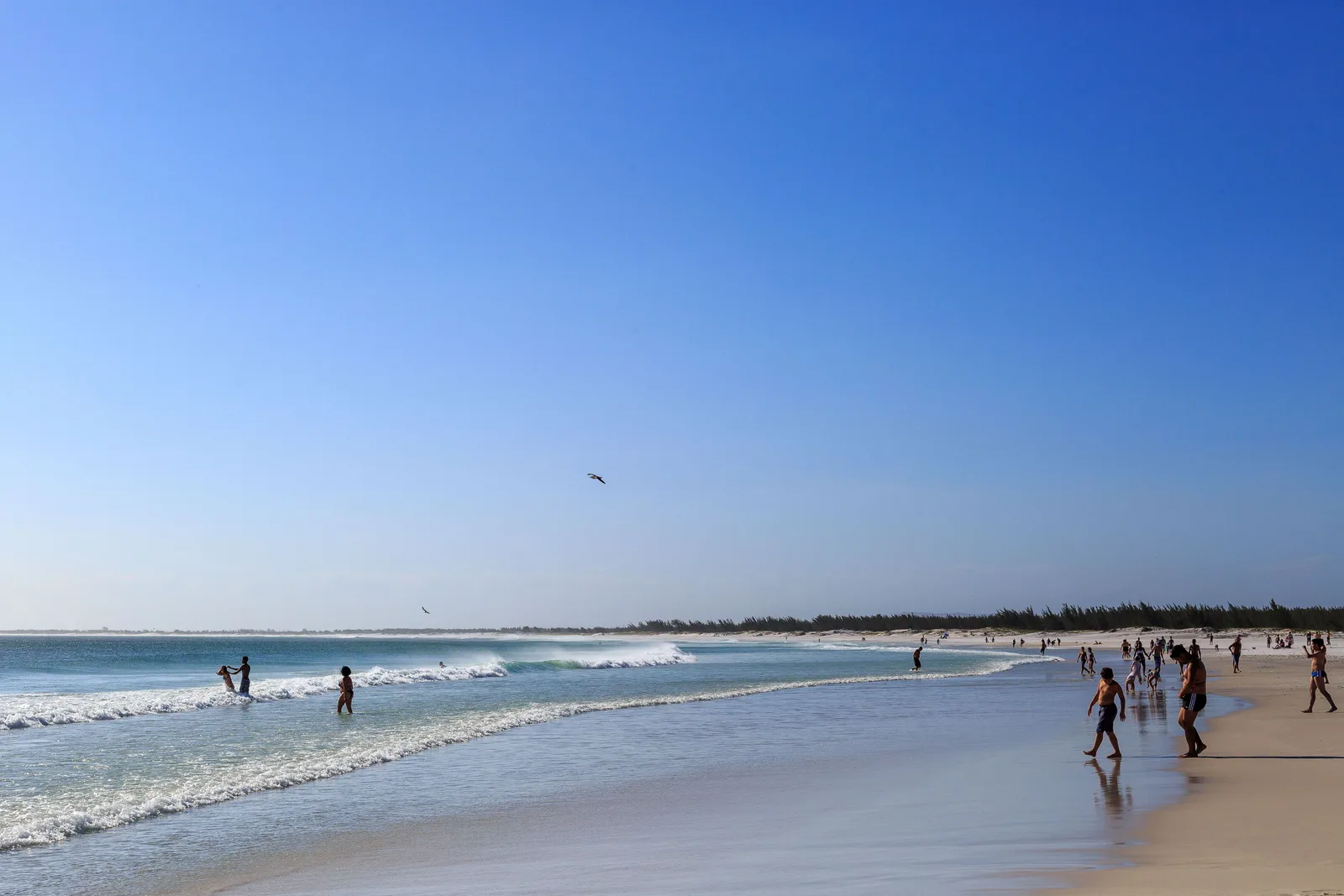
  • The long open beach at Praia Grande in Arraial do Cabo with white surf running up the wet sand and small groups of people walking along the waterline

    Arraial do Cabo · late afternoon

    A walk on Praia Grande

    Praia Grande is the long ocean beach on the western side of Arraial, running away toward Massambaba. It is a surf beach with a shore break rather than a swimming beach, so come for the walk and the light rather than the water.

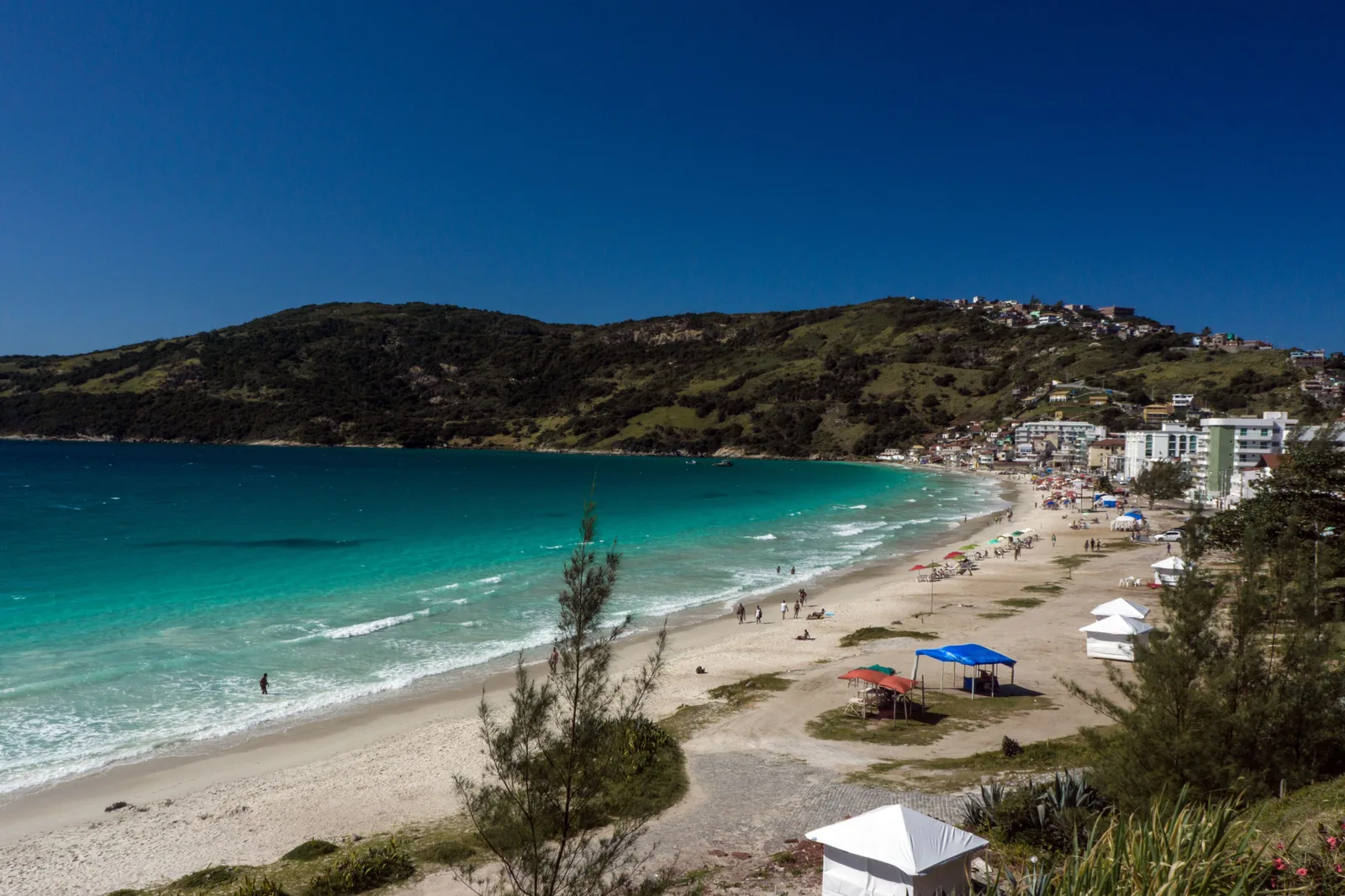
  • The Prainha at Arraial do Cabo seen from a low rise behind the beach: a curve of sand with sunshades and small tents along it, turquoise water with small waves breaking, apartment buildings at the town end and a green headland behind

    Arraial do Cabo · an hour

    The Prainha and its craft market

    Arraial’s town beach, a short curve of calm water with kiosks along the back of it and the hillside houses stacked up behind. It is where the town itself swims, and the covered craft fair beside it sells the usual beachwear and rather better local ceramics. Good for the afternoon you get back from the boat with nothing left in you.

Búzios Beaches

  • The shore at João Fernandes in Búzios seen from a slope above, framed by tall cacti in the foreground, with a narrow strip of beach below, deep blue water and a green headland running out on the far side

    Búzios · half a day

    A morning at João Fernandes

    The sheltered cove on the northeast side of the peninsula, and the one most people mean when they say the water in Búzios is clear. Flat, deep enough to snorkel straight off the sand, rock at both ends, and a row of restaurants along the back charging what a view like that charges. João Fernandinho next door is the smaller, quieter half of the same bay.

  • Calm pale blue water inside Praia da Ferradura in Búzios seen from the sand, with two green headlands framing the narrow mouth of the bay, houses on the left-hand one and a small boat at anchor

    Búzios · a whole day

    Ferradura, the horseshoe

    A near-perfect horseshoe bay with almost no swell inside it, which makes it the family beach and the watersports beach at the same time: kayaks, stand-up boards and small sailing dinghies all work here on a day when the ocean side is unusable. Kiosks and restaurants along the sand, houses on the hills at both ends, and it is about ten minutes by car from the center.

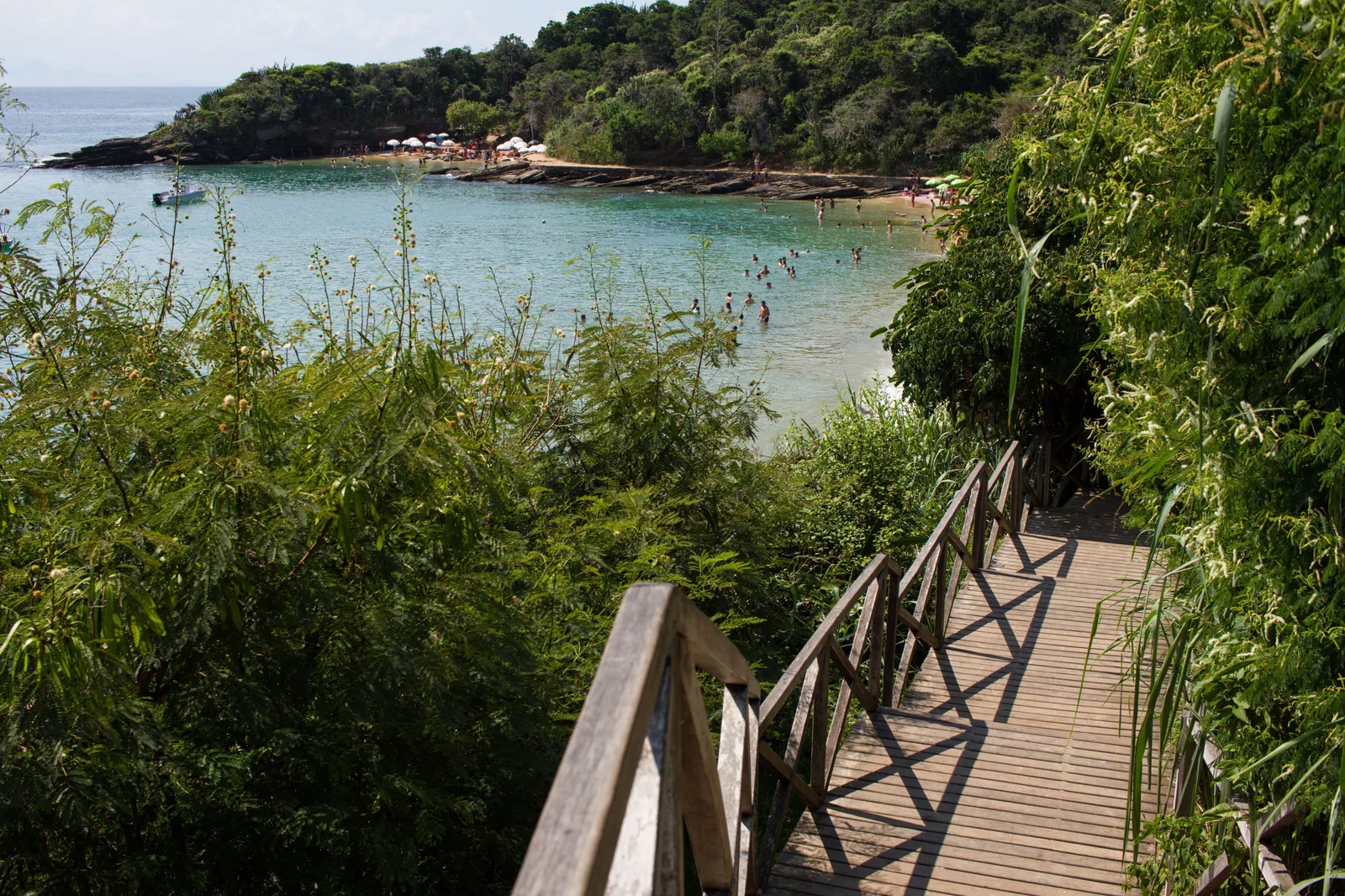
  • A wooden stairway with wooden railings running down through green scrub toward a small cove at Búzios, with swimmers in clear turquoise water and parasols on the sand beyond

    Búzios · a morning

    Azeda and Azedinha

    Two small coves reached on foot from Praia dos Ossos over a headland path, or by boat taxi from the same beach, with no road to either. Clear, calm and shallow. There are caipirinha vendors and not much else, which is the appeal. Go before 11:00am; they are small and they fill.

  • Praia da Tartaruga in Búzios: clear shallow water over pale sand and dark rock in the foreground, a line of parasols and swimmers along the beach beyond, and a low green headland behind

    Búzios · half a day

    Tartaruga

    A sheltered beach on the mainland-facing side with rock shelves at either end and water calm enough to see your feet in. It is the standard stop on the schooner circuit, which means it is busy in the middle of the day and empty either side of that.

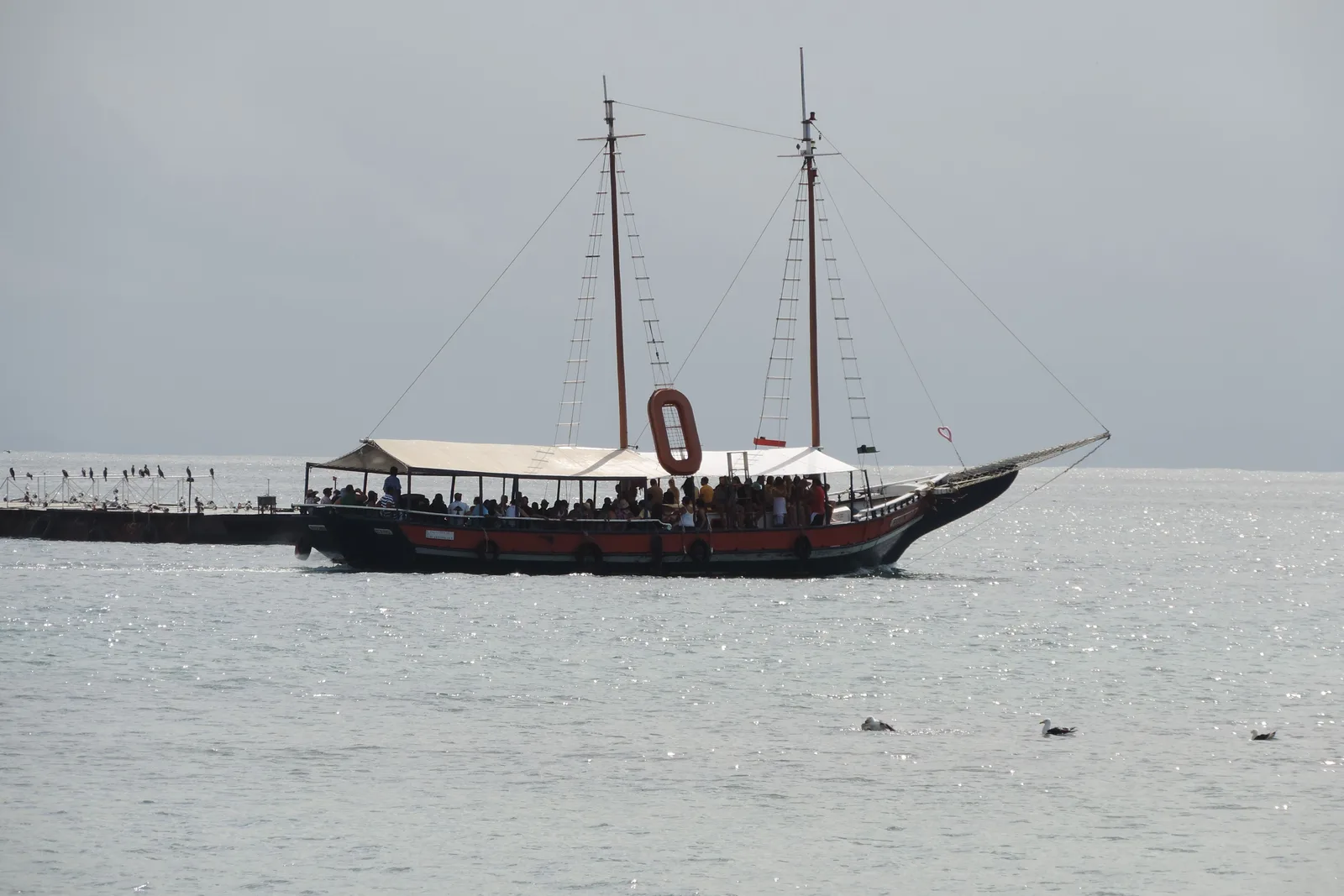
  • A two-masted wooden schooner with a red and black hull and a white canopy over a deck full of passengers, on silver-gray water in the bay at Búzios under an overcast sky, with a jetty behind it

    Búzios · two to three hours

    The schooner circuit

    Two-masted wooden schooners work out of the bay in front of Rua das Pedras and run a loop of the beaches you cannot easily drive to, with swim stops and a great deal of Brazilian pop. It is the lazy way to see the peninsula and it is genuinely the best introduction on a first day, because the coastline makes sense from the water in a way it does not from the road.

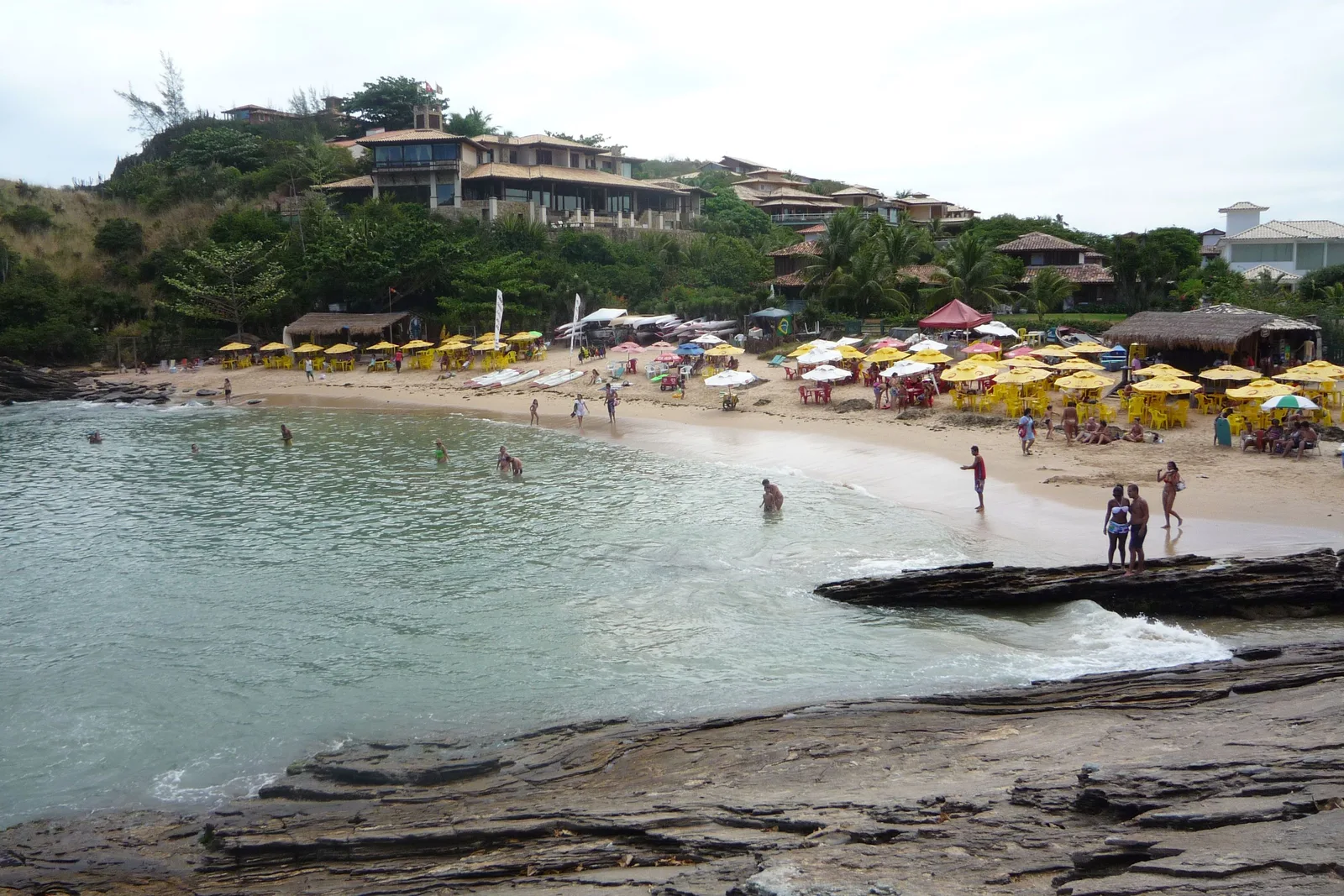
  • The small cove at Ferradurinha in Búzios seen from the flat rock shelf at one end: a crowded beach lined with yellow parasols and kiosks, swimmers in green water, and large houses on the wooded slope behind

    Búzios · two hours

    Ferradurinha

    The little sister of Ferradura, around the headland: a short crescent of sand with a shelf of flat rock along one side that people sit on and jump off.

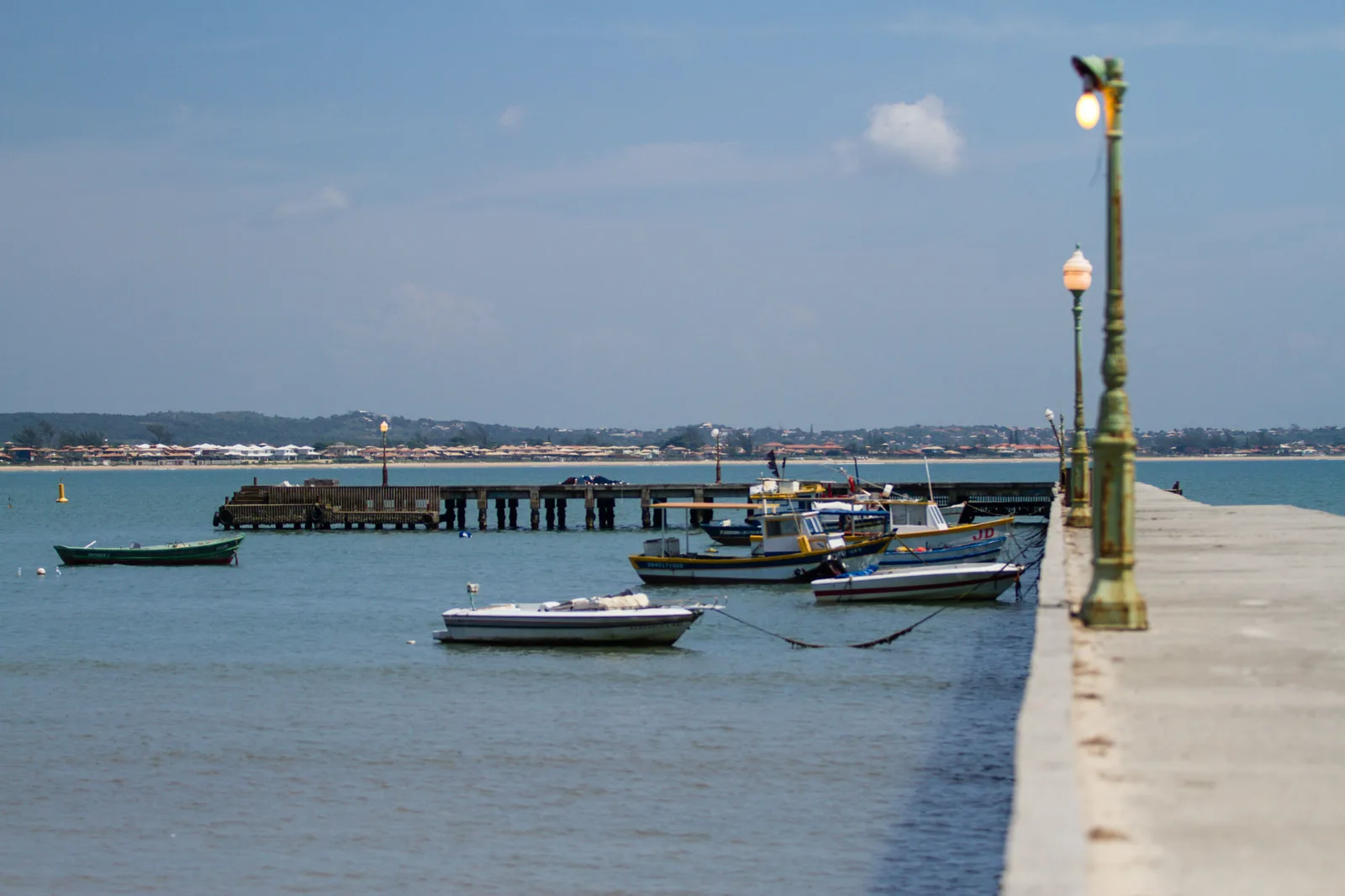
  • A concrete pier at the Porto da Barra in Búzios with green lamp posts along it, a long wooden jetty across the water, and small fishing boats moored on the flat water beside it

    Búzios · an evening

    Manguinhos and the Porto da Barra

    On the mainland side of the isthmus, where the fishing boats and the sailing club are, the Porto da Barra is a waterfront complex of restaurants and shops. It is calmer and less lit than Rua das Pedras and it is where a lot of people prefer to eat. Sunset here looks back across the bay rather than out to sea.

Cabo Frio

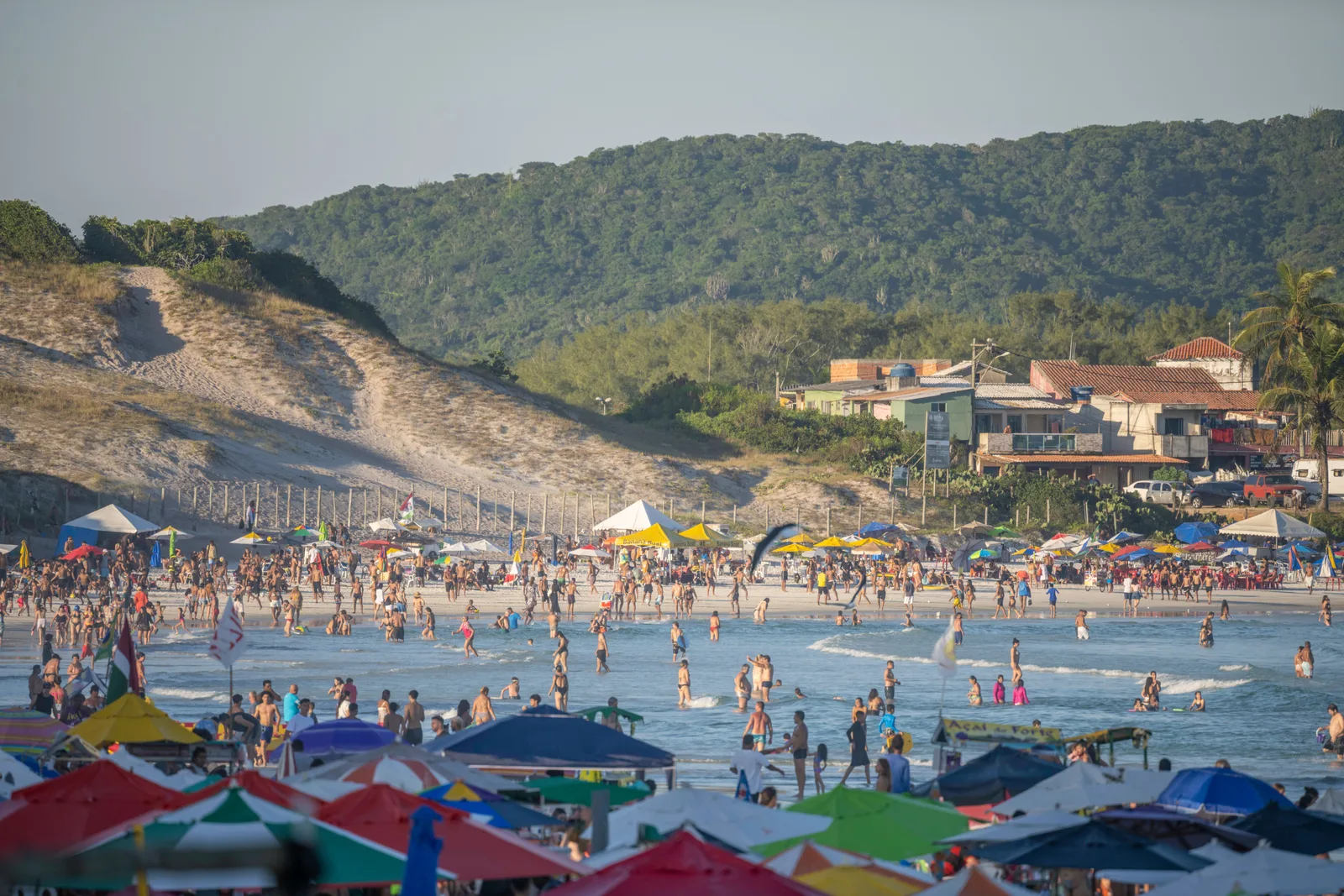
  • A crowded stretch of beach at Cabo Frio packed with colored parasols and swimmers, with white sand dunes and a wooded green hill rising behind the far end

    Cabo Frio · half a day

    An afternoon on Cabo Frio’s beach

    Seven and a half kilometers of open Atlantic sand with a city behind it: apartment towers, thousands of parasols, vendors working the rows, and white dunes at the northern end where the buildings run out. It is not subtle and it is not why you came, but the sand is fine and white, the swimming is real swimming, and it is a genuinely good hot afternoon if you are staying in town.

  • The Forte São Mateus at Cabo Frio seen from the water: a low white fort on a rocky cactus-covered headland with the sea in front of it

    Cabo Frio · half an hour

    The Forte São Mateus

    The 1616 fort on its rock at the southern end of the beach, where the channel from the lagoon meets the sea. Whitewashed walls, a handful of iron cannons still lying on the terrace, cactus growing out of the headland underneath, and a view straight back up the beach. It takes half an hour.

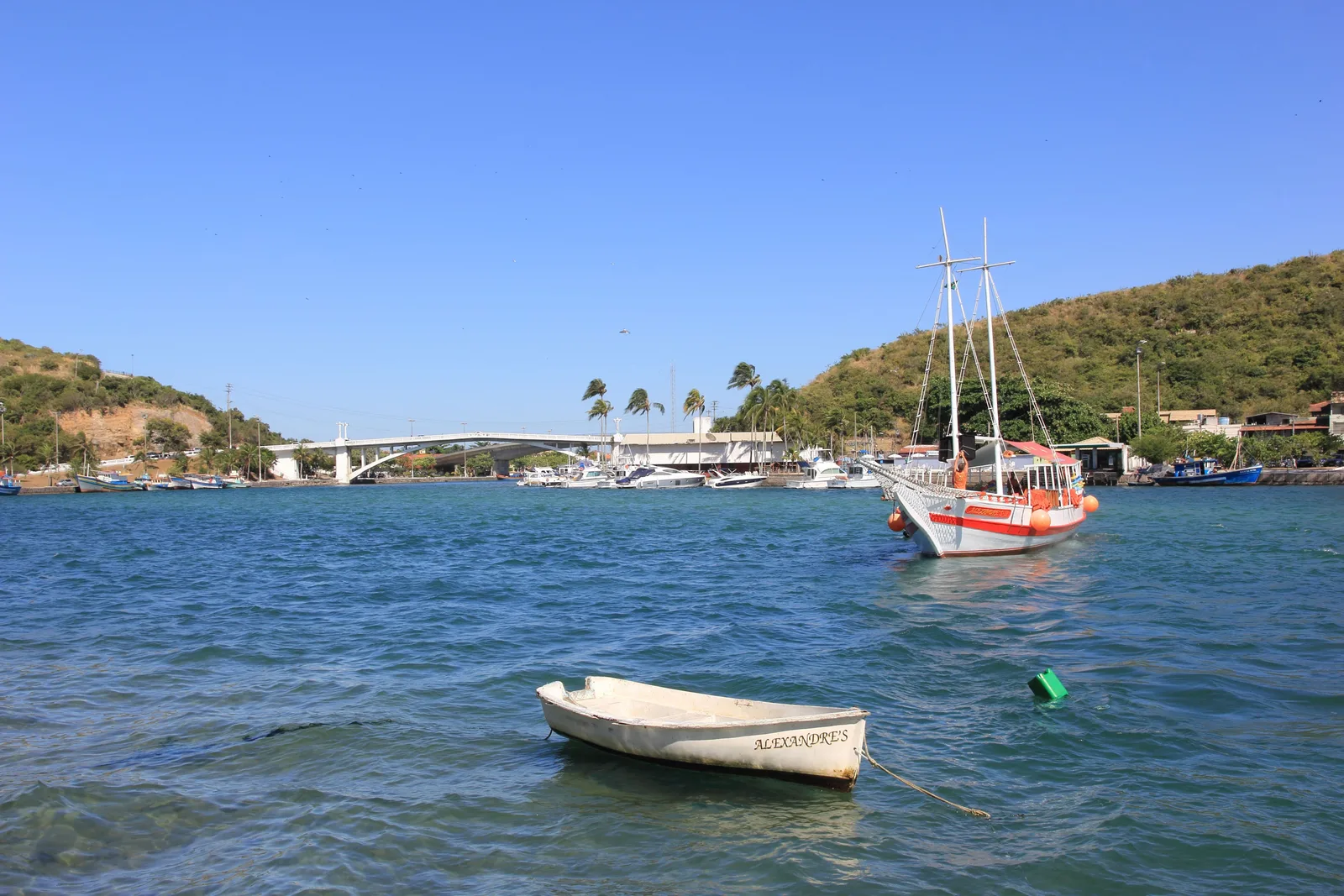
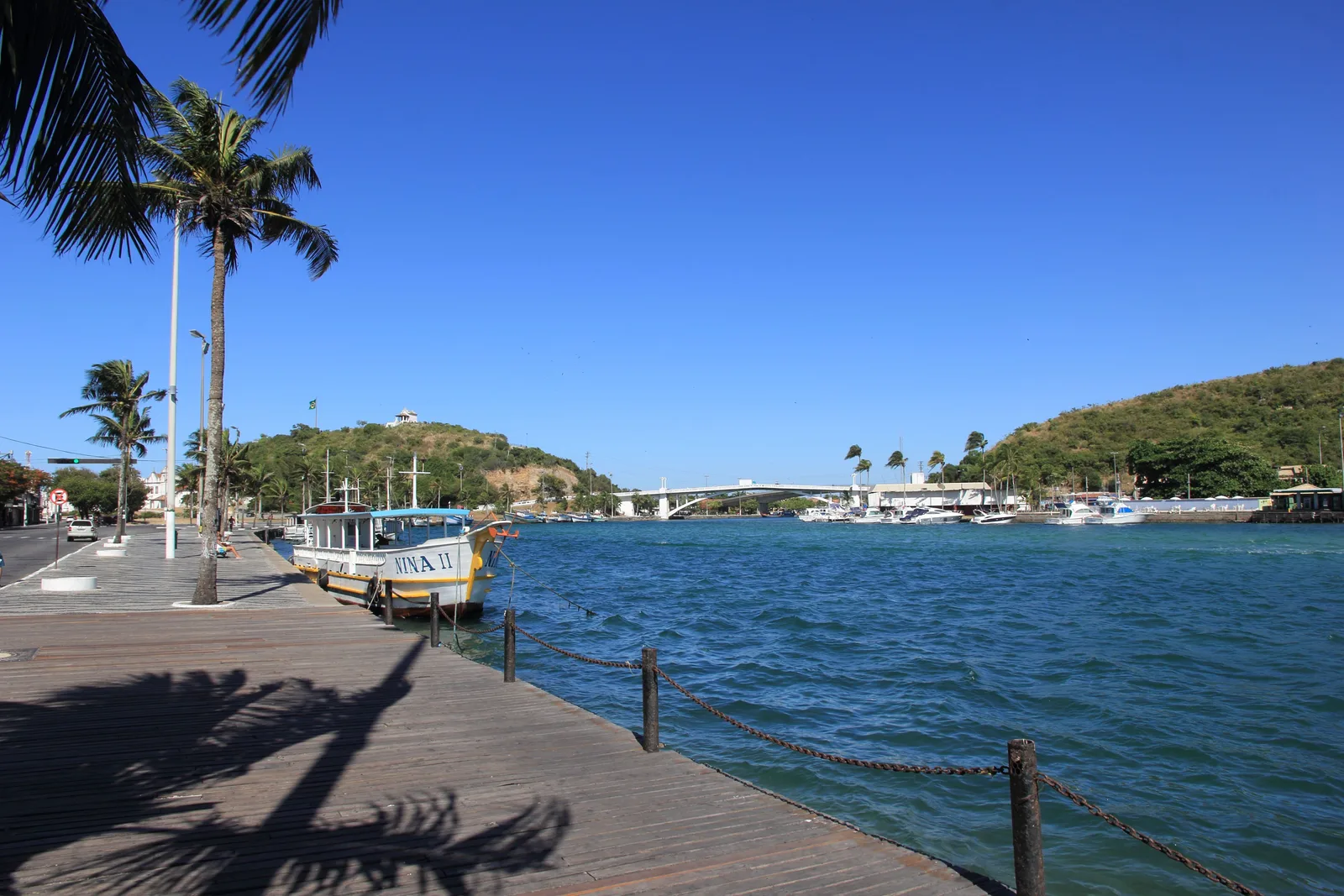
  • The Canal do Itajuru at Cabo Frio: a two-masted schooner and small boats on flat blue-green water, with a road bridge crossing the channel and a green hill behind

    Cabo Frio · an evening walk

    The Canal do Itajuru

    The channel that connects the Lagoa de Araruama to the sea runs straight through the middle of Cabo Frio, and the walk along it is the most pleasant thing in the city: flat green water, moored schooners, the Feliciano Sodré bridge, and a boulevard of bars and restaurants along one bank. Boat trips to the Ilha do Japonês leave from here too.

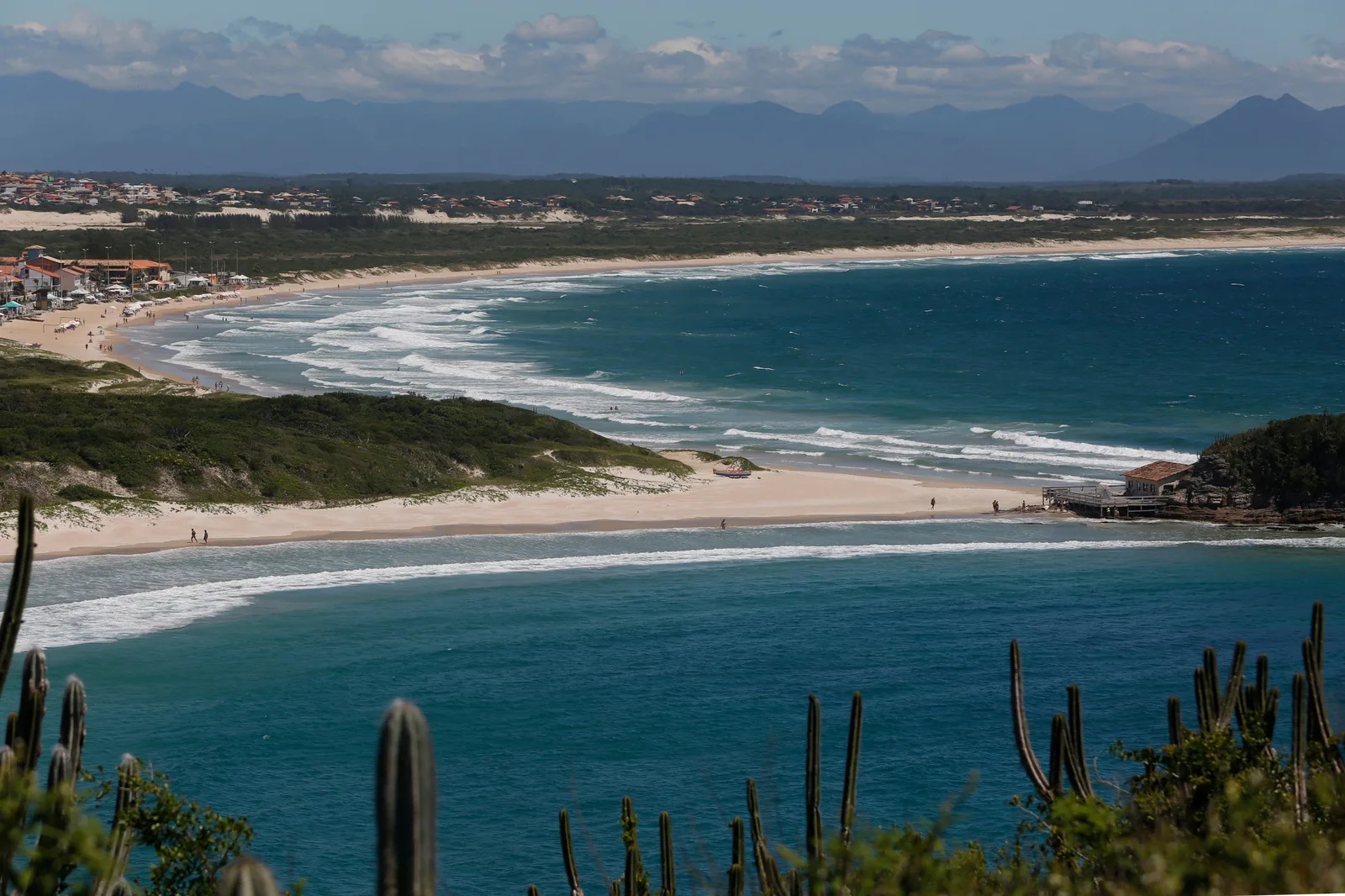
  • Two curving bays north of Cabo Frio seen from a clifftop through cacti: pale beaches along both, deep blue water, and a dark green headland dividing them

    Cabo Frio · half a day

    Praia do Peró and Praia das Conchas

    North of the city the coast opens out into two long bays backed by dunes, and this is the good half of Cabo Frio. Peró is a wide, wind-blown surf beach with a dune field behind it; Conchas, around the headland, is the smaller and calmer of the two. They are twenty minutes from the middle of town.

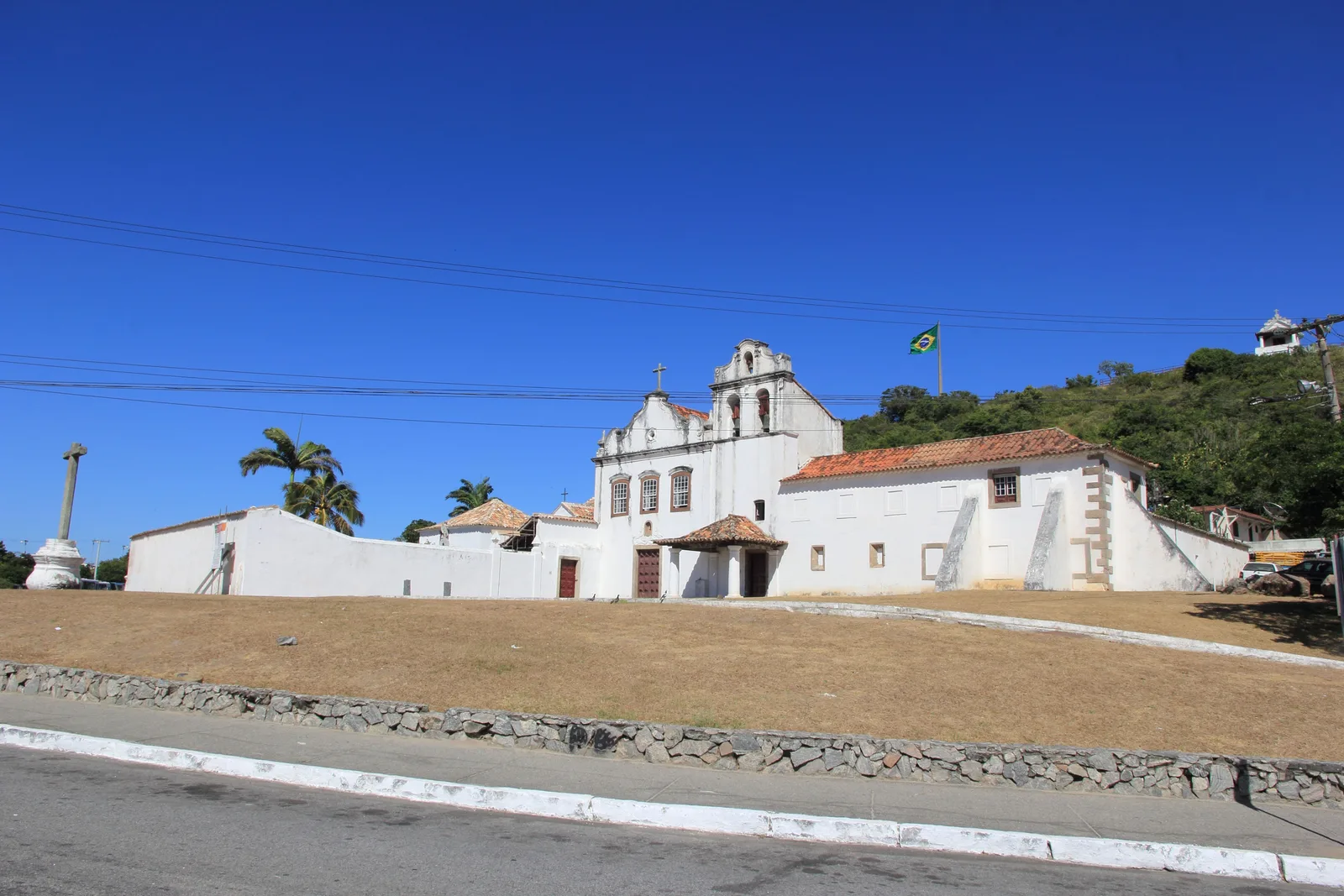
  • The white Convento de Nossa Senhora dos Anjos at Cabo Frio: a long low colonial building with tiled roofs and a curved bell gable, behind a sloping lawn of dry grass, with a stone cross on a column at one end and a green hill behind

    Cabo Frio · half an hour

    The Convento de Nossa Senhora dos Anjos

    A Franciscan convent built at the end of the 1600s on the hill above the old center, whitewashed, plain, and with a small museum of sacred art inside. It is a quiet twenty minutes and it is the other half of the answer to what Cabo Frio was before it was a beach resort. Pair it with the fort and you have seen the city’s history in an afternoon.

Towns & Evenings

  • The Prainha at Arraial do Cabo seen from a low rise behind the beach: a curve of sand with sunshades and small tents along it, turquoise water with small waves breaking, apartment buildings at the town end and a green headland behind

    Arraial do Cabo · an hour

    The Prainha and its craft market

    Arraial’s town beach, a short curve of calm water with kiosks along the back of it and the hillside houses stacked up behind. It is where the town itself swims, and the covered craft fair beside it sells the usual beachwear and rather better local ceramics. Good for the afternoon you get back from the boat with nothing left in you.

  • The Canal do Itajuru at Cabo Frio: a two-masted schooner and small boats on flat blue-green water, with a road bridge crossing the channel and a green hill behind

    Cabo Frio · an evening walk

    The Canal do Itajuru

    The channel that connects the Lagoa de Araruama to the sea runs straight through the middle of Cabo Frio, and the walk along it is the most pleasant thing in the city: flat green water, moored schooners, the Feliciano Sodré bridge, and a boulevard of bars and restaurants along one bank. Boat trips to the Ilha do Japonês leave from here too.

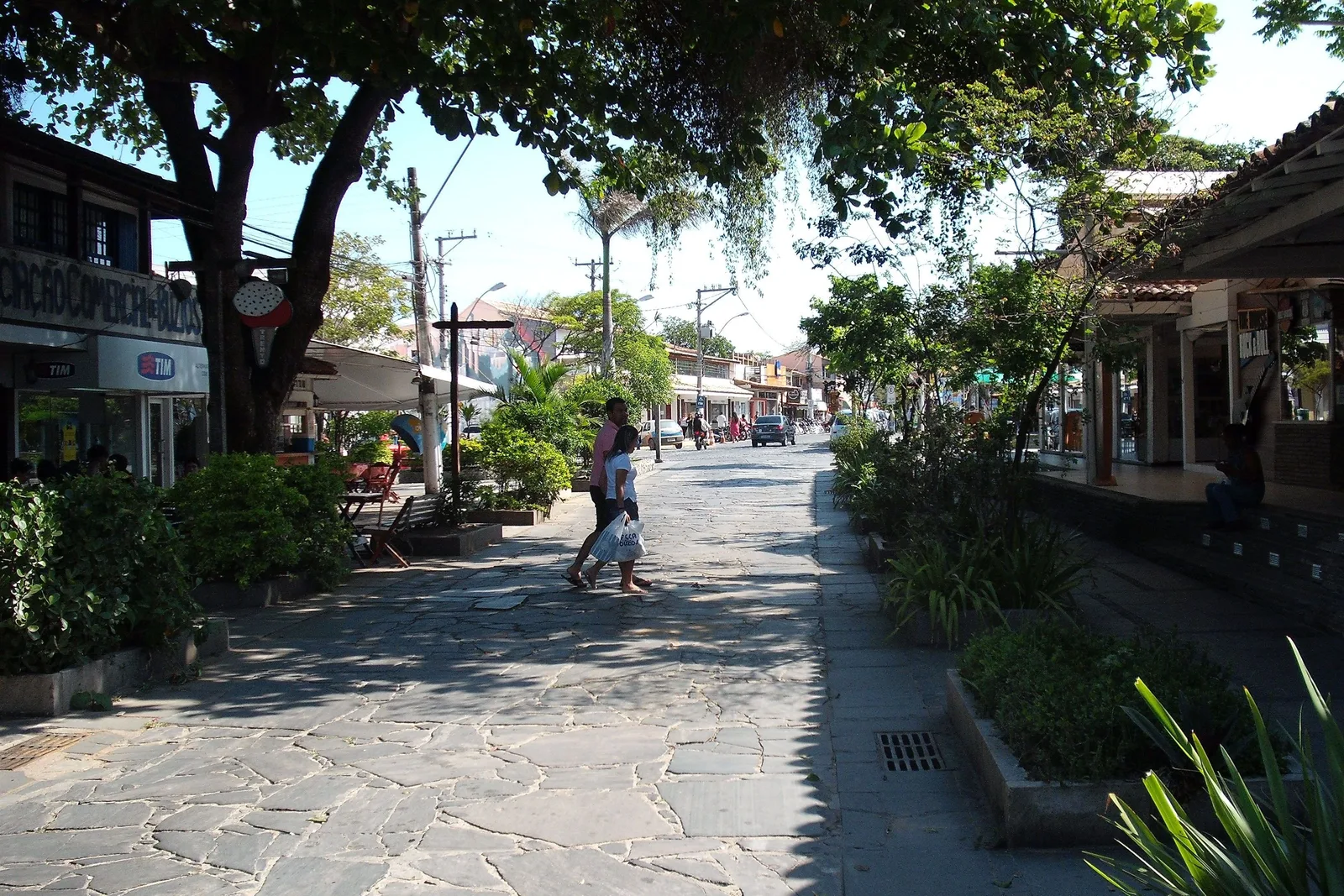
  • Rua das Pedras in Búzios: a street paved in irregular flat stones running between low shopfronts, with trees along one side and a few people walking down the middle

    Búzios · from about 8:00pm

    Walking Rua das Pedras

    The main street of Búzios is irregular stone paving from one end to the other, closed to most traffic in the evening, and about a kilometer long. Shops, restaurants with tables out, bars, galleries, ice cream, and a crowd that moves slowly in both directions. It is the reason a lot of people choose Búzios over Arraial, and the honest description is that it is a very pleasant, quite expensive, slightly self-satisfied resort street.

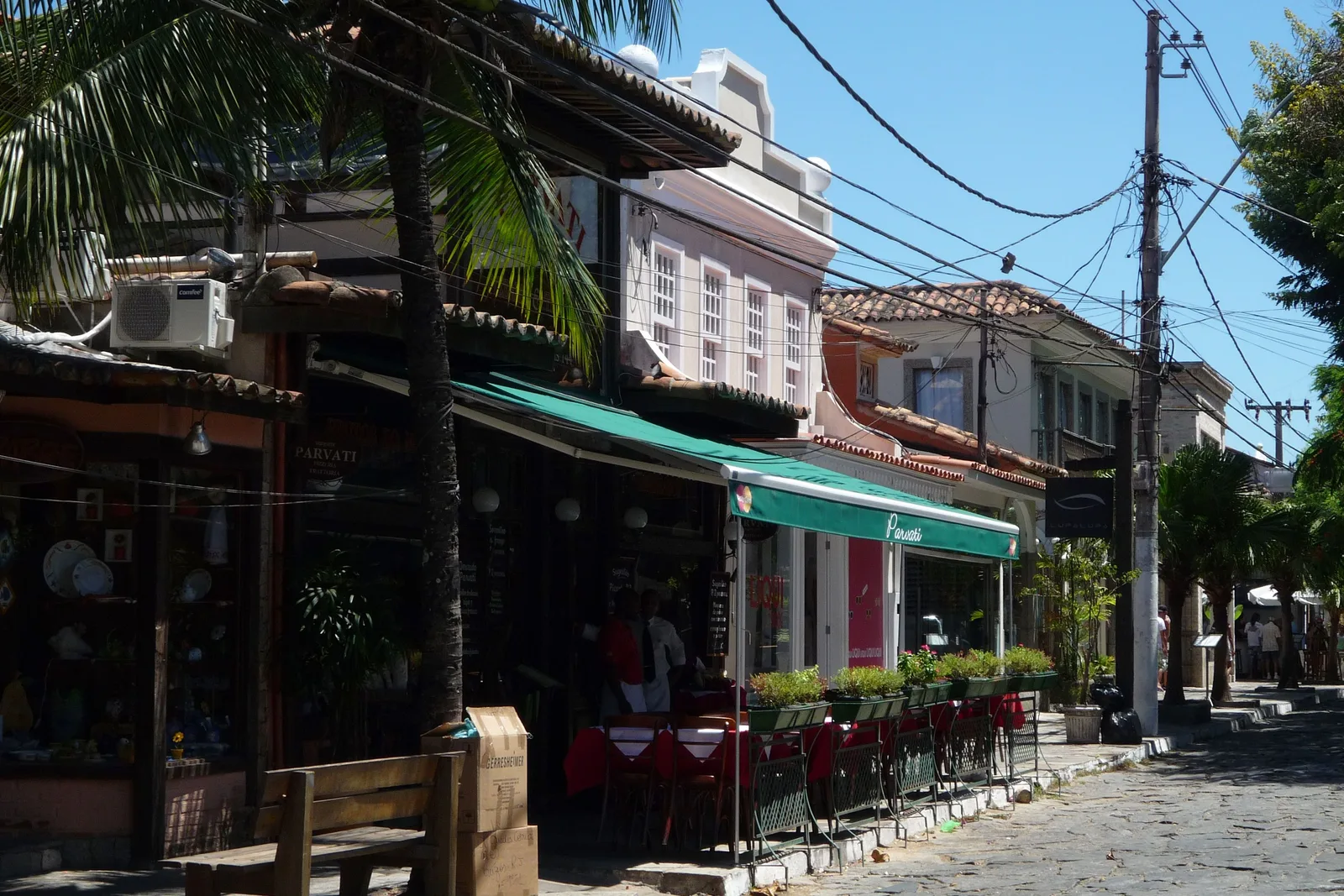
  • A restaurant terrace under a green awning on the stone-paved Rua das Pedras in Búzios, with tables in red cloths set out behind a railing of planters

    Búzios · a whole evening

    Dinner out in Búzios

    The restaurants run from seafood on the sand at Manguinhos to serious Italian and French rooms behind Rua das Pedras that would not be out of place in Ipanema, at Ipanema prices. Book on a summer weekend. Eat late; nothing here fills before 9:00pm.

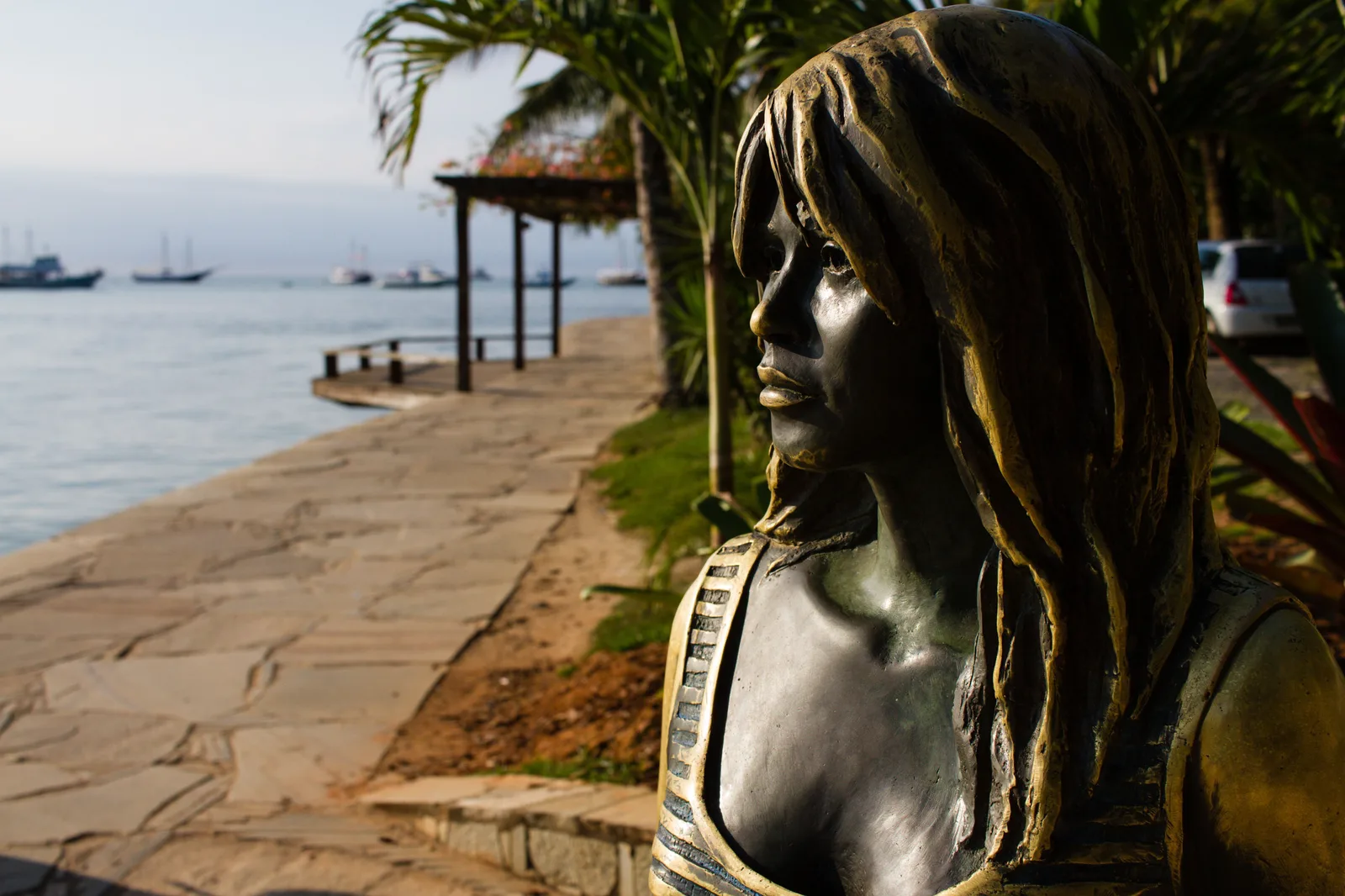
  • The head and shoulders of the bronze Brigitte Bardot statue on the Orla Bardot at Búzios, close up in profile, with the paved waterfront walk, a pergola, palms and moored boats on the bay behind

    Búzios · ten minutes

    The Bardot statue on the Orla

    A bronze of Brigitte Bardot by Christina Motta sits on the seafront walk named after her, and there is usually a small line of people waiting to be photographed with it. Take the picture, and then keep walking to the Três Pescadores at the far end, by the same sculptor and the better piece.

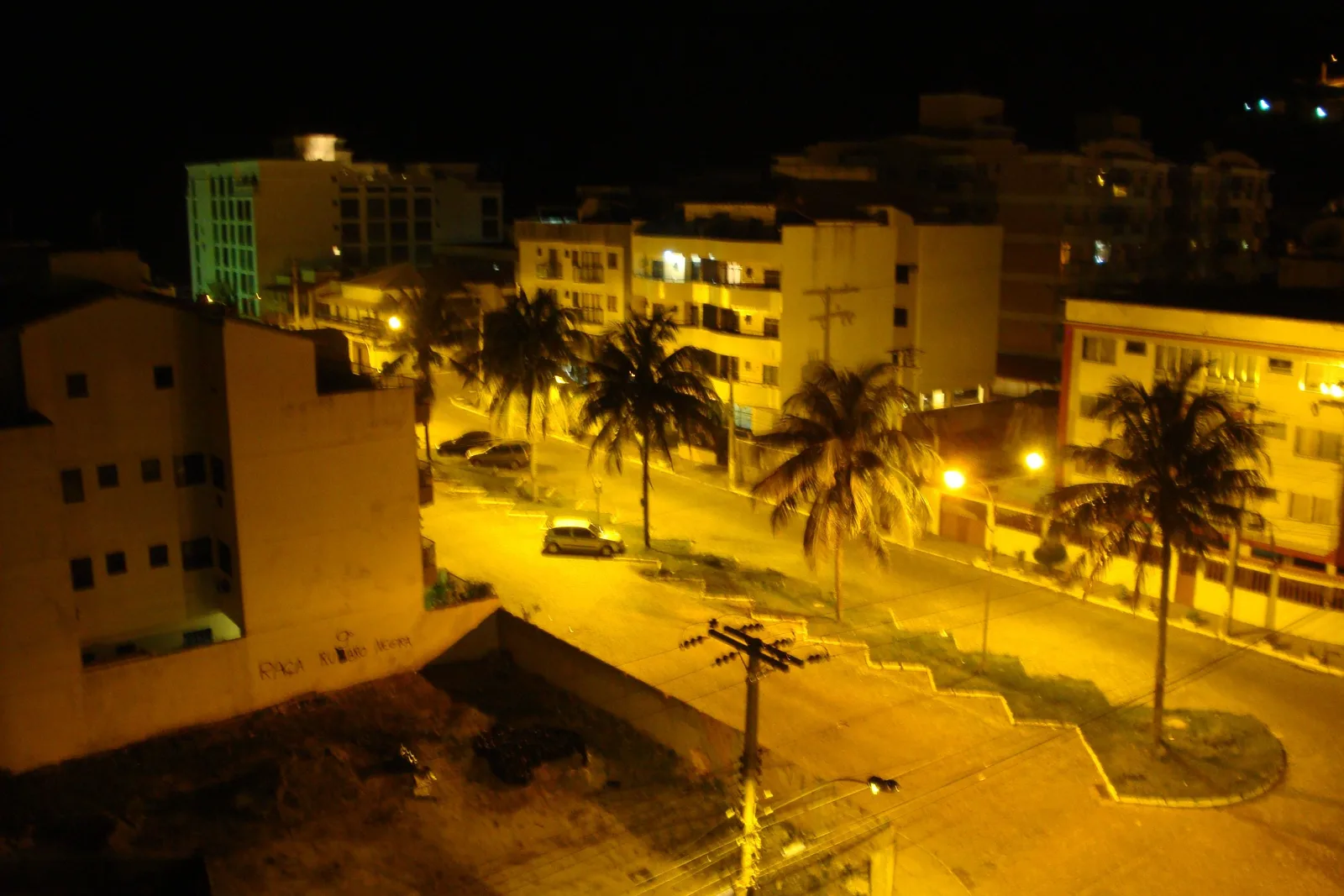
  • A street in Arraial do Cabo at night seen from above under orange streetlights: four- and five-story apartment buildings, a row of palm trees along the road and a few parked cars

    Arraial do Cabo · after the boats come in

    An evening in Arraial do Cabo

    Arraial at night is the opposite of Búzios and that is the point. A handful of lit streets behind the Prainha, pizza and grilled fish, families out, boat crews drinking where they moored, and everything finished by 11:00pm. If the reason you came to this coast is the water rather than the wine list, this is the town to sleep in.

Where to stay

Three towns, and they are not interchangeable.

This is the decision that shapes the trip, and it is genuinely open. Búzios is where the restaurants and the good rooms are, and it is expensive. Arraial do Cabo is where the water is. Cabo Frio is in the middle of both and is neither. Most first-time visitors should split the difference in favor of Búzios and drive to Arraial for a day, which is what the itinerary below does.

Drag and zoom to explore.

Tap an area to open it and see it on the map

  • Our pick

    Best for: A first trip, and walking to dinner

    The waterfront at Praia da Armação in Búzios in a wide frame: a curve of sand with small boats moored just offshore, low buildings along the back of the beach and green hills behind the town

    Armação, between Praia dos Ossos and Praia da Armação, with Rua das Pedras and the Orla Bardot running through the middle of it. Everything is a walk: the restaurants, the bars, the schooners, the craft stalls, two swimmable town beaches and the path over the headland to Azeda. You pay for that and it is worth paying for on a short stay, because the alternative is driving to dinner every night. Take it unless you have a specific reason not to.

    • Walk to dinner
    • Most restaurants
    • Boats from the door
    • Priciest in town
  • Best for: A week, a pool, and a car

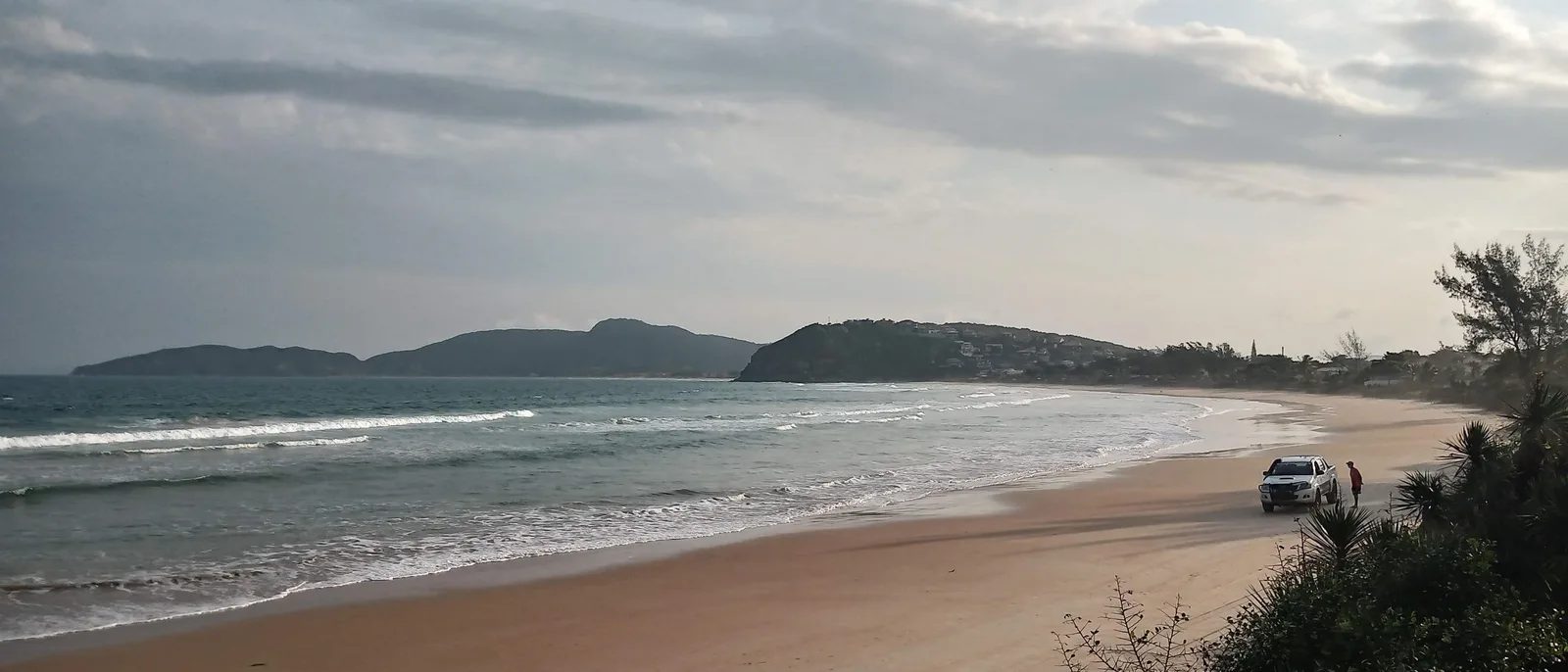
    Praia de Geribá in Búzios in a wide frame under a cloudy sky: a long curve of sand with small surf breaking, a pickup truck parked on the beach, a low headland with houses at the far end and palms in the foreground

    The pousadas and villas spread around the peninsula above Geribá, Ferradura, João Fernandes and Tucuns. The rooms are better than in town for the money, most of them have a pool, and you wake up above a beach rather than above a street. The cost is that you will drive or ride to everything, including dinner, and the far beaches are twenty minutes from the center. Right for a week, wrong for two nights.

    • Best rooms
    • Pools
    • Quiet
    • You need a car
  • Best for: The water, for less

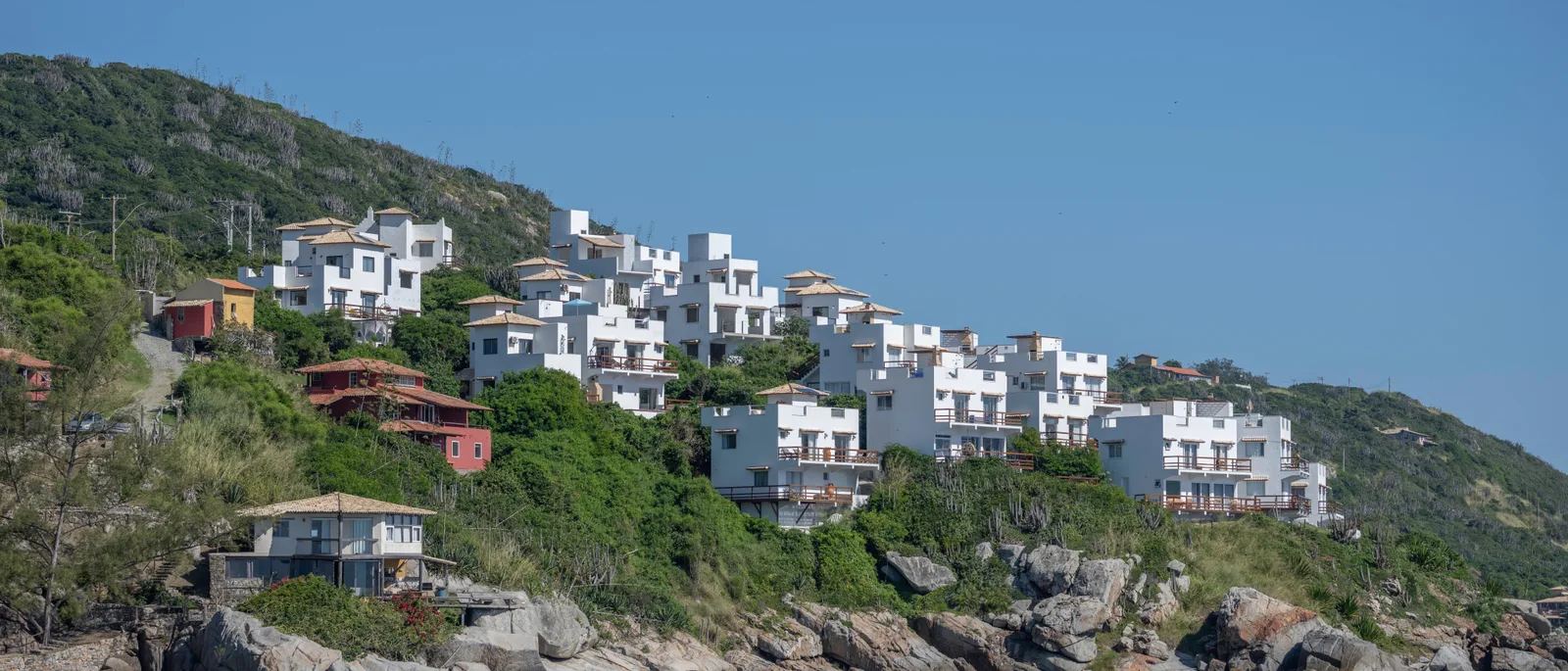
    White houses and a few red ones stacked up a steep green hillside at Arraial do Cabo in a wide frame, with gray boulders along the foot of the slope

    A working fishing town of 31,000 with simple pousadas, a very good ratio of price to location, and the boats leaving from the end of the street. Stay here if the trip is about diving, snorkeling and getting on the water every day, and if you would rather spend the difference on a boat than on a room. The trade-off is real: the evenings are quiet, the restaurants are ordinary, and it can feel like a day-trip town after the last boat comes in.

    • Cheapest
    • Boats from the door
    • Best diving
    • Quiet evenings
  • Best for: Being in the middle of everything, cheaply

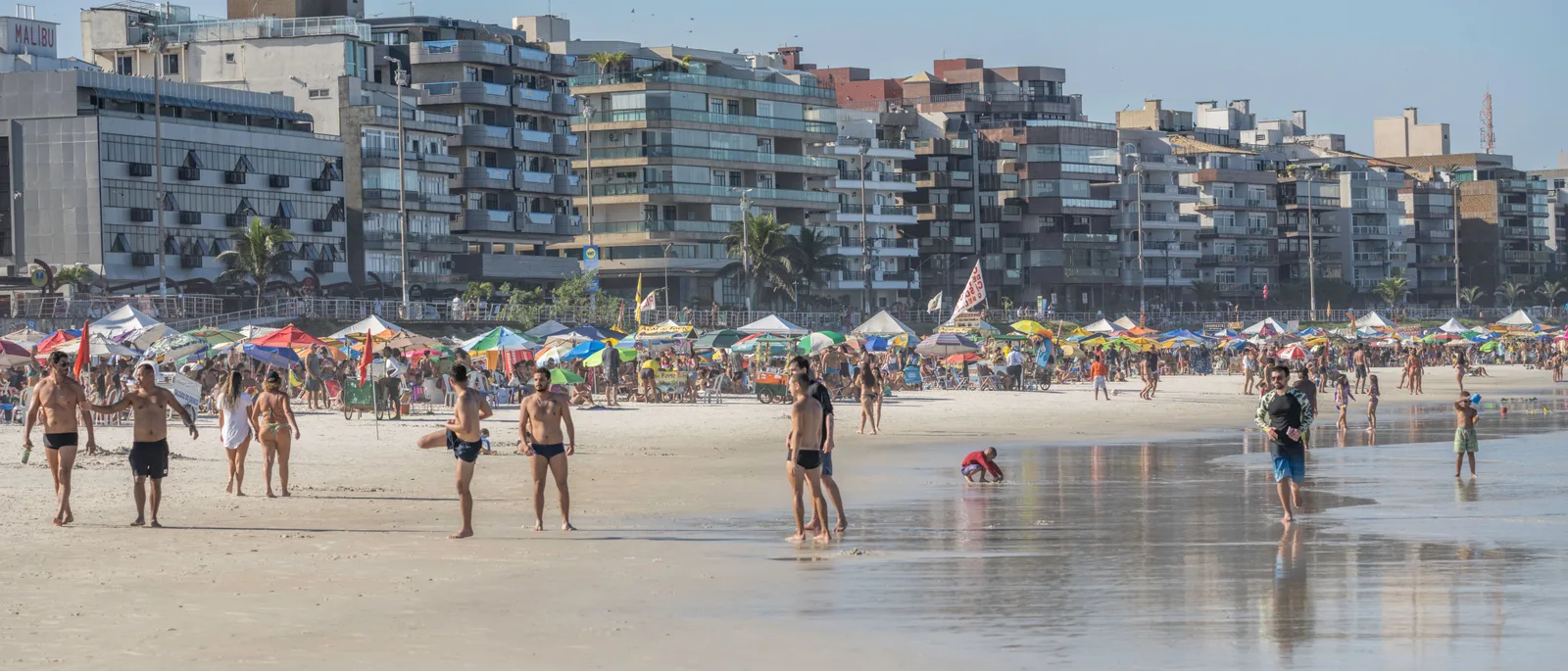
    A wide frame of the beach at Cabo Frio: rows of colored parasols packed along the back of the sand, people walking on the wet foreshore, and a solid wall of tall apartment blocks behind

    The practical choice, and this page is not going to pretend it is more than that. Cabo Frio is a city of 222,000 sitting between the two towns, about 22 km from Búzios and 16 from Arraial, with the airport, cheaper rooms than Búzios, a good seven-and-a-half-kilometer beach and a nice walk along the canal. It is also the least interesting place on this page: a Brazilian coastal city with the traffic and the concrete to match, and a beachfront that could be anywhere. Stay here if you are driving to a different beach every day and the room is only for sleeping in.

    • In the middle
    • Cheapest city rooms
    • Has the airport
    • Least interesting

A working plan

Three nights, and one of them is the boat day.

This is built from a base in Búzios, because that is where most first-time visitors sleep. Only one day here is weather-dependent and it is the Arraial boat day, so keep it flexible and take the first calm morning you get rather than the day you planned.

  1. 01
    A long curving beach in Búzios lined with parasols and kiosks below steep green hills, with turquoise water and small waves breaking over rocks in the foreground

    Búzios peninsula

    Arrive and get in the water

    Out of Rio in the morning, on a Búzios beach by lunchtime. Ferradura if the sea is up, João Fernandes or Azeda if it is not, and then the schooner circuit or a slow walk around the headland. Dinner on Rua das Pedras and the Orla Bardot afterward.

  2. 02
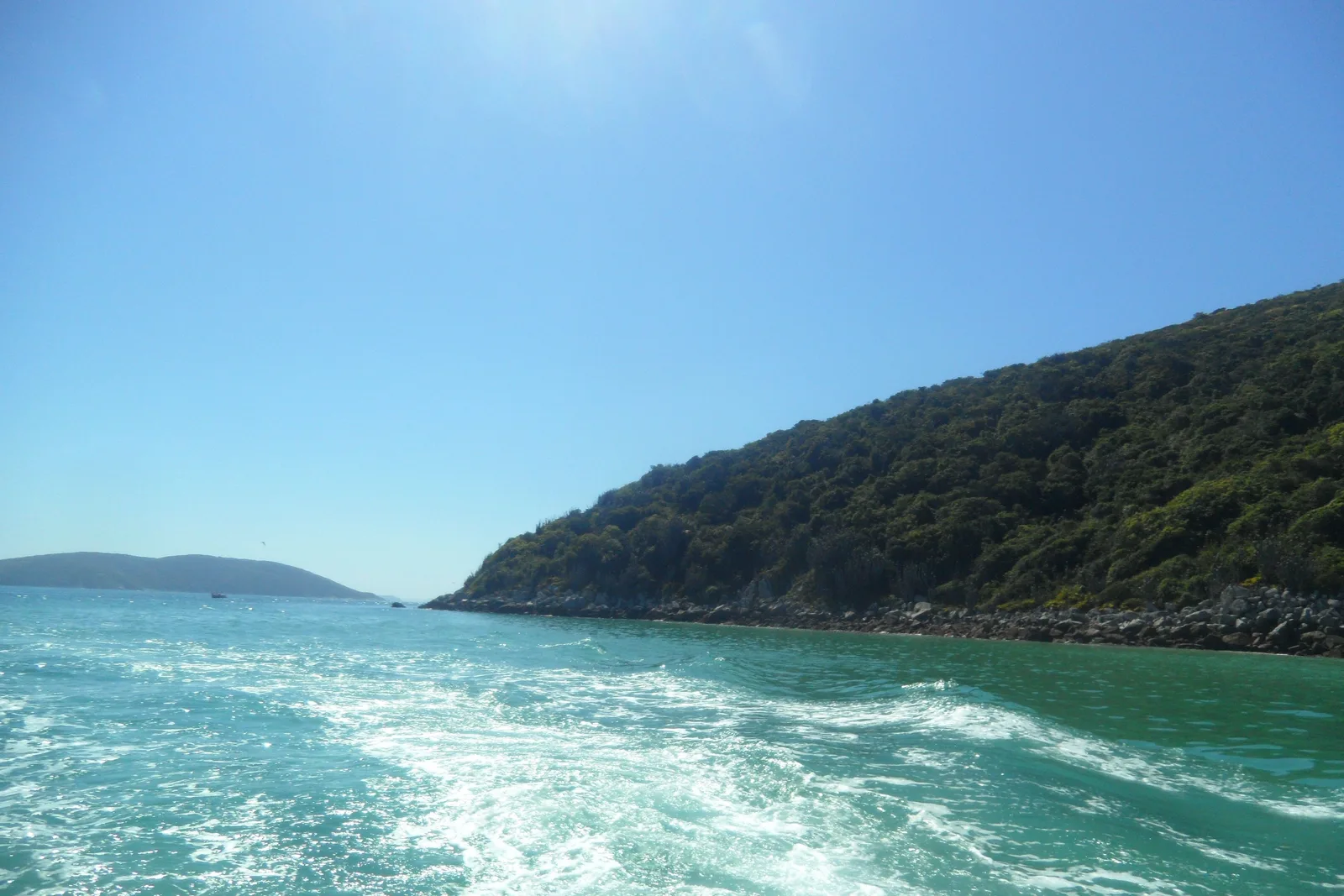
    The foaming wake of a moving boat on green-turquoise water at Arraial do Cabo, running past a forested headland with a boulder shore, and a low hill on the horizon

    Arraial do Cabo & Ilha do Cabo Frio

    The Arraial boat day

    An hour’s drive southwest and onto the first boat out of Praia dos Anjos: the Gruta Azul, the Fenda, a snorkel stop, and the landing at Praia do Farol. Back on the sand by mid-afternoon for the Prainha.

  3. 03
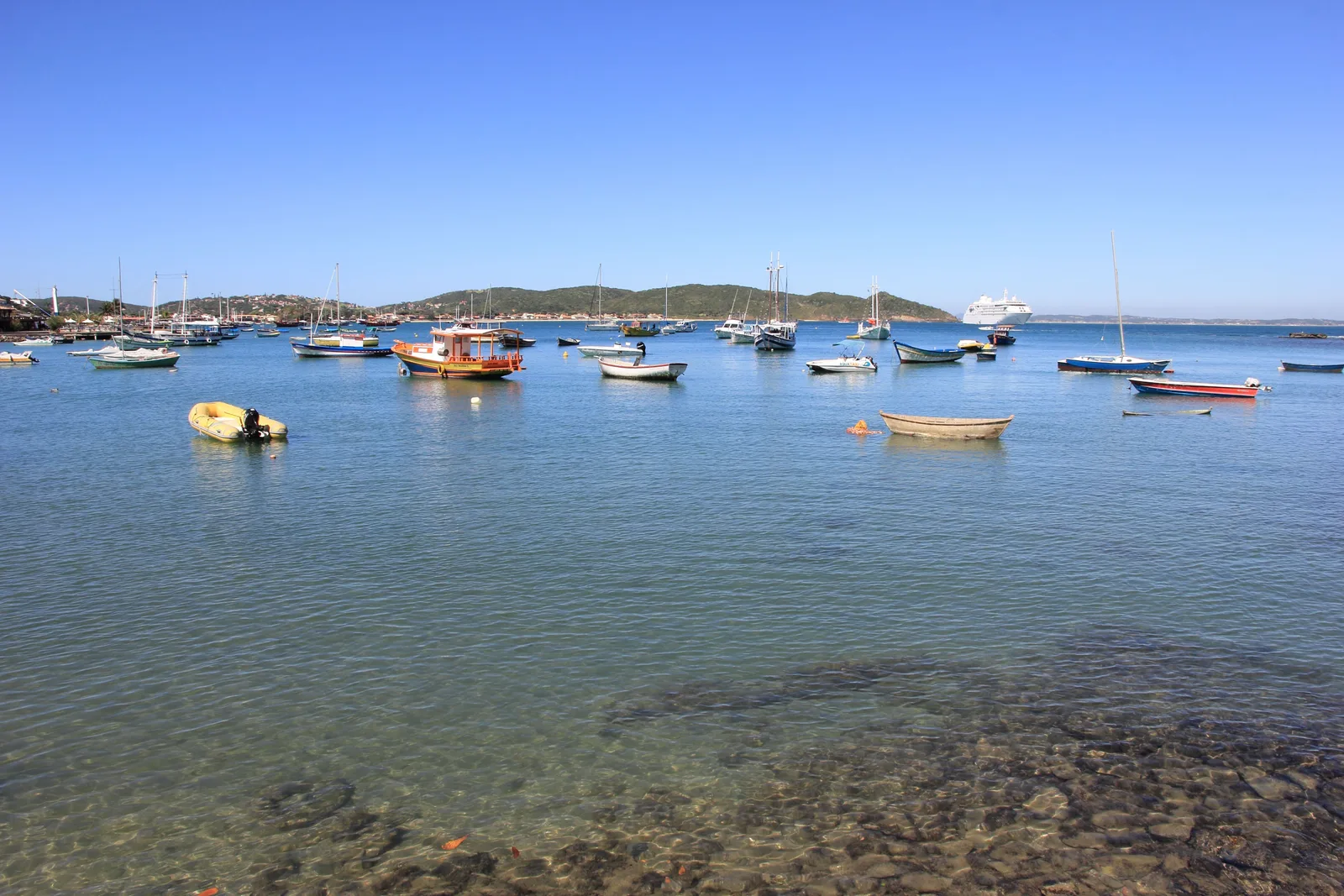
    Clear shallow water over a bed of stones in the foreground at Búzios, with dozens of small boats and yachts moored beyond it, a cruise ship out in the bay and low green hills along the far shore

    Búzios

    The far beaches and the town

    The beaches you did not get to on day one: Tucuns and Geribá at the ocean end, or the walk over to Azeda and Azedinha. Back into town in the late afternoon for the Três Pescadores at sunset, and eat at Manguinhos or the Porto da Barra rather than on Rua das Pedras.

  4. 04
    A boardwalk running along the Canal do Itajuru at Cabo Frio under palm trees, with a moored boat on the rippling water and the road bridge crossing the channel beyond

    Cabo Frio

    Cabo Frio on the way out

    Break the drive back to Rio in the middle: the Forte São Mateus, the walk along the Canal do Itajuru, and lunch on the boulevard. If you have the whole day, go north to Praia do Peró and the dunes first and leave in the afternoon.

This is a starting shape, not a fixed departure — we rearrange it around your dates. Have it built for you

Timing

A dry corner of a wet coast, and a sea that runs cold.

Two things make the weather here unlike the rest of the Rio coast. The first is that it is dry: the Região dos Lagos gets 893 mm of rain a year at the nearest official station, which is why the landscape is cactus and restinga scrub rather than rainforest. The second is the sea. Monthly means run from 21°C in September to 25°C in March and April, and no month here reaches the 26 to 29 you get in the northeast. Air temperature is straightforward: hot and bright from December to March, mild and clear from May to September.

Rainfall, rain days, air and sea temperature and UV for the Região dos Lagos, month by month. Choose a month to see what the weather is doing then.

January

Good
Air
23–32°C 73–90°F
Sea
24°C 75°F
UV
11 Extreme
Rain
8 days 104 mm / 4.1 in

Peak Brazilian summer. Hot, bright, packed, and expensive, with 234 hours of sun on eight rain days. The sea is in its warm half, with the standing caveat that a northeast blow can cool it quickly.

February

Best
Air
24–32°C 75–90°F
Sea
24°C 75°F
UV
11 Extreme
Rain
6 days 61 mm / 2.4 in

The peak. The sunniest month of the year at 237 hours and the hottest at 32.2°C, on only 61 mm of rain. Carnival falls in February or March.

March

Good
Air
23–31°C 73–88°F
Sea
25°C 77°F
UV
10 Very high
Rain
8 days 109 mm / 4.3 in

The warmest sea of the year and one of the three wet months, at 109 mm across eight days. Still 31°C by day and 218 hours of sun, and the crowds have gone home after Carnival.

April

Good
Air
22–29°C 72–84°F
Sea
25°C 77°F
UV
8 Very high
Rain
6 days 65 mm / 2.6 in

The quiet month that still feels like summer: 29°C, 213 hours of sun, 65 mm of rain, and the sea still at its annual maximum.

May

Good
Air
19–27°C 66–81°F
Sea
24°C 75°F
UV
6 High
Rain
7 days 75 mm / 3.0 in

The turn. Days still reach 27°C and the evenings drop to 19°C, the sea starts to cool, and the light gets long and clear. Good for walking the headlands, marginal for a whole day on the sand.

June

Good
Air
18–26°C 64–79°F
Sea
23°C 73°F
UV
5 Moderate
Rain
5 days 41 mm / 1.6 in

One of the two driest months of the year at 41 mm across five rain days. Bright, cool and empty. Swimming is for the committed and the boats still run.

July

Good
Air
18–26°C 64–79°F
Sea
22°C 72°F
UV
5 Moderate
Rain
6 days 53 mm / 2.1 in

The coolest month: 26°C by day, 17.8°C at night, dry and often windy. Brazilian school vacations fill the towns for two weeks in the middle without warming anything up.

August

Good
Air
18–27°C 64–81°F
Sea
22°C 72°F
UV
6 High
Rain
5 days 36 mm / 1.4 in

The driest month of the year at 35.5 mm on five rain days, with 210 hours of sun. Clear, cool and quiet.

September

Trade-offs
Air
19–27°C 66–81°F
Sea
21°C 70°F
UV
8 Very high
Rain
7 days 62 mm / 2.4 in

The coldest sea of the year, colder than midwinter. It is also the second least sunny month at 177 hours.

October

Trade-offs
Air
21–28°C 70–82°F
Sea
22°C 72°F
UV
9 Very high
Rain
8 days 65 mm / 2.6 in

Spring on land and still winter in the water: warm afternoons, 185 hours of sun, and a sea barely off its annual low. The last quiet month before the season.

November

Trade-offs
Air
21–29°C 70–84°F
Sea
23°C 73°F
UV
10 Very high
Rain
10 days 112 mm / 4.4 in

The most rain days of any month, ten, and the fewest hours of sun at 175. The sea is on its way back up and the towns are filling. A month with a genuine catch in it.

December

Good
Air
23–30°C 73–86°F
Sea
24°C 75°F
UV
10 Very high
Rain
9 days 112 mm / 4.4 in

Hot again at 30°C, and one of the three wet months at 112 mm across nine days. Quiet until about the twentieth, and then the whole of Rio arrives and stays until Carnival.

  • Best The one or two peak months
  • Good A real recommendation
  • Trade-offs Workable, with a catch
See Búzios & Arraial do Cabo on the Brazil calendar

UV is the monthly average of the daily peak, 2022 to 2025, calculated from Copernicus Atmosphere Monitoring Service data. Weather data by Open-Meteo.com, CC BY 4.0.

For the weather

February

The sunniest month of the year at 237.1 hours and the hottest at 32.2°C, on 61 mm across six rain days, which is dry for high summer here (INMET 1991–2020 normals, Iguaba Grande station). Carnival falls in February or March.

For the warmest sea

March–April

The annual maximum, and it is 25°C. That is the warmest this water gets in any month (NOAA OISST v2.1, 2021–2025 monthly means off Cabo Frio). Late March and April are also the first weeks after the Brazilian summer season ends.

The cold-water stretch

September–November

The sea bottoms out at 21°C in September, colder than it is in July. These are also the three least sunny months of the year on the record, at 176.6, 185.3 and 175.4 hours. Good walking, poor swimming.

About the rain

The single most useful thing to know about this coast is that it is dry. INMET’s 1991–2020 normals for the Iguaba Grande station, 83114, give 893.3 mm of rain a year across 85 rain days, which is a little under half what Salvador gets. There is no wet season and no dry season in the way most of Brazil has one: the wettest month, November, gets 112 mm and the driest, August, gets 36, and that is the whole range. What you get instead is a cactus-and-scrub landscape, salt pans on the lagoon behind the towns, and a reasonable chance of sun in any month you pick.

Two caveats on the numbers above, both of them honest limits rather than doubts. First, the station is a proxy and it is not on the ocean. Neither Búzios nor Arraial do Cabo has a station in INMET’s normals, and Iguaba Grande sits 32 km west of Búzios on the shore of the Lagoa de Araruama, which runs hotter on a summer afternoon than a beach does. Second, the sea column is not from that station at all. It is NOAA’s OISST v2.1 satellite and buoy analysis, monthly means over 2021 to 2025 for the cell just offshore, cross-checked against Open-Meteo’s marine model, which agrees within half a degree every month. An older in-situ record taken on the Cabo Frio coast between 1971 and 1980 runs about four degrees colder and puts the annual minimum in October rather than September, so treat 21°C as the modern satellite answer rather than the last word.

The dates worth planning around

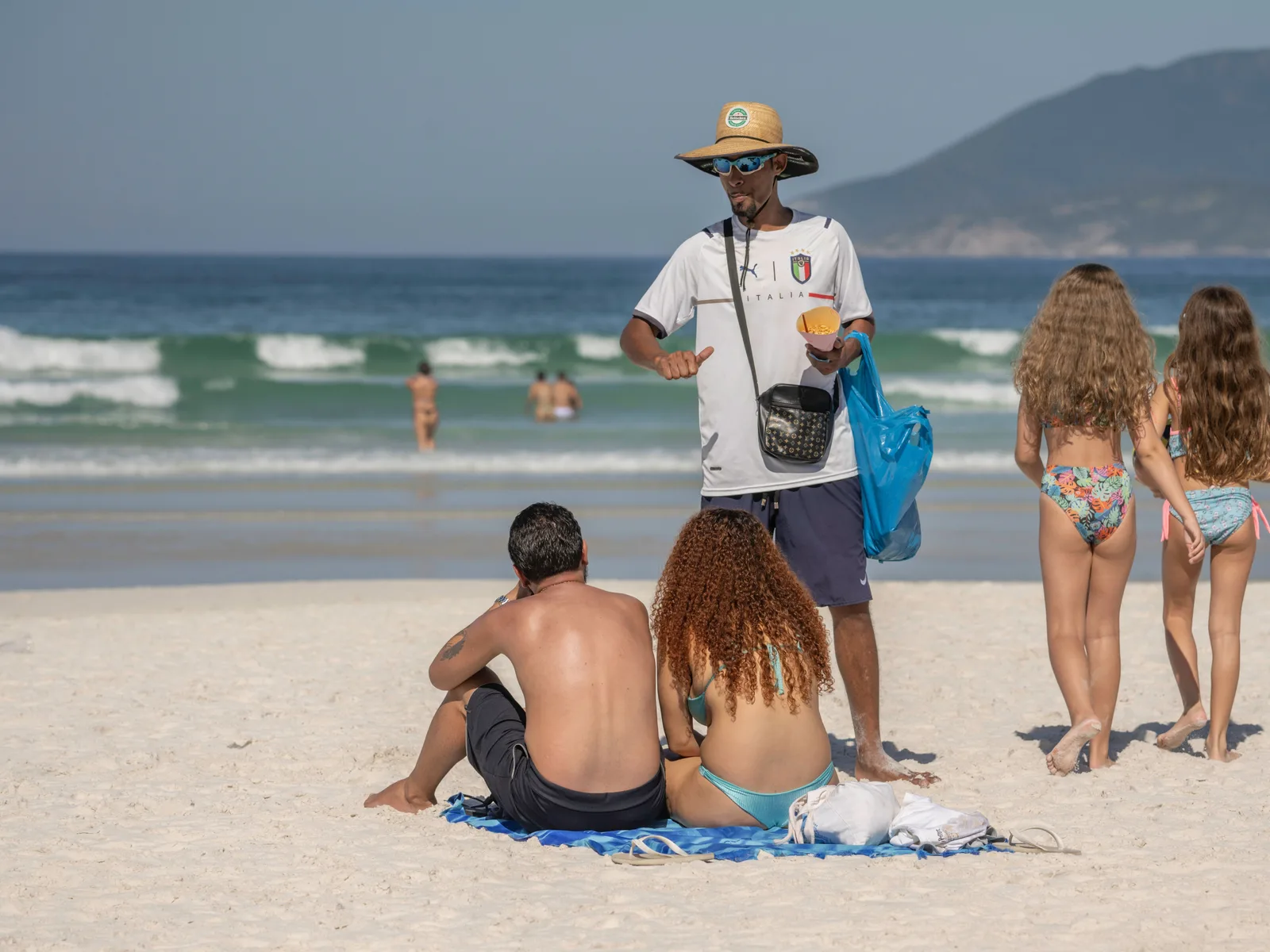
A beach vendor in a straw hat and sunglasses, with a shoulder bag and a blue sack, standing on the sand at Cabo Frio talking to a couple sitting on a towel, two long-haired girls walking past on the right, and green surf and a hazy headland beyond

The summer season

20 December to Carnival

From about the twentieth of December until Carnival ends, this coast belongs to Rio. Búzios fills, Rua das Pedras is shoulder to shoulder, tables need booking and the road out of Rio on a Friday afternoon becomes an ordeal. It is also when the weather is at its best and when the place has the most life in it, so this is a choice rather than a warning. If you want summer weather without the same crowd, come in the second half of March.

The dark curved back and dorsal fin of a humpback whale breaking the surface of blue water off Arraial do Cabo, with spray around it

The whale season

The southern winter

Humpbacks move up and down this coast between the Antarctic and the warm water off Bahia, and the cape at Arraial sits close enough to the route that boats go out specifically to find them. Onda Arraial sells a four-hour trip at R$330 an adult. Published start and end dates vary considerably between sources, from May at one end to November at the other, so if you are building a trip around it, ask the operator for this year’s dates rather than trusting a season you read somewhere.

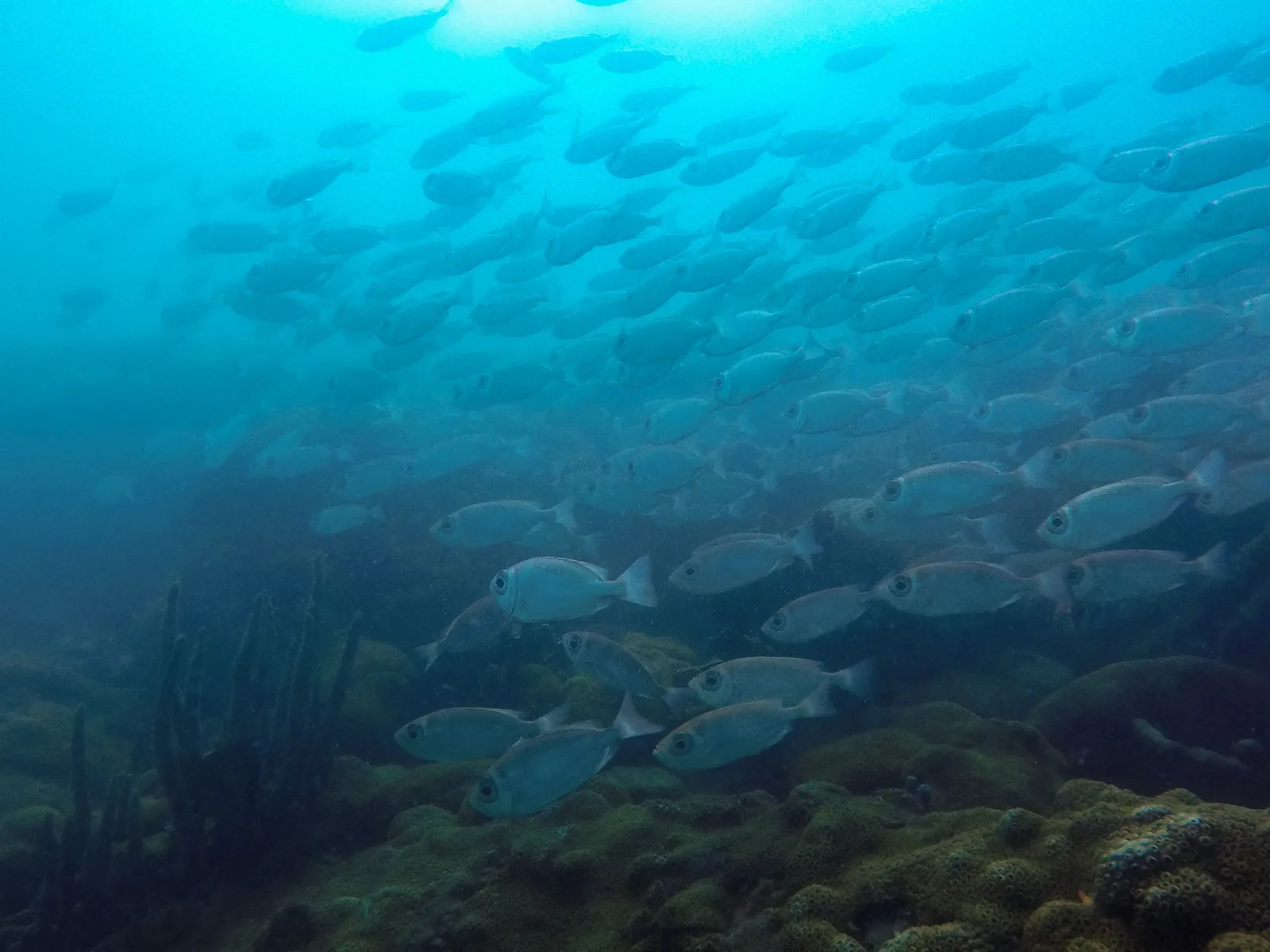
A dense school of silver fish hanging together in clear blue water above dark rock and weed at Arraial do Cabo, lit from the surface above them

The upwelling

Spring and summer, possible any month

Not a festival, and the thing that decides more about this coast than any festival does. A run of northeast wind pushes the warm surface layer offshore and cold, nutrient-rich South Atlantic Central Water rises to take its place, most often in spring and summer. It is why the cape is called Cabo Frio and why the sea here runs 21 to 25°C when the northeast runs 26 to 29. It can arrive in the middle of January at short notice. Pack accordingly and do not book a swimming vacation on the strength of a photograph.

Good to know

Before you come

Búzios or Arraial do Cabo? Or both? +

Both, from one base, in three or four nights. They are 40 kilometers apart, about an hour by road, and they do completely different jobs, which is why splitting your nights between them wastes half a day on a transfer and gains you nothing. Arraial do Cabo is where the water is: the boat trips, the diving, Praia do Farol. Búzios is where the beaches, the restaurants and the evenings are. If you want one sentence: sleep in Búzios and give Arraial a full day, unless the point of your trip is diving, in which case do the reverse and save a lot of money doing it.

How cold is the water, really? +

Colder than the photographs suggest, and that is the defining fact about this coast. Monthly mean sea temperature runs from about 21°C in September to about 25°C in March and April on NOAA’s OISST v2.1 analysis, against 26 to 29 on the beaches this site covers in the northeast. It is caused by upwelling: northeast winds push the warm surface water offshore and cold water rises from below to replace it, which is why the Portuguese named the cape Cabo Frio in the first place. Two consequences. The sea is at its coldest in September rather than in winter, and it can turn cold at short notice in the middle of summer. Wetsuits are normal on the dive boats in every month of the year.

How do I get there from Rio, and how long does it take? +

By road, and about three hours to Búzios in normal traffic. The route is the Rio-Niterói bridge, the BR-101 and then the Via Lagos, the RJ-124, which is a toll road: R$18.40 for a car at the weekday rate and R$30.60 from 12:00pm Friday to 12:00pm Monday and around national holidays, each way, on the state regulator’s published tariff. Auto Viação 1001 runs buses from the Novo Rio bus station to all three towns through the day; allow three and a half to four hours. A private transfer costs more, goes door to door and can stop in Cabo Frio on the way. Cabo Frio has an airport, but nothing flies there from the United States and its domestic flights are seasonal, so do not plan around it.

Is it safe? +

For a visitor, yes, with ordinary caution, and the numbers are worth reading properly because one of them looks alarming out of context. On the Rio state public security institute’s own municipal figures, Armação dos Búzios recorded 21 robberies of pedestrians in the whole of 2025 and Arraial do Cabo recorded four, which is close to nothing; Cabo Frio, five times bigger, recorded 147. At the same time Búzios registered 17 violent deaths in 2025, a rate of 42.5 per 100,000 against a Rio state rate of 24.2. The largest recorded crime in all three towns is fraud, not robbery. Book through a platform that holds your money, and be careful with any rental that wants a bank transfer up front.

Do I need a car? +

For Búzios, effectively yes, unless you are staying in the center and never leaving it. The town itself is walkable and lovely, but the beaches people come for are spread around a peninsula and the far ones are twenty minutes of driving away, so without a car you are paying for taxis several times a day. For Arraial do Cabo, no: everything leaves from Praia dos Anjos and the town beaches are a short walk from anywhere. A rental runs about R$120 a day, and the Via Lagos toll is charged in both directions. The alternative, and it works, is a transfer in from Rio, a schooner trip and a hired driver for the Arraial day.

Keep going

Where this fits on a Rio trip.

Nobody flies to Brazil for the Região dos Lagos alone. These are the three trips it most often sits beside, and all of them are within a few hours of the same airport.

Free · 29 pages

Free guide

Beginner's Guide to Brazil

A free 29-page guide to everything a first-time visitor should know before landing: visas, safety, money, getting around, where to go, and what to eat.

We'll email you a link to confirm your address. Click it and the guide opens right away.

See what's inside
The coastline of the Costa do Sol from a green hillside: a long curve of dark blue sea against steep scrub-covered headlands running away toward a distant point

Skip the planning

Three nights, two towns, one decision.

Tell us your dates and we will tell you plainly which of the two towns to sleep in for the trip you are actually taking, how many nights the Lakes Region is worth beside your days in Rio, which boat day to book and when, and how to get out of the city without losing an afternoon to the Friday traffic.

  • One person, living in Brazil, replying to you directly
  • A reply within one business day, with no call center and no bots
  • No cost to plan, and no obligation to book
  • Built around your dates, not a fixed departure