
Skip to content
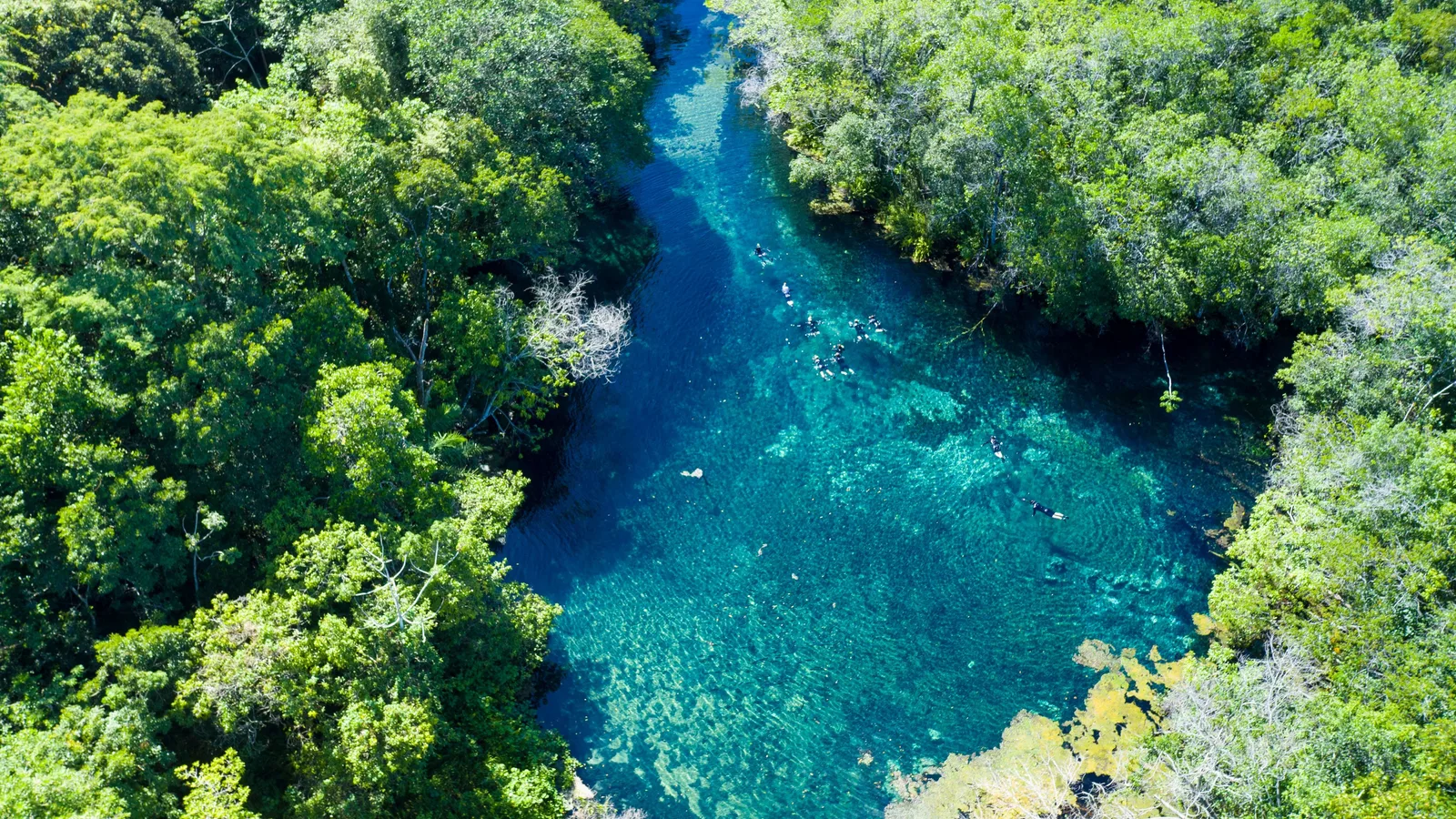
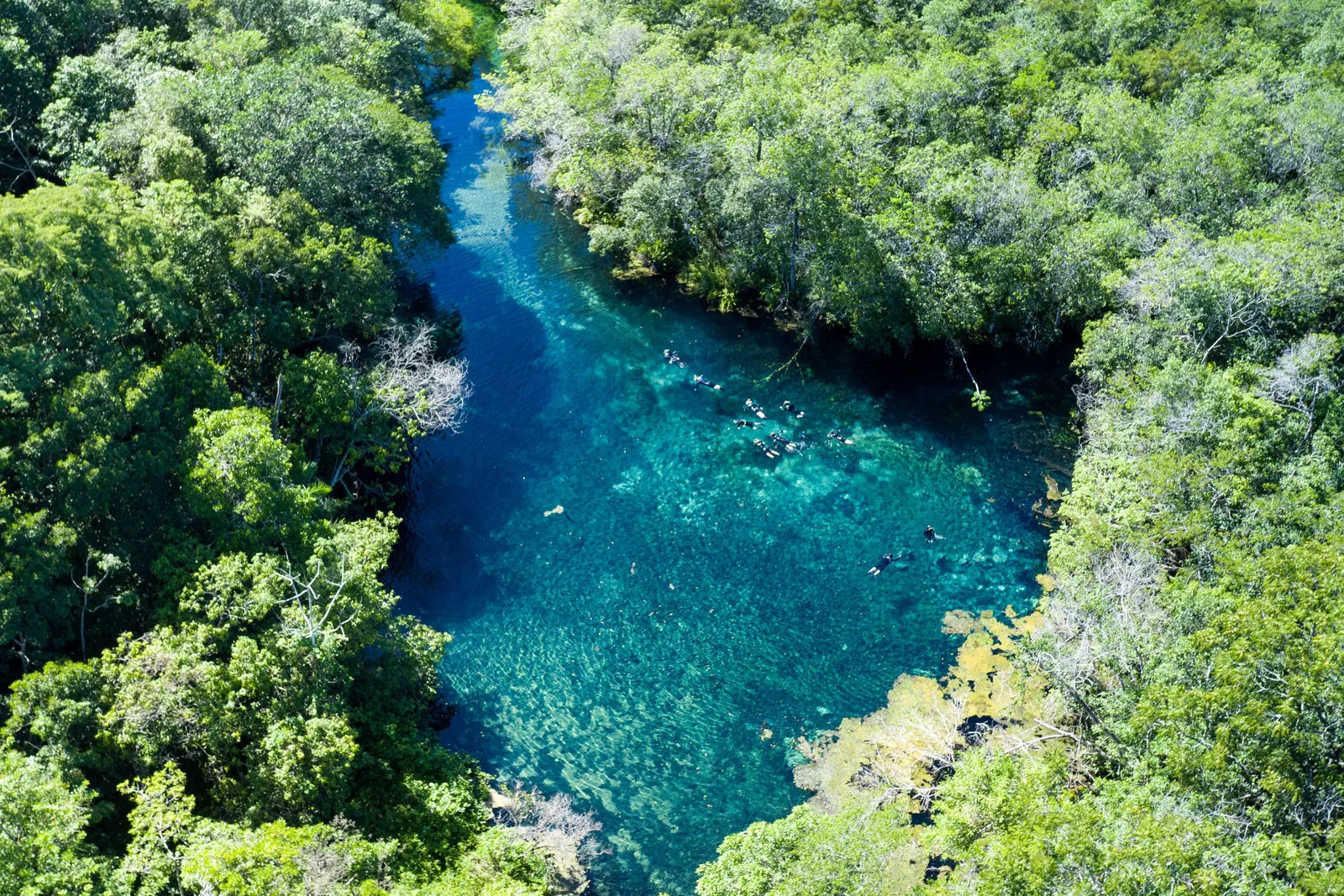
The Rio da Prata from directly above: a deep blue-and-turquoise river running between two walls of dense green forest, with a line of snorkelers in life jackets drifting down the middle of it

Mato Grosso do Sul

Bonito

Rivers so clear you snorkel down them, and a booking system that keeps them that way.

Last checked October 2026

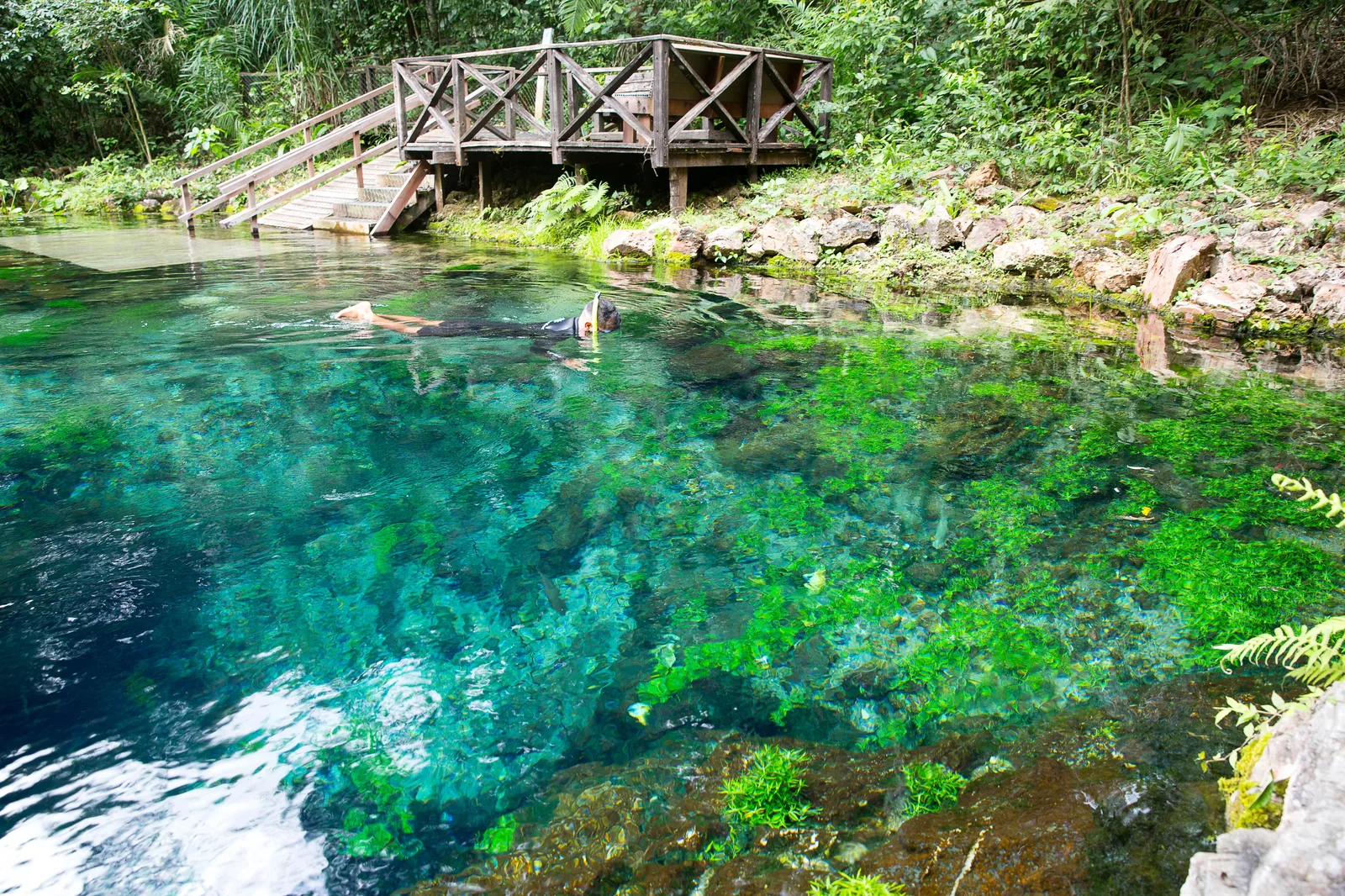
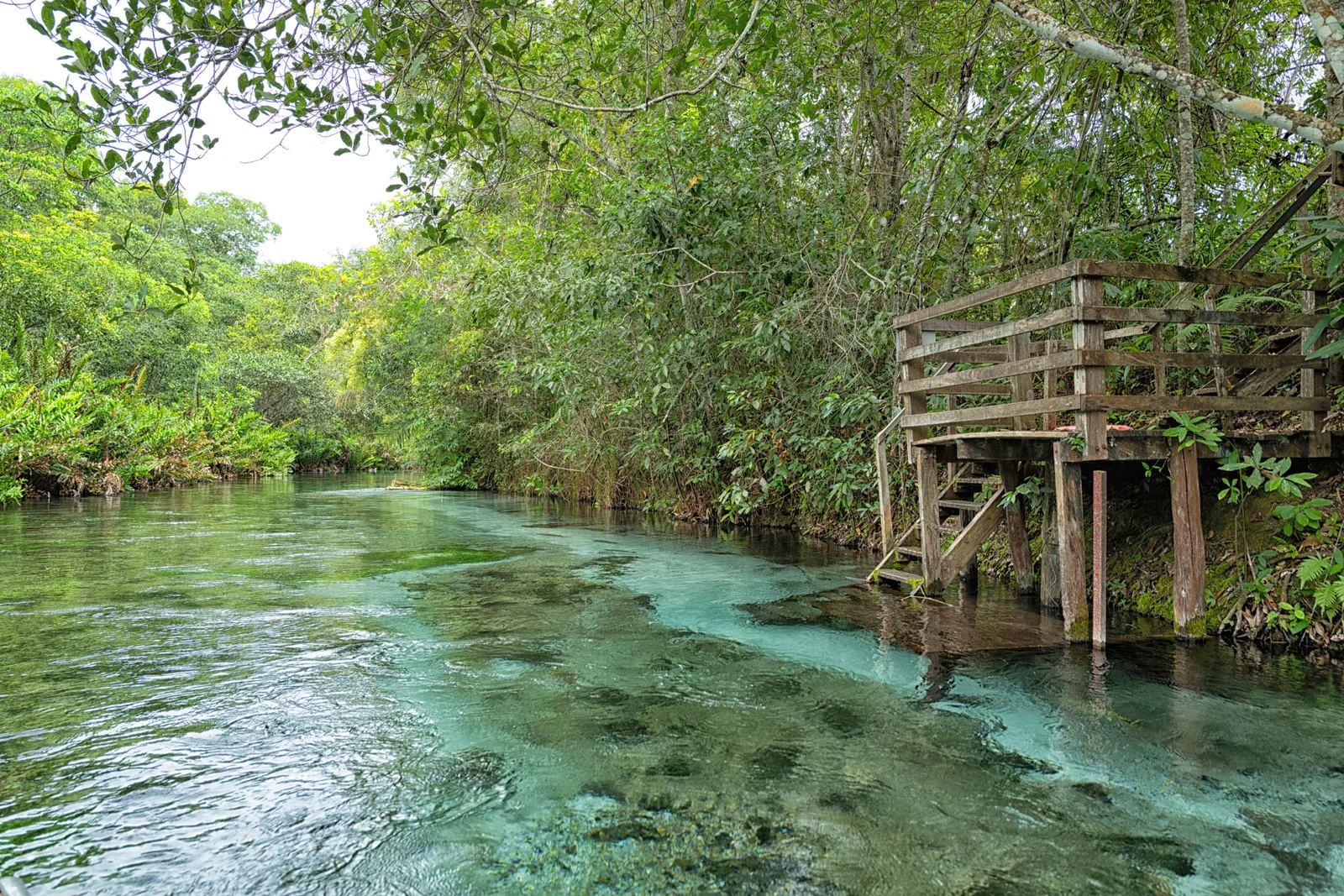
  • A wooden viewing deck on stilts above a shallow, glass-clear river near Bonito, the gravel bed and water plants visible right through the surface
  • A spring-fed river near Bonito running turquoise over pale beds of water weed, with gallery forest closing in from both banks
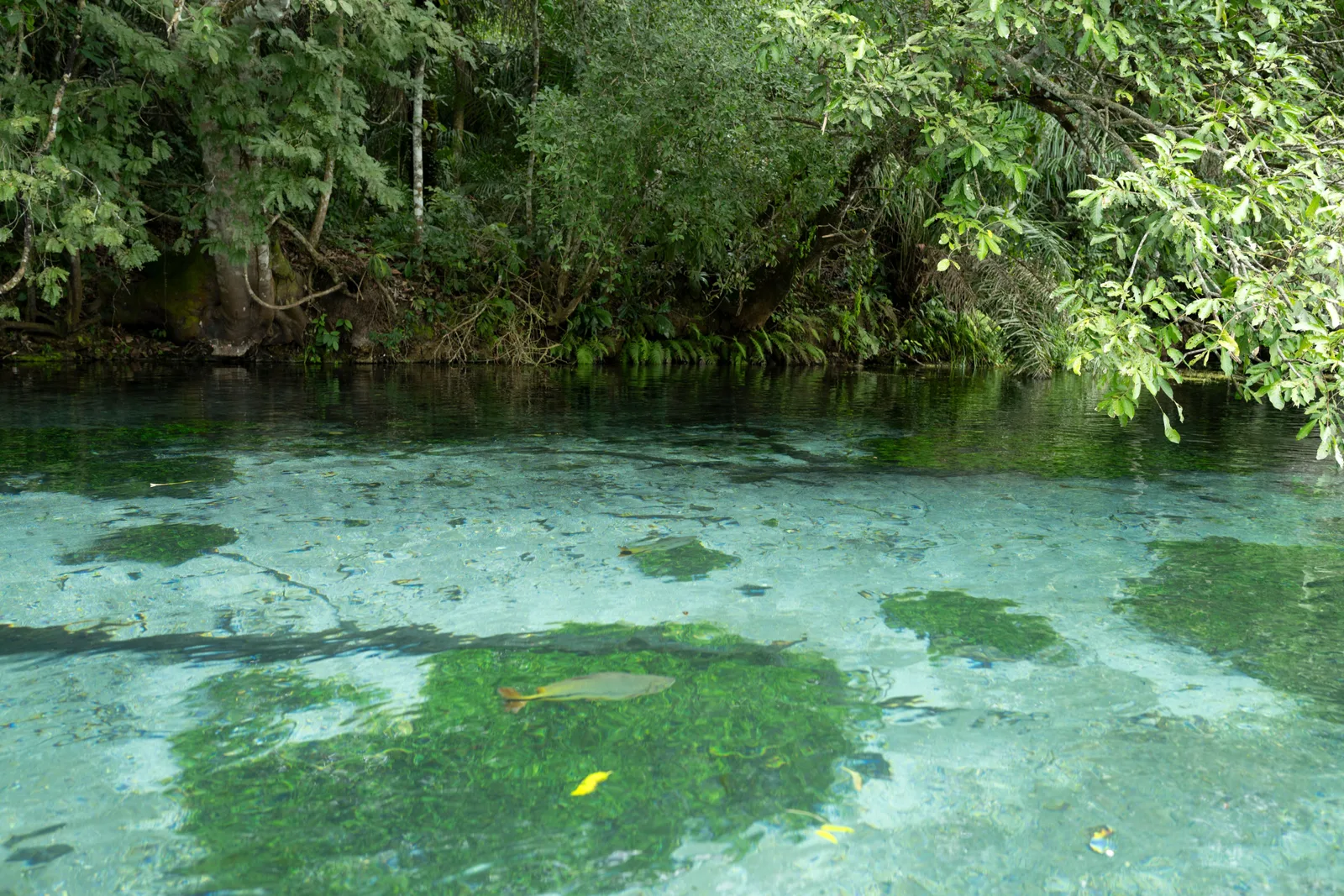
  • Bright blue-green shallows on a spring-fed river near Bonito, patches of dark weed showing through the water and low forest along the far bank
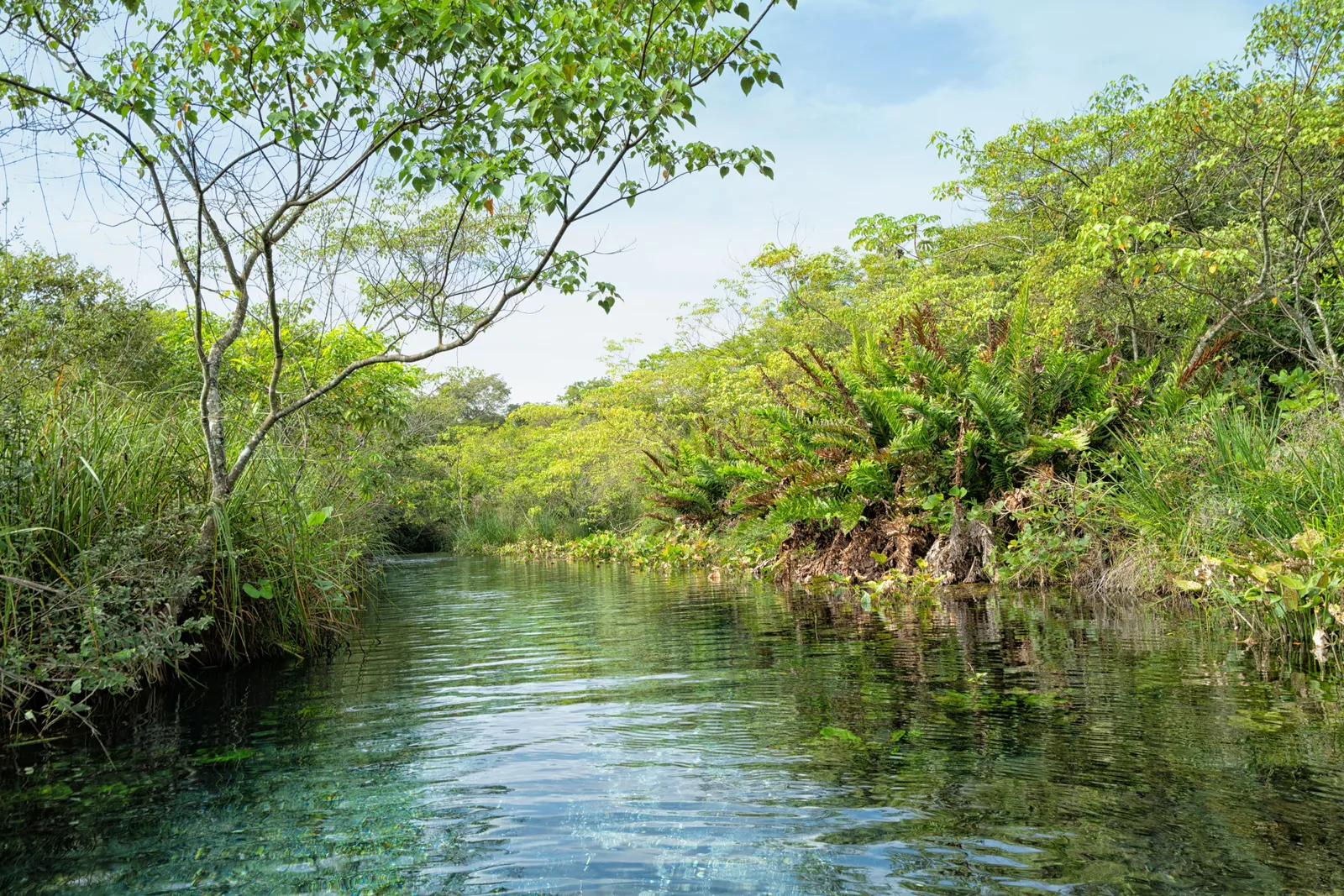
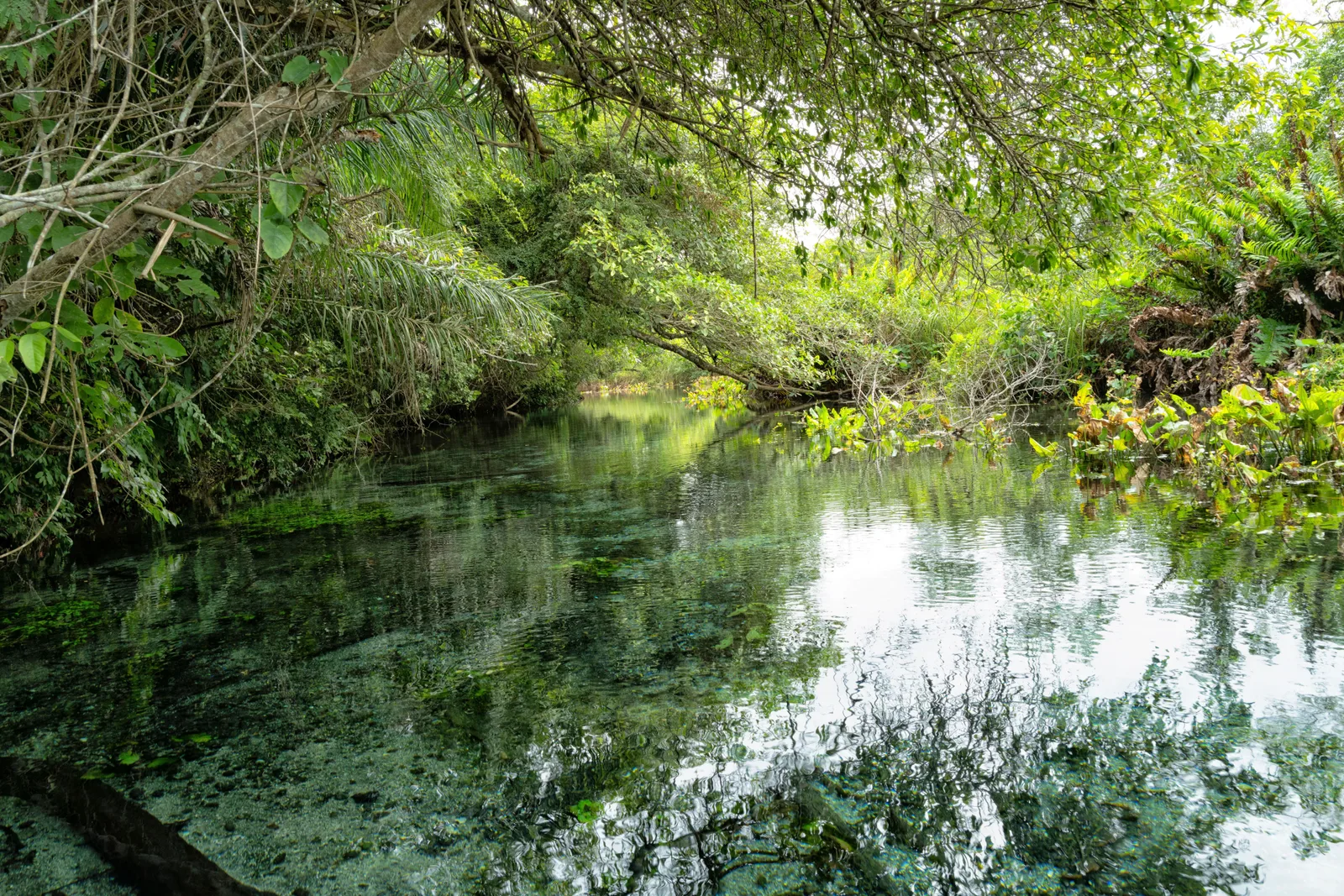
  • A narrow green river channel in the Serra da Bodoquena, water plants trailing in the current and trees leaning in overhead
  • Still water on a river near Bonito reflecting the forest above it, reeds and fallen branches breaking the surface
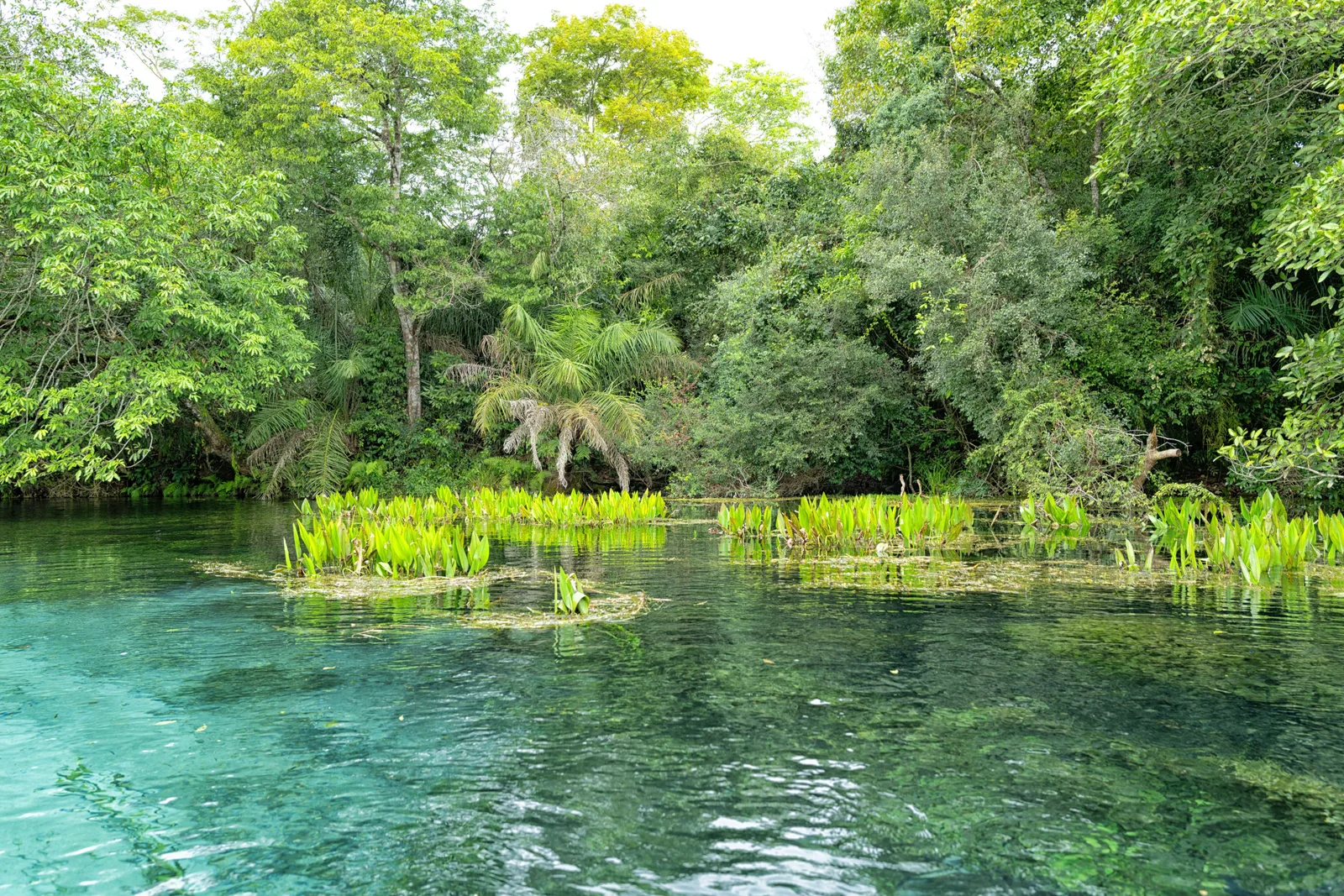
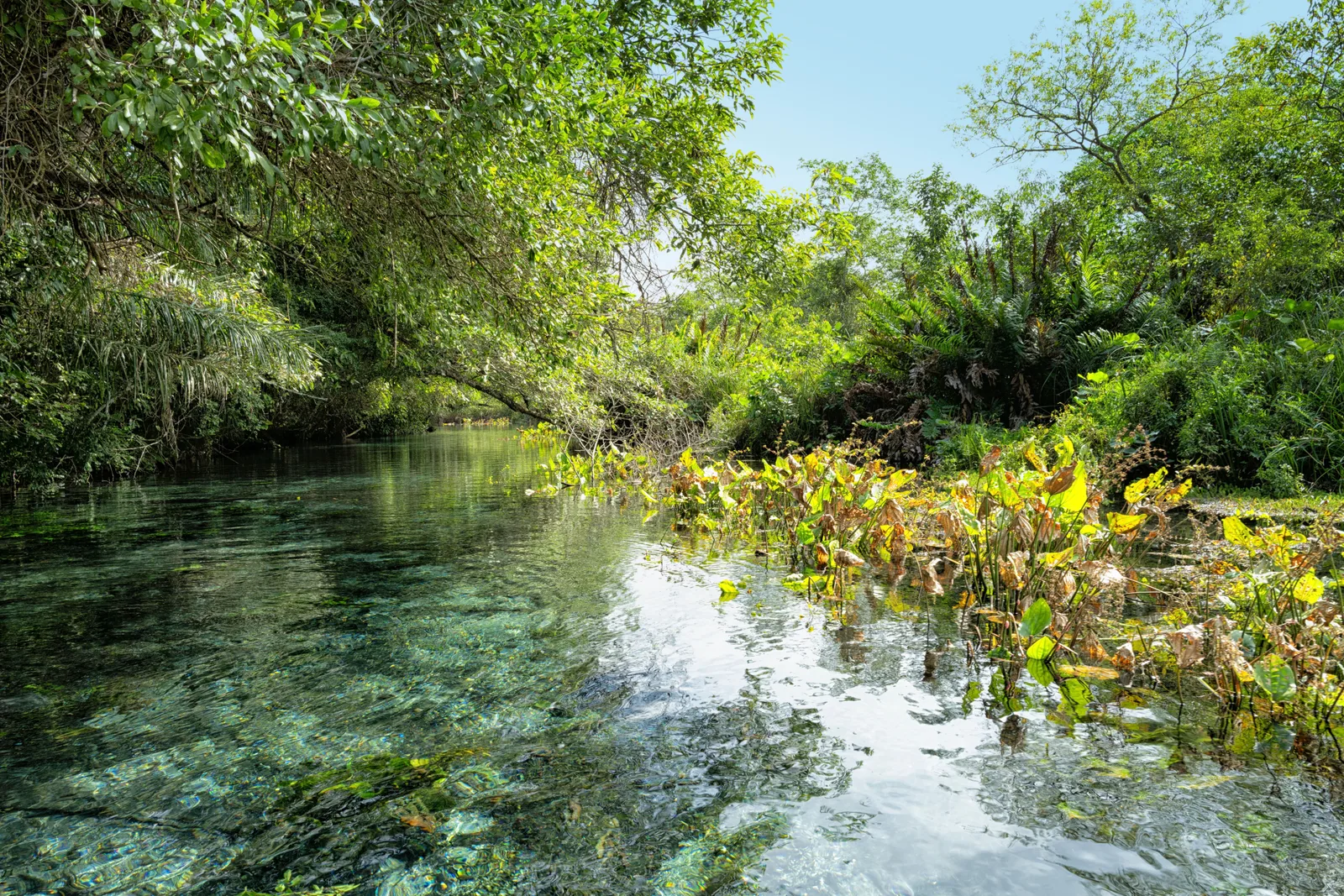
  • A clear river near Bonito running between banks of floating vegetation, with a bright sky above the treeline
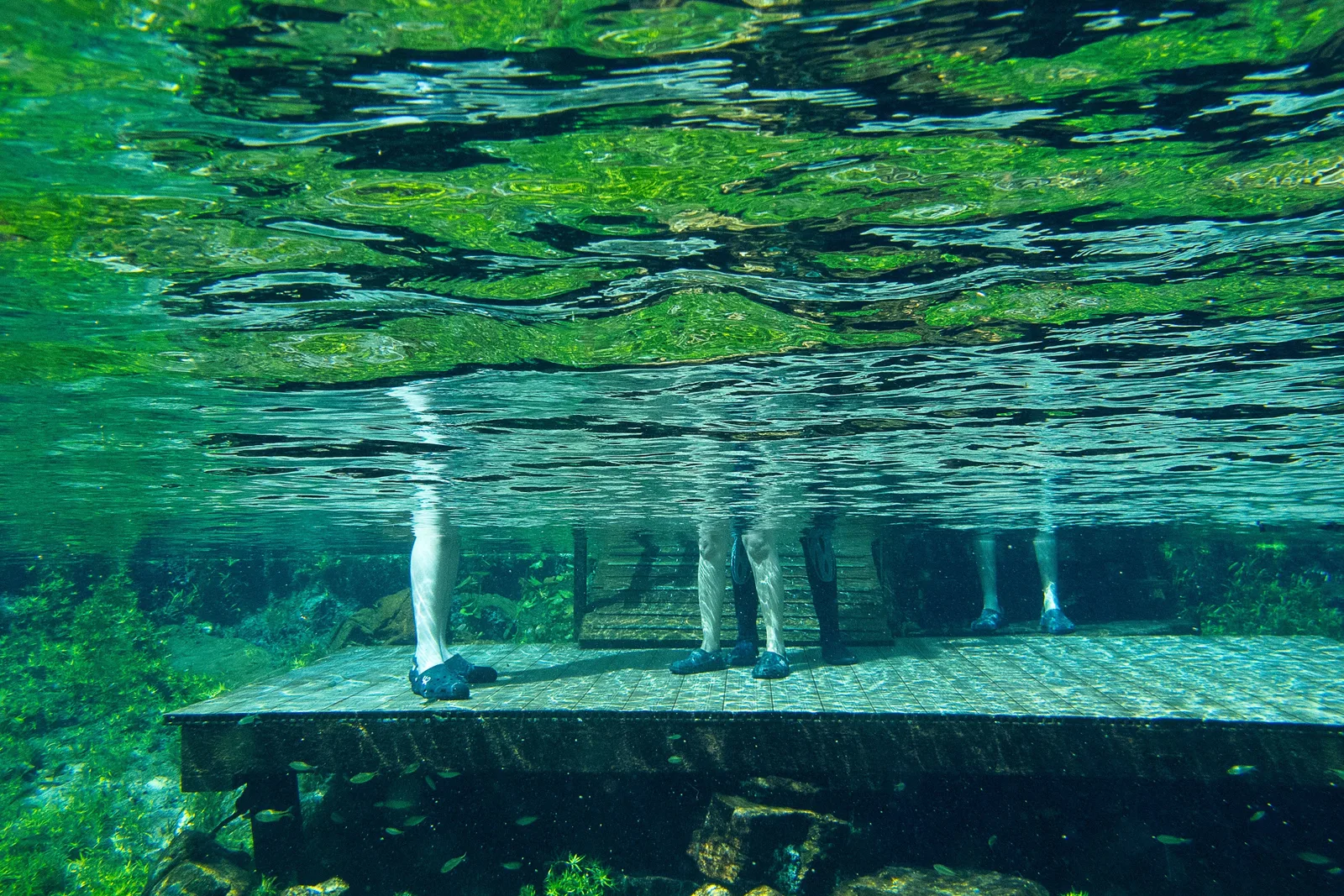
  • An underwater view up at a submerged wooden deck, the mirrored underside of the water surface above it and several pairs of legs standing on the boards
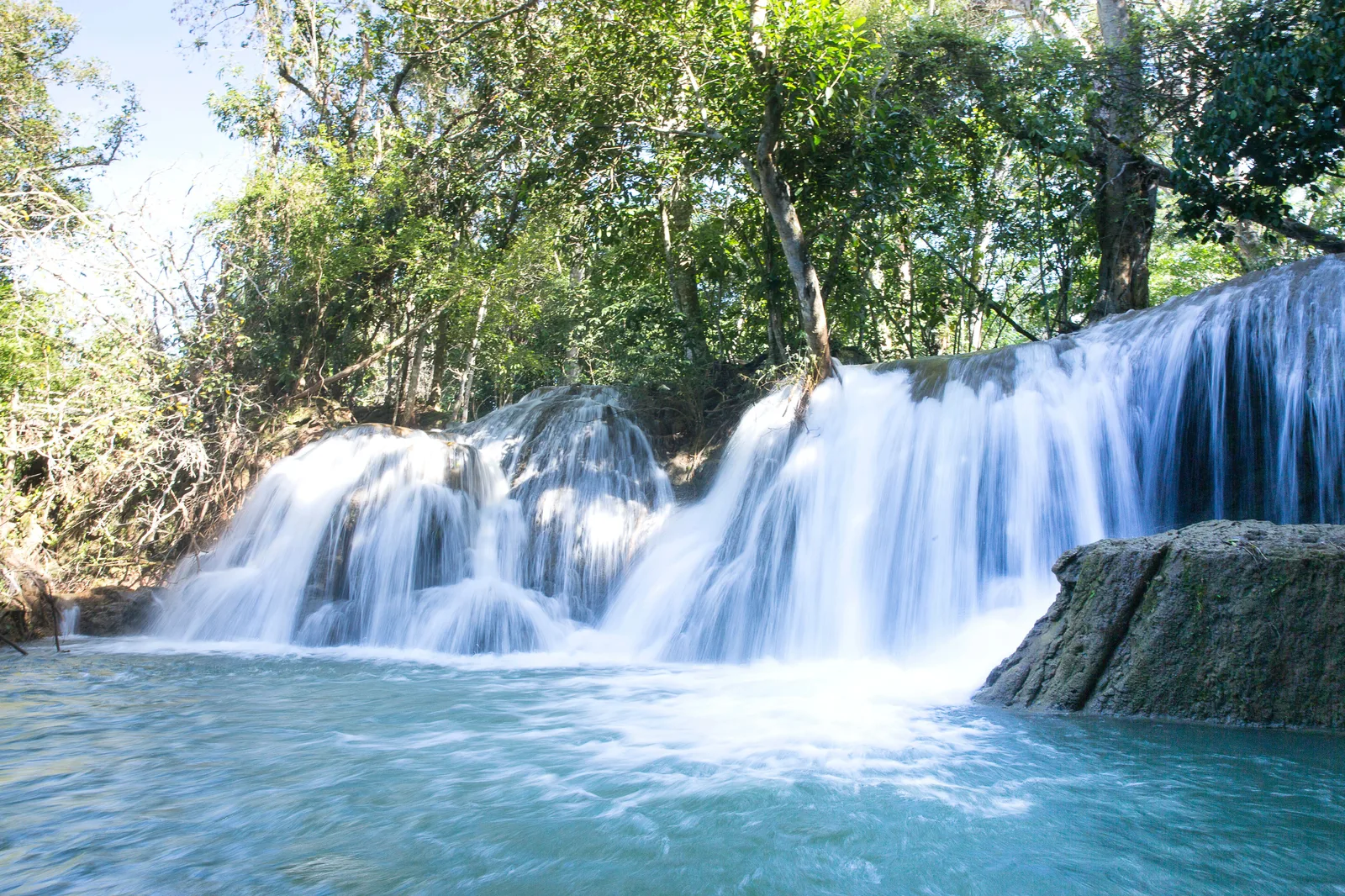
  • A wide travertine waterfall near Bonito dropping in a curtain over a green ledge into a turquoise pool
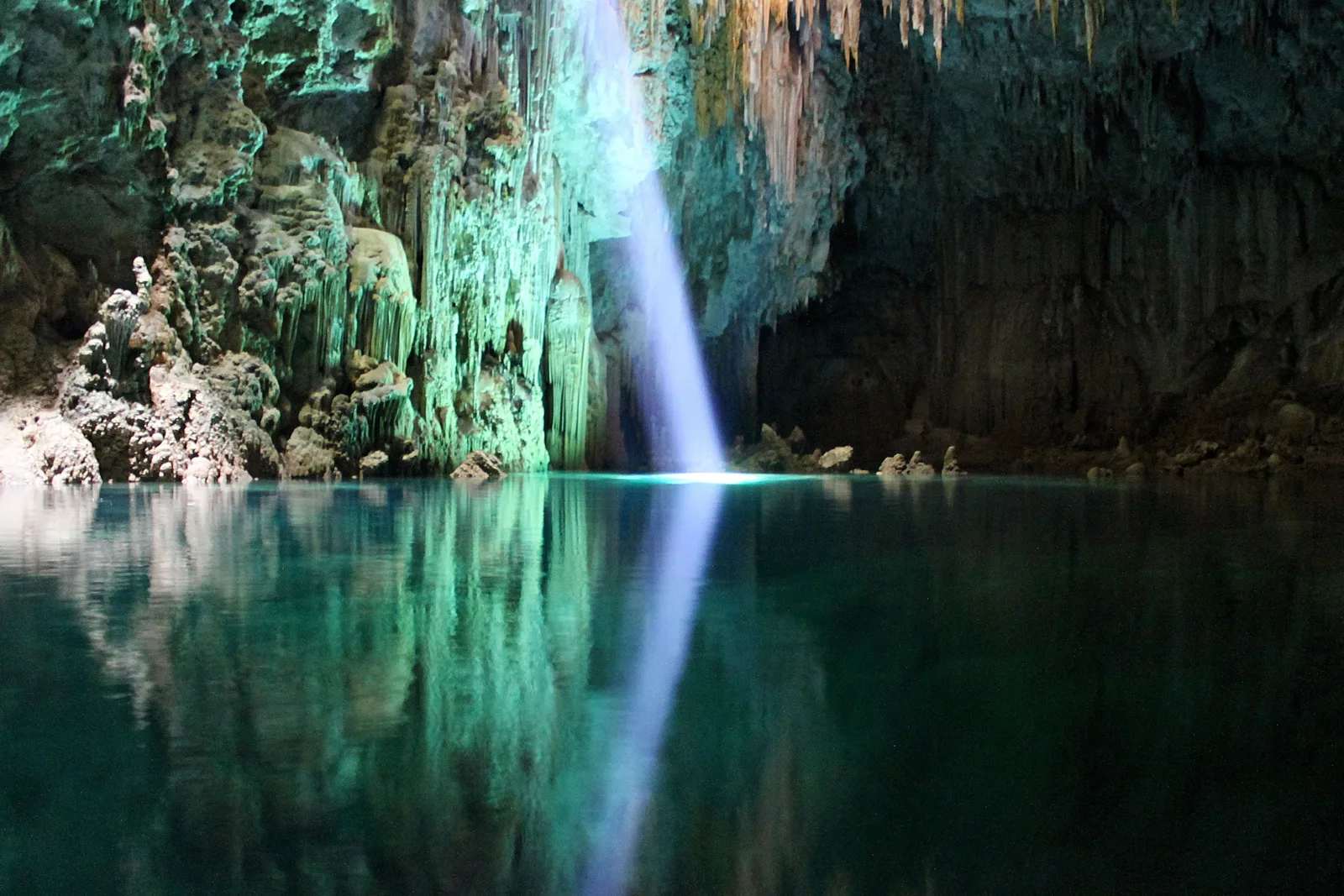
  • A shaft of daylight falling through the roof of the Abismo Anhumas onto the green lake at the bottom, stalactites hanging around it in the dark
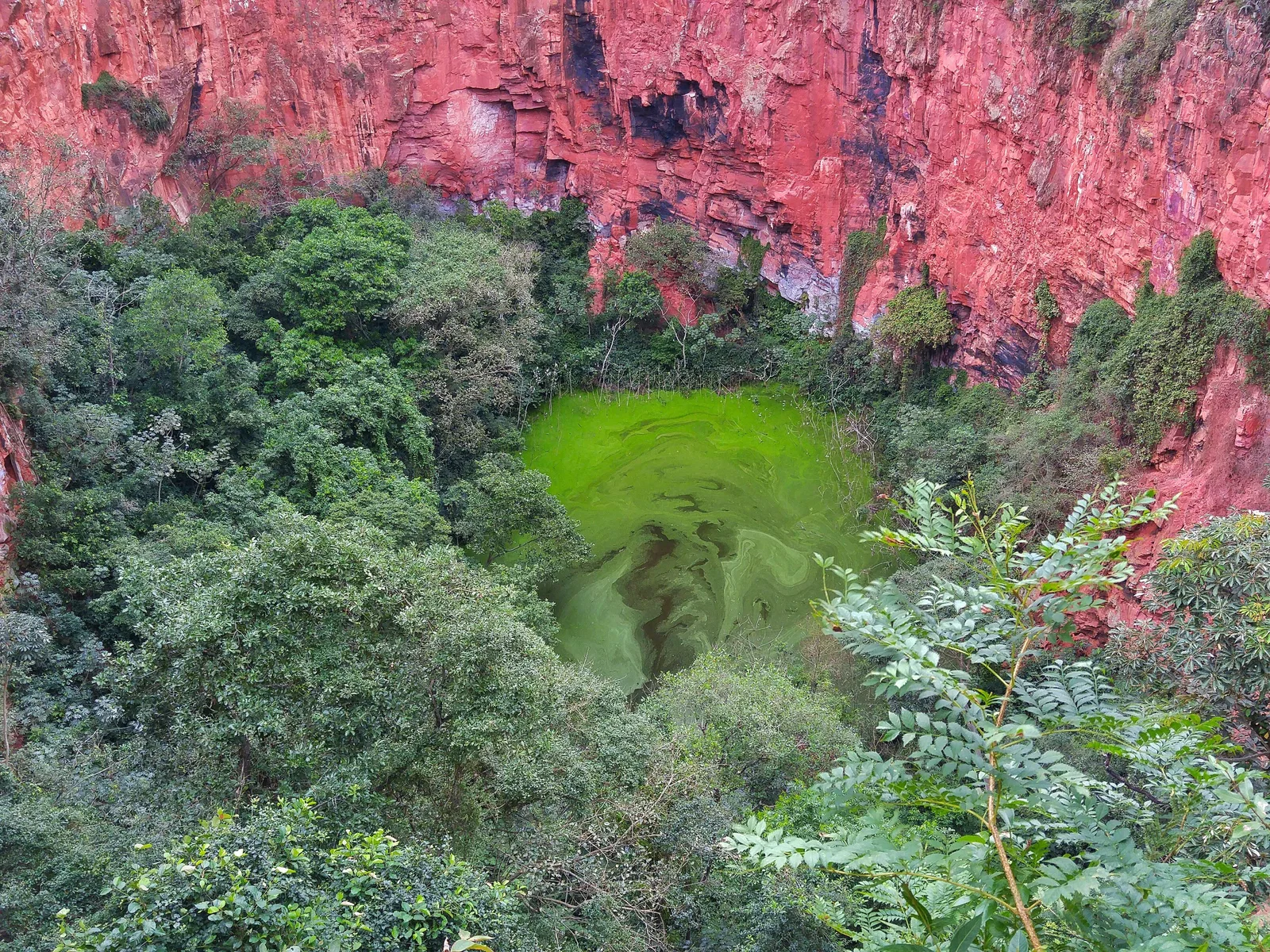
  • The red sandstone wall of the Buraco das Araras sinkhole rising behind a floor of dense green forest
  • A deep blue river seen from the air, cutting a narrow line through unbroken forest in the Bodoquena country near Jardim
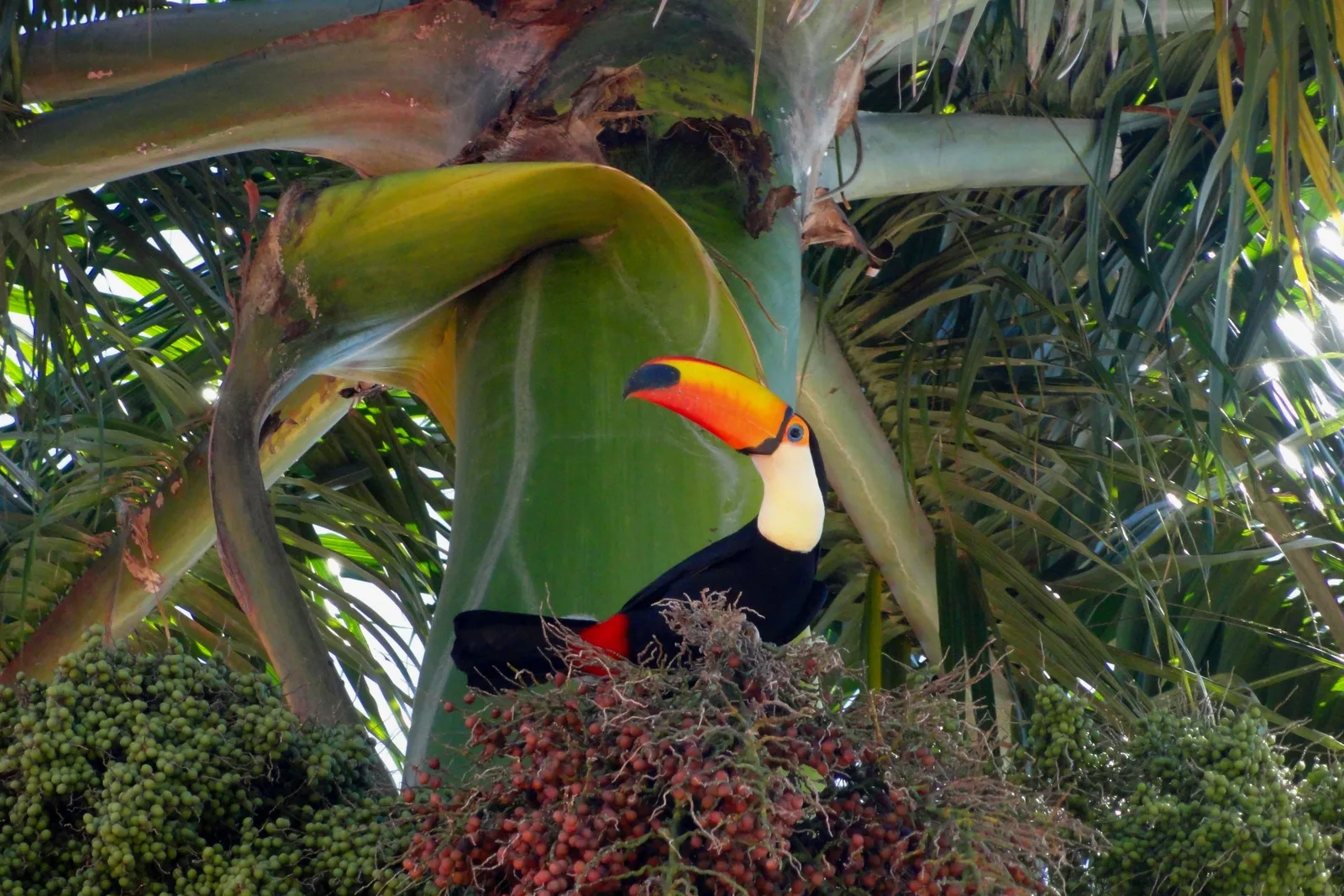
  • A toco toucan with a bright orange bill perched among the fronds of a palm near Bonito
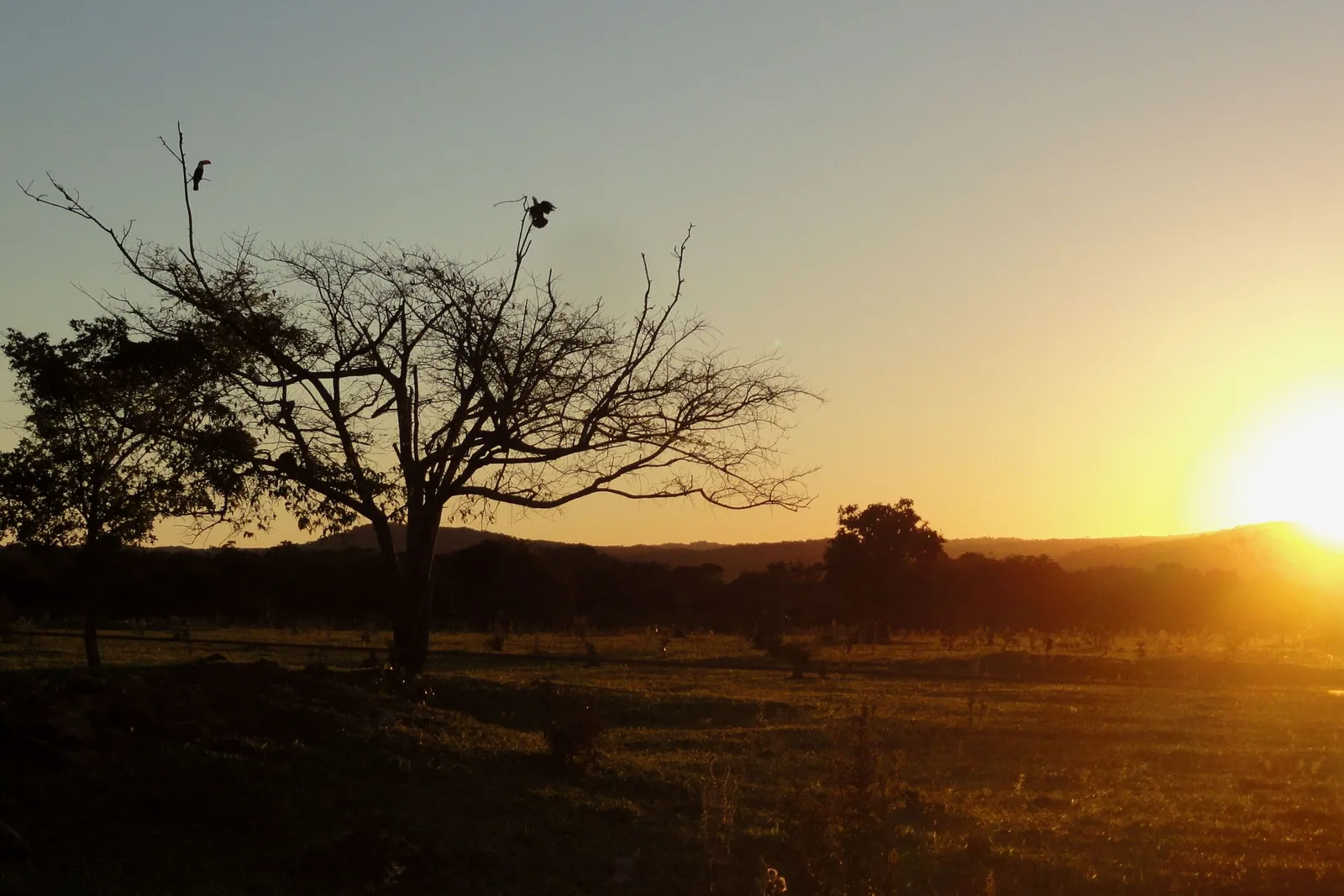
  • Birds perched on the bare branches of a lone tree, silhouetted against a low orange sun over open country near Bonito
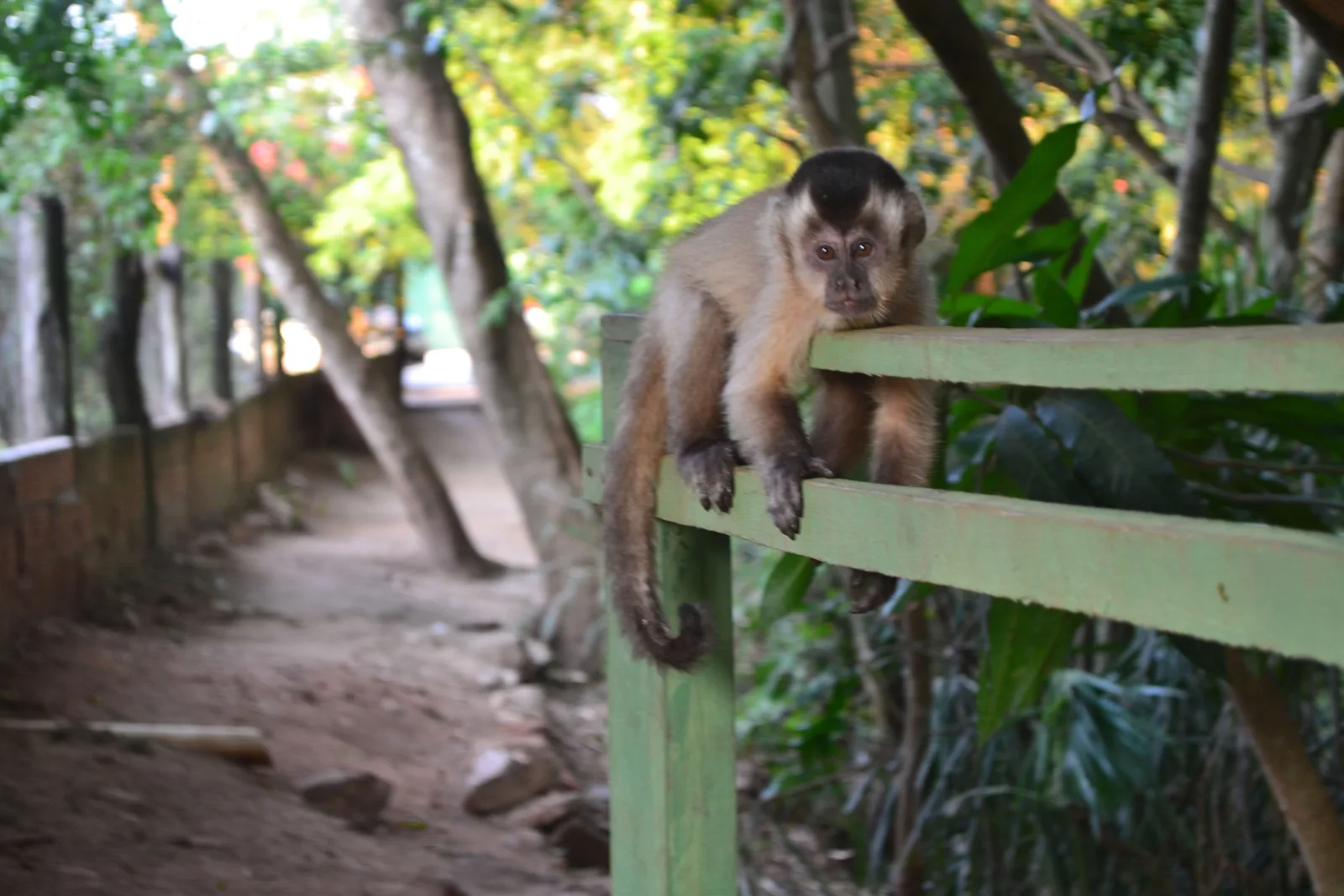
  • A capuchin monkey sitting on a wooden handrail beside a dirt path near Bonito
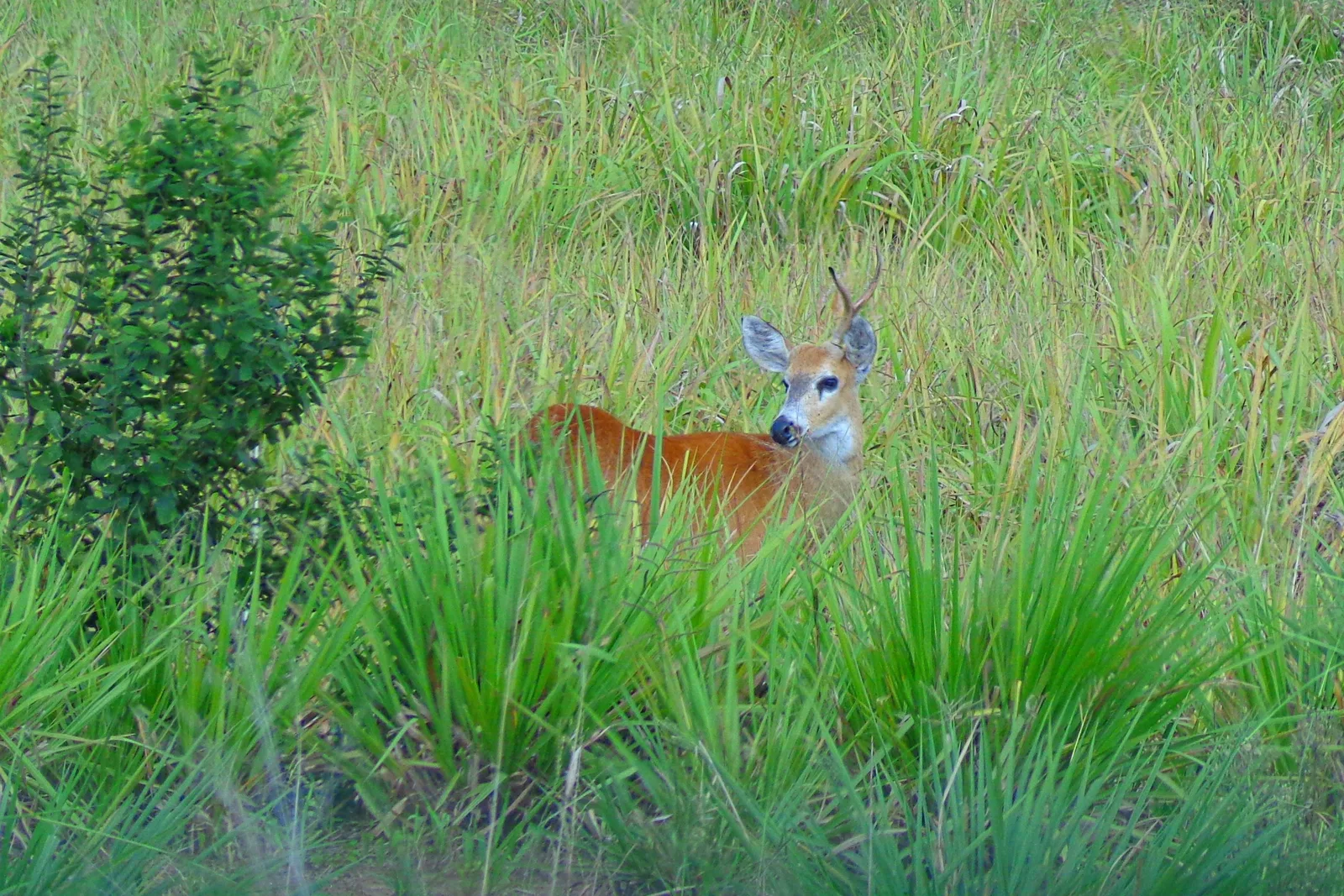
  • A deer standing in tall green grass near Bonito, looking straight at the camera
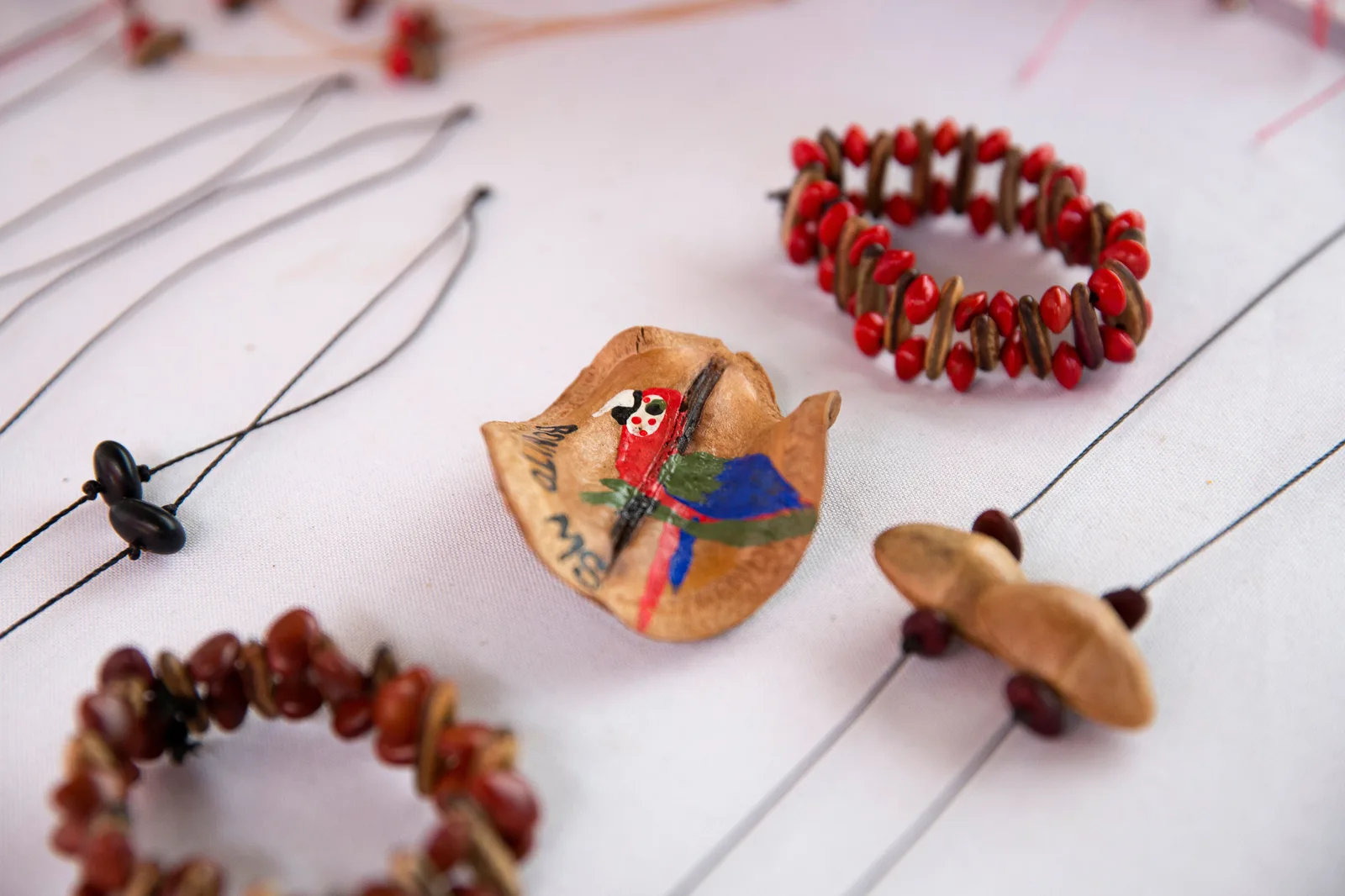
  • Handmade necklaces of red seeds and a painted macaw on a seed pod laid out on a white cloth at a craft stall in Bonito
  • A single tall palm silhouetted against the setting sun over the countryside near Bonito

Orientation

The town in one screen.

Everything logistical, before the pretty pictures start.

General Info

A small town with extraordinary water

Bonito is a town of about 24,000 people in the southwest corner of Mato Grosso do Sul, at the foot of the Serra da Bodoquena. Nothing about the town itself explains why anyone flies there. The reason is underground: the Serra is a block of limestone and dolomite, and rain that falls on it sinks in, filters through the rock and comes back out of springs almost free of sediment. Dissolved calcium carbonate does the rest — it binds whatever particles are left into flakes heavy enough to sink. What emerges is river water you can see through the way you see through air.

The same chemistry builds the landscape above ground. Where the carbonate comes back out of solution it cements into travertine, and the travertine grows across the riverbed as natural dams. That is why the waterfalls here are wide, low, stepped and moss-covered rather than single drops, and why the pools behind them are the color they are. It is also why the caves exist: water dissolving limestone for a very long time leaves holes, and the region is full of them, including one with a lake that divers have followed down to 96 meters without finding the bottom.

What visitors actually do is float. You put on a mask, a snorkel and a wetsuit, walk into a spring, and let the current carry you a mile or two downstream past shoals of fish that do not move out of your way. Around that there is a full menu of caves, sinkholes, waterfall trails and rappels, all of it on private farms and reserves 20 to 60 kilometers out of town, and all of it booked and rationed through a single system. Brazilian travel readers have voted Bonito the country’s best ecotourism destination nineteen times, most recently in March 2026.

Booking

You cannot buy a ticket at the gate

This is the thing about Bonito that catches out almost every first-time visitor, and it is worth understanding before you book flights. Every attraction here caps how many people it admits per day, requires a licensed guide, and sells only through a licensed local travel agency, which issues a document called the Voucher Único. There is no ticket window at the attraction. The system has run since 1995, and it is the reason the rivers still look the way they do after thirty years of visitors.

  • Book through a licensed Bonito agency — in person on the main street, or online before you arrive. The agency enters you into the municipal system, which assigns your date, your time slot and your place in the day’s quota, and issues the voucher. The attraction will not let you in without one.
  • Prices are set centrally and are the same at every agency in town. There is no point shopping around on price, and a quote well below the standard rate is a reason to walk away rather than a bargain. What agencies actually differ on is transport, English-speaking guides and how well they sequence your days.
  • The caps are small and they bind. The Gruta do Lago Azul takes 305 people a day, in groups of no more than 14 plus a guide, and stops admitting at 2:00pm. The Abismo Anhumas takes 60 a day. On the rivers you go in a group of eight to ten behind one guide. In high season the best slots go weeks ahead.
  • Since 20 December 2025 there is also a municipal environmental levy, the Taxa de Conservação Ambiental — R$15 per person for each day you have a tour booked, not per day in town. You pay it yourself online at turistapornatureza.com.br, and your agency cannot issue the voucher until it clears. It carries visitor insurance for the licensed attractions.
  • Attractions run to a timetable rather than opening hours. A float has a start time, the cave stops taking groups in the early afternoon, and a missed slot is a missed day — there is rarely a later one to move to.
  • Plan roughly one attraction per half day and no more than two in a day. They are 20 to 60 kilometers apart on rural roads, each takes two to four hours with the trail and the briefing, and the schedule assumes you are driving between them.

Where It Is

Southwest Mato Grosso do Sul, four hours from Campo Grande

Bonito sits on the Rio Formoso at the eastern edge of the Serra da Bodoquena, about 300 km southwest of Campo Grande and about 160 km from the nearest Paraguayan border crossing at Bela Vista. The attractions spread across three municipalities — Bonito, Jardim to the south and Bodoquena to the north — and travelers book all of them from the same street in Bonito.

Bonito Bonito

21.13° S, 56.48° W

See the Central-West on the interactive map

Cost

What a day here actually costs

Bonito is one of the more expensive places in Brazil, and the reason is unusual: it is not the hotels or the restaurants, which are ordinary interior-Brazil prices. It is the attractions. Each one is a private property running a capped, guided operation, and a single float can cost more than a night’s room. Budget from the attractions backwards — pick the days you want, price those, and everything else is a rounding error.

Estimated daily budget

Budget

$85 / day

A hostel bed, one mid-priced attraction a day, the agency’s shared transport rather than a car, and lunch at a per-kilo place.

Mid-range

$165 / day

A comfortable pousada double split two ways, a rental car, one attraction most days and two on the good ones, dinner out.

Comfortable

$310 / day

A river resort or a well-reviewed pousada with a pool, a car, the expensive attractions rather than the cheap ones, and the best restaurants in town.

Estimates, per person per day, once you are in Bonito — flights and the drive from Campo Grande are separate. The high-season weeks around New Year, Carnival and mid-July carry higher attraction prices as well as higher room rates.

What things cost

  • Rio da Prata float, low season $92 R$470
  • Rio Sucuri float, low season $68 R$349
  • Nascente Azul float, low season $73 R$374
  • Aquário Natural float, low season $69 R$352
  • Gruta do Lago Azul, low season $24 R$120
  • Gruta de São Miguel, low season $21 R$108
  • Buraco das Araras $36 R$185
  • Estância Mimosa waterfalls, low season $67 R$340
  • Boca da Onça trail, low season $109 R$555
  • Lagoa Misteriosa float, low season $53 R$270
  • Abismo Anhumas, rappel and float $313 R$1,598
  • Balneário Municipal, low season $14 R$70
  • Environmental levy (TCA), per person per tour day $3 R$15
  • Shared transport to an attraction, per person $14 R$70
  • Rental car, per day $27 R$140
  • Shared transfer from Campo Grande airport $35 R$180
  • Mid-range pousada double, per night $61 R$310
  • Hostel bed $18 R$90
  • Per-kilo lunch $9 R$45
  • Dinner for two on the main street $39 R$200

Attraction prices are municipally tabled and identical at every agency, which makes them unusually reliable to plan against — but they are revised roughly every six months, and each has a higher high-season rate. The figures above are low-season prices.

High season for attraction pricing runs 19 December through January and 11 July to 2 August (the town’s own 2026 calendar), plus the Carnival week and the longer national holidays. Rooms follow the same calendar and rise further.

The environmental levy is charged per person for each day you have a tour booked, not for each night you sleep in town. Two attractions on the same day are one charge; four tour days across a week are four.

Almost every attraction quotes transport separately, at around R$70 a head each way. If there are two or more of you, a rental car is usually cheaper as well as more flexible.

There is no Uber in Bonito. It is a rental car, the agency’s shuttle, or a private transfer, and that decision is worth making before you arrive rather than on the first morning.

Checked October 2026 and converted at R$5.10 to the dollar. Attraction prices are the tabled municipal rates; everything else is an estimate rather than a quote.

Safety

Very low crime, and a genuine set of physical risks

8 /10

Our rating — about as safe as a Brazilian town gets from crime, with the real risk in the driving and the activities rather than the people.

Bonito is a town whose entire economy depends on visitors leaving happy, and it behaves like one: walking the main street after dinner is completely ordinary, the municipal guard is visible in the tourist blocks, and petty theft is uncommon by any Brazilian standard. What can actually go wrong here has almost nothing to do with crime. It is the road out to the attractions, the sun, the water, and the fact that several of the best things to do involve a rope.

  • The drive is the main risk. You will cover 40 to 120 km a day on rural roads, some of it unpaved, most of it unlit, with capybara, tapir, anteaters and cattle genuinely on the roadway after dark. Get back before nightfall where you can, and drive well below the limit when you cannot.
  • There is no Uber in Bonito. A locally built app, EcoDriver, is the only ride-hailing there is, and nothing will come to a fazenda 50 km out on dirt. That matters after a long lunch at a fazenda: if you drive yourself, you are the designated driver, and Brazil’s drunk driving limit is effectively zero.
  • The UV index averages 11 from November to February, which is extreme on the WHO’s scale. Every float has you face-down in the water for two hours with the back of your neck up. Wear the lycra top the operator offers, and use reef-safe sunscreen or none: several attractions ban ordinary sunscreen outright to protect the water.
  • You will be told to float, not to swim, and there is a reason: fins and kicking stir up the sediment that everyone behind you came to see through, and on some rivers the current is faster than it looks. Follow the guide’s line.
  • The adventure activities are real ones. The Abismo Anhumas is a 72-meter rappel into a cave; Boca da Onça has a 90-meter rappel and a staircase of 886 steps. Operators brief and belay properly, but if you have a heart condition, a recent injury or serious vertigo, say so at booking rather than at the edge.
  • The nearest full hospital is in Campo Grande, about four hours away. Bonito has a small hospital and a clinic for everything short of that. Travel insurance that covers adventure activities is not a formality here — check that yours does not exclude rappelling and diving.
  • Spring water sits at around 22 degrees all year and feels much colder than the air on a 30-degree day. Take the wetsuit even in summer, especially if you feel the cold.

Getting There

Fly in, or drive four hours from Campo Grande

Bonito has its own small airport 13 km from town, and since 2025 all three of Brazil’s main airlines fly into it from São Paulo. The alternative is Campo Grande, which has far more flights and a four-hour drive at the end of them. Which you choose usually comes down to how much a direct flight is worth to you on the day.

  • Bonito airport (BYO) takes LATAM from São Paulo–Guarulhos, Gol from São Paulo–Congonhas and Azul from Campinas–Viracopos. Each runs a few days a week rather than daily, with extra frequencies added in the December and July peaks, so the schedule shapes your dates rather than the other way round.
  • Campo Grande (CGR) is the practical alternative: many more flights, from São Paulo, Brasília, Rio and elsewhere, and a road transfer or rental car for the last leg. The MS-345, paved through in 2024, is now the direct route and shortened the drive; allow about four hours.
  • Intercity buses run Campo Grande to Bonito daily and take around five hours. They are cheap and perfectly comfortable, but they leave you in Bonito without a car in a place where every attraction is out of town.
  • Renting a car is the default recommendation for two or more people. Roads to the main attractions are a mix of asphalt and well-kept dirt, an ordinary car handles them in the dry season, and the flexibility is worth a lot when your attractions are timed and scattered.
  • If you are not driving, book the agency’s shared transport at the same time as the attraction itself. It is usually around R$70 a head each way and it will not be available at short notice on a busy day.
  • Do not plan to land at Campo Grande and be in the water the same morning. Arrive the day before your first attraction — the slot is fixed, and a delayed flight cannot be rescheduled into a full day.

The big four

The four things that make it Bonito.

Not a top-ten list. These are the four you would have to see before you could say you had been here — and none of them is in the town itself.

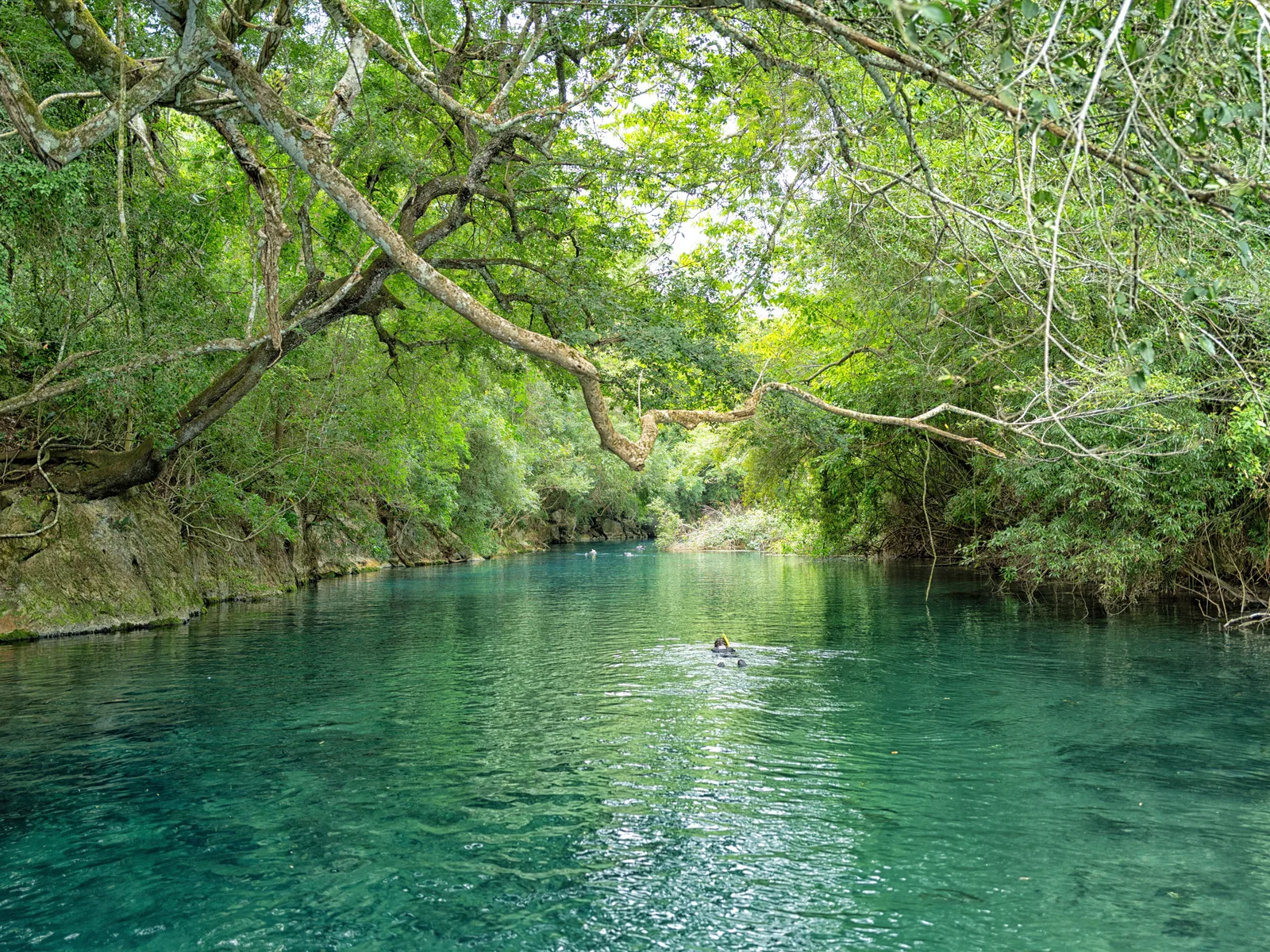
A clear green river near Bonito running under a large overhanging tree, with one person floating in the middle of the channel and dense forest along both banks 01

The reason the town exists on a map

The Rio da Prata and the Rio Sucuri

Float distance
1.8 km to 2.2 km
In the water
About 1½ to 2 hours
Distance out
20 km and 50 km

The two headline floats are the same idea done at different scales. The Rio Sucuri starts 20 km from Bonito at the Fazenda São Geraldo, where three springs surface in the forest; you walk to them on a boardwalk, get into the water and drift 1,800 meters back down to the farm behind a guide, in groups of eight. The Rio da Prata is 50 km south, over the line into the municipality of Jardim, and is the longer, fuller version: a forest trail in, a float that starts in the spring of the Olho d’Água and joins the Prata for a total of about 2,200 meters, and roughly four hours from the briefing to the end of lunch.

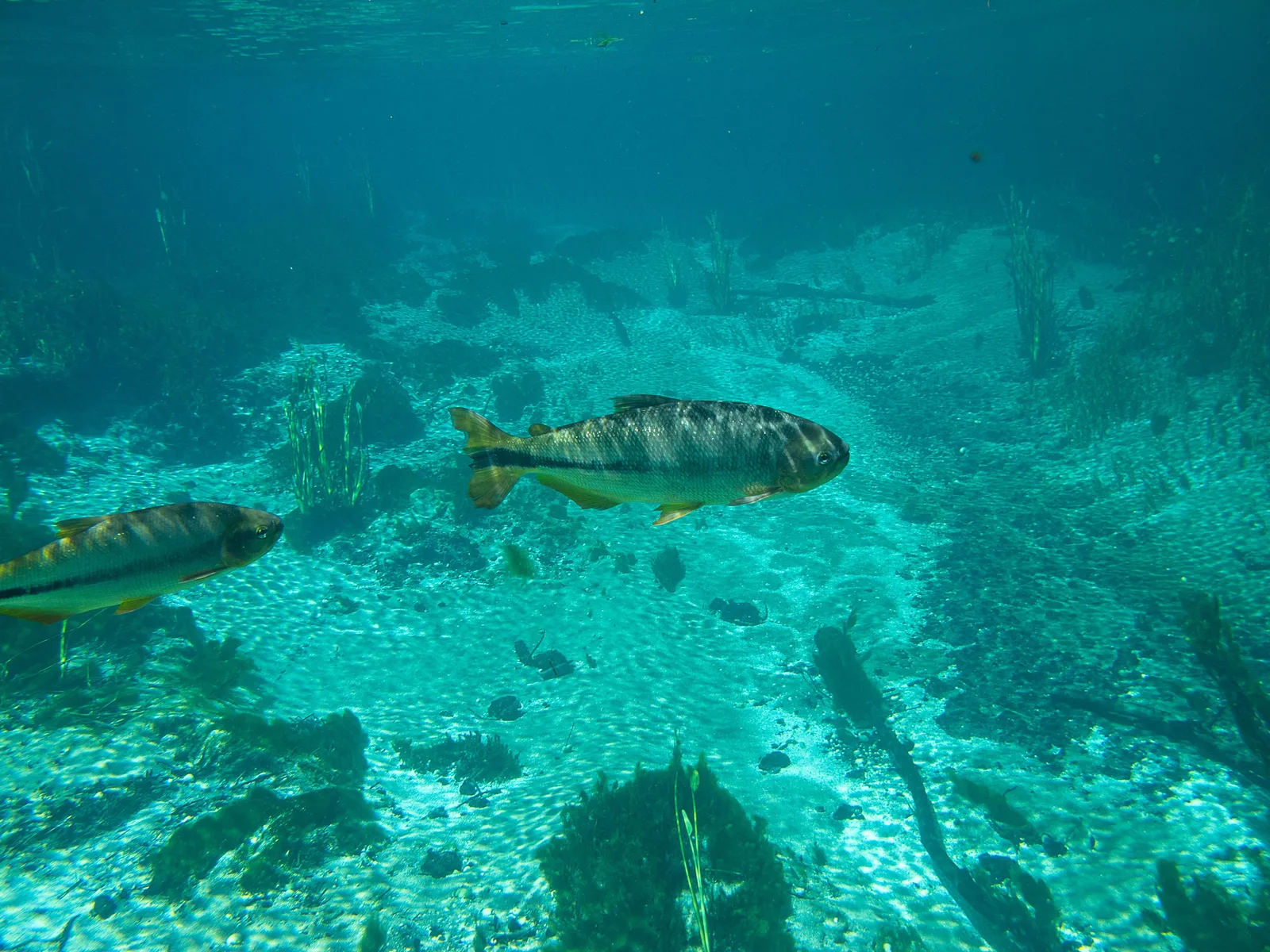
The point of both is the same and it is hard to overstate until you have your face in it. You are not swimming — you are lying on the surface in a life jacket with your arms behind your back, letting a very slow current move you, while shoals of piraputanga and dourado hold station a hand’s width away and submerged trees pass underneath. The water is around 22 degrees all year and the wetsuit is not optional in winter. Which one to book is the standard Bonito argument: the Prata for more fish, more water and a longer day, the Sucuri for the light and a lower price.
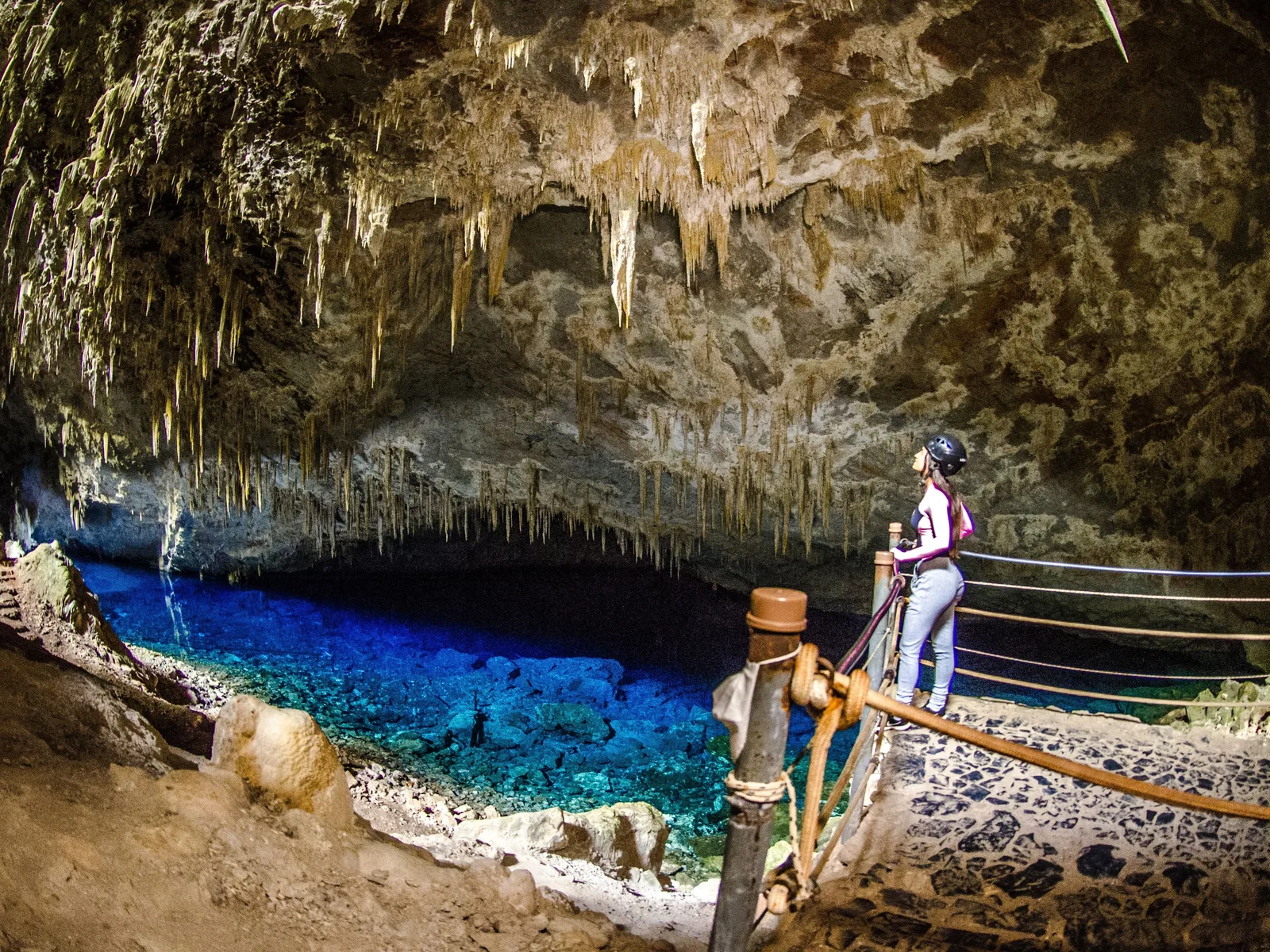
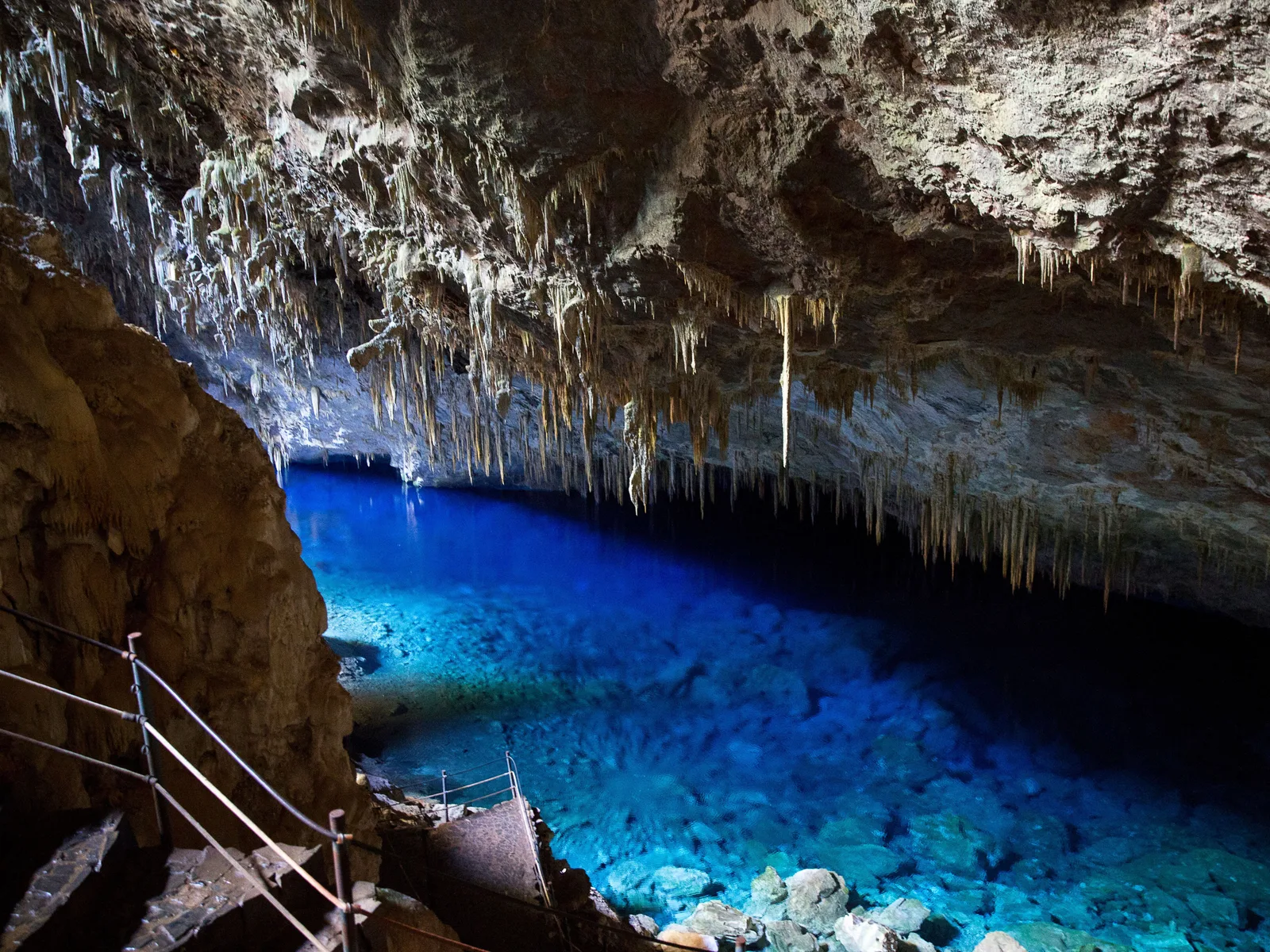
A visitor in a helmet standing at a rope handrail inside the Gruta do Lago Azul, the deep blue underground lake below, with a ceiling of pale stalactites lit from the entrance behind them 02

Found in 1924, and still not measured to the bottom

Gruta do Lago Azul

Descent
About 300 steps
Lake explored to
96 m
Daily cap
305 visitors

A Terena man found the cave in 1924, and it is now a protected natural monument 21 km from town. The visit is a walk down roughly 300 steps into a chamber the size of a cathedral, hung with stalactites, at the bottom of which sits a lake of an almost implausible blue. Divers have followed it to 96 meters without reaching the floor. A Franco-Brazilian expedition in 1992 brought up bones from the bottom, including a giant ground sloth and a saber-toothed cat — animals that fell in during the Pleistocene and never got out.

Two practical things. The color is a light effect, not a pigment, so the hour matters more than the season: the cave admits visitors from 7:00am and stops at 2:00pm, and the blue is at its strongest in the first couple of hours. And for about a month either side of the summer solstice — roughly mid-December to mid-January — the sun clears the entrance at the right angle and drops a beam directly onto the lake, which is the single most photographed thing in Mato Grosso do Sul. That window falls in the wettest, cloudiest part of the year, which is the trade-off in a sentence.

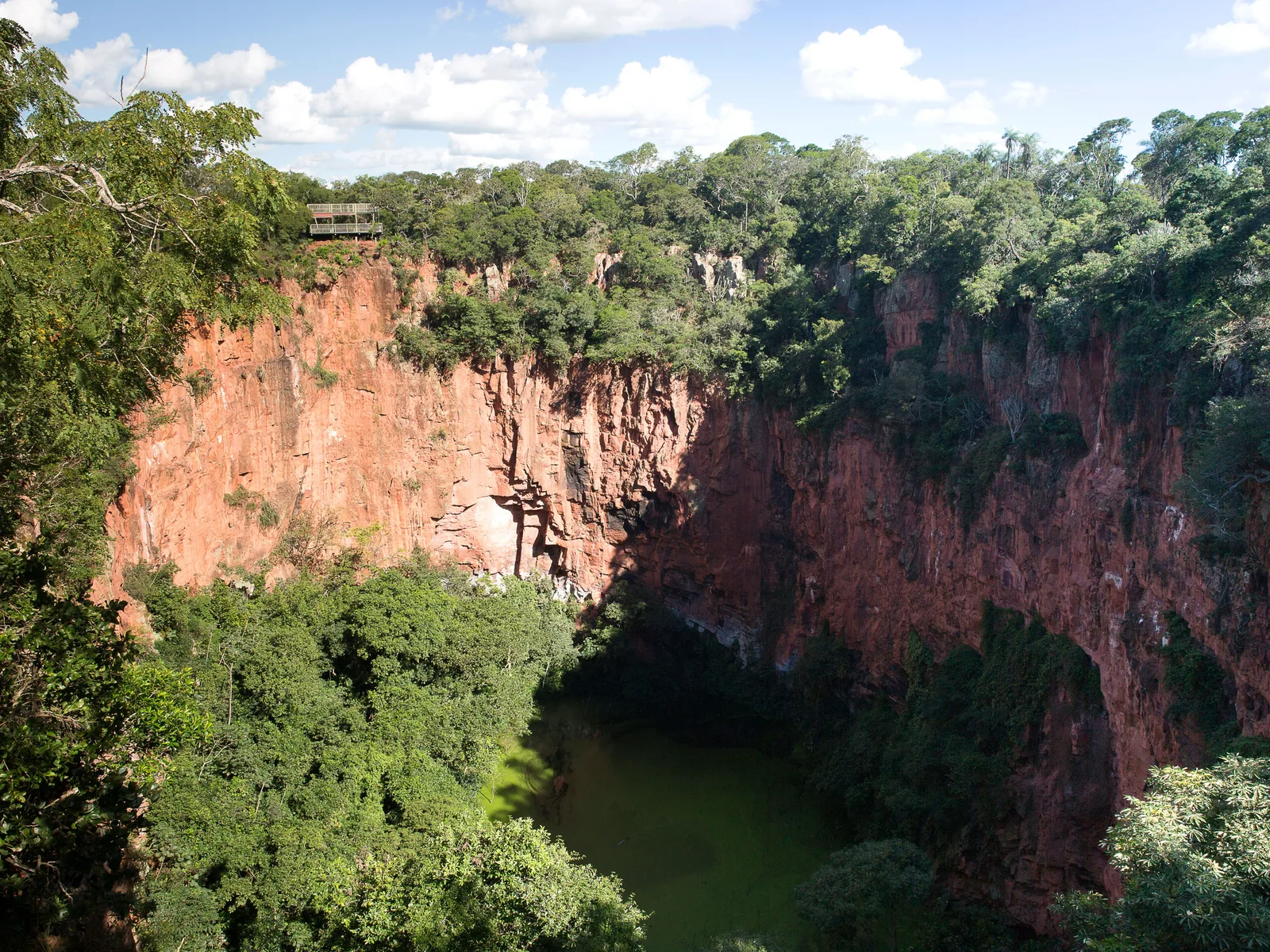
The Buraco das Araras seen from the rim: a vast circular pit with red-orange sandstone walls, dense green forest on the floor and a green pool at the bottom, with a steel viewing platform on the far rim 03

A hole in the ground with a hundred macaws in it

Buraco das Araras

Depth
About 100 m
Around the rim
About 500 m
Where
Jardim, 50 km from Bonito

A sinkhole in red sandstone about 100 meters deep and 500 meters around, on a private reserve in the municipality of Jardim, and one of the largest in South America. What makes it more than a geological curiosity is that red-and-green macaws nest in the walls. They come and go across the void all day in pairs, and because you are standing on the rim looking down, you watch them from above — which is not how anyone normally sees a macaw.

The visit is short and easy: a guided walk of a bit over a kilometer around the rim with two viewpoints, one of them a steel platform cantilevered over the edge. It takes about an hour and a half and needs no fitness at all, which makes it the standard afternoon pairing with the Rio da Prata half an hour up the road. Come early or late if the birds are the point — they are most active around dawn and in the last hours of the day, and quietest in the middle of a hot afternoon.

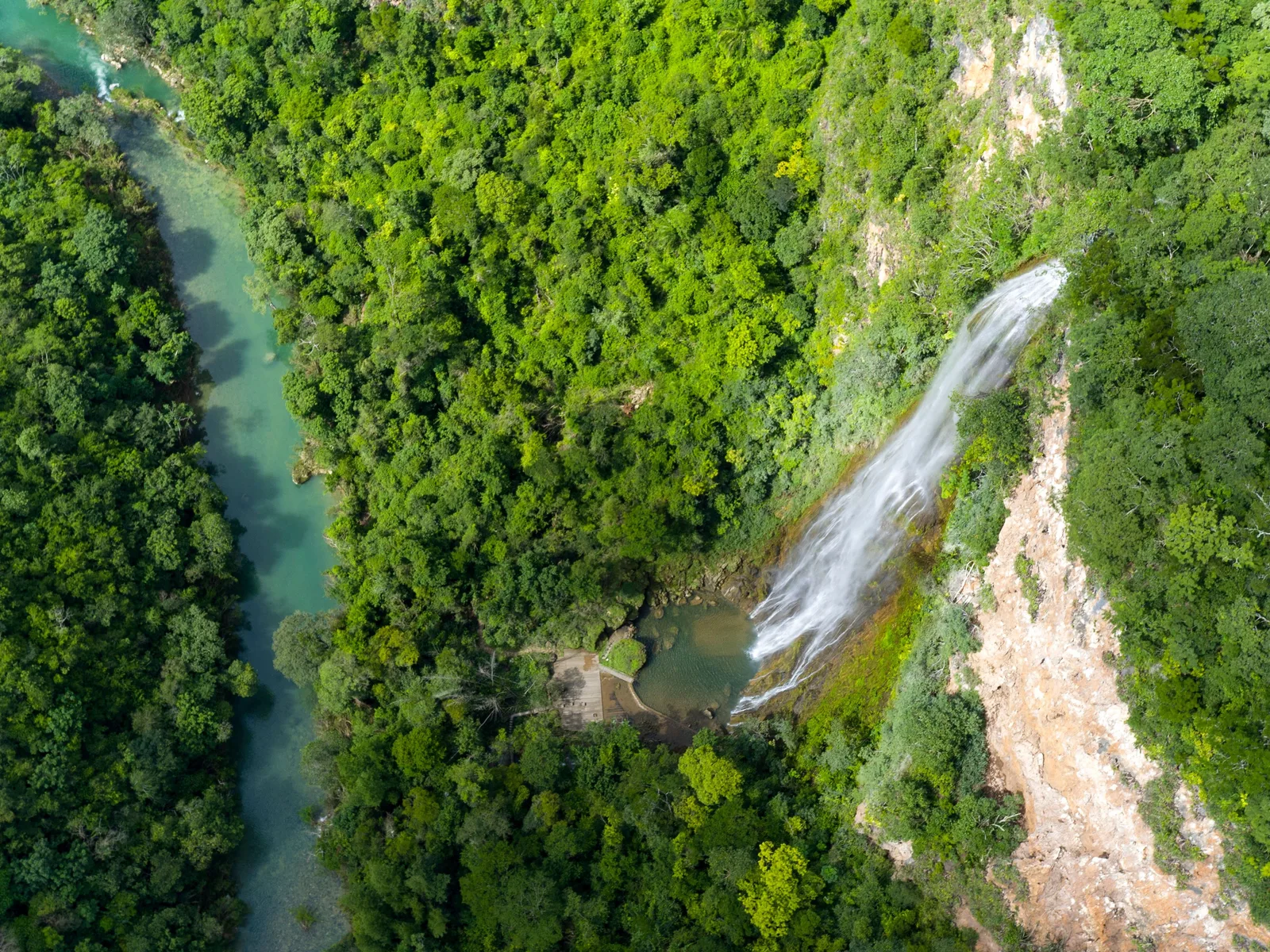
An aerial view of a tall thin waterfall dropping down a pale cliff into a forested canyon, with a turquoise river running along the canyon floor below it 04

The tallest waterfall in the state, and a canyon under it

Boca da Onça and the Bodoquena canyons

Main fall
156 m
Trail
4 km, 886 steps
Where
Bodoquena, 59 km away

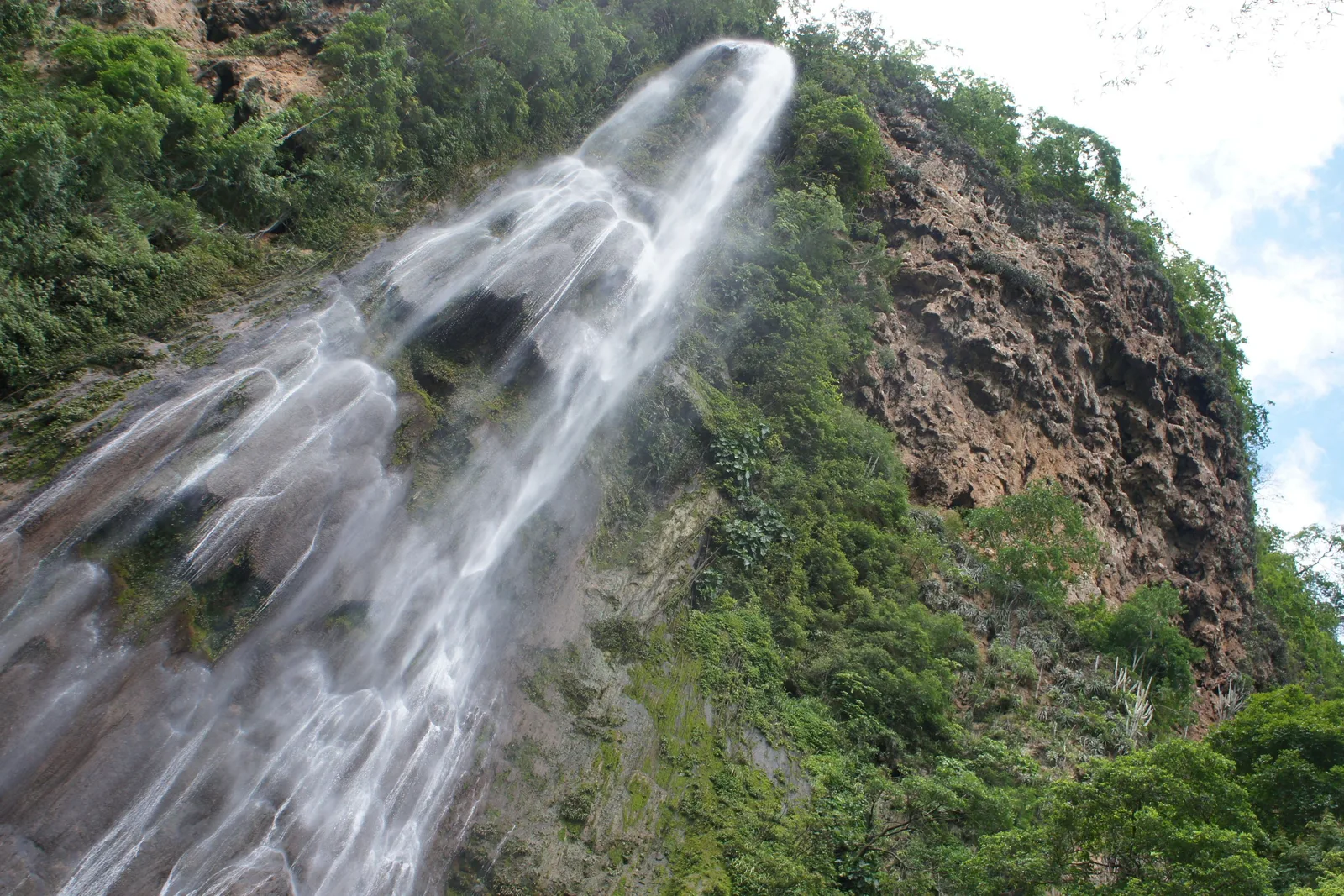
North of Bonito the Serra breaks into canyons, and the Rio Salobra falls off the edge of one of them. The Boca da Onça is 156 meters, the tallest waterfall in Mato Grosso do Sul, named for a rock formation at the lip that looks like a jaguar’s head. The estate around it is in the municipality of Bodoquena, 59 km from Bonito, and the visit is a real walk: about four kilometers along the canyon floor past eight waterfalls, five of which you can swim in, with a staircase of 886 steps in one direction.

It is also where the region does adrenaline. A steel platform reaching fifteen meters out over the drop launches a 90-meter rappel, which is the biggest thing of its kind in Brazil, and there is a shorter zipline and a via ferrata on the same property. You do not have to do any of it — the trail and the swimming pools stand up perfectly well on their own — but this is the day to schedule if the rest of your trip has been spent lying face-down in a river.

What to actually do

One town, five kinds of day.

Pick a category, then scroll sideways through it. Every one of these is a half day, every one needs a voucher booked in advance, and one or two a day is the honest maximum.

Snorkeling

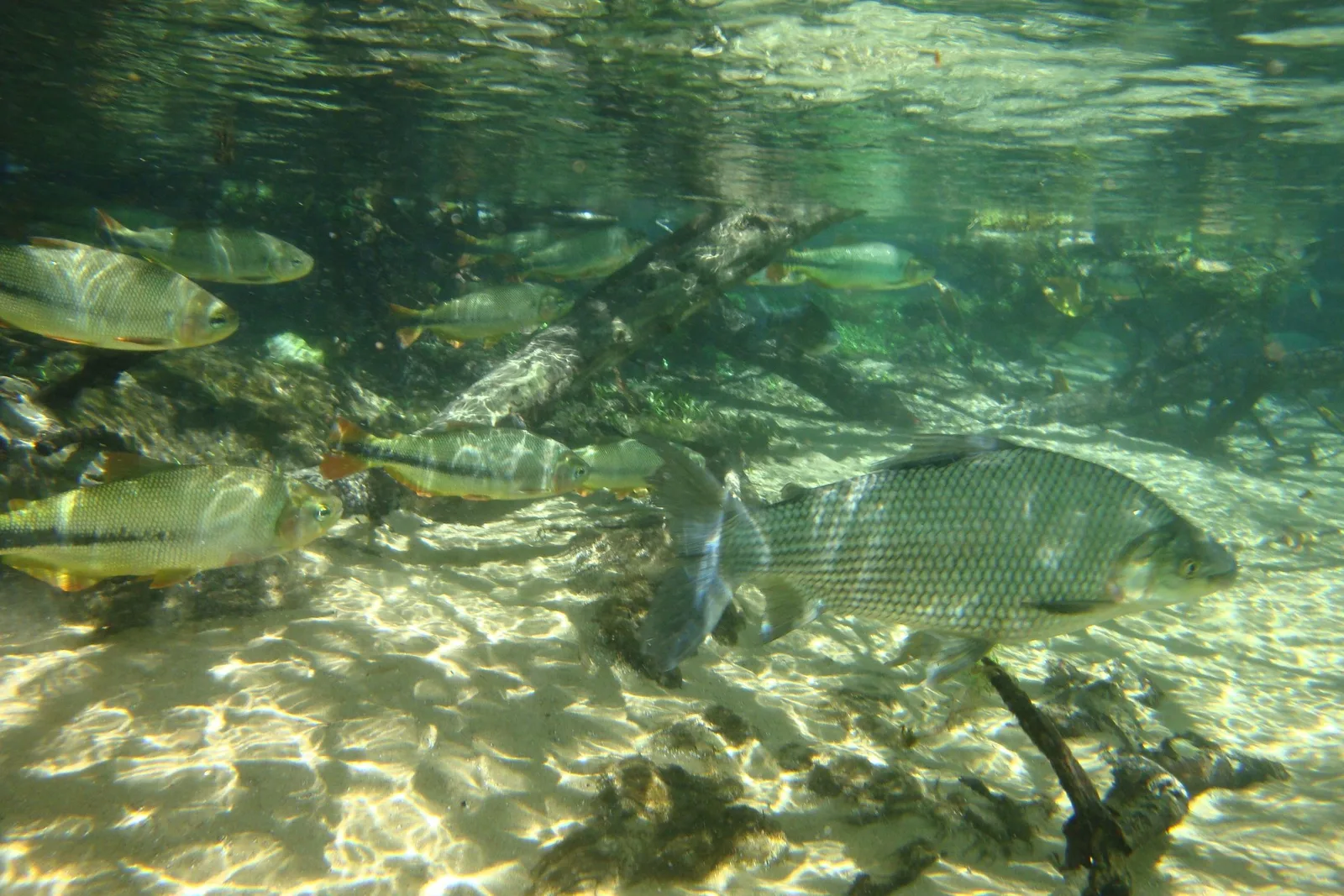
  • An underwater view of a shoal of silver-and-yellow fish holding station over a pale gravel riverbed in clear shallow water at the Rio da Prata

    Jardim, 50 km · half day, about R$470

    Floating the Rio da Prata

    The one most people book if they only book one. A trail through the forest gets you to the spring of the Olho d’Água, and from there you float about 2,200 meters down to where it meets the Rio da Prata, in a group of ten behind a guide. It holds more fish than anywhere else on the standard circuit — piraputanga, dourado, curimbatá and pacu, in numbers that stop being individual animals and start being weather. Four hours end to end including lunch, and worth building a day around rather than pairing with something ambitious.

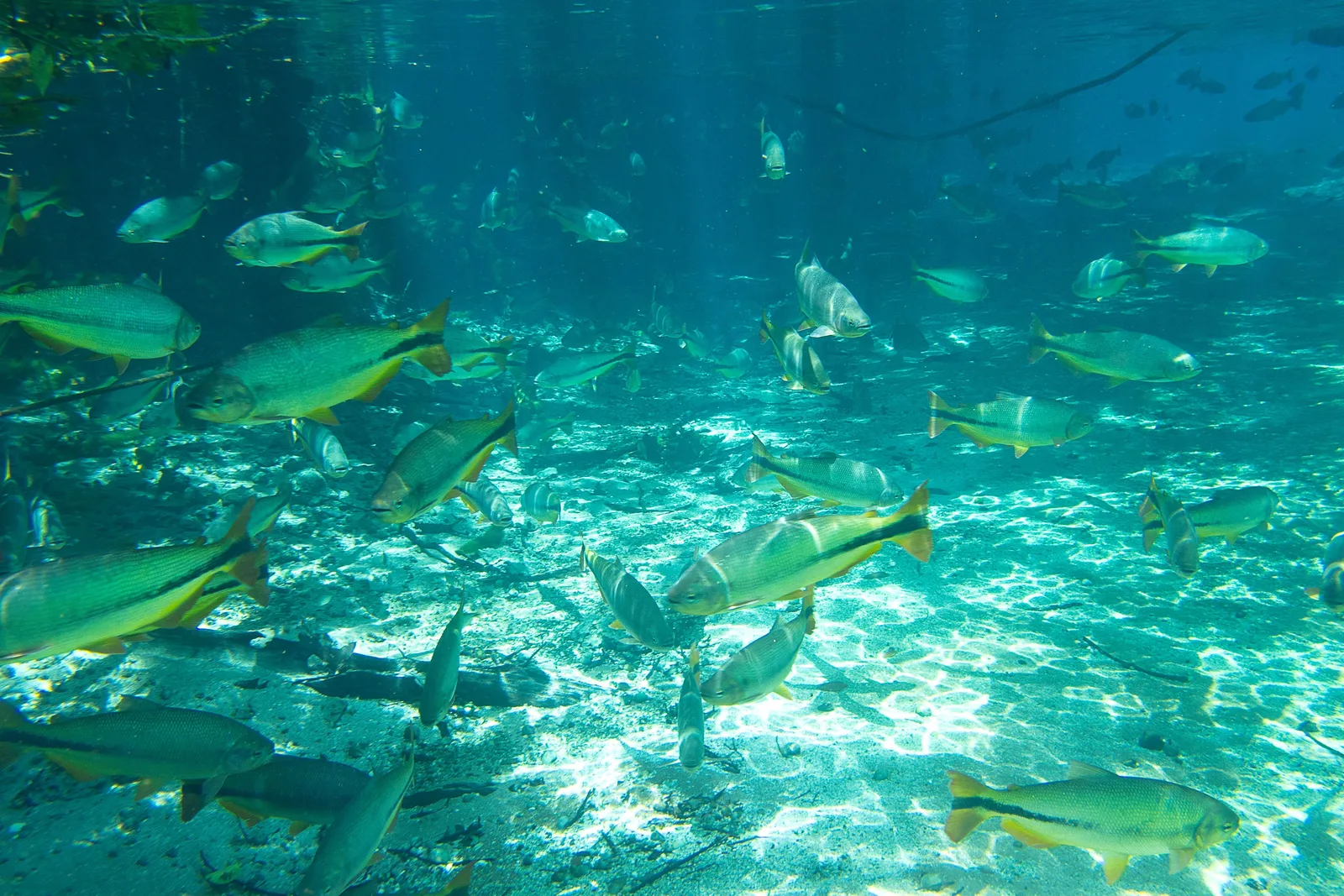
  • An underwater view of a dense shoal of piraputanga with yellow-edged tails swimming over rippled pale sand in bright turquoise water

    Bonito, 20 km · half day, about R$349

    Floating the Rio Sucuri

    The closest of the big floats and the cheapest of them, on the Fazenda São Geraldo twenty minutes out of town. A short walk on a boardwalk takes you past three springs surfacing in the forest, and then you drift 1,800 meters down a river that is often called the clearest in Brazil, in a group of eight, with a support boat alongside. About an hour and a half in the water. Less fish than the Prata, better light, and the right choice if you want to do two things in one day.

  • A wooden footbridge crossing a vivid blue-green spring at the Nascente Azul, with swimmers in the water beneath it and forest closing over the far bank

    Bonito, 25 km · half day, about R$374

    Floating at the Nascente Azul

    A spring on the Rio Mimoso with an easier trail than most — flat, well built and manageable for almost anyone — and a float that is short but concentrated, over a bed of white sand that throws the blue back at you. It is the friendliest of the floats for children and for anyone unsure about the whole idea, and the property has a restaurant and a pool for the people in your group who would rather not get in. Frequently the one that ends up as the favorite.

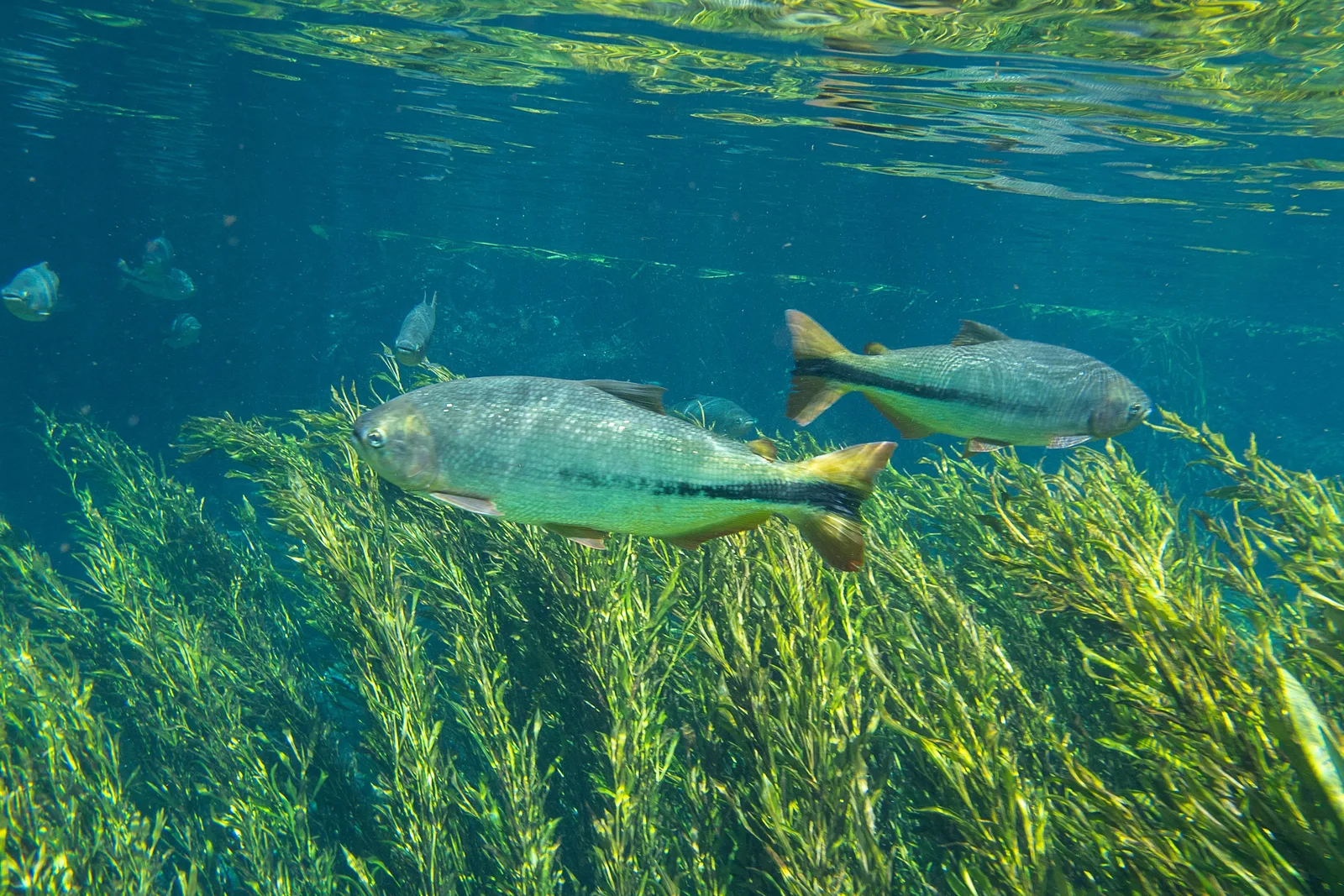
  • Two large piraputanga with yellow-tipped tails swimming just under the surface over long green water weed in clear river water

    Bonito, 7 km · half day, about R$352

    The fish at the Aquário Natural

    The closest attraction to town, on the Baía Bonita, and the shortest and shallowest of the floats — which is exactly why it works for a first go. The spring bubbles up through white sand into water a couple of meters deep, and the fish are so used to people that the whole thing is less snorkeling than standing in an aquarium. Piraputanga, the silver fish with the red-orange tail that is the emblem of these rivers, are the ones you will remember. Under two hours, and it pairs easily with anything.

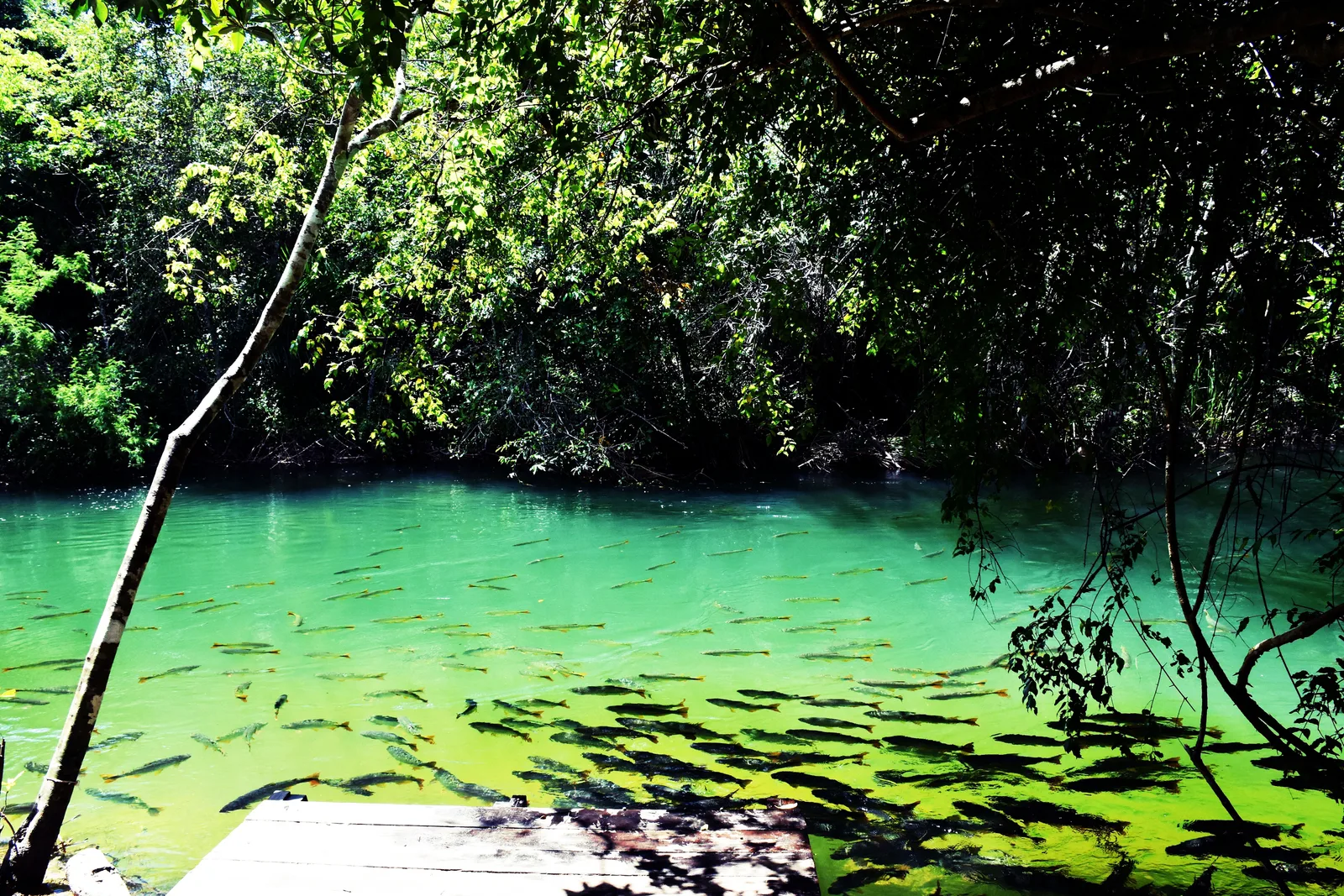
  • Vivid green water at the Balneário Municipal on the Rio Formoso carrying a large shoal of fish, a wooden deck at the near edge and dark forest along the bank

    Bonito, 7 km · half day, about R$70

    Swimming at the Balneário Municipal

    The town’s own stretch of the Rio Formoso, and the cheapest water in the region by a wide margin. It is a public bathing place rather than an attraction: lawns, kiosks, changing rooms, volleyball, families with coolers, and a river full of aquatic plants and fish that you can wade straight into with a mask. It still runs on a voucher and a booking like everything else, but the price is a tenth of a float. The obvious answer to a half day that fell through, or to a first afternoon.

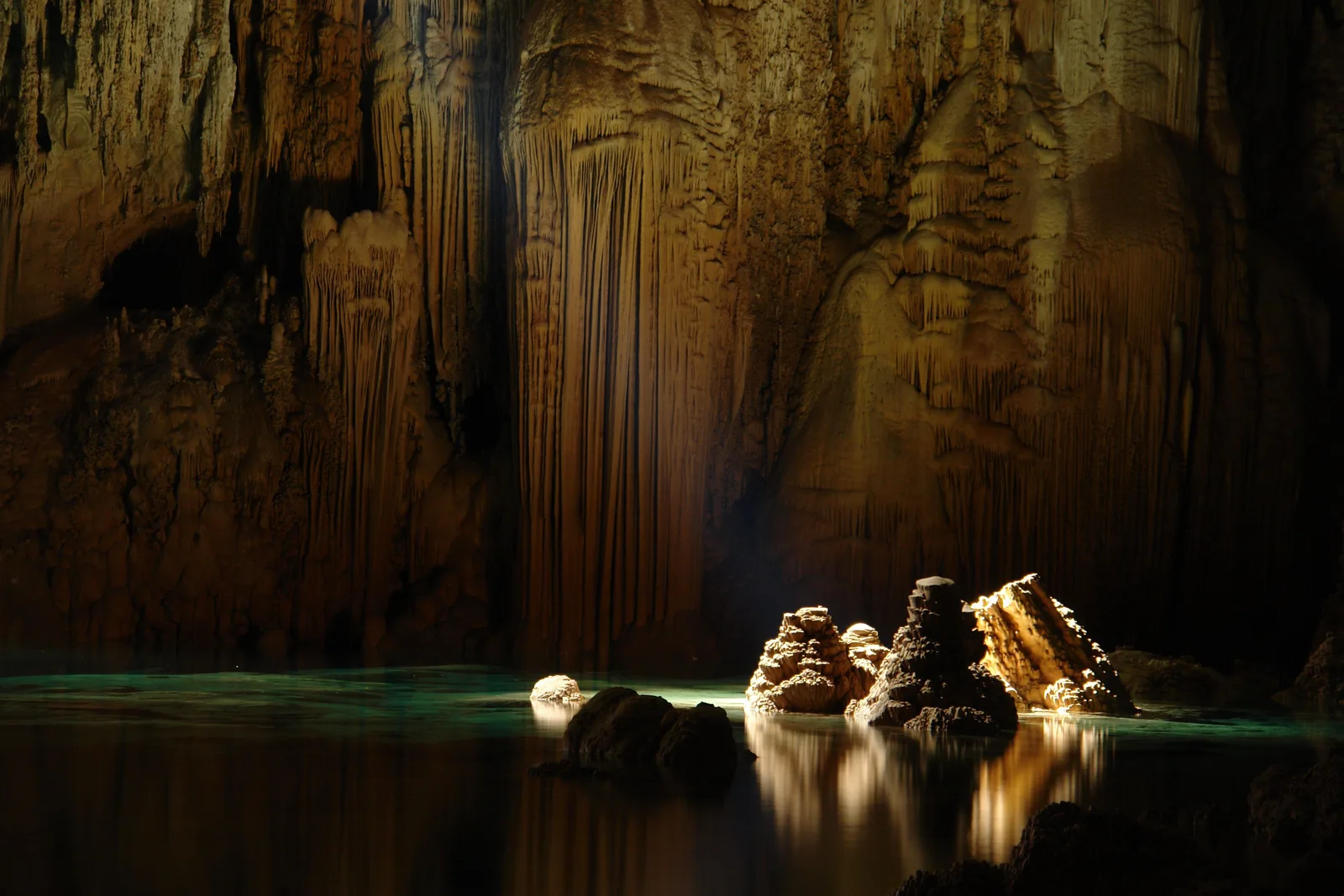
  • Warm-lit cone-shaped rock formations standing out of a still dark lake inside a cavern, reflected in the water, with a stalactite wall rising behind them

    Bonito, 23 km · part of the Anhumas day

    Floating and diving inside the Abismo Anhumas

    Once you are down, you get in a boat, cross the lake and either snorkel it or dive it. What is underneath is a forest of cone-shaped speleothems standing up out of the water, some of them nineteen meters tall, in water clear enough to see the whole way down. Certified divers can go deeper for more money. If a full cave rappel is a step too far, the Lagoa Misteriosa, 50 km away in Jardim, is a much cheaper way to snorkel or dive water like this — and it opens for diving between April and September only.

  • A staircase of wide travertine cascades on the Rio da Prata, white water spilling over three low moss-covered ledges into a turquoise pool

    Jardim, 50 km · part of the Prata day

    The travertine cascades on the Rio da Prata

    Downstream of the float, the Prata does what these rivers do everywhere in the Bodoquena: the dissolved limestone comes back out of solution, cements into travertine, and builds shelf after shelf across the channel. The result is a staircase of wide, shallow falls with pools between them, and it is included in the float day rather than sold separately. It is also the clearest illustration on the whole trip of why the water is the way it is — the rock in front of you is the filter.

Caves & Abysses

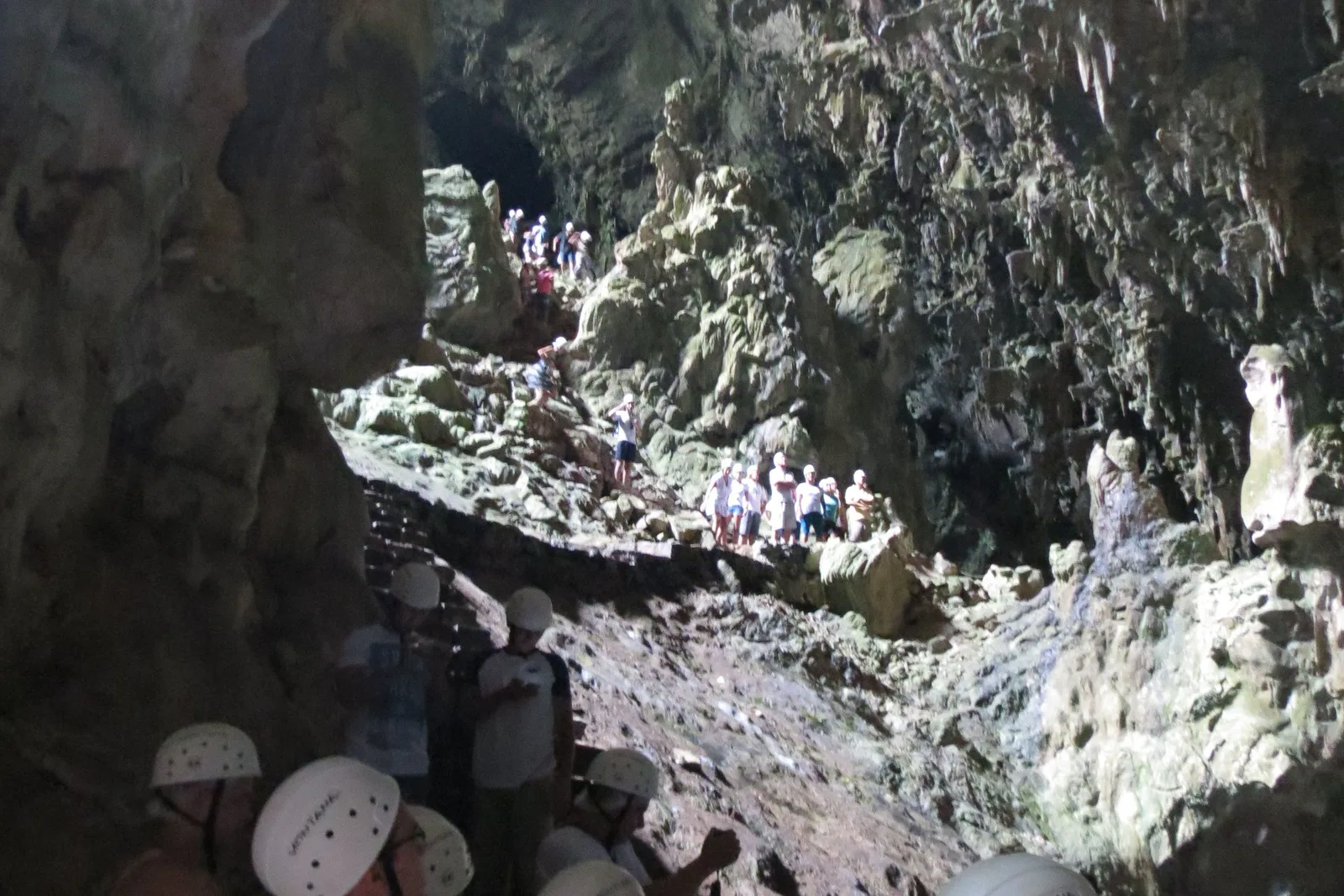
  • A group of visitors in white helmets picking their way down the pale rocky floor of a large cave chamber, with the cave walls rising steeply around them

    Bonito, 21 km · half day, about R$120

    Descending into the Gruta do Lago Azul

    Helmets on at the top, then about 300 steps down a stone staircase into a chamber the size of a church, and at the bottom a lake of a blue that photographs badly and looks impossible in person. Groups are capped at fourteen and the cave stops admitting at 2:00pm, so this is a morning, and the earlier the better — the color depends on light coming through the entrance. Around an hour and twenty minutes underground. The climb back out is the only demanding part, and it is a fair one.

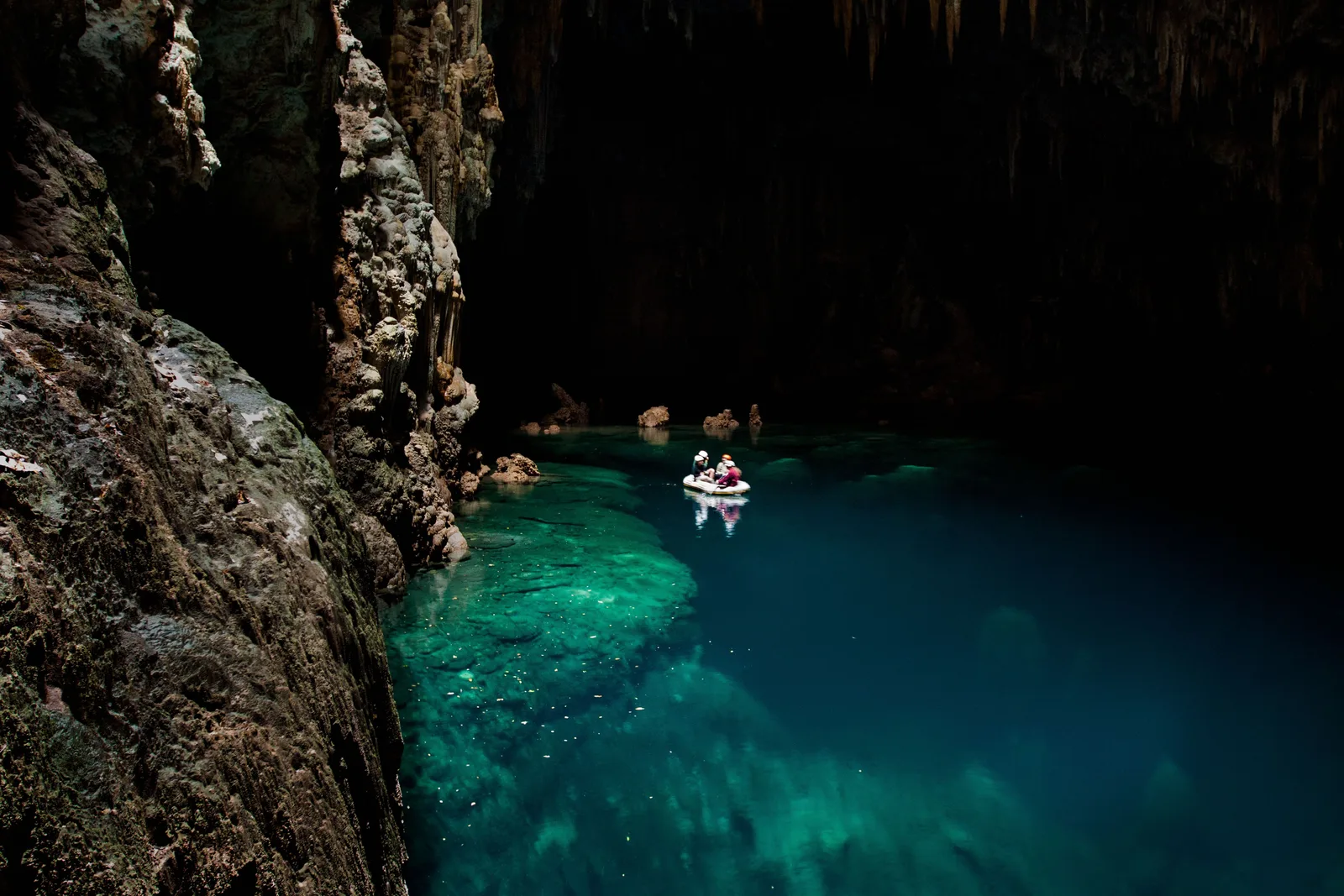
  • Looking down into the Abismo Anhumas at a turquoise lake at the bottom of a rock shaft, with two people on an inflatable raft floating on it

    Bonito, 23 km · full day, about R$1,598

    Rappelling into the Abismo Anhumas

    The most serious thing on the Bonito menu, and the most expensive. You go to the office the afternoon before to be fitted for a wetsuit and sign the safety terms, then in the morning an electric winch lowers you 72 meters down a shaft in the ground, two at a time, about five minutes, and you come out in a cavern with a lake in it. Sixty people a day, no more, split between a morning and an afternoon group. It costs about as much as three other attractions put together and there is no cheap version, but nobody who does it puts it second on their list.

  • Warm-lit cone-shaped rock formations standing out of a still dark lake inside a cavern, reflected in the water, with a stalactite wall rising behind them

    Bonito, 23 km · part of the Anhumas day

    Floating and diving inside the Abismo Anhumas

    Once you are down, you get in a boat, cross the lake and either snorkel it or dive it. What is underneath is a forest of cone-shaped speleothems standing up out of the water, some of them nineteen meters tall, in water clear enough to see the whole way down. Certified divers can go deeper for more money. If a full cave rappel is a step too far, the Lagoa Misteriosa, 50 km away in Jardim, is a much cheaper way to snorkel or dive water like this — and it opens for diving between April and September only.

Waterfalls & Trails

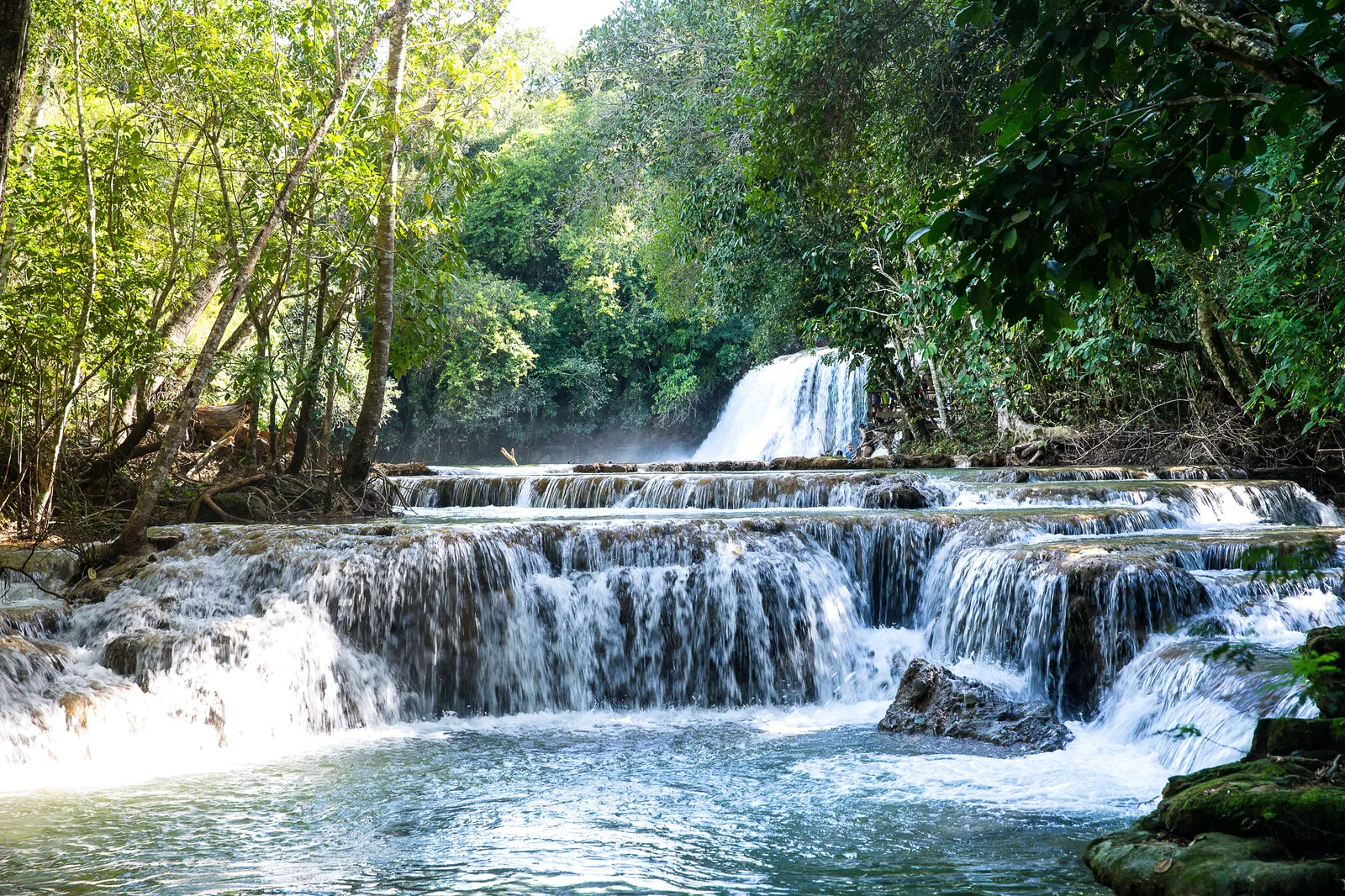
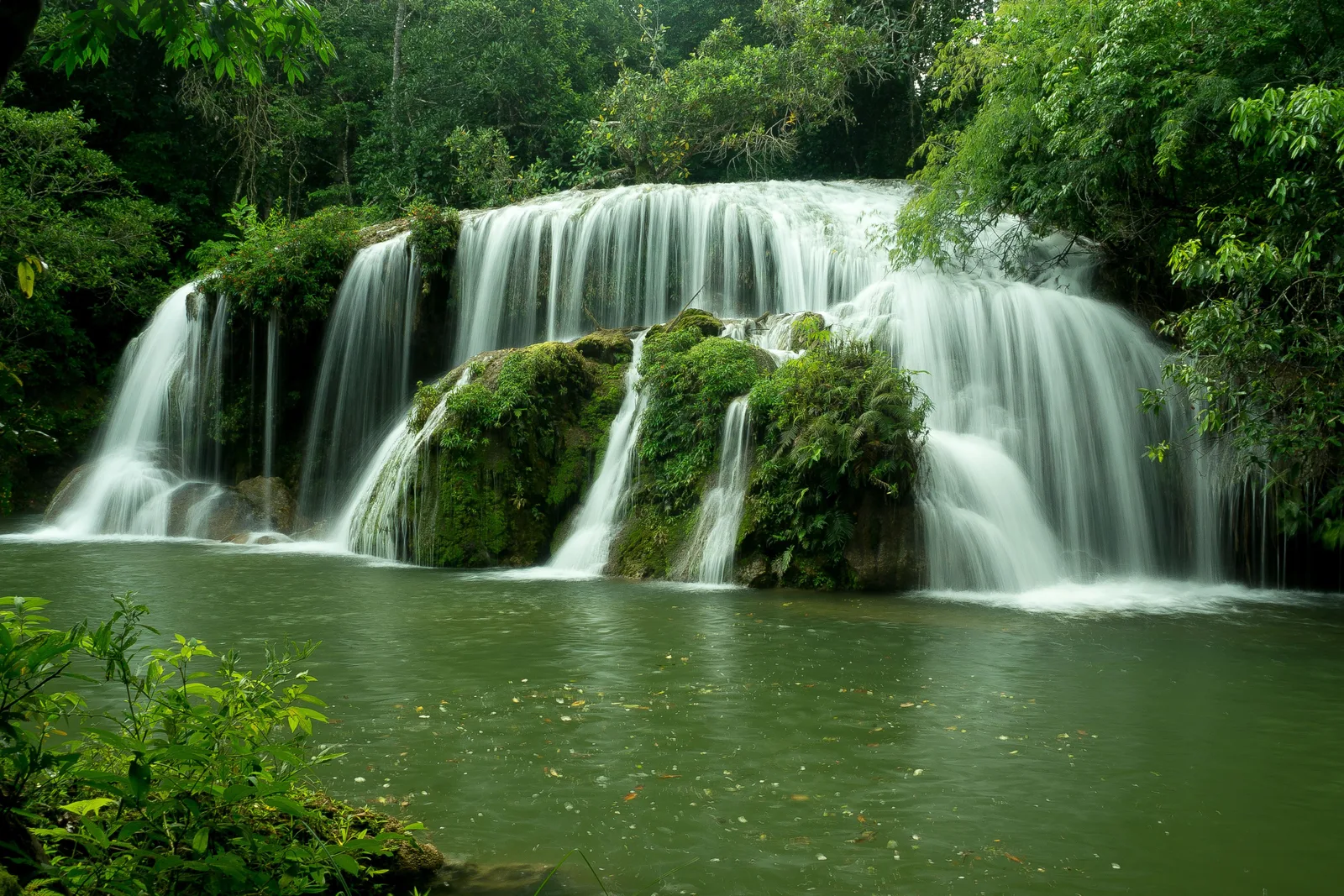
  • A wide, low waterfall on the Rio Mimoso falling in several curtains over a moss-covered travertine ledge into a green pool, with dense forest behind it

    Bonito, 24 km · half day, about R$340

    The waterfall circuit at Estância Mimosa

    A working farm on the Rio Mimoso with a trail linking ten waterfalls, nine of which you can swim in, along 2.8 km of easy forest walking with a short solar-powered boat leg. The falls here are the classic Bodoquena shape — wide, low, moss-topped travertine steps rather than single drops — and the pools behind them are warm and shallow enough to spend an hour in. The gentlest of the waterfall days, good with children, and the one that most looks like the photographs people bring home.

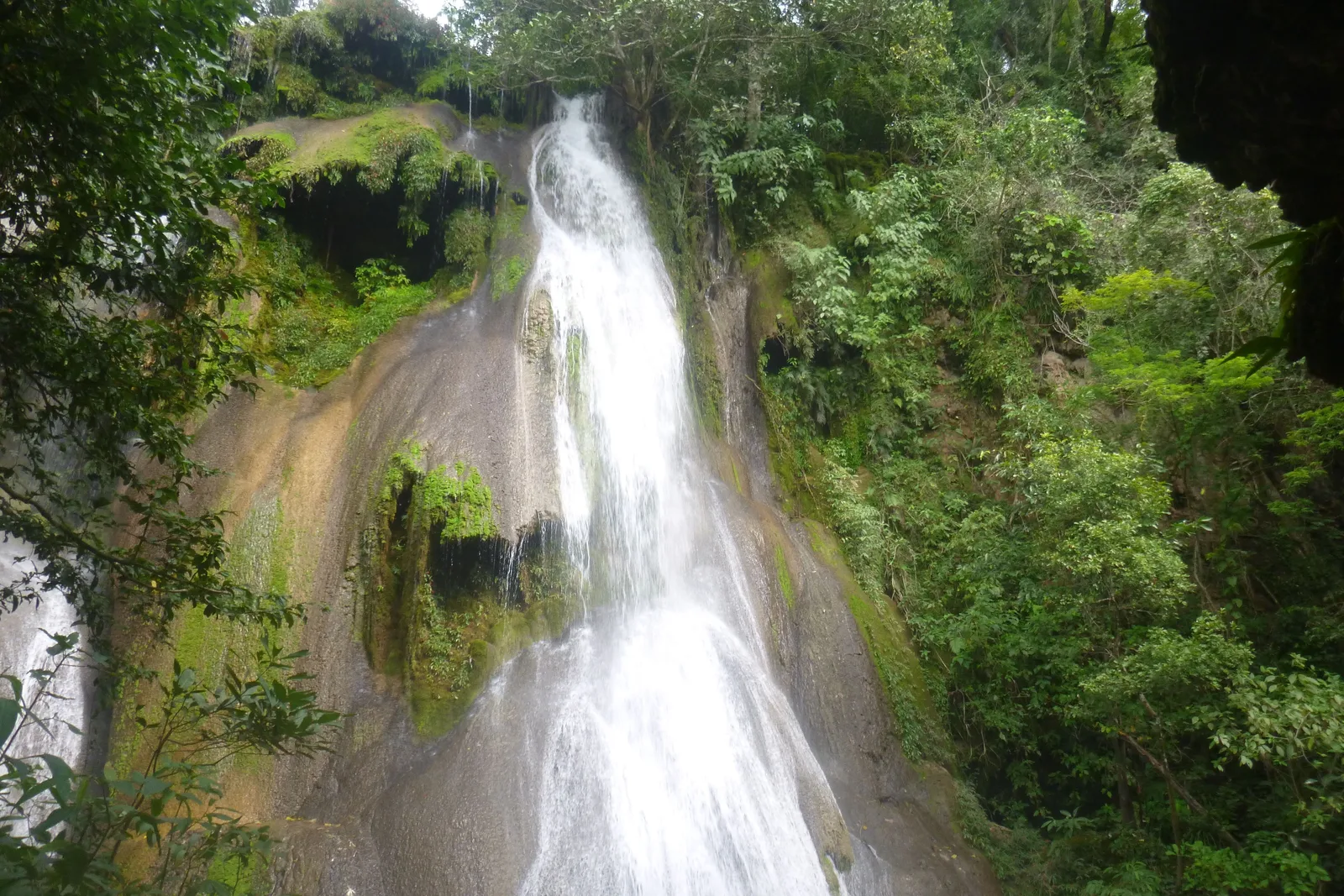
  • A tall, narrow waterfall falling down a steep mossy rock face into a pool on the Boca da Onça trail, surrounded by thick green forest

    Bodoquena, 59 km · full day, about R$555

    The canyon trail at Boca da Onça

    The longest walk in the region and the only one that feels like a hike: four kilometers along the floor of the Rio Salobra canyon, past eight waterfalls with five bathing stops, ending under the 156-meter Boca da Onça itself. There are 886 steps involved, which you can take going up or coming down depending on the version you book. Lunch is included and you will want it. Start early — this is a full day and the canyon gets hot by noon.

  • A tall waterfall dropping in a broad white plume down a pale rock face in the Bodoquena canyon country, with green forest crowding both sides of it

    Bodoquena, 59 km · add-on to the trail day

    The 90-meter rappel at Boca da Onça

    A steel platform runs fifteen meters out over the lip of the canyon, and from the end of it you go over the side on a 90-meter rope — the largest platform rappel in Brazil. No experience is needed; the operator briefs you and controls the descent, and the whole thing takes a few minutes plus a long wait for your nerve. It is booked as an addition to the trail day rather than on its own, and the same property runs a zipline and a via ferrata for people who want the exposure without the drop.

  • A staircase of wide travertine cascades on the Rio da Prata, white water spilling over three low moss-covered ledges into a turquoise pool

    Jardim, 50 km · part of the Prata day

    The travertine cascades on the Rio da Prata

    Downstream of the float, the Prata does what these rivers do everywhere in the Bodoquena: the dissolved limestone comes back out of solution, cements into travertine, and builds shelf after shelf across the channel. The result is a staircase of wide, shallow falls with pools between them, and it is included in the float day rather than sold separately. It is also the clearest illustration on the whole trip of why the water is the way it is — the rock in front of you is the filter.

Wildlife

  • Two large piraputanga with yellow-tipped tails swimming just under the surface over long green water weed in clear river water

    Bonito, 7 km · half day, about R$352

    The fish at the Aquário Natural

    The closest attraction to town, on the Baía Bonita, and the shortest and shallowest of the floats — which is exactly why it works for a first go. The spring bubbles up through white sand into water a couple of meters deep, and the fish are so used to people that the whole thing is less snorkeling than standing in an aquarium. Piraputanga, the silver fish with the red-orange tail that is the emblem of these rivers, are the ones you will remember. Under two hours, and it pairs easily with anything.

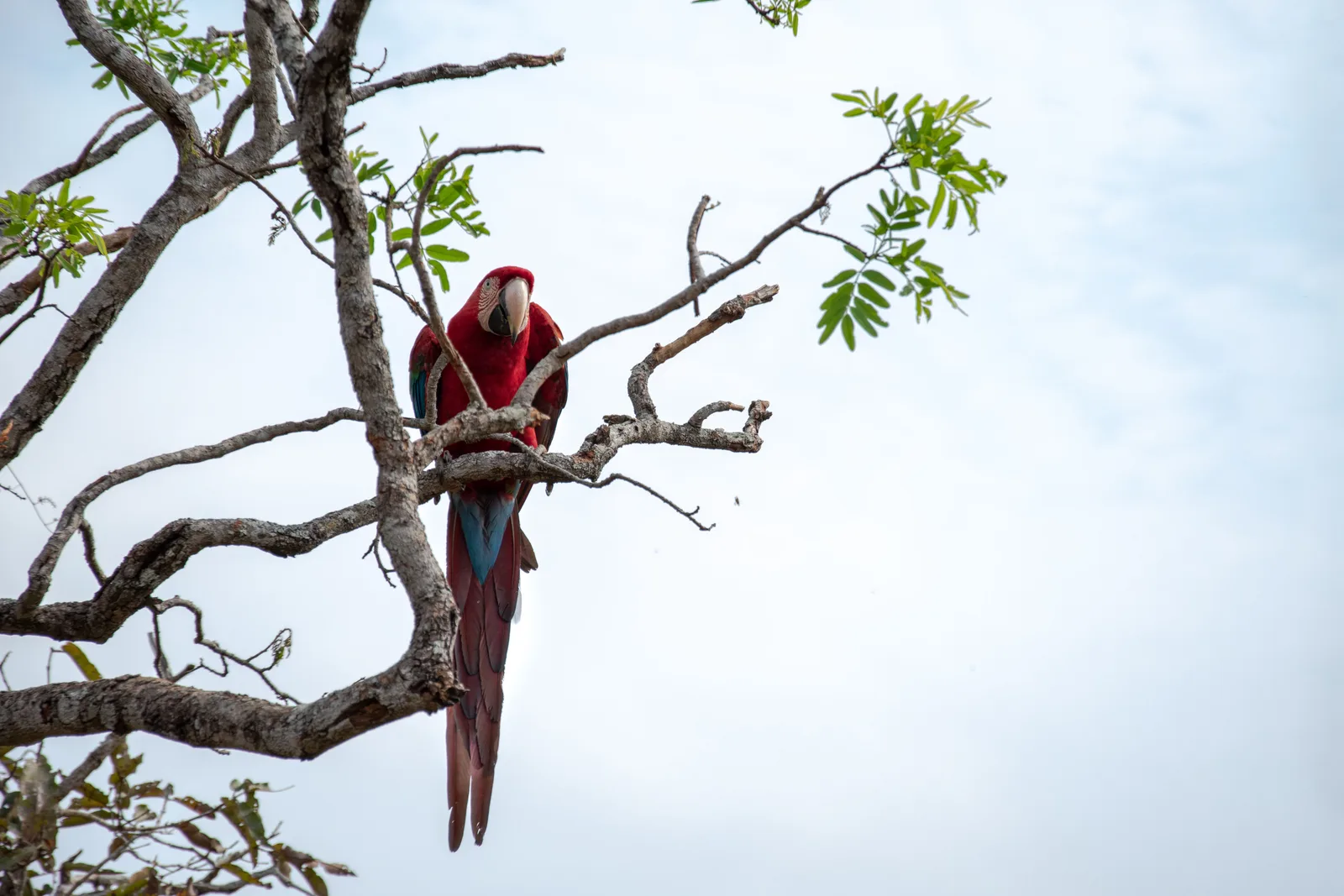
  • A red-and-green macaw perched on a bare branch against a pale sky, its red body and blue-green wing feathers clearly lit

    Jardim, 50 km · 1½ hours, about R$185

    Red-and-green macaws at the Buraco das Araras

    Around a hundred red-and-green macaws nest in the walls of the sinkhole, and the reserve exists largely to keep them there — the species is heavily targeted by wildlife traffickers, and this is one of the places it has held on. You watch them from the rim, which means looking down onto their backs as they cross the void in pairs. Bring binoculars if you have them. More than 150 other bird species have been recorded on the property, and toucans and blue-and-gold macaws turn up as well.

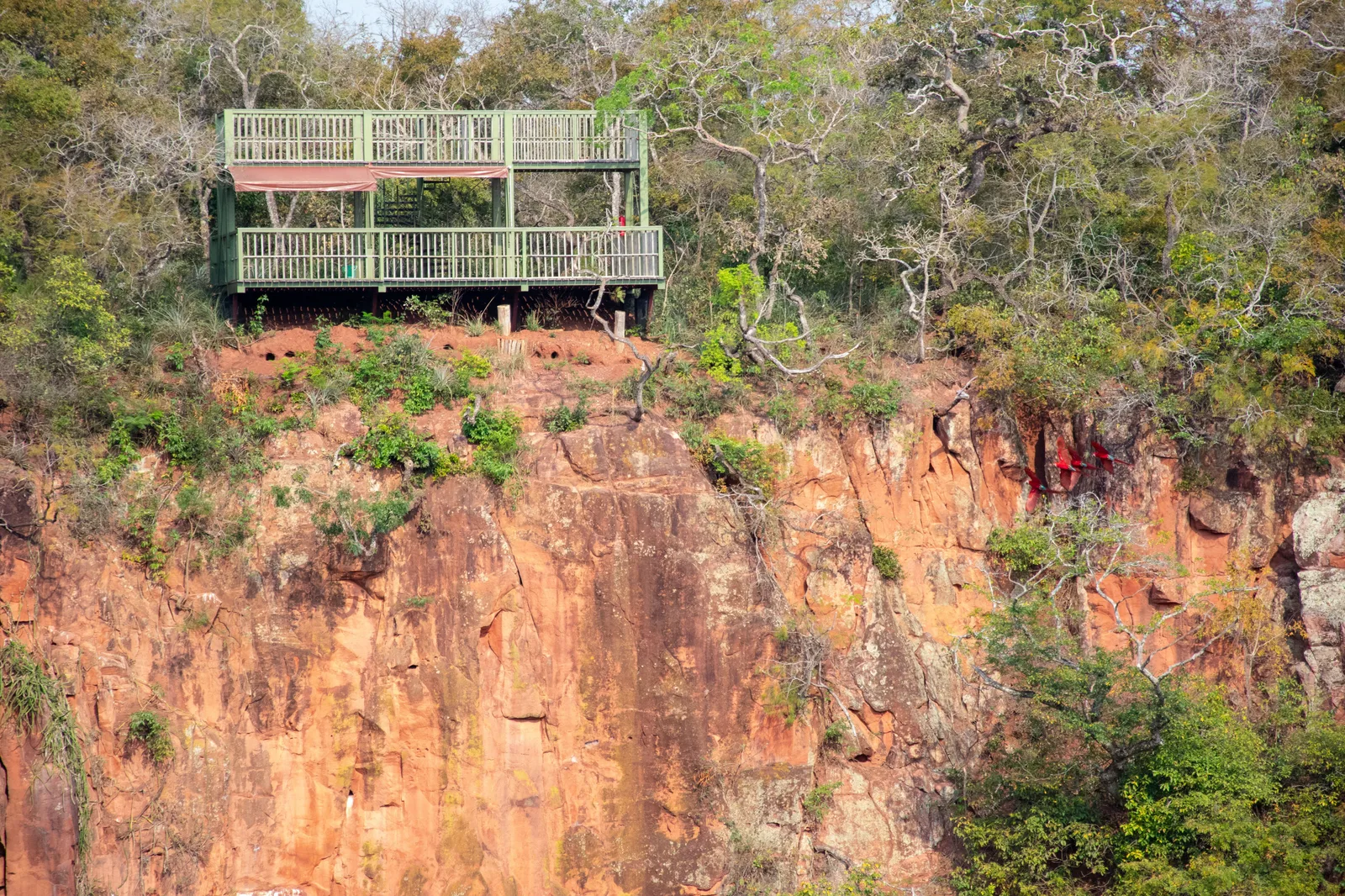
  • A green steel viewing platform standing at the red sandstone edge of the Buraco das Araras, with scrub forest growing along the cliff face below it

    Jardim, 50 km · part of the Araras visit

    The rim trail and platform at the Buraco das Araras

    The walk itself is a bit over a kilometer on a flat, well-made path through dry forest, with two viewpoints. The second is a steel platform that reaches out over the edge, and it is where the scale finally registers: a hundred meters straight down to a green pool, sheer red sandstone all the way round. Guides point out the nest holes and the pairs that use them. It needs no fitness whatsoever, which makes it the easiest attraction in the region and the natural afternoon after a morning in a river.

In Town

  • Vivid green water at the Balneário Municipal on the Rio Formoso carrying a large shoal of fish, a wooden deck at the near edge and dark forest along the bank

    Bonito, 7 km · half day, about R$70

    Swimming at the Balneário Municipal

    The town’s own stretch of the Rio Formoso, and the cheapest water in the region by a wide margin. It is a public bathing place rather than an attraction: lawns, kiosks, changing rooms, volleyball, families with coolers, and a river full of aquatic plants and fish that you can wade straight into with a mask. It still runs on a voucher and a booking like everything else, but the price is a tenth of a float. The obvious answer to a half day that fell through, or to a first afternoon.

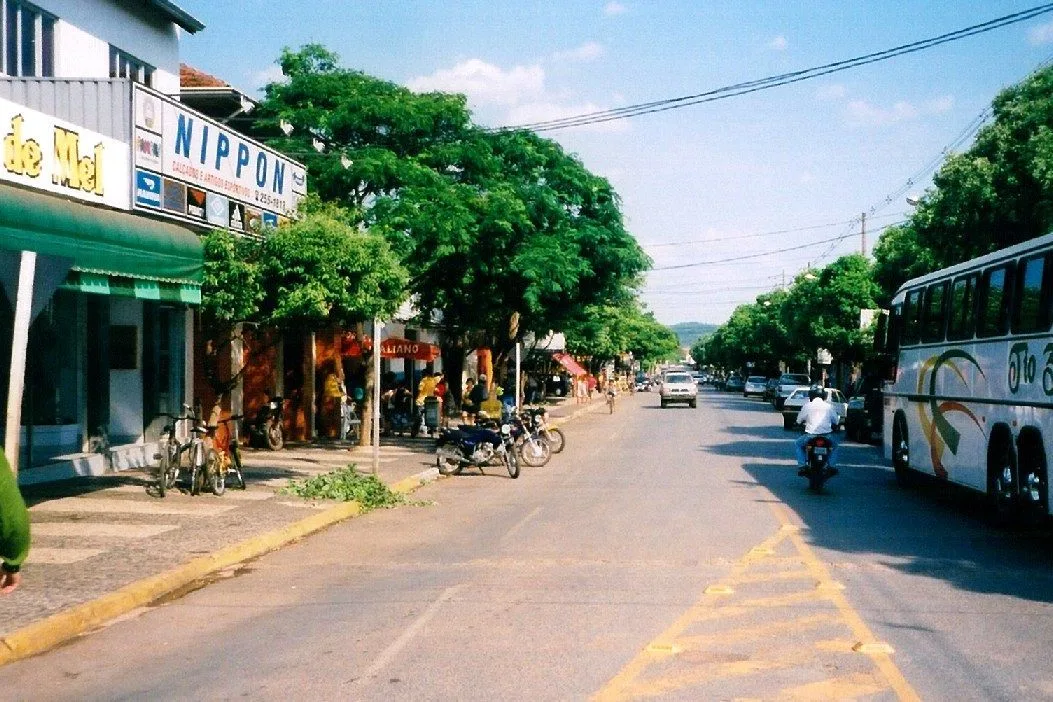
  • The wide, tree-lined main street of Bonito with shopfronts and awnings along one side, parked motorbikes and bicycles at the curb, a coach and a motorcyclist on the road

    Bonito · an evening

    The agencies and restaurants on Rua Coronel Pilad Rebuá

    Bonito’s one long main street is where the whole system lives. The travel agencies are lined up along it, and so are the restaurants, the ice cream, the outdoor shops and the craft stalls. Evenings here follow the same shape for everybody: come back dusty from an attraction, shower, walk the street, argue about tomorrow, book it at a counter. It is not a nightlife town — most places are closing as you finish dinner — and after four days of 6:00am starts you will not mind.

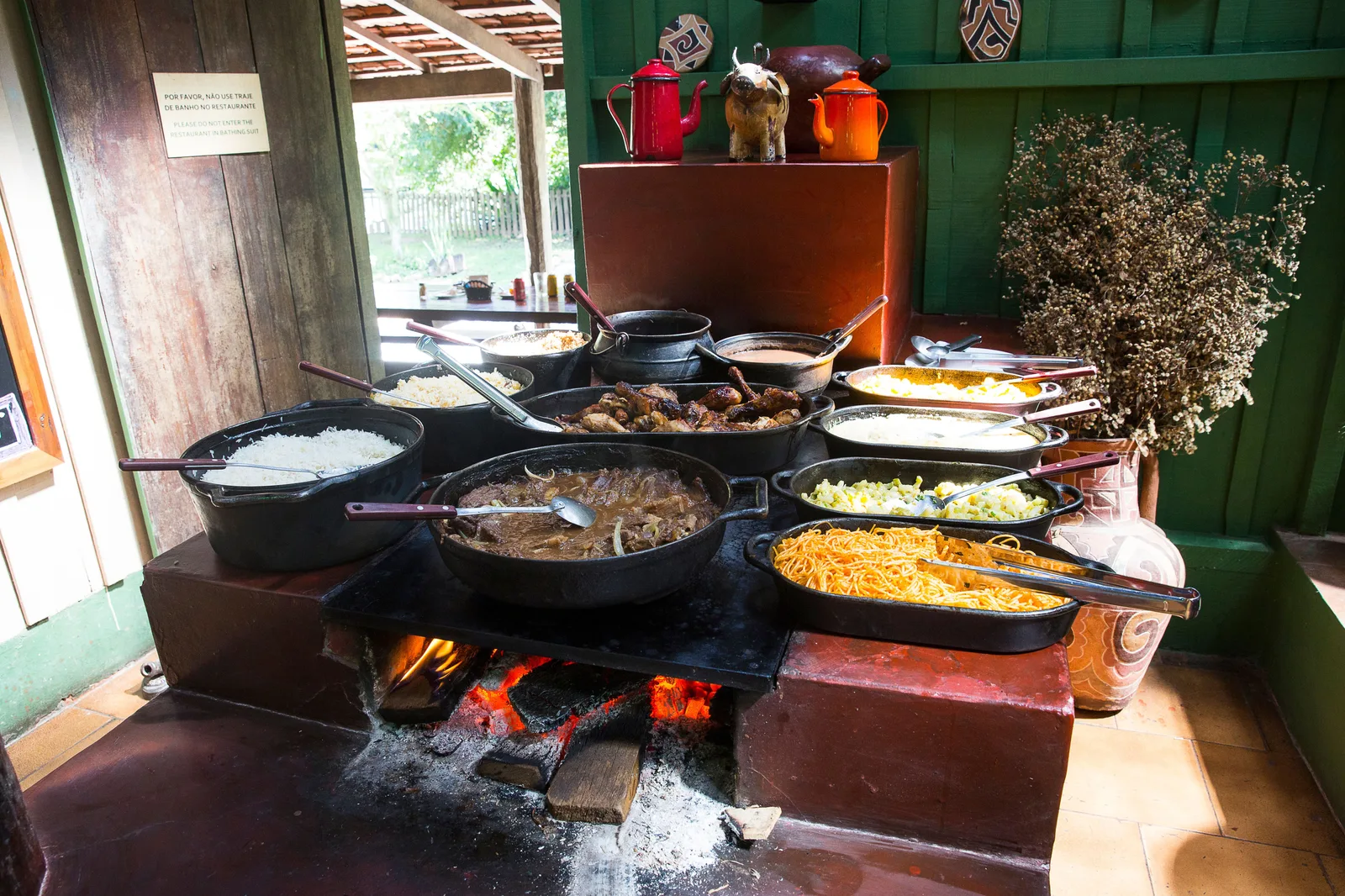
  • A wood-fired farm kitchen with a row of open pans of stews, rice and beans over a fire, jars and dried plants on a shelf above and a green wooden wall behind

    Bonito · a long lunch or dinner

    Eating the river fish

    The regional kitchen here is cattle country crossed with the river: pacu ribs, grilled pintado, traíra, and the sopa paraguaia and chipa that come across from the Paraguayan border a couple of hours away. Several of the attractions serve lunch on the property, and the farm ones do it properly — a wood-fired range, pans of things, and as much as you want. In town, expect around R$200 for two with drinks at a good place on the main street, and a great deal less at a per-kilo counter.

Where to stay

Three choices, and none of them is near the attractions.

Start from this: wherever you sleep in Bonito you are 20 to 60 kilometers from everything you came to do. So the question is not which base is closest — none is — but whether you want the agencies and restaurants on your doorstep, a river at the bottom of the garden, or open country.

Drag and zoom to explore.

Tap an area to open it and see it on the map

  • Our pick

    Best for: Being able to walk to the agencies and to dinner

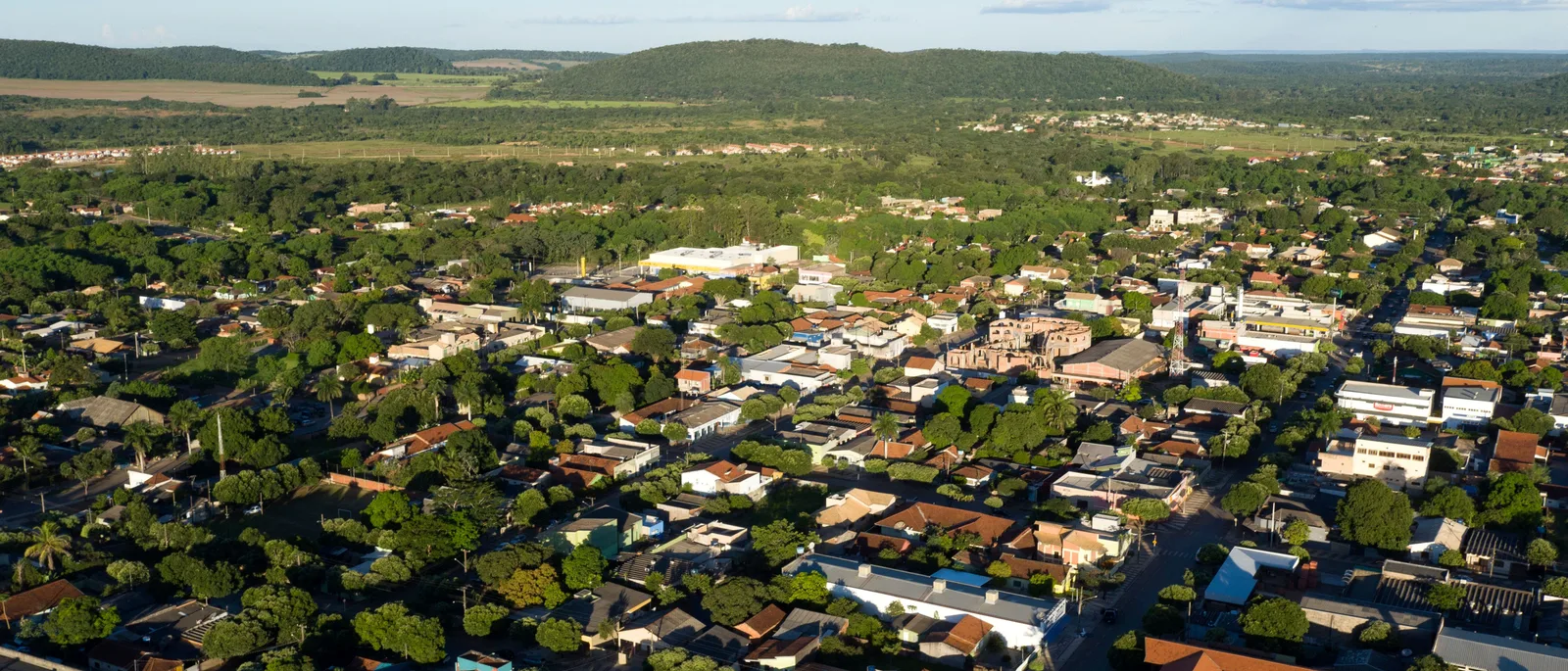
    Bonito from the air: a grid of low houses and red roofs under heavy street trees, with green countryside and low hills running away behind the town

    The grid around Rua Coronel Pilad Rebuá, where the travel agencies, the restaurants, the outdoor shops and the bus station all are. Everything from hostels to comfortable mid-range pousadas with pools sits within a few blocks. The case for it is simple and strong: your evenings are spent booking the next day at a counter and eating afterwards, and doing both on foot is worth more than a view. The trade is that it is an ordinary small Brazilian town to look at, and the water is a drive away like it is from everywhere else.

    • Centro
    • Agencies
    • Restaurants
    • Hostels & pousadas
  • Best for: A pool, grounds, and a river you can get into

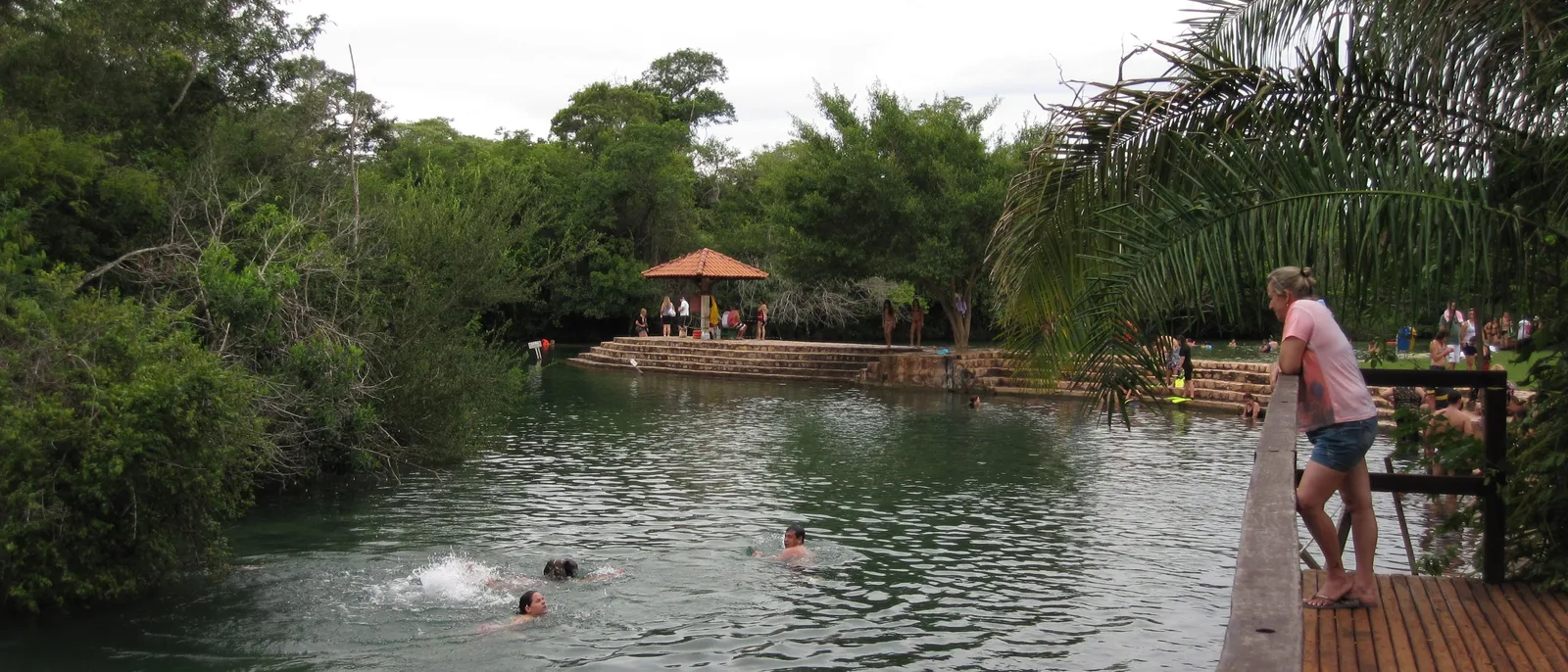
    A calm stretch of the Rio Formoso with a wooden deck and a thatched shelter on the bank, and people swimming in the clear water in front of them

    Southeast of town along the Rio Formoso, where the resorts and the larger hotels are — big grounds, pools, tennis courts, restaurants on site, and in several cases direct access to the river. This is where families and anyone traveling with people who do not want to spend six days in a wetsuit tend to end up, and it is the only part of Bonito where the hotel is itself somewhere to spend an afternoon. Understand the trade: it is a short drive or a taxi to dinner, and the agencies are in town.

    • Resorts
    • Pools
    • Families
    • River access
  • Best for: Quiet, birds at breakfast, and a car

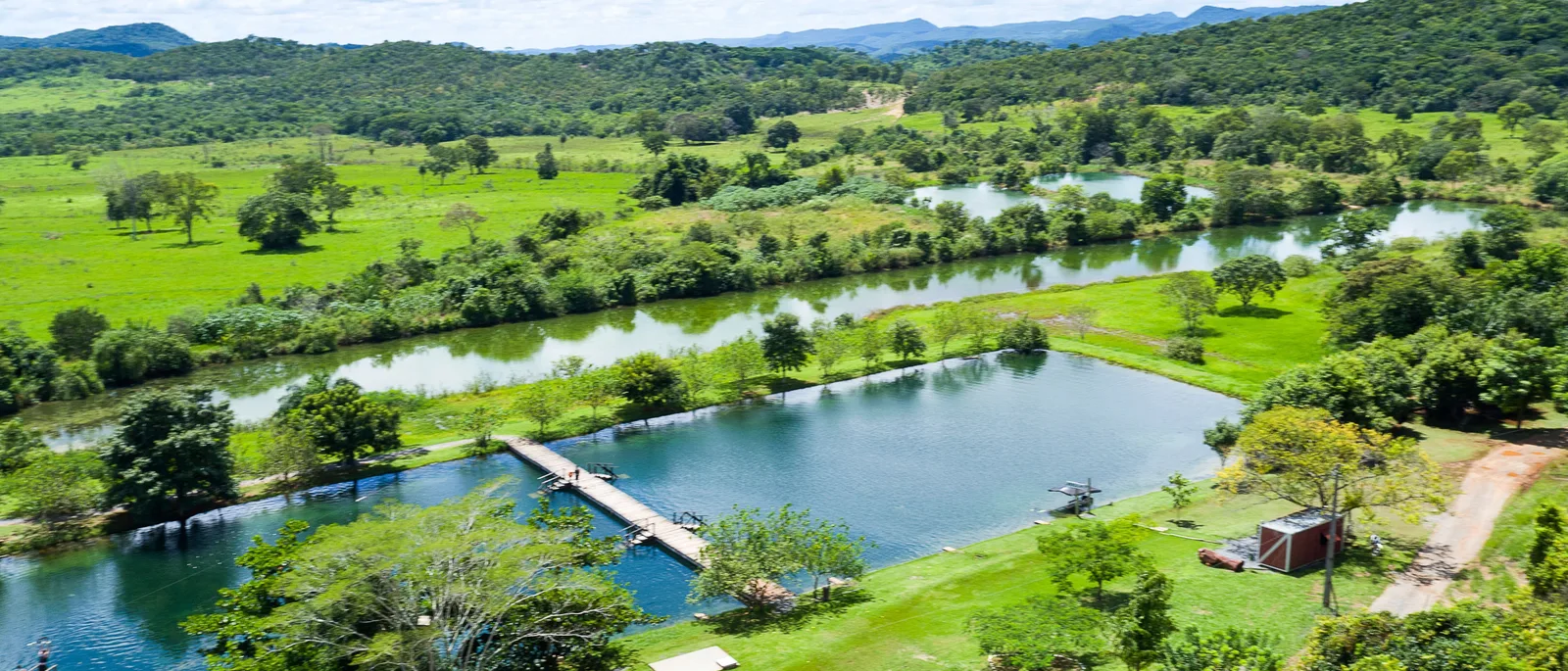
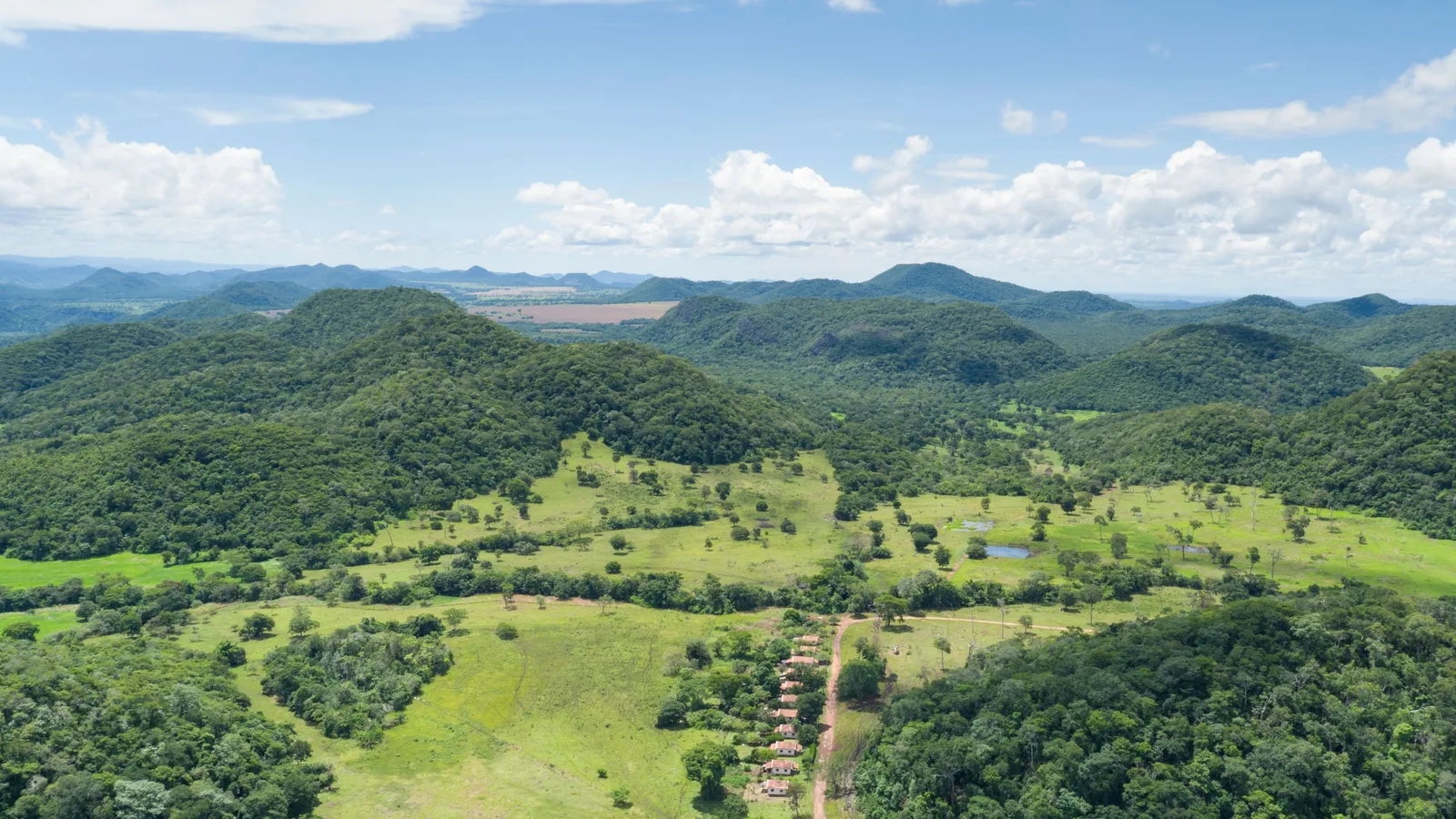
    Green pasture and gallery forest from the air near Bonito, with a small lake, a jetty and farm buildings among the trees

    Scattered across the countryside on the roads out to the attractions: working farms and small eco-pousadas with a handful of rooms, a lake or a stretch of stream, horses, and a great deal of birdlife at breakfast. Some of them are ten minutes from town and some are half an hour on dirt. This is the most attractive way to sleep in Bonito and the least convenient one — you need a car, dinner is wherever you are staying unless you drive back in, and you will want to check exactly what the last few kilometers of road look like before you book.

    • Fazendas
    • Eco-pousadas
    • Birdwatching
    • Car essential

A working plan

Four days, and every one of them booked in advance.

Built around the timetable rather than a checklist, because in Bonito the timetable is the constraint. Book the whole thing before you arrive if you are coming in December, January or July; otherwise the first evening on the main street is enough.

  1. 01
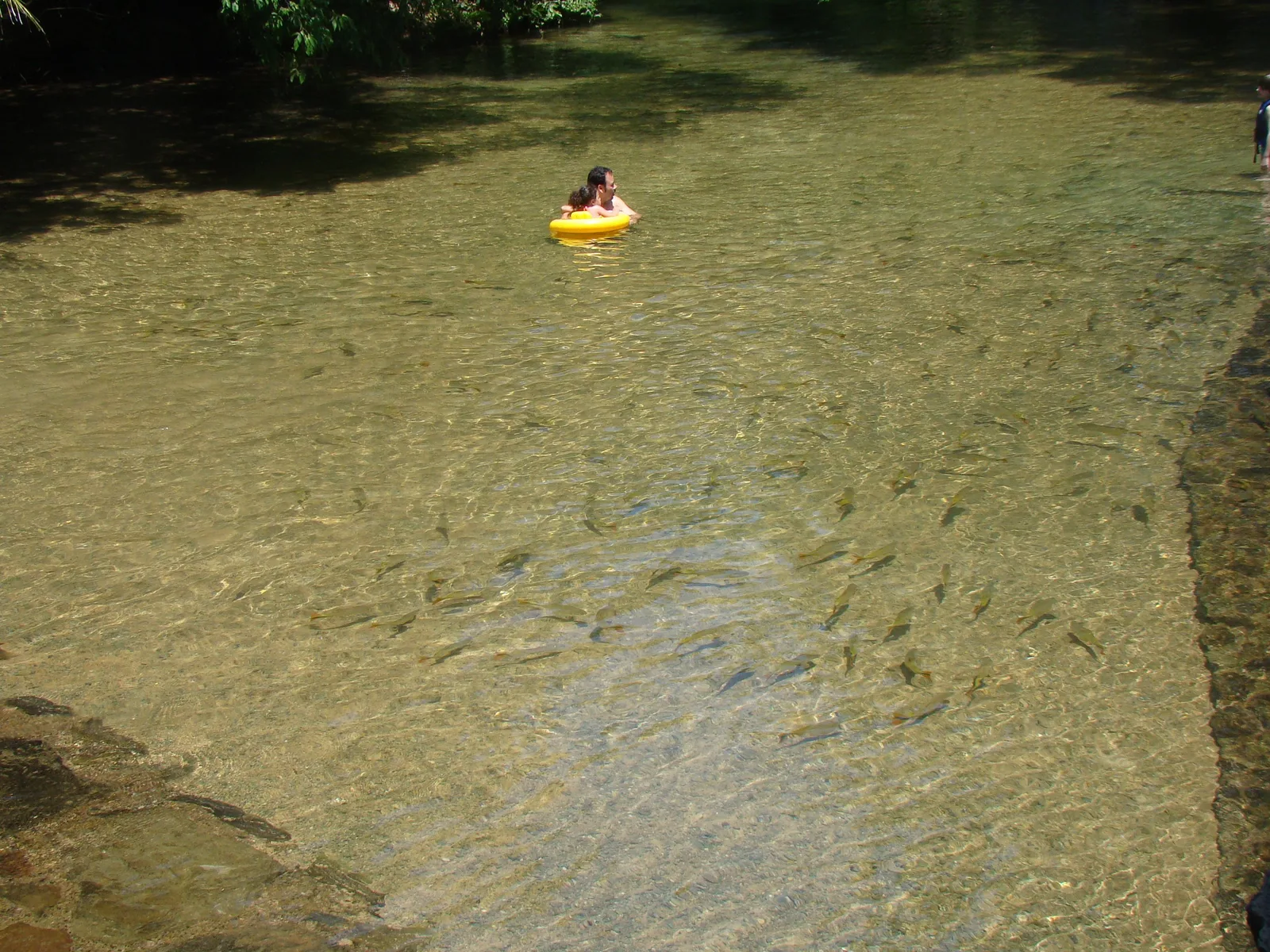
    A person floating on a yellow ring down a wide, shallow, glass-clear river near Bonito, with another figure standing in the water further downstream

    Bonito town and the Rio Formoso

    Arrive, sort the vouchers, get in the river

    Land, collect a car, and spend an hour on the main street settling the next three days with an agency. Then the Balneário Municipal or the Aquário Natural for a first, cheap look at what the water actually does.

  2. 02
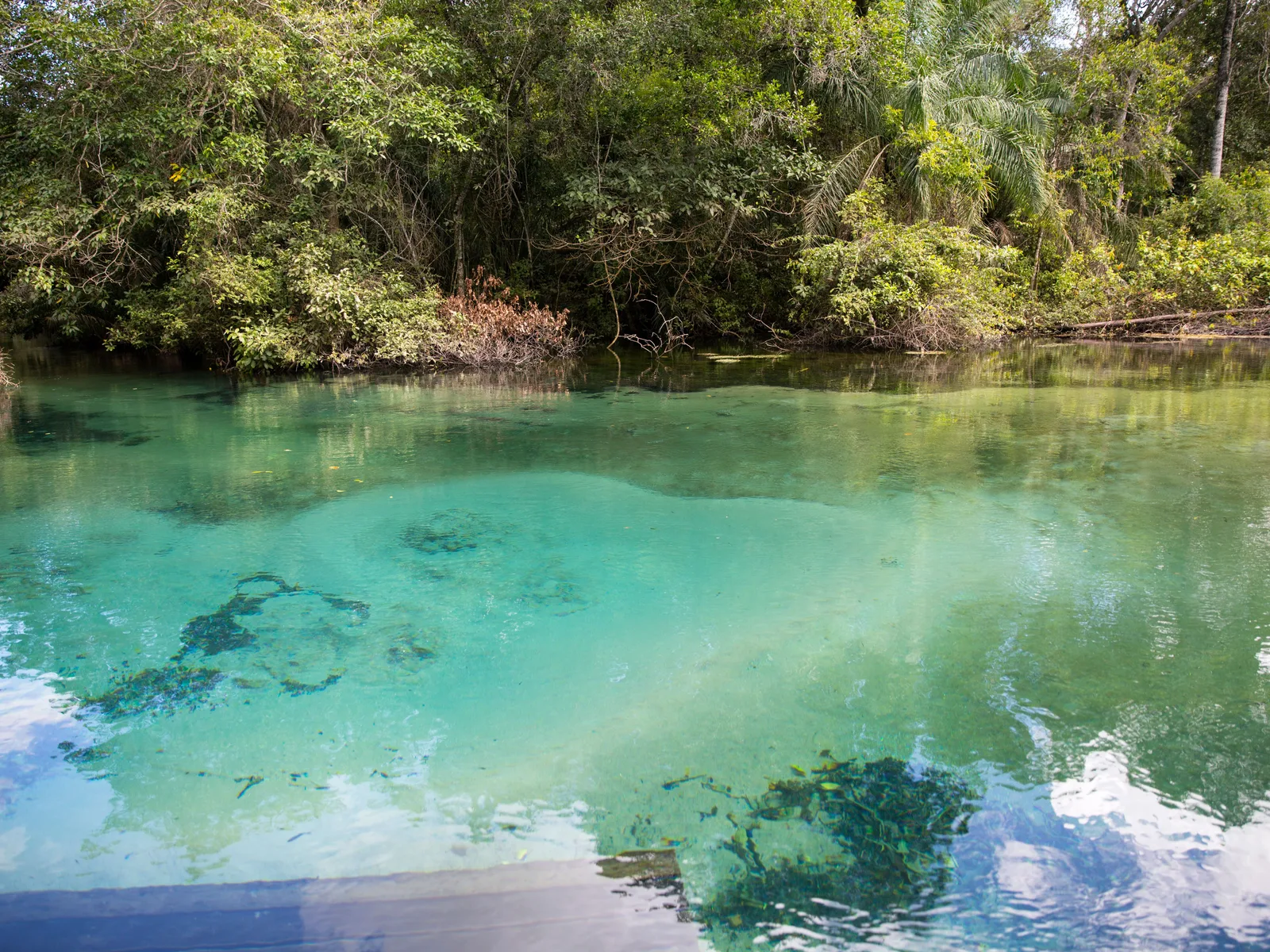
    A still turquoise pool on a river near Jardim, weed beds under the surface and dense green forest along the bank

    Rio da Prata and Buraco das Araras

    South to Jardim: the river and the sinkhole

    The classic Bonito day and the one to protect. The Rio da Prata in the morning — trail, float, lunch on the property — then half an hour up the road to the Buraco das Araras for the macaws in the late afternoon.

  3. 03
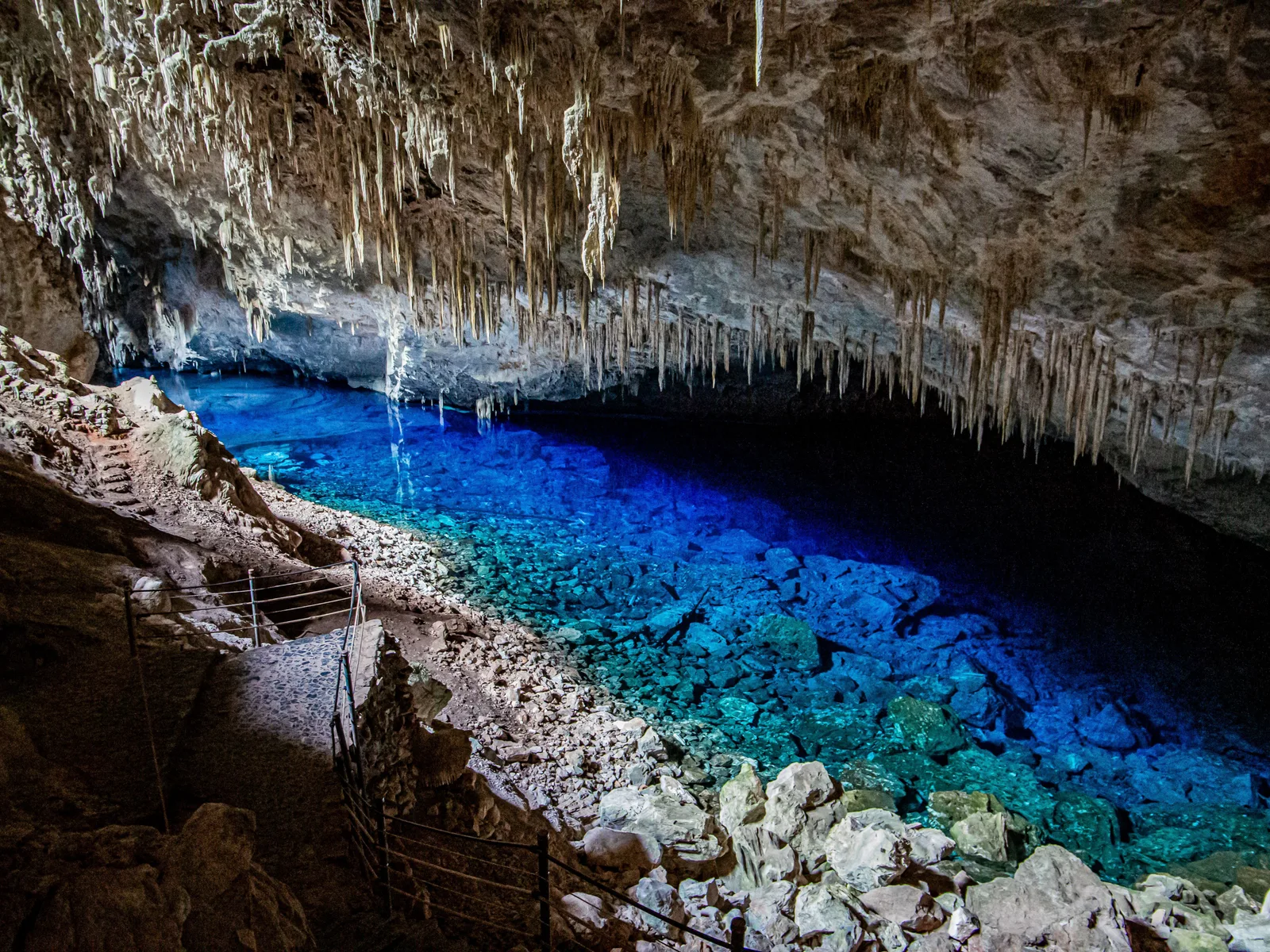
    The interior of the Gruta do Lago Azul: a ceiling of pale stalactites over a brilliant blue underground lake, with a metal staircase running down the rock on the left

    Gruta do Lago Azul and the Rio Mimoso

    The cave at opening, waterfalls after lunch

    An early slot at the Gruta do Lago Azul, because the blue depends on the light and the cave closes at 2:00pm. Then Estância Mimosa or the Nascente Azul for the afternoon, twenty minutes back toward town.

  4. 04
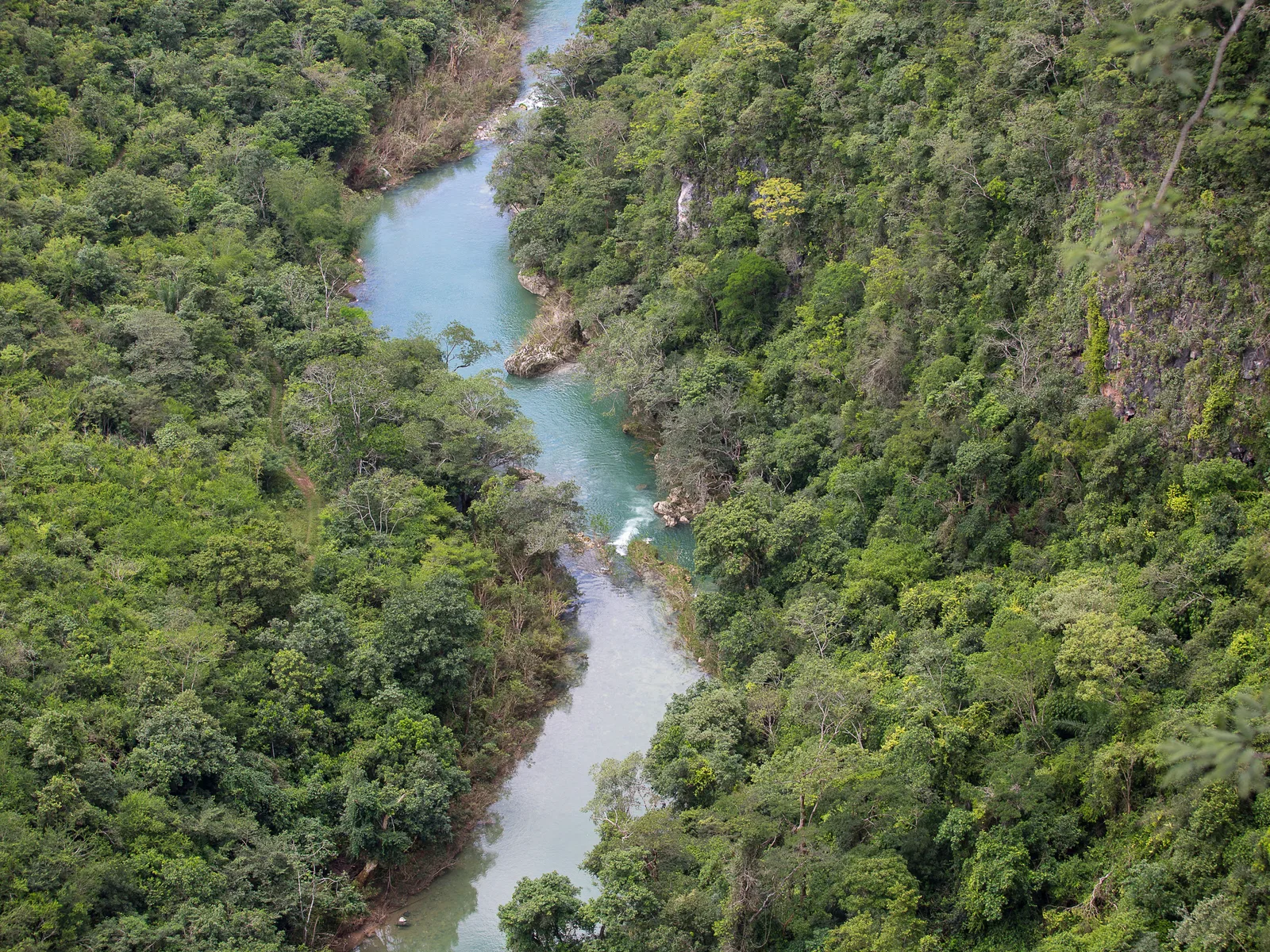
    An aerial view of a turquoise river running through a steep, densely forested canyon in the Serra da Bodoquena

    Abismo Anhumas or Boca da Onça

    The big one, whichever big one you chose

    The day you booked first and paid most for: the 72-meter rappel into the Abismo Anhumas, or the canyon trail and waterfalls at Boca da Onça. Both are full days, both start early, and neither leaves room for anything else.

This is a starting shape, not a fixed departure — we rearrange it around your dates. Have it built for you

Timing

The dry season is the season, and it is not subtle.

Bonito’s entire appeal is water you can see through, and the thing that ruins it is rain. Storms wash sediment off the land and into the rivers, and while the spring-fed stretches recover fast, the bigger channels can stay cloudy for days. The rainfall here is strongly seasonal — December averages 238 mm, July 58 — so the calendar answers itself. June to mid-September is the window.

How good each month is at Bonito. Choose a month for its average air temperature, rainfall, wet days and UV index, and what the rivers are doing then.

January

Trade-offs
Air
22–30°C 72–86°F
UV
11 Extreme
Rain
18 days 230 mm / 9.1 in

The wettest stretch and the busiest. The cave’s sunbeam window runs to about the 15th; the rivers are at their least reliable.

February

Trade-offs
Air
22–30°C 72–86°F
UV
11 Extreme
Rain
17 days 199 mm / 7.8 in

Hot, wet and green, with Carnival prices in the middle of it. Waterfalls at full volume, floats a lottery.

March

Trade-offs
Air
22–30°C 72–86°F
UV
10 Very high
Rain
16 days 169 mm / 6.7 in

The tail of the wet season. Rain easing week by week and the crowds gone, but the rivers are still clearing.

April

Good
Air
20–29°C 68–84°F
UV
8 Very high
Rain
11 days 114 mm / 4.5 in

The dry season opens. Nights cool off, the water starts to clear, and prices are at their lowest of the year.

May

Good
Air
17–26°C 63–79°F
UV
6 High
Rain
9 days 109 mm / 4.3 in

Cool, quiet and clearing. Mornings can start at 15 degrees, which makes a 22-degree spring feel warm.

June

Good
Air
16–25°C 61–77°F
UV
5 Moderate
Rain
6 days 74 mm / 2.9 in

The dry season proper begins, at 74 mm across six wet days. Cold dawns and dry bright days.

July

Best
Air
15–25°C 59–77°F
UV
6 High
Rain
4 days 58 mm / 2.3 in

The pick of the year: 58 mm across four wet days, the driest and coldest month, and the least run-off in the rivers. Brazilian school holidays fill the second half and prices rise with them.

August

Good
Air
17–28°C 63–82°F
UV
7 High
Rain
4 days 59 mm / 2.3 in

Level with July on the rain at 59 mm across four wet days, warming up, and the Festival de Inverno at the end of it.

September

Good
Air
19–30°C 66–86°F
UV
7 High
Rain
7 days 110 mm / 4.3 in

Hot and still mostly clear in the first half. The first storms arrive late in the month and the window closes.

October

Trade-offs
Air
21–30°C 70–86°F
UV
10 Very high
Rain
14 days 171 mm / 6.7 in

The rains return in earnest and the sediment with them. Hot, green and much less predictable underwater.

November

Trade-offs
Air
21–30°C 70–86°F
UV
11 Extreme
Rain
15 days 191 mm / 7.5 in

Wet and hot, with the waterfalls building. Quiet and cheap until about the 20th of December.

December

Trade-offs
Air
22–30°C 72–86°F
UV
11 Extreme
Rain
17 days 238 mm / 9.4 in

The wettest month of the year. From about the 15th the sun starts reaching the cave lake, and from the 20th the town fills up.

  • Best The one or two peak months
  • Good A real recommendation
  • Trade-offs Workable, with a catch
See Bonito on the Brazil calendar

UV is the monthly average of the daily peak, 2022 to 2025, calculated from Copernicus Atmosphere Monitoring Service data. Weather data by Open-Meteo.com, CC BY 4.0.

For the clearest water

June to mid-September

The core of the dry season, and July is the pick: 58 mm on four wet days, the driest and coldest month of the year. August matches it at 59 mm. Nobody publishes a measured clarity for these rivers by month, so the case is the rainfall, and rain is what puts sediment in them. Cold mornings — pack a fleece.

For the cave’s sunbeam

Mid-December to mid-January

From about mid-December to mid-January the sun reaches the lake inside the Gruta do Lago Azul. It is also the wettest, hottest, most crowded and most expensive stretch of the year, and the rivers are at their least clear.

When the rivers cloud up

December to March

165 to 240 mm a month across sixteen to eighteen wet days. The waterfalls are at their most powerful and the country is green, but a heavy storm can cut visibility on the float rivers for days afterwards.

About the rain

The useful way to think about the weather here is not temperature — it is warm enough to be in a river every month of the year — but sediment. The Serra da Bodoquena filters groundwater beautifully, and the springs run clear whatever the sky is doing. What ruins visibility is surface run-off: rain falling on farmland and pasture and washing soil into the channel. That is why a spring-fed float like the Sucuri holds up better after a storm than a river that has collected a lot of country upstream, and why guides will sometimes move you between attractions on the morning itself.

The practical version: in the dry months you can book anything and expect it to look like the photographs. Between December and March, book the spring-fed floats rather than the long ones, keep a spare half day in the plan, and take the guide’s advice on the day about which river is running clear. And if it has rained hard overnight, that is the morning for the cave or the sinkhole rather than the water.

One more thing the numbers do not show: winter here is genuinely cold at dawn. A June or July morning can start at 15 degrees and a cold front can drop it further, and you will be standing in a parking lot at 7:00am waiting to get into 22-degree water. The afternoons reach 25 to 28. Bring a fleece for exactly two hours a day.

The dates worth planning around

The Gruta do Lago Azul from inside: a dense ceiling of pale stalactites over a brilliant blue underground lake, with the pale rock of the chamber lit from the entrance

The sunbeam in the Gruta do Lago Azul

Roughly 15 December to 15 January, early morning

From about mid-December to mid-January the sun clears the mouth of the cave at the right angle and drops a shaft of light straight onto the underground lake. It happens between about 7:30am and 9:30am and it is the image of Mato Grosso do Sul that everybody has seen. It is also the only reason to come to Bonito in the wet season, and you would be trading the clearest rivers of the year for it — worth knowing before you build a trip around a photograph.

Festival de Inverno de Bonito

Late August — 26 to 30 August in 2026, next in late August 2027

The town’s biggest event, in its twenty-fifth edition, run by the municipality and the state culture foundation over five days at the end of August: music, dance, theater, exhibitions, workshops and food, spread across venues around town rather than concentrated on one stage, and free. It falls squarely inside the driest stretch of the year, with August level with July at 59 mm against 58, which makes late August a very strong week to be here and a reason to book beds early rather than late for next year’s edition.

Two fish swimming over a pale rocky bottom in bright turquoise water, the rocks and weed on the riverbed sharply visible through several meters of water

The clear-water season

April to September, best June to mid-September

Not a festival but the thing the whole calendar turns on, and the attractions treat it as a season in its own right — the Lagoa Misteriosa stops its floats and beginner dives from October to mid-April. The dry season opens in April, the water improves through May, and from June to the middle of September the rivers are as clear as they get. Everything else about a Bonito trip — prices, crowds, what you can book at short notice — is downstream of this.

Good to know

Before you come

Do I really have to book everything through an agency? +

Yes. Every attraction around Bonito caps its daily visitors, requires a licensed guide and sells only through licensed local travel agencies, which issue a Voucher Único with your date, time and place in the day’s quota. There is no ticket window at the gate and turning up without a voucher means being turned away. Prices are set centrally and are identical at every agency, so there is nothing to gain from shopping around on price — compare them on transport, on whether they have English-speaking guides, and on how sensibly they sequence your days. You can book online from home or in person on the main street; in the December, January and July peaks, book before you fly. Since 20 December 2025 you also pay a R$15 per person environmental levy for each day you have a tour booked, online at turistapornatureza.com.br, and your agency cannot issue the voucher until it clears.

How do I get to Bonito? +

Either fly straight in or fly to Campo Grande and drive. Bonito’s own airport is 13 km from town and takes LATAM from São Paulo–Guarulhos, Gol from São Paulo–Congonhas and Azul from Campinas–Viracopos, each a few days a week rather than daily, with more frequencies in the December and July peaks. Campo Grande has many more flights and is about four hours away by road on the MS-345, which was paved through in 2024; buses do the same run in around five hours. Renting a car is the usual advice for two or more people, because every attraction is 20 to 60 km out of town and there is no Uber in Bonito. If you would rather not drive, book the agency’s shared transport when you book the attraction itself.

When is the water actually clearest? +

June to the middle of September. Bonito’s rivers are fed by springs that filter through limestone, so the water arrives clear — what clouds it is rain washing soil off the surrounding farmland into the channel. The rainfall is sharply seasonal: July and August average under 60 mm across about four wet days each, while December averages 238 mm across seventeen. The dry season opens in April and the water improves steadily from there, so April and May are a good, cheap, quiet compromise. If you have to come between December and March, book the spring-fed floats like the Sucuri rather than the longer rivers, keep a spare half day, and take the guide’s advice on the morning about which one is running clear.

How many days do I need, and how much can I do in one? +

Four days, doing one attraction per half day and no more than two in a day. That is not laziness — the attractions are 20 to 60 km apart on rural roads, each runs two to four hours including the trail and the briefing, and each starts at a fixed time you cannot move. Four days gets you a float, the Gruta do Lago Azul, the Buraco das Araras, a waterfall trail and one big day at the Abismo Anhumas or Boca da Onça, which is the whole shape of the place. Three works if you drop the big day. Two is not worth the flights.

Why is it so expensive, and what should I budget? +

The attractions are the expense, and they are not cheap because of tourism markup — they are private properties running capped, guided operations with a fixed number of paying visitors a day, and the price reflects that. In low season a float runs about R$349 to R$470, the Gruta do Lago Azul R$120, the Buraco das Araras R$185, and the Abismo Anhumas R$1,598 for the rappel and float. Everything else in town is ordinary interior-Brazil pricing: about R$310 for a mid-range pousada double, R$45 for a per-kilo lunch, R$200 for dinner for two. Budget from the attractions backwards — pick the days you want, price those, and add roughly R$70 a head each way for transport if you are not driving, plus R$15 a day for the environmental levy.

Keep going

Where Bonito fits in a bigger trip.

Bonito is a three- or four-night stop rather than a trip on its own, and it is a long way from the coast. These three are the ones it genuinely builds into.

Free · 29 pages

Free guide

Beginner's Guide to Brazil

A free 29-page guide to everything a first-time visitor should know before landing: visas, safety, money, getting around, where to go, and what to eat.

We'll email you a link to confirm your address. Click it and the guide opens right away.

See what's inside
Rolling green pasture and patches of forest running back to the low wooded ridges of the Serra da Bodoquena under a bright sky

Skip the planning

Get the vouchers right, and the rest of Bonito looks after itself.

Tell us your dates and what you actually want out of it, and we will shape the trip around the timetable — the right float for the season you are coming in, the cave booked for the hour the light works, the expensive day locked in before it sells out, and a plan that does not put two attractions and a two-hour drive into the same afternoon.

  • One person, living in Brazil, replying to you directly
  • A reply within one business day — no call center, no bots
  • No cost to plan, and no obligation to book
  • Built around your dates, not a fixed departure